

The 1933 plebiscite: how silence approved Salazar's constitution
To approve, voters handed in a blank ballot. To reject, they had to write “Não”. Anyone who stayed at home was counted in favour, and the result founded a dictatorship that lasted 41 years.
At a glance
- On Sunday 19 March 1933 Portugal voted in a plebiscite on a new constitution drafted by António de Oliveira Salazar, the head of a military-backed dictatorship in power since 1926.
- Voters approved by handing in a blank ballot and rejected by writing “Não” on it. Registered heads of family who stayed at home without one of three legal excuses were counted as a yes.
- The official count, closed on 9 April, gave 1,292,864 votes for and 6,190 against, out of 1,330,258 registered voters. It never separated real ballots from silent abstentions.
- The Constitution came into force on 11 April 1933. The same issue of the official gazette regulated prior censorship of the press, and a new political police followed in August.
- It founded the Estado Novo, or New State, and stayed in force, revised many times, until the revolution of 25 April 1974. It is the only Portuguese constitution approved by popular vote.
A blank ballot meant yes
On Sunday 19 March 1933, polling stations opened across mainland Portugal and the Atlantic islands, as a rule one for each parish. In Lisbon and Porto the old electoral assemblies had been split into sections of no more than 2,000 voters. The ballot was a plain rectangle of white paper, 15 centimetres by 10, with one printed question: “Aprova a Constituição Política da República Portuguesa?” Do you approve the Political Constitution of the Portuguese Republic?
The instructions were unusual. A voter who agreed was to hand the paper in with nothing written on it. A voter who disagreed had to write the word “Não”, no, on the ballot.
“Electors who are heads of family and who do not attend the plebiscite, and in whose case none of the following circumstances has been proved, are considered to have tacitly given a vote in agreement with the draft.”
Only three excuses for staying away were accepted: the death of a close relative in the three days before the vote, an illness that made it impossible to attend, or absence from the municipality since 12 March. The excuse had to be proved to the polling-station officials before the count began. Any other registered head of family who stayed at home was counted as a yes.
Three weeks later, on Sunday 9 April, a panel of judges and officials met in the Council of Ministers' room at the Ministry of the Interior in Lisbon to close the count. Its chairman was the president of the Supreme Court, Eduardo Augusto de Sousa Monteiro. The panel declared the Constitution approved by 1,292,864 votes to 6,190.
The minutes appeared in the official gazette on 11 April, and the Constitution took effect that day. It founded the Estado Novo, or New State, the dictatorship that ruled Portugal until 1974.
A dictatorship without a constitution
A military coup on 28 May 1926 had ended Portugal's parliamentary First Republic. Under the generals, the republican Constitution of 1911 stayed in force only in theory, changed at will by government decree, and there was no parliament until 1935.
The dictatorship put down a series of republican revolts, beginning in Porto and Lisbon in February 1927. After each one it strengthened the police, tightened repression and deported its leading opponents to the colonies.
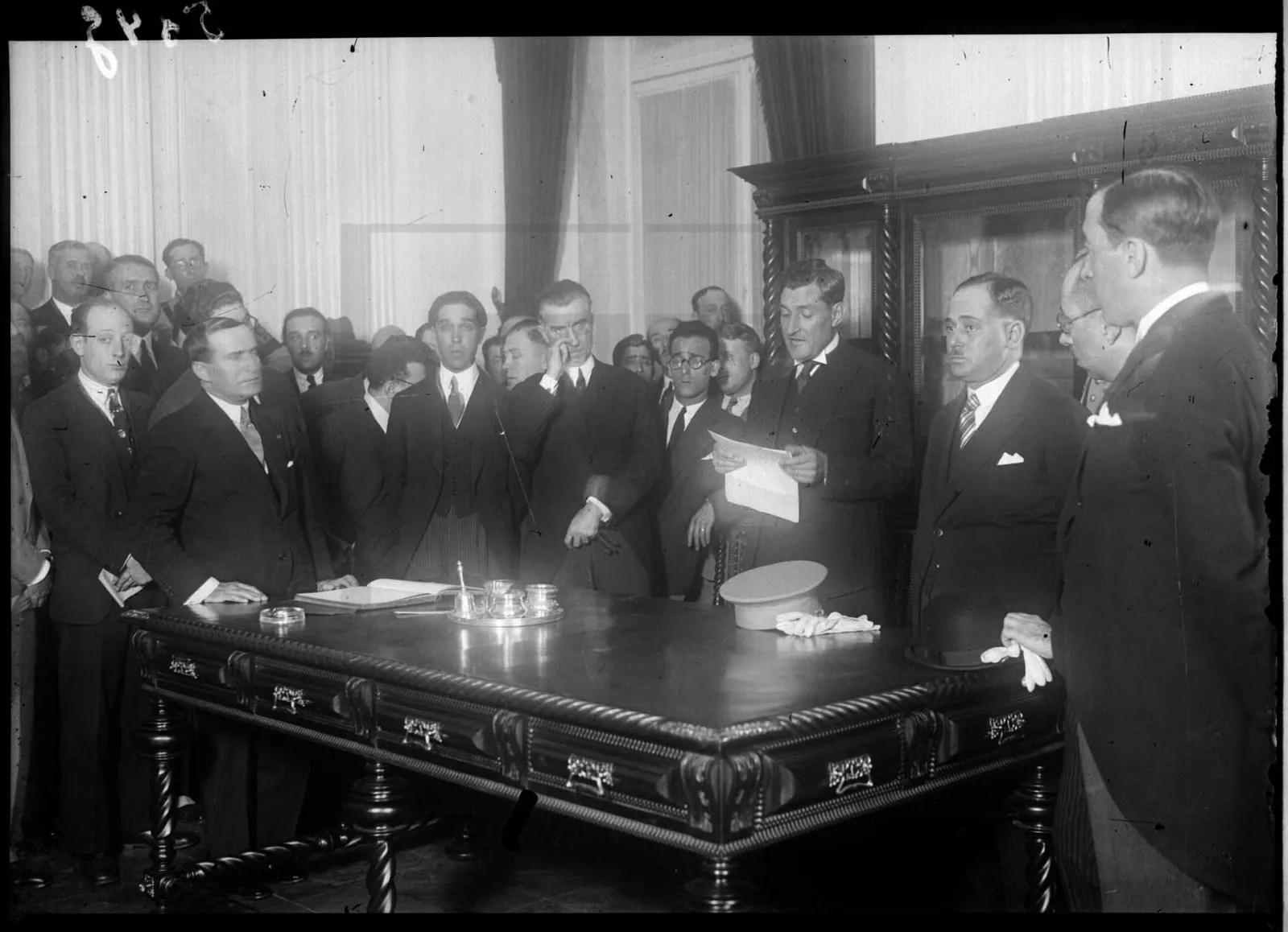
António de Oliveira Salazar joined the government as finance minister in 1928, under General Vicente de Freitas. Between 1928 and 1930 he and his allies broke with the conservative republican officers who saw the dictatorship as a temporary clean-up. In 1930 he founded the União Nacional (National Union) to gather the regime's supporters, and he insisted it was not a party. On 5 July 1932 President Óscar Carmona appointed him head of government.
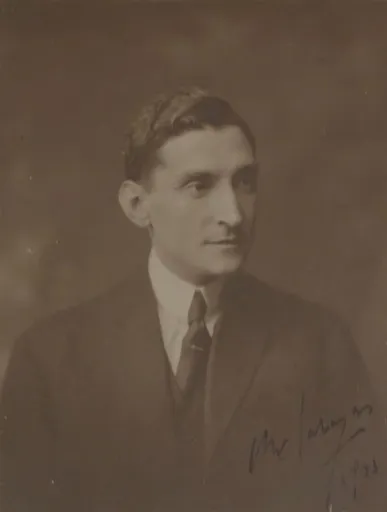
Salazar wanted a regime that was neither a liberal democracy nor a totalitarian state. In 1932 he said the new constitution rejected democratic and parliamentary foundations and the “abstractions” of popular sovereignty, while limiting the state's power by “morality and law” and by respect for individual and corporative rights. Outside the União Nacional, he added, the state recognised political freedoms, but it would not tolerate offences against the government's work or the aims of the Constitution.
Drafting the text
No elected assembly wrote the 1933 Constitution. The draft was Salazar's, prepared with a small group of collaborators, among them the Coimbra law professor Domingos Fezas Vital, Quirino de Jesus and the young Marcello Caetano.
Early versions had the president and parliament chosen by corporatist suffrage, with people voting through their professions and interest groups instead of as individuals. Salazar and a council of notables, the National Political Council, which first met to discuss his draft on 5 May 1932, changed a great deal before the text was put to public debate on 28 May 1932. That version proposed a legislature of 90 deputies, half elected directly and half by corporatist suffrage.
It drew fire from several sides. Republican army officers objected to corporatist representation. The monarchists of Integralismo Lusitano and Francisco Rolão Preto's National Syndicalists, a home-grown fascist movement, thought it gave too much ground to liberalism. The Catholic Church was more concerned that the text did not mention God. President Carmona and Salazar argued mainly about how power would be divided between them.
The statutes of the União Nacional, approved in May 1932, were published through the Ministry of the Interior on the eve of the draft's publication. The legal historian Paulo Ferreira da Cunha sees a concerted strategy. The government prepared the ground in other ways too. In 1932 it sent “crimes of rebellion” to special military courts, and it ordered schools to print approved maxims in textbooks and hang them on classroom walls, among them a line of Salazar's: “The will to obey is the only school for learning to command.”
The final text was a compromise. Article 5 made Portugal “a unitary and corporative Republic”, but the president and the National Assembly were both to be elected by direct suffrage, and the corporatist principle went into a separate chamber that could only give advice. Salazar himself admitted the gap between the text and the ideal he had set out.
“The reality that was possible within our political moment.”
The rules of the vote
Decree 22:229, signed on 21 February 1933 by Carmona, Salazar and every minister, set the date and the rules. The draft was printed in a supplement to the official gazette the next day. Municipal councils had to send copies to every parish, and parish officials had to post them in a public place by 12 March.
The vote used the political electoral register of 1932, which held 1,330,258 names. The rules for registering came from a decree of 5 May 1931: a man over 21 qualified if a public-exam certificate showed he could read, write and count, or if he paid at least 100 escudos in certain taxes. A woman over 21 qualified only with a secondary-school or university diploma. The plebiscite decree made voting compulsory for registered voters who were heads of family.
The decisive rule was article 4. The Constitution would pass if, when the count closed, a majority of all registered voters, not of those who voted, had given it a “concordant vote”. Because every unexcused head of family who stayed away counted as concordant, a voter who disagreed had one way to say so: go to the polling station and write “Não”.
5 July 1932
Salazar takes office
President Carmona appoints him head of government.
28 May 1932
The draft goes public
A first version, with half the deputies chosen by corporatist suffrage, is put to public debate.
21 February 1933
Decree 22:229
The plebiscite is set for 19 March, with abstentions counted as approval.
22 February 1933
Text published
The final draft appears in a supplement to the Diário do Governo.
12 March 1933
Posting deadline
Copies must be displayed in every parish.
19 March 1933
The plebiscite
Voters hand in blank ballots to approve or write “Não” to reject.
9 April 1933
Count closed
The general assembly in Lisbon declares the Constitution approved.
11 April 1933
In force
The minutes are published and the Constitution takes effect.
Counting silence
- Date
- Sunday 19 March 1933
- Question
- Do you approve the Political Constitution of the Portuguese Republic?
- Registered voters
- 1,330,258
- Counted as approving
- 1,292,864 (ballots and abstentions together)
- Against
- 6,190
- In force
- 11 April 1933
The official minutes give five figures. Of 1,330,258 registered voters, 1,292,864 were counted as approving the Constitution, 6,190 rejected it and 666 ballots were void. A further 30,538 were recorded as voters who took no part or whose returns were missing.
The official result of the 1933 plebiscite
registered voters
The four categories in the minutes of the general count, closed on 9 April 1933, add up to the 1,330,258 voters on the 1932 register. The approving total mixes blank ballots with the abstentions of registered heads of family, which the decree counted as approval.
Show the data
| Voters | |
|---|---|
| Counted as approving | 1,292,864 |
| Took no part or no return | 30,538 |
| Against | 6,190 |
| Void | 666 |
What the minutes do not say is how many of the 1,292,864 approvals were blank ballots and how many were people who stayed at home. Under article 4 the two were the same thing, and the count never separated them. Nor do the minutes say how many of the 1,330,258 registered voters were heads of family, the only people the tacit-yes rule covered.
Paulo Ferreira da Cunha calls it a vote whose results are still uncertain, in which abstentions counted as favourable votes. The Assembleia da República's history of the period puts the electorate at about 1.3 million and says abstentions and blank ballots both counted for the Constitution.
The count covered the colonies too, unevenly. The minutes record returns from the mainland, the Atlantic islands, São Tomé and Portuguese India, and none at all from Cape Verde, Guinea, Angola, Mozambique, Macau or Timor.
What the Constitution said
The text opened with Portugal's territory, from the mainland and its islands to Angola, Mozambique, Portuguese India, Macau and Timor. Article 5 based the “unitary and corporative Republic” on the equality of citizens before the law. In the same article, equality allowed exceptions for women: “the differences resulting from their nature and from the good of the family”.
Article 8 listed rights familiar from liberal constitutions: freedom of expression in any form, freedom of belief, of teaching, of assembly and of association, and no imprisonment without charge except in listed cases. Its second paragraph handed the main freedoms to “special laws”.
“Special laws shall regulate the exercise of the freedom of expression of thought, of teaching, of assembly and of association, and must, as to the first, prevent, by preventive or repressive means, the perversion of public opinion in its function as a social force…”
Until 1974, the historian Irene Flunser Pimentel notes, the government and its political police maintained that article 8 was respected and that nobody was jailed for their ideas. In their account, people were arrested only for organising to overthrow the legal order that the same Constitution had set up.
| Organ | How it was chosen | What it did |
|---|---|---|
| President of the Republic | Elected by direct suffrage for seven years (art. 72) | Appointed and dismissed the President of the Council and ministers; could dissolve the National Assembly (art. 81) |
| National Assembly | 90 deputies elected by direct suffrage for four years (art. 85) | Made laws, limited to their general bases; sat for three months a year from 10 January (arts. 91, 92, 94) |
| Corporative Chamber | Representatives of local authorities and of social interests, chosen as the law laid down (art. 102) | Gave written opinions on every bill before the Assembly debated it (art. 103) |
| Government | President of the Council, appointed and dismissed freely by the President of the Republic, and his ministers (art. 106) | The President of the Council answered to the President of the Republic, and the ministers to him (art. 107); none answered to the Assembly |
The courts were the fourth organ of sovereignty named in article 71.
In practice the head of government held the power. Ministers answered to the President of the Council, he answered only to the President of the Republic, and the Assembly had no say in appointing or dismissing either. Over time, Ferreira da Cunha argues, Salazar's dominance and the 1959 revision turned the system into a “presidentialism of the prime minister”.
Censorship, police and a single list
The issue of the Diário do Governo that carried the plebiscite minutes on 11 April also carried six decree-laws. One regulated the right of assembly. Another, Decree-Law 22:469, regulated prior censorship of printed publications. A third republished the Colonial Act, the law governing the empire, as article 132 of the Constitution required.
The political police followed. On 29 August 1933 Decree-Law 22:992 merged two existing forces into the Polícia de Vigilância e Defesa do Estado (PVDE). Its main task was the repression of communism, and it worked with foreign police forces. In 1945 it became the PIDE.
On 23 September 1933 six decree-laws, led by the National Labour Statute, set up the corporatist labour system. Free trade unions had to adopt state-approved statutes or dissolve, and stopping work to win better conditions became punishable. The Statute owed much to the Labour Charter of Mussolini's Italy, tempered by Catholic social teaching. The unions answered with an attempted revolutionary general strike on 18 January 1934, which was harshly repressed.
The first National Assembly was elected in 1934 and met in 1935. Men over 21 could vote if they could read or, failing that, paid at least 100 escudos in tax; women needed a secondary, higher or special diploma. Political prisoners and anyone holding ideas “contrary to the existence of Portugal as an independent state” were barred from standing, and every seat went to the União Nacional's list.
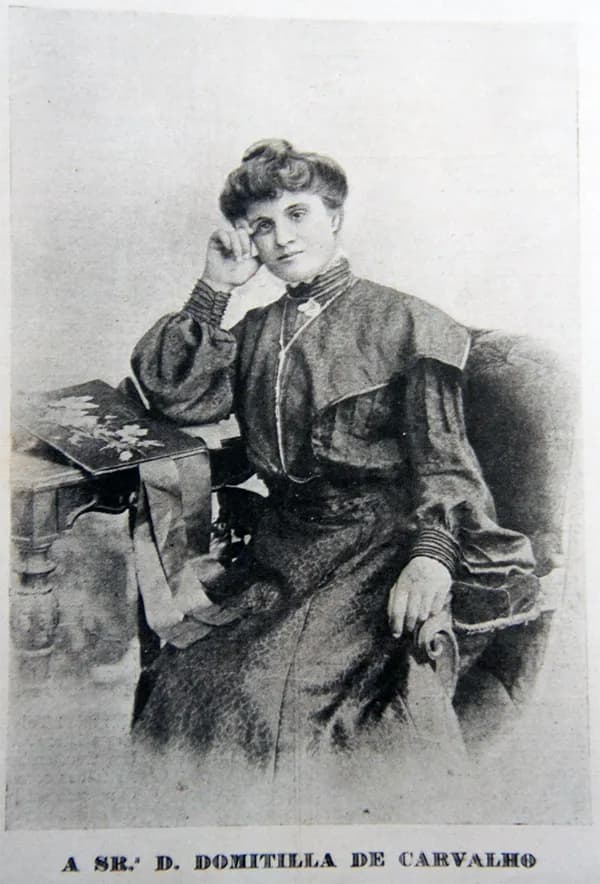
Three of the 90 deputies were women, the first in a Portuguese parliament: the doctor Domitila de Carvalho, the lawyer Cândida Parreira and Maria Guardiola, rector of the Maria Amália girls' lycée. Carvalho, born in 1871, had been the first woman to study at the University of Coimbra. Parliament's biographical record describes her as a monarchist, a devout admirer of Salazar and sceptical of feminism.
Forty-one years of revisions
The Constitution was amended often, always by law or decree. Ferreira da Cunha lists revisions by law in 1935, 1936, 1937, 1938, 1945, 1951 and 1959, and another by decree-law in 1961. The last came in 1971.
The 1945 revision let the government issue decree-laws even when there was no urgency, which made it the country's normal lawmaker. The Corporative Chamber's opinion on the change said so openly.
“The Government is the normal legislative organ and the Assembly the exceptional legislative organ.”
The 1959 revision came after General Humberto Delgado's presidential campaign of 1958 drew mass support. The president would no longer be elected by the people but by an electoral college of deputies, members of the Corporative Chamber and representatives of the municipalities and colonies.
Women won the vote on the same terms as men only with a law of 26 December 1968, and even then the vote was limited to people who could read and write. Marcello Caetano's revision of 1971 kept power concentrated in the President of the Council and the President of the Republic, and many deputies of the reformist “liberal wing” later resigned their seats.
The National Assembly met for the last time, without a quorum, on the morning of 25 April 1974, as the Armed Forces Movement's coup brought the regime down. On 14 May the Junta of National Salvation abolished the Assembly and the Corporative Chamber. The same day it kept the 1933 Constitution provisionally in force wherever it did not contradict the Movement's programme. A new Constitution was approved on 2 April 1976.
11 April 1933
In force
Censorship and assembly decrees appear the same day.
1935
First revisions
Two laws amend the text in the year the National Assembly first meets.
1945
Government as lawmaker
Decree-laws no longer need a case of urgency.
1959
No more direct presidential vote
An electoral college replaces the popular vote after Delgado's campaign.
1968
Equal vote for literate women
A law of 26 December ends the separate rules for women voters.
1971
Last revision
Caetano's revision leaves the concentration of power in place.
25 April 1974
Revolution
The National Assembly meets for the last time, without a quorum.
14 May 1974
Transitional law
The Assembly and the Corporative Chamber are abolished; the Constitution survives only where it fits the MFA programme.
2 April 1976
Replaced
The Constituent Assembly approves a new Constitution.
Why it still matters
The 1933 text is the only Portuguese constitution approved by popular vote, the Assembleia da República notes. Every later change to it was made by law or decree-law, without consulting the voters.
For Ferreira da Cunha, what matters most is the distance between what the text promised and what the regime did. He calls the 1933 Constitution an “inauthentic” text, borrowing Adriano Moreira's word: it proclaimed rights that censorship, the political police, the ban on parties and the ordinary laws then took away. He finds the written text less anti-liberal than the regime's ideology, and the regime's practice correcting that.
The plebiscite fits the same pattern. The count produced an overwhelming majority, but the decree that set it up had already decided that silence meant consent.
FAQs
Did abstentions really count as yes votes in the 1933 plebiscite?
Yes. Decree 22:229 of 21 February 1933 said that registered heads of family who did not vote were considered to have tacitly approved the draft, unless they proved a death in the family, illness or absence from the municipality. Approval required a majority of all registered voters, not of those who voted.
What was the official result of the 1933 constitutional plebiscite?
The official minutes, published on 11 April 1933, gave 1,292,864 votes counted as approving, 6,190 against and 666 void, out of 1,330,258 registered voters, with 30,538 who took no part or whose returns were missing. The approving figure mixes blank ballots and abstentions, so the real turnout is not known.
Could women vote in the 1933 plebiscite?
Only some. The plebiscite used the 1932 electoral register, which under a decree of 5 May 1931 admitted women over 21 only if they held a secondary-school or university diploma. Men needed only to prove they could read, write and count, or to pay at least 100 escudos a year in certain taxes.
What was the Corporative Chamber?
It was the advisory body the 1933 Constitution set up beside the National Assembly, made up of representatives of local authorities and social and economic interests. It gave written opinions on every bill before the Assembly debated it, but it could only advise. It was abolished on 14 May 1974.
How long was the 1933 Constitution in force?
From 11 April 1933 until the revolution of 25 April 1974, with many revisions. A transitional law of 14 May 1974 kept it provisionally in force where it did not contradict the Armed Forces Movement's programme, until the Constitution of 2 April 1976 replaced it.
On the timeline
Open the timelineNearby moments from dictatorship and the estado novo (1926–1974).
The first issue of 'Avante!', the Portuguese Communist Party's newspaper, appears. For the next 43 years, until the 1974 revolution, it was printed on clandestine presses inside Portugal and passed from hand to hand under the dictatorship.
Death of Manuel II, the last King of Portugal, aged 42, at Fulwell Park in Twickenham, where he had lived in exile since the 1910 revolution, devoting himself to a scholarly catalogue of early Portuguese books. Salazar's government grants a state funeral, and crowds line Lisbon's streets as his coffin passes to the Braganza pantheon at São Vicente de Fora.
Poet Ruy Belo is born in São João da Ribeira, near Rio Maior. A law graduate who left the Opus Dei and spent years teaching Portuguese in Madrid, he became one of the great voices of 20th-century Portuguese poetry with books such as 'Homem de Palavra(s)', before dying at just 45.
The 1933 constitutional plebiscite
The Constitution of the Estado Novo is approved by national plebiscite, formally establishing António de Oliveira Salazar's authoritarian corporatist regime that would govern Portugal for over four decades, until the Carnation Revolution of 1974.
The Estado Novo is formally established in Portugal following the approval of the new constitution by plebiscite on March 19, consolidating Salazar's authoritarian corporatist regime.
Birth in Lisbon of Celeste Caeiro, the restaurant worker who gave the Carnation Revolution its name. On 25 April 1974 her restaurant cancelled its first-anniversary party, for which it had bought carnations; she took the metro to Rossio and walked up to the Chiado, where a soldier on an armoured car asked her for a cigarette. She gave him a carnation instead, which he slipped into the barrel of his rifle.
Birth of Álvaro Siza Vieira in Matosinhos. Portugal's most celebrated architect and winner of the 1992 Pritzker Prize, his works — from the Boa Nova Tea House to the rebuilt Chiado and the Portuguese Pavilion at Expo '98 — define modern Portuguese architecture.
Coming up in history
All long reads 21 March 1846Rafael Bordalo Pinheiro: the Lisbon cartoonist who invented Zé Povinho
 22 March 1312Vox in excelso: how Portugal's Templars became the Order of Christ
 23 March 2011Sócrates resigns and Portugal heads for a bailout: 23 March 2011
 24 March 1962Students against Salazar: the academic crisis of 1962
15 sources
Archives, scholarship and reporting this article was checked against.
- 1
Decreto n.º 22:229: fixa o dia 19 de Março de 1933 para a realização do plebiscito nacional para aprovação do Projecto de Constituição Política da República PortuguesaDiário do Governo, I série, n.º 42, 21 February 1933 (Diário da República Eletrónico)
- 2
- 3
- 4
Da Constituição do Estado Novo português (1933) (Paulo Ferreira da Cunha)Historia Constitucional, n.º 7, 2006
- 5
O Estado Novo (1933-1974)Assembleia da República
- 6
O Essencial sobre a PIDE (Irene Flunser Pimentel)Imprensa Nacional, 2023
- 7
The Corporatist Wave: corporatism and the diffusion of “organic representation” in European dictatorships (António Costa Pinto), p. 19ICS Working Papers 2/2016, Instituto de Ciências Sociais da Universidade de Lisboa
- 8
- 9
A construção do Estado Novo vista pelos editoriais do jornal Diário da Manhã (Vítor Neto)Revista de História das Ideias, vol. 37, 2019, pp. 285–312, Universidade de Coimbra
- 10
- 11
- 12
Maria de Lourdes Pintasilgo e a sociedade portuguesa (Susana Mota)E-Revista de Estudos Interculturais, n.º 3, CEI–ISCAP, Politécnico do Porto, May 2015
- 13
Domitila Hormizinda Miranda de Carvalho (biographical record)Assembleia da República, Deputados da Assembleia Nacional 1935–1974
- 14
- 15
Image credits
- The swearing-in of the new government headed by António de Oliveira Salazar, 5 July 1932, photographed for the newspaper O Século. The man reading at the table is thought to be Salazar. Unknown author, Public domain, via Wikimedia Commons.
- Salazar in a portrait photograph that he signed and dated in 1933, the year of the plebiscite. Unknown author, Public domain, via Wikimedia Commons.
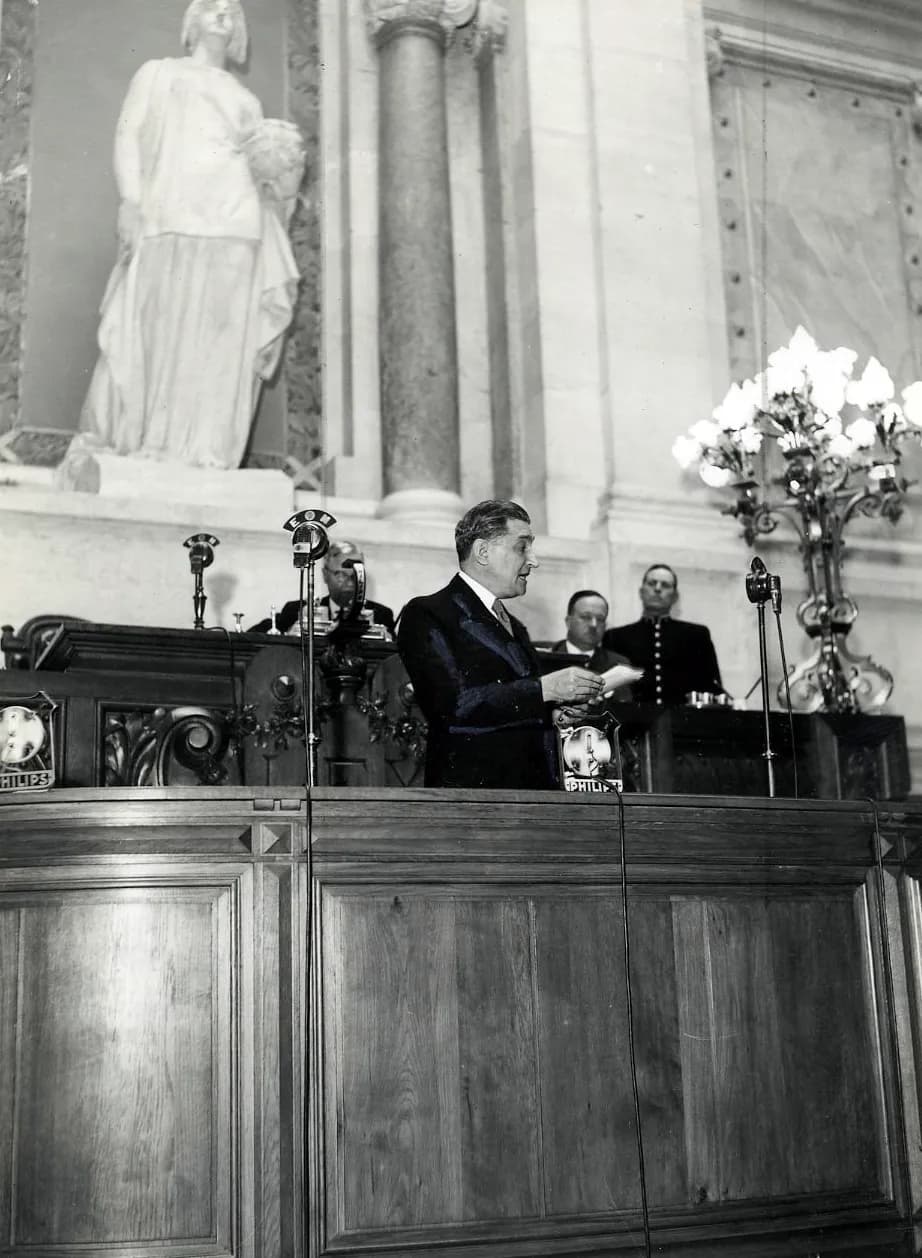
- Salazar speaks in the Sala das Sessões of the Palácio de São Bento at the close of the National Assembly's first legislature, 28 April 1938. Unknown author, Public domain, via Wikimedia Commons.
- Domitila de Carvalho as a young woman, in a portrait printed with the caption “A Sr.ª D. Domitilla de Carvalho”. In 1935 she was one of the first three women to sit in a Portuguese parliament. Unknown author, Public domain, via Wikimedia Commons.
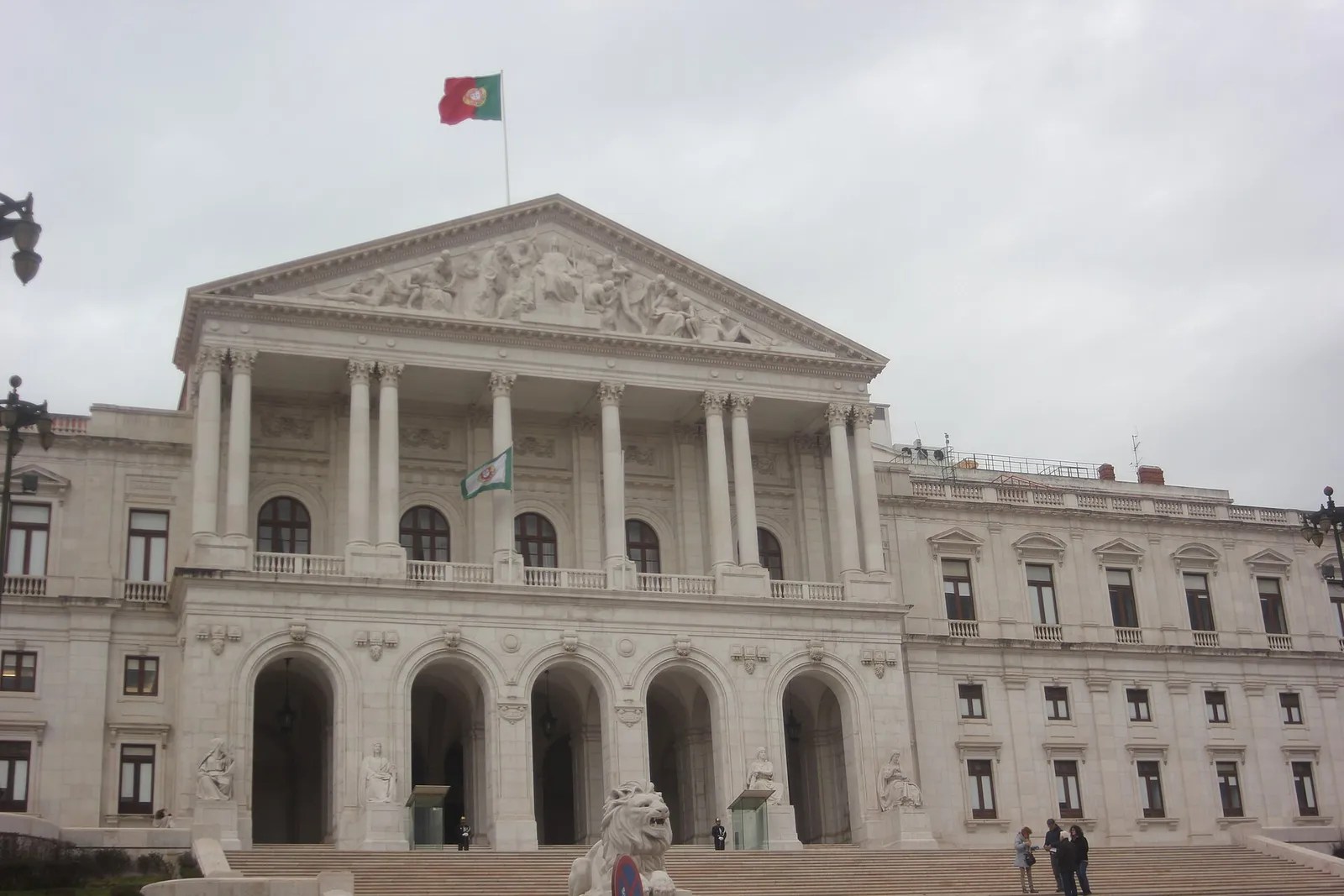
- The Palácio de São Bento in Lisbon in 2018. The Estado Novo's National Assembly met here from 1935 to 1974; today it houses the Assembleia da República. Matthew Black from London, UK, CC BY-SA 2.0, via Wikimedia Commons.