

The Dutch East India Company and Portugal's war for Asia, 1602–1663
A charter sealed in The Hague merged the Dutch East India traders into one company with the right to build forts and keep soldiers. Portugal, then ruled by the king of Spain, became its main enemy.
At a glance
- On 20 March 1602 the States General of the Dutch Republic chartered the United East India Company (VOC), merging the rival Dutch companies trading with Asia into one.
- The charter gave it, for 21 years, the sole Dutch right to sail east of the Cape of Good Hope, and the power to make treaties, build forts, keep soldiers and appoint governors.
- Portugal was then ruled by the king of Spain, the Dutch Republic's enemy, so Portugal's Asian empire, the Estado da Índia, became the VOC's main target.
- Between 1605 and 1663 the VOC took Amboina, Malacca, every Portuguese fort in Ceylon and the Malabar coast, ending with Cochin in January 1663 and Cannanore that February.
- The peace signed at The Hague on 6 August 1661 took effect outside Europe only from its publication, on 14 March 1663 by the Dutch reckoning, by which time the Dutch held Cochin; Portugal never got it back.
A seal in The Hague
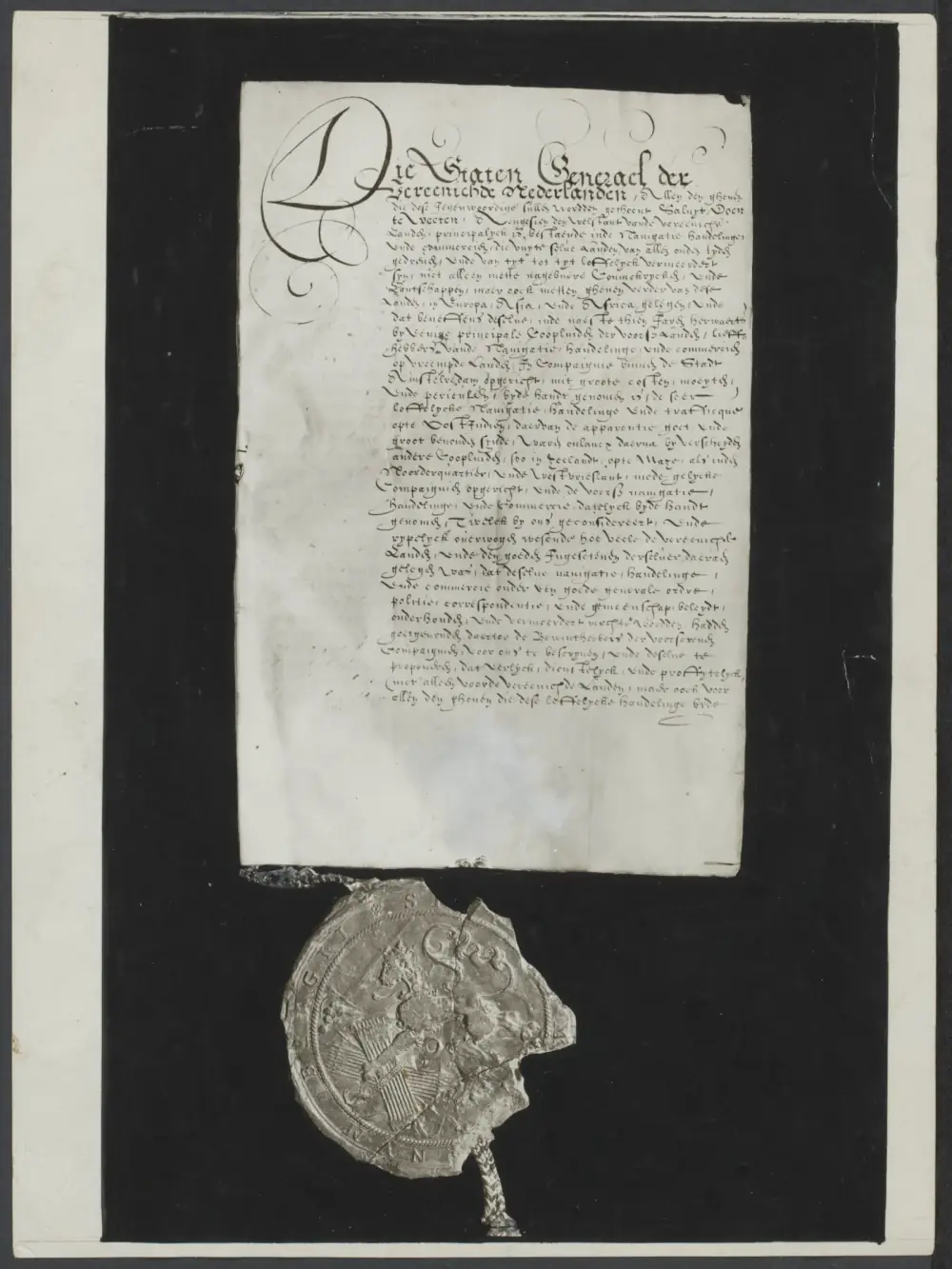
The document opens with a greeting: “The States General of the United Netherlands salute all those who will be shown this.” It was given under the seal of the States General, the assembly of the rebel Dutch provinces, in The Hague on 20 March 1602. In a long list of articles it merged the rival companies that had been racing each other to the spice markets of Asia into one: the United East India Company, in Dutch the Vereenigde Oostindische Compagnie, or VOC.
Most of the charter is about money and procedure: who pays what share, where the directors meet, how the accounts are audited. Near the end, between a clause on cargo inventories and one on spice taxes, comes a line about enemies.
“If it should occur that Spanish or Portuguese ships or those of another enemy attack the ships of this company and should during such fight some ships be captured, the captured ships and goods shall be apportioned in the way it is usually done in the country.”
Portugal had no king of its own in 1602. Its crown had passed to the Spanish Habsburgs in 1580, and the Dutch were in revolt against that same dynasty. So Portugal's string of fortresses and trading posts from East Africa to Macau, the Estado da Índia governed from Goa, sat squarely in the new company's path. Over the next 61 years the VOC took a large part of it.
Portugal under a Spanish king
For a century, the Portuguese had shipped Asian pepper and spices home on the Carreira da Índia, the annual fleets between Lisbon and Goa, and Dutch and Flemish merchants had bought them in Lisbon and Antwerp to sell across northern Europe. The Habsburg takeover of 1580 and Philip II's war with the Dutch rebels did not stop that trade at once. Despite periodic seizures of their ships, Dutch skippers kept trading in Portuguese ports, Setúbal among them, through the 1580s and 1590s.
What changed things was a bad year at sea. In 1591 no ships at all returned to Lisbon from India, and pepper supplies to the north dried up. In 1594 the States General licensed Jan Huygen van Linschoten's Itinerario, a travel and navigation guide to the Portuguese East, and in 1595 Cornelis de Houtman sailed from Texel for Java carrying the first printed part of Linschoten's route descriptions and a few Portuguese maps. Houtman had himself spent two years as an agent in Portugal gathering information on its Asian trade.
Within a few years, companies in Amsterdam, Zeeland, the Meuse towns and North Holland were all sending fleets. The Huygens Institute's register of Dutch-Asiatic shipping lists 66 voyages by these voorcompagnieën, the pre-companies, before the VOC took over. The States General invited their directors to unite them in “a fixed, secure and orderly entity”.
A company with the powers of a state
- Granted
- 20 March 1602, by the States General, in The Hague
- Term
- 21 years from 1602, with a general audit every ten years
- Chambers
- Amsterdam half of the capital, Zeeland a quarter, the Meuse towns and North Holland an eighth each
- Board
- Seventeen directors: eight from Amsterdam, four from Zeeland, two each from the Meuse and North Holland, the seventeenth in rotation
- Monopoly
- No other Dutch ship east of the Cape of Good Hope or through the Strait of Magellan
- Powers in Asia
- Make contracts with princes, build forts, appoint governors and judges, keep armed forces
- Fee to the state
- 25,000 pounds of 40 Flemish groats
Anyone living in the United Provinces could buy in, with as little or as much as they liked. In Amsterdam 1,143 people subscribed. Of these, 301 came from the southern Netherlands, still under Spanish rule, some of them still living in Antwerp, and they put in 1.4 million guilders, 38 per cent of the chamber's capital. Only two of the subscribers were Portuguese.
Its servants in Asia swore loyalty to the States General, but in practice the company could act as a sovereign. Van Veen, following the Dutch historian Femme Gaastra, calls it a state outside the State. On paper its warlike aims were modest: the clause on Spanish and Portuguese ships deals only with sharing out prizes, because some of the early Asia traders wanted no part in a trading company that made war and took prizes.
From trade to war, 1603–1619
The restraint did not last a year, though the first great prize came from a fleet that had sailed before the company existed. Jacob van Heemskerck had left Texel with eight ships on 23 April 1601. On 25 February 1603, at the mouth of the Johor river off the Strait of Singapore, he attacked the Portuguese carrack Santa Catarina, with nearly a thousand people on board. Her captain, Sebastião Serrão, surrendered.
Van Heemskerck had no privateering commission. He presented the attack as revenge for crewmen of an earlier Dutch fleet whom the Portuguese had executed at Macau. He sailed the prize all the way to the Netherlands, and on 9 September 1604 the Amsterdam Admiralty declared it a good prize and ordered the ship and cargo sold.
The case also produced a famous book. The company hired Hugo Grotius, a young lawyer and a cousin of Van Heemskerck, to justify the seizure. One chapter of his treatise appeared anonymously as Mare Liberum, The Free Sea, an attack on Portugal's claim to own the route to the Indies. It is usually dated 1609; Van Veen says it came out in November 1608.
“Every nation is free to travel to every other nation, and to trade with it.”
By then the directors, the Heeren XVII, had chosen war. In 1603 the States General advised them to send bigger, well-armed ships that could damage the enemy, and the directors' instructions to Steven van der Haghen, who sailed that year, said the company was, in Ernst van Veen's translation, “obliged to take the offensive, in whatever manner, against the Spaniards, Portuguese and their allies”. He was to wait off Mozambique for the ships from Lisbon.
In 1605 Van der Haghen took the Portuguese fort on Amboina, in the Moluccas, and joint attacks with the forces of the sultan of Ternate drove the Portuguese from Tidore and Makian too. In 1606 Cornelis Matelief besieged Malacca with the help of the sultan of Johor until a fleet from Goa drove him off. Paulus van Caerden in 1607 and Pieter Verhoeff in 1608 laid siege to the Portuguese fortress on Mozambique Island and failed both times, but took or wrecked several India ships on the way.
In Europe, Spain and the Dutch agreed the Twelve Years' Truce in 1609. In Asia it changed little, and each side accused the other of breaking it. In 1619 the governor-general Jan Pieterszoon Coen took the Javanese port of Jacatra, razed it and rebuilt it as Batavia, now Jakarta. It became the company's main base in Asia.
Two shipping lines, going opposite ways
The numbers show the shift. In the first decade of the seventeenth century the Carreira da Índia sent 71 ships from Lisbon. In the 1630s it managed 33, and in the 1660s 21. The Dutch, starting from almost nothing, sent more ships to Asia every decade.
Ships leaving Europe for Asia: Portugal's Carreira da Índia and the Dutch, by decade
ships sailing
- Carreira da Índia, departures from Lisbon
- Dutch outward voyages to Asia
Portuguese departures include ships that turned back to Lisbon (arribadas), from Ernst van Veen's appendix 3.1a, based on T. Bentley Duncan. Dutch voyages are Lisboeta's own count of outward voyages in the Huygens Institute's Dutch-Asiatic Shipping database, by year of departure; the 1601–10 figure includes 20 voyages of the pre-companies in 1601.
Show the data
| Carreira da Índia, departures from Lisbon | Dutch outward voyages to Asia | |
|---|---|---|
| 1601–10 | 71 | 98 |
| 1611–20 | 66 | 124 |
| 1621–30 | 60 | 141 |
| 1631–40 | 33 | 156 |
| 1641–50 | 42 | 159 |
| 1651–60 | 35 | 208 |
| 1661–70 | 21 | 246 |
The Dutch did real damage. In 1606 Willem Haultain's fleet blockaded Lisbon and kept that year's India ships in port: seven by van Veen's count, eight by Murteira's. In July 1622 Anglo-Dutch ships caught the outward fleet off Mozambique, carrying a new viceroy and 200,000 cruzados in silver; three ships were lost, with most of the silver. That December an Anglo-Dutch fleet arrived off Goa and kept the homeward ships in port until April 1623. From 1636 to 1644 the VOC blockaded the bar of Goa every season.
Even so, the Portuguese historian André Murteira found that enemy action caused fewer failed voyages than the sea did. Of the Carreira's sailings between 1598 and 1625, he counted 27 ruined by privateers or blockades, against 62 lost to wrecks or forced to turn back for other reasons. Over almost the same years the Portuguese, with a century's experience of the Cape route, lost 42 ships on it, against 11 for the Dutch newcomers.
Why Carreira da Índia voyages failed, 1598–1625
voyages
André Murteira's count of failed outward and return voyages, out of 196 sailed or planned. The first two causes together made up 13.8 per cent of the total; the other two, 31.6 per cent.
Show the data
| Failed voyages | |
|---|---|
| Taken or sunk by the enemy | 14 |
| Stopped by blockades of Lisbon | 13 |
| Ship lost, other causes | 31 |
| Turned back (arribada) | 31 |
Cinnamon and Ceylon, 1638–1658
The decisive war was fought for Ceylon, now Sri Lanka, and its cinnamon. The Portuguese held its coasts. Inland, the kingdom of Kandy under Raja Sinha II (Rajasinghe II) had held out against them for decades, and in March 1638 his army destroyed a Portuguese force sent into the hills at Gannoruwa. Its commander, Diogo de Melo, was killed, and the king sent his sword to the Dutch admiral off Goa.
Raja Sinha had already sent envoys to Batavia. By the terms João Ribeiro, a Portuguese soldier in Ceylon, later reported, every fort taken was to be the king's, and he would pay the company's costs, down to each ship lost and each shot fired. With 2,000 of his men alongside, a VOC fleet took the small fort of Batticaloa on 18 May 1638 and razed it, then Trincomalee on 1 May 1639.
The sources disagree on these dates. The historian P. E. Pieris, who translated Ribeiro, gives both in his notes, and the British historian F. C. Danvers also dates Batticaloa to May 1638. But Ribeiro put both captures in 1639, and in another chapter Danvers has Batticaloa falling on 15 August 1639 and Trincomalee a year later.
The richer south-west coast came next. Dutch troops took Negombo on 9 February 1640. On 13 March, with Kandy's army camped six miles away, they stormed Galle through a breach in the São Tiago bastion. The Portuguese recaptured Negombo that November. Two months later, on 14 January 1641, Malacca surrendered after a five-month siege, in which 40 vessels sent by the sultan of Johor, an old enemy of the Portuguese, guarded the harbour. The Portuguese never regained a foothold on the Malay peninsula.
By then Portugal had a king again. The revolt of 1 December 1640 put the Duke of Braganza on the throne as João IV, and the new kingdom, at war with Spain, sought peace with the Dutch. On 12 June 1641 it signed a ten-year truce in The Hague. In Asia the truce was to apply after a year, or sooner if proclaimed there.
The VOC took its time. Its commissioner Pieter Boreel arrived with the armistice on 2 March 1643 and would not publish it at Galle, where the Dutch were hemmed in. At Goa he declined again unless the Portuguese gave up the lands around Galle, which, he claimed, Raja Sinha had mortgaged to the company. The truce was finally published at Goa on 10 November 1644. It was due to lapse in 1651, and the Portuguese government feared what would follow.
Fighting in Ceylon resumed in 1652. On 14 October 1655 the Dutch under Gerard Hulft took Kalutara, then laid siege to Colombo, the Portuguese capital in Ceylon, with Raja Sinha's army encamped alongside; Ribeiro put it at 40,000 fighting men and labourers. Hulft was killed during the siege, which lasted seven months. Ribeiro, who was inside, wrote that famine drove the defenders to eat their elephants, and that from 15 March 1656, when plague broke out, to 20 April, the dead counted in the city reached 22,030.
“At three o'clock in the afternoon of the 12th of May, 1656, we came out of the city, seventy-three very emaciated soldiers, all that remained there.”
The Dutch officers who received them thought at first that they were the officers of the garrison, not all that was left of it. The alliance did not survive the victory. The Dutch kept Colombo, and within days Raja Sinha was fighting his allies; Ribeiro says the king left them only the forts and a few villages near the shore.
In February 1658 Rijcklof van Goens sailed for the north of the island, with ten ships and 3,200 soldiers according to Ribeiro, or about 1,500 men by the Dutch records. Mannar fell on 22 February, and then Jaffna, after a siege in which more than 1,600 people inside died or were killed. Its last 140 defenders marched out on 24 June 1658, Ribeiro says; the Dutch records give 22 June. Portuguese Ceylon was over.
The Malabar coast and the peace that came too late
Across the strait lay the Malabar coast of south-west India, its pepper ports divided among rival kings. Van Goens took Quilon on 29 December 1658, but could not hold it. Then the Dutch found an ally in the Zamorin of Calicut, the strongest of those kings and for 150 years an enemy of the Portuguese and of the raja of Cochin. In February 1661 the Zamorin agreed a joint attack with the governor of Ceylon, and the Dutch handed him the Portuguese fort of Palliport once they had taken it.
Van Goens came back in December 1661 with some 4,000 men and retook Quilon. On 15 January 1662, with Nairs, Malabar's warrior caste, sent by the Zamorin in the trenches, he stormed Cranganore. The Portuguese lost about 120 Europeans there, besides a large number of Nairs, slaves and others; Baldaeus, a chaplain with the fleet, counted 200 Christians dead.
Cochin had its own quarrel. The Dutch backed a claimant to its throne, a young man covered in jewels who spoke good Portuguese; the reigning queen favoured the Portuguese, and Van Goens's troops stormed her palace. An assault on Portuguese Cochin on 5 February 1662 failed, and on the night of 2 March the Dutch embarked before the monsoon.
The two countries had in fact already made peace. At The Hague on 6 August 1661 Portugal agreed to pay the Dutch Republic 4 million cruzados, each worth two Carolus guilders, in 16 annual instalments of money, sugar, tobacco or salt. Portugal also had to hand back the Dutch guns captured at Recife and the other forts of north-eastern Brazil, which Portuguese settlers had taken from the Dutch West India Company by 1654.
Article VI held the trap. Fighting was to stop in Europe two months after signing, but in the rest of the world only from the day the treaty was published, and each side would keep whatever it held by then. Portugal ratified on 24 May 1662. The States General followed late in 1662: Galletti, from the Batavia records, gives 14 December, Danvers 4 December and the Portuguese treaty collection 4 November.
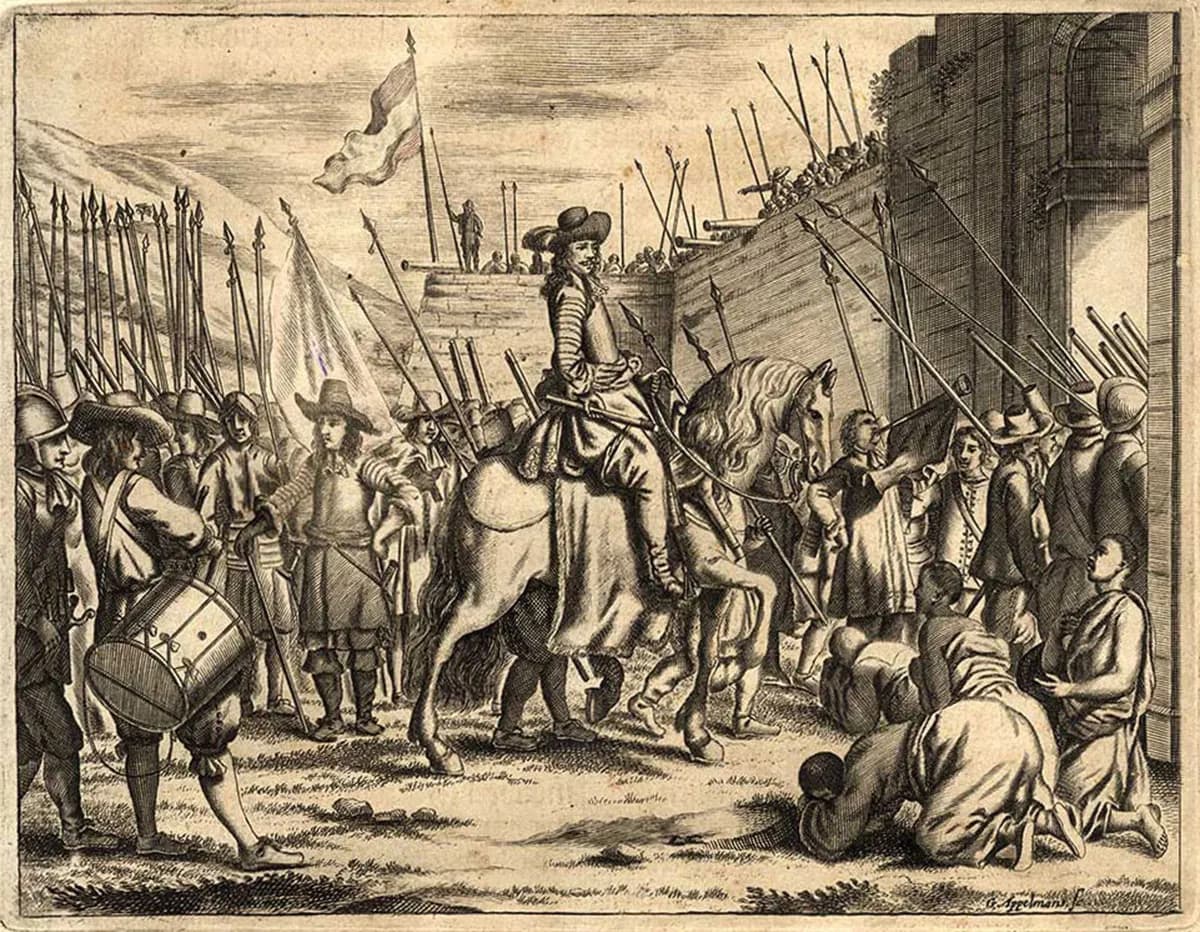
The Dutch were back before Cochin, in greater force, late in 1662. They were in a hurry, since news of the peace was expected any day. After a failed first assault, a second broke into the town on 6 January, and on the 7th the governor, Inácio Sarmento, signed a capitulation. On the 8th about 1,100 people came out, fewer than 300 of them soldiers; the siege had cost the Dutch 360 men. Unmarried Portuguese were shipped to Europe and married ones sent to Goa.
Cannanore, the last Portuguese fort on the coast, capitulated on 13 February 1663; at Goa its commander was executed for giving up too easily. Batavia had official word of the peace only in June. In March 1664 an envoy from the viceroy at Goa demanded Cochin and Cannanore back, since both fell after the treaty was signed. The Dutch answered that the peace counted in Asia only from its publication, on 14 March 1663. Portugal's ambassador in the Netherlands pressed the claim again in 1666 and got nowhere.
A further treaty, signed on 30 July 1669, left Cochin and Cannanore in Dutch hands as security until Portugal paid the overdue instalments and the cost of the campaign, and settled another 500,000 cruzados in salt from Setúbal. Bombay had meanwhile gone to England, under the marriage treaty of Catherine of Braganza and Charles II of 23 June 1661.
The company's Indian allies did less well than it did. The Zamorin had expected to be made king of Cochin, or at least to be given the island of Vypeen, and got neither. The Dutch were instead bound by treaty to protect the king of Cochin, his old rival, and were drawn into their wars for the next half-century.
| Place | Region | Taken | Notes |
|---|---|---|---|
| Amboina (Ambon) | Moluccas | 1605 | Steven van der Haghen |
| Batticaloa | East Ceylon | 18 May 1638 | Razed; with 2,000 of Raja Sinha's men |
| Trincomalee | East Ceylon | 1 May 1639 | Razed |
| Galle | South Ceylon | 13 March 1640 | Stormed after a breach |
| Malacca | Malay peninsula | 14 January 1641 | After a five-month siege; Johor's fleet guarded the harbour |
| Colombo | West Ceylon | 12 May 1656 | After a seven-month siege, with Kandy's army |
| Jaffna | North Ceylon | 22 or 24 June 1658 | After Mannar; end of Portuguese Ceylon |
| Quilon | Malabar | 29 December 1658; again December 1661 | Abandoned in April 1659 |
| Cranganore | Malabar | 15 January 1662 | Stormed, with the Zamorin's Nairs |
| Cochin | Malabar | 7–8 January 1663 | Capitulation signed on the 7th |
| Cannanore | Malabar | 13 February 1663 | Last Portuguese fort on the coast |
Negombo, taken in February 1640, was retaken by the Portuguese that November and changed hands again later. The Batticaloa and Trincomalee dates are those of Ribeiro's translator, P. E. Pieris (one passage of Danvers agrees on Batticaloa); Ribeiro dates both to 1639, and another passage of Danvers to August 1639 and 1640. Jaffna: 24 June in Ribeiro, 22 June in the Batavia records. Cannanore: 13 February in Galletti; Danvers's text reads 10 or 15 February.
What Portugal kept, and why it still matters
1580
Portugal's crown passes to Philip II of Spain
1595
Cornelis de Houtman sails for Java
20 March 1602
The States General charter the VOC
25 February 1603
Van Heemskerck takes the Santa Catarina
1605
Amboina falls to Van der Haghen
1609
Grotius's Mare Liberum published; Twelve Years' Truce in Europe
1619
Coen takes Jacatra and builds Batavia
1636–1644
Annual Dutch blockades of Goa
1638–1640
Batticaloa, Trincomalee, Negombo and Galle fall
14 January 1641
Malacca surrenders
12 June 1641
Ten-year truce signed in The Hague; published at Goa in 1644
12 May 1656
Colombo surrenders
June 1658
Jaffna surrenders
6 August 1661
Peace signed at The Hague
January–February 1663
Cochin and Cannanore fall
14 March 1663
The peace is published, by the Dutch reckoning
The war left the Estado da Índia a fraction of its old size. Goa, blockaded every season from 1636 to 1644, never fell to the Dutch, and it stayed Portuguese until December 1961. The forts and cinnamon of Ceylon, the Malabar pepper ports and the Malacca strait passed to the VOC.
The Dutch sold the fort at Cannanore to the local ruler, the Ali Raja, in 1771, and held Cochin until a British force took it in 1795. In Ceylon they stayed until 1796, when Galle surrendered to the British a week after Colombo.
Historians still argue about how much the Dutch caused that decline. Ernst van Veen's Leiden thesis of 2000 argued that it had causes in Brazil, Africa and Europe as well as in Asia, and he blamed the Carreira's heavy losses on poor seamanship and pilotage more than on foreign raiders. Murteira's figures point the same way for the early years: Dutch raids mattered, but wrecks and voyages abandoned for other reasons mattered more.
The company outlived its rival's eastern empire but not by much. Its ships made 4,722 outward voyages to Asia in all; the last left the Netherlands on 26 December 1794, and the company was disbanded in 1798. Its archive is in the Nationaal Archief in The Hague.
FAQs
When was the Dutch East India Company founded?
The States General of the Dutch Republic granted its charter in The Hague on 20 March 1602. It merged the earlier Dutch companies trading with Asia into one, the Vereenigde Oostindische Compagnie (VOC), with a 21-year monopoly on Dutch trade east of the Cape of Good Hope.
Why did the VOC fight Portugal?
From 1580 to 1640 Portugal was ruled by the Spanish Habsburg kings, with whom the Dutch were at war, and Portugal claimed the sea route to Asia for itself. The VOC's charter let it keep soldiers and build forts, and from 1603 its directors ordered attacks on Portuguese ships and strongholds.
What did Portugal lose to the Dutch in Asia?
Amboina in the Moluccas (1605), Malacca (1641), every Portuguese fort in Ceylon between 1638 and 1658, including Colombo in 1656, and the Malabar ports of Quilon, Cranganore, Cochin and Cannanore between 1658 and 1663. Goa held out.
Why did Portugal not get Cochin back after the 1661 peace?
The treaty signed at The Hague on 6 August 1661 said hostilities outside Europe would end only from its publication. The Dutch took Cochin in January 1663 and Cannanore in February, before it was published on 14 March 1663, and argued that they could keep them. A treaty of 1669 left both in Dutch hands.
On the timeline
Open the timelineNearby moments from the iberian union (1580–1640).
Death in Viana do Castelo of Bartolomeu dos Mártires, the Lisbon-born Dominican Archbishop of Braga who was a leading voice at the Council of Trent and founded one of the first seminaries under its reforms. So revered was he as 'father of the poor' that Viana's townsfolk guarded his body against claims from Braga; Pope Francis declared him a saint in 2019.
Roderigo Lopes, a New Christian physician from Crato who had become chief doctor to Elizabeth I, is hanged, drawn and quartered at Tyburn in London after the Earl of Essex accused him of plotting to poison the queen. The only royal physician ever executed in England, he may have inspired Shylock in Shakespeare's 'The Merchant of Venice'.
Philip II of Spain, who had ruled Portugal as King Filipe I since 1580, dies at the palace-monastery of El Escorial; the crowns of the Iberian Union pass to his son Philip III.
The VOC and Portugal
The Dutch East India Company (VOC) is formally established in the Netherlands, creating a powerful rival to Portugal's Estado da Índia trading empire. The VOC would systematically challenge Portuguese dominance in the Indian Ocean, capturing key fortresses in the Spice Islands, Malacca, and Ceylon.
The Battle of Sesimbra Bay — an English squadron under Sir Richard Leveson and William Monson defeats a fleet of Spanish galleys and captures a large Portuguese carrack returning from the East Indies. The engagement takes place during the Anglo-Spanish War, while Portugal is bound to Spain under the Iberian Union.
Birth of João, future Duke of Braganza, at Vila Viçosa (some sources give 18 March). In 1640 the Restoration conspirators proclaimed him King João IV, ending 60 years of Spanish rule and founding the Braganza dynasty that reigned until 1910.
Bento de Góis, a Jesuit lay brother from the Azores, dies at Suzhou (now Jiuquan) on China's western frontier. Disguised as an Armenian merchant, he had trekked for three years from Agra across Afghanistan and the Pamirs, proving that Marco Polo's 'Cathay' and China were one and the same country.
Coming up in history
All long reads 22 March 1312Vox in excelso: how Portugal's Templars became the Order of Christ
 23 March 2011Sócrates resigns and Portugal heads for a bailout: 23 March 2011
 24 March 1962Students against Salazar: the academic crisis of 1962
 25 March 1505Francisco de Almeida sails as Portugal's first viceroy of India, 1505
16 sources
Archives, scholarship and reporting this article was checked against.
- 1
A translation of the charter of the Dutch East India Company (Verenigde Oostindische Compagnie or VOC), granted by the States General of the United Netherlands, 20 March 1602 (translated by Peter Reynders, edited by Rupert Gerritsen)Australasian Hydrographic Society, 2009 (PDF hosted by the Dutch Australian Cultural Centre)
- 2
Decay or Defeat? An inquiry into the Portuguese decline in Asia, 1580–1645 (Ernst van Veen), doctoral thesisResearch School CNWS, Leiden University, 2000
- 3
O corso neerlandês contra a Carreira da Índia no primeiro quartel do século XVII (André Murteira), Anais de História de Além-Mar IX (2008), pp. 227–264CHAM, Universidade Nova de Lisboa
- 4
Dutch-Asiatic Shipping in the 17th and 18th centuries (J. R. Bruijn, F. S. Gaastra and I. Schöffer), digital edition: introduction and voyage databaseHuygens Institute, Royal Netherlands Academy of Arts and Sciences
- 5
The Portuguese in India, vol. II (Frederick Charles Danvers)W. H. Allen, London, 1894 (Internet Archive scan)
- 6
- 7
- 8
- 9
The capture of the Santa Catarina, 1603 (Rens Steenhard, 20 November 2018)Peace Palace Library, The Hague
- 10
- 11
The conquest of Jacatra by the VOC in 1619Atlas of Mutual Heritage (Nationaal Archief, Rijksmuseum and partners)
- 12
A short story of 1st December (José Miguel Sardica)Universidade Católica Portuguesa
- 13
- 14
Goa – 18 de Dezembro 1961; Diu – 18 de Dezembro 1961; Homenagem aos Mortos da Marinha na Índia em 1961Revista da Armada no. 459, Portuguese Navy, January 2012 (PDF)
- 15
The historic city of Galle and its fortifications: ICOMOS evaluation, World Heritage List no. 451 (31 December 1986)ICOMOS / UNESCO World Heritage Centre
- 16
Fort Kochi: St Francis ChurchRené ten Dam, Shared Cemeteries, 29 January 2022
Image credits
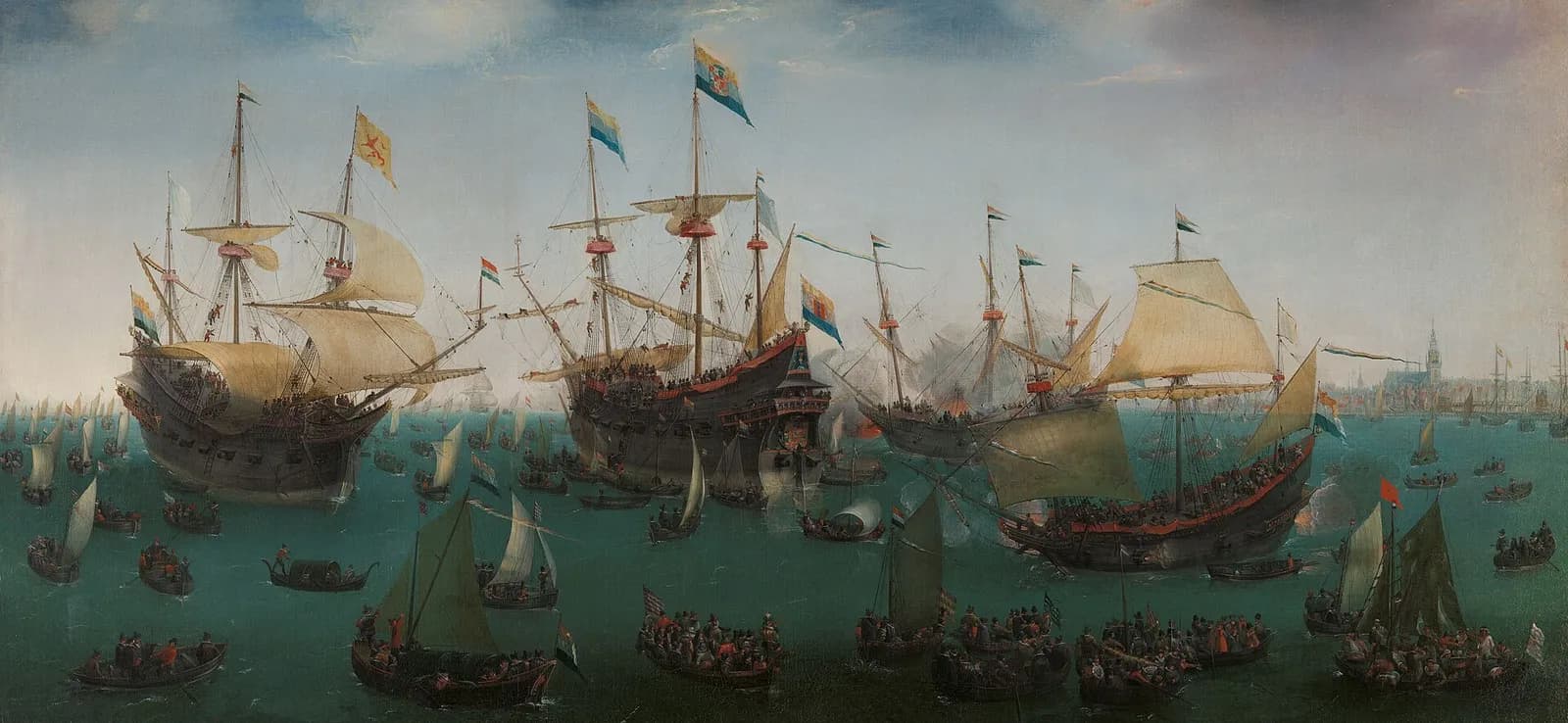
- Hendrick Cornelisz Vroom's painting of the return of Jacob van Neck's fleet to Amsterdam from the East Indies on 19 July 1599. Three years later the rival Dutch companies trading with Asia were merged into the VOC. Hendrick Cornelisz Vroom, Public domain, via Wikimedia Commons.
- The first page of the VOC charter of 1602, with the seal of the States General, in an archival photograph. The original is item 1 of the VOC archive in the Nationaal Archief, The Hague. Algemeen Rijksarchief, CC0, via Wikimedia Commons.
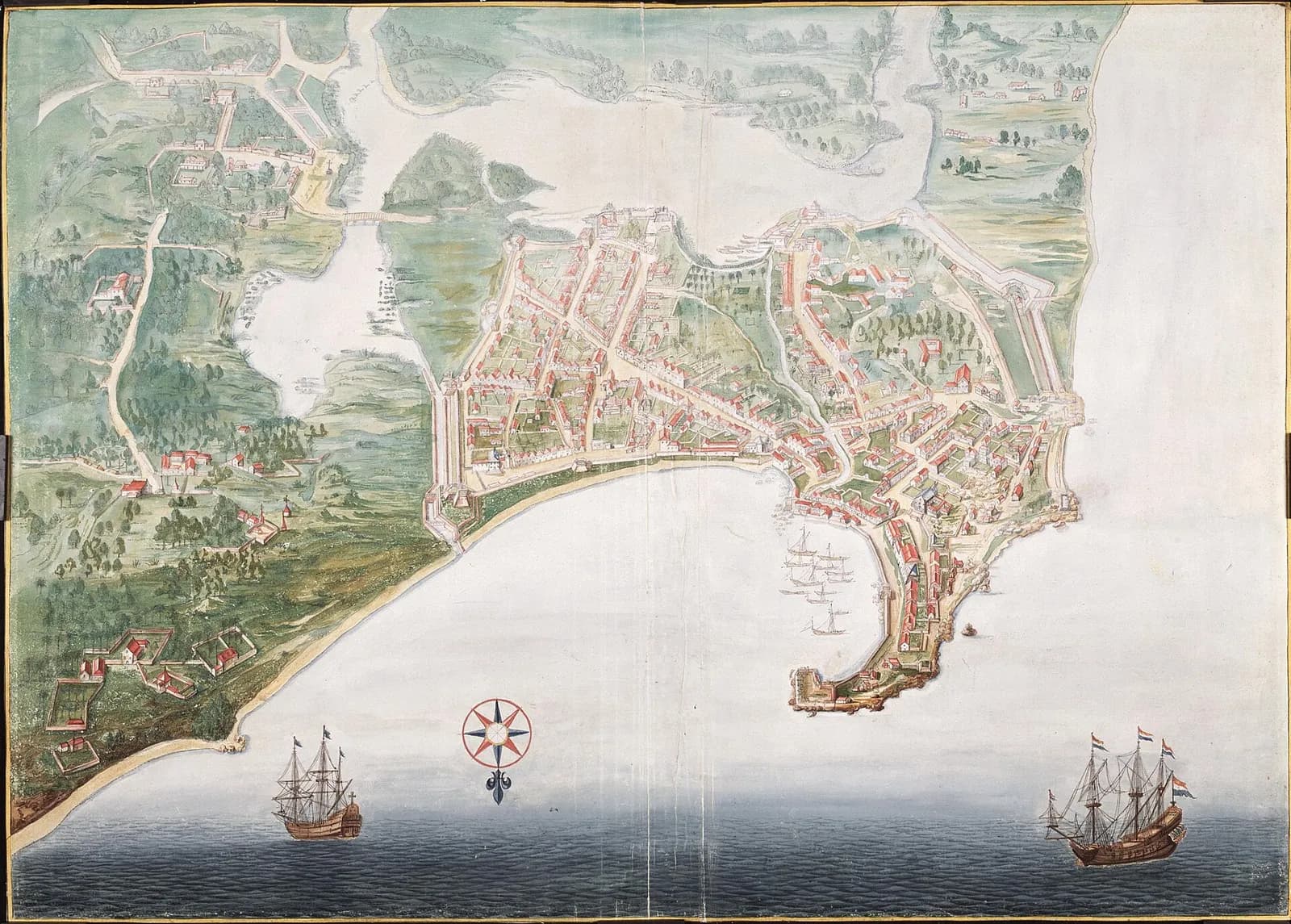
- A watercolour bird's-eye view of Colombo by the Dutch mapmaker Johannes Vingboons, made around 1665, about a decade after the city fell to the VOC. It is in the Nationaal Archief, The Hague. Johannes Vingboons, Public domain, via Wikimedia Commons.
- The Dutch taking possession of Cochin in 1663, an engraving signed by G. Appelmans from an edition of Philip Baldaeus's account of Malabar, Coromandel and Ceylon, first published in 1672. Philip Baldaeus, Public domain, via Wikimedia Commons.
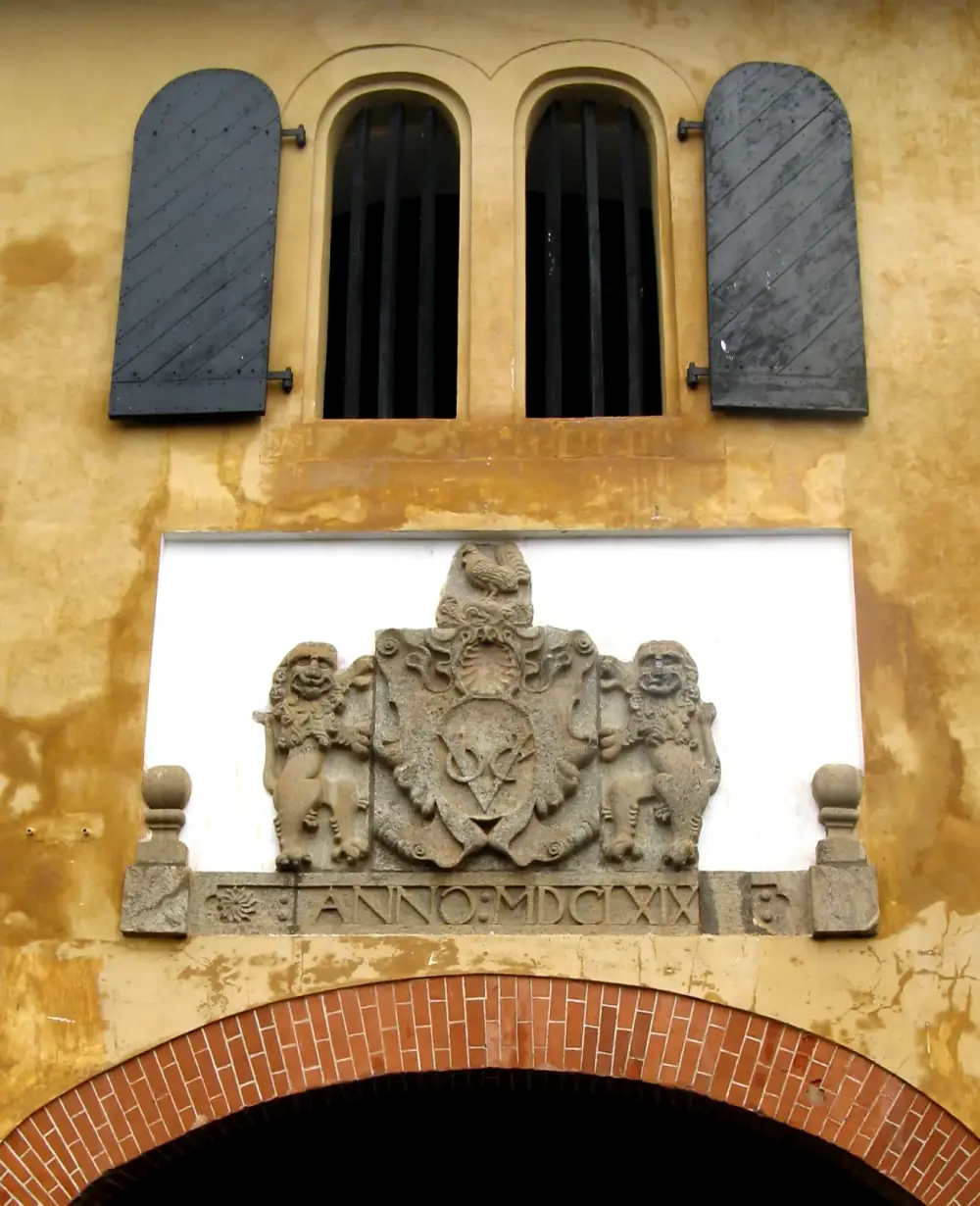
- The VOC monogram, dated 1669, on the inner face of the Old Gate of Galle Fort in Sri Lanka, photographed in 2008. The cockerel is the emblem of Galle. Michael Gunther, CC BY-SA 4.0, via Wikimedia Commons.