

Vox in excelso: how Portugal's Templars became the Order of Christ
A pope abolished the Knights Templar under pressure from the king of France. In Portugal no Templar is known to have been arrested: King Dinis took their castles, and seven years later a new order inherited them.
At a glance
- On 22 March 1312, during the Council of Vienne, Pope Clement V suppressed the Order of the Temple with the bull Vox in excelso, “not by definitive sentence, but by apostolic provision”.
- The Templars had held land in Portugal since 1128, when Countess Teresa gave them Soure. Their master Gualdim Pais began the castle of Tomar, their headquarters, on 1 March 1160.
- No arrests of Templars are recorded in Portugal. From 1307 King Dinis had their castles declared Crown property, and in 1310 he agreed with Castile to keep Templar goods out of outside hands.
- On 14 March 1319 Pope John XXII created the Order of Christ with the bull Ad ea ex quibus, seated at Castro Marim, and gave it the Templars' property. It later moved to Tomar.
- Under Henry the Navigator, its administrator from 1420, the order's wealth went into the voyages of discovery and its red cross flew on the caravels' sails. It survives as an honorific order of the Portuguese state.
A bull at Vienne
On 20 March 1312 Philip IV of France went to Vienne, a city on the Rhône where Pope Clement V had been holding a general council of the Church for five months. First on its agenda was the Order of the Temple, the military order of knight-monks whose members Philip had arrested across France four and a half years earlier.
The council was not doing what the king wanted. By the pope's own account, most of the cardinals and four-fifths of the prelates chosen to study the case, in every nation, wanted the order to be allowed to defend itself, and held that it could not be condemned for heresy on the evidence so far. In February the pope had bargained in secret with Philip's envoys, without consulting the council. In March Philip held an assembly of his kingdom at nearby Lyon.
Two days later, on 22 March 1312, Clement gave a commission of cardinals the bull that ended the order. Like all papal bulls it is known by its opening words, Vox in excelso, “a voice from on high”. The council approved it at its second session, on 3 April.
“Therefore, with a sad heart, not by definitive sentence, but by apostolic provision or ordinance, we suppress, with the approval of the sacred council, the order of Templars, and its rule, habit and name, by an inviolable and perpetual decree.”
The wording was careful. The pope did not find the order guilty. He abolished it as an act of government, because its good name was ruined and, he wrote, no good person would want to join it any more. The fate of its surviving members and of its estates, given over the centuries for the defence of the Holy Land, he reserved for later decisions. In Portugal those decisions would take seven years and produce a new order.
Knights of the Temple on the Portuguese frontier
The Templars reached Portugal almost as soon as the order spread west. On 19 March 1128 Countess Teresa, widow of Count Henry of Portugal, gave them the castle of Soure, south of Coimbra, on the open frontier with the Muslim south. Three months later her son, Afonso Henriques, defeated her supporters at São Mamede and took power. He confirmed the gift in 1129 or 1130.
The order fought in Afonso Henriques's wars, perhaps for the first time in his army at the capture of Santarém in March 1147, and he rewarded it with land and churches. The Templars rebuilt old castles and built new ones to hold the frontier and to settle the empty country around them, granting charters to attract settlers: Redinha in 1159, Tomar in 1162, Pombal in 1174, Castelo Branco in 1213.
The man most linked with them is Gualdim Pais. Born around 1118, he spent five years in the East, where he took part in the capture of Ascalon in 1153, and became master of the Templars in Portugal on his return in 1156. His mastership, which lasted until his death in 1195, was the order's high point in the kingdom.
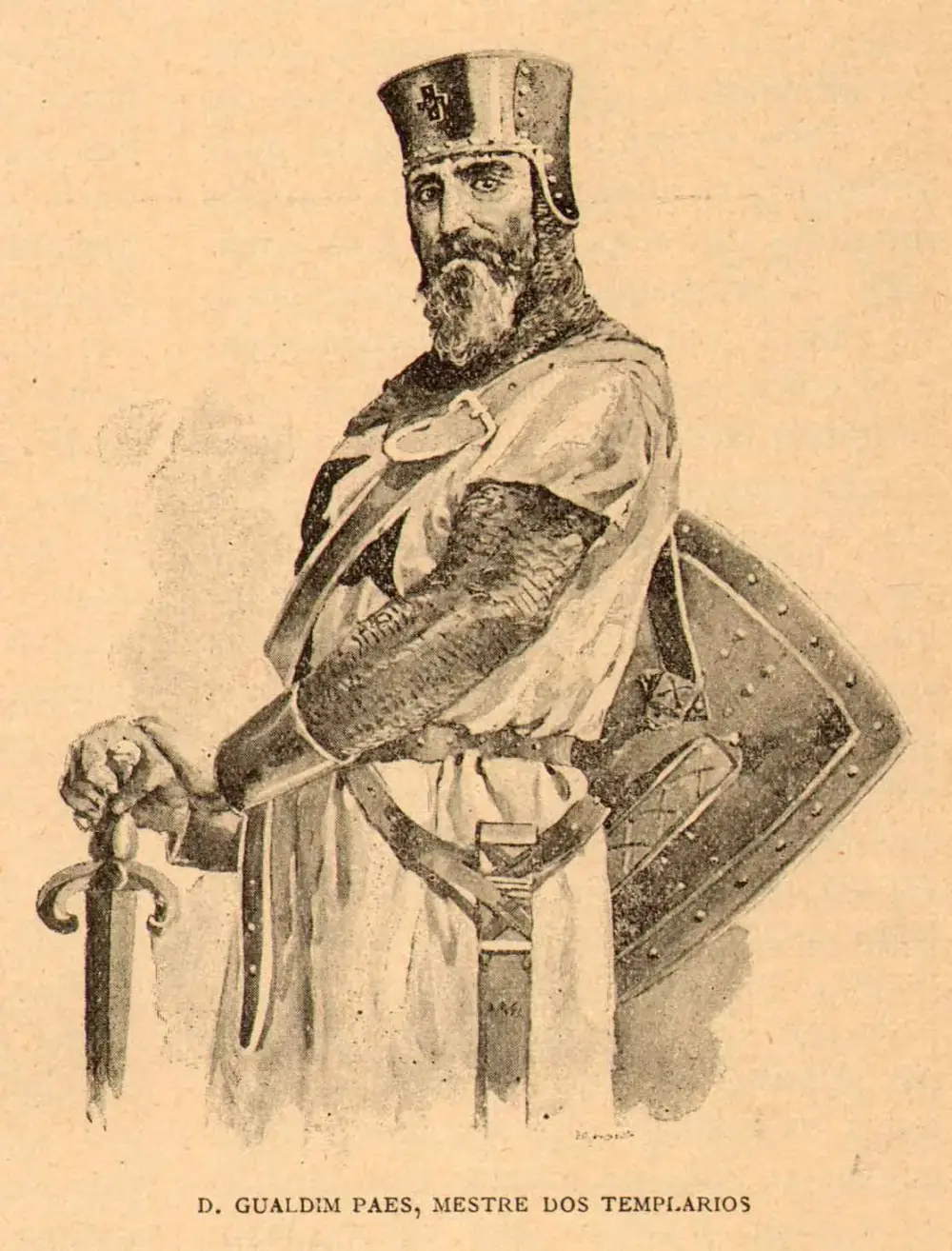
In 1159 Afonso Henriques gave the order the castle of Ceras and a large territory reaching from the Mondego to the mouth of the Zêzere. Ceras was in ruins. Witnesses questioned in 1317 said the master left it for a nearby site because it was a better hilltop and had better water. Work on the castle of Tomar began on 1 March 1160, and an inscription dates its keep, the oldest in Portugal, to that year.
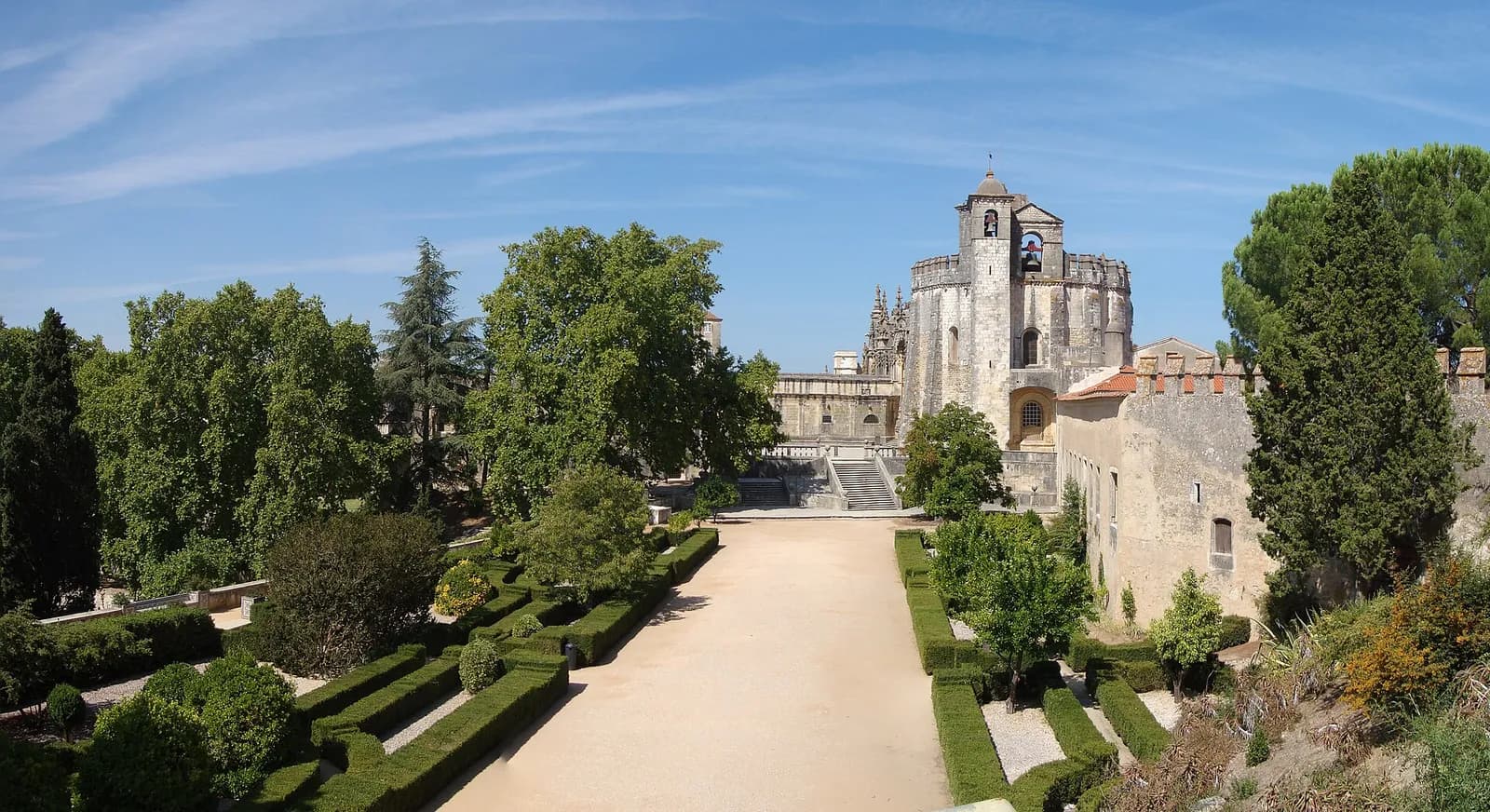
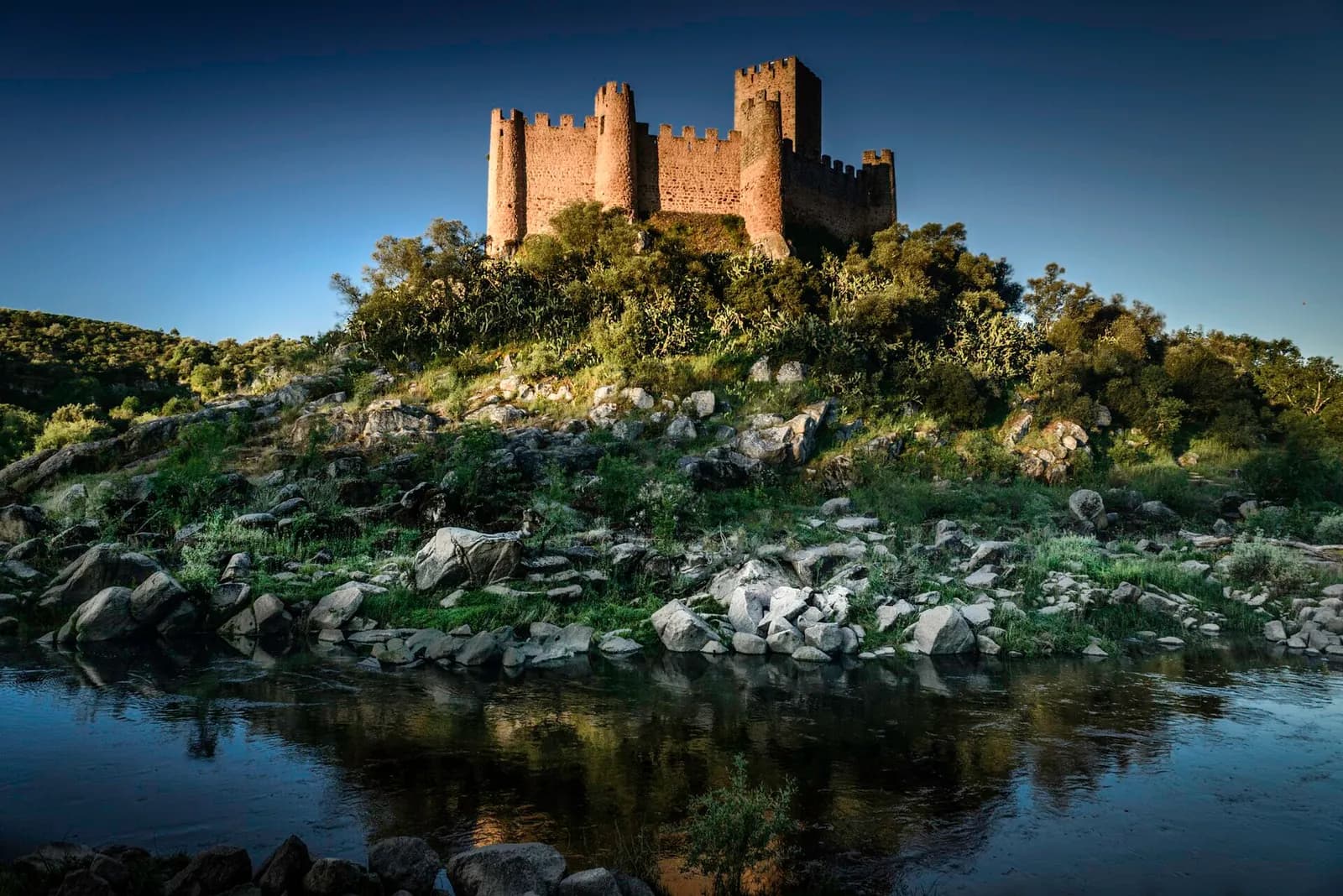
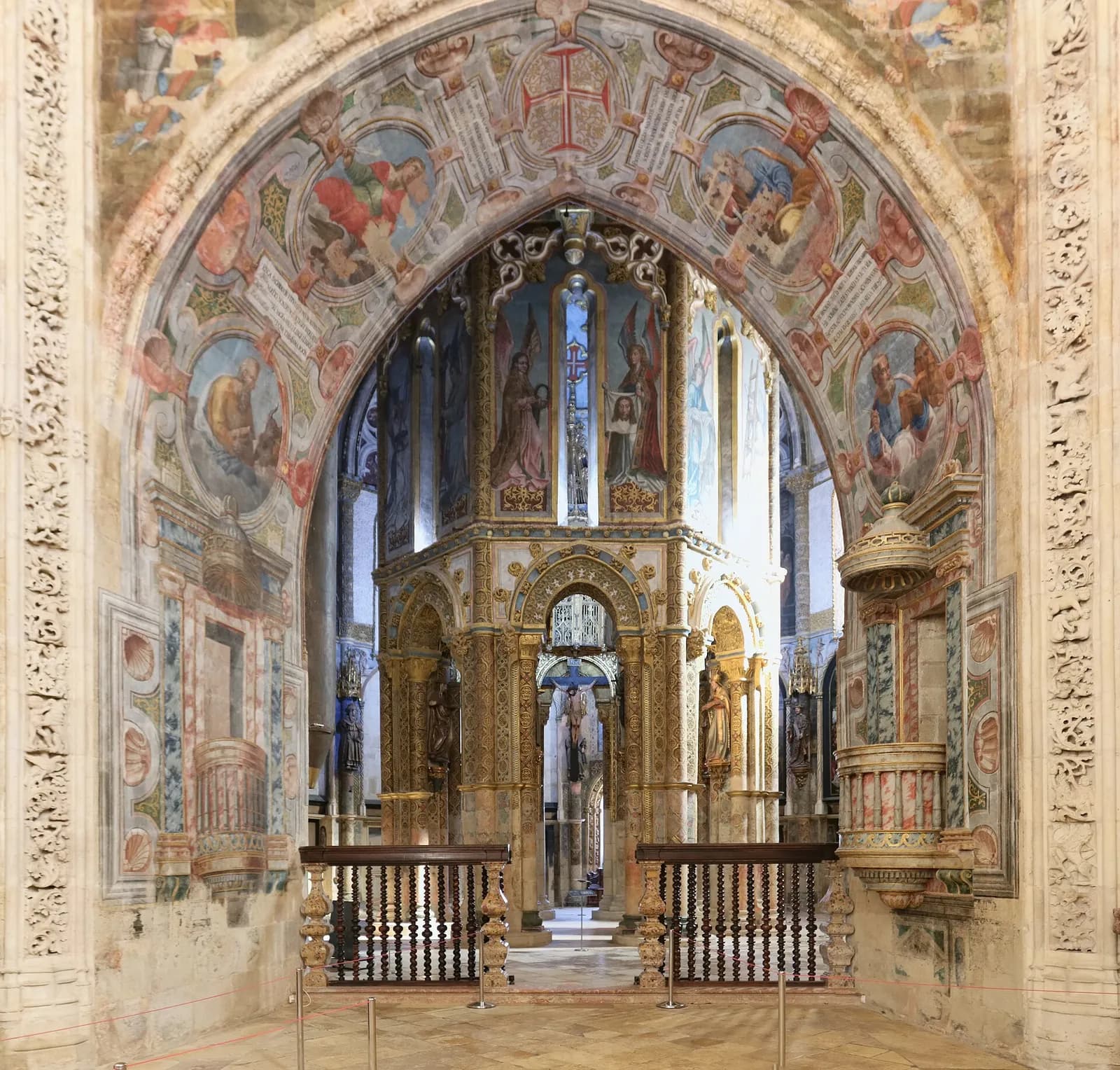
Tomar became the Templars' headquarters in Portugal. Inside its walls they built the Charola, a round church modelled on the Church of the Holy Sepulchre in Jerusalem. Their castles brought in ideas from the crusader fortresses of the East, among them the alambor, a sloping stone apron at the foot of the walls. Soon after Tomar was finished, in 1171, they built Almourol on a rocky island in the Tagus, to control a ford and the road north to Coimbra.
| Place | Templar origins | 1307 to 1319 |
|---|---|---|
| Soure | Given by Countess Teresa, 19 March 1128; first Templar seat | Taken by the Crown by sentence of 27 November 1309; handed to the Order of Christ, 24 June 1319 |
| Pombal | Castle begun soon after 1156; keep dated 1171 | Taken by the Crown, 27 November 1309; handed over, 24 June 1319 |
| Tomar | Castle begun 1 March 1160; Templar headquarters | Granted to a cardinal in 1317 and contested; named in the 1319 bull as never to be alienated |
| Almourol | Built from 1171 on an island in the Tagus | Named in the 1319 bull as never to be alienated |
| Longroiva | Given 10 June 1145; keep built 1174 | Named in the 1319 bull as never to be alienated |
| Castelo Branco | Land given November 1214 | Named in the 1319 bull as never to be alienated |
| Idanha-a-Velha | Given 30 November 1165 | Royal inquiry, 19 January 1310; handed over, 24 June 1319 |
| Castro Marim | Never Templar; a royal castle in the Algarve | Seat of the new Order of Christ from 1319 |
Dates of donation and building from the heritage service's study of Templar castles; seizures and restitutions from Gomes (2011) and Costa (2021); the four inalienable places from the bull Ad ea ex quibus as summarised by Costa and Rossi Vairo.
Arrests in France, a seizure in Portugal
On 13 October 1307 Philip IV had the Templars of France arrested. They were accused of denying Christ and spitting on the cross when they were received into the order, among other crimes, and many, including the grand master, Jacques de Molay, confessed. The pope took over the case and asked other kings to arrest the knights in their own lands.
King Dinis of Portugal had moved first. The earliest Portuguese document about the Templars' property is dated 18 August 1307, two months before the arrests in France. On 3 January 1308 Clement wrote to Dinis that the grand master and the knights of France were in prison and asked him to do the same. There is no record that he did. Before 4 February 1308 the Portuguese master, Vasco Fernandes, and the commanders of Pombal and Soure had left the kingdom, officially to answer the charges before the pope.
“I could not judge them as defaulters at law, because they left my kingdoms in fear of what they were accused of, and because I had seized all the things they had in my kingdoms.”
Dinis's attention was on the order's property. Until then he had favoured the Templars: he took them under his protection in 1279 and confirmed their privileges in 1285. Now a commission of men loyal to him, including the archbishop of Braga and the bishop of Lisbon, ruled between 1307 and 1310 that their castles had been royal gifts and belonged to the Crown. The Templars protested that the judges were not impartial.
On 27 November 1309 the Crown took Soure, Pombal, Ega and Redinha, and in January 1310 an inquiry examined Idanha-a-Velha and Salvaterra. The other Iberian kings feared that Templar lands would pass to the Hospitallers, the military order of St John of Jerusalem, and leave their control. On 21 January 1310 Fernando IV of Castile proposed a pact to defend the Templar properties in both kingdoms against all claimants. Dinis accepted on 14 April, and James II of Aragon joined on 17 August 1311.
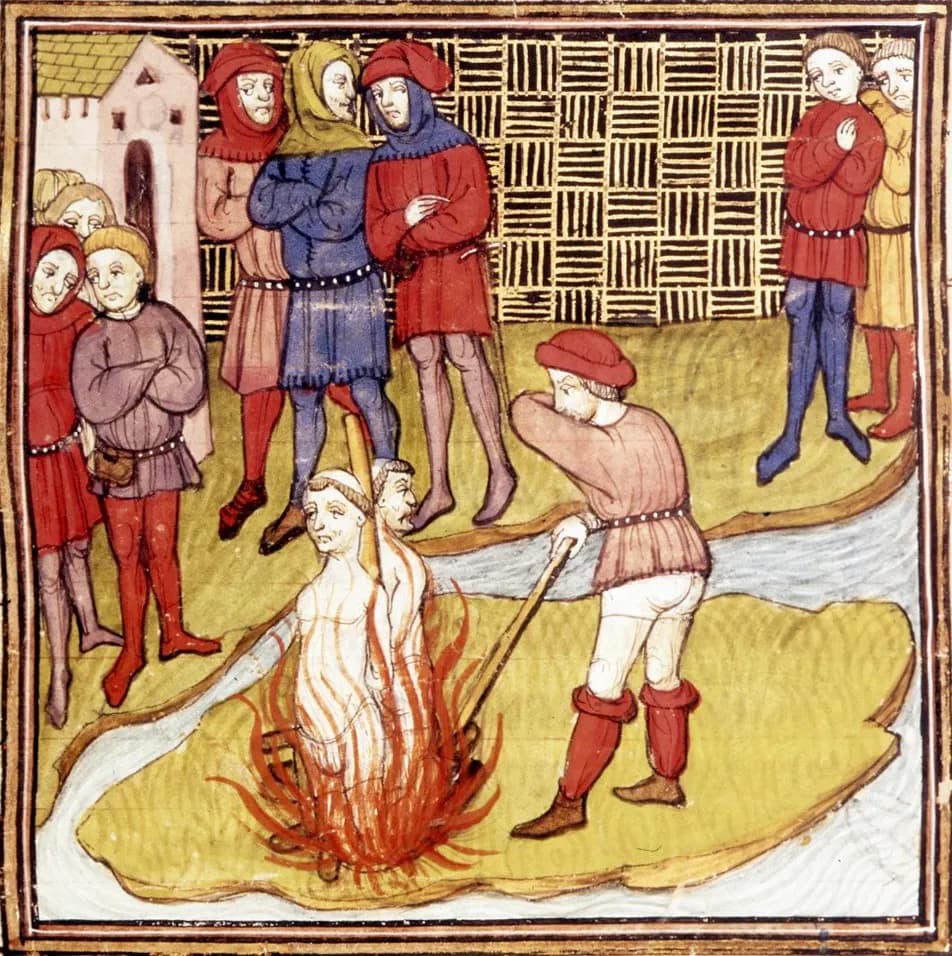
The Templars of the peninsula fared far better than their brothers in France. Church councils in Castile in April 1310 and at Salamanca that October, with the bishop of Lisbon among those present, found them innocent on most charges but left the final word to the pope. In France many knights went to the stake, some as late as 1314.
The Iberian exception
Vox in excelso reserved the Templars' people and property for the pope. On 2 May 1312 the bull Ad providam gave the property to the Hospitallers, with one exception: the Templar lands in the kingdoms of Castile, Aragon, Portugal and Majorca, which the pope kept for his own later decision. The envoys of the Iberian kings at Vienne had argued for this. A bull of 6 May let former Templars be judged by councils in their own provinces, with pensions for those cleared and for those who confessed.
The exception did not give the lands to Dinis. They were Church property and could not simply pass to a king. On 23 August 1312 Clement wrote to the Iberian rulers asking what they meant to do with the Templar estates, and gave them until 1 February 1313 to answer. The rulings of the king's commission were never approved in Avignon.
Dinis built his case. In April 1314 his inquirers took 25 questions to Soure, Castelo Branco, Montalvão and Nisa, designed to show that the Templars' lands had always been royal gifts. The witnesses were mostly laymen, clerics and the order's servants, with a few former brothers. One, André Gonçalves of Pombal, had been at Acre when it fell to the sultan of Egypt in 1291. Clement died that month, on 20 April, and the papacy stayed empty until John XXII was elected on 7 August 1316.
Not everyone obliged. At Castelo Branco, Gil Fernandes Barreto said he was the king's man and would tell what he knew, which was more than the articles contained, only when he saw a letter or a sure message from the king. Paula Pinto Costa reads the inquiry as history written to order: the questions were framed to get the answers the Crown wanted.
The danger to the Crown was real. In 1317 John XXII granted Tomar itself, the Templars' old headquarters, to a cardinal, Bertrand de Montfavez, to hold in commendam, drawing its income. A protest was lodged on 21 December 1317 in the name of Dinis's heir, Prince Afonso, who was already in open conflict with his father. It set out the Crown's case that the Templars had held their castles only in return for military service, and that the castles still belonged to the king.
A “fist of Christ” for the southern frontier
There was a precedent next door. On 10 June 1317 James II of Aragon, Dinis's brother-in-law, had obtained a new military order, Montesa, in Valencia in the same circumstances. On 14 August 1318 Dinis gave power of attorney to two envoys at Avignon: João Lourenço de Monsaraz, a knight, and Pedro Peres, a canon of Coimbra cathedral.
They succeeded. On 14 March 1319, in the bull Ad ea ex quibus, John XXII created the Militia of Jesus Christ, which he called a pugillum Christi, a “fist of Christ”, to resist the Muslims who raided the south of the kingdom and to win back lost lands. It would follow the rule of the Castilian order of Calatrava, under the oversight of the Cistercian abbot of Alcobaça. Its seat would be Castro Marim, a hilltop castle in the Algarve that watched the land border with Castile and the coast.
“a very strong castle, which the lie of the place makes defensible, which is on the frontier of the said enemies and borders on them, where a new knighthood of fighters of Jesus Christ could be made”
The next day the pope named the first master: Gil Martins, until then master of the order of Avis. The master owed the king an oath of loyalty, but the bull stated that the oath gave Dinis no rights over the order's property. The new order received everything the Templars had owned. Four places were named and could never be given away: Castelo Branco, Longroiva, Tomar and Almourol.
On 24 June 1319 Dinis signed the castles over. In the charter he admitted that the sentences against the Templars had been unjust, said he wished to clear his conscience, and called the Order of Christ a reform of the Temple. Soure, Pombal, Ega, Redinha, the two Idanhas, Salvaterra, Segura, Proença and Rosmaninhal passed to the new order.
The handover took months. Gil Martins swore his oath of loyalty to the pope, before the king, on 18 November 1319. Two days later the master and his brothers signed a receipt for the property; Rossi Vairo reads the same act as also giving the king the incomes of the old Templar estates. On 26 November, in houses at Santarém that had belonged to the Temple, the order issued its first ordinance. Its master admitted in another document that he did not know where all the property was.
Some Templars joined the new order. Their last master, Vasco Fernandes, had been arrested in Castile by Fernando IV, who seized 50,000 torneses the master had lent to the order of Alcántara. On 23 August 1321 John XXII told Gil Martins to receive him into the Order of Christ and give him a commandery, and he seems to have held Montalvão until his death around 1323. The statutes of 1321 set the new order's strength at a minimum of 86 brothers, 71 of them knights.
18 August 1307
First Portuguese document on the Templars' property
13 October 1307
Philip IV has the Templars of France arrested
Before 4 February 1308
Master Vasco Fernandes and two commanders leave Portugal
27 November 1309
The Crown takes Soure, Pombal, Ega and Redinha
21 January 1310
Castile proposes a pact on Templar property; Dinis accepts on 14 April
October 1310
Council of Salamanca finds the Iberian Templars innocent on most charges
22 March 1312
Vox in excelso suppresses the order
2 May 1312
Ad providam gives Templar property to the Hospitallers, except in Iberia
April 1314
Royal inquiry into Templar lands
21 December 1317
Protest against the grant of Tomar to a cardinal
14 March 1319
Ad ea ex quibus creates the Order of Christ
24 June 1319
Dinis hands the Templar castles to the new order
26 November 1319
First ordinance of the Order of Christ, at Santarém
23 August 1321
The pope orders the old Templar master received into the new order
From Castro Marim to the caravels
Castro Marim was poor and remote, and the brothers did not stay. A master moved the convent to Tomar without papal permission. Sources disagree on when: the Presidency's history of the order gives 1356, the Torre do Tombo 1357, and the heritage service's study “after 1366”. Statutes issued with papal authority ratified the move only in 1449.
In 1420 Pope Martin V made Prince Henry, the son of João I later known as Henry the Navigator, its administrator, and the order's income helped pay for his voyages of discovery.
The papacy tied the order to the new lands. On 13 March 1456 Calixtus III's bull Inter caetera gave the Order of Christ spiritual jurisdiction over the lands from Cape Bojador through Guinea and beyond. The order's cross went up on the sails of Portuguese caravels and became one of the best-known national symbols.
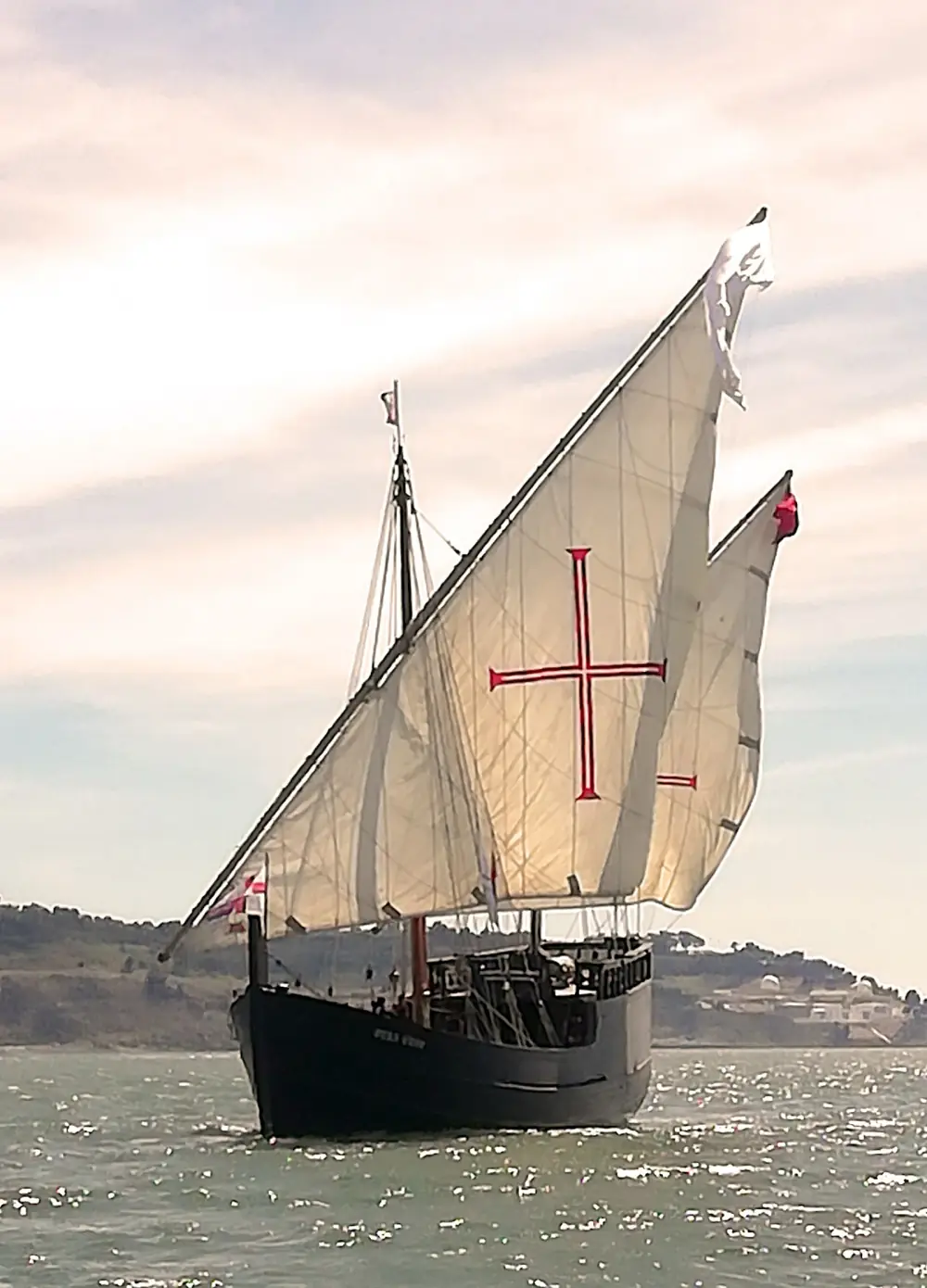
Then the order became the Crown's. Manuel, its governor since 1484, became king in 1495 and was the first king to be its master. In 1551 Pope Julius III's bull Praeclara clarissimi joined the masterships of the military orders to the Crown for good. At Tomar, Manuel added a nave to the Charola, built between 1510 and 1515, with the carved window of the chapter house that is now read as a symbol of the maritime expansion.
What the Templars left
The Order of Christ still exists, as an honour. The Republic abolished the old orders on 15 October 1910 and restored this one on 1 December 1918, to reward services to the country or to humanity. It now goes to holders of the highest offices of state, such as former prime ministers and presidents of parliament, and on state visits to the spouses of foreign heads of state and sometimes to the heads of state themselves.
The Templars' buildings have lasted too. The Convent of Christ at Tomar, which grew around their castle over seven centuries, was inscribed on UNESCO's World Heritage List in 1983. The state took the whole complex back in the mid-1980s, after a politician, Costa Cabral, had bought part of it at auction in 1835.
Legend has grown around them. Paula Pinto Costa notes that the stigma against the Templars in the 1310s was a French affair: late medieval Portuguese documents mention the link between the Temple and the Order of Christ without embarrassment, and most of the speculation came with Romantic writers much later. In her reading, the Order of Christ was created above all to hold a patrimony. It inherited the Templars' castles and revenues, while its early statutes said almost nothing about its religious life.
Even the roll of Templar masters in Portugal is disputed. Lists drawn up by chroniclers and historians run from 11 to 33 names, partly because some add the masters who governed Castile and León as well as Portugal.
Templar masters of Portugal: ten lists compared
masters listed
Number of masters in ten lists of the Templar masters in Portugal, as compared by Saul António Gomes (2011, note 11). The lists do not all count the same thing: Bernardo da Costa includes the masters of the “three kingdoms” of Portugal, Castile and León, Simões Dias counts 32 successions, and Maria Cristina Fernandes lists 17 for Portugal and seven more for the three kingdoms.
Show the data
| Masters in each historian's list | |
|---|---|
| António Brandão | 11 |
| M. C. Fernandes (2009) | 17 |
| Valente (2002) | 19 |
| Lucas de Santa Catarina (1722) | 22 |
| José de Brito | 24 |
| Vieira Guimarães (1936) | 27 |
| Santa Rosa de Viterbo | 28 |
| Capêlo (2003) | 28 |
| Simões Dias (1999) | 32 |
| Bernardo da Costa (1771) | 33 |
FAQs
What was the bull Vox in excelso?
It was the papal decree, dated 22 March 1312 at the Council of Vienne, by which Clement V suppressed the Knights Templar. It did not convict the order of heresy: the pope abolished it “by apostolic provision”, because its reputation was ruined, and reserved its members and property for later decisions. The council approved it on 3 April 1312.
Were the Templars persecuted in Portugal?
Not as in France. No arrests are recorded, the master and two commanders left the kingdom in 1308, and church councils in Castile in 1310 found the Iberian Templars innocent on most charges. But King Dinis had their castles declared Crown property from 1307, and some historians argue he was after their land rather than protecting them.
Is the Order of Christ the same as the Knights Templar?
No. It was a new order, created by Pope John XXII on 14 March 1319 at King Dinis's request, with the rule of Calatrava and its own master, Gil Martins. It inherited the Templars' property in Portugal and took in some former Templars, including their last master, Vasco Fernandes.
Why is the cross of the Order of Christ on Portuguese caravels?
From 1420 Henry the Navigator administered the order, and its wealth helped pay for the voyages of discovery. In 1456 the pope gave it spiritual jurisdiction over the lands from Cape Bojador through Guinea, and its red cross was painted on the sails of Portuguese ships.
Where was the Order of Christ based?
The bull of 1319 set its seat at the castle of Castro Marim, in the Algarve. In the fourteenth century the convent moved to Tomar, the old Templar headquarters; sources date the move to 1356, 1357 or after 1366, and it was ratified with papal authority only in 1449.
On the timeline
Open the timelineNearby moments from the burgundian kings (1249–1383).
King Dinis signs 'Scientiae thesaurus mirabilis', founding the Estudo Geral that becomes the University of Coimbra — one of the oldest universities in continuous operation. It actually began life in Lisbon and shuttled between the two cities before settling for good in Coimbra in 1537.
The future Afonso IV is born in Lisbon, son of King Dinis and Isabel of Aragon, the 'Rainha Santa'. Known as 'the Brave', a name tradition ties to the victory at Salado in 1340, he is remembered just as much for the killing of Inês de Castro, his son Pedro's beloved, by his order or with his consent, in 1355.
By the Treaty of Alcañices, King Dinis of Portugal and Fernando IV of Castile settle the frontier between their kingdoms and seal an alliance of friendship — a border that survives almost unchanged as one of the oldest in Europe.
The Templars and the Order of Christ
Pope Clement V dissolves the Knights Templar with the bull 'Vox in excelso'. No Templar is known to have been arrested in Portugal, where King Dinis has already claimed their castles for the Crown; in 1319 they pass to the new Order of Christ, whose red cross would later billow on the sails of the caravels.
King Dinis signs a contract with the Genoese mariner Manuel Pessanha, making him hereditary Admiral of the Kingdom and obliging him to bring twenty men 'skilled in the sea' to command the royal galleys — the charter regarded as the founding act of the Portuguese Navy.
Afonso IV of Portugal and his son-in-law Alfonso XI of Castile rout the Marinid army of Abu al-Hasan and the forces of Granada at the Battle of Salado near Tarifa, ending the last major Moroccan invasion of the Iberian Peninsula.
Inês de Castro, the Galician noblewoman loved by Crown Prince Pedro, is killed in Coimbra by courtiers acting with the consent of King Afonso IV, who feared Castilian influence over the succession. Once king, Pedro declared they had secretly married, and legend says he had her corpse crowned queen.
Coming up in history
All long reads 24 March 1962Students against Salazar: the academic crisis of 1962
 25 March 1505Francisco de Almeida sails as Portugal's first viceroy of India, 1505
 26 March 1211The death of Sancho I, 1211: the king who settled Portugal's frontier
 27 March 1905Kaiser Wilhelm II in Lisbon, 1905: three days on the way to Tangier
11 sources
Archives, scholarship and reporting this article was checked against.
- 1
The dissolution of the Order of the Temple and the creation of the Order of Christ in PortugalGiulia Rossi Vairo, Ordines Militares. Colloquia Torunensia Historica 21 (2016), pp. 43–60
- 2
A Ordem de Cristo: incorporação e modelação de um passado templário e régioPaula Pinto Costa, in I. C. F. Fernandes (coord.), Ordens Militares, Identidade e Mudança, vol. 2, Palmela, 2021 (Universidade do Porto repository)
- 3
A Extinção da Ordem do Templo em PortugalSaul António Gomes, Revista de História da Sociedade e da Cultura 11 (2011), pp. 75–116, Universidade de Coimbra
- 4
Council of Vienne 1311–1312: introduction and decrees, including the bulls Vox in excelso and Ad providamPapal Encyclicals Online, from N. P. Tanner (ed.), Decrees of the Ecumenical Councils (1990)
- 5
Os Castelos da Ordem do Templo em PortugalPaula Noé, DGPC/SIPA (Direção-Geral do Património Cultural), December 2016
- 6
História da Ordem Militar de CristoOrdens Honoríficas Portuguesas, Presidência da República
- 7
Convento de CristoMuseus e Monumentos de Portugal
- 8
- 9
Instituição da Ordem de CristoArquivo Nacional Torre do Tombo
- 10
A Ordem de Cristo ao tempo de AlfarrobeiraIsabel L. Morgado de Sousa e Silva, in Livro de Homenagem ao Professor Doutor Humberto Carlos Baquero Moreno (via medievalistas.es)
- 11
European Treaties bearing on the History of the United States and its Dependencies to 1648, vol. IFrances Gardiner Davenport (ed.), Carnegie Institution of Washington, 1917 (Internet Archive)
Image credits
- The Convent of Christ at Tomar in 2012. The tall many-sided building is the Charola, the round church the Templars built inside their castle; the Order of Christ later made the castle its headquarters and wrapped a convent around it. ines saraiva from Belgium / Portugal, CC BY 2.0, via Wikimedia Commons.
- Gualdim Pais, master of the Templars in Portugal, as imagined by the illustrator Alfredo Roque Gameiro for Manuel Pinheiro Chagas's popular history of Portugal, 1899. Roque Gameiro, Public domain, via Wikimedia Commons.
- The castle of Almourol on its island in the Tagus, photographed in 2016. The Templars built it from 1171, and the bull of 1319 named it among four places the Order of Christ could never give away. Luís Ascenso, CC BY 3.0, via Wikimedia Commons.
- The burning of the Templars' grand master and another Templar, painted after 1380 in a French chronicle, the Chroniques de France ou de St Denis (British Library, Royal MS 20 C VII). Workshop of Virgil Master, Public domain, via Wikimedia Commons.
- The Vera Cruz, a modern replica caravel, on the Tagus in 2019, with the cross of the Order of Christ on its lateen sails. Lopo Pizarro, CC BY-SA 4.0, via Wikimedia Commons.
- The Charola, the Templars' round church at Tomar, seen in 2022 through the arch that joins it to the nave built for Manuel I. Ingo Mehling, CC BY-SA 4.0, via Wikimedia Commons.