

Rafael Bordalo Pinheiro: the Lisbon cartoonist who invented Zé Povinho
He drew Portugal's politicians as saints and pigs, gave the country a cartoon everyman it still recognises, and turned a factory at Caldas da Rainha into a workshop of jokes in clay.
At a glance
- Rafael Bordalo Pinheiro was born on Rua da Fé in Lisbon on 21 March 1846, into a family of artists; his younger brother was the painter Columbano.
- On 12 June 1875, in his paper A Lanterna Mágica, he drew Zé Povinho for the first time: the long-suffering Portuguese everyman who pays for everything and answers with a rude gesture.
- He spent 1875 to 1879 in Rio de Janeiro, then ran O António Maria, Pontos nos ii and A Paródia in Lisbon, mocking both rotating parties, the Church, the king and Britain after the 1890 Ultimatum.
- From 1884 he ran the artistic side of a faience factory at Caldas da Rainha, whose cabbage-leaf plates and lizards are still made in the town today.
- He died in Lisbon on 23 January 1905, aged 58. The Museu Bordalo Pinheiro on Campo Grande, opened by a collector in 1916, is devoted to his work.
A collection for Saint Anthony
On 12 June 1875, the eve of the feast of Saint Anthony, Lisbon's patron saint, readers who opened the fifth issue of A Lanterna Mágica found the government dressed up for the festival. Across the two centre pages the head of the government, António Maria Fontes Pereira de Melo, sat on a popular throne as the saint. On his lap, wearing a little crown, sat King Luís I as the infant Jesus.
Fontes's finance minister, António de Serpa, went round collecting money for the saint's candles, while the head of the city council stood guard with a whip. The man handing over his coins was new. He was a stocky countryman in a broad hat, and on one trouser leg the artist had written “Your Zé Povinho”.
Zé is the familiar form of José, and povinho means “the little people”. The figure came back again and again in the artist's papers for almost thirty years: the ordinary Portuguese who footed the bill, watched the politicians come and go, and said it was always the same.
The artist was Rafael Bordalo Pinheiro, 29 years old, born on Rua da Fé in Lisbon on 21 March 1846. Within ten weeks of drawing Zé Povinho he was on a ship to Brazil. In a career of 35 years he founded eight satirical papers, drew nearly every Portuguese politician of his day, and in his late thirties became a potter whose designs are still in production.
A family of artists in a country of two parties
Rafael was the third son of Manuel Maria Bordalo Pinheiro, a civil servant who painted, sculpted and engraved, and Maria Augusta Prostes. There were eight children. His brother Columbano, 11 years younger, became one of the leading Portuguese painters of his time and has an article of his own.
He was a restless student. He tried the stage as a young actor and attended the Lisbon Academy of Fine Arts on and off between 1861 and 1871 without finishing. In 1866 he married Elvira Ferreira de Almeida against her parents' wishes. Their son, Manuel Gustavo, born in 1867, later drew alongside him.
His first caricatures were of writers and actors. In 1870 he published O Calcanhar de Aquiles (“Achilles' heel”), an album of etched caricatures of Lisbon's literary men. He also began A Berlinda, loose lithographed sheets on politics, and broke it off for O Binóculo, a theatre weekly that ran to four issues and was sold inside the theatres. A Berlinda's seventh and last sheet, in 1871, mocked the government's ban on the Casino Conferences, lectures given by young radicals such as Antero de Quental and Eça de Queirós.
In March 1873 the Illustrated London News sent him to Spain to draw the war between Carlists and Liberals, and he contributed to the Madrid weekly El Mundo Cómico. The London paper invited him to move to England. He turned it down.
Zé Povinho, always the same
A Lanterna Mágica first came out on 15 May 1875. Its texts were signed Gil Vaz, a shared pen name of the poets Guilherme de Azevedo and Guerra Junqueiro. It began as a weekly selling in the streets for 60 réis, and on 1 July, with issue 8, it became an evening daily of four large pages.
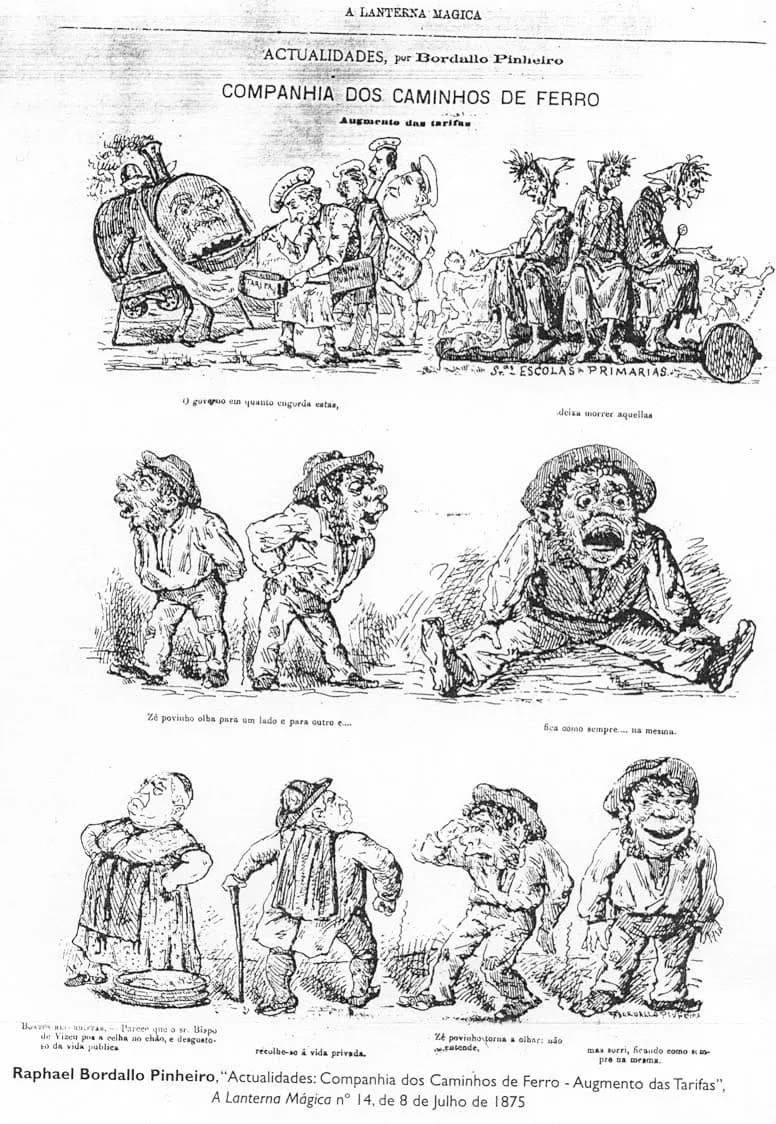
Zé Povinho was its lasting invention. In later issues he sat on the ground, legs splayed, as railway fares went up and the primary schools starved. Bordalo drew him as a broad, bearded peasant, slow and easily fooled. Now and then he was provoked into the manguito, a rude arm gesture of defiance, and a cry of “Toma!” (“Take that!”).
The historian João Medina, one of the main scholars of the figure, calls him the national stereotype, a self-caricature in which the Portuguese have long recognised themselves.
“Resigned and conformist, aloof from politics and seeing in it only the pantomime and swindle he ends up paying for (…), our people see themselves faithfully in the self-caricature of this stereotype. Only now and then, on truly stormy days, does Zé explode.”
The paper lasted little more than two and a half months. Bordalo suspended it on 31 July 1875 and, to the surprise of his friends, sailed for Rio de Janeiro on 19 August.
Four years in Rio de Janeiro
Brazil, the former colony, was the favourite destination of Portuguese emigrants, and its cities were big buyers of Portuguese books and papers. Manuel Rodrigues Carneiro Júnior, owner of the Rio comic weekly O Mosquito, hired Bordalo while he was still in Lisbon. His first drawing appeared in issue 313, on 11 September 1875, and told the story of his own voyage. In 1876 his wife and daughter joined him; Manuel Gustavo stayed with his grandparents.
He drew the Emperor Pedro II submitting to Pope Pius IX like a schoolboy holding out his hand for the cane. He also invented Manel Trinta Botões, “Manuel Thirty Buttons”, a Portuguese immigrant in clogs, in answer to a Brazilian deputy's speech about Portuguese immigrants. Irisalva Moita, a curator of Lisbon's municipal museums, writes that Bordalo himself paraded through Rio in a blue jacket with three rows of ten mother-of-pearl buttons.
After a quarrel with Carneiro he launched papers of his own: Psitt!!! in 1877, which ran to nine issues, and O Besouro (“The Beetle”), 49 weekly issues between 6 April 1878 and 8 March 1879. Their pages carried a long, angry exchange of open letters with the cartoonist Angelo Agostini.
O Besouro's owners dispensed with him in March 1879. Moita writes that enemies he made in Rio twice tried to kill him, and that with his wife pressing to leave he went home. She dates his arrival to August 1879, but he was in Lisbon by early June. Because he came from a city struck by yellow fever, he was held in quarantine at the lazaretto across the Tagus from Lisbon. He turned the experience into a comic book, No Lazareto de Lisboa.
O António Maria and the Fontes years
On 12 June 1879, four years to the day after Zé Povinho's debut, Bordalo launched O António Maria. The title was a joke on António Maria Fontes Pereira de Melo, his favourite target. It came out on Thursdays at 60 réis, eight pages with the front, back and centre spread given over to his drawings, and sold on average 7,000 copies.
“O António Maria has no choice, in most cases, but to be declared and frank opposition to governments, and open and systematic opposition to the oppositions.”
He kept that promise. The paper went after both rotating parties, the king, the Church and the way elections were bought. In 1883 he drew a Last Supper with Zé Povinho in the place of Christ, which took him to court. The lawsuits piled up so fast that he joked he was opening an office at the Boa-Hora courthouse.
Alongside it he published the Álbum das Glórias, 42 portrait-caricatures of statesmen, writers, actors and institutions, most of them between 1880 and 1883, with texts by Guilherme de Azevedo and Ramalho Ortigão. Ortigão's entry on Zé Povinho, in September 1882, called him “the Sovereign” and foresaw a day when he might change his name from Zé Povinho to simply the People.
From March 1881 governments answered growing discontent with restrictions on the press, and in 1884 a reform of the penal code tightened them further. At a meeting of journalists Bordalo proposed that every paper close for eight days in protest. Someone smiled that a weekly would lose nothing by it. He replied in the issue of 21 January 1885.
“O António Maria closes its doors as a sign of mourning, and closes them for ever.”
In his farewell he said he belonged to no camp. The monarchists called him a revolutionary and the republicans called him a sell-out, so he would be “simply a worker”.
Pontos nos ii, the Ultimatum and a failed revolt
“For ever” lasted three and a half months. On 7 May 1885 Bordalo launched Pontos nos ii, Portuguese for “dots on the i's”. Its opening programme was spoken by Maria, “the widow of António”, who announced that her mourning was over and that she would go on laughing at everything, as she had during “a honeymoon of six and a half years” with her late husband.
The old woman in a headscarf, Maria da Paciência (“Mary of Patience”), became the paper's emblem and was perhaps Zé Povinho's wife. The targets did not change: Fontes, now drawn with a crown that seemed to grow out of his body, and the civil governor Peito de Carvalho, reduced to a starched shirt front.
Its angriest pages came after January 1890, when an ultimatum from Britain, Portugal's oldest ally, inflicted what Paulo Henriques calls a huge national humiliation, a story told in our article on the British Ultimatum. From then on John Bull, the cartoon Englishman, was Zé Povinho's tormentor, and in Caldas Bordalo made him into a chamber pot.
On 31 January 1891 a republican revolt in Porto failed, as our article on the Porto revolt tells. Five days later Pontos nos ii, issue 293, opened with a leader headed “Glória aos vencidos!”, glory to the vanquished.
“The revolution in Porto, which was a madness as useless as it was splendid, should remind the monarchy how accurate is the forecast we have more than once made it from these pages.”
Moita writes that these pages, with a text by the writer Fialho de Almeida, led the civil governor to suspend the paper. On 5 March 1891 Bordalo revived O António Maria for a second series, which ran until July 1898. Disillusioned by the public's apathy after the Ultimatum, he turned more to the theatre, the opera and Lisbon society.
| Paper | Where | Dates | Notes |
|---|---|---|---|
| A Berlinda | Lisbon | 1870 to 1871 | Loose lithographed sheets; seven issued |
| O Binóculo | Lisbon | 29 October to 10 December 1870 | Theatre weekly sold in the theatres; four issues |
| A Lanterna Mágica | Lisbon | 15 May to 31 July 1875 | Weekly, then an evening daily from 1 July; Zé Povinho's first home |
| O Mosquito | Rio de Janeiro | 11 September 1875 to 24 May 1877 | Existing weekly he joined as illustrator; his drawings from no. 313 |
| Psitt!!! | Rio de Janeiro | 1877 | Nine issues |
| O Besouro | Rio de Janeiro | 6 April 1878 to 8 March 1879 | 49 weekly issues |
| O António Maria | Lisbon | June 1879 to January 1885; March 1891 to July 1898 | Weekly named after Fontes; average print run 7,000 |
| Pontos nos ii | Lisbon | 7 May 1885 to 5 February 1891 | 293 issues; suspended by the civil governor |
| A Paródia | Lisbon | 17 January 1900 to June 1907 | Print runs close to 25,000; run by his son after 1905 |
O Mosquito was founded in 1869 by others; Bordalo founded the other eight. Dates and counts from the Hemeroteca Municipal de Lisboa's histories of each title, Irisalva Moita and the last issue of Pontos nos ii.
Issues published by six of Bordalo's papers
issues
The early papers were short-lived; the later ones were weeklies that lasted for years. A Paródia's figure covers only its first title, 1900 to 1902; renamed Paródia: Comédia Portuguesa, it restarted its numbering in 1903 and reached no. 192 by June 1907. O António Maria is left out because the sources give no exact count of its issues.
Show the data
| Issues | |
|---|---|
| O Binóculo (1870) | 4 |
| A Berlinda (1870–71) | 7 |
| Psitt!!! (1877) | 9 |
| O Besouro (1878–79) | 49 |
| Pontos nos ii (1885–91) | 293 |
| A Paródia (1900–02) | 155 |
A factory of jokes in clay
Bordalo came to ceramics in his late thirties. In 1883 and 1884 he painted his first plates at the Sacavém factory near Lisbon, then the most modern in the country, and at the Gomes de Avelar works in Caldas da Rainha. In October 1883 the articles of a new company, the Fábrica de Faianças das Caldas da Rainha, were approved, and the deed was signed on 9 August 1884. His brother Feliciano ran the business, and Rafael was in charge of everything technical and artistic.
Caldas, a spa town north of Lisbon, had a long tradition of glazed clay figures and jugs. From the 1850s the potter Manuel Cipriano Gomes Mafra had added the relief leaves, fish and reptiles of the French Renaissance potter Bernard Palissy, and was made a supplier to the royal household. Bordalo built on both.
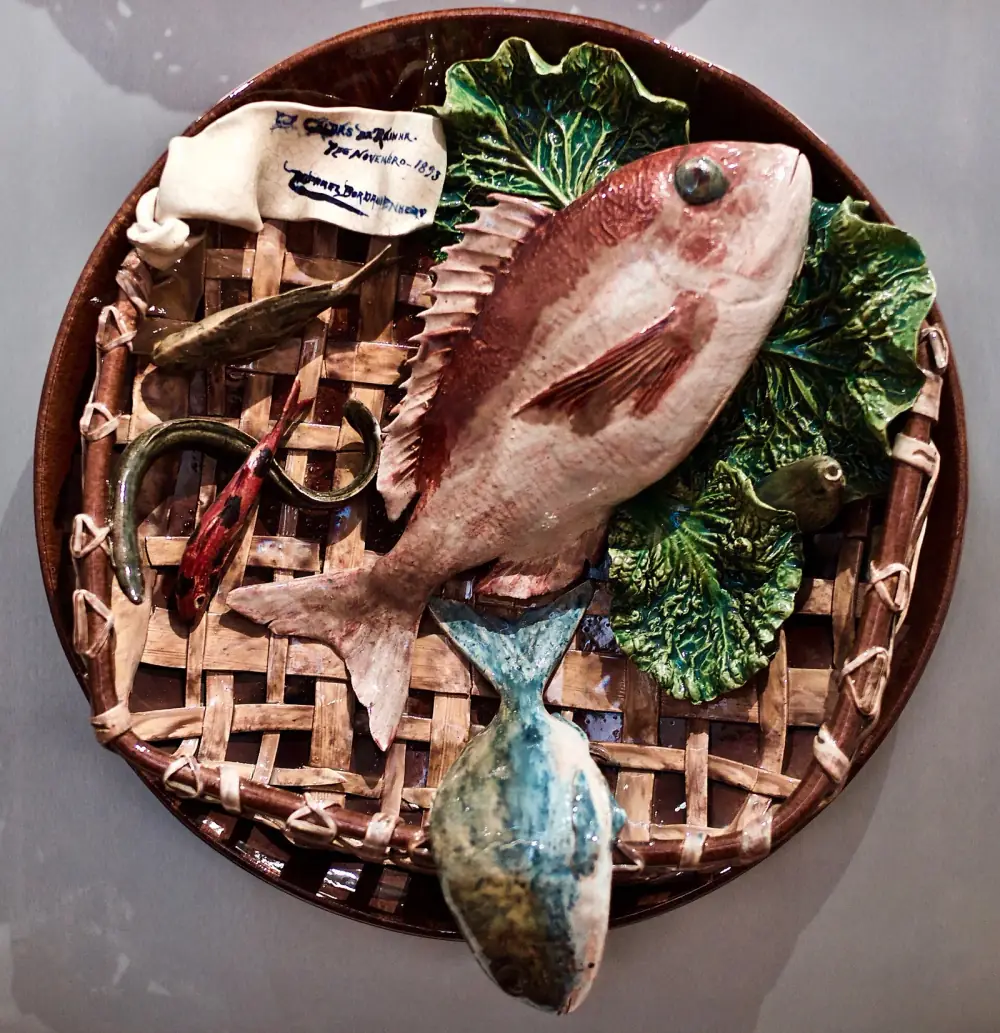
The factory made bricks and roof tiles from 1884, decorative faience from the middle of 1885 and tableware from 1888. Bordalo and his modellers worked from nature: cabbage leaves, loquats, lizards, frogs, sardines and dried cod. Some pieces imitated whole objects, such as a wicker basket of fish or a top hat with gloves. He also trained apprentices, in a link with the town's industrial school.
He brought his cartoon cast with him. Zé Povinho, Maria da Paciência, fishwives, priests, policemen and politicians became whistles, bottles, inkwells and wobbling figures with loose heads. A moneylender became a spittoon.
The showpieces won prizes. At the Paris Exposition of 1889 he decorated the Portuguese pavilion, and France gave him the Legion of Honour. King Carlos bought his Talha Manuelina, a great jar topped by a little Manueline temple, in 1893. A Beethoven jug 2.8 metres tall, made between 1896 and 1898, was too big for the patron's house, so Bordalo took it to Rio de Janeiro and gave it to the president of Brazil.
The business was often short of money. Paulo Henriques, who wrote the museum's essay on the factory, refers to serious financial crises, and in 1896 Bordalo dedicated an elaborate censer to a man who had helped him through one of them. He never gave up drawing either: the factory and the papers ran side by side for twenty years.
A Paródia and the last years
On 17 January 1900 he launched his last paper, A Paródia, at 20 réis, with his son Manuel Gustavo as co-owner and chief helper. Its first editorial called it “caricature in the service of the great public grief”. In its early years it printed close to 25,000 copies, with four pages in colour.
The cast changed. In a series of nine drawings politics was “the Great Sow”, finance “the Great Dog”, the economy “the Brooding Hen”, parliamentary rhetoric “the Great Parrot” and national progress “the Great Crab”. Zé Povinho appeared less often. In December 1902 the paper was seized over a drawing of King Carlos by Manuel Gustavo; a judge later annulled the seizure and awarded damages.
In 1903 Bordalo was given a banquet at the Teatro D. Maria II. On 11 June that year he drew himself twice in A Paródia: the haughty young dandy of O António Maria in 1879, and the tired old man of twenty years later, meeting in the street like strangers, one asking the other for a light.
He died at home in the Largo da Abegoaria, now Largo Rafael Bordalo Pinheiro, on 23 January 1905, aged 58, just back from Porto, where he had worked on the carnival decorations. Manuel Gustavo kept A Paródia going until 1907.
The Regenerator leader Hintze Ribeiro, one of Bordalo's most frequent victims, came to the funeral. Asked why, he is said to have answered that when he wanted to remember his political life, he leafed through Bordalo's pages.
21 March 1846
Born on Rua da Fé, Lisbon
1866
Marries Elvira Ferreira de Almeida
1870
First albums and papers: O Calcanhar de Aquiles, O Binóculo, A Berlinda
March 1873
Sent to Spain by the Illustrated London News
12 June 1875
Zé Povinho first appears, in A Lanterna Mágica
19 August 1875
Sails for Rio de Janeiro
12 June 1879
Back in Lisbon, launches O António Maria
9 August 1884
Deed of the Caldas da Rainha faience factory signed
21 January 1885
Closes O António Maria in protest at press restrictions
7 May 1885
Launches Pontos nos ii
1889
Legion of Honour at the Paris Exposition
5 February 1891
Last issue of Pontos nos ii; O António Maria returns on 5 March
17 January 1900
Launches A Paródia
23 January 1905
Dies in Lisbon, aged 58
The factory and the museum
The factory did not stay in the family. Manuel Gustavo ran it from 1906 to 1908, but it was mortgaged, a court ordered its seizure and Manuel Godinho Leal bought it at auction. After a long fight in the courts Manuel Gustavo recovered his father's moulds, and on 5 November 1908 he opened a new Bordalo Pinheiro factory in Caldas with workers from the old one.
The museum came from an admirer. Artur Ernesto Santa Cruz Magalhães (1864 to 1928), a poet, critic and collector, commissioned a villa on Campo Grande from the architect Álvaro Machado in 1913 and opened it to the public as a museum of Bordalo's work on 6 August 1916. He gave the building and collection to Lisbon City Council in 1924. In 1920 Manuel Gustavo left it Columbano's portrait of his father.
Building work next door damaged the villa in 1999 and it closed for repairs, reopening in 2005. Since 2016, its centenary year, it has been run by EGEAC, the city's cultural venues company.
The Caldas company, which dates itself to 1884, reached the twenty-first century close to insolvency. In 2009 it was bought by the Visabeira group, which also owns the Vista Alegre porcelain brand. By 2018 its administrator was reporting fast growth, and the company was enlarging its works. Contemporary artists including Joana Vasconcelos and Paula Rego have made pieces for the brand, some of them reworking his designs.
- Factory founded
- 1884, Caldas da Rainha
- New family factory
- Opened by Manuel Gustavo on 5 November 1908
- Bought by Visabeira
- 2009
- Turnover
- About €2.4 million in 2009; more than €6 million estimated for 2017
- Sales abroad
- Half of the pieces sold in 2017 went to foreign buyers
- Staff
- 187, rising to 254 with the 2018 expansion
Why he still matters
Zé Povinho outlived his creator and the monarchy he was drawn to mock. In 2026 the Museu Bordalo Pinheiro marked his 150 years with the exhibition Toma!, which followed him from the comic papers to the stage, popular ceramics, advertising and political posters, postage stamps and trademarks, and on to the national football team, which used him as a mascot.
His papers are a running record of Portuguese politics from 1870 to 1905, and the museum and Lisbon's municipal newspaper library have put them online. His cabbage-leaf dishes sit in so many Portuguese homes that they pass for something typically Portuguese.
FAQs
Who was Rafael Bordalo Pinheiro?
A Lisbon caricaturist, illustrator and ceramicist (1846 to 1905). He founded satirical papers including A Lanterna Mágica, O António Maria, Pontos nos ii and A Paródia, created the character Zé Povinho, and directed the art of the Caldas da Rainha faience factory from 1884.
When did Zé Povinho first appear?
On 12 June 1875, in the centre pages of issue 5 of A Lanterna Mágica, paying into a collection for Saint Anthony's candles in a cartoon that showed Fontes Pereira de Melo as the saint.
What does Zé Povinho's gesture mean?
It is the manguito, a rude arm gesture of defiance, which goes with a cry of “Toma!”, roughly “Take that!”. Bordalo's Zé usually puts up with everything, and the gesture is his rare moment of revolt.
Is today's Bordallo Pinheiro brand the factory he founded?
It dates its history to his factory of 1884. After his death that works was seized and sold at auction, and his son Manuel Gustavo opened a new factory in Caldas da Rainha in 1908 using the recovered moulds. The Visabeira group bought the company in 2009.
Where can I see his work in Lisbon?
At the Museu Bordalo Pinheiro, Campo Grande 382, founded by the collector Cruz Magalhães in 1916 and run today by EGEAC. His tile panels are on the Tabacaria Mónaco in Rossio.
On the timeline
Open the timelineNearby moments from invasions, brazil and the liberal wars (1807–1851).
Porto's D. Maria II suspension bridge opens to traffic over the Douro as the river floods, four months after crowds had celebrated its first crossing. Replaced by the Luís I bridge and dismantled in 1887, it is still recalled by two stone obelisks on the Porto bank.
Teófilo Braga is born in Ponta Delgada, in the Azores. A prolific historian of Portuguese literature and positivist thinker, he headed the Provisional Government after the 5 October 1910 revolution and briefly served as President of the Republic in 1915.
Eça de Queirós is born in Póvoa de Varzim, the illegitimate son of parents who married only years later. The great realist novelist of 'O Crime do Padre Amaro' and 'Os Maias' spent much of his life as a consul abroad — in Havana, Newcastle, Bristol and Paris — turning a sharply ironic eye on Lisbon society.
Rafael Bordalo Pinheiro
Rafael Bordalo Pinheiro is born in Lisbon into a family of artists. In satirical papers such as 'O António Maria' he mocked kings, ministers and Britain alike, and in 1875 he gave the nation its enduring cartoon alter ego, Zé Povinho, the shrugging, put-upon everyman.
In the palace coup known as the Emboscada, Queen Maria II dismisses the Duke of Palmela's government and hands power to Marshal Saldanha, reigniting the unrest of the Maria da Fonte revolt and precipitating the Patuleia civil war.
Birth of Alfredo Keil in Lisbon. The painter and composer would write 'A Portuguesa', the patriotic song born of the 1890 British Ultimatum crisis that was adopted as Portugal's national anthem after the 1910 Republican Revolution.
Coming up in history
All long reads 23 March 2011Sócrates resigns and Portugal heads for a bailout: 23 March 2011
 24 March 1962Students against Salazar: the academic crisis of 1962
 25 March 1505Francisco de Almeida sails as Portugal's first viceroy of India, 1505
 26 March 1211The death of Sancho I, 1211: the king who settled Portugal's frontier
22 sources
Archives, scholarship and reporting this article was checked against.
- 1
Ficha histórica: A Lanterna Mágica (1875) (Álvaro Costa de Matos)Hemeroteca Municipal de Lisboa, 2014
- 2
- 3
Rafael Bordalo Pinheiro: the man and the artist (Irisalva Moita)Revista de Cultura, Instituto Cultural de Macau, October 1988 to March 1989
- 4
A National Ceramics Factory (Paulo Henriques)Museu Bordalo Pinheiro, Guide to the work of Rafael Bordalo Pinheiro
- 5
- 6
- 7
- 8
- 9
- 10
- 11
- 12
- 13
- 14
- 15
- 16Paródia lisboeta: um roteiro pela cidade com as caricaturas de Bordalo Pinheiro (Inês Lacerda)Observador, 16 May 2026
- 17
Pontos nos ii, vol. 1 (1885), issues of 17, 24 and 31 December 1885Internet Archive (scan from the Getty Research Institute)
- 18
- 19
Manuel Gustavo Bordalo Pinheiro #3: a ceramicist beginning (1900s)Museu Bordalo Pinheiro on Google Arts & Culture
- 20Da falência ao êxito: aumenta procura de peças de Bordallo Pinheiro no estrangeiroDiário de Notícias, 18 August 2018
- 21
Bordallo Pinheiro lança Peça do Ano: Jarra com Lagostas celebra os 140 anos da marcaGrupo Visabeira, press release, February 2024
- 22Gato assanhado e macaco sem galho: review of Isabel Castanheira, As Caldas de Bordalo (Vasco Rosa)Observador, 10 November 2015
Image credits
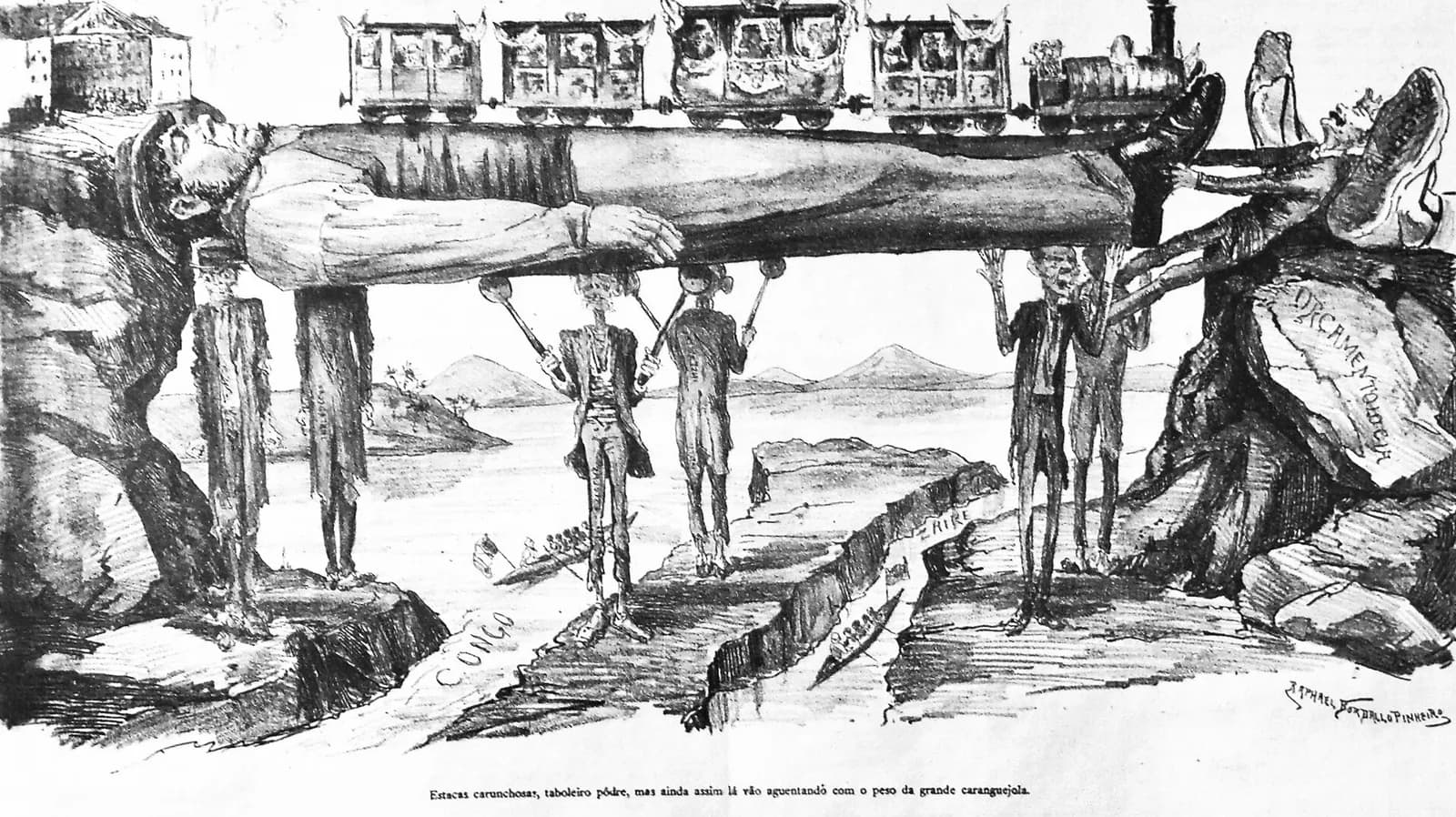
- Zé Povinho as the rotten deck of a bridge carrying the train of state, in a lithograph Bordalo drew for O António Maria around 1883. The caption reads: “Worm-eaten piles, a rotten deck, and still they bear the weight of the great rickety contraption.” Museu Bordalo Pinheiro, Lisbon. Pedro Ribeiro Simões from Lisboa, Portugal, CC BY 2.0, via Wikimedia Commons.
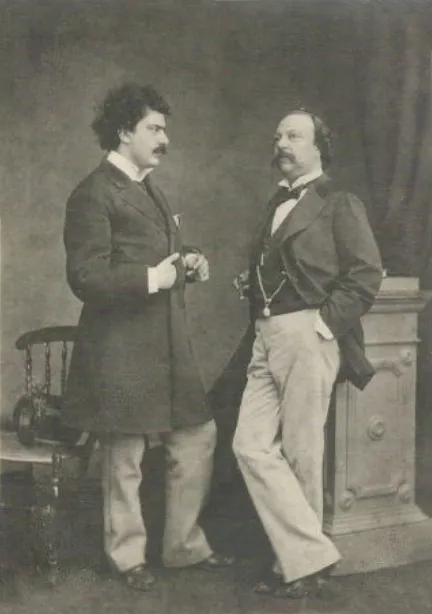
- Bordalo, left, with the writer Júlio César Machado in 1879, the year he came back from Brazil. Machado wrote the texts for two of his early books. Museu Bordalo Pinheiro. Unknown author, Public domain, via Wikimedia Commons.
- Zé Povinho in A Lanterna Mágica no. 14, 8 July 1875, under the title “Railway company: fares increase”. The government fattens the railway and lets the schools die; Zé looks this way and that, and stays “as always, the same”. Raphael Bordallo Pinheiro, Public domain, via Wikimedia Commons.
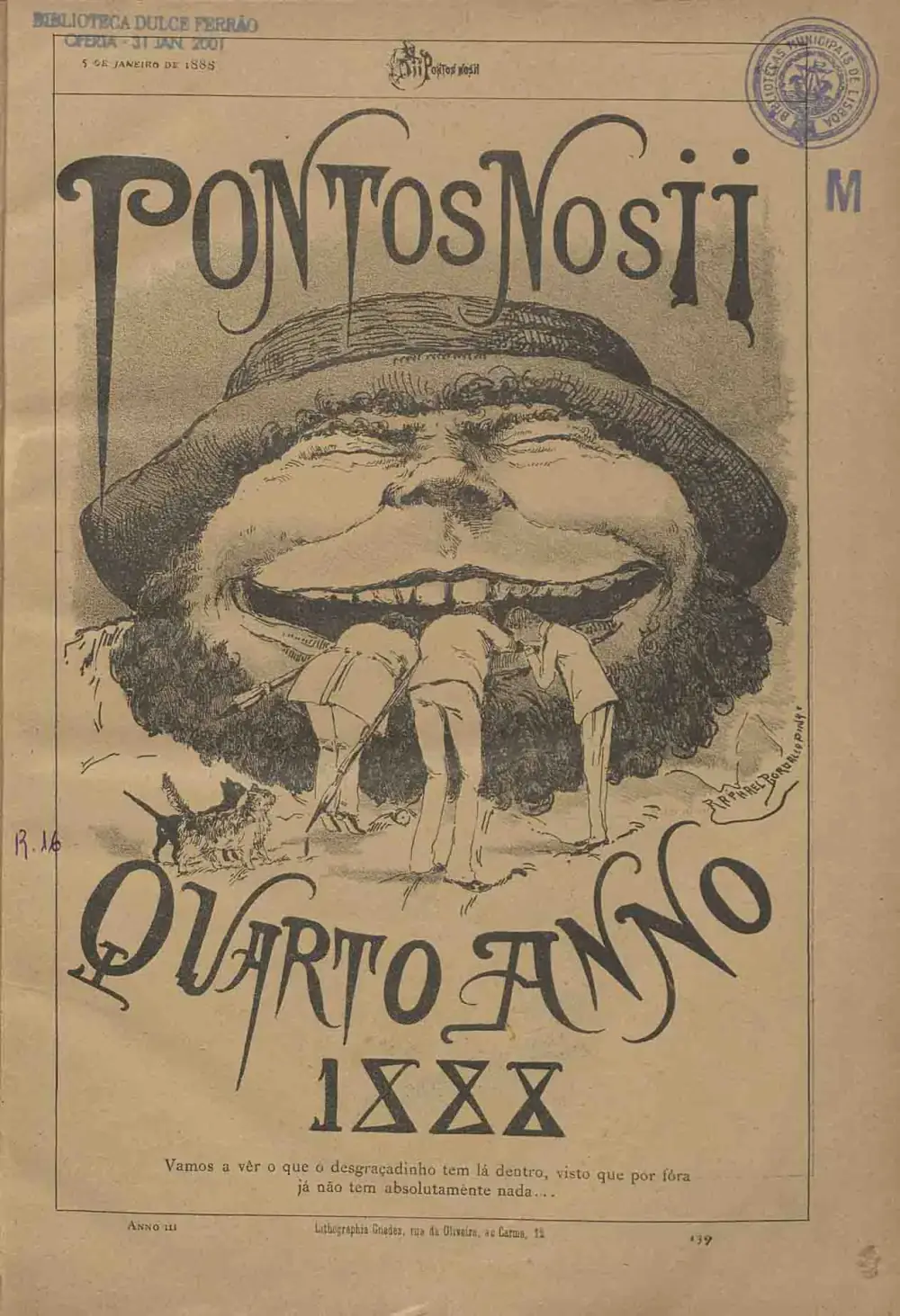
- Cover of Pontos nos ii no. 139, 5 January 1888, headed “Quarto anno” (fourth year). Politicians peer into Zé Povinho's mouth: “Let's see what the poor wretch has inside, since on the outside he has absolutely nothing left.” The stamps are those of Lisbon's municipal libraries. Rafael Bordalo Pinheiro, CC0, via Wikimedia Commons.
- Wall plate with fish and cabbage leaves on a wicker tray, inscribed “Caldas da Rainha, 7 November 1893” with Bordalo's signature. Museu Bordalo Pinheiro, Lisbon. Pedro Ribeiro Simões from Lisboa, Portugal, CC BY 2.0, via Wikimedia Commons.