

Francisco de Almeida sails as Portugal's first viceroy of India, 1505
Manuel I sent a veteran nobleman to stay in India with a fleet, an army and orders to build forts. Almeida won the sea battle of Diu, lost his only son and quarrelled with his successor, and was killed on a South African beach on the way home.
At a glance
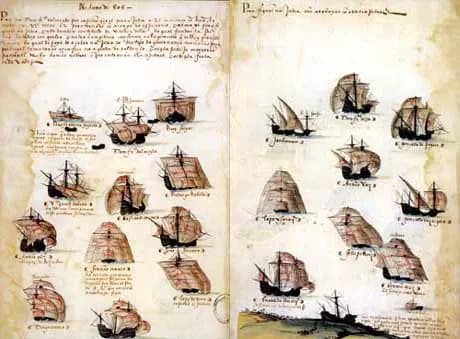
- On 25 March 1505 Francisco de Almeida sailed from Belém, in Lisbon, with 21 or 22 ships and about 1,500 soldiers, as the first viceroy Portugal sent to India.
- His orders were to stay three years, build fortresses from Sofala and Kilwa in East Africa to Cannanore, Cochin and Quilon in India, and keep a fleet in Indian waters to stop Muslim shipping carrying spices to the Red Sea.
- On the way he stormed Kilwa and sacked Mombasa on the East African coast; in India he built forts at Anjediva, Cannanore and Cochin.
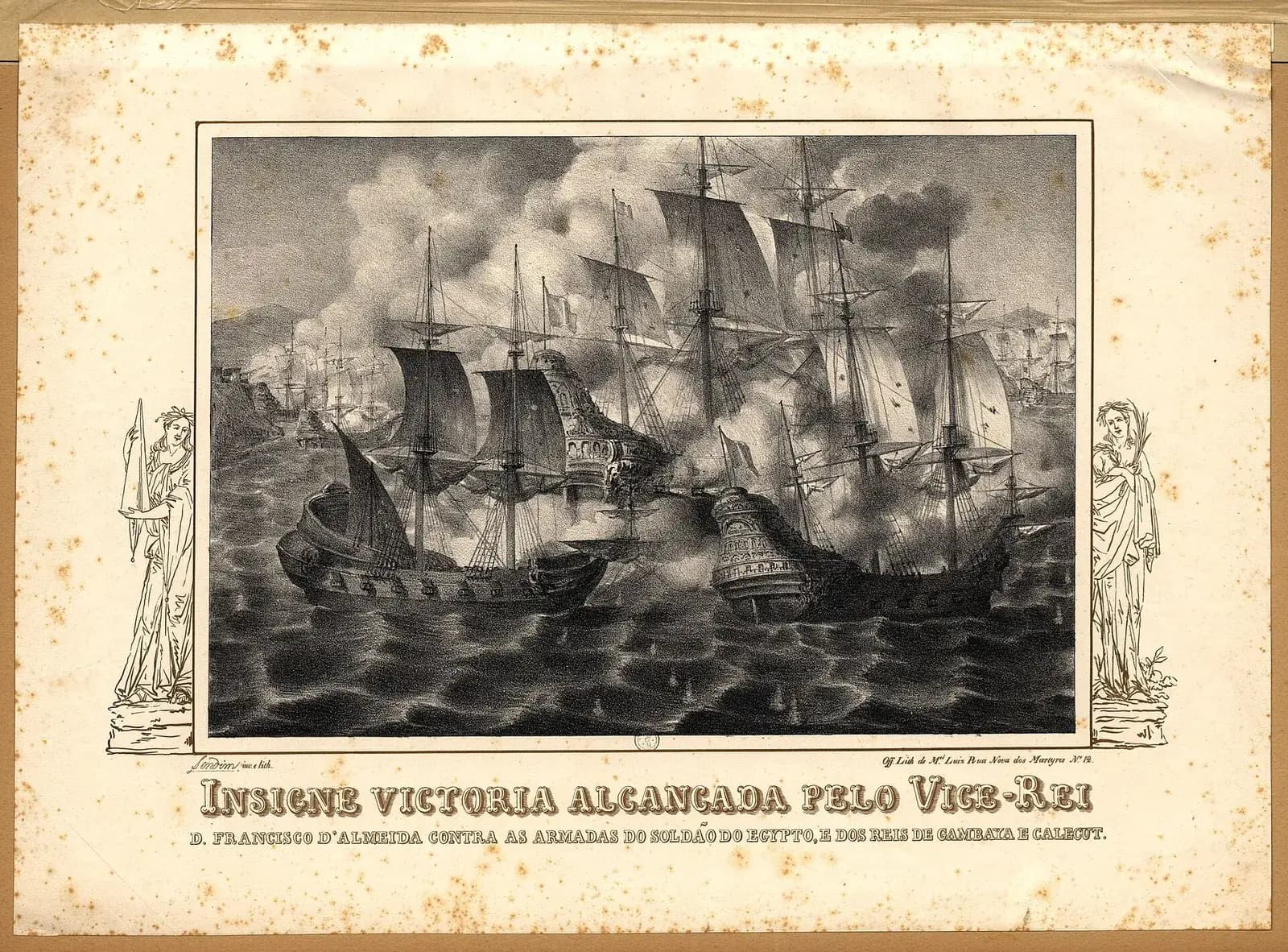
- His only son, Lourenço, was killed fighting an Egyptian Mamluk fleet at Chaul in 1508. Almeida took his revenge off Diu on 3 February 1509, destroying that fleet and its Gujarati and Calicut allies.
- He handed India over to Afonso de Albuquerque only in November 1509, after months of quarrelling. On 1 March 1510 Khoikhoi herders at Table Bay, near today's Cape Town, killed him and more than 60 of his men.
A banner at the Sé, sails at Belém
On a Sunday shortly before the fleet sailed, King Manuel I went to hear Mass at the Sé, Lisbon's cathedral. There, with great ceremony, he handed Dom Francisco de Almeida the royal banner. The captains and noblemen of the fleet were then escorted by the lords of the court down to the riverside quay, where they boarded. João de Barros, the official historian of Portuguese Asia, called it the most solemn embarkation the kingdom had seen for anyone not of royal blood.
Contrary winds kept the ships at anchor off Belém for days. The king came aboard Almeida's flagship expecting to see him off, and had to go home again. On 25 March 1505, the feast of the Annunciation, the weather eased. Manuel went out by boat to watch, and stayed until the fleet cast off to shouts and the roar of every gun aboard and on the shore.
Going down the Tagus, the crew of one caravel, fresh from the plough in Whiteway's phrase, could not tell larboard from starboard. Their captain, João Homem, hung a string of onions on one side of the ship and a string of garlic on the other, and told the pilot to steer by onions and garlic. After that, the chronicler Castanheda wrote, they steered straight.
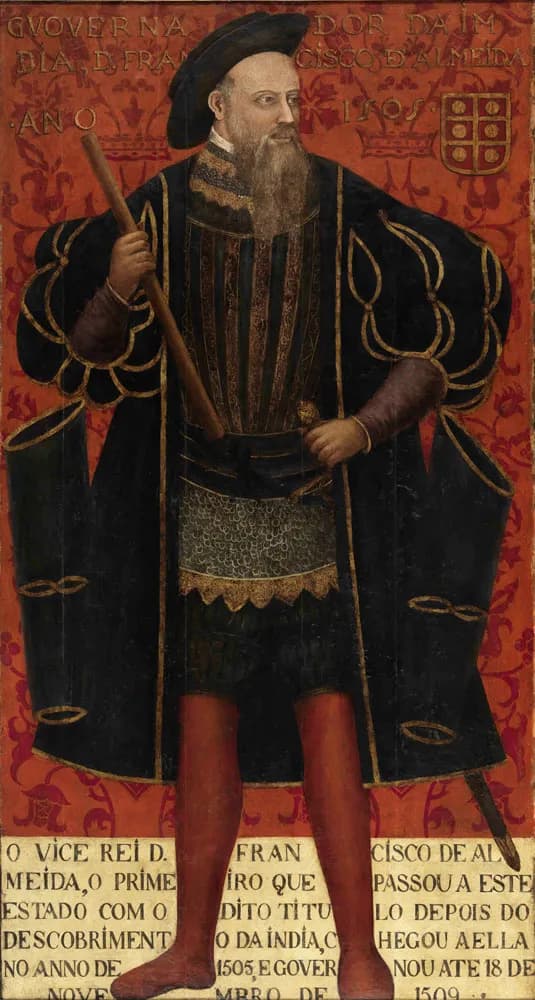
Almeida was the seventh son of Lopo de Almeida, first Count of Abrantes. Accounts of his age differ: Whiteway made him 45, while the 1911 Encyclopaedia Britannica put his birth around 1450, which would make him about 55. He had been chosen at short notice. The king's first choice, Tristão da Cunha, was struck by a sudden blindness, and Almeida was called from Coimbra, where he was staying with his brother the bishop. His only son, Lourenço, sailed with him.
Why Lisbon needed a man in India
Vasco da Gama had reached India by sea in 1498. In the years that followed, Portugal sent a fleet every year that loaded pepper on the Malabar coast, in today's Kerala, and sailed home. That left its allies alone for most of the year. The rulers of Cochin and Cannanore traded with the Portuguese, while the Zamorin, ruler of Calicut, and the Muslim merchants who carried spices to the Red Sea and on to Egypt and Venice, fought them.
Barros put the problem plainly. Ships that came and went could not wage war on the Muslims and keep up trade with the Hindu rulers at the same time; each time they left, the Muslims became masters of the coast again. The answer was a governor who would stay three years, with ships, soldiers and fortresses where the cargo fleets could load in safety.
- Left Belém
- 25 March 1505
- Ships
- 22 (Barros) or 21 (Castanheda)
- Soldiers
- About 1,500 men-at-arms, besides the crews
- Term
- Three years in India, for him and his men
- Soldier's pay
- 800 reais a month, 400 more for food when ashore, and two and a half quintals of pepper a year
- Forts ordered
- Sofala, Kilwa, Anjediva, Cannanore, Cochin and Quilon
The orders also split the sea in two. One captain-major would cruise from Cape Guardafui, at the Horn of Africa, to Cambay, guarding the mouth of the Red Sea against ships from Calicut; another would patrol from Cambay to Cape Comorin, the southern tip of India. If a local ruler refused a fort, Whiteway summarised, a base was to be chosen and war made on him until he gave in.
Kilwa, Mombasa and the forts
The fleet reached the East African coast in July. On 22 July Almeida anchored off Kilwa, an island city in today's Tanzania that controlled the gold trade of Sofala. He complained that its ruler had not even raised the Portuguese flag Vasco da Gama had given him, and two days later he landed his men. Lourenço led 200 of them along the beach to the palace while his father, with about 300, fought through streets so narrow that his soldiers climbed onto the flat roofs to clear the defenders throwing stones. The ruler fled.
Almeida installed a new king, Muhammad Ankoni, a leading townsman of about sixty who was not of the royal line but had been friendly to the Portuguese. Then he built a fort in about twenty days, taking his turn at one end of a hand-barrow himself. He named it Santiago, because the city had fallen on the eve of St James's Day, and left 150 men there under Pêro Ferreira Fogaça.
Next came Mombasa, in today's Kenya. The fleet arrived on 13 August, and on the 15th the Portuguese stormed the town. Castanheda counted more than 700 of its people dead and nearly 200 taken captive, for no more than five Portuguese killed. Barros gave 1,513 dead, a figure he said came from the townspeople themselves. The town was looted and burned.
“Ruined Kilwa, together with Mombasa, threatens him with me for the harm he did them.”
In India the work went quickly. A fort was begun on the island of Anjediva on 14 September 1505. At Cannanore the men landed on 23 October and, working in shifts with nobles and labourers side by side, raised the walls high enough for guns in five days. Almeida named it Sant'Angelo and left 150 men in it. At Cochin he spent much of the next year finishing the fortress. Castanheda says that when he was ashore he went at dawn to the shipyard or the fortress works and stayed until midday.
| Place | Where it is today | Built | What became of it |
|---|---|---|---|
| Kilwa (Santiago) | Kilwa Kisiwani, Tanzania | July and August 1505, in about 20 days | Garrison of 150 under Pêro Ferreira Fogaça |
| Anjediva | Anjadip Island, Goa, off Karwar, India | Begun 14 September 1505 | Found useless and dismantled in 1507 |
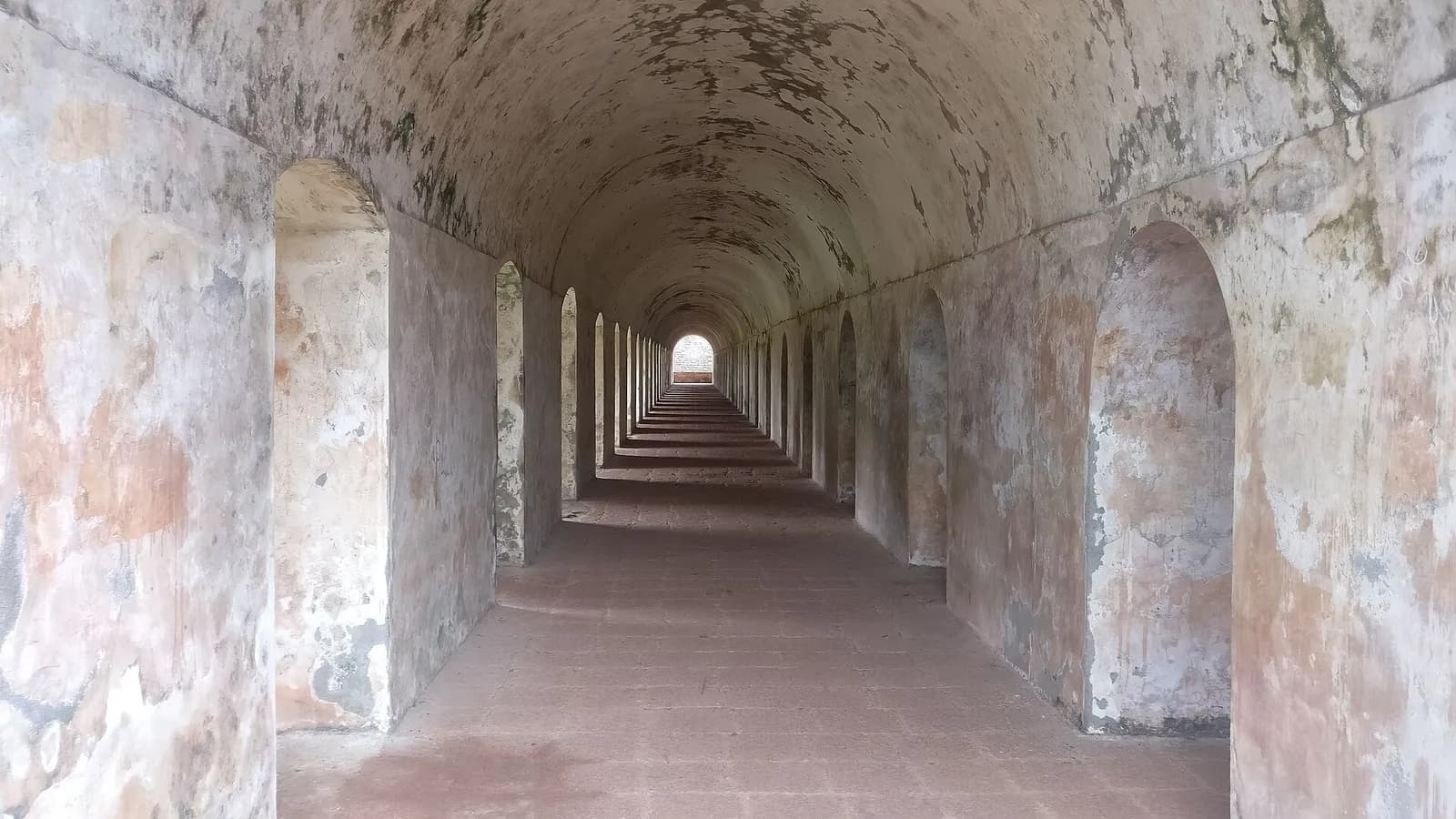
| Cannanore (Sant'Angelo) | Kannur, Kerala, India | Walls raised from 23 October 1505 | Besieged from April to August 1507; the present fort stands on the site |
| Cochin | Kochi, Kerala, India | Late 1505 and 1506 | Almeida's headquarters |
| Sofala | Sofala, Mozambique | By Pêro de Anhaia's squadron, which left Lisbon on 18 May 1505 | Built to tap the gold trade of the interior |
Quilon (Kollam) was on the list too, but late in 1505 its townspeople killed the Portuguese at the trading post after a Portuguese captain seized the rudders and sails of ships loading pepper there.
A son at sea
Lourenço de Almeida commanded the fleet at sea while his father governed from Cochin. He was famous for his strength, and the chroniclers made him a hero of romance. On 16 March 1506 a Portuguese squadron of three large ships and a brigantine fell on an armed convoy of 200 to 300 vessels that the Zamorin and his Muslim allies had fitted out on the Malabar coast, and killed, by Whiteway's reading of the sources, 3,500 to 4,000 men without losing one Portuguese. He also reached Ceylon, today's Sri Lanka, though he did little there but set up a stone marker.
Meanwhile the Mamluk sultan of Egypt, whose customs revenues were falling as the Portuguese choked the spice route, built a fleet at Suez with timber brought from the Mediterranean. Its commander, Amir Husain al-Kurdi, whom the Portuguese called Mirocem, reached Diu, the island port of the Sultanate of Gujarat, in 1507. Diu's governor, Malik Ayaz, joined him.
In January 1508 Lourenço went north on convoy duty with eight ships and dismissed the rumours of an Egyptian fleet. It found him in the river at Chaul, south of today's Mumbai. Whiteway puts the battle in March, as does the Encyclopaedia of Portuguese Expansion in its entry on Diu; its entry on Chaul says January.
After two days of fighting, with Malik Ayaz's light galleys tipping the balance, the Portuguese slipped out on the ebb tide. Lourenço's ship, holed at the waterline, ran onto fishing stakes and stuck fast. With part of a leg shot away, he sat in a chair by the mainmast and kept urging his men on until a second shot killed him.
His body was never found. The Portuguese lost 140 killed and 124 wounded; the Gujarati accounts put their own dead at about 400. Whiteway notes that Malik Ayaz treated his prisoners with great humanity.
“I will have the bell rung in the church for the dead man, and people will come and say paternosters for his soul, for whoever ate the cockerel must eat the cock, or pay for it.”
In Correia's telling the news reached Cochin with a caravel that came in without firing its salute. The viceroy, watching from a window, sat down and said it brought the news he already had in his heart. He then sent his officers away, telling them words of comfort were for women. Whiteway thought his wish for revenge was the only thing that made sense of what Almeida did in the next year.
Diu, 3 February 1509
On 5 December 1508 Afonso de Albuquerque reached Cannanore from Hormuz and demanded the government of India. He had been named Almeida's successor in 1506, that year's fleet from Lisbon had brought the king's order for the handover, and Almeida's three years were up. Almeida refused to hand over until he had fought the Egyptians, and a week later, on 12 December, he sailed north with 18 ships and about 1,200 men by Castanheda's count. Gaspar Correia counted 21 sail. At the end of December he stormed and burned the port of Dabul.
On 2 February 1509, Candlemas, the lookout sighted Diu. Mirocem had twelve ships of his own (three naus, three galleons and six galleys), four large ships of Gujarat, Malik Ayaz's among them, and the light craft of Diu and Calicut: more than 100 sail in all. Castanheda has Malik Ayaz advising him to stay at anchor under the town's guns. His captains also persuaded Almeida not to lead the attack himself.
The Portuguese attacked on 3 February. From midday to nightfall there was a confused fight at close quarters among the anchored ships. It was said, Castanheda writes, that the viceroy's flagship alone fired 1,900 shots that day. The Egyptian fleet was destroyed: by his count more than 4,000 of the enemy died and only 22 Mamluks escaped, for 32 Portuguese dead. The Encyclopaedia of Portuguese Expansion quotes the naval historian Saturnino Monteiro calling it one of the rare sea battles in which the losing fleet was wiped out.
Portuguese killed in Almeida's main fights, as the chroniclers counted them
Portuguese killed
Kilwa: none, according to Barros. Mombasa: no more than five (Castanheda). Chaul: 140, plus 124 wounded (Whiteway). Diu: 32 (Castanheda). Table Bay: 65 with the viceroy (Castanheda); Whiteway gives 63. All are Portuguese counts; enemy losses were far higher in every fight except the last.
Show the data
| Portuguese killed | |
|---|---|
| Kilwa 1505 | 0 |
| Mombasa 1505 | 5 |
| Chaul 1508 | 140 |
| Diu 1509 | 32 |
| Table Bay 1510 | 65 |
Almeida made peace with Malik Ayaz, who handed over the Portuguese prisoners taken at Chaul, and the viceroy trimmed his beard for the first time since his son's death. On the way south he forced tribute from the coastal towns. Whiteway records that at every Muslim town he passed he executed captives in batches and fired their limbs from his guns over the town. He was back in Cochin on 8 March.
Two men, one India
Victory did not end the quarrel. Almeida still would not hand over, arguing that the king had ordered him to sail home in a particular ship, which had not arrived (it had been wrecked). Albuquerque's servants and friends were taken from him, his supporters were jailed or sent away, and a petition was got up asking that he should not be given the government. In the monsoon he was sent to Cannanore, in effect a prisoner. Almeida later told the Marshal that Albuquerque was not under arrest and stayed there by choice.
The deadlock broke when the Marshal of Portugal, Fernando Coutinho, a relative of Albuquerque, arrived with a large fleet and royal powers no one could resist. In November 1509, at the gate of the Cochin fortress, Almeida inside and Albuquerque outside, a notary recorded the handover of India, its forts, ships, guns and men. Most of the noblemen in India sailed home with Almeida, Castanheda says, because none dared stay after what they had done to Albuquerque.
Death at Table Bay
Almeida's three ships left Cochin on 19 November 1509, by Castanheda's account (Whiteway says 1 December), and Cannanore on 1 December. Rounding the Cape of Good Hope safely, they put in to take on water at what the Portuguese called the watering place of Saldanha, Table Bay, beside today's Cape Town. Castanheda says Almeida made his will the day before they arrived, saying he did not know whether a pulley block might fall on his head.
At first the Khoikhoi herders of the area traded cattle for cloth and iron. Then a party of about twelve Portuguese went to a village inland, and a fight broke out. The chroniclers disagree on why. Castanheda says the sailors tried to carry off one of the villagers by force; Correia says they tried to take a cow without paying the price asked. Only Barros blamed the Khoikhoi.
Some of the captains argued that the insult was not worth avenging; others said the watering place would be unsafe for every future fleet unless the villagers were punished. Almeida agreed to an attack. At dawn on 1 March 1510 between 150 and 200 men, most without armour so they could move faster, raided the village and drove off its cattle.
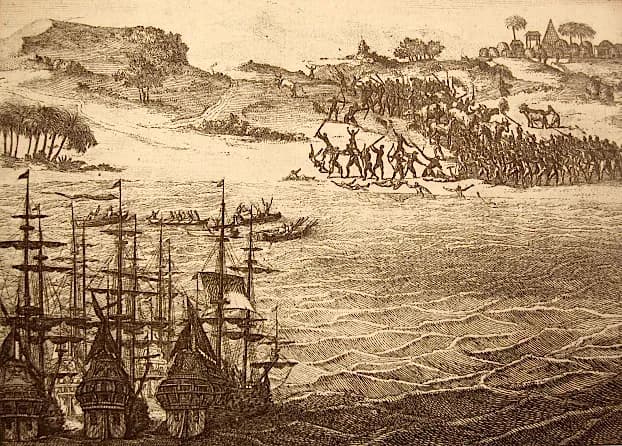
The herders, who could stop and move the cattle with calls, used the herd as a moving shield and attacked with stones and fire-hardened throwing spears. The retreat to the boats became a rout. When Lourenço de Brito, one of his captains, told him three times that the cattle were being taken, Castanheda has Almeida reply, in translation: “Give the cattle to the devil now, for they will take it from us, and us with it.” Near the shore a throwing spear with no iron head went through his throat; he fell to his knees, raised his hands to the sky and died.
Castanheda counted 65 dead, the viceroy and eleven captains among them; Whiteway, from the same chronicles, gives the viceroy, 12 leading noblemen and 50 others. The royal banner was lost. Almeida was a little over fifty. He had survived Kilwa, Mombasa and Diu.
“The Cape of Storms, which will keep his memory with his bones, will not be ashamed to take from this world the spirit that all India and Egypt could not take.”
Why it still matters
The chroniclers who wrote within living memory were uneasy about the ending. Damião de Góis suggested that God let the Portuguese die at the hands of unarmed men to punish cruelties committed in their victories, and Camões linked the death to the ruin of Kilwa and Mombasa. The literary historian David Johnson notes that the Khoikhoi victory was remembered only sporadically for 500 years.
It came back into South African politics on 26 March 1999, when President Thabo Mbeki, speaking in Parliament at Nelson Mandela's retirement, said the 1510 victory in Table Bay had “lit our skies for ever”. Johnson reads that speech as one more use of the story for the politics of its own time.
In Asia, Diu stayed in Portuguese plans for four and a half centuries. In 1509 Albuquerque won only a trading house there; after several failed attacks, Portugal began its own fortress at Diu in 1535. It held the island until the Indian army took Goa, Daman and Diu in December 1961.
25 March 1505
The fleet leaves Belém
24 July 1505
Kilwa stormed; the fort of Santiago follows
15 August 1505
Mombasa taken and burned
14 September 1505
Fort begun on Anjediva
23 October 1505
Fort of Sant'Angelo begun at Cannanore
16 March 1506
A Portuguese squadron routs a Calicut-backed convoy
April to August 1507
Siege of Cannanore, relieved by Tristão da Cunha
March 1508
Lourenço killed at Chaul (some sources say January)
5 December 1508
Albuquerque reaches Cannanore and claims the government
3 February 1509
Battle of Diu
November 1509
Almeida hands India to Albuquerque
1 March 1510
Almeida killed at Table Bay
FAQs
Who was the first viceroy of Portuguese India?
Dom Francisco de Almeida, son of the first Count of Abrantes. He sailed from Lisbon on 25 March 1505 and governed until November 1509. His orders said he would take the title of viceroy once he had built fortresses in India; Barros says it was the first such title granted in Portugal.
How many ships did Almeida take to India in 1505?
Barros counts 22 sail, twelve of them large ships meant to come home with spices; Castanheda counts fifteen ships and six caravels. One ship, the Bela, sank in the Atlantic on 4 May; her crew were saved. Six more ships followed in May with Pêro de Anhaia to build a fort at Sofala.
What happened at the battle of Diu in 1509?
On 3 February 1509 Almeida's fleet of about 18 ships attacked the Egyptian Mamluk fleet of Amir Husain and its Gujarati and Calicut allies in the harbour of Diu and destroyed it. Castanheda counts 32 Portuguese dead against more than 4,000 of the enemy. Almeida fought partly to avenge his son Lourenço, killed by the same fleet at Chaul in 1508.
How did Francisco de Almeida die?
On his way home, at Table Bay near today's Cape Town, his men quarrelled with Khoikhoi herders. On 1 March 1510 he led a raid on their village; on the way back the Khoikhoi attacked with stones and throwing spears, using their cattle as a shield, and killed about 65 Portuguese, Almeida among them.
Why did Almeida and Albuquerque fall out?
Albuquerque, the king's chosen successor, arrived in December 1508 and demanded the government. Almeida refused to step down until he had avenged his son and later until a particular ship arrived, and kept Albuquerque in effect under arrest at Cannanore. He handed over only in November 1509, after the Marshal Fernando Coutinho arrived with overriding powers.
On the timeline
Open the timelineNearby moments from the age of discoveries (1415–1580).
Frei Henrique de Coimbra celebrates the first Catholic Mass in Brazil on the islet of Coroa Vermelha (now in Santa Cruz Cabrália, Bahia), four days after Cabral's fleet arrived.
Portuguese navigator Diogo Dias, blown off course during Pedro Álvares Cabral's voyage to India, becomes the first European to sight Madagascar, naming it Ilha de São Lourenço after the feast day of St Lawrence.
The Infanta Isabel, daughter of Manuel I and Maria of Aragon, is born in Lisbon. Married to the Emperor Charles V in 1526, she became Queen of Spain and Holy Roman Empress and governed Spain as regent during her husband's long absences.
Almeida, first viceroy of India
Francisco de Almeida departs Lisbon with a fleet of 22 ships as the first Viceroy of Portuguese India, tasked with establishing permanent Portuguese naval dominance in the Indian Ocean.
The Lisbon Massacre begins: urged on by Dominican friars, a mob attacks New Christians (forcibly converted Jews) at the Church of São Domingos. The killing lasts three days and leaves an estimated 1,000 to 4,000 dead — one of the darkest episodes in the history of Portugal's Jewish community, three decades before the Inquisition was established.
Days after his handful of ships destroyed the fleet of Hormuz, Afonso de Albuquerque has its young king, Seyf ad-Din, accept terms of submission: a yearly tribute of 15,000 xerafins, duty-free entry for goods from Portugal and a site for a fort. Mutiny among his own captains wrecked the plan within months, and Portugal only took the Gulf trading hub in 1515.
A Portuguese fleet under Viceroy Francisco de Almeida defeats the combined fleets of Mamluk Egypt, the Sultanate of Gujarat and the Zamorin of Calicut at the Battle of Diu, off western India, leaving Portugal the strongest naval power in the Indian Ocean.
Coming up in history
All long reads 27 March 1905Kaiser Wilhelm II in Lisbon, 1905: three days on the way to Tangier
 28 March 1810Alexandre Herculano: the soldier-historian who took the miracle out of Ourique
 29 March 1809The Ponte das Barcas disaster: Porto's bridge of boats, 29 March 1809
 30 March 1904Alexandrina of Balasar: the bedridden mystic said to live without food
11 sources
Archives, scholarship and reporting this article was checked against.
- 1
Da Asia de João de Barros, Década I, parte 2Régia Oficina Tipográfica, Lisbon, 1778 (Internet Archive scan)
- 2
- 3
- 4
- 5
Remembering the Khoikhoi victory over Dom Francisco Almeida at the Cape in 1510 (David Johnson)Postcolonial Studies, vol. 12, no. 1 (2009), pp. 107–130
- 6
Diu (Luís Frederico Antunes)Encyclopaedia of Portuguese Expansion, CHAM, NOVA FCSH and University of the Azores, 2009
- 7
Almeida, Dom Francisco deEncyclopædia Britannica, 11th edition (1911), via Wikisource
- 8
Os Lusíadas (Luís de Camões, 1572)Project Gutenberg
- 9
- 10
Operation Vijay: The Liberation of ‘Estado da India’ – Goa, Daman and Diu (Brigadier A. S. Cheema)Journal of the United Service Institution of India, vol. CXLIII, no. 594, October–December 2013 (PDF)
- 11
Mosteiro dos Jerónimos: fundação, o mosteiro, panteãoMuseus e Monumentos de Portugal, Mosteiro dos Jerónimos e Torre de Belém
Image credits
- The battle of Diu of 3 February 1509 as imagined by the Lisbon lithographer Maurício Sendim in 1840. The title reads “Signal victory won by the Viceroy D. Francisco de Almeida against the fleets of the Sultan of Egypt and the kings of Cambay and Calicut”. Maurício José do Carmo Sendim (1786-1870), Public domain, via Wikimedia Commons.
- Almeida's fleet of 1505 as painted in the Livro das Armadas, a register of the India fleets made around 1568 and kept by the Academia das Ciências de Lisboa. Each ship carries its captain's name. Unknown author, Public domain, via Wikimedia Commons.
- Almeida as painted after 1545, decades after his death. The inscription calls him the first to come to the State of India with the title of viceroy, says he arrived in 1505, and dates the end of his government to 18 November 1509. Unknown author, Public domain, via Wikimedia Commons.
- Almeida's last fight at the Cape of Good Hope in 1510, as a Dutch engraver imagined it two centuries later. From Pieter van der Aa's collection of voyages to the East and West Indies, Leiden, 1707. Pieter van der Aa, Public domain, via Wikimedia Commons.
- A vaulted gallery in St Angelo Fort, Kannur, in 2019. The fort was rebuilt by later owners, but it stands on the headland where Almeida's men raised the walls of Sant'Angelo in October 1505. Mujeebcpy, CC BY-SA 4.0, via Wikimedia Commons.