

Alexandrina of Balasar: the bedridden mystic said to live without food
A farm girl from the Minho jumped from a window at 14 and never walked properly again. From her bed she became the centre of a quarrel between doctors and priests over whether a woman could live on communion alone.
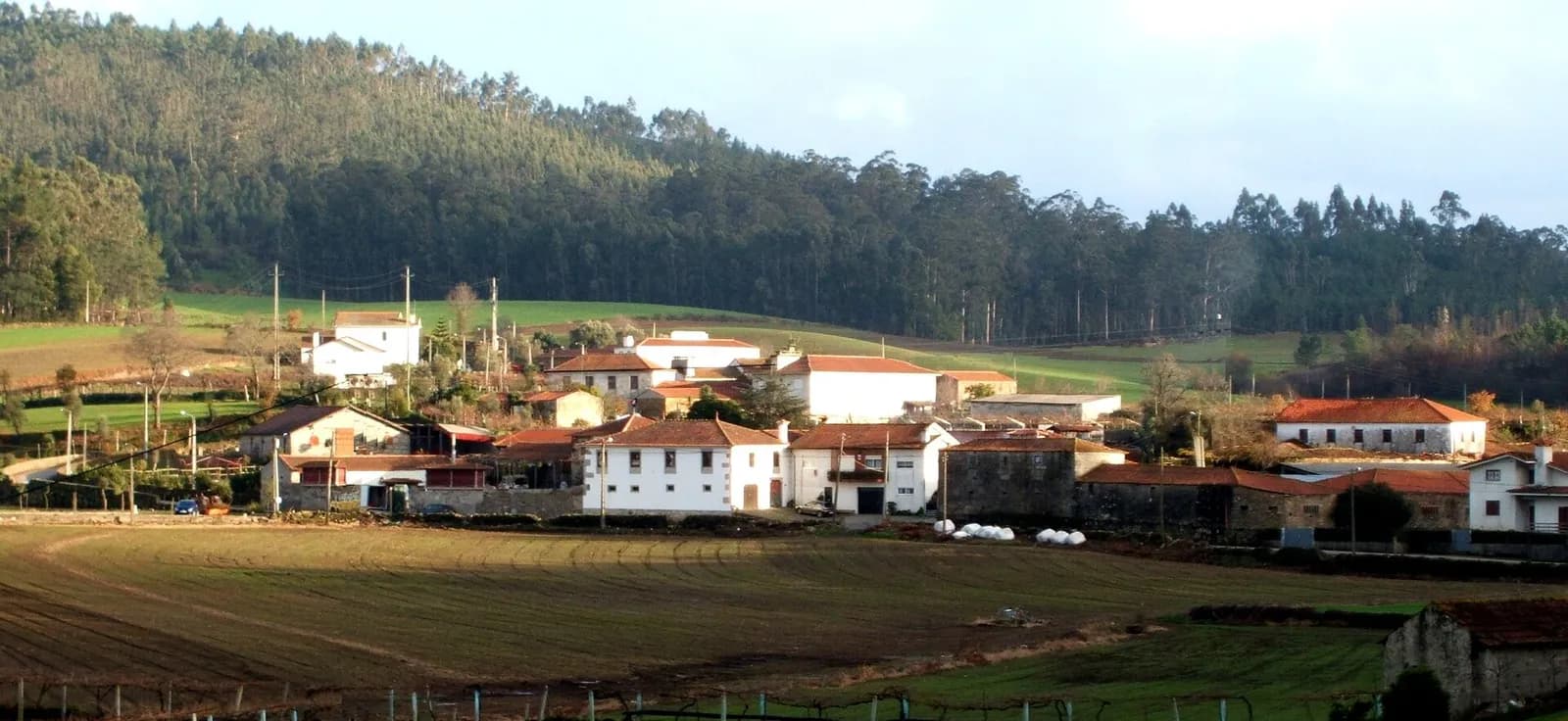
At a glance
- Alexandrina Maria da Costa was born on 30 March 1904 in Balasar, a farming parish of Póvoa de Varzim in northern Portugal, and died there on 13 October 1955.
- On Holy Saturday 1918, aged 14, she jumped about four metres from a window to escape three men who had forced their way into her home. Paralysis followed, and from 14 April 1925 she never left her bed.
- From 27 March 1942 until her death she was said to take no food or drink except communion. Doctors watched her for 40 days at a clinic in Foz do Douro, Porto, in 1943 and reported that she neither ate, drank nor passed urine.
- The case split doctors and clergy. A psychiatrist reportedly called it fraud and autosuggestion in 1938, a commission of priests gave a negative verdict, and the neurologist who ran the 1943 test called her a neuropath while saying he could not explain how long she went without liquids or urine.
- John Paul II beatified her in Rome on 25 April 2004, after the Church accepted as unexplained the 1995 recovery of a Portuguese woman, an emigrant to France, who had prayed to her.
A jump from the sewing-room window
On Holy Saturday 1918, three girls were sewing in a house in the parish of Balasar, in the Minho, the green farming country of north-west Portugal. Alexandrina Maria da Costa was learning the trade from her older sister, Deolinda, alongside a young apprentice. Easter fell on 31 March that year, so the Saturday before it was 30 March: Alexandrina's fourteenth birthday.
Deolinda saw three men coming towards the house. One was Alexandrina's former employer, a neighbour she had worked for and later called a perfeito carrasco, a perfect tyrant. The girls shut themselves in the room. The men got into the house and tried to force the door. The former employer went through the kitchen and attacked a trapdoor into the room with a mallet, but the girls had put the sewing machine on top of it. The Vatican's biography says the men meant to rape the girls; her own autobiography, Reis and Cardoso note, does not say so directly.
When Deolinda opened the door to try to escape, Alexandrina stayed behind. As her old employer came towards her, she jumped from the window, a drop of about four metres. In the account she later dictated, she got up, picked up a stick, went back in, called the men dogs and threatened to shout for help unless they let the other girl go.
The worst effects of the fall were not immediate. Over the next seven years it left her paralysed, and the rest of her life was spent in one bed in one room. From there, in the 1940s, she became the subject of a long argument among Portuguese doctors and priests over a single claim: that for thirteen years she lived on nothing but communion.
A Minho childhood
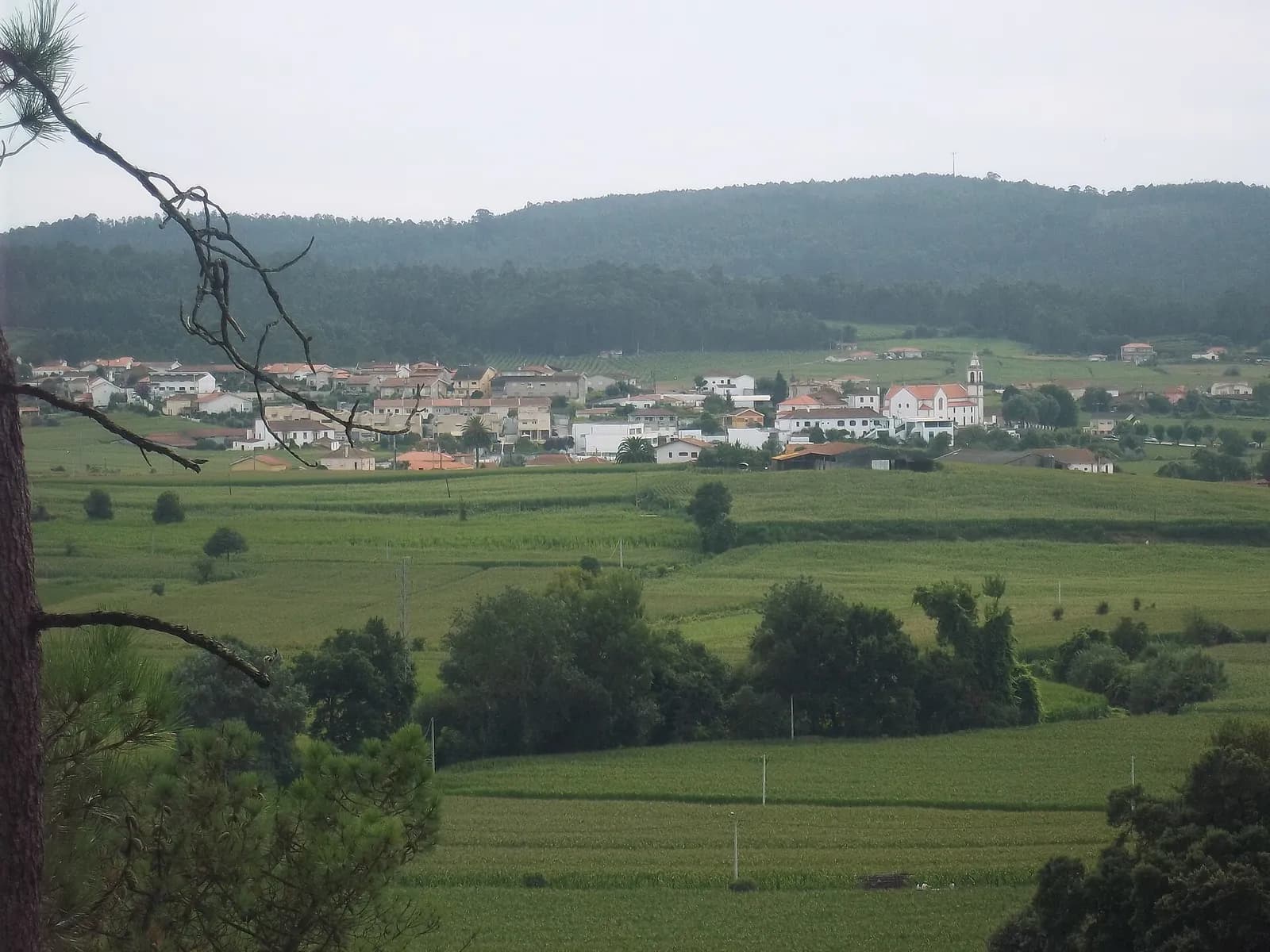
Alexandrina was born on 30 March 1904 in Balasar, a parish of the municipality of Póvoa de Varzim in the Archdiocese of Braga, and baptised on Holy Saturday, 2 April. Balasar is about 12 kilometres inland from the coastal town of Póvoa, and today has some 2,500 inhabitants.
Her parents never married. Her father, António Gonçalves Xavier, emigrated to Brazil, a common path out of the poor rural north at the time. He came back a rich man but did not keep his promise to marry her mother, Maria Ana da Costa. Maria Ana raised Deolinda and Alexandrina alone. People in Balasar told the historian Tiago Pires Marques that the family had lived in extreme poverty.
There was little schooling. Alexandrina spent about 18 months in Póvoa de Varzim, from 1911, lodging with a cabinetmaker so she could attend primary school. Back in Balasar she worked in the fields, strong enough to be paid the same as the men. At about 12 she nearly died of an infection, perhaps typhoid, and her health never fully recovered.
Thirty years in one room
After the fall the doctors who saw Alexandrina judged the damage irreversible. Until she was 19 she could still drag herself to church, where people watched her pray bent over. In 1923 a Porto doctor, João de Almeida, predicted she would be paralysed. Her own doctor later described the illness as a myelitis, an inflammation of the spinal cord, in the lumbar region.
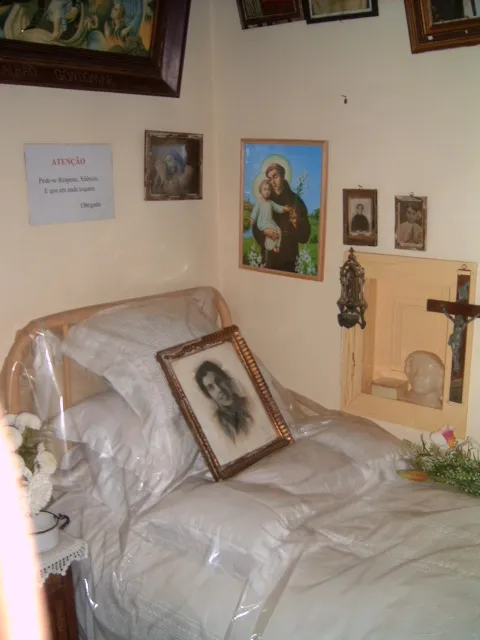
On 14 April 1925, by the Vatican's and the sanctuary's dating, she took to her bed for good, looked after by her mother and Deolinda. Marques puts it in 1924, when she was 19. Until 1928 she prayed for a cure and promised to become a missionary if she were healed. Then, by her own account, she came to see suffering as her vocation and offered it for the conversion of sinners.
In the early 1930s Mariano Pinho became her spiritual director. Sources give his years with her as anything from 1932, 1933 or 1934 to 1941 or 1942. From 1934 he had her put into writing what she said Jesus told her. She did not write the texts by her own hand: they were dictated to her sister, to the village schoolteacher and to her doctor. Typed up for her beatification process, they ran to more than 4,000 pages. Marques calls them a palimpsest whose authorship is more collective than individual.
From 1936 (1935, according to Marques) she asked the Pope through Pinho to consecrate the world to the Immaculate Heart of Mary, and the Holy See questioned the Archbishop of Braga about her three times. On 31 October 1942 Pius XII made that consecration in a radio message in Portuguese heard at Fátima. The Vatican's biography of Alexandrina sets the two facts side by side without saying that one caused the other.
The Fridays of the Passion
From Friday 3 October 1938 until March 1942, Alexandrina was said to relive the Passion of Christ every Friday, 182 times by the Vatican biography's count. In that account, though paralysed, she would get down from the bed and for about three and a half hours act out the Stations of the Cross with gestures of great pain. Visitors crowded into the room to watch, and her doctor later had the ecstasies photographed.
Church authorities were already watching her. Marques records that the Holy See sent a commission of theologians to observe her in 1937, and again in 1938, followed by Elísio de Moura, a Coimbra psychiatrist who in 1939 became the first head of the Portuguese medical association. According to Pinho's own biography of her, Moura ruled out hysteria but called the case one of fraud and autosuggestion. Pinho's answer was that the psychiatrist understood nothing of theology or mysticism.
In 1941 a new doctor came on the scene: Manuel Augusto Dias de Azevedo, a former seminarian with an interest in mysticism, who looked after her until she died. He found her intelligent and mentally healthy, and wrote that nothing he saw could be classed as natural or diabolical. For him, that meant the ecstasies came from God.
By then Pinho had stopped directing her, in 1941 by the Vatican's account. The case became public in 1942, when a priest of the Holy Ghost Fathers, a missionary order, published an account of her ecstasies. A theological quarrel followed in Catholic magazines, and medical authorities were drawn into it.
Forty days at Foz do Douro
On 27 March 1942 a new claim began. From then until her death, some thirteen and a half years later, Alexandrina was said to take no food or drink except the communion wafer. Anything else, her later director and biographer Umberto Pasquale wrote, she vomited back in great pain. The Vatican's biography says that at one point she weighed 33 kilograms.
Dias de Azevedo wanted proof. He arranged for her to be admitted to the Refúgio da Paralisia Infantil, a polio clinic in Foz do Douro, Porto's seaside district, run by the neurologist Henrique Gomes de Araújo. Gomes de Araújo had published a book on hysteria in 1919, and by Azevedo's account he expected to find that the patient was deceiving the people around her.
Azevedo set two conditions: her mental faculties would be examined and the result put in writing, and she would not be forced to eat or be injected with anything against her will. The stay had no therapeutic aim. It was, Marques writes, in effect a clinical experiment to certify the fast and her sanity.
She was carried to Porto and watched day and night from 10 June to 20 July 1943. The stay was planned for 30 days. In her autobiography she says that one of the watchers described the case to another doctor, who said watchers were easily fooled. Gomes de Araújo told him to send someone he trusted, and he sent his own sister. Gomes de Araújo then asked Alexandrina to stay ten more days to convince the doubter. She also recalled the doctors leaving plates of steak by the bed to tempt her.
“It is entirely certain to us that during the forty days of her stay the patient neither ate nor drank, nor urinated nor defecated, and this leads us to believe that such phenomena may have occurred in earlier times. We cannot doubt it. The thirteen months, as we are told? We do not know.”
The full report was less of a certificate than devotional accounts suggest. Gomes de Araújo described her as sincere, intelligent and without a shadow of imposture, but carrying fixed, systematised ideas that determined her abstinence. Citing the French neurologist Charcot on mental anorexia in hysterical patients, he wrote that this was partly her case, but only partly, and called her a neuropath.
What he could not explain was the length of time without liquids and without passing urine. Medicine, he wrote, could account for much of the case, but those details called for a suspension of judgement until a clear explanation shed light on them. A second report, dated 26 July 1943 and signed by Dias de Azevedo and Carlos Lima, a professor of medicine at the University of Porto, confirmed the fast and declared her of sound mind.
Alexandrina saw the forty days as a trial passed, matching Christ's forty days of fasting in the desert. In her account perhaps 1,500 people came to see her at the end, the police were needed to keep order, and flowers were thrown onto her stretcher as she left.
Doctors for, priests against
Medical reports did not settle the matter inside the Church. The curia of the Archdiocese of Braga held its own inquiry, in which a commission of priests gave a negative verdict, and the archbishop issued a circular letter with a series of prohibitions on the case. The Vatican's biography, which does not date these steps, also says that doctors treated her in a cold and hostile way, and that members and leaders of the Church added to her suffering.
Some of the hardest doubters were Jesuits. According to Dias de Azevedo, Father Agostinho Veloso went to see Gomes de Araújo before the report was written, to tell him the patient was an impostor and her doctor a fanatic. In 1947 Veloso returned to the case in the Jesuit magazine Brotéria, using the psychiatric terms hysteria and “psychosis of the marvellous”.
Marques calls this an inversion of the positions held at the start of the century. Around 1900, republican doctors had treated mystical states as illness and Catholics had defended them. In Alexandrina's case Catholic doctors vouched for the religious character of what they saw, while some churchmen argued, in psychiatric language, that it was pathological.
| When | Who | Conclusion, as reported |
|---|---|---|
| 1937 and 1938 | Commissions of theologians sent by the Holy See | Findings not given in the sources used here |
| 1938 | Elísio de Moura, psychiatrist, Coimbra | Not hysteria, but “fraud and autosuggestion” (as reported in Father Pinho's biography) |
| From 1941 | Manuel Augusto Dias de Azevedo, her doctor | Lumbar myelitis; mentally sound; the phenomena could not be called natural or diabolical |
| 10 June to 20 July 1943 | Henrique Gomes de Araújo, neurologist, Foz do Douro | No food, drink, urine or stool in 40 days; “a neuropath” with fixed ideas; the anuria awaited an explanation |
| 26 July 1943 | Carlos Lima (University of Porto) and Dias de Azevedo | Fast confirmed during the stay; sound mental faculties |
| Undated (1940s) | Commission of priests, Archdiocese of Braga | Negative verdict, followed by the archbishop's circular of prohibitions |
| 1947 | Agostinho Veloso SJ, in Brotéria | Used the terms “hysteria” and “psychosis of the marvellous” |
The medical reports are known only from excerpts printed by her biographers and devotees; Marques could not consult the hospital originals.
Historians have read the case in other ways. The anthropologist João de Pina Cabral, studying the Minho, grouped the cult of women who fasted, the jejuadoras, with the cults of the souls in Purgatory and of incorrupt bodies, and mentioned Alexandrina among them. Marques sets her beside the fasting women saints studied by the historian Caroline Walker Bynum. Reis and Cardoso compare her with the “anorexic saints” described by two Brazilian authors in a psychiatry journal: women for whom eating, not fasting, was what made them ill.
Marques also found that people in Balasar saw her as a corpo aberto, an “open body”: in the region's folk healing, a person exposed to the spirits of the dead who could gain powers of divination. In her autobiography she complained that people called her a witch and asked her questions as if she could see the future. Villagers told Marques that some brought her other people's clothes so that she could cure their owners, which she rejected as humiliating.
Death in Balasar and the road to Rome
In 1944 Umberto Pasquale, an Italian priest of the Salesian order, became her second director and had her keep dictating a diary, and she joined the Salesian Cooperators, the order's lay association. From 1946, at her own request, she lay on hard boards. Visitors came from far away in growing numbers to ask for advice.
She died on the evening of 13 October 1955, the anniversary of the last of the apparitions of the Virgin reported at Fátima in 1917. The record kept at her bedside by the village schoolteacher gives the time as 8.29; the Vatican's biography says 7.30. Earlier that evening she had said: “I am going to heaven.”
An account quoted by Pasquale says people filed past her body from one in the afternoon until ten the next morning, medical professors and lawyers among the farm families. She was buried in a plain grave, turned towards the tabernacle of her church as she had asked. On 14 July 1948 she had written her own epitaph.
“Sinners, if the dust of my body can be of help to save you, come close, walk over it, kick it around until it disappears. But never sin again: do not offend Jesus anymore!”
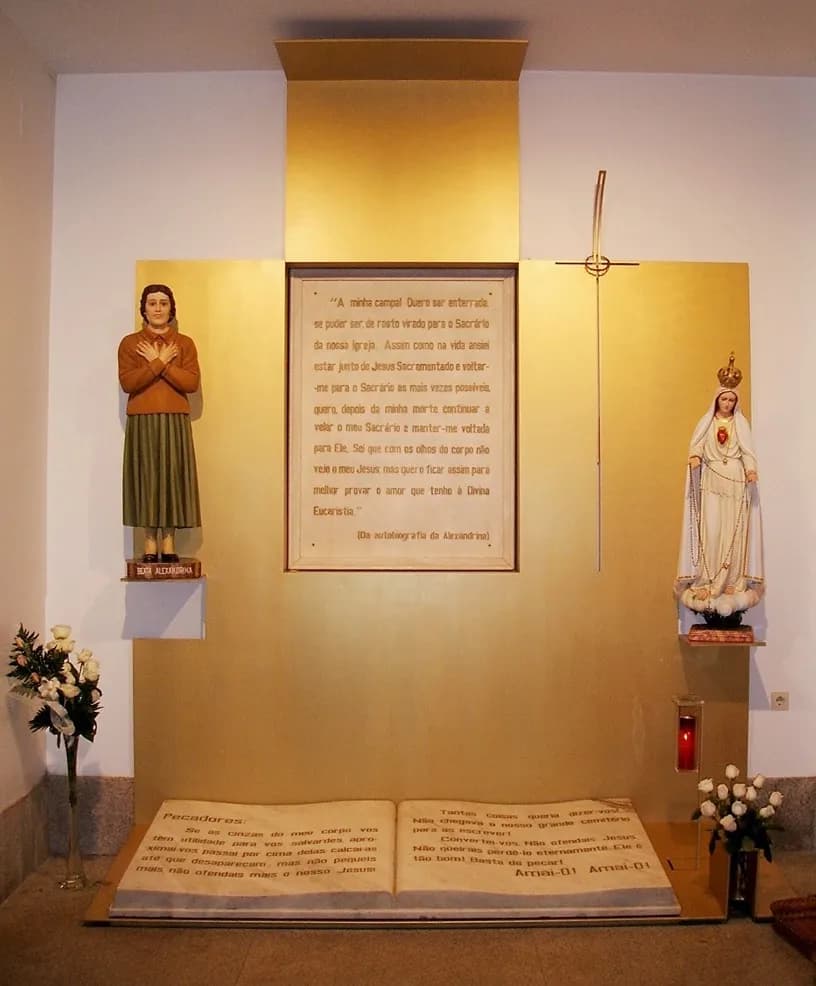
The Archdiocese of Braga opened the diocesan process for her beatification on 14 January 1967. Its tribunal heard 46 witnesses before the process closed on 10 April 1973 and the papers went to Rome. Her remains were moved from a chapel-tomb in the cemetery into the parish church on 18 July 1978. On 12 January 1996 the Congregation for the Causes of Saints, having recognised that she lived the Christian virtues to a heroic degree, declared her Venerable.
Her beatification rested on a healing: the recovery of Maria Madalena Azevedo Gomes Fonseca, a woman from the Vila Nova de Famalicão area who had emigrated to France and had been ill since 1983 with a condition later diagnosed as Parkinson's disease. She had met Alexandrina in person around 1951. On 3 March 1995, at the end of a novena to her, she said she felt suddenly well. According to the sanctuary, her doctors could find no clinical explanation, two neurologists who examined her for a Braga tribunal set up in 2002 found no sign of Parkinson's, and the Holy See's doctors judged the cure inexplicable. A decree of 20 December 2003 cleared the way for beatification.
John Paul II beatified Alexandrina in St Peter's Square on 25 April 2004, with five others, before about a thousand Portuguese pilgrims. His homily repeated the claim that the Eucharist had been “her only source of nourishment for the final 13 years of her life”. As of October 2026 she is a Blessed, not a saint.
How long each step of the cause came after her death
years after 1955
Calendar year of each step minus 1955. Dates from the Santuário de Balasar and the Holy See.
Show the data
| Years after her death in 1955 | |
|---|---|
| Process opened (1967) | 12 |
| Process closed (1973) | 18 |
| Remains moved (1978) | 23 |
| Venerable (1996) | 41 |
| Beatified (2004) | 49 |
30 March 1904
Born in Balasar
Baptised on 2 April.
30 March 1918
The jump
Holy Saturday, her fourteenth birthday.
14 April 1925
Bedridden for good
Marques gives 1924.
3 October 1938
First Friday “Passion”
182 in all, to March 1942, by the Vatican's count.
27 March 1942
Fast said to begin
10 June to 20 July 1943
Observed at Foz do Douro
13 October 1955
Dies in Balasar
14 January 1967
Diocesan process opens
3 March 1995
Healing later accepted as a miracle
12 January 1996
Declared Venerable
25 April 2004
Beatified by John Paul II
Why it still matters
Balasar is now a place of pilgrimage. Researchers who followed events there through 2024 found her house open to visitors, its rooms kept behind glass doors or ropes, including the sewing room with the window she jumped from. Below the window a section of the garden is called the School of Suffering. Shops sell relics and souvenirs, and a display of ex-votos, including wedding dresses, is renewed each year for the feast of her beatification on 25 April.
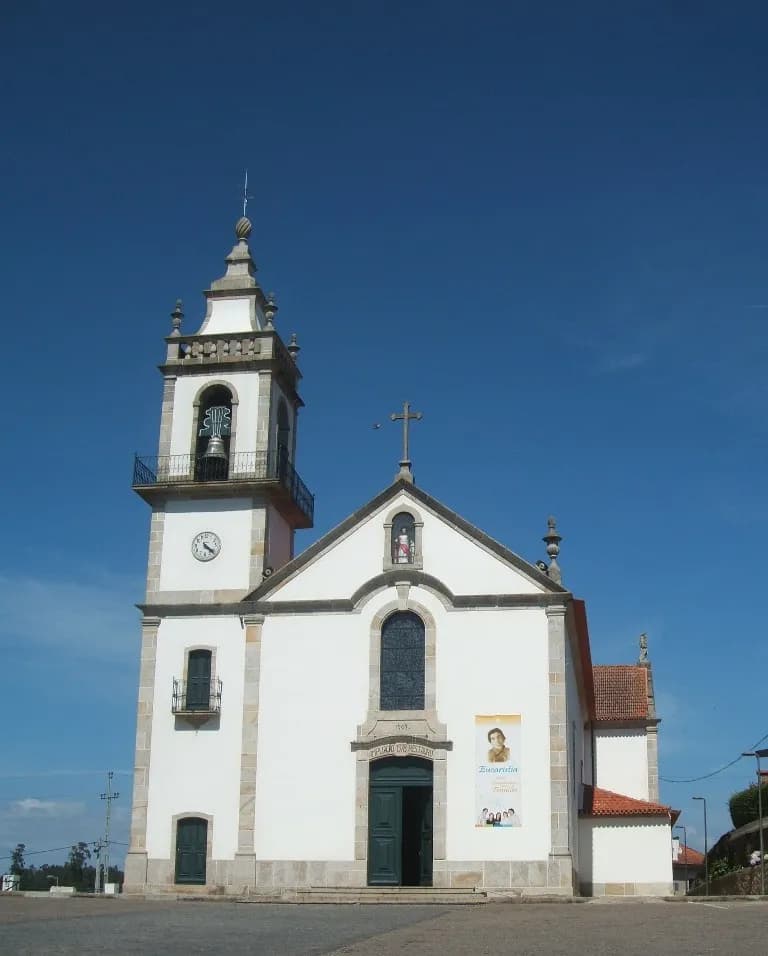
The cult has outgrown the parish church. The archdiocese and the Fundação Alexandrina de Balasar have built a new Eucharistic sanctuary, and from 10 October 2026 all worship in her honour moved there, while the old church went back to serving the parish. Their programme set the transfer of her remains to the sanctuary for that day and its dedication by the papal nuncio for the next. On the evening of 12 October, the eve of the anniversary of her death, hundreds walked by candlelight from her house to the new building.
Beatification does not oblige Catholics to believe in her fast or her visions. The Church's approval of a private revelation means only that it contains nothing against faith and morals, as the sanctuary itself reminds pilgrims, quoting Benedict XVI. What Rome examined was her writings, her virtues and one healing. The fast remains a claim, accepted by her devotees and by the Pope who beatified her, doubted by some of the clergy who studied the case in her lifetime, and at odds with what medicine knows about survival without water.
For historians the case shows how much of a saint's life is made by others. Marques reads Alexandrina's story as the work of a poor rural community, of Jesuit and Salesian directors, and of doctors who brought clinical tests and photographs into a devotion that had looked medieval. Her words reached the world through the people who wrote them down.
FAQs
When and where was Alexandrina of Balasar born?
Alexandrina Maria da Costa was born on 30 March 1904 in Balasar, a rural parish of Póvoa de Varzim in the Archdiocese of Braga, northern Portugal, and baptised there on 2 April 1904. She died in Balasar on 13 October 1955.
Did Alexandrina really live for 13 years without eating?
That is the claim of her devotees, repeated by John Paul II at her beatification. The only medical observation covered 40 days in 1943, when doctors at a Porto clinic reported she neither ate, drank nor passed urine. The neurologist in charge said he did not know whether she had fasted for the months before, called her a neuropath with fixed ideas and said the absence of urine awaited an explanation. People without food or water normally die within about two weeks.
Why was she paralysed?
On Holy Saturday 1918, aged 14, she jumped about four metres from a window to escape three men who had broken into her home, one of them a former employer. Her mobility declined over the following years, and from 14 April 1925 she was confined to bed. Her doctor diagnosed a lumbar myelitis.
What miracle led to her beatification?
The Church accepted as unexplained the recovery of Maria Madalena Azevedo Gomes Fonseca, a Portuguese woman who had emigrated to France and was diagnosed with Parkinson's disease, who said she felt suddenly well on 3 March 1995 at the end of a novena to Alexandrina. John Paul II beatified Alexandrina in Rome on 25 April 2004.
Is Alexandrina of Balasar a saint?
Not yet. She was declared Venerable in January 1996 and beatified in 2004, which makes her Blessed Alexandrina. Her cause for canonisation has not been completed.
On the timeline
Open the timelineNearby moments from regeneration and the last kings (1851–1910).
Joaquim Mouzinho de Albuquerque, the cavalry officer hailed as a national hero for capturing the Gaza emperor Gungunhana at Chaimite in Mozambique in 1895, takes his own life in Lisbon at the age of 46.
Birth in Aveiro of Fernando Pessa. As a BBC announcer in wartime London he brought uncensored news to Portuguese listeners, and decades later he was still filing wry TV street reports for RTP, signed off with the catchphrase 'E esta, hein?' ('How about that, eh?'). He died in 2002, days after turning 100.
Former Casa Pia pupils led by Cosme Damião meet at the Farmácia Franco in Belém and found Sport Lisboa. A 1908 merger with Grupo Sport Benfica created Sport Lisboa e Benfica, which grew into Portugal's record league champion and one of the world's best-supported clubs.
Alexandrina of Balasar
Birth in Balasar, near Póvoa de Varzim, of Alexandrina Maria da Costa. Paralysed after leaping from a window at 14 to escape three men, she lay bedridden for some 30 years and from 1942 was said to take no food but daily communion. She was beatified in 2004.
At the Pembe ford on the Cunene River in southern Angola, Kwanyama (Cuanhama) warriors rout a Portuguese expeditionary column sent to impose colonial rule on the region, killing some 250 men, more than half the force — one of the rare outright African victories over a European army during the colonial wars of conquest.
Henrique de Barros, the agronomist who taught for decades at Lisbon's Instituto Superior de Agronomia, is born in Coimbra. Elected for the Socialist Party after the Carnation Revolution, he presided over the Constituent Assembly that drafted the democratic Constitution of 1976.
Rafael Bordalo Pinheiro dies in Lisbon aged 58. The caricaturist, illustrator and ceramicist created Zé Povinho, the shrugging everyman who still stands for the long-suffering Portuguese public, and helped found the Caldas da Rainha faience factory whose cabbage-leaf tableware and outsized animals remain coveted today.
Coming up in history
All long reads 1 April 1996Mário Viegas, the actor who said Portugal's poems aloud, dies at 47
 2 April 1976The Constitution of 2 April 1976: how Portugal wrote down its democracy
 3 April 1954Aristides de Sousa Mendes: the consul who defied Salazar dies poor, 1954
 4 April 1819Maria II: the queen born in Rio who fought for her throne
20 sources
Archives, scholarship and reporting this article was checked against.
- 1
De corpo e alma na margem: catolicismo, santidade e medicina no Norte de Portugal (c. 1900 — c. 1950) (Tiago Pires Marques)Topoi. Revista de História, vol. 13, no. 25 (2012), pp. 147-167
- 2
Alexandrina Maria da Costa (1904-1955), biografiaHoly See, Office of Liturgical Celebrations (beatification of 25 April 2004)
- 3
- 4
Jejum EucarísticoSantuário Alexandrina de Balasar (Fundação Alexandrina de Balasar)
- 5
- 6
Ex-votos, objetos, relíquias e souvenirs: a materialidade em torno da beata portuguesa Alexandrina de Balasar (Mara Bontempo Reis and Kaique Matheus Cardoso)Caminhos (Goiânia), vol. 23, no. 1 (2025), pp. 161-173
- 7
- 8
- 9
Easter dates, 1600-2099United States Census Bureau
- 10
- 11
- 12
Ask the Experts: how long can a person survive without food? (Alan D. Lieberson)Scientific American, March 2005
- 13
- 14
- 15
- 16
- 17
- 18
- 19
- 20
Image credits
- Gresufes, one of the hamlets of Balasar, the rural parish where Alexandrina Maria da Costa was born on 30 March 1904. Photographed in 2012. Vitorreis2, CC BY-SA 3.0, via Wikimedia Commons.
- Alexandrina's bedroom in her house in Balasar, kept as a place of devotion, photographed in July 2005. A framed portrait of her rests on the bed. Manuel Anastácio, CC BY-SA 2.5, via Wikimedia Commons.
- Alexandrina's tomb in the parish church of Balasar in December 2013. The open stone book carries the epitaph she wrote in 1948; the panel above quotes her wish to be buried facing the tabernacle. anjo-sozinho, CC0, via Wikimedia Commons.
- The parish church of Santa Eulália in Balasar, built in 1907–1910, which held Alexandrina's tomb from 1978. A banner with her portrait hangs by the door. Undated photograph. Vítor Reis, CC0, via Wikimedia Commons.
- Fields and houses of Balasar, a rural parish of Póvoa de Varzim in the Minho. Undated photograph. Vítor Reis, CC0, via Wikimedia Commons.