

Philippa of Lancaster, the English queen who raised Portugal's princes
John of Gaunt's eldest daughter came to Portugal to seal an alliance against Castile. She was queen for 28 years, bore eight children and died of plague days before her sons sailed for Africa.
At a glance
- Philippa of Lancaster, eldest child of John of Gaunt and Blanche of Lancaster, was born on 31 March 1360, at Leicester Castle according to modern biographies.
- Under an alliance against Castile, King João I of Portugal chose her over her half-sister Catherine and married her in Porto cathedral on 2 February 1387. She was about 26.
- She bore eight children; six lived to adulthood, among them King Duarte, Pedro of Coimbra, Henry the Navigator and Isabel, Duchess of Burgundy. Camões later called them the 'Ínclita geração'.
- She caught plague as the fleet for Ceuta was being readied and died at the monastery of Odivelas, near Lisbon, on Thursday 18 July 1415. The fleet sailed a week later.
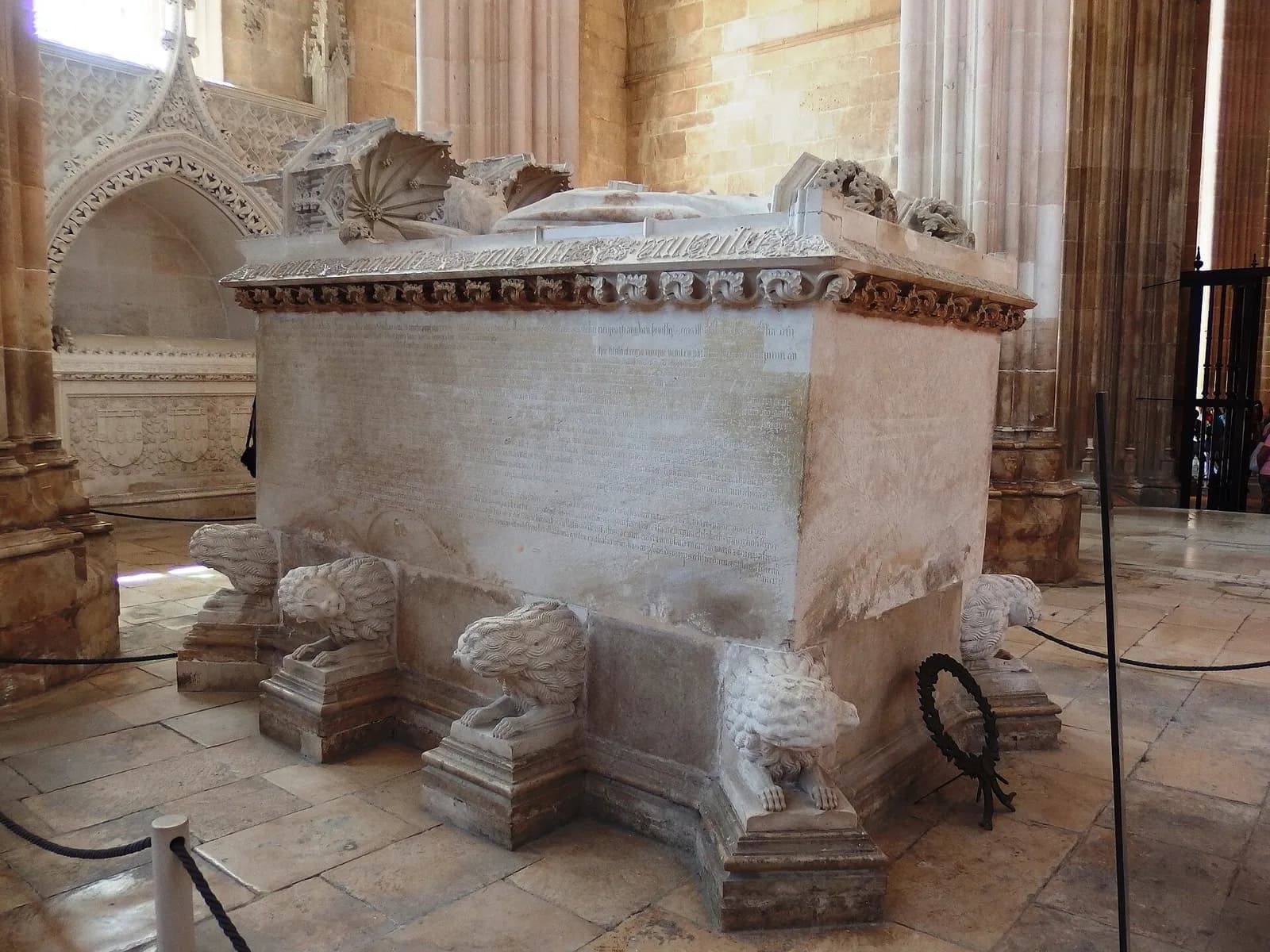
- Her body was moved to Batalha in 1416. Since 1434 she has lain beside João I in the Founder's Chapel, their stone effigies holding hands.
A north wind at Odivelas
In mid-July 1415 a wind got up over the Cistercian monastery of Odivelas, a few miles north of Lisbon, strong enough to be heard in the room where the queen of Portugal lay dying of plague. She asked her sons which wind it was. The north wind, they told her. Then it would be good for their voyage, she said.
The voyage was the secret expedition against Ceuta, the Moroccan port across the Strait of Gibraltar. A fleet lay at Restelo, on the Tagus below Lisbon, and her three eldest surviving sons, Duarte, Pedro and Henrique, were to sail with their father. According to the chronicler Gomes Eanes de Zurara, she told them her illness would not delay them: they would leave on the feast of Santiago, 25 July. That was no more than eight days away, and nobody at the bedside believed it.
Philippa of Lancaster had been queen for 28 years. Born in England on 31 March 1360, she married into a new dynasty that had won its throne by revolt and war, and gave it the heirs it needed. Her sons included a king and the prince remembered abroad as Henry the Navigator, and her daughter became Duchess of Burgundy.
A Lancastrian daughter
Philippa was the eldest child of John of Gaunt, a son of Edward III of England, and his first wife, Blanche, heiress of the duchy of Lancaster. Modern biographies give her birth as 31 March 1360 at Leicester Castle, one of the family's seats. Of Blanche's five children, three survived infancy: Philippa, her sister Elizabeth and her brother Henry, who would seize the English throne in 1399 as Henry IV.
Blanche died in 1368 or 1369, when Philippa, by Armitage-Smith's reckoning, was in her ninth year. The girls were put in the care of Katherine Swynford, a lady of the household who became their governess and, before long, their father's mistress. In September 1371 Gaunt married Constance of Castile, daughter of the deposed King Pedro of Castile, and from then on styled himself King of Castile and León in her right.
Portugal, meanwhile, had a new king. When Fernando I died in 1383 with only a daughter, married to Juan I of Castile, João, Master of the military Order of Avis and Fernando's illegitimate half-brother, led the resistance. The Cortes of Coimbra made him king in 1385, and that August he beat the Castilians at Aljubarrota. In May 1386 his envoys sealed the Treaty of Windsor with Richard II, an alliance of mutual defence and trade between the two kingdoms.
From Galicia to Porto
In July 1386 John of Gaunt landed in Galicia with an army to take Castile. He brought his wife and both unmarried daughters, Philippa and Catherine, Constance's only child. On 1 November, the feast of All Saints, he met João at Ponte do Mouro, a bridge on Portugal's northern border between Melgaço and Monção, and the two men dined together in the king's tents.
The treaty they agreed there committed Portugal to send 2,000 lances, 1,000 crossbowmen and 2,000 foot soldiers into Castile at its own cost, and gave João the hand of Philippa. The choice of bride had been left to him. According to Fernão Lopes, many of his councillors urged him to take Catherine, whose claim might one day bring him Castile. João refused. Marrying Catherine, he said, meant war without end, and he wanted peace once he had recovered what Castile had taken.
Catherine did not lose out. In 1388 Gaunt gave up his claim in return for money and a marriage: Catherine, then sixteen, married Enrique, heir to Juan I of Castile. Armitage-Smith made her fourteen, but the historian Óscar Villarroel González dates her birth to the late spring of 1372. The two half-sisters ended up as queens of the two neighbouring kingdoms that had just been at war.
Philippa was brought to Porto and lodged in the bishop's palace beside the cathedral. João came from Évora, saw her for the first time and talked with her in the bishop's presence. They exchanged jewels that afternoon: he sent a gold brooch set with a cockerel in precious stones and pearls, and she sent him one with an eagle.
There was a problem. João had taken religious vows as Master of Avis and needed a papal dispensation to marry, and the papal letters had still not arrived. With Septuagesima about to begin, the church season in which weddings were barred until after Easter, the king rode through the night from Guimarães, eight leagues, and married Philippa in Porto cathedral on 2 February 1387, the feast of the Purification. The bishop of Porto was waiting in his vestments to bless them; Lopes calls him D. João here and D. Rodrigo in the next chapter. The bull from Pope Boniface IX that regularised the marriage was read out in Lisbon cathedral only on 1 July 1391.
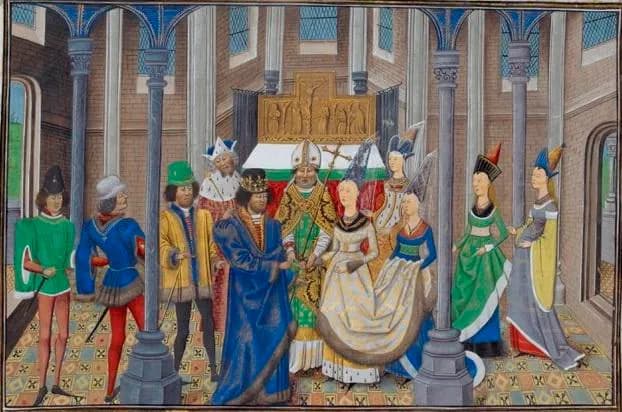
The public wedding followed on Thursday 14 February. Streets were strewn with greenery, and a jousting ground was laid out in front of the São Domingos friary and along the Rua do Souto, then still gardens. The archbishop of Braga led the queen's horse to the cathedral, where the bishop took the couple by the hand and said mass. Nuno Álvares Pereira, the Constable who had won Aljubarrota, served as master of the hall at the feast. Neither Gaunt nor Constance came; they were busy with the campaign.
“The king rode out of that palace on a white horse, royally dressed in cloth of gold, and the queen on another like it, very nobly adorned; on their heads they wore crowns of gold, very richly worked with stones and seed pearls of great price.”
31 March 1360
Philippa is born
Eldest child of John of Gaunt and Blanche of Lancaster.
1368 or 1369
Her mother dies
Katherine Swynford is governess to Philippa and Elizabeth.
9 May 1386
Treaty of Windsor
Alliance between Richard II and João I.
July 1386
Gaunt lands in Galicia
His wife and both unmarried daughters sail with him.
1 November 1386
Meeting at Ponte do Mouro
João agrees to marry one of Gaunt's daughters and chooses Philippa.
2 February 1387
Marriage in Porto cathedral
Before the papal dispensation arrives.
14 February 1387
Wedding feast
Celebrations last a fortnight in Porto and elsewhere.
1 July 1391
Papal bull read in Lisbon
Boniface IX dispenses João from his vows and confirms the marriage.
The queen's household
During the fortnight of celebrations the king gave his wife a household of her own. Its steward was Lopo Dias de Sousa, Master of the Order of Christ; her finances went to Lourenço Anes Fogaça, one of the envoys who had sealed the treaty at Windsor. She had a chief confessor and a chief chaplain, English and Portuguese squires, ladies-in-waiting and a governess, Beatriz Gonçalves de Moura, who was still at her side in 1415. Until she was given lands, the house ran on the revenues of the customs and tolls, which Lopes reckoned at an easy 25,000 dobras.
Lopes, who wrote the chronicle of João I in the 1430s and 1440s at the request of their son Duarte, devoted a short chapter to her habits. She said the canonical hours by the use of Salisbury, the English Sarum liturgy, and taught it to her chaplains. On Fridays she recited the whole Psalter without speaking to anyone until she had finished. She fasted often, read scripture and gave alms to churches and monasteries.
“She loved her most noble husband very faithfully, taking great care never to vex him, and took care over the good teaching and upbringing of her children.”
Lopes also gives her a lighter side: easy conversation, kind words and games with her ladies-in-waiting. Historians read his portrait with care. Amélia Polónia and Hugo Rincon Azevedo both show how the chroniclers of the Avis dynasty built her into a model queen, the opposite of Fernando I's widow Leonor Teles, the villain of Lopes's first volume. A dynasty born of a popular revolt needed a saintly mother.
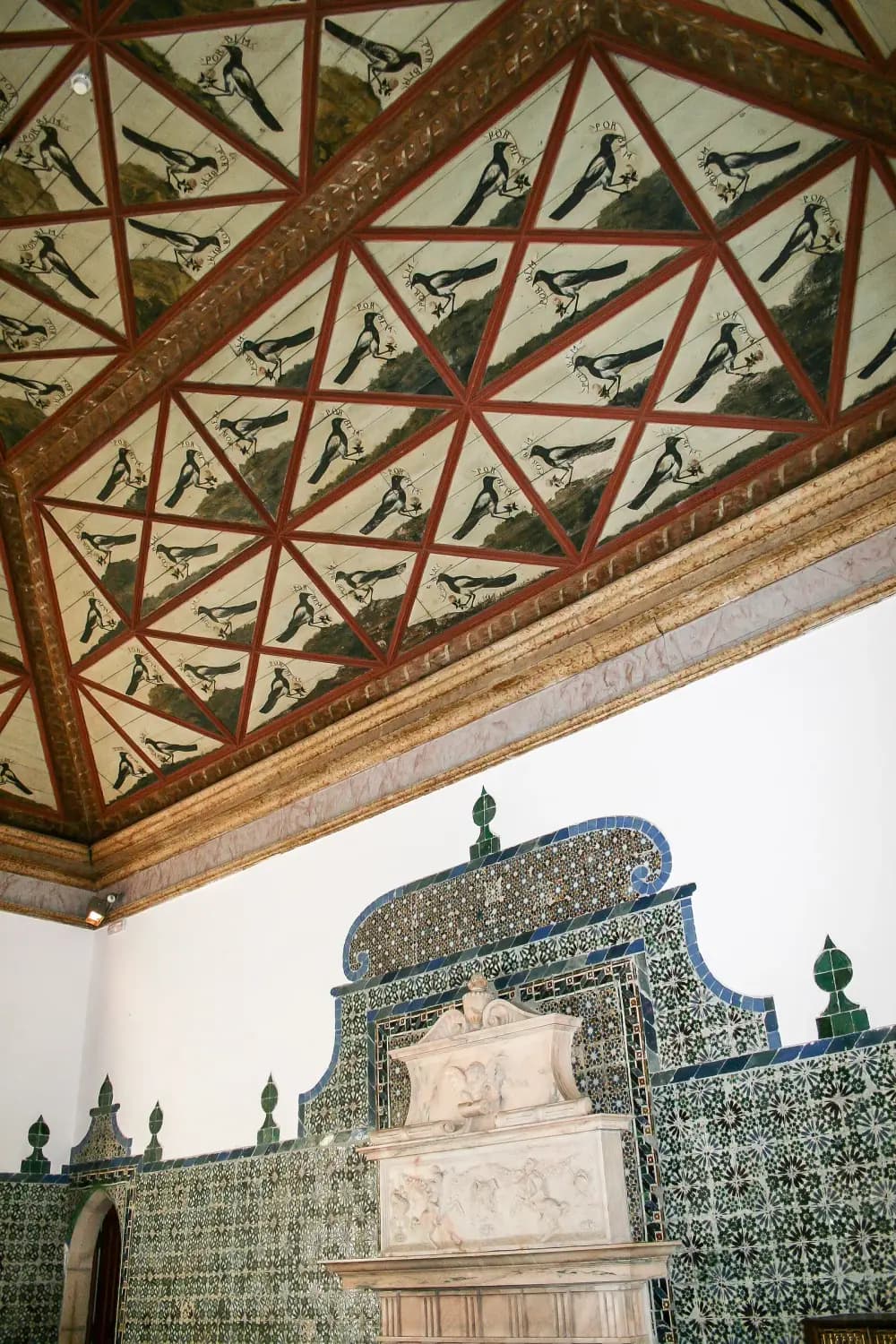
The court moved between Lisbon, Santarém, Évora and the palace at Sintra, where João I arranged his apartments around the central courtyard. Zurara places one of the king's talks with the queen about the Ceuta expedition at Sintra. The palace leaflet notes that João received there in 1413 the spies sent to report on Ceuta's harbour.
The 'Illustrious Generation'
The marriage began badly. That summer João fell gravely ill with fever on the road back from the Castilian campaign, and Philippa, who was pregnant, lost the child. Lopes credits her prayers with his recovery. Over the next fifteen years she had eight children, the last when she was over 40, and Lopes recorded where and when each was born.
| Child | Born | Place | Later |
|---|---|---|---|
| Branca | 13 July 1388 | Lisbon | Died at about eight months; buried in Lisbon cathedral |
| Afonso | 30 July 1390 | Santarém | Died young (at about 12, says Lopes); buried in Braga cathedral |
| Duarte | 31 October 1391 | Viseu | King of Portugal after his father |
| Pedro | 9 December 1392 | Lisbon | Duke of Coimbra |
| Henrique | 4 March 1394, Ash Wednesday | Porto | Duke of Viseu (Henry the Navigator) |
| Isabel | 21 February 1397 | Évora | Duchess of Burgundy |
| João | January 1400 | Santarém | Governor of the Order of Santiago |
| Fernando | 29 September 1402 | Santarém | Governor of the Order of Avis |
Dates from Fernão Lopes, part II, chapter 148, converted from the Era of Caesar, which ran 38 years ahead of the Christian era.
The last birth nearly killed her. In 1402 she fell ill with fever while pregnant, and her physicians advised ending the pregnancy. According to Lopes she refused, saying she would not be the killer of her own flesh, and sent for a relic of the True Cross. Fernando was born at Santarém on 29 September. He died in 1443 and was later venerated as a martyr.
Six children grew up, five sons and a daughter, an unusual record for a medieval royal family. That gave the new dynasty its succession: Duarte followed his father in 1433, Henrique became the patron of the voyages down the African coast, and Isabel married the Duke of Burgundy. A century and a half later the poet Luís de Camões, in his epic Os Lusíadas, gave the brothers the name Portugal still uses.
“Ínclita geração, altos Infantes. (An illustrious generation, high princes.)”
Three stanzas earlier, Camões had celebrated the peace with Castile sealed by giving the two enemy kings 'as duas ilustríssimas Inglesas', the two most illustrious English princesses, as wives.
Plague and the swords
Zurara, who wrote his chronicle of the Ceuta campaign around 1450 for her grandson Afonso V, gives the queen a central part in it. He has João tell his sons that the expedition faced two great obstacles, and that the first was the queen: she was so loved that without her consent no one would back the venture. The princes won her round, and she asked the king herself to send them.
When João told her that he would go too, she asked one favour: that he knight their sons in her presence as they embarked, with swords she would give them. He agreed, and the next day she told João Vasques de Almada, one of the men preparing the fleet, to have three swords made and richly decorated with gold, seed pearls and precious stones.
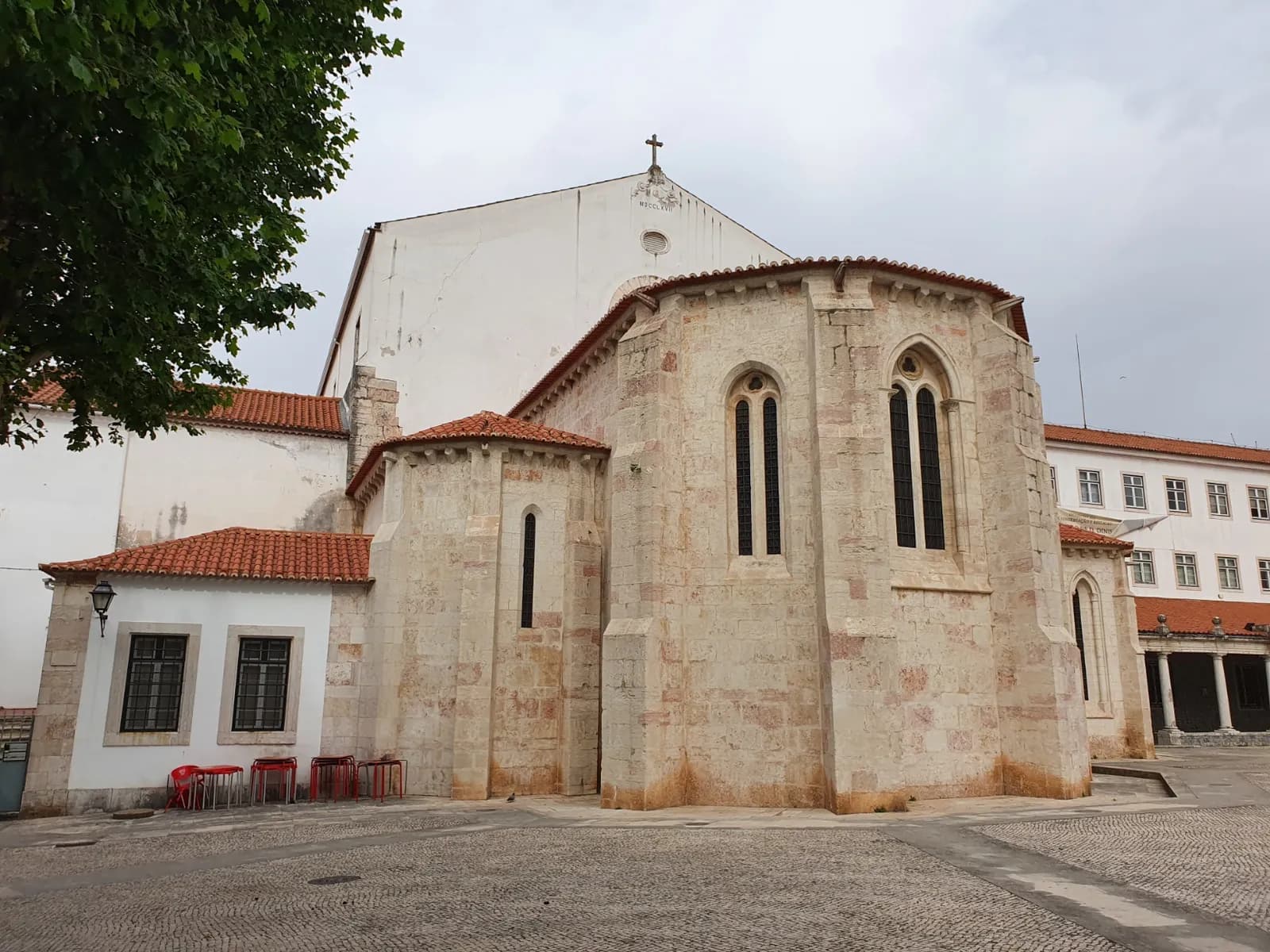
In the summer of 1415 plague was raging in Lisbon. The court was at Sacavém, just outside the city, when people there fell ill too. The king left for the monastery of Odivelas. The queen stayed to finish her devotions, saying that a woman as old as she was should not fear the plague, and was taken ill in church that same morning. She set off for Odivelas believing it was only one of her usual weaknesses.
Henrique arrived with the ships he had fitted out in Porto three days into her illness. When it was clear she would die, she gave each of her three eldest sons a piece of a cross believed to hold wood of the True Cross, keeping the fourth for the king. The swords were not ready, so she sent to Lisbon for them, and João Vasques de Almada soon arrived with them.
She gave the largest to Duarte, the heir, to be a sword of justice for the great and the small of the kingdom. Pedro, who had always looked after ladies and maidens, was to protect them. The third went to Henrique, her favourite in Zurara's telling, with the care of the lords, knights, gentlemen and squires of the kingdom. Zurara knew Henrique well: the prince, by then 56, told him he had worn his piece of the cross every day since. Polónia reads the scene as Zurara passing the queen's aura on to the prince of the voyages.
“And see, son, when I say justice, I mean justice with mercy, for justice that has no mercy in any part of it is not called justice but cruelty.”
Her sons persuaded João to leave, so that he would not see her die, and he crossed the Tagus to Alhos Vedros. Philippa took communion and was anointed. On the Thursday, a little after midday, she asked the clergy to begin the office of the dead, corrected them when they stumbled, and died as the last prayer ended. Because of the heat, she was buried that night at the monastery, as quietly as possible.
Zurara does not give the date, only that it was a Thursday and that the sun stood at two degrees of Leo. His editor, Francisco Maria Esteves Pereira, dates the death to 18 July 1415, as do Armitage-Smith and Azevedo. In the Julian calendar then in use, 18 July 1415 was a Thursday.
The court did not stay in mourning. On 24 July the king's galley left Restelo and anchored a little downriver, and on 25 July, the feast of Santiago, the fleet set sail for the open sea, as she had foretold. Ceuta was taken on 21 August 1415. In the city's mosque, newly consecrated as a church, the three princes came before their father wearing 'the swords of the blessing'. Each knelt and handed him his sword, and João knighted him with it.
The tomb at Batalha
João I did not leave her at Odivelas. According to her epitaph, her body was dug up on 9 October of the following year, found whole and sweet-smelling, and carried by the king and the princes to the Dominican monastery of Santa Maria da Vitória at Batalha, which João had begun in 1387 to give thanks for Aljubarrota. She was the first member of the royal family buried there.
Around 1415 the king began a square burial chapel off the church, the Founder's Chapel. In his will of 1426 he asked to lie in one monument with her, each in a separate coffin. He died in August 1433, and on 14 August 1434, the first anniversary of his death, the couple were placed in the new tomb in the middle of the chapel. The tombs of four of their sons were later set along its south wall.
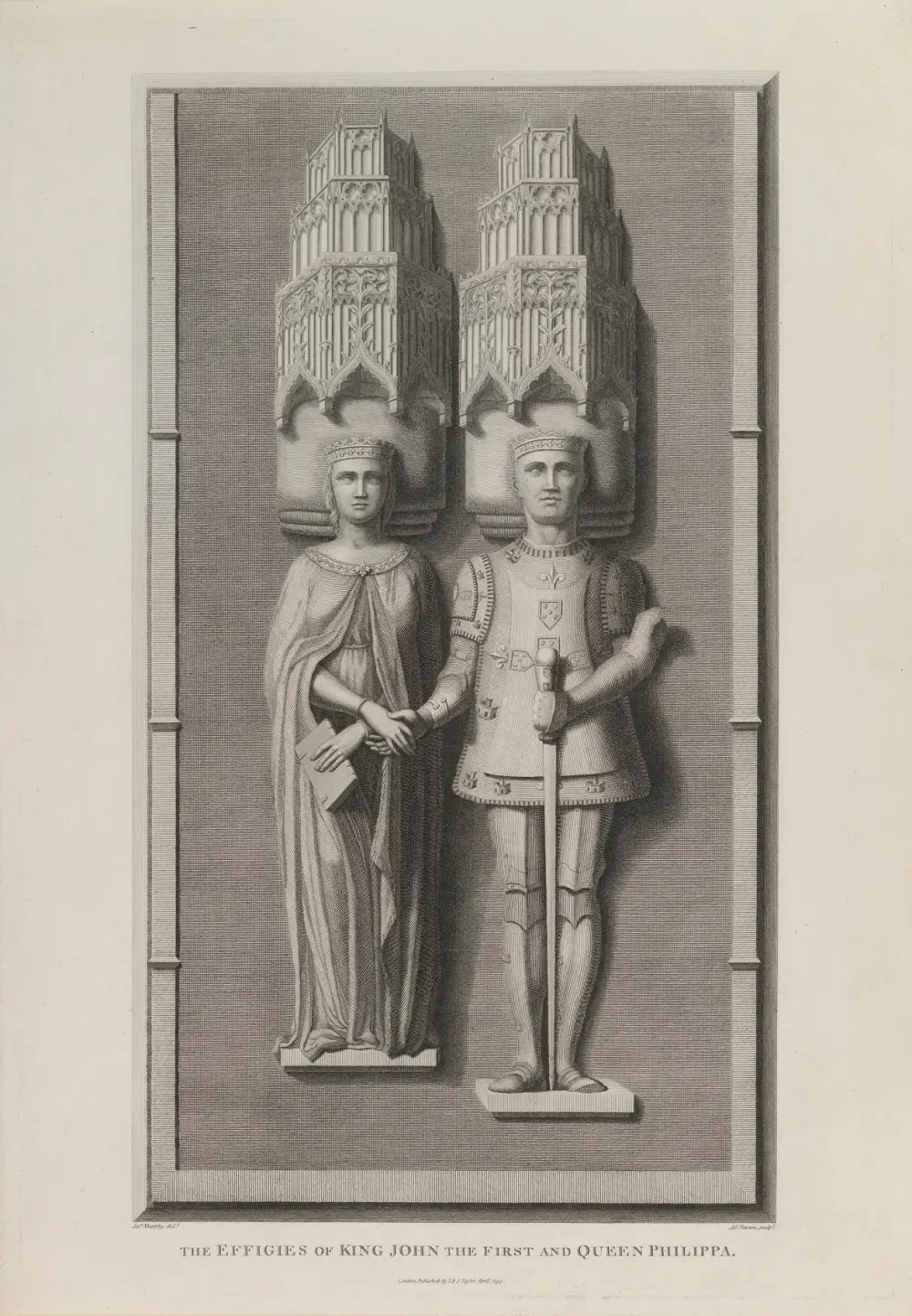
On the lid the king and queen hold each other's right hand. The double effigy with joined hands was an English fashion, seen in the Westminster tomb of Richard II and Anne of Bohemia, and this is its first known appearance in Portugal. Philippa wears a crown instead of the veil usual on queens' tombs, and holds a book of prayers in her left hand.
The epitaph, placed in Latin and Portuguese by King Duarte, calls her a model of 'conjugal virtue for married women, guide and teaching for maidens'. Duarte also wrote about her death in his own book of moral advice, the Leal Conselheiro. He had been suffering from a long depression, which he called a melancholic humour, and her death ended it.
“The very virtuous queen, my lady and mother, God rest her, died of the pestilence, which grieved me so much that I lost all fear. I stayed close to her in her illness and served her without hindrance, as if I felt no such pain, and this was the beginning of my cure, for in feeling for her I stopped feeling for myself.”
Why she still matters
- Born
- 31 March 1360, at Leicester Castle according to modern biographies
- Parents
- John of Gaunt, Duke of Lancaster, and Blanche of Lancaster
- Married
- João I of Portugal, Porto cathedral, 2 February 1387 (feast 14 February)
- Children
- Eight, of whom six reached adulthood
- Died
- Odivelas monastery, Thursday 18 July 1415, of plague
- Buried
- Founder's Chapel, Batalha monastery (moved from Odivelas in 1416)
Her marriage turned the Treaty of Windsor into a family bond. The National Archives in London describes it as adding a dynastic element to the alliance. Her brother became Henry IV of England in 1399, and her half-sister's descendants ruled Castile.
In Portugal she is remembered above all as the mother of the princes who led Portugal's first expansion overseas, beginning at Ceuta. How much she shaped them is hard to measure, because nearly everything known about her comes from chroniclers writing for her son Duarte and her grandson Afonso V. Duarte himself wrote that he and his brothers owed their 'principal teaching' to their father and mother.
FAQs
When and where was Philippa of Lancaster born?
Modern biographies give 31 March 1360 at Leicester Castle in England. She was the eldest child of John of Gaunt and Blanche of Lancaster. The Portuguese chroniclers give ages that point to 1358 or 1359 (Lopes) and 1361 or 1362 (Zurara), but English evidence supports 1360.
When did Philippa marry João I of Portugal?
The church ceremony was in Porto cathedral on 2 February 1387, hurried so it could take place before Septuagesima. The public wedding and feast followed on Thursday 14 February, so both dates appear in histories.
Who were the 'Ínclita Geração'?
The name Camões gave in Os Lusíadas to the children of João I and Philippa: Duarte, Pedro, Henrique (Henry the Navigator), João and Fernando, with their sister Isabel, Duchess of Burgundy. Two other children, Branca and Afonso, died young.
How did Philippa of Lancaster die?
Of plague, caught at Sacavém near Lisbon in July 1415 while the fleet for Ceuta was being prepared. She died at the monastery of Odivelas on Thursday 18 July, a week before her husband and sons sailed.
Where is Philippa of Lancaster buried?
In the Founder's Chapel of the Batalha monastery, in a joint tomb with João I. She was first buried at Odivelas and moved to Batalha in 1416; the couple were placed in the present tomb in 1434.
On the timeline
Open the timelineNearby moments from the burgundian kings (1249–1383).
King Dinis signs a contract with the Genoese mariner Manuel Pessanha, making him hereditary Admiral of the Kingdom and obliging him to bring twenty men 'skilled in the sea' to command the royal galleys — the charter regarded as the founding act of the Portuguese Navy.
Afonso IV of Portugal and his son-in-law Alfonso XI of Castile rout the Marinid army of Abu al-Hasan and the forces of Granada at the Battle of Salado near Tarifa, ending the last major Moroccan invasion of the Iberian Peninsula.
Inês de Castro, the Galician noblewoman loved by Crown Prince Pedro, is killed in Coimbra by courtiers acting with the consent of King Afonso IV, who feared Castilian influence over the succession. Once king, Pedro declared they had secretly married, and legend says he had her corpse crowned queen.
Philippa of Lancaster
Birth of Philippa of Lancaster in Leicester, England. She would marry King João I of Portugal in 1387, becoming Queen consort and mother of the remarkable 'Illustrious Generation' (Ínclita Geração) including Prince Henry the Navigator.
Portugal and England sign the Treaty of Tagilde near Guimarães — a pact between King Fernando I and John of Gaunt, Duke of Lancaster, that prepares the ground for the 1373 Anglo-Portuguese Treaty and the Treaty of Windsor of 1386. It is the diplomatic seed of the longest-lasting alliance in the world.
Portugal and England sign the Anglo-Portuguese Treaty in London, a pact of perpetual friendship between King Fernando I and King Edward III. Renewed at Windsor in 1386, the treaty is the oldest still-active diplomatic alliance in the world.
Battle of Saltes. Off Saltes Island, near Huelva, a Castilian fleet of 17 galleys under Fernán Sánchez de Tovar destroys a Portuguese fleet of 23 galleys commanded by João Afonso Telo, Count of Barcelos, capturing all but one. The disaster wipes out Portugal's naval strength and leaves Castile master of the Atlantic coast during the Third Fernandine War.
Coming up in history
All long reads 2 April 1976The Constitution of 2 April 1976: how Portugal wrote down its democracy
 3 April 1954Aristides de Sousa Mendes: the consul who defied Salazar dies poor, 1954
 4 April 1819Maria II: the queen born in Rio who fought for her throne
 5 April 1883Sampaio Garrido: the Portuguese envoy who sheltered Jews in Budapest
15 sources
Archives, scholarship and reporting this article was checked against.
- 1
Crónica da tomada de Ceuta por el Rei D. João I (Gomes Eanes de Zurara), ed. Francisco Maria Esteves PereiraAcademia das Sciencias de Lisboa, 1915 (digitised by Internet Archive)
- 2
- 3
A união matrimonial que transcende à morte: a memória funerária da rainha D. Filipa de Lencastre como um projeto político da Dinastia de Avis (Hugo Rincon Azevedo)Revista Diálogos Mediterrânicos, no. 28 (2025), pp. 39-59
- 4
D. Filipa de Lencastre: representações de uma rainha (Amélia Polónia)Faculdade de Letras da Universidade do Porto, 1988 (Repositório Aberto da Universidade do Porto)
- 5
- 6
Some Observations on the Dates and Circumstances of the Fifteenth-Century Portuguese and Castilian Translations of John Gower's Confessio Amantis (Bernardo Santano Moreno)SELIM, Journal of the Spanish Society for Medieval English Language and Literature, vol. 1 (1991), pp. 111-128
- 7
Philippa [Philippa of Lancaster] (1360–1415), queen of Portugal, consort of João IOxford Dictionary of National Biography (subscription)
- 8
- 9
History's unparalleled alliance: the Anglo-Portuguese Treaty of Windsor, 9th May 1386The National Archives (UK), History blog
- 10
De peón a reina: el poder femenino y la diplomacia de la reina Catalina de Lancaster (Óscar Villarroel González)En la España Medieval 48 (2025), Universidad Complutense de Madrid
- 11
Palácio Nacional de Sintra (visitor leaflet)Parques de Sintra – Monte da Lua
- 12
- 13
Os Lusíadas (Luís de Camões, 1572)Project Gutenberg
- 14
História do Mosteiro da BatalhaMosteiro da Batalha (Museus e Monumentos de Portugal)
- 15
Image credits
- The joint tomb of João I and Philippa of Lancaster in the Founder's Chapel of the Batalha monastery, photographed in 2017. Their effigies lie side by side on the lid. Palickap, CC BY-SA 4.0, via Wikimedia Commons.
- The marriage of João I and Philippa of Lancaster as imagined about 90 years later in Jean de Wavrin's Chronique d'Angleterre, made for Edward IV of England around 1480 (British Library, Royal MS 14 E IV, f. 284). Jean de Wavrin (Chronique d'Angleterre), Public domain, via Wikimedia Commons.
- The Sala das Pegas (Magpie Room) in the National Palace of Sintra, photographed in 2007. Each of the 136 magpies on the fifteenth-century ceiling carries João I's motto, 'por bem', and a rose. Szilas, CC0, via Wikimedia Commons.
- The Gothic east end of the church of the former Cistercian monastery of São Dinis at Odivelas, photographed in 2022. Philippa died in the monastery on 18 July 1415. GualdimG, CC BY-SA 4.0, via Wikimedia Commons.
- The effigies of João I and Philippa on their tomb at Batalha, engraved by James Newton after a drawing by the Irish architect James Cavanagh Murphy, published in 1794. James Newton (engraving), after James Cavanagh Murphy, Public domain, via Wikimedia Commons.