

Sampaio Garrido: the Portuguese envoy who sheltered Jews in Budapest
Portugal's minister in Hungary hid a dozen people in a rented country house after the German occupation of 1944. His deputy, Alberto Teixeira Branquinho, then turned Lisbon's grudging permission into protection for about a thousand.
At a glance
- Carlos de Sampaio Garrido was born on 5 April 1883 and spent more than forty years in Portugal's consular and diplomatic service; he was minister in Budapest from 1939 to June 1944.
- After Germany occupied Hungary on 19 March 1944 he sheltered about a dozen people, most of them Jews, in a country house the legation rented at Galgagyörk, without telling Lisbon.
- At five in the morning on 28 April 1944 police broke into the house and took his guests to Budapest; he protested and got them freed, and Hungary declared him persona non grata.
- His successor as head of the legation, Alberto Teixeira Branquinho, issued provisional passports that named no nationality; by October 1944 Portugal protected about 1,000 people.
- Yad Vashem recognised Sampaio Garrido as Righteous Among the Nations on 2 February 2010, long after his death. Branquinho has not been recognised.
Five in the morning at Galgagyörk
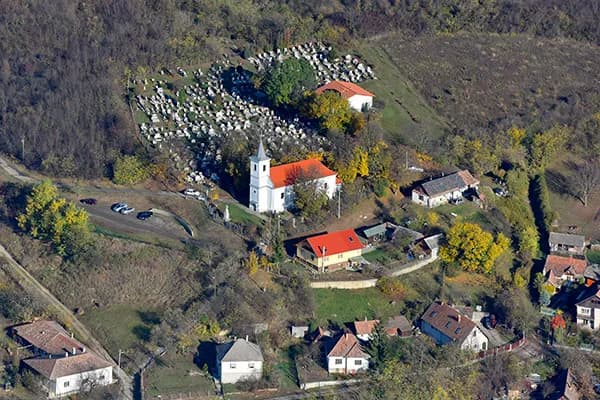
The men came to the country house at five in the morning on 28 April 1944. The house stood in Galgagyörk, a village about 50 kilometres from Budapest, and Portugal's minister to Hungary, Carlos de Sampaio Garrido, had rented it for his legation a few weeks earlier to get away from the air raids on the capital. The intruders took his guests prisoner and, when the guests asked to go back to the legation, took them to the central police station in Budapest instead.
Garrido was not sure who they were. In his cipher telegram to Lisbon he called them “Gestapo agents or Hungarian police”, and his successor later wrote of German and Hungarian police “in ridiculous disguise”. Yad Vashem's account speaks of the Hungarian police. Garrido sent the Hungarian prime minister a protest the same day, calling the raid a “revolting attempt” on the principle that a legation is foreign territory.
“I strongly opposed such detention and after a few hours managed to have some of the people released.”
Among the prisoners was his Jewish secretary, Magda Gabor, a sister of the future Hollywood stars Zsa Zsa and Eva Gabor. Several of her relatives were staying in the house too. Annette Tillemann, a Budapest girl who later married the American congressman Tom Lantos, is quoted on a Yad Vashem panel describing the moment the police tried to take Magda away.
“When the Ambassador saw the Hungarian police taking Magda, he put his foot in the door and would not let them leave.”
Garrido turned 61 that month. Within six weeks he had left Hungary for good. The work he started was carried on by his deputy, Alberto Teixeira Branquinho, and by the end of October 1944 the Portuguese legation had papers out that it reckoned covered about a thousand people.
Forty years in the consular service
Carlos de Almeida Afonseca de Sampaio Garrido was born on 5 April 1883. He studied economics and finance and joined the Foreign Ministry as a legation aide on 24 December 1901, when he was 18. For most of the next thirty years he was a consul, and most of that time he spent in Brazil: Rio Grande do Sul from 1910, then Porto Alegre, Bahia and São Paulo, and from 1921 the consulate general in Rio de Janeiro.
In December 1930 he became consul general in Paris. He was promoted to minister plenipotentiary in 1933, posted to Buenos Aires in 1935 and named envoy to Budapest on 27 July 1939, five weeks before the war began. He reached Hungary in October 1939.
- Born
- 5 April 1883
- Joined the service
- 24 December 1901, as a legation aide
- Main posts
- Brazil (1910 to 1930), Paris (1930), Buenos Aires (1935), Budapest (1939 to 1944), Stockholm (1945)
- In Budapest
- Envoy and minister plenipotentiary, appointed 27 July 1939; left Hungary 5 June 1944
- Honour
- Righteous Among the Nations, decided by Yad Vashem on 2 February 2010, awarded posthumously
An ally occupied
Until 1944 Hungary was Germany’s ally. The regent, Miklós Horthy, ran a right-wing, antisemitic government that joined the Axis in November 1940 and passed three major anti-Jewish laws between 1938 and 1941. Tens of thousands of Jewish men died in forced labour units. Yet most of the country's Jews were still alive in early 1944: between 760,000 and 780,000 people, the largest Jewish population left in Europe.
On 19 March 1944 German troops crossed the border, and Horthy was made to appoint a pro-German prime minister, Döme Sztójay. Adolf Eichmann and his deportation staff came with them. Garrido's telegram of the next day was brief: the Germans had met no resistance on the way to Budapest. Four days later he reported that the Gestapo were arresting “people of repute and even Members Parliament”. Lisbon told him to act with “the maximum prudence and reserve” towards the new government.
Then came the yellow star, compulsory from 5 April, and ghettos in provincial towns. Between 15 May and 9 July 1944 about 437,000 Jews were deported from Hungary on 147 trains, about 420,000 of them to Auschwitz-Birkenau, where some 330,000 were gassed on arrival. Esther Mucznik's article for Yad Vashem rounds the deportations to nearly 450,000. By July the provinces had been emptied of Jews, and the roughly 200,000 in Budapest were almost all that remained.
19 March
Germany occupies Hungary
The Sztójay government is installed.
28 March
Lisbon recalls Garrido
He is to be replaced by a chargé d'affaires, to mark Hungary's lost independence.
11 April
The house at Galgagyörk
Garrido reports that the legation has rented a country house outside Budapest.
28 April
The raid
Police seize the legation's guests at five in the morning.
15 May
Mass deportations begin
About 437,000 Jews are deported by 9 July.
5 June
Garrido leaves
Branquinho takes charge of the legation; Garrido goes to Bern.
7 July
Horthy halts the deportations
Budapest's Jews are spared for the moment.
August
Provisional passports
Lisbon lets Branquinho issue passports that name no nationality.
15 October
Arrow Cross coup
Ferenc Szálasi takes power and says foreign protection will not be respected.
27 October
698 released
The Hungarian Foreign Ministry agrees to release holders of Portuguese passports.
29 October
Branquinho leaves
Vice-consul Jules Gulden takes over day-to-day business.
Guests in the country house
Garrido's recall came first, and for other reasons. After the Allies told Lisbon that the Sztójay government was a puppet, on 28 March the ministry ordered its minister home “without delay”. He was to be replaced by a chargé d'affaires, “so as not to give the idea that it was breaking diplomatic ties but to mark the decreased independence of the Hungarian State”. Garrido stayed on until a secretary arrived, so that Hungarians would not read his departure as a break.
Meanwhile the legation moved. Allied bombers had begun to hit Budapest, and several neutral missions left for the suburbs; Yad Vashem's account says the Hungarian government ordered them to. On 11 April Garrido told Lisbon about the house at Galgagyörk, and added that hundreds of people from countries with no legation in Budapest were coming to the Portuguese consulate every day to ask for protection. He would keep refusing them, he wrote, “unless otherwise instructed”.
In the house itself he was less careful. He took in about a dozen Hungarians, most of them Jews, among them Magda Gabor and members of her family, and he did not tell Lisbon. Yad Vashem's account puts the house 60 kilometres from Budapest; his own telegram of 11 April says 50.
After the raid he had to explain. On 10 May he described the twelve people lodged at Galgagyörk as “all Catholic although some of Jewish extraction”, people who had fled the bombing and political persecution. They included a member of the Hungarian upper house, a Hungarian minister plenipotentiary, a nephew of Hungary's minister in Japan and a sister-in-law of a London Rothschild. Other neutral legations, he added, were doing the same.
Lisbon was surprised but not angry. The ministry regretted the “disturbances” and noted that Garrido had not said who his guests were. On 11 May it told him that if he had given asylum for “humanitarian reasons which the Portuguese Government has no wish to ignore”, he should have asked for instructions first. It promised to keep protecting the real political refugees until it could decide. The Hungarian press attacked Garrido by name, and Hungary declared him persona non grata.
Instructions from Bern
Garrido left Budapest on 5 June 1944, the day before the Normandy landings, heading for Portugal by way of Switzerland. Mucznik writes that he took his Jewish secretary with him. He stopped in Bern, where at the end of June he was still waiting for German permission to cross France.
He did not let the refugees go. Through the Portuguese minister in Bern he asked Lisbon for consular passports for the people still sheltered by the legation, and he kept sending advice and lists of names to Budapest. On 27 June he warned the ministry's secretary general that the Hungarians' good will would not be enough without pressure from Lisbon on Berlin.
“The lives of refugees whose situation is becoming increasingly tormented depends on your good will and decisive influence.”
Lisbon wanted him to stop. On 7 July the secretary general told him that his direct instructions to Budapest would only “disturb” the chargé d'affaires, “who has shown zeal”. On 25 July came a sharper message: Garrido had given protection to many refugees without consulting anyone, and Lisbon had learned what had really happened only after the raid. It was “inconvenient and impossible” for the legation in Budapest to take orders from Bern. Even so, on 12 July the ministry granted asylum to a Madame Kende on Garrido's recommendation.
Branquinho's passports
Alberto Carlos de Liz Teixeira Branquinho was born in Viseu on 27 January 1902 and graduated in 1928 from the Instituto Superior de Comércio in Lisbon. He had served in Rio de Janeiro, Peking and Shanghai. His service record posts him to the Budapest legation on 25 April 1944, but his own report places his arrival after the raid, and Mucznik dates it to June. He ran the legation as interim chargé d'affaires from 5 June to 29 October.
His first months were spent defending what Garrido had left: the refugees in the legation house and the legation's Jewish staff, who, he wrote, were the only people in Hungary who knew any Portuguese. On 7 July Horthy stopped the deportations. In August, with the Germans pressing for deportations from Budapest, Branquinho looked to the Swedish minister, who had already issued about 700 Swedish passports that named no nationality and was putting their holders in houses under Swedish protection.
“I believe that this Legation should act similarly as in current circumstances only diplomatic asylum is efficient protection.”
Lisbon agreed the same day that “our effort must be to save as many as possible of those who took refuge with us”, and on 15 August it authorised provisional Portuguese passports on humanitarian grounds. It also set limits. It would not match the numbers of the other neutrals, it said, since “only a very small number may legitimately claim direct links Portugal and Brazil”. By 14 August the Swedes had gone from 700 protected people to 3,000, and the Swiss were preparing the departure of about 30,000 people for Palestine and other countries.
The scheme ran through the Portuguese consulate. Applications went to a committee of the vice-consul, Jules Gulden, a lawyer from the Brazilian legation and a member named by the Hungarian Jewish committee which checked each file. Applicants had to show some “moral, intellectual or commercial” tie with Portugal or Brazil, whose interests Portugal looked after in Hungary. By 26 August he had issued 200 passports and asked for 400 more, for about 400 families or 1,200 people bound for Palestine.
On 15 October 1944 Horthy announced that he would seek an armistice with the Soviet Union. The Germans detained him and installed Ferenc Szálasi of the fascist Arrow Cross party, whose militias began a reign of terror in Budapest. Szálasi declared on the radio that foreign protection of Jews would not be tolerated and that passports already granted would not be respected. On 25 October Branquinho reported forced marches of Jews towards Vienna; some of the marchers held Portuguese passports.
Lisbon would not recognise the new government. On 22 October it recalled Branquinho, while approving his request to set up a Portuguese Red Cross section at the legation to look after the protected people once he had gone. Two days later the Hungarian foreign minister told him that any concessions depended on recognition. On 27 October the Hungarian Foreign Ministry issued an aide-mémoire releasing the 698 Jews who held provisional Portuguese passports.
Branquinho drove out of Budapest on 29 October in two legation cars, heading for Bregenz near the Swiss border. With him were his wife, a Mr and Mrs Gabor, a Mrs Tillmann and her daughter Agnes, and two others. Hillary Clinton said in 2012 that Annette Tillemann had escaped Hungary on a Portuguese protective passport with a group of the legation's diplomats, and that on Christmas Day 1944, aged 13, she crossed alone into Switzerland.
How many were protected
The figure of “about 1,000” comes from Branquinho himself. In his report Mission to Budapest he listed the people the Hungarian government and the German minister had undertaken to respect on the day he left, and handed a complete list to the Hungarians. He concluded that about a thousand would owe their lives to Portugal. The Foreign Ministry's own catalogue says Portuguese action in Hungary “officially” helped save about 1,000 people.
The people Portugal protected in Budapest on 29 October 1944, by Branquinho's count
people
Branquinho gave the staff families as “approximately two hundred” and the passport holders as seven hundred; the five groups add up to about 985. From his report Mission to Budapest (1944), transcribed in the Foreign Ministry catalogue Spared Lives.
Show the data
| People | |
|---|---|
| Sheltered in the legation | 30 |
| Sheltered in the consulate | 20 |
| Jewish staff | 35 |
| Staff families | 200 |
| Provisional passport holders | 700 |
Other documents give other numbers, and they do not all count the same thing. The Hungarian aide-mémoire counts 698 passport holders. Branquinho's note of April 1945 says the consulate granted about 800 provisional passports. Mucznik's article for Yad Vashem gives about 1,000 protective documents, 700 of them provisional passports. The historian Yehuda Bauer, quoted in the catalogue, credited the vice-consul Jules Gulden with 1,200 protection papers.
| Figure | What it counts | Source |
|---|---|---|
| 12 | People lodged in the Galgagyörk house, May 1944 | Garrido's telegram no. 49, 10 May 1944 |
| 200 | Provisional passports issued by 26 August 1944 | Branquinho's telegram no. 138 |
| 698 | Holders of provisional Portuguese passports released by Hungary | Hungarian Foreign Ministry aide-mémoire, 27 October 1944 |
| About 800 | Provisional passports granted, valid to 31 December 1944 | Branquinho's note, 20 April 1945 |
| About 1,000 | All people under Portuguese protection when Branquinho left | Branquinho's report Mission to Budapest; Mucznik (Yad Vashem), 2010 |
| 1,200 | Protection papers credited to vice-consul Jules Gulden | Yehuda Bauer, quoted in Spared Lives |
The 698 and the 700 in Branquinho's report are probably the same group. The catalogue notes that Gulden's own letter of December 1944 does not mention the 1,200 papers.
A promise to respect papers was not the same as survival. In Lisbon the ministry admitted on 4 November that it had no exact count of the passport holders but knew that some were already on lists for deportation “under particularly cruel conditions”. Gulden left Budapest in December under threats, and two legation employees, Peter Pajzs and Thomas Herzog, had vanished; he suspected they had been executed by Arrow Cross extremists.
On 1 January 1945, according to a letter from the man Gulden left in charge, Count François Pongrácz, the SS attacked the legation and carried off the Jewish refugees inside. Soviet troops reached Budapest's two ghettos on 16 to 18 January and freed about 119,000 Jews in the city. How many of Portugal's protected people were among them is not known. Swedish and Swiss efforts were on a much larger scale, and the USHMM credits the neutral diplomats together with saving tens of thousands.
Aftermath and recognition
Both careers went on. Garrido was named envoy to Stockholm in December 1945. Branquinho served in Washington, Caracas, Jakarta and Ankara, ended his career as ambassador in The Hague and retired at the end of 1966.
The catalogue's editor, Manuela Franco, wrote that by the time Germany occupied Hungary it was already clear that Germany would lose the war, and that for Lisbon “it was a question of being on the winning side”. Mucznik quotes the historian Avraham Milgram: Salazar's aim was less to help the Jews than to win political points for the future. The two diplomats, she argued, used that calculation to save lives.
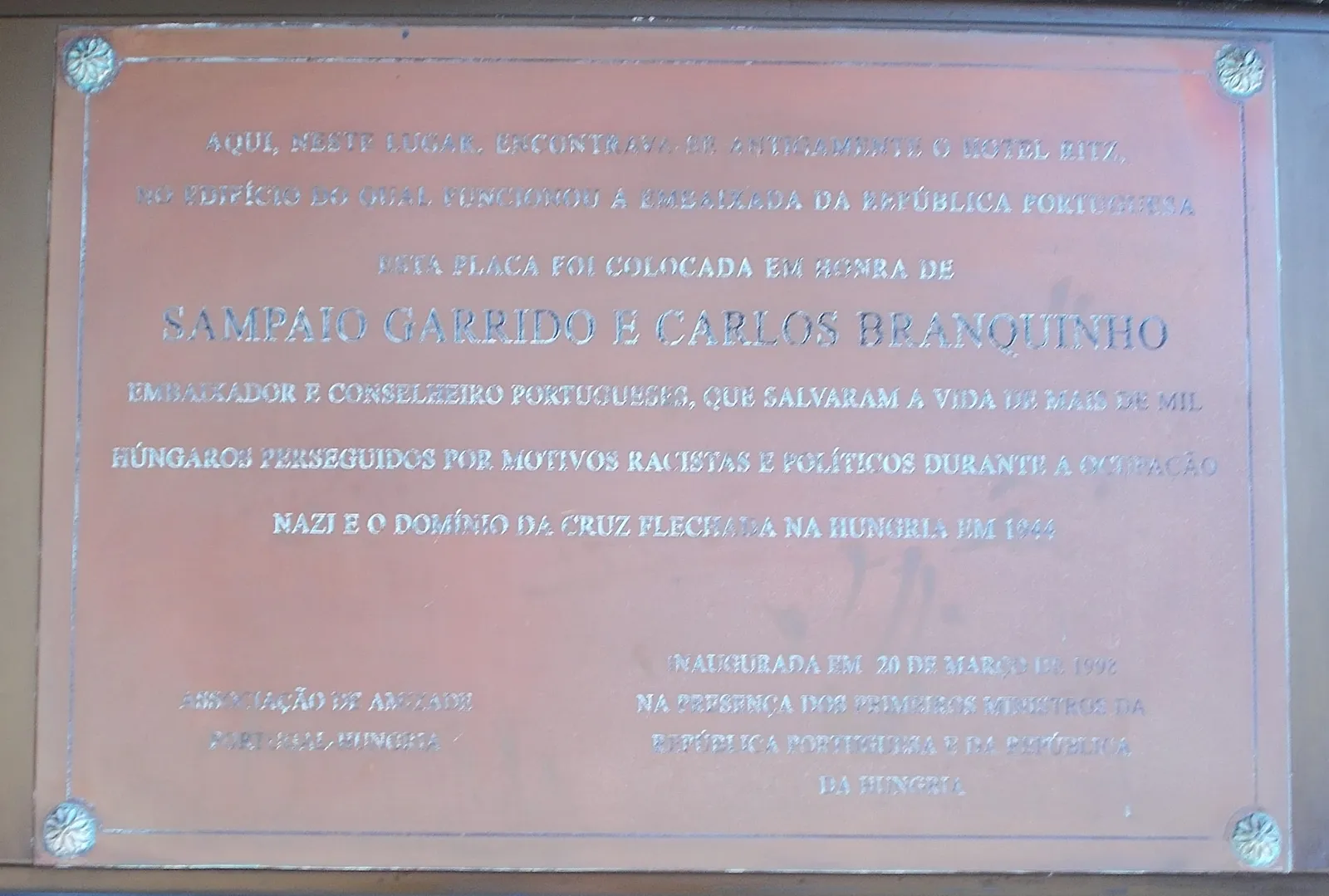
The story surfaced slowly. In 1994 Público ran reports headlined “Two Portuguese saved a thousand Jews” (translated from Portuguese). When the prime minister António Guterres visited Budapest in 1998, plaques to the two diplomats were put up where the legation had stood. In 2000 the Foreign Ministry opened its documents in the exhibition Spared Lives, which was made to tour Portuguese consulates in the United States; the International Raoul Wallenberg Foundation honoured both men in 2006, and the Hungarian Jewish Museum showed the telegrams in 2009.
On 2 February 2010 Yad Vashem, Israel's Holocaust remembrance centre, recognised Sampaio Garrido as Righteous Among the Nations, a title for non-Jews who risked themselves to save Jews. The medal was awarded posthumously, to be handed to his family by the Israeli ambassador in Lisbon. Mucznik argued that Branquinho deserved it too; he has not received it. Yad Vashem's statistics list three Righteous under Portugal as of 1 January 2024, out of 28,707 worldwide. Portuguese sources, counting by nationality, name four, adding the priest Joaquim Carreira and the emigrant worker José Brito Mendes to Sousa Mendes and Garrido.
Aristides de Sousa Mendes, who disobeyed orders in Bordeaux in 1940, is still the Portuguese rescuer everyone knows. In 2021 Portugal's foreign minister told a ceremony for “rescuer diplomats” that the action of Sampaio Garrido and Teixeira Branquinho in Budapest was by then well documented. In 2018 the Portuguese ambassador laid a wreath at the old legation site.
FAQs
Who was Carlos Sampaio Garrido?
A Portuguese diplomat born on 5 April 1883, who was Portugal's minister in Budapest from 1939 to June 1944. After the German occupation of Hungary he sheltered about a dozen people, most of them Jews, in a country house the legation rented, and fought their arrest in April 1944. Yad Vashem recognised him as Righteous Among the Nations in 2010.
How many Jews did Portugal save in Budapest?
The usual figure is about 1,000 people, from Branquinho's own count of those under Portuguese protection in October 1944, including about 700 holders of provisional passports. Other documents give 698, about 800 and 1,200 for different kinds of paper. How many of them survived the Arrow Cross terror and the siege is not known.
Did Sampaio Garrido disobey Salazar like Sousa Mendes?
Only partly. He sheltered people without telling Lisbon, and the ministry later complained of it, but his career continued and Lisbon then backed the protection effort. The provisional passports Branquinho issued were authorised by the Foreign Ministry, within limits it set.
Is Teixeira Branquinho recognised by Yad Vashem?
No. Yad Vashem recognised Sampaio Garrido in 2010, but Branquinho is not among the Portuguese it has honoured, although he ran the passport scheme. Esther Mucznik argued in Yad Vashem's own Portuguese materials that the title should be extended to him.
On the timeline
Open the timelineNearby moments from regeneration and the last kings (1851–1910).
Birth in Guarda of Carolina Beatriz Ângelo, Portugal's first woman surgeon. In 1911, as a widow and 'head of household', she won a court case that let her become the first woman to vote in Portugal — prompting the Republic to rewrite the electoral law in 1913 to bar women explicitly.
Lisbon marks the tercentenary of Camões's death with a great 'cortejo cívico' through its streets, organised by a commission of the Portuguese press and echoed by processions in towns across the country. The first large civic commemoration of its kind in Portugal turns 10 June into a national symbol and lays the foundations of today's Dia de Portugal.
Birth in Porto of naval officer José Carvalho Araújo (two Navy sources say 1880). In October 1918, commanding the small patrol boat 'Augusto de Castilho', he fought the German submarine U-139 for nearly two hours so that the steamer 'São Miguel', carrying 206 passengers from Madeira to the Azores, could escape. He died in the fight, and his ship was sunk.
Sampaio Garrido in Budapest
Birth of Carlos Sampaio Garrido, Portugal's envoy in Budapest during the Nazi occupation of Hungary. In 1944 he sheltered Jews in the legation's country house, among them relatives of the actress Zsa Zsa Gabor; after he left, his successor Teixeira Branquinho extended Portuguese protection to about 1,000 people. Yad Vashem named him Righteous Among the Nations in 2010.
Birth in Loulé of José Mendes Cabeçadas, the naval officer who helped both to make and to unmake the First Republic. A leader of the mutiny aboard the cruiser Adamastor in the 1910 revolution, he raised the 1926 revolt in Lisbon that toppled the Republic and was briefly head of state, until the generals pushed him aside. He spent his last decades conspiring against Salazar.
The Berlin Conference ends with 14 nations, Portugal among them, signing its General Act on trade and claims in Africa. Its rule that new coastal claims needed 'effective occupation' pushed Lisbon to back its claims with expeditions and the 'Pink Map' plan to link Angola and Mozambique, crushed by Britain's 1890 ultimatum.
Birth of Aristides de Sousa Mendes at Cabanas de Viriato, Beira Alta. As Portuguese consul-general in Bordeaux in June 1940, he would defy Salazar's standing orders and issue thousands of visas to refugees — many of them Jews — fleeing the Nazi advance, an act of conscience that cost him his career and would later earn him the title 'Righteous Among the Nations'.
Coming up in history
All long reads 7 April 1541Francis Xavier sails from Lisbon for Asia, 7 April 1541
 8 April 1484Diogo Cão, the mouth of the Congo and João II's reward of 8 April 1484
 9 April 1918La Lys, 9 April 1918: the morning Portugal’s army in France was overrun
 10 April 1871Domitila de Carvalho, the first woman to study at Coimbra since 1772
17 sources
Archives, scholarship and reporting this article was checked against.
- 1
Spared Lives: The Actions of Three Portuguese Diplomats in World War II. Documentary exhibition catalogue (Manuela Franco and Maria Isabel Fevereiro, eds.)Ministério dos Negócios Estrangeiros, Instituto Diplomático / Arquivo Histórico-Diplomático, Lisbon, 2000 (English edition hosted by the International Raoul Wallenberg Foundation)
- 2
Sampaio Garrido, o outro “Justo” português (Esther Mucznik)Yad Vashem, International School for Holocaust Studies, Portuguese educational materials, 2010
- 3
Portugal: Carlos Sampaio Garrido (exhibition panel drawing on Yad Vashem and the Arquivo Histórico-Diplomático)Direção-Geral da Educação (Ministério da Educação), Lisbon
- 4
The Holocaust in HungaryUnited States Holocaust Memorial Museum, Holocaust Encyclopedia
- 5
- 6
Zsa Zsa Gabor, often-married actress known for glamour, dies (Associated Press obituary)Anchorage Daily News, 18 December 2016
- 7
Secretary of State Hillary Clinton Commemorates Holocaust Days of Remembrance at Marshall CenterThe White House Blog, 27 April 2012
- 8
Os salvadores portugueses: diplomatas (service records of Carlos Sampaio Garrido and Alberto Teixeira Branquinho)Ministério dos Negócios Estrangeiros, Nunca Esquecer: Programa Nacional em torno da Memória do Holocausto
- 9
Da Constituição do Estado Novo português (1933) (Paulo Ferreira da Cunha)Historia Constitucional, n.º 7, 2006
- 10
- 11
Newsletter #168: Alberto Carlos de Liz Teixeira Branquinho, an ISEG alumnusISEG, Universidade de Lisboa, 5 January 2024
- 12Flores para Sampaio Garrido e Carlos BranquinhoDiário de Notícias, 28 January 2018
- 13
- 14
Megmentett életek: Portugál diplomaták Budapesten 1944-ben (Spared lives: Portuguese diplomats in Budapest in 1944), exhibition, 10 June to 10 August 2009Magyar Zsidó Múzeum és Levéltár (Hungarian Jewish Museum and Archives), Budapest
- 15
Aristides de Sousa Mendes homenageado em exposição na ONUSábado, 28 January 2019
- 16
Intervenção do Ministro de Estado e dos Negócios Estrangeiros na sessão de homenagem «Nunca esquecer os diplomatas salvadores»XXII Governo Constitucional, portugal.gov.pt, 10 December 2021
- 17
Holocausto: Alberto Carlos de Liz Teixeira BranquinhoABC Portuscale, Portuguese community newspaper in France, 31 March 2018
Image credits
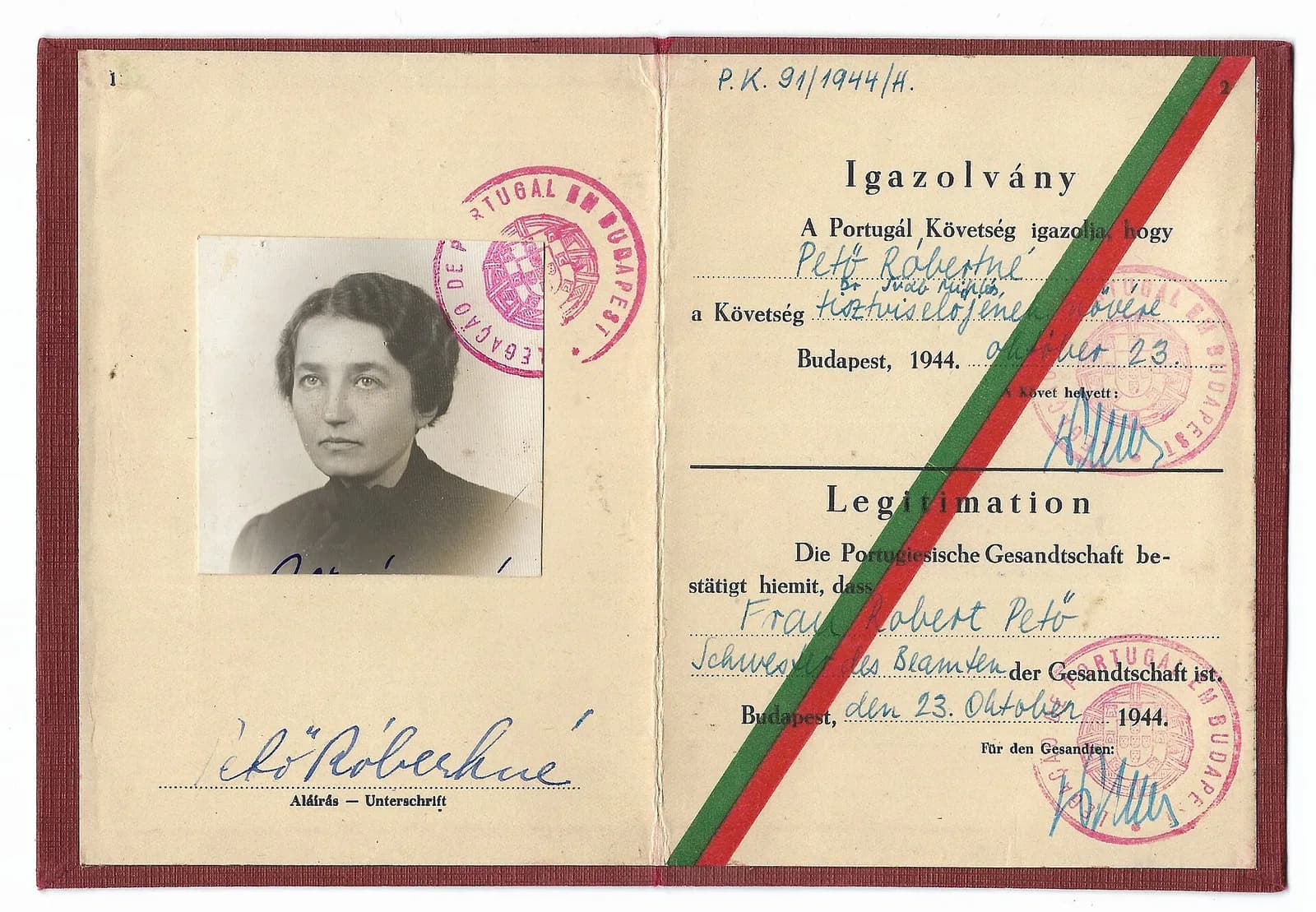
- An identity document issued by the Portuguese legation in Budapest on 23 October 1944, in Hungarian and German, certifying that Mrs Róbert Pető was the sister of a legation official. It was signed on behalf of the minister in the last week of Branquinho's mission. Huddyhuddy, CC BY-SA 4.0, via Wikimedia Commons.
- Galgagyörk from the air in 2018, with its Lutheran church and cemetery. The village is where the Portuguese legation rented a country house in April 1944; the house itself is not identified in the sources and is not shown here. Civertan, CC BY-SA 4.0, via Wikimedia Commons.
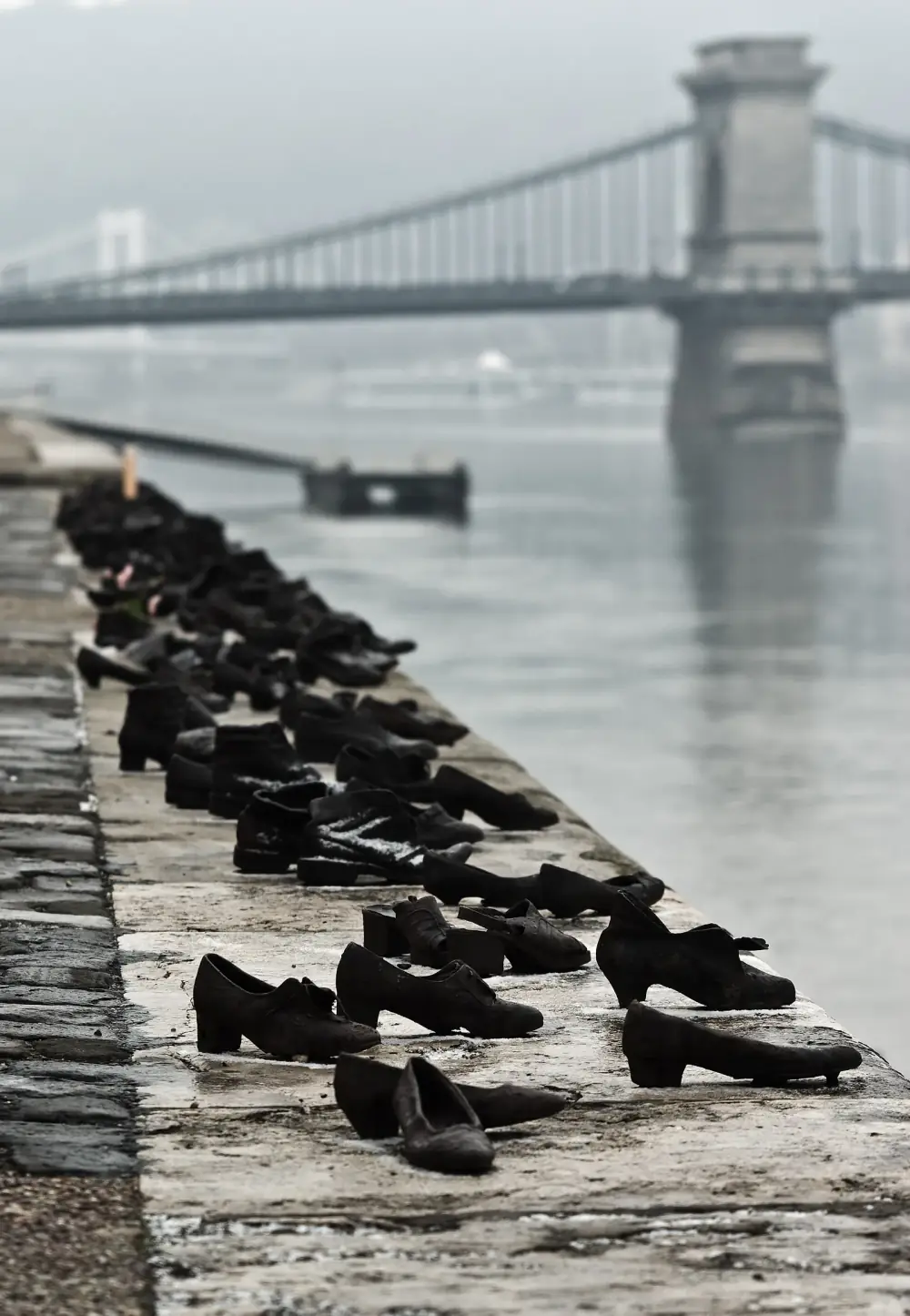
- The Shoes on the Danube Bank in 2012, a memorial to the Jews shot into the river by Arrow Cross militiamen in 1944 and 1945, with the Chain Bridge behind. The 1944 Portuguese legation stood a few hundred metres away. Nikodem Nijaki, CC BY-SA 3.0, via Wikimedia Commons.
- The plaque on the Hotel InterContinental in Budapest, photographed in 2018. In Portuguese it says the Hotel Ritz, which housed the Portuguese legation, once stood here, and that the two diplomats saved more than a thousand Hungarians persecuted on racial and political grounds in 1944. It was unveiled on 20 March 1998 in the presence of the Portuguese and Hungarian prime ministers. Globetrotter19, CC BY-SA 3.0, via Wikimedia Commons.