

Diogo Cão, the mouth of the Congo and João II's reward of 8 April 1484
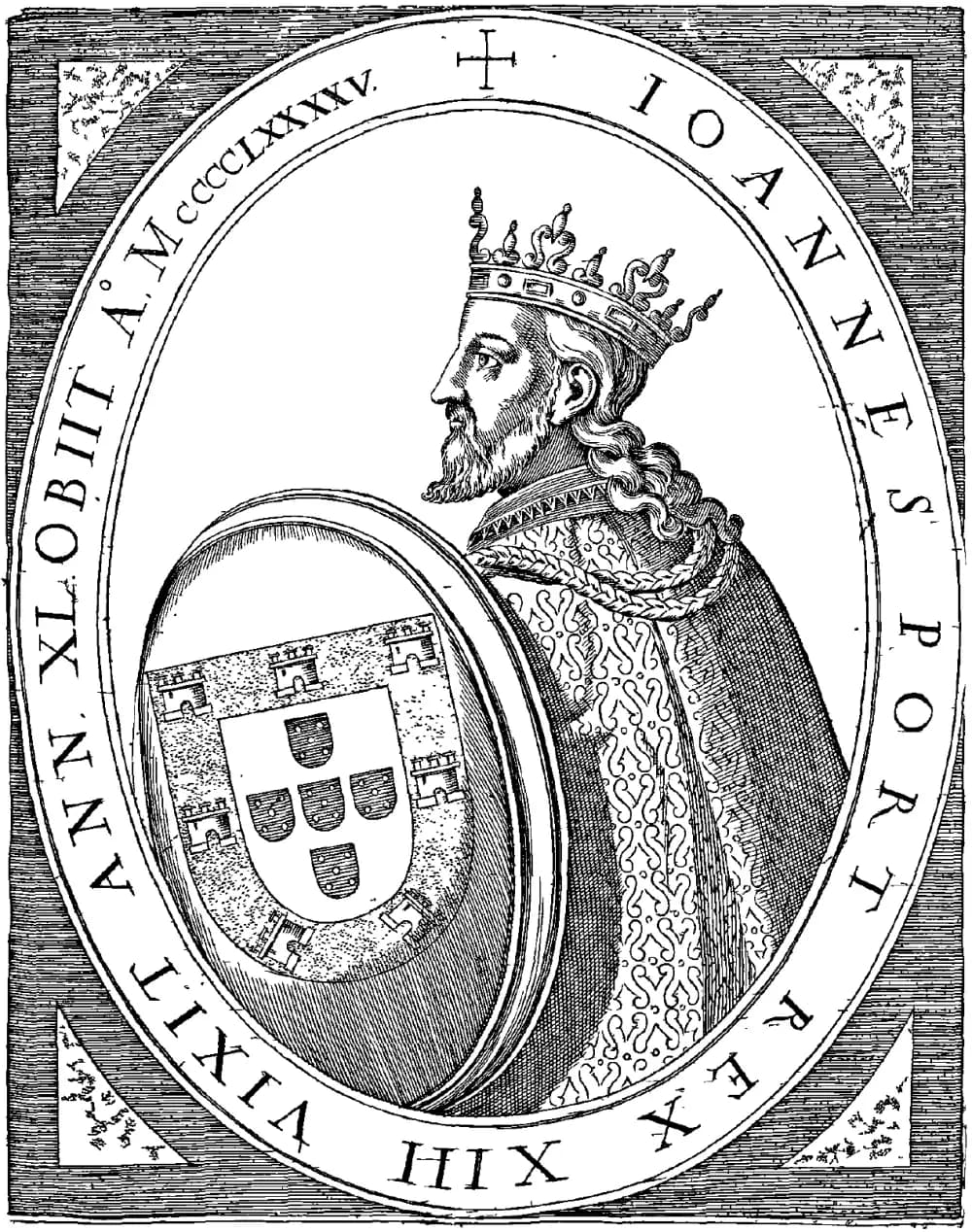
In 1482 a Portuguese captain found fresh water far out at sea and followed it to the mouth of the Congo. Back in Lisbon, King João II paid him an annuity and gave him a coat of arms with two stone pillars on it.
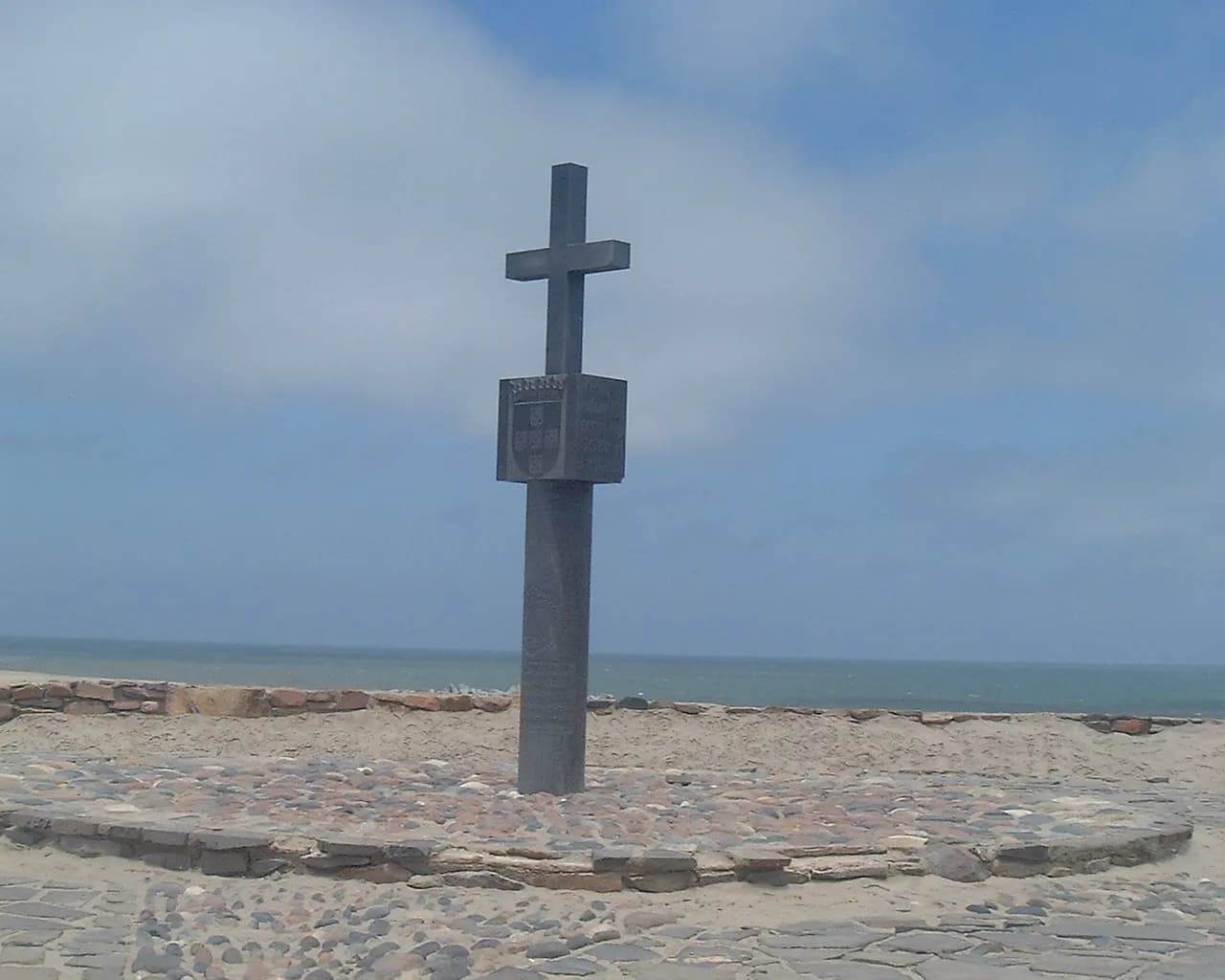
At a glance
- Diogo Cão sailed from Lisbon in 1482 on King João II's orders and became the first European known to reach the mouth of the Congo, which its people called the Zaire.
- He marked the coast with padrões, stone pillars carved in Portugal with the royal arms and an inscription. His first, dedicated to St George, stood at the river mouth; the second at Cabo de Santa Maria in Angola.
- On 8 April 1484 João II granted him an annuity of 10,000 reais for the voyage, and on 14 April made him a nobleman with a coat of arms showing two pillars.
- On a second voyage, from late 1485, he brought back to Kongo the four men he had seized there as hostages on the first, carved his name on a rock near the Yellala Falls up the Congo, and set up a last pillar at Cape Cross in Namibia.
- No one knows how his life ended. A map of about 1489 says he died beyond Cape Cross; the chroniclers have him return to Kongo and Lisbon. That last pillar was returned to Namibia by Germany in 2019.
Fresh water far out at sea
Working south along the African coast just north of the Congo in 1482, Diogo Cão's ship passed a line of red cliffs. While the ship was still five leagues from land, about 30 kilometres, the water around it was fresh. A legend on a chart drawn soon after the voyage records the moment.
João de Barros, the royal historian who told the story in 1552, wrote that in the rainy season the river came into the sea so strongly that its water was fresh twenty leagues out. Its own people called it the Zaire. The Portuguese first named it the river of the padrão, after the stone pillar Cão set up at its mouth. Later they called it after the kingdom it ran through, Kongo.
Cão took his ship a short way upstream. People crowded the banks, but his interpreters, Africans from coasts already known to the Portuguese, could not make themselves understood. By signs, the people told him that a powerful king lived inland, so many days' walk away.
On 8 April 1484, back in Lisbon, King João II rewarded Cão for that voyage with an annuity. Six days later he made him a nobleman, with a coat of arms bearing two of his stone pillars. What became of Cão after his next voyage is still unknown.
What you need to know first
Portuguese ships had been working down the west coast of Africa since Gil Eanes rounded Cape Bojador in 1434. Under King Afonso V the crown leased the Guinea trade to a contractor, Fernão Gomes, on condition that his captains discovered new coast; Barros credits them with 500 leagues of it. By the time his monopoly ended in 1475 they had reached Cabo de Santa Catarina, just south of the equator, where a tree marked their furthest point.
João II, Afonso's son, had drawn the revenues of the Guinea trade since 1473 and became king in 1481. His first move was to protect that trade from Castilian and other interlopers. On 20 January 1482 Diogo de Azambuja laid the foundations of São Jorge da Mina, a fortress on the Gold Coast. Through it, Barros wrote, the king meant to take possession of the whole coast.
Then he took up exploration again. The chronicler Rui de Pina called him a good Catholic and a man with an inquiring mind. His captains were also after trade and, before long, news of Prester John, a Christian king Europeans hoped to find somewhere in Africa or Asia.
He chose Diogo Cão, of whom little is known before 1482. The geographer E. G. Ravenstein, who studied the documents in 1900, called him a man of the people, descended from a bailiff of Vila Real in Trás-os-Montes. In 1480 he had captured three Spanish ships on the Guinea coast. Vila Real claims him as a native, and in 1948 the town put a plaque on a house on its main square said to have been his.
The first voyage, 1482 to 1484
No log or letter from the voyage survives. Its dates come from stone and parchment. The pillar Cão set up in Angola is inscribed with the year 6681 of the world and 1482 of Christ. In the calendar it uses, the year 6681 began on 1 September 1481, so Ravenstein concluded that the king gave his order between January and August 1482 and that Cão sailed around June.
The chroniclers got the dates wrong. Barros put the voyage in 1484 and Rui de Pina in 1485. Royal letters from April 1484 prove Cão was already home by then.
Cão called at São Jorge da Mina for supplies and then made for Cape Lopez, in modern Gabon. Beyond it progress was slow, because the current runs north and the winds blow from the south. One bay, which may be Loango Bay, he named the beautiful beach of São Domingos. If he arrived on the saint's day, 4 August, he reached the Congo later that month, which is why the discovery is usually dated to August 1482. The Belgian historian René Cambier put it in 1483.
On the southern point of the river mouth, in what is now Angola, he set up his first pillar. It was dedicated to St George, a saint for whom the king had a singular devotion, Barros says. Cão then sent a few of his men inland with presents for the king, guided by local people who promised to bring them back within a set number of days. Ravenstein and Cambier describe the envoys as Black Christians from his crews.
The king they were sent to was the ruler of Kongo, the Mani Kongo, whose capital, Mbanza Kongo, lay nearly 250 kilometres inland. It was later renamed São Salvador and is now in northern Angola.
Cão did not wait for them. He sailed south along the coast of present-day Angola, past the islands off modern Luanda. At a low headland he called Cabo do Lobo, Seal Cape, now Cabo de Santa Maria at 13 degrees 26 minutes south, he set up his second pillar, dedicated to St Augustine. A chart drawn soon afterwards marks it as the last one.
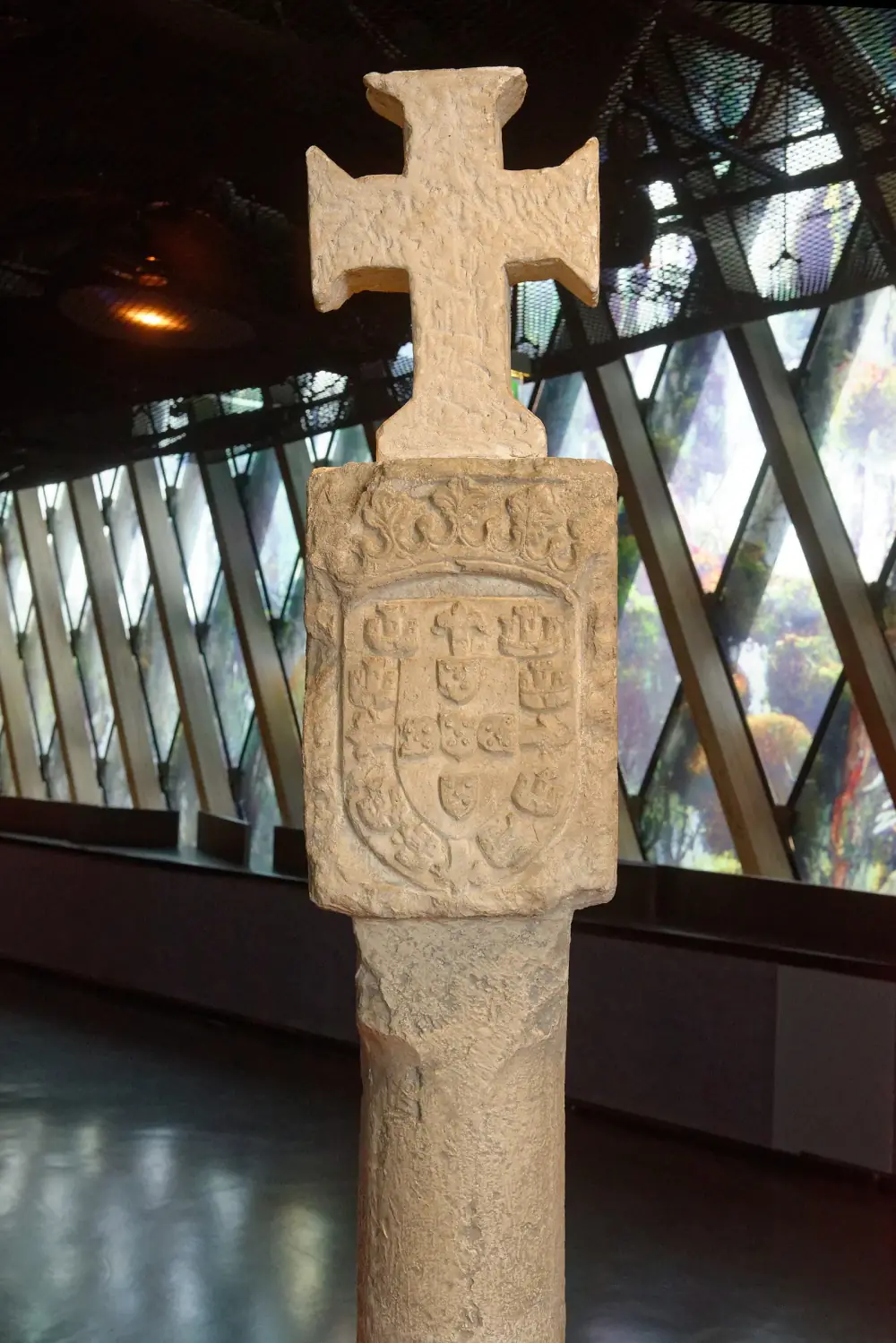
“In the year 6681 of the World, and in that of 1482 since the birth of our Lord Jesus Christ, the most serene, most excellent and potent prince, King D. João II of Portugal did order this land to be discovered and these padrões to be set up by Dº Cão, an esquire of his household.”
Back at the Congo, the envoys had not returned, though they had been gone twice the time agreed. Local people still came aboard freely to trade. Cão seized four of them and let their people understand, by signs, that he would bring them back in fifteen moons and exchange them for his own men. Barros says the four were noblemen.
According to Rui de Pina, the Portuguese at the king's court had been well treated until then. When the king heard what Cão had done, he refused to receive them and threatened to kill them if his people were not brought back in time.
Two pillars on a coat of arms
Cão was back in Lisbon early in 1484. His hostages had picked up Portuguese on the way, Barros says, and could already answer questions about their country. João II was pleased with one of them, a nobleman called Caçuta. The four were dressed in fine cloth and silk.
The king first made Cão a cavaleiro, a knight of the royal household. Then, on 8 April 1484, he granted him an annuity of 10,000 reais, which could pass after his death to one surviving son, “in consideration of the services rendered in the course of a voyage of discovery to Guinea, from which he had now returned”.
On 14 April, six days later, the king ennobled him and gave him arms. The shield was green, with two silver columns, each rising from a small mound and topped by a cross: the two padrões he had planted in Africa. For a crest, the two columns were crossed and tied with a green ribbon.
- Annuity granted
- 8 April 1484
- Arms and nobility
- 14 April 1484
- Granted by
- King João II
- Annuity
- 10,000 reais a year, transferable to one surviving son
- Rank
- Knight (cavaleiro) of the royal household, then noble
- Arms
- Green field with two silver pillars, each topped by a cross
- Published
- By Albano da Silveira in 1845 and Luciano Cordeiro in 1892
The promotion can be read in stone. On the pillar of 1482 he is an escudeiro, an esquire of the king's household. On the pillar he set up on his next voyage, carved after these grants, he is a cavaleiro, a knight.
The second voyage and the rock at Yellala
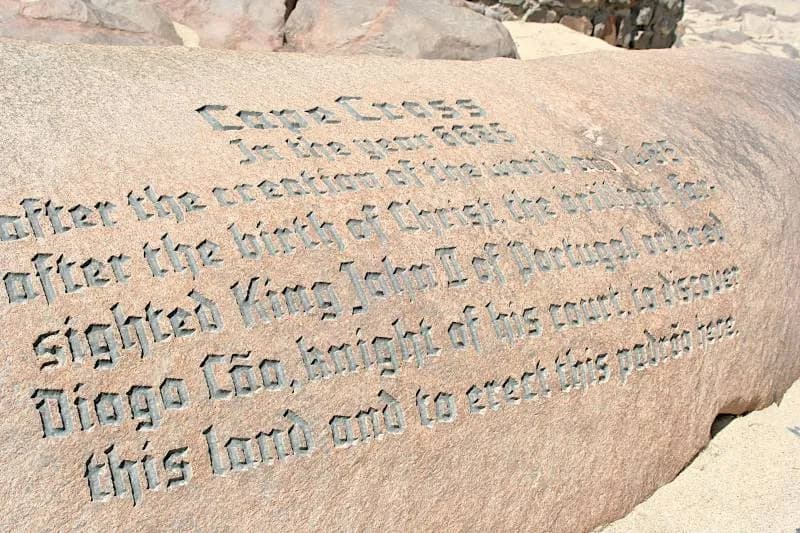
The next expedition did not sail until late 1485: the Cape Cross pillar gives the year 6685 of the world, which began on 1 September 1485, and 1485 of Christ. Ravenstein thought the delay may have been to carve the new royal arms João II adopted that year. The date was carved in Portugal before the ships left, so the pillar itself probably went up in 1486, the year the German government gives for it.
This time Cão led more than one ship. Ravenstein names Pero Anes and Pero da Costa as his fellow captains. On board were the four Kongo hostages, carrying presents from João II and a message inviting their king to give up his old religion and become a Christian.
Barros says the people at the river mouth were delighted to see their kinsmen alive and well dressed. Cão sent one of the four inland to the king, got his own men back in exchange for the other three, and promised to visit the king on his way back from the south.
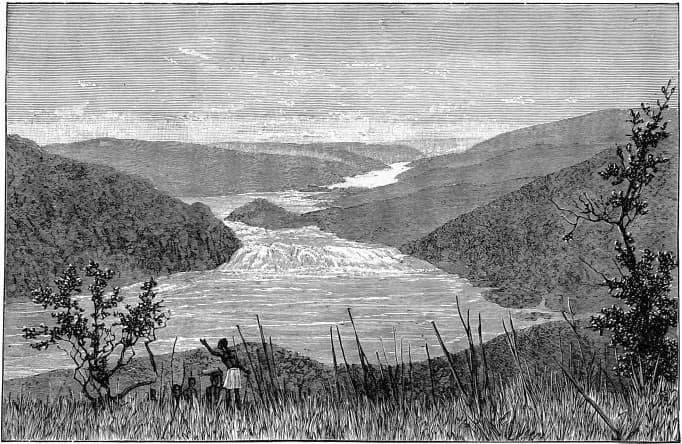
At some point the Portuguese also went up the river itself, about ninety miles, past the site of the modern port of Matadi to where the Congo breaks into rapids. Within sight of the Yellala Falls they cut a cross, the royal arms and their names into the rock.
“Thus far came the vessels of the illustrious King D. João II. of Portugal: Dº Cão, Pº Annes, Pº da Costa.”
More names follow. Pero Escolar later piloted one of Vasco da Gama's ships, and João de Santiago sailed with Bartolomeu Dias in 1487, as pilot of the store-ship according to Barros. Among the names are crosses and the words “of illness”, which may mark men who died of disease.
One name is missing. Martin Behaim, the Nuremberg merchant whose globe of 1492 survives, later claimed to have commanded one of Cão's ships. Ravenstein concluded that he was never part of the expedition.
Barros does not mention the trip, and the inscription has no date. Its coat of arms is the version adopted in 1485, so it cannot be earlier, and Ravenstein and Cambier both place it on the second voyage. The rock is about 2 kilometres above the mouth of the Mpozo river, where the rapids begin. A map marked a “Portuguese padrão” there by 1882. Cambier credits its discovery to a missionary at Matadi, Domenjos, whose photograph of it was published in 1907.
Then Cão headed south past his old pillar, raiding ashore now and then to seize people who could be taught Portuguese and used as interpreters, Barros says. About 160 miles beyond Cabo de Santa Maria, at 15 degrees 41 minutes south, he set up a pillar on a black headland that rises like an island, Monte Negro.
The coast grew poorer until there were only sandhills and bare rock. At 21 degrees 50 minutes south, on a low cone of red sandstone in what is now Namibia, he set up his last pillar. The place is Cape Cross. Ravenstein identified the furthest point the fleet reached as the Serra Parda of the old charts, a dark cliff a little further south.
| Pillar | Place | Latitude | Voyage | What became of it |
|---|---|---|---|---|
| São Jorge | Southern point of the Congo mouth, Angola | About 6° S | First, 1482 | Broken up by the Dutch in 1642; two large fragments went to the Lisbon Geographical Society |
| Santo Agostinho | Cabo do Lobo, now Cabo de Santa Maria, Angola | 13° 26′ S | First, dated 1482 | Recovered intact, without its cross |
| Monte Negro | Cabo Negro, Angola | 15° 41′ S | Second, 1485 to 1486 | Inscription worn away; taken to the Lisbon Geographical Society |
| Cape Cross | Cape Cross, Namibia | 21° 50′ S | Second, dated 1485 | Taken to Germany in 1893; returned to Namibia in 2019 |
Latitudes as given by Ravenstein (1900); Cambier (1951) puts Cape Cross at 21° 47′ S. The Congo pillar stood on Shark Point, on the south side of the river mouth. Ravenstein's list prints 5° 4′ S for it, evidently a misprint, since it comes between points at 5° 44′ and 6° 31′.
How far south the Portuguese had reached, 1475 to 1488
degrees south of the equator
Latitudes from Ravenstein's 1900 list of place-names, converted from degrees and minutes: Cabo de Santa Catarina 1° 50′, Cabo do Lobo 13° 26′, Serra Parda 22° 9′, and Cape Agulhas 34° 49′, the most southerly point of Africa, which Dias passed. In two voyages Cão moved the known coast about 20 degrees south.
Show the data
| Furthest point on the African coast | |
|---|---|
| Santa Catarina, by 1475 | 1.8 |
| Cão, 1482-84 | 13.4 |
| Cão, 1485-86 | 22.2 |
| Dias, 1487-88 | 34.8 |
The mystery of his death
After 1486 Cão's name disappears from Portuguese records. How his life ended is still argued over, and two very different accounts survive.
The first is a note on a world map drawn around 1489 by Henricus Martellus Germanus. Beside the African coast he wrote that Cão had died just beyond his last pillar.
“This mountain, called the Black mountain, was reached by the fleet of the second King of Portugal, which fleet was commanded by Diegus Canus, who, in memory of this fact, set up a marble column, with the emblem of the cross, and proceeded onwards as far as the Serra parda, which is distant 1000 miles from the Black mountain, and here he died.”
A Spanish document seems to agree. In 1524 the astronomers and pilots advising Spain at the meeting with Portugal at Badajoz wrote that Cão, on his second voyage, discovered the coast from Monte Negro to the Serra Parda, “donde murió”, where he died. Among those who signed it were Hernando Colón, son of Christopher Columbus, and Juan Sebastián Elcano.
The Portuguese chroniclers tell a different story. Rui de Pina and Barros have Cão return to the Congo and visit the king, who asked João II for priests, masons, carpenters and women to bake bread. The king sent Caçuta back to Portugal with Cão as his ambassador, with young men to be taught and baptised, and gifts of ivory and palm cloth. At Beja, Barros says, Caçuta was baptised with the king as his godfather and the queen as godmother, and took the name João da Silva.
Ravenstein found that the dates did not fit. Caçuta appears to have been baptised early in 1489, but Cão's ships were back before Dias sailed in August 1487, probably by the autumn of 1486. Ravenstein thought the chroniclers had given Cão events that belonged to a later voyage, perhaps Dias's.
Others have disagreed. Writing in 1951, Cambier reported the view of Mgr Cuvelier, an authority on the Portuguese discoveries, that the second voyage left in 1484 or early 1485, and that Cão made a third in 1487 and 1488 and then went home to die in Vila Real. Cambier was not persuaded. He accepted only that the expedition, with or without its leader, was back in Lisbon before Dias set out.
What the pillars led to
Soon after Cão's ships came home, Bartolomeu Dias was given command of a new fleet. He sailed in August 1487, taking home some of the people Cão had seized south of the Congo, passed Cão's last pillar and went on to round the southern tip of Africa. Barros counted 750 leagues of new coast found by the two captains, with six pillars along it.
The contact Cão made with Kongo lasted much longer than he did. In December 1490 Caçuta, now João da Silva, sailed home with João II's ambassador, though both died of plague on the way, and the embassy reached the Congo in about a hundred days. It was received by the king of Kongo in 1491, and the conversion of that king, which Barros saw as the fruit of the hostages' baptism, is another story.
The Capuchin missionaries Cavazzi and Merolla recorded that the Dutch broke up the São Jorge pillar when they occupied the Congo coast in 1642. Local priests kept the fragments as powerful charms, until two large pieces went to the museum of the Lisbon Geographical Society, which also received the Monte Negro pillar.
In 1893 Captain Becker of the German warship Falke carried the Cape Cross pillar off from what was then German South West Africa. It went to Kiel and then to the Institute of Oceanography in Berlin. In 1895 Kaiser Wilhelm II had a granite copy set up on the cape, with an added German inscription and the imperial eagle.
20 January 1482
Foundations of São Jorge da Mina laid
João II secures the Gold Coast before sending ships further south.
c. June 1482
Cão sails from Lisbon
Ravenstein's estimate, from the date on the Santo Agostinho pillar.
Probably August 1482
Mouth of the Congo
Padrão of São Jorge set up; envoys sent to the king of Kongo.
1482 or 1483
Cabo de Santa Maria
Padrão of Santo Agostinho; four Kongo men taken as hostages on the way home.
8 April 1484
Annuity of 10,000 reais
Granted by João II for the voyage of discovery.
14 April 1484
Ennobled
Coat of arms with two padrões.
After 1 September 1485
Second voyage sails
With the hostages and new pillars carved with the arms of 1485.
1485 or 1486
Yellala and the south
Names carved near the Yellala Falls; pillars on Monte Negro and Cape Cross.
By 1487
Ships home
Cão's own fate is unknown.
c. 1489
Martellus map
A legend says Cão died at the Serra Parda.
1893
Cape Cross pillar removed
Taken to Germany by the cruiser Falke.
August 2019
Pillar back in Namibia
Shipped home after Germany agreed to return it.
Why it still matters
Five centuries on, Cão's last pillar became the subject of a restitution claim. Namibia asked Germany for it in a diplomatic note of 1 June 2017. On 16 May 2019 the trustees of the Deutsches Historisches Museum in Berlin, where it had been on show since 2006, agreed to give it back. The museum describes the cross as limestone, 3.5 metres tall and weighing 1.1 tonnes.
“The pillar is important for reconstructing our own history and we are grateful that the Board of Trustees granted the wish of the Namibian government and people to have it restituted.”
The pillar reached Namibia by ship in August 2019. In May 2021 the German government told the Bundestag that it was still in a warehouse in Walvis Bay, carefully packed, while the two countries negotiated the formal handover. The German copy of 1895 had been declared a Namibian national monument in 1968, and a faithful replica of the original was unveiled on the site in 1986.
For Portugal, Cão's landing at the Congo began a long relationship with Kongo, and it began with gifts and hostages. The river still carries the name of the kingdom he found on its banks, and the point where his first pillar stood is still called Ponta do Padrão, the point of the pillar.
FAQs
Who was Diogo Cão?
A Portuguese captain sent by King João II to explore the African coast beyond the equator. On two voyages, in 1482 to 1484 and from late 1485, he reached the mouth of the Congo and followed the coast of Angola into Namibia, marking it with stone pillars. He was knighted, given an annuity on 8 April 1484 and ennobled on 14 April.
Did Diogo Cão discover the Congo River?
He was the first European known to reach its mouth, probably in August 1482. The people living there already knew it as the Zaire. He set up a stone pillar on its southern point and later sailed up it as far as the rapids near the Yellala Falls, above present-day Matadi.
What is a padrão?
A stone pillar topped with a cross and carved with the Portuguese royal arms and an inscription naming the king, the year and the captain. João II introduced them to replace wooden crosses, and Diogo Cão was the first to carry them. He set up four: at the Congo mouth, at Cabo de Santa Maria and Cabo Negro in Angola, and at Cape Cross in Namibia.
How did Diogo Cão die?
No one knows. A map by Henricus Martellus from about 1489, and a Spanish opinion of 1524, say he died at the Serra Parda, just south of Cape Cross, on his second voyage. The chroniclers Rui de Pina and João de Barros have him return to Kongo and Lisbon. Another theory has him dying at home in Vila Real after a third voyage.
Where is the Cape Cross pillar now?
It was taken to Germany in 1893 and shown in Berlin until Germany agreed in 2019 to return it. It reached Namibia by ship in August 2019. Germany put up a copy on the cape in 1895, and a faithful replica was unveiled there in 1986.
On the timeline
Open the timelineNearby moments from the age of discoveries (1415–1580).
Isabel of Portugal, Duchess of Burgundy, dies at Aire-sur-la-Lys aged 74. The only surviving daughter of João I and Philippa of Lancaster, she governed the Burgundian Low Countries in her husband's absence, negotiated trade deals with England and was the mother of Charles the Bold.
Portugal and Castile sign the Treaty of Alcáçovas, ending the War of the Castilian Succession; Castile keeps the Canaries while Portugal's possession of Madeira, the Azores, Cape Verde and Guinea is recognised — the first treaty to divide the Atlantic world between European powers.
King Afonso V of Portugal, known as 'the African' for his conquests in Morocco, dies at Sintra and is succeeded by his son João II, under whom Portuguese exploration would flourish.
Diogo Cão and the Congo
King João II grants an annuity 'in consideration of his services' to Diogo Cão, back in Lisbon from the voyage on which he became the first European to reach the mouth of the Congo. Days later he was given a coat of arms bearing the two padrões — carved stone pillars — he had planted on the African coast.
Pêro da Covilhã and Afonso de Paiva set out from Santarém on João II's secret overland mission to find the spice route to India and the court of Prester John. Travelling disguised as merchants via Cairo and Aden, Covilhã would reach India years before Vasco da Gama.
Bartolomeu Dias lands at Mossel Bay, South Africa, on the day usually reckoned from its old name, São Brás (St Blaise's day). He had passed the Cape of Good Hope unseen, the first known European to sail beyond Africa's southern tip.
Nzinga a Nkuwu, ruler of the Kingdom of Kongo, is baptised by Portuguese missionaries and takes the Christian name João, after Portugal's king. The alliance brings priests and masons, but within a generation his son Afonso I is writing to João III to protest that Portuguese slave traders are depopulating his kingdom.
Coming up in history
All long reads 10 April 1871Domitila de Carvalho, the first woman to study at Coimbra since 1772
 11 April 1607Bento de Góis: the Azorean Jesuit who walked from India to China
 12 April 2016Francisco Nicholson, the revue writer who gave Portugal its own telenovela
 13 April 1961The Abrilada: how Salazar outmanoeuvred his generals in April 1961
9 sources
Archives, scholarship and reporting this article was checked against.
- 1
The Voyages of Diogo Cão and Bartholomeu Dias, 1482-88 (E. G. Ravenstein)The Geographical Journal, vol. XVI, no. 6, December 1900, pp. 625-655 (digitised by the Internet Archive)
- 2
- 3
Martin Behaim: His Life and His Globe, chapter VII: Behaim's African voyage, 1484-85 (E. G. Ravenstein)George Philip & Son, London, 1908 (online edition, Friedrich-Alexander-Universität Erlangen-Nürnberg)
- 4
Cão ou Cam (Diogo) (R. Cambier)Biographie Coloniale Belge, vol. II (1951), col. 134-137, Institut royal colonial belge (Royal Academy for Overseas Sciences)
- 5
The Stone Cross from Cape Cross: the Deutsches Historisches Museum to return the Stone Cross of Cape Cross to NamibiaDeutsches Historisches Museum, press release, 17 May 2019
- 6
Die Säule von Cape Cross: Antwort der Bundesregierung (Drucksache 19/29464)Deutscher Bundestag, 7 May 2021
- 7
Minister of State Müntefering on the return of the Stone Cross of Cape Cross to NamibiaFederal Foreign Office (Germany), press release, 16 May 2019
- 8Visita Guiada: Sociedade de Geografia de Lisboa (episode 16, season 9)RTP, 30 September 2019
- 9
Museu da Sociedade de Geografia de LisboaVisit Lisboa (Turismo de Lisboa)
Image credits
- A replica of Diogo Cão's padrão at Cape Cross, on the coast of Namibia, photographed in 2005. The original, the southernmost pillar he set up, was shipped to Germany in 1893 and went back to Namibia in 2019. Bupa66, CC BY-SA 2.0, via Wikimedia Commons.
- A plaster cast, made in the 1930s, of the padrão of Santo Agostinho that Cão set up at Cabo do Lobo, now Cabo de Santa Maria in Angola. Its inscription is dated 1482, and the arms are the version in use before 1485. Royal Museum for Central Africa, Belgium. Marie-Lan Nguyen, CC BY 4.0, via Wikimedia Commons.
- King João II, who reigned from 1481 to 1495, in an engraving by Pedro Perret published in 1603, more than a century after his death. Pedro Perret, Public domain, via Wikimedia Commons.
- The Yellala Falls on the lower Congo, above Matadi, in an engraving from Henry Morton Stanley's book of 1885. Cão's men carved their names on rocks within sight of the falls. Henry Morton Stanley, Public domain, via Wikimedia Commons.
- An English version of the Cape Cross inscription, carved on a stone beside the replica pillar at Cape Cross. It is dated 1485, the year João II ordered Diogo Cão, knight of his court, to set up the padrão. National Heritage Council of Namibia, CC BY 4.0, via Wikimedia Commons.