

La Lys, 9 April 1918: the morning Portugal’s army in France was overrun
One worn-out Portuguese division, hours from being relieved, held seven miles of French Flanders when the second German spring offensive struck. By midday it had ceased to exist, and some 6,500 of its men were on their way to German prison camps.
At a glance
- At about 4.15 on the morning of 9 April 1918 German guns opened Operation Georgette, the second of Ludendorff’s spring offensives, on a front in French Flanders whose centre was held by the Portuguese 2nd Division.
- The division was alone in a sector built for two, and was due to be relieved that night. Eight German divisions attacked it out of thick fog at about 8.45; by early afternoon it had been destroyed as a fighting force.
- Portuguese counts of the losses run from 6,983 men (398 dead and 6,585 prisoners) to about 7,500. Most were captured, among them all three of the division’s front-line brigade commanders.
- Private Aníbal Milhais covered the retreat with his Lewis gun and spent days behind German lines. He received the Tower and Sword, dated 31 August 1918 in the official register, and the nickname Soldado Milhões, “Soldier Millions”.
- The Portuguese Expeditionary Corps never fought again as a corps. Since 1921 the date has been marked at the tomb of the Unknown Soldier in the Batalha monastery, and since 2020 9 April has been Portugal’s official day of its war veterans.
Every line cut
Captain Dartford, a British liaison officer attached to the Portuguese 4th Infantry Brigade, woke at 4.10 on the morning of Tuesday 9 April 1918 to very heavy shelling. He telephoned brigade headquarters. Every line was already cut. He dressed and set out up the Rue de la Gare under fire, smelt gas, pulled on his respirator and dodged into doorways as the shells came down.
When he reached the brigade dugout there was nothing to do. For three hours the men inside kept the gas blankets down and struggled for air, while a thick fog lay over the flat country of French Flanders and cut every post off from its neighbours. Along the whole Portuguese front the telephone lines had gone.
“Next three hours we could do nothing, but nearly got asphyxiated by lack of oxygen owing to having to keep gas blankets down. Heavy fog on and everybody seemed isolated from others.”
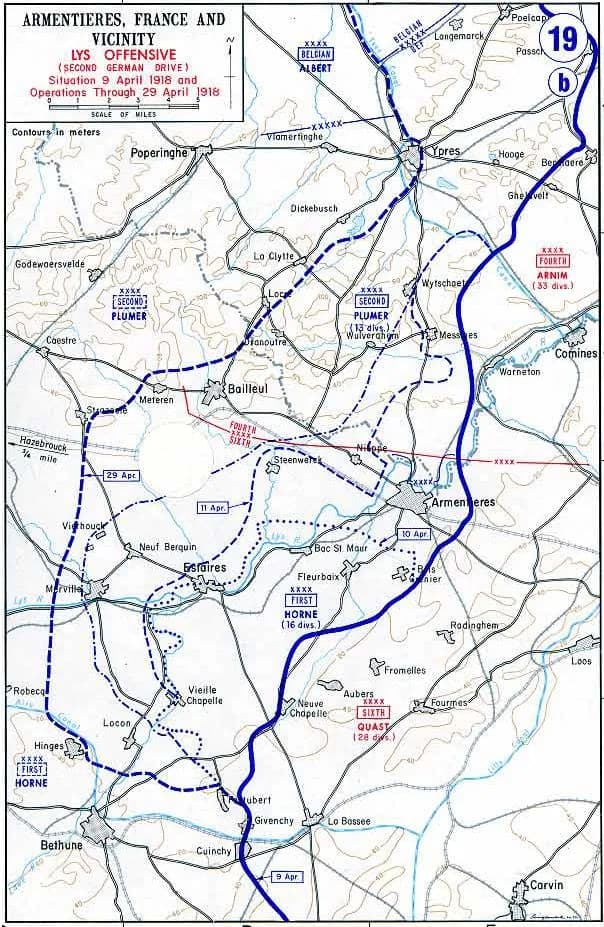
By the end of the morning the Portuguese sector between Neuve Chapelle and Fauquissart had been overrun. Portugal calls what followed the Battle of La Lys, after the river that ran behind the lines. It was the costliest day of the country’s war.
One division left in the line
Portugal had sent the Corpo Expedicionário Português (CEP), an army corps of two divisions, to fight inside the British army under a convention signed in January 1917. From November 1917 both divisions held a sector of about 12 to 14 kilometres between Neuve Chapelle and Fauquissart, a stretch the British thought quiet.
The men had been promised relief and home leave. It never came. After Sidónio Pais seized power in Lisbon in December 1917 no more reinforcements reached France, and officers on leave were allowed to stay at home. The commander of the 2nd Division, Simas Machado, went to Lisbon in February 1918 and did not return; General Gomes da Costa took over the division in March.
Under a plan Pais had accepted, the British began taking the Portuguese out of the line. On 4 April men of three battalions of the 1st Division refused to go back to the trenches, and two days later the division was withdrawn. The 2nd Division was placed under General Richard Haking’s British XI Corps and left to hold the whole sector alone until its own relief, due on the night of 9 to 10 April.
Front held by each division on the morning of 9 April 1918
yards
From south to north along the attack front, as given by Jesse Pyles (2012). The British figures are from the British official history, which puts the Portuguese front at 10,000 yards; Pyles, following Gomes da Costa’s report, says it exceeded 12,000 yards, about 11 kilometres. Portuguese accounts give 12 kilometres.
Show the data
| Front line held | |
|---|---|
| British 55th Division | 4,000 |
| Portuguese 2nd Division | 12,000 |
| British 40th Division | 7,500 |
Its three front-line brigades had four battalions each. In each brigade sub-sector two battalions held the front lines, called A and B, a third waited in Line C and the fourth sat in reserve in the Village Line. A fourth brigade, the 3rd, was in divisional reserve, posted so far back that it could not help quickly.
The battalions were badly under strength. By April the division was 399 officers and 7,059 men short, and the twelve battalions averaged about 400 rifles each. One, the 1st Battalion, had 13 officers and 153 men fit for duty.
Carlos Lopes dates to 7 April Haking’s order that the division must die on Line B. Jesse Pyles found the decision behind it in the minutes of an XI Corps conference of 25 March: Haking resolved that his British divisions would make their stand on the Village Line, about a kilometre further back, while the Portuguese were told to fight on Line B. By Pyles’s reading of the minutes, Haking did not mean to tell them.
Ludendorff’s second blow
The attack was part of the German gamble of spring 1918. With Russia out of the war, General Erich Ludendorff could bring divisions west and try to win before the Americans arrived in strength. Operation Michael, launched on 21 March against the British in Picardy, drove them back but stalled, and was called off on 5 April. Four days later came Georgette.
Its aim was to break through towards Hazebrouck, a railway junction and British supply depot behind the Portuguese front, and push on towards the Channel ports. The French historian Jean-Jacques Becker told RTP that Ludendorff chose the spot because it offered a short road to the Flemish coast and because he expected to meet less hardened troops.
The German Sixth Army under General Ferdinand von Quast struck the joins between the Portuguese and the British divisions on either side, as the Germans had struck the join between British and French armies in March. Its guns were directed by Colonel Georg Bruchmüller, the artillery planner of Operation Michael.
- German guns
- About 1,500 (Fraga) to 1,686 (Zabecki, cited by Pyles)
- Shells fired on the first day
- About 1.4 million (Zabecki, cited by Pyles)
- German divisions against the Portuguese
- Eight in most accounts; the Revista Militar says four, followed by four more, and General Tamagnini’s dispatch spoke of four
- Attack front
- About 15 kilometres (Fraga); 10 to 11 miles (Pyles)
- Portuguese defenders
- About 20,000 in all (EuroDefense); the three front-line brigades mustered 294 officers and 9,028 men (Pyles)
Overrun in the fog
The bombardment worked from the rear forwards, smashing roads, batteries and headquarters, then the trenches. Most of the men in the front line survived it. Then a creeping barrage began to walk towards them, with the German infantry close behind. One platoon of the 20th Battalion, on the Portuguese left, lost 26 of its 38 men to it at about nine.
The main German infantry attack went in at about 8.45. The attackers came in small storm-troop groups that slipped past strongpoints and left them to the waves behind, and the fog, which did not lift until after ten, hid them until they were in the trenches. Portuguese reports describe posts that were fighting Germans to their front being taken from the flank or rear.
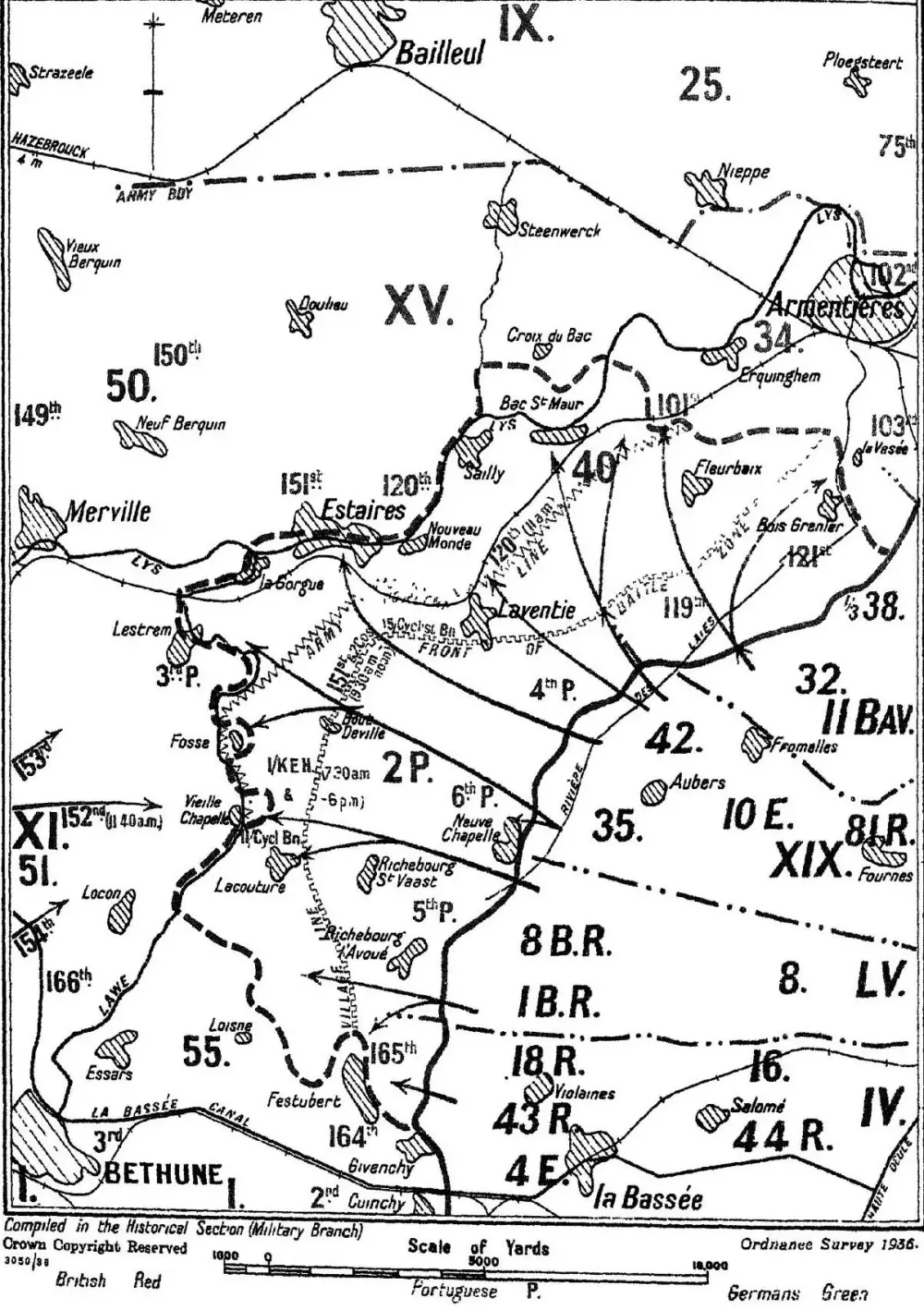
With the telephone lines gone and runners failing to return, the brigade commanders could not see their battles. All three stayed at their headquarters trying to direct the defence and were captured. The 4th Brigade, on the left, suffered losses of about 60 per cent, the highest in the division. In the reserve, two companies of the 14th Battalion and the whole of the 15th pushed forward through the barrage.
Pockets held out until they ran out of ammunition. A German account, cited by Brigadier-General J. E. S. Brind in a letter to the British official historian, had the 22nd Reserve Regiment taking Neuve Chapelle only around midday. By about a quarter past twelve the 2nd Division had been destroyed as a fighting force, and the British 40th Division to its north had been broken too.
“A soldier who had gone out came to tell me there are Germans at Pont du Hem, that is, behind our position, coming from the direction of Laventie. We are lost, surrounded, prisoners!”
9 April, about 4.15
German bombardment opens on the Portuguese front
Fraga gives 4.20; Dartford woke to it at 4.10.
9 April, about 8.45
German infantry attack in thick fog
Tamagnini’s dispatch gave 7.30, and EuroDefense says 8; Pyles puts the first infantry contact at about 8.20.
9 April, after 10.00
The fog lifts
9 April, late morning
Carlos Olavo’s battery finds Germans behind it at Pont du Hem
9 April, about midday
Neuve Chapelle falls to the German 22nd Reserve Regiment
9 April, about 12.15
The 2nd Division no longer exists as a fighting force
10 April
The offensive widens north of Armentières against the British Second Army
12 April
End of the four days of fighting in which the Portuguese losses are usually counted
29 April
The German offensive on the Lys ends
Soldado Milhões
Aníbal Augusto Milhais was born in 1895 into a poor family in Valongo, a village in the municipality of Murça in Trás-os-Montes. He never went to school, worked as an errand boy and herdsman, and was called up in 1915. In France he was a Lewis gunner in a machine-gun section of the 15th Infantry Battalion, which had come out of the front line the day before the attack and spent the night at Croix Marmuse.
In a recording he made in 1967, Milhais told how his battalion first fought around Haute Maison and then fell back, while he and a comrade nicknamed Malha Vacas stayed behind to cover the withdrawal. His comrade was lost in the shelling. Milhais took up positions near La Couture. His family’s telling adds that he fired his Lewis gun, which he called Luisinha, from different spots so the Germans would think the post was strongly held.
Cut off, he made his way back towards Saint-Venant over several days, living on a packet of sugared almonds and meeting stray groups of Portuguese and Scottish soldiers. Near a canal he met a Scottish officer; one account makes him a doctor whom Milhais saved from drowning in a marsh. The Scot wrote a long letter praising him, and word of what he had done reached the Allied command.
He was given the Tower and Sword, Portugal’s highest military decoration; the Presidency’s register of the orders dates it 31 August 1918 and lists him under his new name, Milhões. The name came from a pun by his commander, Major Ferreira do Amaral: “Tu és Milhais, mas vales milhões” (“You are Milhais, but you are worth millions”).
A law of 5 July 1924 renamed his village Valongo de Milhais. He went back to farming, lived poorly enough that a public subscription was raised for him, and died in 1970.
Counting the losses
Nobody agrees on the exact toll, partly because both armies collected the wounded and many of the missing were only accounted for when they came home from German camps. Every count agrees that most of the losses were prisoners. Officers made up 270 of them in the Revista Militar’s tally, against 29 officers killed.
| Source | Dead | Prisoners | Total given |
|---|---|---|---|
| Revista Militar (Brandão Ferreira, 2014), 9 April | 398 | 6,585 | 6,983 |
| Assembleia da República, after Fraga (2015) | 398 | 6,585 | Not given |
| Fraga, cited by Lopes (2012), 9 to 12 April | 614 | 6,585, many of them wounded | About 7,199 |
| EuroDefense Portugal (2022) | About 400 | About 7,000 | Not given |
| RTP (Portugal na I Grande Guerra) | Not given | Not given | About 7,500 dead, wounded, missing and prisoners |
| Jesse Pyles (2012), estimates for the 2nd Division | 400 to 700 | 6,800 to 7,700 | 8,500 to 9,500, with 2,000 to 2,500 wounded |
Pyles’s ranges gather Portuguese estimates and add his own deduction for the wounded; the other counts leave out wounded men who were not captured. Some popular accounts give much higher numbers of dead.
Portuguese soldiers taken prisoner on the Western Front, 1917 to 1918
prisoners
Of 6,778 Portuguese prisoners recorded for the whole campaign, 6,585 were taken on 9 April 1918. Figures from Carlos Lopes (2012). The Revista Militar gives 102 prisoners before La Lys but only 6,678 for the whole campaign, fewer than its own La Lys and earlier figures added together.
Show the data
| Prisoners | |
|---|---|
| Before 9 April 1918 | 168 |
| 9 April 1918 | 6,585 |
| 11 April to 11 November 1918 | 25 |
The scale shows in a comparison. In the year at the front before 9 April the CEP had lost 1,044 men killed, by the Revista Militar’s count, and between about 100 and 170 captured. In one morning it lost more men as prisoners than its losses of every kind, dead, wounded, gassed and captured, in the whole of that year, which the same count puts at 5,420.
Who was to blame
The British blamed the Portuguese almost at once. Haig wrote in his diary on 11 April that if the Portuguese had not bolted the attack would have been checked. After the war British officers wrote to their official historian of a hasty flight, of stolen bicycles and of three men riding each mule, and the rout became Britain’s picture of Portugal’s war. Lisbon asked for an inquiry; London sent a report by General Horne that put the blame on the Portuguese.
Gomes da Costa’s own report, written about a month later, was frank about units that did not move up, but it noted that his division had to hold three lines of trenches some 40 kilometres long in total, with no corps reserve. Major Vitorino Godinho listed reasons for the defeat headed by too long a spell at the front and losses that were never made good.
In Portugal the blame was political. On the sixth anniversary, in 1924, the deputy Carlos Olavo, a veteran of Flanders, accused the government of 1918, Sidónio Pais’s, of “a crime without a name” for leaving the troops in Flanders without relief or replacements. The prime minister, Álvaro de Castro, refused to call the battle a disaster. Tamagnini, the CEP’s commander, had been replaced in August 1918, and Pais was murdered that December.
More recent work has turned against the British version. Jesse Pyles, in a 2012 master’s thesis based on Portuguese and British unit reports, argues that the British 40th Division gave way at the same time, that British war diaries shifted blame onto the Portuguese, and that no British witness recalled seeing large numbers of Portuguese running. The historian Filipe Ribeiro de Meneses notes real weaknesses, above all a shortage of officers, but also a British failure to make use of a willing ally.
“A good deal of unfair derision has been cast on the Portuguese troops for the feebleness of their defence… they could not, in the circumstances in which they were placed, have put up a successful resistance against so formidable an attack.”
Aftermath: labourers and prisoners
The CEP never fought again as a corps. The British spread the survivors and the 1st Division among their own divisions to dig and repair rear defences, and split up the artillery. Only in October 1918 did a group of officers win General Garcia Rosado, Tamagnini’s successor, leave to rebuild some combat units. Three battalions were made ready, and were back in the line, under British brigades, when the armistice came on 11 November.
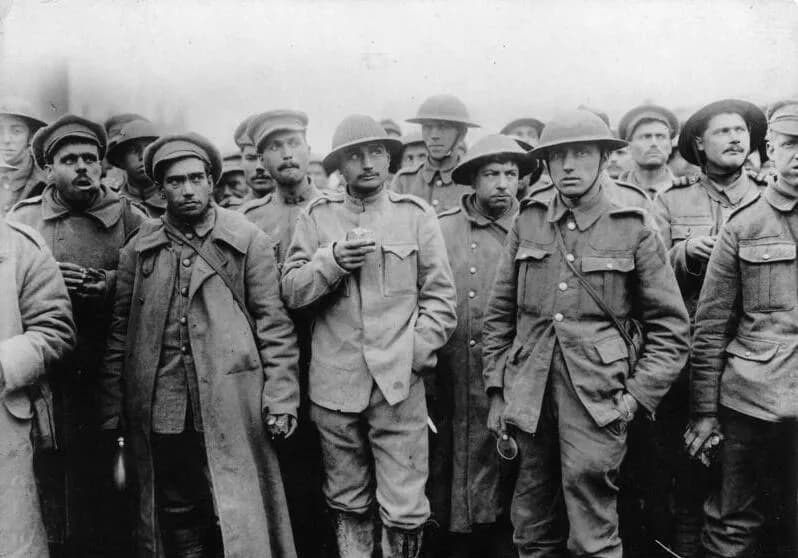
Many prisoners were sent back across no man’s land on their own and gathered behind the German lines into small columns under a light escort. Most were held at Friedrichsfeld, in Germany, which by August 1918 held more than 5,000 Portuguese; the officers, 262 of them by the armistice, were moved to a camp at Breesen. For most, captivity lasted less than nine months, but hunger and hard labour left many with damaged health.
Repatriation was slow. The first 485 former prisoners came home through Brest in November 1918. About 710 more landed in Lisbon from the Pedro Nunes on 2 January 1919 and were met by the president, João do Canto e Castro. The British ship Helenus brought 1,529 on 19 January, and the Menominee 1,337 on 19 April. Many came home to families already in mourning for them, and the welcome soon faded.
How Portugal remembers
Three years to the day after the battle, on 9 April 1921, declared a national holiday, two unknown soldiers, one from Flanders and one from Africa, were carried through Lisbon. The next day they were laid in the chapter house of the Batalha monastery, built by João I after his victory at Aljubarrota in 1385.
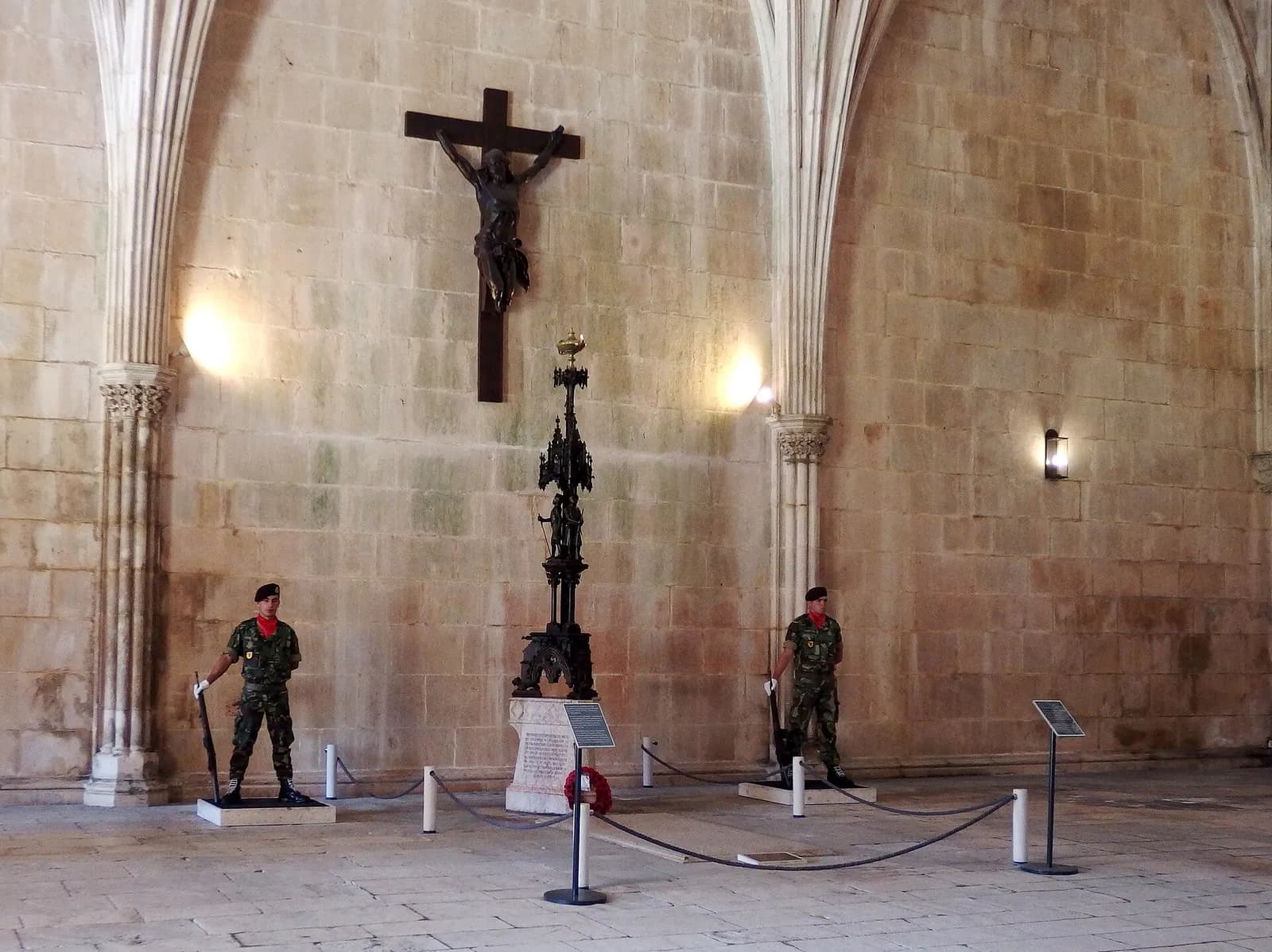
Above the tomb hangs the Christ of the Trenches, a metal crucifix from the church at Neuve Chapelle. By the usual account it lost its legs and right arm in the fighting of 9 April 1918 and was carried out of the ruins. Portugal asked France for it in 1958, and it was formally handed over at Batalha on 9 April that year. It belongs to the Liga dos Combatentes, the veterans’ league founded after the war.
For decades the Liga has marked 9 April with ceremonies at Batalha and at the Portuguese cemetery and memorial in France. Its 82nd pilgrimage to the tomb, on 14 April 2018, closed the commemorations of the centenary.
In 2020 the Estatuto do Antigo Combatente, the law setting out veterans’ rights, made 9 April the official Dia do Antigo Combatente, a day to honour all of Portugal’s former soldiers. In France, 1,831 Portuguese soldiers, 238 of them unknown, lie in the Portuguese military cemetery at Richebourg, among them prisoners who died in Germany.
FAQs
What was the Battle of La Lys?
It is the Portuguese name for the first day of the German Lys offensive, Operation Georgette, on 9 April 1918. A German army attacked a front in French Flanders whose centre was held by the Portuguese 2nd Division, which was overrun by early afternoon.
How many Portuguese soldiers died at La Lys?
Counts range from 398 dead (the Revista Militar and the Assembleia da República, after Luís Alves de Fraga) to 614 (Fraga as cited by Carlos Lopes, for 9 to 12 April); some Portuguese estimates go up to 700. About 6,585 were taken prisoner, and Portuguese counts put the total lost at between about 7,000 and 7,500.
Why was only one Portuguese division in the line?
Reinforcements had stopped after Sidónio Pais took power in December 1917, and the British were taking the exhausted CEP out of the line. The 1st Division was withdrawn after a refusal to return to the trenches on 4 April, leaving the 2nd Division alone in the sector until its own relief, due on the night of 9 to 10 April.
Who was Soldado Milhões?
Aníbal Augusto Milhais, a farm worker from Murça, covered the Portuguese and British retreat with his Lewis gun on 9 April 1918 and made his way back to Allied lines days later. He received the Tower and Sword, dated 31 August 1918 in the official register, and his commander’s pun, “You are Milhais, but you are worth millions”, gave him his nickname.
How is 9 April commemorated in Portugal?
Since 1921 the date has been marked at the tomb of the Unknown Soldier in the Batalha monastery, where the Liga dos Combatentes holds an annual ceremony. Since the 2020 Estatuto do Antigo Combatente, 9 April has been the official Dia do Antigo Combatente.
On the timeline
Open the timelineNearby moments from the first republic (1910–1926).
The third of six apparitions of the Virgin Mary to the three shepherd children of Fátima — Lúcia, Francisco and Jacinta. It is on this day that, according to the seers, Our Lady entrusts them with the famous 'Three Secrets', the third of which would not be made public by the Vatican until the year 2000.
The three Fátima seers — Lúcia, Francisco and Jacinta — are seized and detained by Artur Santos, administrator of Vila Nova de Ourém, preventing the expected apparition at the Cova da Iria.
At the Cova da Iria near Fátima, a crowd estimated at 30,000 to 70,000 people witnesses the 'Miracle of the Sun' during the sixth and final apparition reported by the shepherd children Lúcia, Francisco and Jacinta, an event that made Fátima one of the great Catholic shrines of the world.
Battle of La Lys
Battle of the Lys (La Lys): the Portuguese 2nd Division, about to be relieved after months in the trenches of French Flanders, takes the full force of the German spring offensive. Overrun in a single morning, it loses some 7,000 men, most of them taken prisoner — Portugal's worst defeat of the First World War. 9 April is now Portugal's official Veterans' Day (Dia do Antigo Combatente).
The painter Amadeo de Souza-Cardoso, pioneer of modernism in Portugal and friend of Modigliani and Brancusi in Paris, dies of Spanish influenza at Espinho, aged only 30.
President Sidónio Pais is assassinated at Lisbon's Rossio station as he arrives to catch the night train to Porto. José Júlio da Costa, a 25-year-old left-wing former army sergeant who has been waiting for him, shoots him in the chest. The charismatic 'President-King', who had seized power a year earlier, dies within minutes; four bystanders are killed in the shooting and panic that follow.
Monarchist troops under Henrique de Paiva Couceiro proclaim the restoration of the monarchy in Porto, the so-called Monarchy of the North, and a Junta Governativa do Reino takes power across much of northern Portugal. Never sanctioned by the exiled D. Manuel II, the rising collapses on 13 February, when a republican counter-coup inside Porto restores the Republic.
Coming up in history
All long reads 11 April 1607Bento de Góis: the Azorean Jesuit who walked from India to China
 12 April 2016Francisco Nicholson, the revue writer who gave Portugal its own telenovela
 13 April 1961The Abrilada: how Salazar outmanoeuvred his generals in April 1961
 14 April 2020Maria de Sousa, the immunologist who mapped where lymphocytes live
21 sources
Archives, scholarship and reporting this article was checked against.
- 1
Os portugueses na Grande Guerra: uma experiência de combate e de cativeiro (Carlos Jorge Alves Lopes, MA dissertation)Universidade Aberta, 2012
- 2
The Portuguese Expeditionary Corps in World War I: From Inception to Destruction, 1914-1918 (Jesse Pyles, MA thesis)University of North Texas, 2012 (UNT Digital Library)
- 3
The Portuguese Expeditionary Corps in France (1917-18) and the Long Shadow of the Peninsular War against Napoleon (Filipe Ribeiro de Meneses)e-Journal of Portuguese History 16 (2), 2018; author's copy, Maynooth University Research Archive Library
- 4
Portugal na I Guerra Mundial (João José Brandão Ferreira)Revista Militar no. 2553, October 2014, pp. 879-892
- 5
Portugal e a Primeira Guerra Mundial (Luís Alves de Fraga)Janus 1999-2000, Universidade Autónoma de Lisboa
- 6José Augusto Milhais, o “Soldado Milhões” (Carlos Guerreiro and Sandy Gageiro)RTP Ensina and Antena 1, Portugal na I Grande Guerra
- 7
Portugal e os Soldados Desconhecidos da Grande Guerra (Margarida Portela)Portugal 1914-1918, Instituto de História Contemporânea
- 8
A participação portuguesa na Batalha de La LysEuroDefense-Portugal
- 9Uma gota portuguesa no oceano da guerra (interview with Jean-Jacques Becker by Sofia Leite, António Louçã and Sara Piteira)RTP, Portugal na I Grande Guerra
- 10
Uma “Luisinha” e um pacote de amêndoas fizeram um herói português (Olímpia Mairos)Renascença, 21 October 2015
- 11
Machine-Gun Milhais’ Last Stand (Dave Kindy)HistoryNet, 19 April 2019
- 12
Entidades nacionais agraciadas com ordens portuguesas: Milhões, Aníbal Augusto (Soldado)Presidência da República, Ordens Honoríficas Portuguesas
- 13
A Freguesia de Valongo de MilhaisCâmara Municipal de Murça
- 14
Evocação da Batalha de La Lys (1924)Assembleia da República, Comunicar
- 15
História do Mosteiro da BatalhaMosteiro da Batalha (Museus e Monumentos de Portugal)
- 16
‘Christ of the Trenches’, Neuve-Chapelle (1918) (Mark Crathorne)British Historical Society of Portugal
- 17
Exposição “Neste vale de lágrimas” tem «O Cristo das Trincheiras» como peça emblemática (Leopoldina Simões)Santuário de Fátima, 1 December 2014
- 18
- 19
Discursos do Presidente da Liga dos Combatentes, 2018 (including the centenary of La Lys at Batalha, 14 April 2018)Liga dos Combatentes
- 20
Estatuto do Antigo CombatenteGovernment of Portugal (portugal.gov.pt)
- 21Cemitério português de Richebourg em lista para candidatura à UNESCODiário de Notícias (Lusa), 1 February 2017
Image credits
- Portuguese and British soldiers, among the first prisoners brought in from what the German caption calls the battle of Armentières, in a German photograph probably taken in April 1918. The archive’s own record dates it to 1914, which the Portuguese helmets rule out. Unknown author (Bundesarchiv, Bild 146-2008-0314), CC BY-SA 3.0, via Wikimedia Commons.
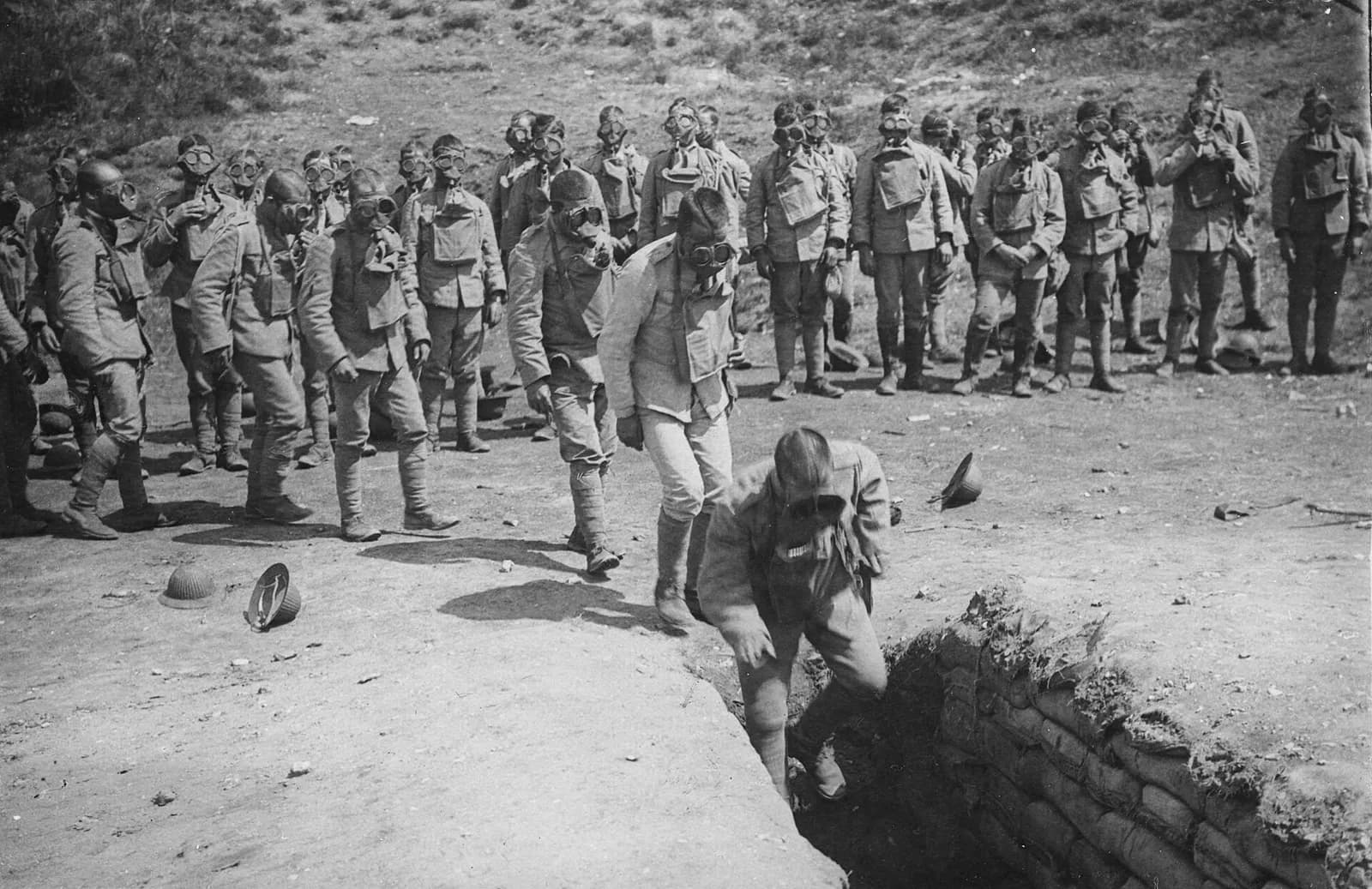
- Portuguese troops in gas masks file into a gas trench during training in France, around 1917 to 1918. Gas shells were part of the bombardment of 9 April. John Warwick Brooke, Public domain, via Wikimedia Commons.
- The break-in on the Laventie front on 9 April 1918, from the British official history (1937). The Portuguese 2nd Division (2 P.) held the centre; the German divisions are marked on the right, the line reached that day by a heavy dashed line. Major E.A. Becke, Public domain, via Wikimedia Commons.
- The whole Lys offensive from 9 to 29 April 1918. The Portuguese sector lay south of Armentières, around Neuve Chapelle, where the bulge began. United States Military Academy, Public domain, via Wikimedia Commons.
- The Christ of the Trenches above the tomb of the Unknown Soldier in the chapter house at Batalha, with its honour guard, in 2017. The crucifix came from the church at Neuve Chapelle, wrecked in 1918. Palickap, CC BY-SA 4.0, via Wikimedia Commons.