

Francis Xavier sails from Lisbon for Asia, 7 April 1541
King João III asked Rome for priests to send to his Asian empire. He got a Navarrese scholar who sailed from Belém on his birthday, never came back, and whose body still lies in Goa.
At a glance
- On 7 April 1541, his 35th birthday, the Navarrese priest Francis Xavier sailed from Lisbon for India on the Santiago, flagship of a fleet of five ships carrying the new governor, Martim Afonso de Sousa.
- He went because King João III had asked Ignatius of Loyola for priests of his new Society of Jesus. Ignatius chose two; when one fell ill, Xavier took his place at a day's notice.
- The voyage took 13 months, including six in Mozambique, and he reached Goa on 6 May 1542. He then worked on the Fishery Coast of southern India, in Malacca, the Moluccas and Japan.
- In 1546 he wrote to the king asking him to send the Inquisition to India. A tribunal was set up in Goa in 1560, eight years after his death, after requests from others as well.
- He died on the island of Shangchuan, off China, in December 1552, waiting for a ship to the mainland. His body was taken to Goa in 1554 and lies in the Basilica of Bom Jesus.
A birthday off Belém
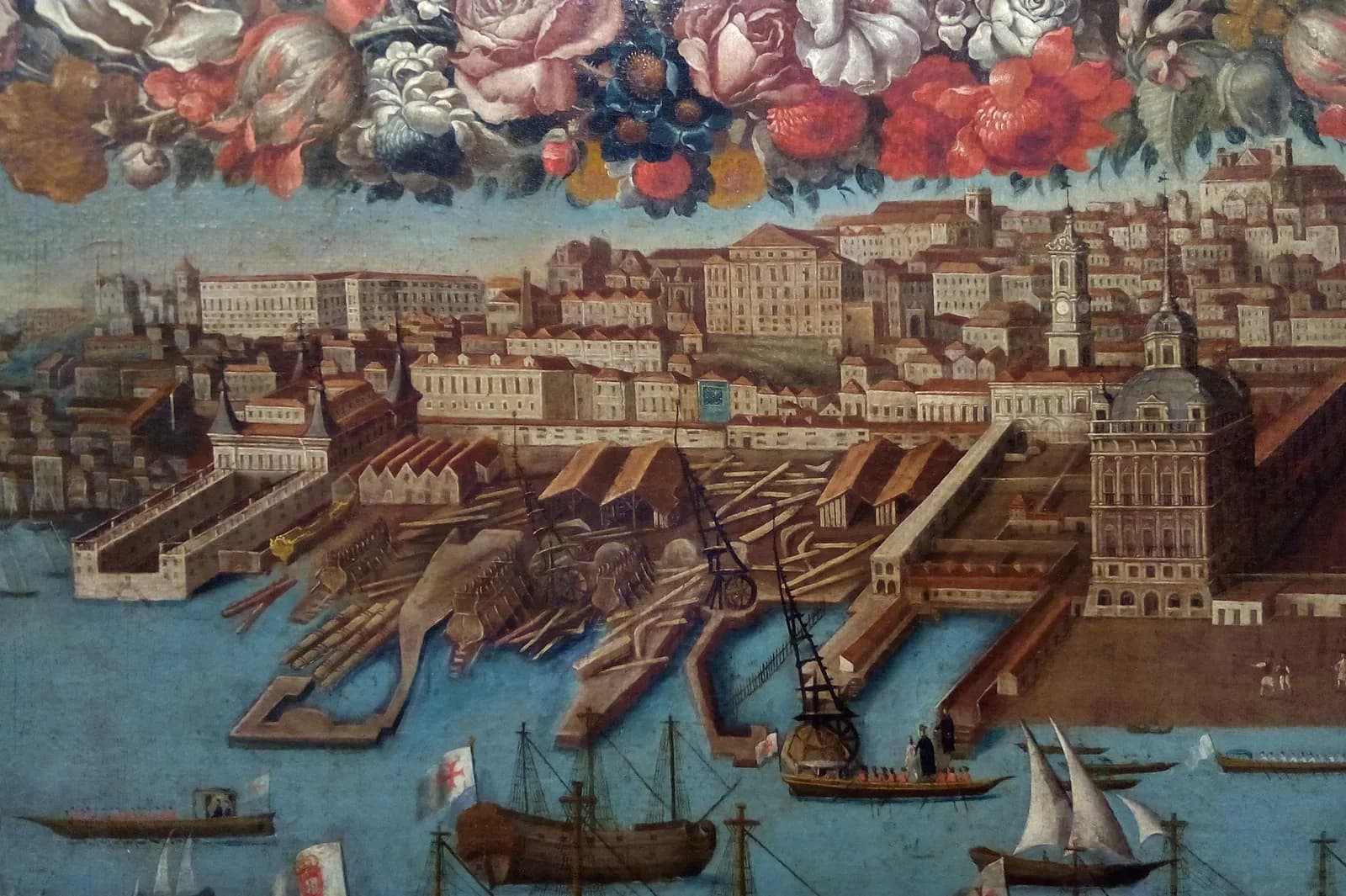
On Thursday 7 April 1541, in Passion Week, five ships lay in the Tagus off Belém, by the monastery of Our Lady just outside Lisbon, ready for the yearly run to India. On board the flagship, the Santiago, a priest from Navarre was spending his 35th birthday saying goodbye. Francis Xavier was sailing to Asia as the pope's envoy, with two companions and little else.
Simão Rodrigues, a Portuguese priest who had been one of his student friends in Paris, came aboard the governor's ship for the farewell. The two had expected to sail together. Instead Rodrigues was staying behind at the king's wish, and the friends never met again.
- Date
- Thursday 7 April 1541, Xavier's 35th birthday
- Ship
- Santiago, flagship of a fleet of five
- Commander
- Martim Afonso de Sousa, the new governor of India
- Companions
- Paulo de Camerino, an Italian priest, and Francisco Mansilhas, not yet a priest
- Arrived in Goa
- 6 May 1542, 13 months later
- Returned to Europe
- Never; he died off China in 1552
A king asks for priests
Francis Xavier was born in 1506 in the castle of Xavier, near Sangüesa in Navarre, in northern Spain. In 1525 he went to study in Paris at the Collège de Sainte-Barbe, where he shared a room with the Savoyard Pierre Favre and, from 1529, with an older Basque student, Ignatius of Loyola.
On 15 August 1534, in a chapel at Montmartre, Xavier, Favre, Loyola and four friends took private vows of poverty and chastity and promised to go to the Holy Land. War kept them out of Jerusalem, so they offered themselves to the pope instead. In 1539 they agreed to found a religious order, the Society of Jesus, better known as the Jesuits.
João III of Portugal heard of the group from Diogo de Gouveia, head of Sainte-Barbe and one of his advisers, who urged him to ask for some of Loyola's companions as missionaries for the Indies. The king told his ambassador in Rome, Pedro Mascarenhas, to make the request. The ambassador asked for six. Ignatius would give only two, and the pope did not press him.
Ignatius named Simão Rodrigues, a Portuguese nobleman the king would welcome, and the Spaniard Nicolás Bobadilla. Rodrigues sailed for Lisbon at once with Paulo de Camerino. Bobadilla reached Rome from Naples just as Mascarenhas was leaving and fell too ill to travel. The ambassador would not go without his second priest.
“Master Francis, you know that His Holiness has commanded two of us to go to India and that our second choice was Bobadilla. He, on account of his indisposition, cannot go, and the ambassador is unable to wait until he is well again. Here is an undertaking for you.”
Xavier answered that he was ready. He mended his clothes, got the pope's blessing, left his vote for the election of a superior general (for Ignatius), and rode north out of Rome with the ambassador in mid-March 1540. They crossed Italy, the Alps and Spain, and reached Lisbon in June.
Ten months in Lisbon
The next India fleet would not sail until the spring, so Xavier and Rodrigues waited. João III received them for more than an hour, offered them rooms near the palace and meals from the royal kitchen. They chose to beg their food and lodge at the royal hospital of All Saints. Lisbon soon called them “the apostles”.
Their work included the prisoners of the Inquisition. The king's brother Henrique, the Inquisitor General, asked them to take charge of the prisoners' souls. Schurhammer counts 50 prisoners, most of them New Christians: Jews forced into baptism in 1497, and their descendants. He records that the two priests went with two of them to the stake.
“We visit them every day, and apply ourselves to make them understand how great a favour God has done them in placing them in this school of penance.”
Preaching and hearing confessions at court, the pair did so well that the king began to think they would be more useful at home. Rodrigues asked Ignatius to decide. Ignatius left it to the king but advised that Rodrigues stay and Xavier go. João III agreed. Rodrigues stayed to build the Jesuit order in Portugal.
Papal briefs arrived naming Xavier apostolic nuncio in the East, the pope's representative there. The Count of Castanheira, who was fitting out the fleet, asked what he needed and offered him a servant: a nuncio should not wash his own clothes and cook his own food. Xavier refused anything but a few books and warmer clothing.
Thirteen months to Goa
Xavier sailed on the governor's own ship. He was seasick for the first two months, and then the fleet lay becalmed off the coast of Guinea. It reached Mozambique Island about five months out, too late in the season to cross to India, and the governor decided to winter there.
“We left Lisbon on the 7th April 1541, and reached India the 6th May of this the following year, having thus spent a year and more in the voyage, which is generally made in about six months.”
In Mozambique the three missionaries moved into the hospital. Xavier wrote that “as many as eighty died” of the sickness that swept the crews during the six months there. Schurhammer's 1928 biography counts 40 deaths on the island. Xavier caught a fever himself. When the governor sailed on, he left Paulo and Mansilhas behind with the sick and took Xavier with him as his confessor.
7 April 1541
Fleet of five ships leaves Belém
Xavier sails on the flagship, the Santiago, with the governor Martim Afonso de Sousa.
Spring 1541
Sickness and calms
Xavier is seasick for two months; the fleet is becalmed off Guinea.
Late summer 1541
Mozambique Island
Too late in the season to cross to India, the fleet winters there for six months. Xavier wrote that about 80 died.
End of February 1542
On to India
The governor sails on with Xavier; Paulo and Mansilhas stay with the sick. Stops at Malindi and Socotra.
6 May 1542
Goa
Arrival in the capital of Portuguese India, 13 months after leaving Lisbon.
From the Fishery Coast to Japan
Goa impressed him: a city “entirely in the hands of Christians”, with a cathedral and a large Franciscan house. After five months preaching, teaching children and nursing the sick there, he left in about October 1542 for the Fishery Coast, the pearl-fishing shore near Cape Comorin at the southern tip of India.
Its people, the Paravas, had asked for Portuguese protection against Muslim rivals in the 1530s. Priests sent with the soldiers baptised about 20,000 of them without instruction, since nobody knew their language, and then left. Xavier had the main prayers translated into Tamil, learned them by heart and went from village to village teaching them.
On the Travancore coast in late 1544 he claimed to have made “more than ten thousand” Christians in a month. His letter described the method, from reciting the creed in the local language to the destruction that followed baptism.
“When all are baptized I order all the temples of their false gods to be destroyed and all the idols to be broken in pieces.”
| Years | Place | What he did |
|---|---|---|
| 1542 | Goa | Preached, taught children and visited the hospitals and prisons for five months |
| 1542 to 1545 | Fishery Coast and Travancore, southern India | Instructed the Paravas, translated prayers into Tamil, baptised on the Travancore coast |
| 1545 | Malacca | Preached in the Portuguese port on the Malay peninsula |
| 1546 to 1547 | Moluccas | Amboina, Ternate and Moro, in the Spice Islands |
| 1547 to 1549 | Malacca and Goa | Met Anjirō, a Japanese exile, and prepared a mission to Japan |
| 1549 to 1551 | Japan | Kagoshima, Hirado, Yamaguchi, Kyoto and Bungo |
| 1552 | Goa, Malacca, Shangchuan | Tried to enter China; died on Shangchuan in December |
In Malacca in 1547 he met Anjirō, a Japanese man who had fled his country after killing someone and wanted to become a Christian. Baptised in Goa as Paulo de Santa Fé, he went back to Japan with Xavier and two other Jesuits, Cosme de Torres and Juan Fernández. The party left Malacca on a Chinese junk in June 1549 and landed at Kagoshima, Anjirō's home town, on 15 August 1549.
“In the first place, the nation with which we have had to do here surpasses in goodness any of the nations lately discovered.”
Japan was harder than it looked. After a year in Kagoshima the missionaries moved on to Hirado and Yamaguchi. In the winter of 1550 to 1551 Xavier reached Kyoto, the imperial capital, hoping to win over the emperor, and found a city damaged by civil war and a powerless court. After 11 days he left. He did better back in Yamaguchi, now dressed as an envoy and bringing gifts, and then in Bungo, before sailing from Japan in November 1551.
The letter asking for the Inquisition
On 16 May 1546, from Amboina in the Moluccas, he wrote to João III. The first need he named was preachers. When Jesuit editors first printed the letter, around 1900, they worked from the original, then displayed for veneration on the high altar of the main church of Marchena, in Andalusia. Only the address was in Xavier's own hand, and the signature had been cut away.
“The second need that India has, for those who live there to be good Christians, is that Your Highness send the Holy Inquisition, because there are many who live by the law of Moses and the Moorish sect, without any fear of God or shame before the world.”
Because such people were “many” and “spread through all the fortresses”, he went on, India needed the Inquisition and many preachers. A year earlier, in 1545, he had asked a fellow Jesuit in Portugal to have someone write to Henrique, the Inquisitor General, so that the Inquisition would punish those who persecuted converts. Paiva notes that this request was not aimed at New Christians.
Historians disagree on how much these letters mattered. António Baião argued in 1945 that the tribunal grew out of pressure from Jesuits, Xavier and Belchior Carneiro above all, who feared the growing number of New Christians in Kochi and Goa. Anant Priolkar took up his view in 1961.
Ana Cannas da Cunha, in 1995, did not deny the Jesuits' warnings but held crown policy mainly responsible: fear that New Christians from Portugal were taking hold in Asia and trading with Ottoman Jews, the poor results of conversion, and the need for one court to judge matters of faith. José Pedro Paiva, in 2017, sees a cluster of causes, and notes that the vicar-general of Goa, Miguel Vaz, had asked for a tribunal before Xavier did.
The 1546 letter names no one. Its targets were people living among the Portuguese who followed “the law of Moses” or Islam, and Paiva notes that New Christians feature in it. It says nothing about Hindus. Yet most of the people the Goa tribunal went on to try were Indian converts accused of keeping Hindu practices.
The Goa tribunal was ordered by Henrique on 2 March 1560, and its first two inquisitors, Aleixo Dias Falcão and Francisco Marques Botelho, arrived in December 1560, eight years after Xavier's death. It was the first Inquisition tribunal outside Europe. Between 1561 and 1812 it held about 15,000 trials and passed more than 200 death sentences.
Cases tried by the Goa Inquisition, 1561 to 1623, by charge
% of about 3,800 cases
Of about 3,800 cases in the tribunal's first six decades, the largest group were local Christians accused of keeping Hindu practices, not the New Christians Xavier had written about. Percentages from José Pedro Paiva (2017), citing Giuseppe Marcocci; he also lists some cases of sodomy and of trading with non-Christians.
Show the data
| Share of cases | |
|---|---|
| Paganism (Indian converts) | 44 |
| Islam | 18 |
| Blasphemy | 10 |
| Judaism (New Christians) | 9 |
| Bigamy | 8 |
| Obstructing the Holy Office | 7 |
| Protestantism | 1.5 |
Death on Shangchuan
Back in Goa at the start of 1552, Xavier turned to China, of which he had heard much in Japan. The viceroy agreed to send Xavier's friend Diogo Pereira, a merchant, as ambassador to the Chinese emperor, with Xavier in the party, and in April 1552 Xavier left Goa.
At Malacca the plan broke. The captain of the sea, Álvaro de Ataíde, a son of Vasco da Gama, refused to let Pereira sail as ambassador, had the rudder taken off his ship and put soldiers to guard it. Xavier sailed on without the embassy in mid-July, on the Santa Cruz, with a few companions including a Chinese servant, Antonio, hoping to be smuggled onto the mainland.
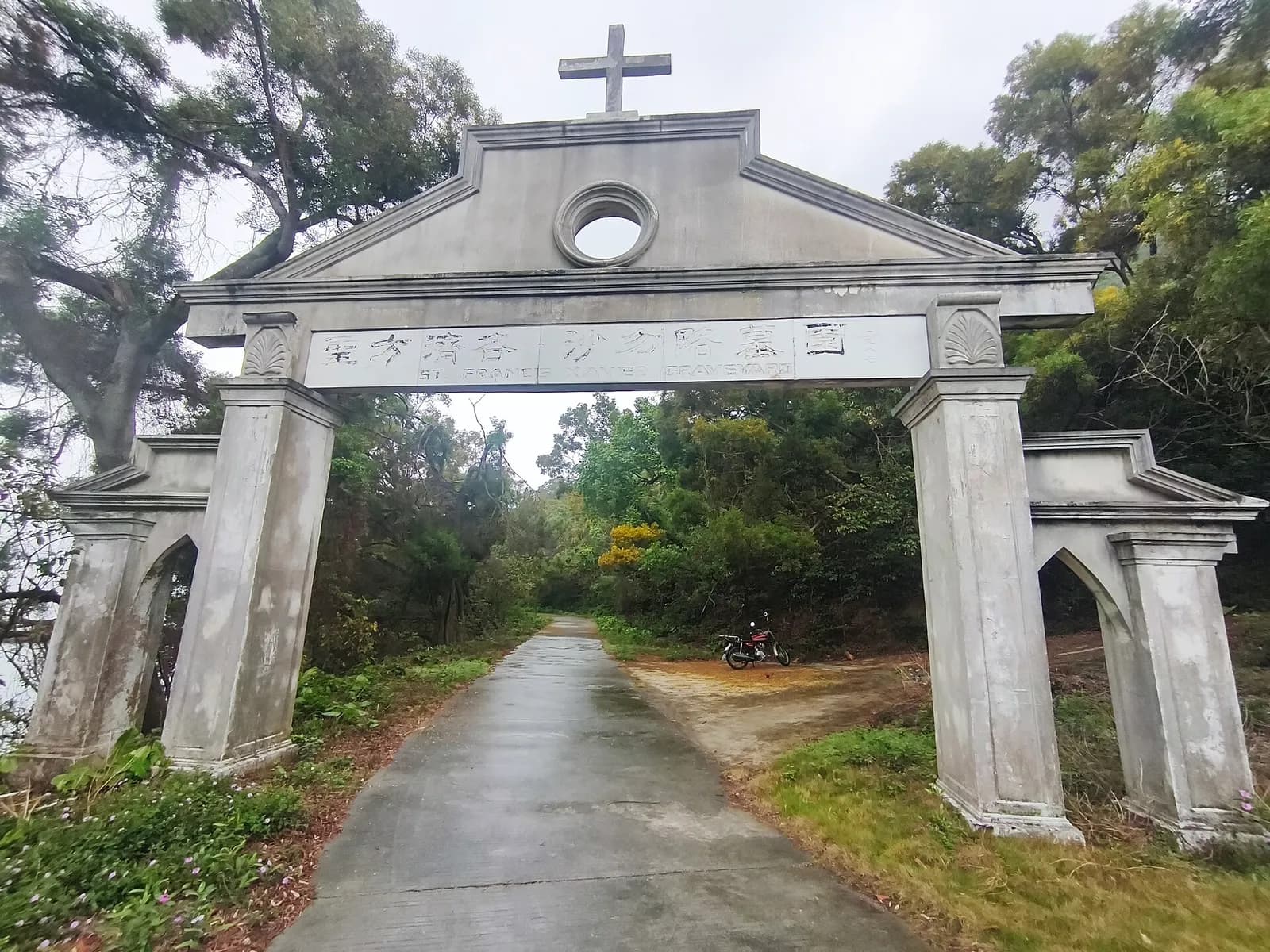
At the end of August the Santa Cruz anchored at Shangchuan, a small island off the Chinese coast near Canton, where Portuguese and Chinese merchants met to trade from straw huts on the beach. No Chinese trader would take him across. In late November he fell ill with fever and was moved from the ship to a hut on shore.
Antonio stayed with him. According to Schurhammer, Xavier died about two hours after midnight on Saturday 3 December 1552, holding the candle Antonio had lit for him. He was 46. Antonio, two helpers and a Portuguese buried him the next day in a wooden coffin filled with four sacks of lime, and rolled a stone over the grave.
A body for Goa
When the Santa Cruz was ready to leave, about two and a half months later, the grave was opened to see whether the body could be moved. The man sent to open it reported that it was well preserved, which his contemporaries took as a sign of holiness. The ship sailed on 17 February 1553 and reached Malacca on 22 March, where the body was buried again in the church of Our Lady of the Mount.
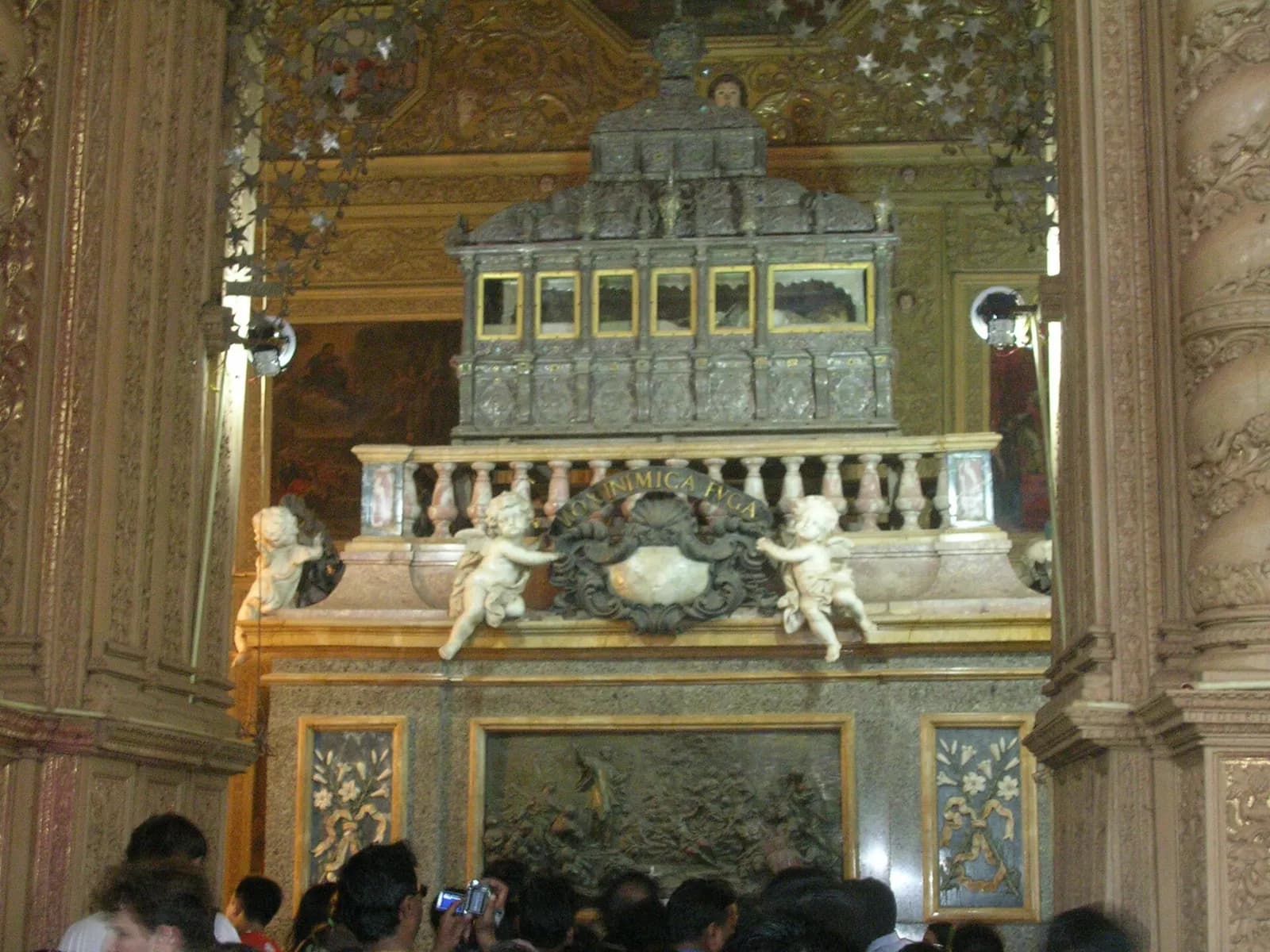
It was carried on to Goa by sea and arrived on 16 March 1554, to be met by the viceroy, the clergy and crowds pressing to touch the coffin. It was laid in the church of the Jesuit College of St Paul. The Basilica of Bom Jesus, the Jesuits' church in Goa, begun in 1594, received it in 1624.
4 December 1552
Buried in lime on Shangchuan
17 February 1553
Exhumed and shipped to Malacca
Reburied there on arrival in March.
16 March 1554
Arrives in Goa
Laid in the church of St Paul's College.
1614
Right forearm cut off
Sent to Rome on the orders of the Jesuit superior general and placed in the church of the Gesù.
1622
Canonised with Ignatius of Loyola
The bull was published in 1623, after the death of Gregory XV.
1624
Moved to the Basilica of Bom Jesus
1698
Medici tomb installed
A marble base made in Florence, the gift of Grand Duke Cosimo III.
1782
First public exposition
Organised by the state after the Jesuits' expulsion.
21 November 2024
18th exposition opens
The relics are moved to the Sé Cathedral of Old Goa for veneration.
Cosimo III de' Medici, Grand Duke of Tuscany, had received the pillow from Xavier's coffin as a relic and in gratitude paid for a marble base for the tomb. It was made under his court artist, Giovanni Battista Foggini, from 1689. It was shipped to Goa by way of Lisbon in 65 crates and assembled in Bom Jesus in late 1698 by two Florentine craftsmen.
Why it still matters
Others followed Xavier from Lisbon. João III endowed a Jesuit college at Coimbra with 100 scholarships, and its students were eager for the missions: three Jesuits sailed for India in 1545 and nine in 1546. In 1927 the Catholic Church named Xavier patron of the missions.
In Goa he is Goencho Saib, as the state's Catholics call him. His body is brought out for public veneration about once a decade. At the opening of the 18th exposition, on 21 November 2024, the relics were taken to the Sé Cathedral in an electric carriage, and 12,000 people attended the inaugural Mass.
The Basilica of Bom Jesus was also tied to the colonial state. After the viceroy Francisco de Távora handed his staff of command to the saint during a Maratha attack in 1683, new viceroys and governors came to receive the saint's blessing in a ritual exchange of the staff.
The 1546 letter is part of the same record. An accurate account of Xavier includes the man who walked the Fishery Coast teaching prayers in Tamil and the man who ordered temples smashed and asked his king for the Inquisition.
FAQs
When did Francis Xavier leave Lisbon for India?
On 7 April 1541, his 35th birthday, aboard the Santiago, the flagship of the governor Martim Afonso de Sousa. After wintering in Mozambique he reached Goa on 6 May 1542, 13 months later.
Why did a Navarrese priest sail for the king of Portugal?
João III asked Ignatius of Loyola for missionaries for his Asian territories. Ignatius sent the Portuguese Simão Rodrigues and Nicolás Bobadilla; when Bobadilla fell ill, Xavier replaced him. The king then kept Rodrigues in Portugal, so Xavier went east without him.
Did Francis Xavier ask for the Inquisition in Goa?
Yes. In a letter to João III from Amboina dated 16 May 1546 he asked the king to send the Inquisition to India. The Goa tribunal was created in 1560, after his death, and historians see several causes besides his letter, including requests from Miguel Vaz and crown policy.
Where is Francis Xavier buried?
Most of his body lies in a silver casket in the Basilica of Bom Jesus in Old Goa, where it has been since 1624. His right forearm was taken to the Gesù in Rome in 1614. He was first buried on Shangchuan island, off China, and then in Malacca.
On the timeline
Open the timelineNearby moments from the age of discoveries (1415–1580).
In a chapel on the hill of Montmartre in Paris, Ignatius of Loyola and six companions — among them Simão Rodrigues, a young Portuguese nobleman from Vouzela — take vows of poverty and chastity, forming the nucleus of the Society of Jesus. Rodrigues went on to establish the Jesuits in Portugal, the springboard for their missions across the Portuguese empire.
The Treaty of Baçaim (Bassein) is signed aboard the galleon São Mateus in Bassein harbour. Through his envoy, Sultan Bahadur of Gujarat cedes Bassein with its lands, islands and seas, among them the islands of Bombay, to make peace with Portugal while under Mughal pressure. Bombay later passed to England in Catherine of Braganza's dowry and is today the heart of Mumbai.
Pope Paul III issues the bull 'Cum ad nihil magis', establishing the Inquisition in Portugal at the insistence of King João III; the tribunal would shape Portuguese religious and cultural life for nearly three centuries.
Francis Xavier leaves Lisbon
Francis Xavier sails from Lisbon on his 35th birthday aboard the 'Santiago', sent east by João III as one of the first Jesuit missionaries to Portuguese Asia. He reached Goa 13 months later and went on to Malacca and Japan; his body still lies in Goa's Basilica of Bom Jesus.
Portuguese musketeers under Cristóvão da Gama, Vasco's son, storm a hillfort held by forces of the Adal Sultanate at the Battle of Baçente in northern Ethiopia, part of Portugal's military alliance with the Christian Ethiopian Empire.
By his comrade Castanhoso's date (others give 29 or 31 August), the Adal imam Ahmad Grañ overruns the camp of Cristóvão da Gama, Vasco da Gama's son, at Wofla in the Ethiopian highlands. Found wounded and hiding next morning, Gama is beheaded by the imam. Survivors of his 400 men helped defeat the imam, who was killed, the following year.
The mathematician and cosmographer Pedro Nunes is appointed to the chair of Mathematics at the University of Coimbra, the most prestigious post then open to a Portuguese mathematician. Inventor of the nonius, a scale for precise angle readings, and a pioneer of the mathematics of navigation, he held the chair until he retired in 1562.
Coming up in history
All long reads 9 April 1918La Lys, 9 April 1918: the morning Portugal’s army in France was overrun
 10 April 1871Domitila de Carvalho, the first woman to study at Coimbra since 1772
 11 April 1607Bento de Góis: the Azorean Jesuit who walked from India to China
 12 April 2016Francisco Nicholson, the revue writer who gave Portugal its own telenovela
11 sources
Archives, scholarship and reporting this article was checked against.
- 1
The Life and Letters of St. Francis Xavier, vol. 1 (Henry James Coleridge SJ), new editionBurns and Oates, London, 1881 (University of Toronto copy, Internet Archive)
- 2
- 3
- 4
The Inquisition Tribunal in Goa: why and for what purpose? (José Pedro Paiva)Journal of Early Modern History 21 (2017), 565–593; open copy in Estudo Geral, Universidade de Coimbra
- 5
- 6
St. Francis Xavier (Antonio Astrain)The Catholic Encyclopedia, vol. 6 (Robert Appleton Company, New York, 1909), via New Advent
- 7
The Basilica of Bom Jesus: a symbol of Goan identity (Vishvesh Kandolkar)Sahapedia
- 8
Saint Francis XavierSociety of Jesus (jesuits.global)
- 9
Cosimo III Medici's greatest gift to Goencho Saib (J. M. John Marshal)The Goan, 31 October 2023
- 10
18th Exposition of St Francis Xavier's sacred relics begins in Goa, India (Sr Florina Joseph SCN)Vatican News, 22 November 2024
- 11
Preaching of St. Francis Xavier in Goa (André Reinoso, ca. 1619)Museu de São Roque, Santa Casa da Misericórdia de Lisboa
Image credits
- The royal shipyard of the Ribeira das Naus and the palace on the Lisbon waterfront, in a detail of a view of about 1730 by an unknown painter, known as The Departure of St Francis Xavier (Museu Nacional de Arte Antiga). It shows the city as it looked almost two centuries after he left. Unknown painter, c. 1730; photograph by RickMorais, CC BY-SA 4.0, via Wikimedia Commons.
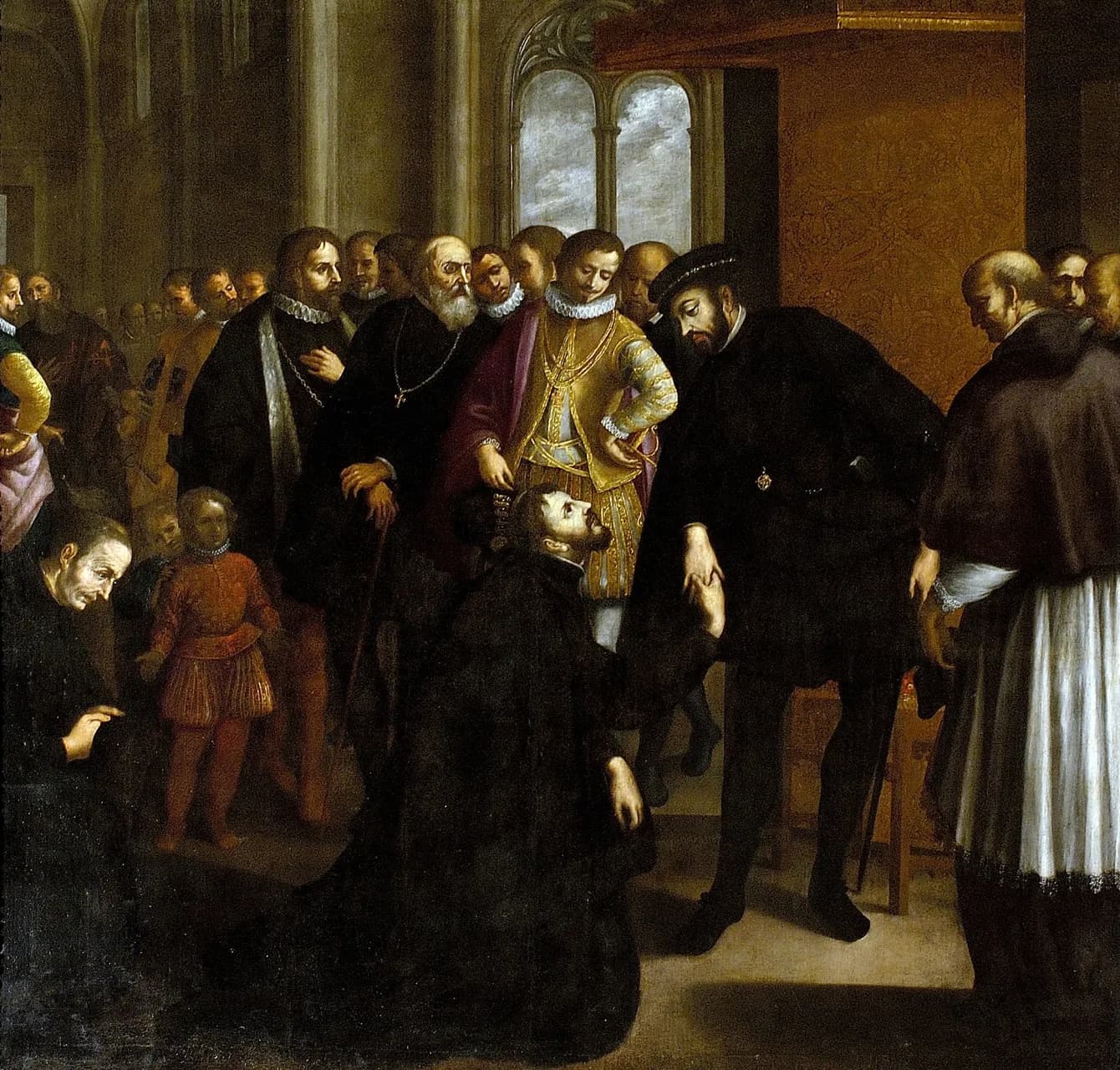
- Xavier taking leave of King João III, painted by José de Avelar Rebelo in 1635, almost a century after the event. The king bends to take the kneeling Jesuit's hand, watched by courtiers and clergy. José de Avelar Rebelo, Public domain, via Wikimedia Commons.
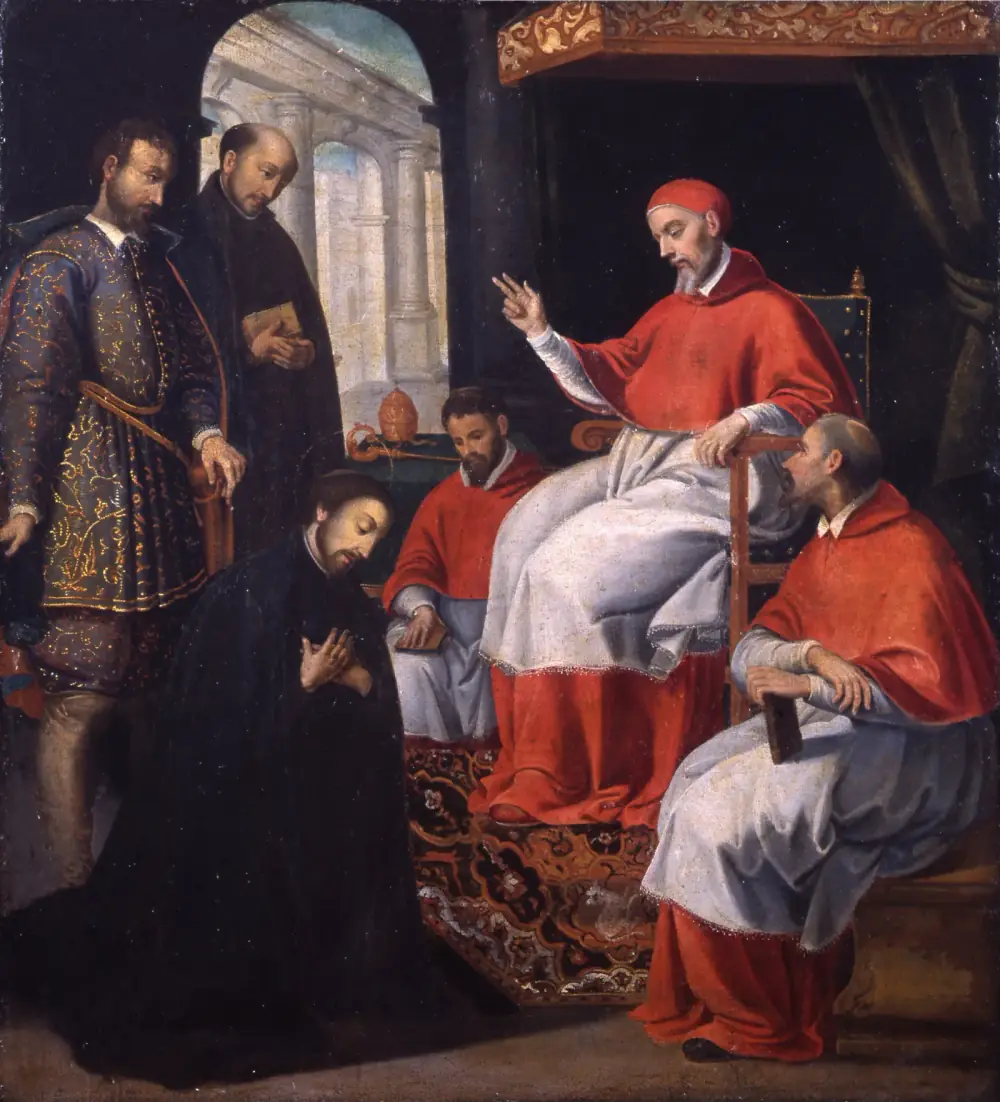
- Pope Paul III blesses Xavier before he leaves Rome for Portugal in 1540, in a painting of about 1619 by André Reinoso. Ignatius of Loyola, holding a book, and the ambassador Pedro Mascarenhas stand behind him. André Reinoso, Public domain, via Wikimedia Commons.
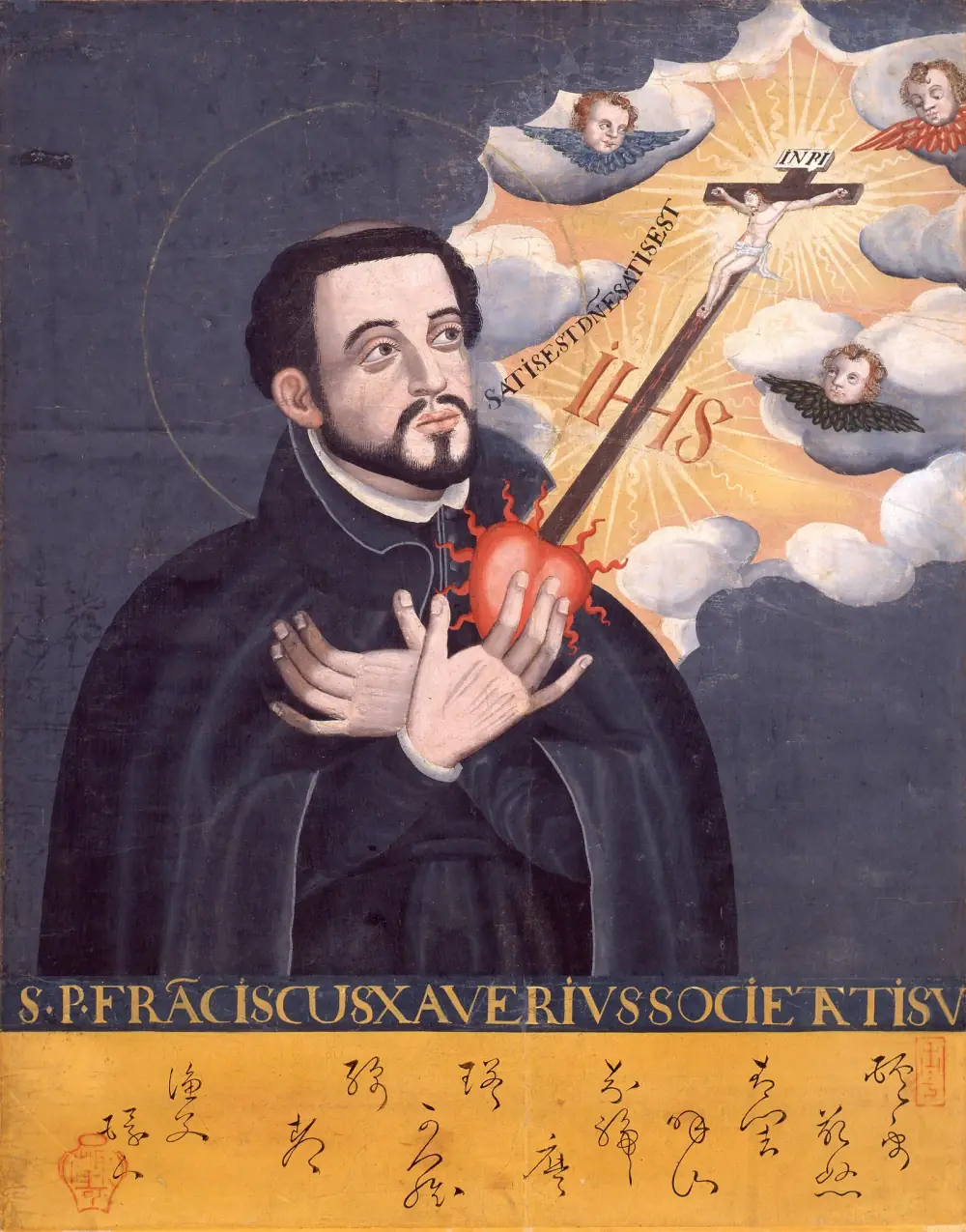
- A portrait of Xavier painted in Japan in the early seventeenth century, decades after his death, with the Latin inscription S. P. Franciscus Xaverius Societatis Iesu. It belongs to the Kobe City Museum. Unknown author, Public domain, via Wikimedia Commons.
- The gateway to the St Francis Xavier graveyard on Shangchuan island, Guangdong, in April 2026. The site is held to mark the place where he was first buried in 1552. GVZpedia, CC BY-SA 4.0, via Wikimedia Commons.
- Xavier's silver casket on its Florentine marble tomb in the Basilica of Bom Jesus, Old Goa, photographed in 2007. Ben Bromley from Chapel Hill, NC, USA, CC BY-SA 2.0, via Wikimedia Commons.