

The Cortes of Coimbra elect João I king of Portugal, April 1385
Portugal had four claimants to its throne and Castile was preparing to invade again. In a palace hall in Coimbra, a lawyer set out to prove that none of them had any right to it, so that the kingdom could choose a fifth.
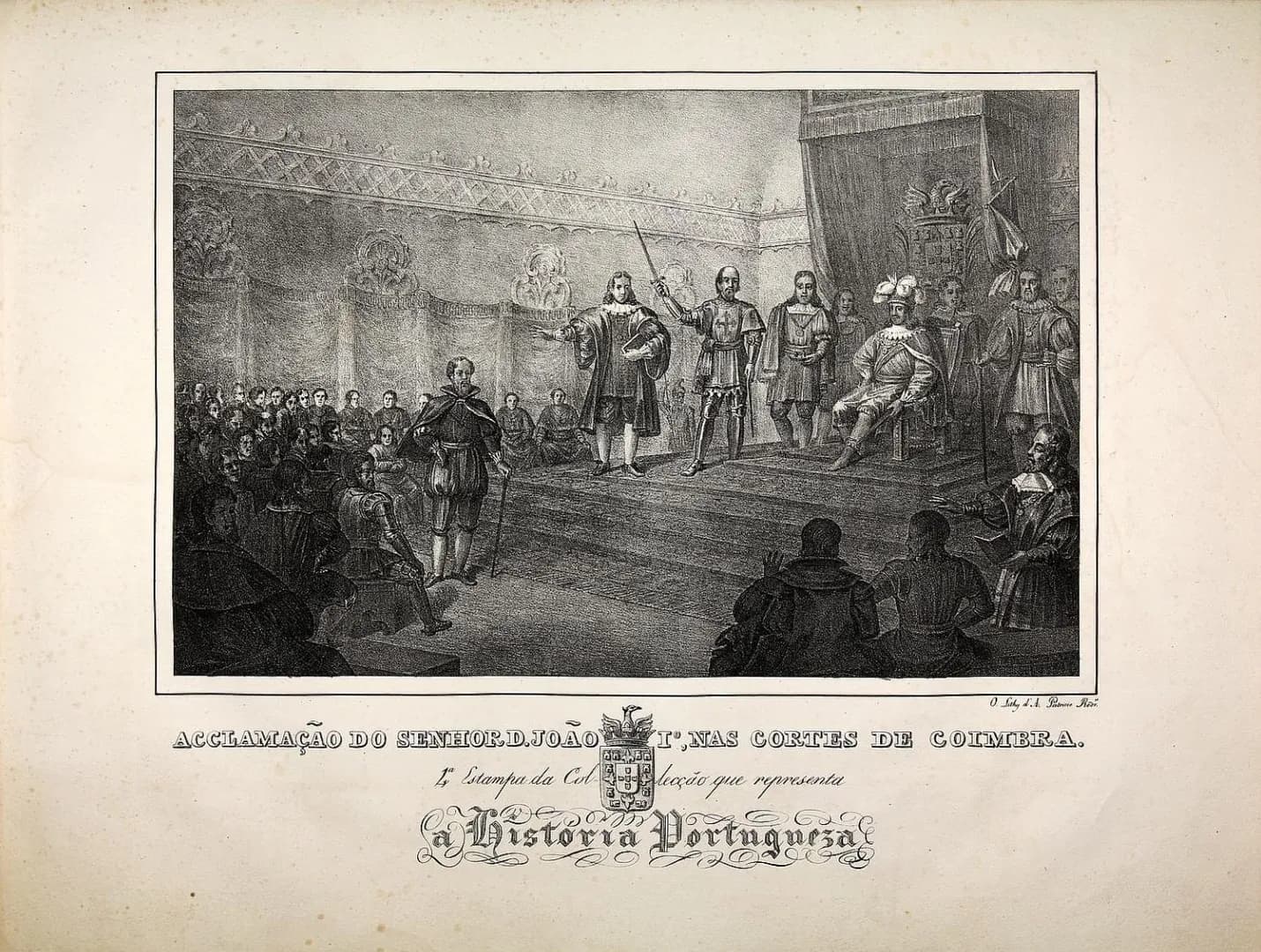
At a glance
- On Thursday 6 April 1385 the Cortes, the assembly of clergy, nobles and town representatives, meeting at Coimbra, raised João, Master of the Order of Avis, as King João I of Portugal.
- The throne had been disputed since Fernando I died in October 1383. His daughter Beatriz was married to Juan I of Castile, and Inês de Castro's sons and the Master also had supporters.
- The lawyer João das Regras argued that none of the claimants could inherit, so the kingdom was vacant and free to elect a king. Some nobles still backed the Infante João, a prisoner in Castile.
- The towns presented 24 general articles asking for a royal council drawn from the estates and Cortes every year. The king granted what cost him little and kept his own hands free.
- The war went on: Castile invaded again that summer and lost at Aljubarrota on 14 August 1385. João I reigned until 1433 and founded the House of Avis.
Hobby horses on the Leiria road
The boys of Coimbra had made their horses themselves, out of canes cut in the reed beds, with pennants tied on. On Friday 3 March 1385 they ran out along the Leiria road for about a league, a few miles, to meet the man riding in from the south. As they ran they shouted for him as if he were already king.
“Portugal, Portugal, for King Dom João! In a good hour comes our king!”
The rider was João, Master of the military Order of Avis, an illegitimate son of King Pedro I, who had governed the part of Portugal loyal to him for fifteen months. He and his commander Nuno Álvares Pereira took the boys' cries for a sign from God, speaking through children as through the mouths of prophets. Outside the gates the clergy waited in procession. The Master got down from his horse, knelt, kissed the cross and walked into the city with them.
He was lodged in the royal palace of the Alcáçova, at the top of the hill, where most of the kings of the first dynasty had been born. Not everyone came out to greet him. Gonçalo Mendes de Vasconcelos, who held Coimbra castle, said his oath still bound him to Fernando I's widow, Leonor Teles. A few days later he changed sides, and he was present when the Master was elected.
A kingdom with too many heirs
Fernando I had died in Lisbon on 22 October 1383 without a son, and a treaty signed that spring left his crown to his daughter Beatriz, born in 1372, and her husband, Juan I of Castile. To many Portuguese that meant absorption by their larger neighbour. On 6 December 1383 the Master killed the queen's favourite, Count Andeiro, Lisbon rose, and he became regent and defender of the kingdom.
Juan invaded. On 6 April 1384 Nuno Álvares Pereira beat a much larger Castilian force at Atoleiros, near Fronteira, and from May Juan besieged Lisbon until plague in his camp drove him home on 3 September. In Lisbon nobles, clergy and people swore to the Master again as regent and defender, and he summoned the Cortes to Coimbra.
| Claimant | His or her claim | Regras's objection |
|---|---|---|
| Beatriz, queen of Castile | Fernando I's daughter; the 1383 treaty named her heir | Illegitimate: her mother's first husband was alive when Leonor married Fernando, and gossip about Leonor made her paternity doubtful |
| Juan I of Castile | Beatriz's husband, and Fernando's first cousin | He broke the treaty, and as a follower of the Avignon pope he was a schismatic |
| Infante João | Son of Pedro I and Inês de Castro | No marriage to Inês was ever proved, and it would have been void anyway; he had also fought for Castile against Portugal. A prisoner in Castile since 1383 |
| Infante Dinis | Younger son of Pedro I and Inês de Castro | Same defect of birth, and he had marched on Lisbon with a Castilian army in Fernando's reign |
| João, Master of Avis | Illegitimate son of Pedro I; regent and defender since December 1383 | Regras did not claim he could inherit: he was to be elected. The Master himself cited his birth and his vows in the Order of Avis |
Arguments as given by Fernão Lopes, Crónica de D. João I, Part I, chapters 182 to 192.
Two parties in the palace
Coimbra filled with the men who meant to defend Portugal. Lopes names the Archbishop of Braga, five bishops and several abbots. Among the nobles were Nuno Álvares Pereira, Vasco Martins da Cunha the Elder with his sons, and Diogo Lopes Pacheco, one of the three men Pedro I had blamed for the killing of Inês de Castro in 1355, though Lopes thought him innocent. João das Regras counted about fifty procurators of towns and cities.
Not every town could send them. Santarém, the usual fifth great town, was under Castilian obedience, so the first bench of procurators was Lisbon, Porto, Évora and Coimbra. Lopes thought the Master had come for one purpose only, and he offered proof: Lisbon's corregedor, the crown's judge in the city, and its leading citizens had empowered their two procurators, Pedro Afonso Sardinha and Martim Lourenço, “to raise and receive as king and lord of these kingdoms the very noble lord Dom João, Master of the knighthood of Avis”.
Évora's mandate said the same, Lopes adds, and so did those of all the other towns. Armindo de Sousa doubts that the summons ever mentioned choosing a king. The council minutes of Loulé, in the Algarve, discuss the coming Cortes several times up to 2 April 1385 and never speak of an election.
Before the sessions began the town was already split. One party, led by Martim Vasques da Cunha and his brothers, wanted the Infante João, Inês de Castro's elder son, held prisoner in Castile since Juan arrested him in 1383, with the Master as regent until he was freed. Most of the other nobles and the common people would hear none of it: one prince was in a Castilian prison and the other had made war on Portugal.
“You may do as you please and make king whoever you like, for I am one man and my voice counts for little; and whoever you make king, I will serve him and help defend the kingdom until I die. But that I should consent to the Master being king, that I will never say.”
The procurators met apart from the nobles, and one of them lost patience with the endless talk.
“I have always heard it said: a king to face a king, and anything else is worth nothing. And since we are to be warred on by a king, let a king be our defender and the kingdom's.”
Nuno Álvares Pereira, then 24, led the Master's side among the nobles, and his quarrels with Martim Vasques grew so heated that the Master begged him to keep the peace. Nuno offered instead to rid him of “this braggart”. The Master refused. Then one day, while the Cunha brothers were with the Master in the palace, Nuno walked in with more than 300 squires in mail coats, with swords and shields. He spoke mildly to the Master, and one by one the Cunhas and their kinsmen, Diogo Lopes Pacheco and his sons among them, slipped away.
The doctor's case
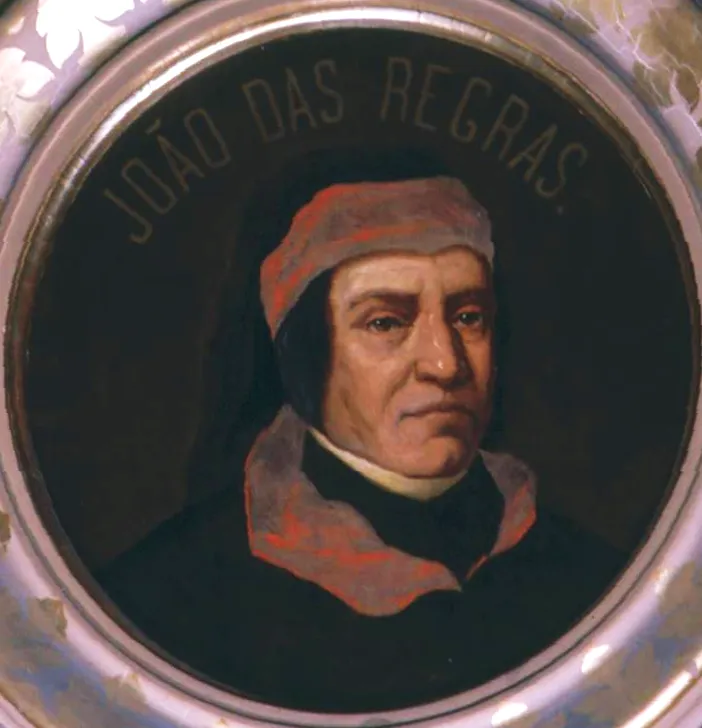
The case for the Master in the assembly was made by João das Regras, a doctor of laws whom Lopes calls a man of perfect authority, famous among lawyers for his subtlety and clear speech. Lopes did not hear him. He admits he worked from what some laymen wrote down of the speech, “the crumbs” of what they could catch.
Regras began with a surprise. Some said the kingdom had no lawful heir, he told the assembly, but he would show that it had plenty: Juan of Castile and Beatriz, and Pedro I's sons by Inês de Castro. First he dealt with those who said so small and divided a gathering could not choose a king at all.
“For if the Pope, who is a greater thing, can be elected by a single cardinal, all the others dying and he alone remaining … how much more can we, placed in such need, though we are few and the kingdom divided, elect one who will rule the kingdom and shield us from our enemies.”
Then he took the heirs apart. Beatriz was born of a marriage made while her mother's first husband lived. Juan had broken the treaty. The Church then had two rival popes, and Juan and Beatriz obeyed the one at Avignon rather than Urban VI in Rome, which made them schismatics in the eyes of Portugal's defenders. The kingdoms, he concluded, were entirely vacant.
Inês's sons were the hard part, because Pedro I had sworn in 1360 that he had secretly married her. Regras called the story unbelievable, and argued that such a marriage would have been void anyway: Inês was Pedro's kinswoman and had stood godmother to his son Luís. The Cunha party would not be moved.
So, Lopes says, Regras produced documents. He read a letter in which Afonso IV asked the Archbishop of Braga, then at the papal court, to stop the Pope from granting his son a dispensation to marry Inês. He showed a parchment roll, worn with age and signed by Pedro's councillors, in which Pedro as king asked the Pope to confirm the marriage and make the children legitimate. Then he read Pope Innocent VI's letter refusing.
According to Lopes, this ended the argument. The assembly was astonished by things it had not known, and Martim Vasques da Cunha and his allies dropped their objection. Regras then listed what a king needed: good lineage, a great heart to defend the land, love for his subjects, goodness and devotion. The Master was a king's son and had held Lisbon through the siege and the hunger. Regras ended with the formula of election.
“We name and choose, in the best manner that can be, this Dom João, son of King Dom Pedro, as king and lord of these kingdoms, and grant him that he be called king.”
Thursday 6 April
Prelates, nobles and procurators went together to the Master and asked him to accept. He said no. He was not fit for such an honour, he told them, and there were impediments: the defect of his birth and the vows he had taken in the Order of Avis. He would fight the King of Castile anyway, and if he won as a knight, the honour would be greater; if he lost as a king, the shame would be worse.
They begged him, Lopes says, at the tops of their voices. Without a king, people would lose heart, and the kingdom would fall to schismatics, rebels against the Church. They promised their bodies and goods, and embassies to Rome to obtain dispensations for his birth. The Master accepted, “in honour and reverence of the Holy Father and of the Apostolic See of Rome”.
Nuno was put in charge of making the palace ready. Walking through the hall where the new king would dine, he could not hold back: “This time my lord the Master will be king, by God's pleasure and whoever it may grieve.”
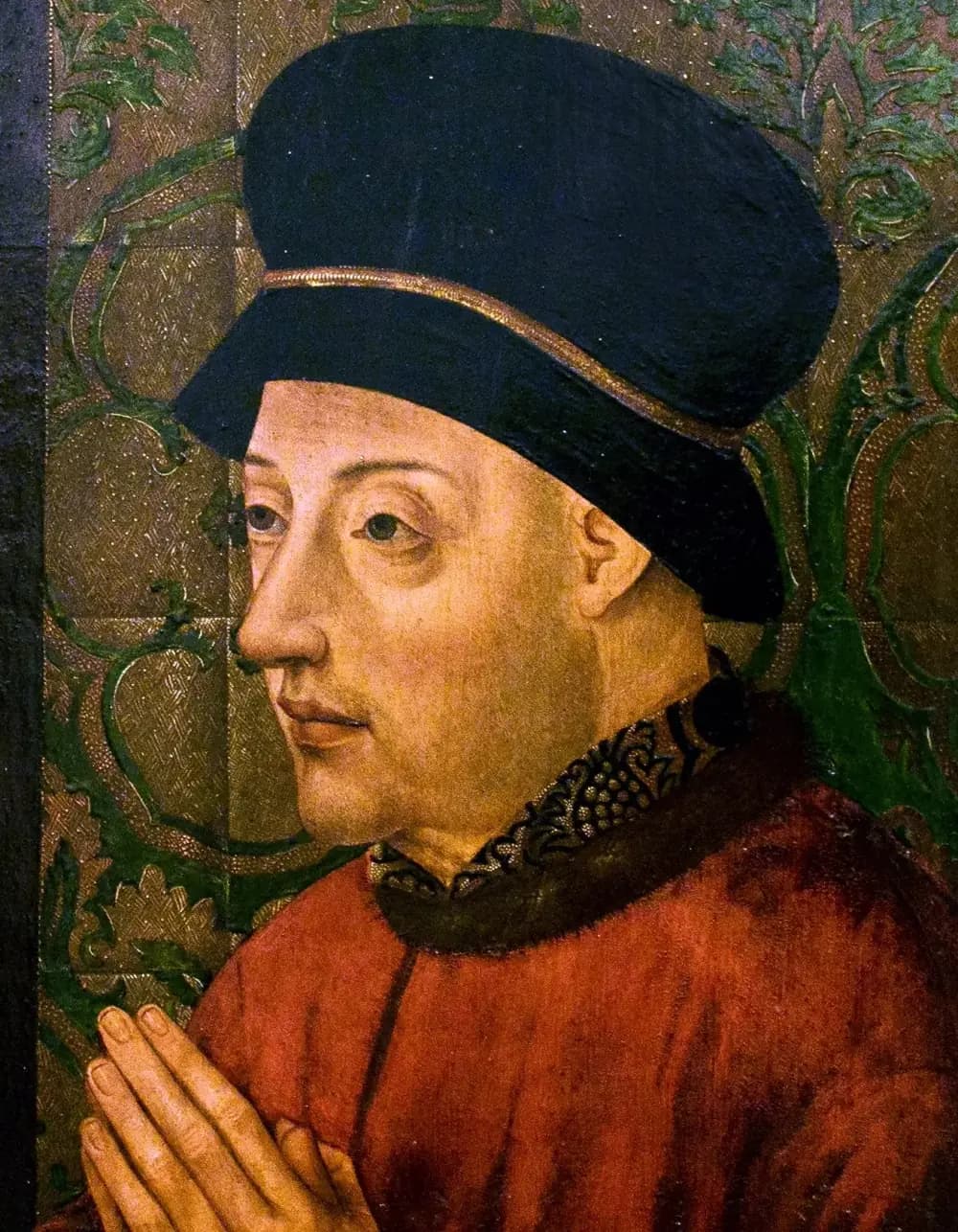
Lopes dates the day exactly: Thursday, the sixth day of April in the Era of 1423, the reckoning then used in Portugal, which is AD 1385, and 6 April 1385 was a Thursday in the Julian calendar. João was raised as king with church ceremony and secular rite, followed by spear-throwing at a wooden board and other games, in Coimbra and in the towns that held for him. In Lisbon a procession went from the cathedral to São Domingos, and the royal banner was carried through the streets to cries of “Real, real, for King Dom João!”
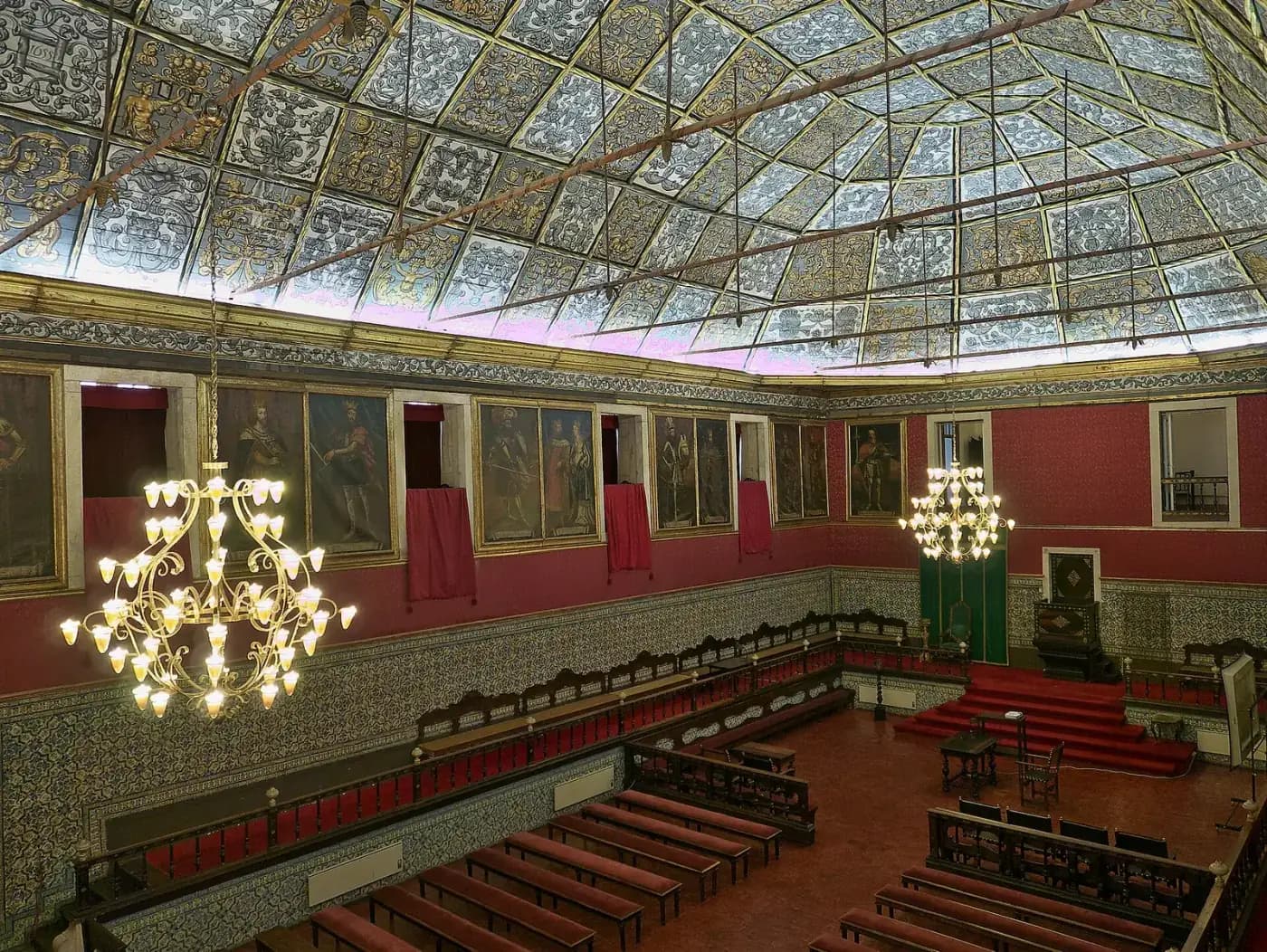
Lopes describes no crowning. The art historian António Filipe Pimentel thinks João was enthroned in royal robes and insignia at a Mass said by the Bishop of Lamego, not the Archbishop of Braga, probably in the palace chapel, and that Regras most likely spoke in the palace's great hall. The act of election itself survives in the Torre do Tombo, the national archive: a large parchment with signatures, notaries' marks and ten pendant wax seals, the seal of the council of Coimbra in the centre.
- Where
- Royal palace of the Alcáçova, Coimbra
- When
- 3 March to 6 April 1385
- Present
- Prelates, nobles and about 50 town procurators
- Election
- Thursday 6 April 1385
- Record
- Parchment act with ten wax seals, Torre do Tombo
A constable, a council and a bill
The new king filled his household at once. Nuno Álvares Pereira was made constable, the commander of the army, an office Fernando I had introduced when English troops came to Portugal in his reign; the Fundação Batalha de Aljubarrota, which runs the battlefield centre, dates the appointment to the day after the Cortes closed. João das Regras took over the chancery in place of the chancellor, Lourenço Anes Fogaça, who was in England. The king kept the mastership of Avis for himself.
The towns had drafted their general articles before the election, and some were written as no Cortes wrote before or after. The first five, and one more, read as decisions of the assembly: “we agree”, “we consider”, “you will promise us”. The rest were requests in the usual pleading style. The historian Armindo de Sousa traced the radical ones to Lisbon, which also brought 32 special articles of its own, eight more than the general list.
The towns' 24 general articles at Coimbra, by subject
articles
Armindo de Sousa's classification of the 24 general articles of 1385 by their main subject. The political ones include the royal council, a promise to keep the towns' customs, no war, peace, coinage or royal marriage without the towns' agreement, and yearly Cortes.
Show the data
| General articles | |
|---|---|
| Political | 6 |
| Administrative | 5 |
| Social | 4 |
| Judicial | 3 |
| Military | 3 |
| Legal | 1 |
| Fiscal | 1 |
| Financial | 1 |
They justified one of the boldest with a maxim of Roman law, which they put in Portuguese as “it is right that, in things which concern all and of which all feel the burden, all should be called to them”. They asked the king to make no war or peace, coin no money and marry no wife without their agreement, to hold Cortes every year, and to keep Fernando's councillors and the dowager queen's people out of office.
| Estate | Proposed | Confirmed by the king |
|---|---|---|
| Prelates (2) | João, Bishop of Évora; Rui Lourenço, Dean of Coimbra | The Bishop of Évora |
| Nobles (4) | Diogo Lopes Pacheco, Vasco Martins da Cunha, Gonçalo Mendes de Vasconcelos, Vasco Martins de Melo | Diogo Lopes Pacheco, Vasco Martins de Melo |
| Lawyers (4) | Dr Gil do Sem, Dr João das Regras, Dr Martim Afonso Charneca, João Afonso de Azambuja | Gil do Sem, João das Regras, Martim Afonso Charneca |
| Citizens (4) | One each from Lisbon, Porto, Coimbra and Évora | Mentioned only in vague terms |
Article 1 of the general chapters and the king's answer, as analysed by Armando Luís de Carvalho Homem. Names of the proposed councillors from Lopes, whose summary of the answer reads as if the king accepted all the prelates and nobles named. None of the six confirmed had sat on Fernando I's council.
João I answered carefully. The war he had begun he would fight, Lopes reports, but he would start no other without their counsel. On his marriage he would promise nothing, since kings before him had married freely. He would force no one to marry by royal letter, as Fernando and Leonor had done, and he lifted the ban on hunting deer and partridge around Lisbon. Lisbon got the seat of the royal tribunals and a promise that only a native of the city would keep the public seals.
Then came the bill. The king had agreed to lift the sales taxes and levy no others, and the towns had promised him whatever the war required, so they voted a pedido, a one-off grant, of 400,000 libras, which Lopes reckoned at about 100,000 dobras. It was paid in old coin and silver and reminted as a debased real worth 10 soldos, at mints in Lisbon and Évora, to pay the soldiers. Almada, which had suffered a Castilian siege, was let off its share.
Lisbon was paid in land. A charter dated at Coimbra on 10 April confirmed all its privileges, and another gave it Sintra, Torres Vedras, Alenquer, Mafra, Colares, Ericeira and Vila Verde as its termo, the district it governed, so that the city's jurisdiction reached eight leagues out. Porto received Bouças, Maia, Gaia and other districts around it.
After Coimbra
The election settled who would lead the war, not who would win it. A Castilian fleet was back off Lisbon in early April. From Coimbra the king sent envoys to England, to ask for recognition and troops, to the Pope and to the towns, and on 15 April he left for Porto, where he was welcomed with celebrations.
A Castilian raid into the Beira was beaten near Trancoso on 29 May. Juan I then invaded with his main army and was defeated at Aljubarrota on 14 August 1385. The English alliance was sealed at Windsor in May 1386.
22 October 1383
Fernando I dies in Lisbon
6 December 1383
The Master kills Count Andeiro
Lisbon rises and he becomes regent and defender.
6 April 1384
Battle of Atoleiros
Nuno Álvares Pereira beats a larger Castilian force near Fronteira.
3 September 1384
Juan I lifts the siege of Lisbon
3 March 1385
The Master enters Coimbra
The Cortes meet over the next five weeks.
2 April 1385
English ships fight past the galleys into Lisbon
6 April 1385
The Master is raised as King João I
7 April 1385
Nuno Álvares Pereira made constable
10 April 1385
Charter confirming Lisbon's privileges
15 April 1385
João I goes to Porto
29 May 1385
Castilian raid beaten at Trancoso
14 August 1385
Battle of Aljubarrota
The towns' great project came to little. Sousa found that the king satisfied the councils without weakening the monarchy his predecessors had built, and quoted the advice the Master's Lisbon ally Álvaro Pais had given him at the start of the crisis: give what is not yours, promise what you do not have, and forgive those who did you no wrong. Of the fourteen councillors proposed, João I kept six, and he reserved the right to choose his council himself.
Why it still matters
Coimbra gave Portugal its second dynasty, the House of Avis. João I reigned until his death in 1433, almost half a century and the longest reign of the Portuguese Middle Ages. His son and successor Duarte gave Fernão Lopes a pension in 1434 to write the chronicles of the kings.
The historian Marcello Caetano, in a study first published in 1951, thought the towns' articles pointed towards a representative government that might have developed along lines parallel to Britain's. Sousa called the project revolutionary in intention and a failure in fact. João I went on calling Cortes often, six times at Coimbra alone between 1385 and 1400.
Much of the drama survives only because Fernão Lopes wrote it down. Historians now read him alongside the documents, among them the towns' articles, copied in Porto's municipal archive, and the sealed act in the Torre do Tombo.
FAQs
When and where was João I elected king of Portugal?
At the Cortes of Coimbra, which met in the royal palace of the Alcáçova from early March 1385. The Master of Avis was raised as King João I on Thursday 6 April 1385.
What did João das Regras argue at Coimbra?
That none of the claimants could inherit: Beatriz was illegitimate, Juan I had broken the 1383 treaty and followed the Avignon pope, and Inês de Castro's sons were born of a marriage never proved valid. The throne was therefore vacant and the kingdom could elect a king, and he proposed the Master.
Why could the Master of Avis not simply inherit the crown?
He was an illegitimate son of Pedro I and a professed knight of the religious Order of Avis. He raised both objections himself, and the Cortes promised to ask Rome for dispensations.
Did the Cortes of Coimbra end the 1383 to 1385 crisis?
No. They gave the war a king, but Juan I of Castile invaded again that summer. His defeat at Aljubarrota on 14 August 1385 decided the war in Portugal's favour.
What did the towns ask for in return?
Among 24 general articles: a royal council drawn from prelates, nobles, lawyers and citizens, Cortes every year, and no war, peace, coinage or royal marriage without their agreement. The king confirmed six of the fourteen councillors they proposed and kept his freedom to marry.
On the timeline
Open the timelineNearby moments from crisis and the house of avis (1383–1415).
King Fernando I, 'o Formoso', dies in Lisbon aged 37, the last king of the House of Burgundy. His death, leaving the crown to his daughter Beatriz and her husband Juan I of Castile, triggers the crisis of 1383–85 that ended with João I on the throne.
Battle of Atoleiros: near Fronteira in the Alentejo, Nuno Álvares Pereira has his roughly 1,400 men fight on foot in a tight formation that breaks the mounted charges of a Castilian army of some 5,000. The victory, early in the 1383–1385 crisis, showed that Castile could be beaten.
The Cortes of Coimbra, 1385
The Cortes of Coimbra elect João, Master of the Order of Avis, as King João I of Portugal, founding the House of Avis. Nuno Álvares Pereira is made Constable of the Kingdom the next day, and the succession war is decided at Aljubarrota that August.
Just over 300 Portuguese men-at-arms and local levies, under Beira nobles who had just settled a feud, rout a Castilian raiding force near Trancoso as it heads home with captives and plunder from the sack of Viseu; nearly all its men-at-arms die. In the midst of the 1383–85 succession crisis, the victory is a prelude to Aljubarrota that August.
King João I and his constable Nuno Álvares Pereira rout the invading Castilian army at the Battle of Aljubarrota, ending the crisis of 1383–85, securing Portuguese independence and establishing the House of Avis on the throne.
The Treaty of Windsor is signed, sealing the Anglo-Portuguese Alliance first agreed in 1373 — the oldest diplomatic alliance in the world still in force. The following year João I married John of Gaunt's daughter, Philippa of Lancaster.
Coming up in history
All long reads 8 April 1484Diogo Cão, the mouth of the Congo and João II's reward of 8 April 1484
 9 April 1918La Lys, 9 April 1918: the morning Portugal’s army in France was overrun
 10 April 1871Domitila de Carvalho, the first woman to study at Coimbra since 1772
 11 April 1607Bento de Góis: the Azorean Jesuit who walked from India to China
10 sources
Archives, scholarship and reporting this article was checked against.
- 1
Chronica de el-rei D. João I, Part I (Fernão Lopes, Crónica de D. João I), volumes 1 to 3Bibliotheca de Classicos Portuguezes, Lisbon, 1897 (digitised by Internet Archive)
- 2
- 3
O discurso político dos concelhos nas Cortes de 1385 (Armindo de Sousa)Revista da Faculdade de Letras: História, II série, vol. 2, Universidade do Porto, 1985, pp. 9-44
- 4
De João das Regras ao Conselho Régio: os legistas na afirmação da nova dinastia (Armando Luís de Carvalho Homem)Medievalista, no. 28, July to December 2020 (Instituto de Estudos Medievais, NOVA FCSH)
- 5
A Batalha de Trancoso (with the political background and a narrative of 1383 to 1385)Fundação Batalha de Aljubarrota, Centro de Interpretação da Batalha de Aljubarrota
- 6
A Morada da Sabedoria, I: O Paço Real de Coimbra das origens ao estabelecimento da Universidade (António Filipe Pimentel)Almedina, 2005, via Estudo Geral, Universidade de Coimbra
- 7
Fernão Lopes, guardador das escrituras do Tombo (1418-1454): exhibition leafletArquivo Nacional Torre do Tombo, October 2018
- 8
Medieval Portuguese Royal Chronicles: Topics in a Discourse of Identity and Power (Bernardo Vasconcelos e Sousa)e-Journal of Portuguese History, vol. 5, no. 2, 2007
- 9
Chronica de el-rei D. Pedro I (Fernão Lopes, Crónica de D. Pedro)Bibliotheca de Classicos Portuguezes, Lisbon, 1895 (Project Gutenberg edition, from Biblioteca Nacional Digital scans)
- 10
Image credits
- The acclamation of João I at the Cortes of Coimbra as an artist imagined it in 1829, in a lithograph by Maurício José do Carmo Sendim from a series on Portuguese history. The costumes and the hall are the artist's invention, not a record of 1385. Maurício José do Carmo Sendim, Public domain, via Wikimedia Commons.
- João das Regras as José Malhoa imagined him in 1889, for the ceiling of the great hall of Lisbon City Hall. It is an imagined likeness. José Malhoa, Public domain, via Wikimedia Commons.
- João I at prayer, by an unknown fifteenth-century painter. Museu Nacional de Arte Antiga, Lisbon. anonymous, Public domain, via Wikimedia Commons.
- The Sala dos Capelos, the great hall of the University of Coimbra in the old royal palace, in 2015. It stands on the site of the palace's main hall but was rebuilt in the sixteenth century, and its ceiling and portraits of the kings are later still. José Luis Filpo Cabana, CC BY 4.0, via Wikimedia Commons.