

The Ponte das Barcas disaster: Porto's bridge of boats, 29 March 1809
Soult's army broke into Porto in the morning. Within hours the city's only bridge, a floating road over the Douro, had become a trap, and the river was full of bodies. Porto still lights candles for them.
At a glance
- On 29 March 1809, during Napoleon's second invasion of Portugal, Marshal Soult's army stormed the lines that defended Porto, held by about 30,000 mostly untrained Portuguese.
- Soldiers and townspeople fled down to the Ponte das Barcas, a wooden roadway laid on about 20 boats and opened in 1806, the city's only bridge over the Douro.
- A section in the middle was open. Most Portuguese accounts say a drawbridge or trapdoor had been raised to stop the French; others say boats sank under the weight. The crowd behind kept pushing the people in front into the river.
- Nobody counted the dead. Contemporary figures for all Portuguese killed that day ran from 4,000 to 20,000; Charles Oman guessed 7,000 or 8,000, thousands of them drowned, while some historians speak of many hundreds drowned.
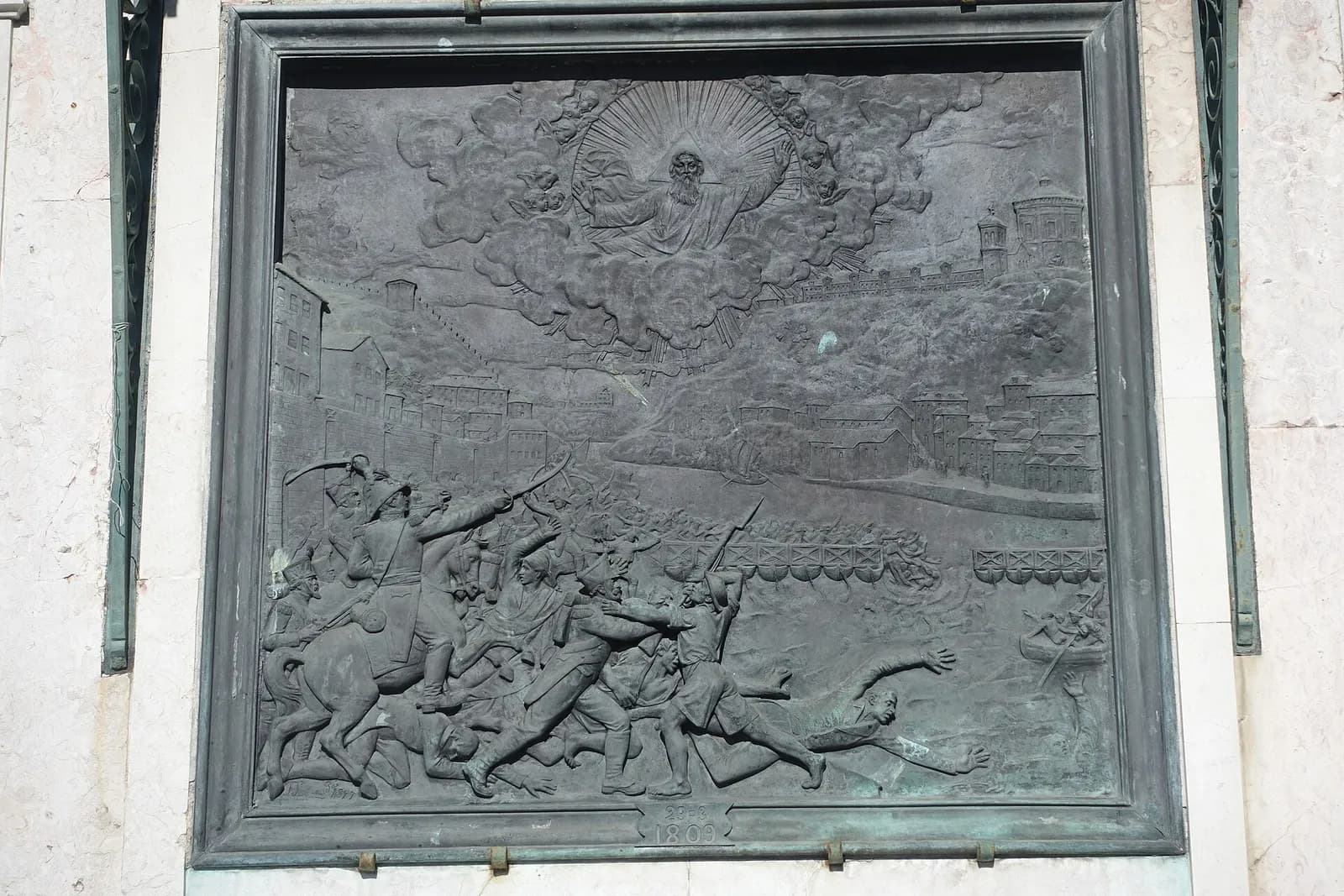
- On the Ribeira quay, candles still burn at the Alminhas da Ponte, a bronze relief of 1897 by José Joaquim Teixeira Lopes, and a mass for the victims is said every 29 March.
Thunder before dawn
At three in the morning of 29 March 1809 a thunderstorm broke over Porto, driven by a gale from the north-west. Portuguese sentries in the earthworks above the city thought they saw French columns coming up through the rain and opened fire. For half an hour some 200 guns of position fired into the dark at nothing. Napier puts the storm and the false alarm nearer midnight.
The French were out there, lying soaked in the fields, but they had not moved. Marshal Nicolas Soult put back his attack by an hour so his men could dry off, eat something and let the ground harden. At seven o'clock they went forward.
Below the lines, the city ran steeply down to the Douro. At the bottom of its streets, at the Ribeira quay, a single bridge crossed the river to Vila Nova de Gaia: a wooden roadway laid on boats, the Ponte das Barcas. Within a few hours a fleeing crowd had been pushed into the water there, and nobody has ever known how many died.
“Here all the horrid circumstances of war seemed to be accumulated, and the calamities of an age compressed into one doleful hour.”
A city in arms, and in uproar
Portugal was facing its second French invasion in two years. During the first, a French army under General Junot had occupied Lisbon and the royal family had left for Brazil. After an Anglo-Portuguese victory at Vimeiro in August 1808, the last of Junot's men left the kingdom on 9 October 1808. Napoleon then ordered Marshal Soult, who had just driven a British army out of Spain at Corunna in January 1809, to invade from the north.
Soult's vanguard crossed the frontier near Chaves on 9 March 1809, and the French marched into Chaves three days later. On 20 March he broke a huge but badly armed peasant army in front of Braga. Its commander, Bernardino Freire, had been dragged from prison and killed by his own men a few days before, accused of treachery.
In three weeks the people of Porto had dug a line of works six or seven miles long, from São João da Foz on the sea to the chapel of Bonfim above the river: twelve redoubts on the hills north of the city, palisades and ditches between them, and 197 guns. A battery on the Serra do Pilar, across the river in Gaia, overlooked the bridge and the whole city: twenty heavy guns according to Oman, fifty according to Napier.
Inside the lines there was something close to anarchy. When news of Braga arrived, a crowd hauled people accused of French sympathies out of the prisons and hanged fourteen of them, among them a brigadier, Luís de Oliveira. On the night of 28 March the bishop blessed the garrison and crossed the river to the convent on the Serra do Pilar, leaving three brigadiers to fight the battle.
- French attackers
- About 16,000 men available to Soult, 3,000 of them cavalry
- Portuguese defenders
- About 30,000 by Oman's reckoning (5,000 regulars, 9,000 armed citizens, more Ordenança); 24,000 according to Pinho Leal; nearly 40,000 according to Napier
- Artillery in the lines
- 197 guns, with fewer than 1,000 trained gunners
- Population of Porto
- About 70,000; half had left in the two days before the attack
- Merchant ships at the quay
- Nearly thirty, mostly English and loaded with port wine, held in by contrary winds
A road on twenty boats
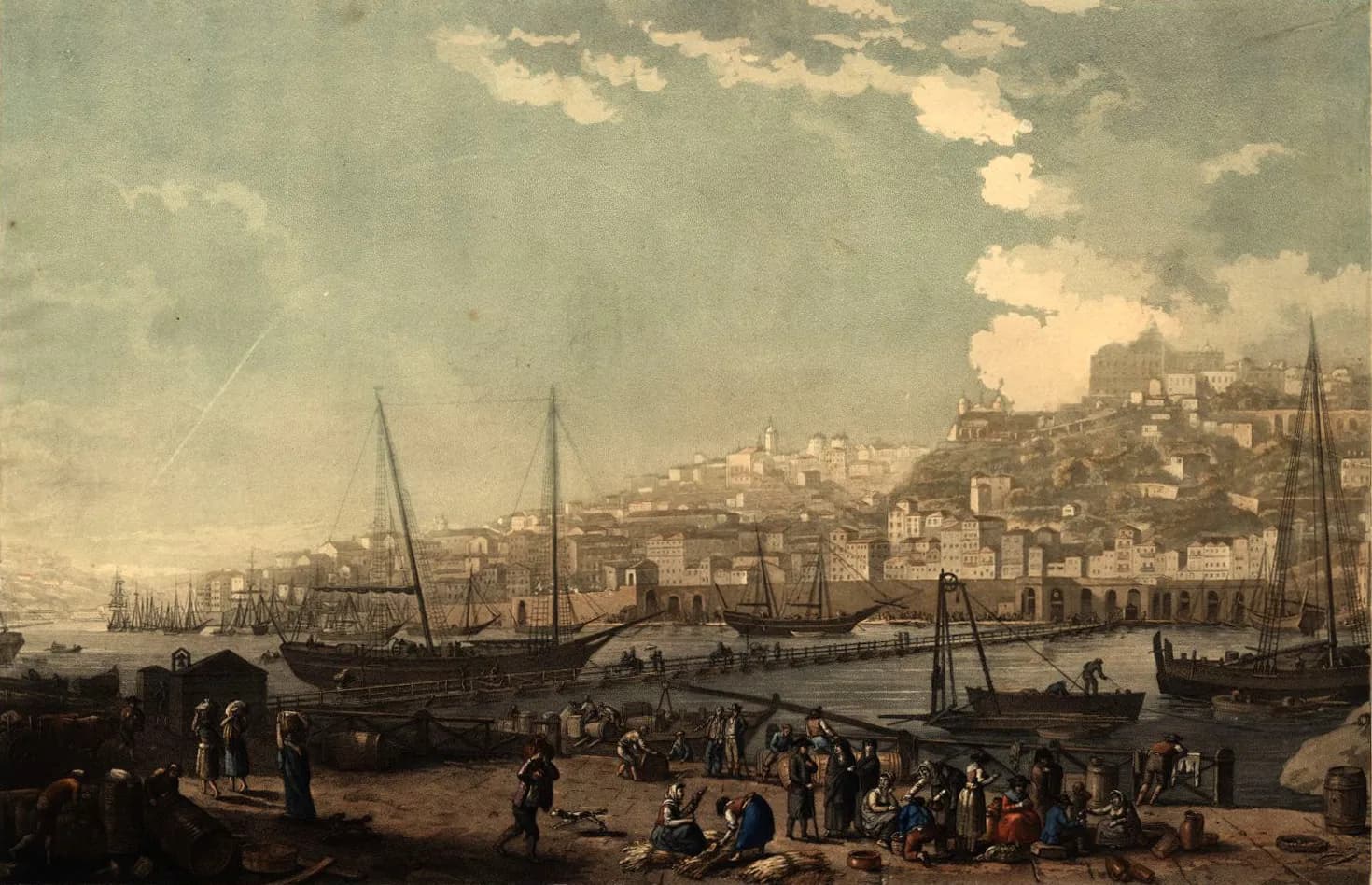
For centuries people crossed the Douro between Porto and Gaia by boat. A permanent bridge of boats opened on 15 August 1806, which Pinho Leal gives as the day Our Lady of the Pillar was honoured at her church on the Serra do Pilar, the hill above the Gaia bank. It is credited to the military engineer Carlos Amarante. Pinho Leal says the government had it built at the request of the city's authorities; Porto's tourist board says it was ordered by the Companhia Geral da Agricultura das Vinhas do Alto Douro, the Douro wine company.
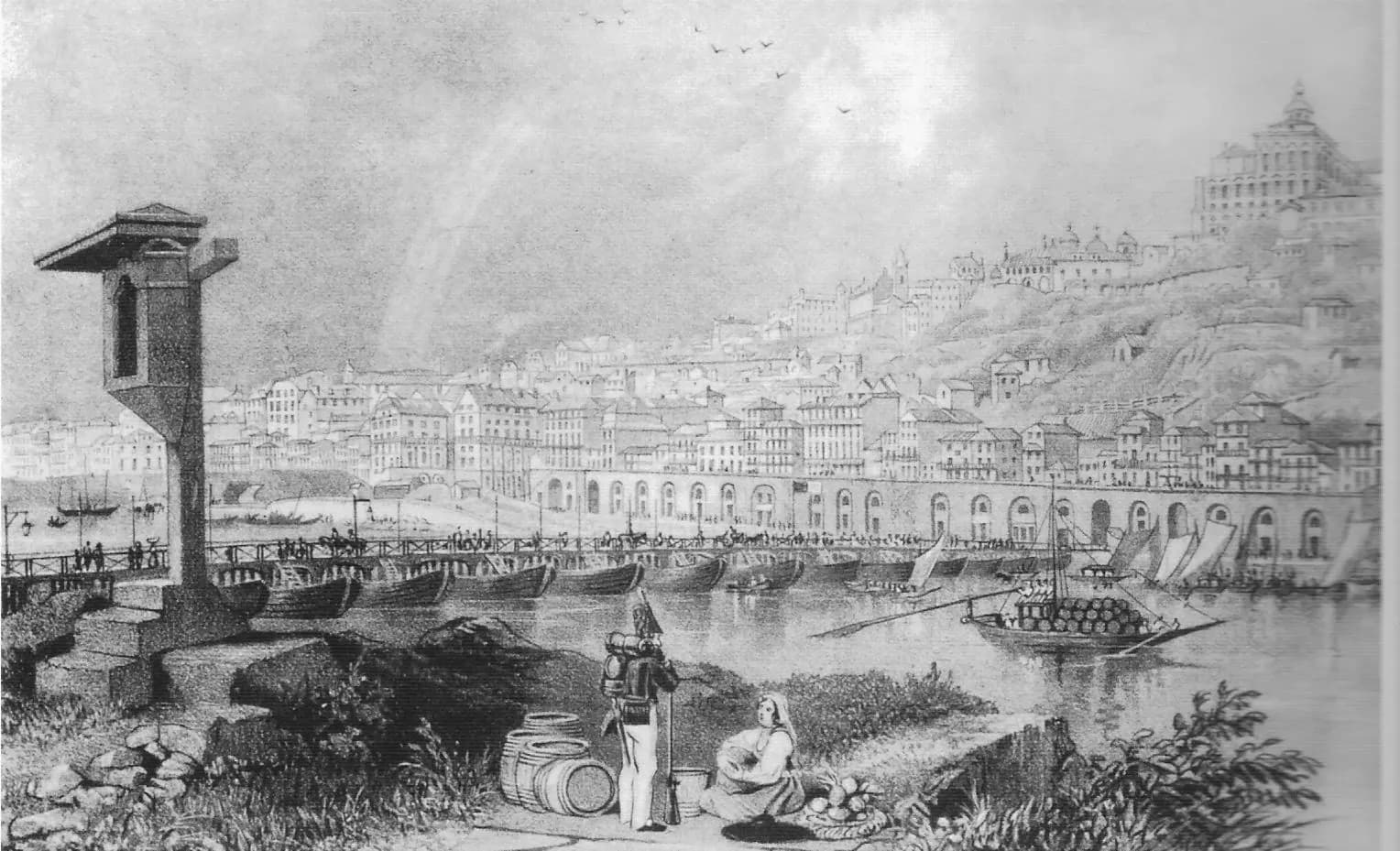
It was about 20 boats moored side by side and anchored upstream and downstream, joined by iron cables, with a wooden deck for people, animals and carts. João António Monteiro de Azevedo, in his topographical description of Vila Nova de Gaia, praised it because it rose and fell with the tides, opened to let larger vessels through and could be taken apart when the river flooded. Oman puts its length at more than 200 yards; Napier, at nearly 300.
The lines break
Soult attacked on the flanks first. General Merle pushed into the houses and gardens below the western end of the Portuguese line, and General Delaborde broke into the north-eastern corner of the city. Brigadier Parreiras, who held the centre, sent most of his reserves to help both wings. That was what Soult had been waiting for.
He threw General Mermet's division and two regiments of dragoons at the half-empty central redoubts. The Portuguese gunners fired two salvos before the French were in through the embrasures. The line was cut in two, and Mermet's men chased the defenders down the streets towards the river. The Diário de Notícias account has the alarm raised in the city at nine.
Brigadier Vitória took the eastern wing out along the Valongo road and got away. In the west, Brigadier Lima Barreto ordered his men to spike their guns and fall back; they shot him as a traitor. Merle's division then drove them towards Foz and the sea, where several thousand, trapped between the river and the ocean, were cut down or pushed into the water. Napier says that nearly all of those who tried to swim or row across the river mouth died.
The gap in the bridge
The centre ran for the Ribeira. Parreiras crossed the bridge early to report to the bishop, and several thousand men followed him. Then, Oman writes, an unknown officer had the drawbridge between the central boats raised to stop the French following, while most of the fugitives were still on the Porto side.
Behind the soldiers came the townspeople. When word spread that the lines had fallen, men, women and children rushed down to the quays to get across before the sack began. The boats were still riding on their cables, and from the bank the bridge looked whole. Only those at the front could see the gap.
“For more than half an hour, it is said, the rush of fugitives kept thrusting its own front ranks into the death-trap, forty feet broad, in the midst of the bridge.”
Nobody at the back could hear the warnings. French infantry reached the quay and fired into the rear of the crowd, and the twenty guns on the Serra do Pilar opened fire on the French. Then a squadron of Portuguese cavalry, cut off from the eastern road, galloped out of a side street into the packed crowd at the bridgehead and trampled hundreds before the mass of bodies stopped it.
So many were pushed in that the gap filled with the living and the dead, and a few fugitives are said to have scrambled across on top of them. Germano Silva adds that boats trying to reach Gaia capsized as the bridge gave way and in the crossfire between the two sides.
The French on the quay saw that the crowd was mostly women, children and other civilians, and their firing died away. Both Oman and Napier say many soldiers then turned to helping people out of the river. Others drove the crowd back from the bridgehead with their musket butts. In the late afternoon some of Mermet's men patched the gap with planks and rafters, crossed, and took the battery on the Serra do Pilar.
Raised, sunk or left open
Writers have never agreed on how the gap opened. Le Noble, Soult's official chronicler, and Napier who followed him, said the central boats simply sank under the weight. So did Hennegan, who had brought British ammunition to Porto and was in the city that day. Luz Soriano and other Portuguese witnesses said the gap was made on purpose, and Pinho Leal gives both versions at once.
Oman sided with the Portuguese version, on the grounds that historians who tell a story against their own side can usually be trusted. Porto historians are still divided. At the bicentenary in 2009 Júlio Couto backed the weight version, while the military historian Sérgio Veludo thought it more likely that Portuguese sappers had pulled up planks to stop the French. Germano Silva mentions a darker hypothesis that has been raised, without endorsing it: that the bishop, from the Serra do Pilar, ordered the trapdoor opened so the French would fall into the trap.
| Account | What opened the gap | Who went into the river |
|---|---|---|
| Napier (1829), following Le Noble, Soult's official chronicler | The nearest boats sank under the weight of the crowd | More than 4,000 people were seen pressing onto and towards the bridge |
| Hennegan, who brought British ammunition to Porto and was there that day (as reported by Oman) | Central boats sank | Not given |
| Pinho Leal (c. 1876), p. 316 | The bridge broke and partly sank; the first fugitives to reach Gaia had left the trapdoors open to stop the pursuit | 4,000 people fleeing the city |
| Pinho Leal (c. 1876), p. 318 | Retreating defenders raised the trapdoor | About 5,000, of both sexes and all ages |
| Oman (1903), following Luz Soriano and Portuguese witnesses | An unknown officer, or the first fugitives across, had the drawbridge between the central boats raised | Thousands of the inhabitants drowned |
| Júlio Couto and Sérgio Veludo, Porto historians (JPN, 2009) | Couto: the bridge gave way under the crowd. Veludo: Portuguese sappers more likely removed planks | Not given |
| Diário de Notícias, with Germano Silva (2020) | The trapdoor may have been left open by mistake or to stop the French | Silva thinks 4,000 an exaggeration for the city's population |
Leal gives both figures in the same volume. His 1806 entry prints the date of the disaster as 20 March, an evident misprint for 29 March.
The nineteenth-century novelist Camilo Castelo Branco put the weight version into his novel Onde Está a Felicidade?: the crowd choked the boats, the weight broke the spars with a crash, and the abyss swallowed “families bound together in a last embrace” (translated from Portuguese).
How many died
Nobody counted. The bodies went down the river, and the figures given afterwards usually lump together everyone killed in the lines, at Foz, on the bridge and in the sack. Oman found contemporary totals ranging from 4,000 to 20,000. Napier wrote that ten thousand Portuguese were “said” to have died. Soult reported his own losses as 80 killed and 350 wounded.
Estimates of Portuguese dead in the storming of Porto, 29 March 1809
people killed (all causes)
All five figures count everyone killed that day, in battle, by drowning or in the sack, not only those lost at the bridge. Contemporary range and Oman's estimate from Oman (1903); ten thousand from Napier (1829). Soult reported French losses of 80 killed.
Show the data
| Estimate | |
|---|---|
| Lowest contemporary figure | 4,000 |
| Oman's estimate, low | 7,000 |
| Oman's estimate, high | 8,000 |
| Napier, “it is said” | 10,000 |
| Highest contemporary figure | 20,000 |
Oman thought the lower figure nearer the truth and guessed 7,000 or 8,000 dead, about half soldiers and half civilians, with thousands drowned. He noted that the town was not emptied and that most of its defenders turned up later in other Portuguese forces. One regiment of the line still had only 193 men under arms six months later.
For the bridge itself the numbers are smaller and softer. Pinho Leal gave 4,000 and 5,000 in the same book. In 2020 the Diário de Notícias reported that some historians speak of many hundreds of victims and others of more than four thousand; Germano Silva called the disaster one of the worst in the city's history but thought four thousand too high.
Sack and occupation
Away from the bridge, small groups fought on from barricaded houses. Militiamen in the bishop's palace held out for hours and were bayoneted when the doors gave way: 400 of them, according to Oman, 200 according to Napier. Then came the sack, with looting, rape and killing through the afternoon.
Napier says the fury grew when French soldiers found comrades who had been taken prisoner tied up in a square, alive and horribly mutilated. He also says Soult and hundreds of his officers and men tried to stop the slaughter, at the risk of their lives. Oman credits Soult with restoring order before the next morning, and notes that dozens of French prisoners were found alive, so not all had been killed or tortured. Germano Silva told the Diário de Notícias in 2020 that the French looted, killed and raped for three days.
Soult took 200 guns, a large store of British munitions and more than thirty merchant ships loaded with wine. He held Porto for six weeks, and Leal records churches, convents and houses stripped of anything of value. The French repaired the bridge, then destroyed it in May to stop Arthur Wellesley's Anglo-Portuguese army; Wellesley crossed the Douro anyway on 12 May and drove them out of the city.
15 August 1806
Bridge opens
The bridge of boats between Porto and Gaia opens to the public.
9 March 1809
Invasion
Soult's vanguard crosses the frontier near Chaves.
12 March 1809
Chaves
The French enter Chaves after its garrison capitulates.
20 March 1809
Braga
Soult routs the Portuguese levies in front of Braga.
26 March 1809
The Ave
The French force the line of the river Ave, about 15 miles north of Porto.
28 March 1809
The bishop leaves
The bishop crosses to the Serra do Pilar and hands the defence to three brigadiers.
29 March 1809, 3 a.m.
False alarm
In a thunderstorm the Portuguese guns fire for half an hour at an enemy who is not there.
29 March 1809, 7 a.m.
Assault
Merle and Delaborde attack the flanks; Mermet breaks the centre.
29 March 1809, morning
The bridge
Fugitives are pushed into the gap in the middle of the bridge of boats.
29 March 1809, late afternoon
Gap patched
French troops plank over the gap and take the battery on the Serra do Pilar.
11–12 May 1809
Wellesley
The French destroy the repaired bridge; the Anglo-Portuguese army crosses the Douro anyway and the French leave Porto.
Porto rebuilt its bridge of boats, this time on 33 pontoons, and later built another. In 1843 a suspension bridge replaced them.
The little souls of the bridge
Porto has had other disasters, among them the wreck of the steamer Porto in 1857, in which everyone aboard died, and the fire at the Teatro Baquet in 1888. None, Germano Silva told the Diário de Notícias, is remembered with as much feeling as the bridge of boats.
Remembrance began on the quay. For many years a painting of the disaster by an unknown artist hung in a niche in the medieval city wall at the Ribeira, and people left flowers, candles and coins there for the alminhas da ponte, the “little souls of the bridge”. In 1810 the people of the Ribeira handed the money they had collected to the Brotherhood of Souls of the church of São José das Taipas, so that a mass would be said for the victims every 29 March. It still is.
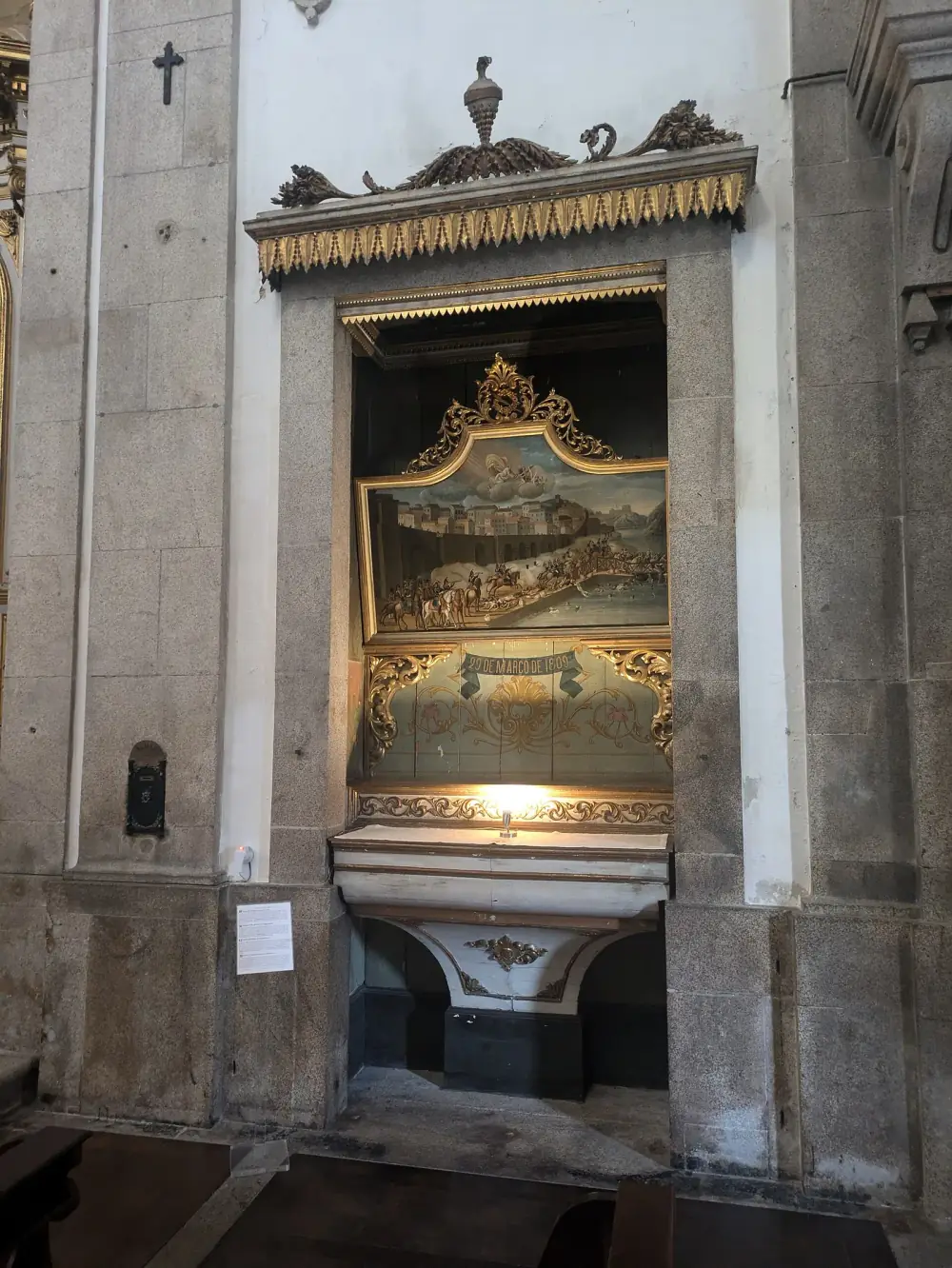
There was also a yearly procession from the Cordoaria down to the Ribeira. It stopped after the First Republic was proclaimed in 1910 and has never been revived. The painting moved into the church of São José das Taipas, where it hangs in an altar niche.
At the Ribeira the candles now burn under a bronze relief made in 1897 by José Joaquim Teixeira Lopes (1837–1918), the father of the better-known sculptor António Teixeira Lopes. It shows French horsemen riding down the crowd at the bridgehead, the bridge and the drowning in the river, and God the Father in the clouds above. In 2020 the Diário de Notícias wrote that the lights there never go out.
For the bicentenary in 2009, a monument by the architect Eduardo Souto de Moura was unveiled, made for Porto's urban renewal agency, APOR: two symmetrical sculptures of 12-millimetre Corten steel, one on each bank, jutting about three metres out over the river near where the bridge was moored.
Why it is still remembered
The disaster was a military defeat, a civilian massacre and a failure of command all at once, and the Portuguese sources do not spare their own side. The defence was run by a bishop who left the night before. Two Portuguese generals in the campaign, Freire at Braga and Lima Barreto at Porto, were killed by their own men, and the gap, in most Portuguese tellings, was opened by Portuguese hands.
What the city chose to remember was the people on the bridge. Its memorial is a shrine where people light candles, not a battle monument, and the mass paid for by the Ribeira's alms in 1810 is still said each spring. On 29 March the candles at the Alminhas da Ponte are lit for people whose number nobody has ever known.
FAQs
What was the Ponte das Barcas?
A bridge of boats over the Douro between Porto and Vila Nova de Gaia, opened on 15 August 1806: about 20 boats anchored side by side with a wooden roadway on top. A section in the middle could be opened to let ships through, and the whole bridge could be taken apart when the river flooded. It was the city's only bridge in 1809.
How many people died in the Ponte das Barcas disaster?
Nobody knows. Contemporary figures for all Portuguese killed when Soult stormed Porto ran from 4,000 to 20,000, and Charles Oman estimated 7,000 or 8,000, thousands of them drowned. For the bridge alone, Pinho Leal gave 4,000 and 5,000; others speak of many hundreds.
Did the bridge collapse?
Not in the usual sense. The boats stayed on their cables, but there was a gap in the middle. Soult's chronicler Le Noble, Napier and Hennegan, who was in Porto that day, said the central boats sank under the crowd; most Portuguese witnesses, followed by Oman, said a drawbridge or trapdoor had been raised to stop the French. The crowd behind pushed those in front into the gap.
What are the Alminhas da Ponte?
A shrine to the victims on the Cais da Ribeira in Porto, with a bronze relief of the disaster made in 1897 by José Joaquim Teixeira Lopes. People have left candles, flowers and alms for the dead there for more than two centuries, first before a painting and now before the bronze, and the money pays for a mass every 29 March at the church of São José das Taipas.
On the timeline
Open the timelineNearby moments from invasions, brazil and the liberal wars (1807–1851).
An Anglo-Portuguese force under Sir Arthur Wellesley, the future Duke of Wellington, defeats General Delaborde's French troops at the Battle of Roliça — the first battle fought by the British army in the Peninsular War, on Portuguese soil north of Lisbon.
At the Battle of Vimeiro, Wellesley's Anglo-Portuguese army defeats General Junot's French forces, a victory that leads directly to the French evacuation of Portugal under the Convention of Sintra.
The Convention of Sintra is signed, by which the defeated French army under General Junot agrees to evacuate Portugal following the Battle of Vimeiro, ending the first French invasion — though its generous terms caused outrage in Britain.
The Ponte das Barcas disaster
As Marshal Soult's French army storms Porto during the second French invasion, crowds fleeing across the Ponte das Barcas, the bridge of boats over the Douro, are pushed into a gap in its middle, and hundreds or thousands drown. A shrine on the Ribeira quay still recalls the disaster.
In a daring surprise attack, Arthur Wellesley — the future Duke of Wellington — ferries his troops across the Douro in commandeered wine barges and drives Marshal Soult's French army out of Porto in the Second Battle of Porto. The defeat ends Napoleon's second invasion of Portugal.
In Rio de Janeiro, the exiled Portuguese court signs the Strangford Treaty with Britain, its protector against Napoleon. British goods were to enter Brazil at a duty of just 15 per cent, less than the 16 per cent then charged on goods from Portugal itself; the two rates were equalised almost a year later, but Britain kept its low tariff in Brazil until the 1840s.
Birth of Alexandre Herculano in Lisbon, who would become one of Portugal's greatest historians and novelists. His monumental 'History of Portugal' and historical novels helped define Portuguese national identity and historiography.
Coming up in history
All long reads 31 March 1360Philippa of Lancaster, the English queen who raised Portugal's princes
 1 April 1996Mário Viegas, the actor who said Portugal's poems aloud, dies at 47
 2 April 1976The Constitution of 2 April 1976: how Portugal wrote down its democracy
 3 April 1954Aristides de Sousa Mendes: the consul who defied Salazar dies poor, 1954
11 sources
Archives, scholarship and reporting this article was checked against.
- 1
A History of the Peninsular War, vol. II: January–September 1809 (Charles Oman)Clarendon Press, Oxford, 1903; Project Gutenberg edition
- 2
- 3As “alminhas da ponte” não deixam esquecer a tragédia da Ponte das Barcas (Maria João Martins)Diário de Notícias, 27 February 2020
- 4
Portugal antigo e moderno, vol. 7, entry “Porto”, annals for 1809 (p. 318) (Augusto Pinho Leal)Mattos Moreira, Lisbon, c. 1876 (Getty Research Institute copy, Internet Archive)
- 5
- 6
As Pontes do Porto (Manuel de Azeredo, 1997–1999)Faculdade de Engenharia da Universidade do Porto (U.Porto web archive)
- 7
Ponte das BarcasVisit Porto (Câmara Municipal do Porto)
- 8
Ponte das Barcas: o que resiste 200 anos depois? (Sara Santos Silva)JPN, Jornalismo Porto Net (Universidade do Porto), 28 March 2009
- 9
187th birth anniversary of Joaquim Teixeira LopesMuseu Nacional Soares dos Reis
- 10
A Construção da Identidade Nacional Portuguesa por meio dos Monumentos da Cidade do Porto (1818-1933), section 1.10 and pp. 65–67 (Isabela Ramos)Master's dissertation, Faculdade de Letras da Universidade do Porto, 2025 (Repositório Aberto da U.Porto)
- 11
Monument to the “Barcas Bridge” over River DouroAFA Consult (project sheet)
Image credits
- Porto seen from the Vila Nova de Gaia bank in 1817, after Henri L'Evêque. The bridge of boats in the middle distance is the one rebuilt after 1809, at the same crossing to the arcades of the Ribeira. Henri L'Evêque, Public domain, via Wikimedia Commons.
- A later bridge of boats at the same crossing, in a view by Joseph James Forrester made before 1848. The boats are anchored in a line with the roadway laid across their decks. Joseph James Forrester, Public domain, via Wikimedia Commons.
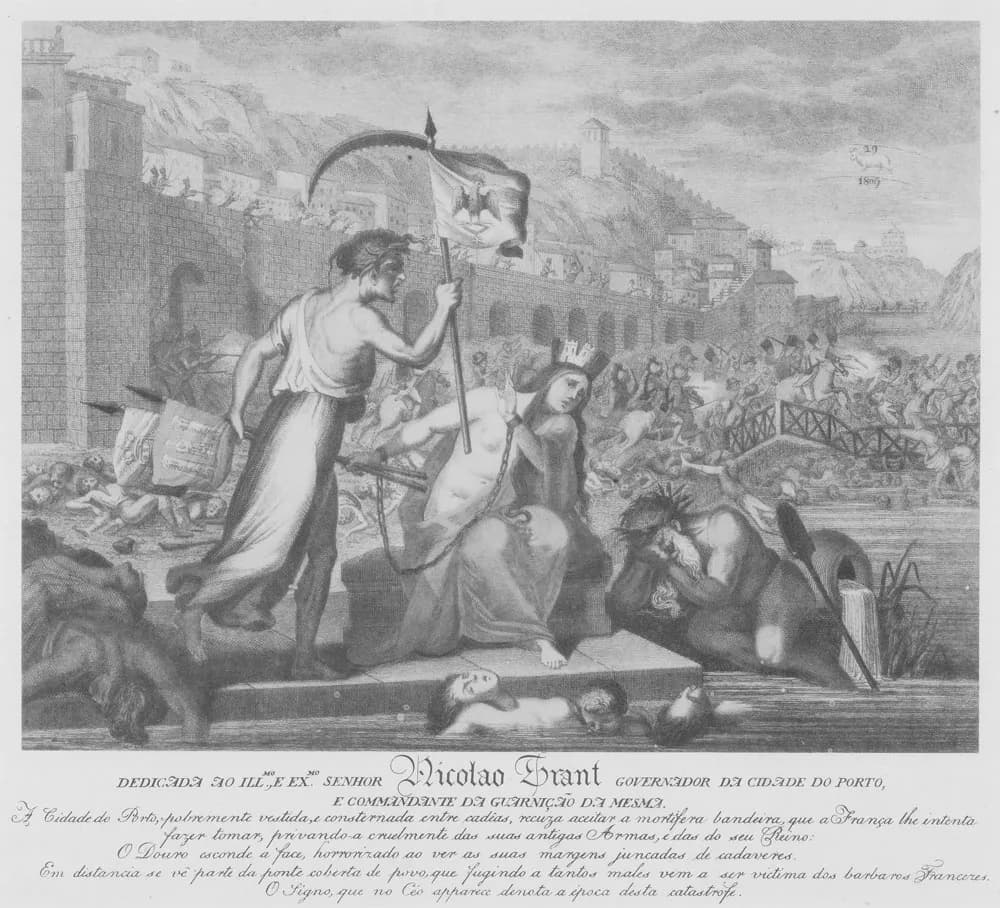
- The Catastrophe of the Ponte das Barcas, an engraving of about 1809 dedicated to Nicholas Trant, the British officer it names as governor of the city of Porto. Its legend explains that the city in chains refuses the French flag, the Douro hides his face at banks strewn with corpses, and the ram of Aries in the sky marks the date. Unknown author, Public domain, via Wikimedia Commons.
- The Suffrage of the Bridge of Boats, an oil painting on copper of 1845 by an unknown painter, in its altar niche in the church of São José das Taipas, Porto. Photographed in 2025. Atrapalhado, CC BY 4.0, via Wikimedia Commons.
- The bronze relief of the Alminhas da Ponte on the Ribeira quay, signed “T. Lopes Pae” and dated 1897. Photographed in 2024. Joseolgon, CC BY 4.0, via Wikimedia Commons.