

Kaiser Wilhelm II in Lisbon, 1905: three days on the way to Tangier
Lisbon brought out its state coaches and swapped its British flags and greetings for German ones, days after cheering Britain's Queen Alexandra. The emperor was on his way to Morocco, and in Lisbon, two of his companions said, he nearly gave up the plan.
At a glance
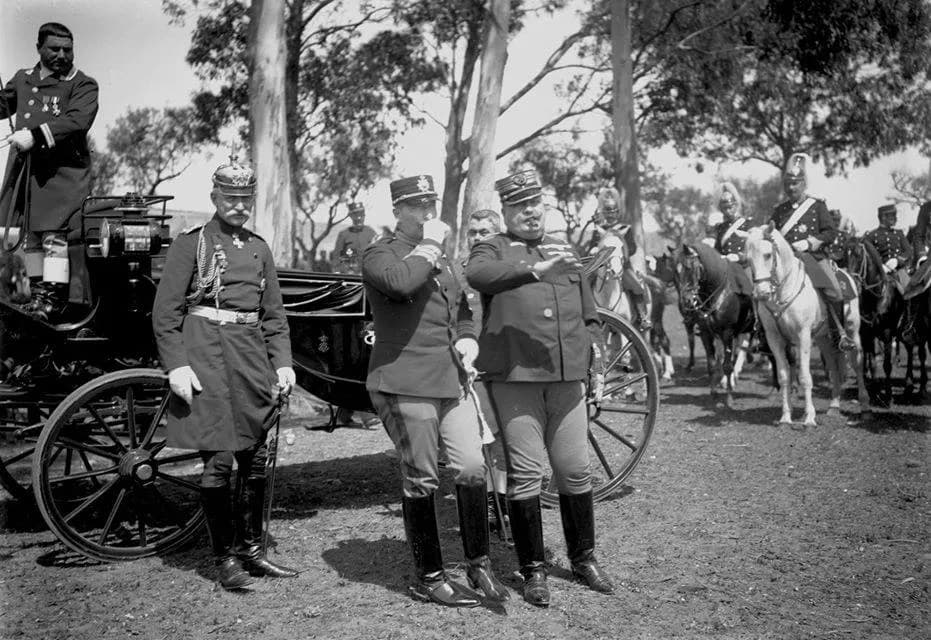
- On Monday 27 March 1905 Kaiser Wilhelm II landed at Lisbon's Cais das Colunas from the Hamburg-America liner Hamburg and rode with King Carlos I to Belém in the state coach of João V.
- Over the next three days he dined at the Ajuda palace with some 220 guests, watched cavalry exercises, spoke at the Geographical Society and lunched at Sintra; he sailed on 30 March.
- His visit followed, by two days, that of Queen Alexandra of Britain. Portugal was Britain's oldest ally, and Britain and Germany had secretly planned in 1898 for the day Portugal might lose its colonies.
- Lisbon was the last stop before Tangier. On 31 March the Kaiser rode into the Moroccan port and declared he was visiting the Sultan as an independent sovereign, which opened the First Moroccan Crisis.
- A British ambassador later reported that, on reaching Lisbon, Wilhelm had resolved to give up the Tangier landing and changed his mind only after reports from Berlin. At the Algeciras conference of 1906 Portugal followed Britain.
Ten past four at the Cais das Colunas
The liner Hamburg tied up in the Tagus on the afternoon of Monday 27 March 1905. King Carlos I set off from the Navy Arsenal in the royal brigantine, the ceremonial barge, while the warships in the river fired their salutes. With him went the crown prince, Luís Filipe, the king's brother, Infante Afonso, the ministers of the navy and of foreign affairs, the German minister and consul, and the agents of the Hamburg-America Line, which owned the ship.
After greetings and introductions on board, Kaiser Wilhelm II, the German emperor, came ashore. A procession of boats like the one that had landed Queen Alexandra of Britain a few days earlier carried him to the Cais das Colunas, the marble steps at the river end of the Terreiro do Paço. It was a fine spring day. A Porto chronicler timed the landing at ten past four.
In the royal pavilion on the square, the British emblems and flags put up for the queen had been replaced with German ones. The Council of State, the ministers, the city council with its standard and officers of the army and navy waited there. The Kaiser wore the uniform of a Portuguese cavalry regiment of which he was honorary colonel; Carlos and Afonso wore those of honorary officers of a German infantry regiment. On the quay the German colony of Lisbon, and part of Porto's, cheered their emperor, and pupils of the German school lined up to watch.
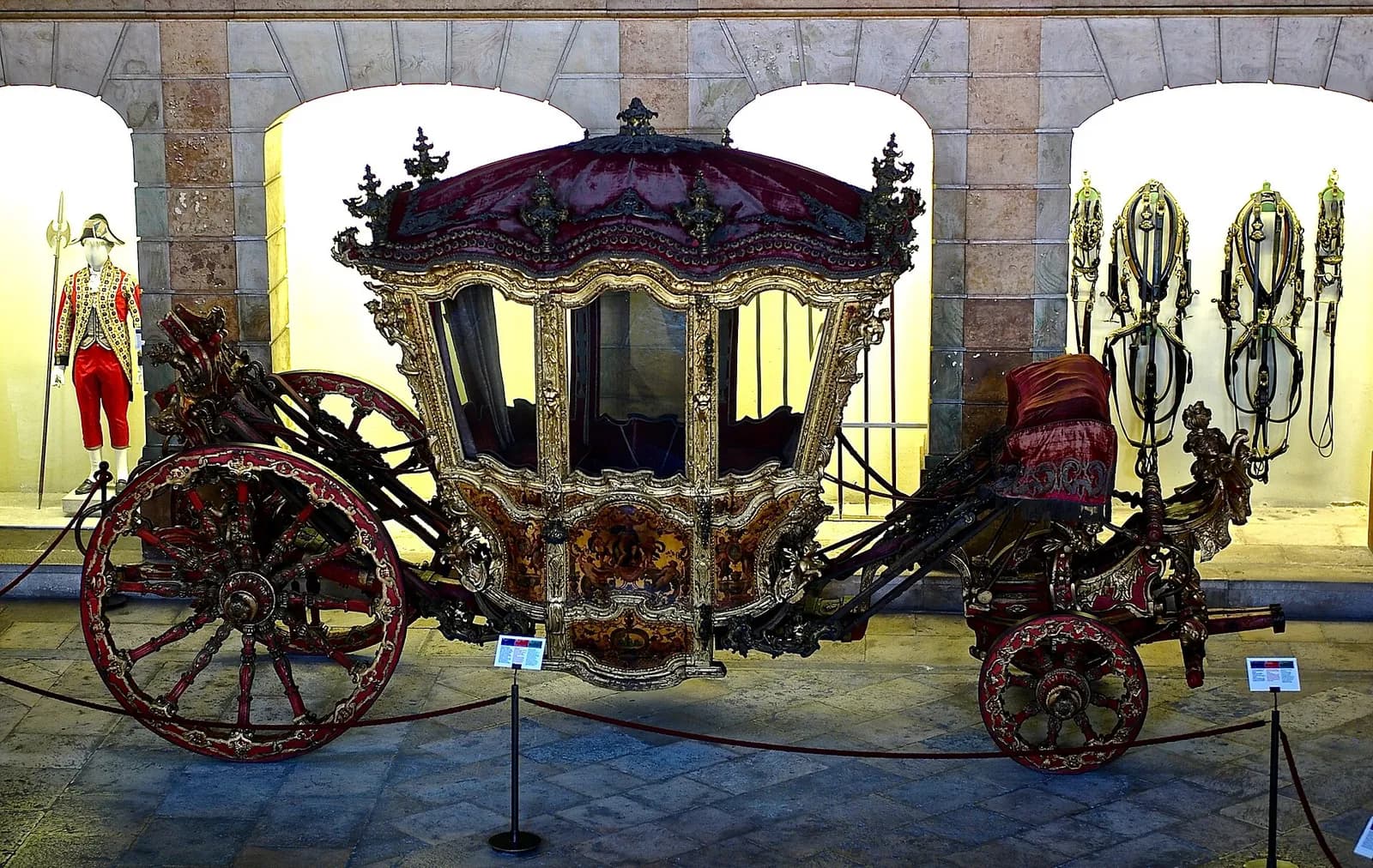
Then the coaches rolled out. Eight state carriages, each known by the name of a past member of the royal family, carried the two suites west. The Kaiser and Carlos rode in the last, João V's, behind about 300 mounted municipal guards and ahead of a cavalry brigade of lancers and troopers. They went up the Rua do Ouro to the Chiado, down the Rua do Alecrim to the river, and along the Aterro and the Rua da Junqueira to the palace at Belém. The crowd along the way, the Porto chronicler wrote, was beyond counting.
Two 1905 accounts, the Porto chronicle and the Lisbon review O Occidente, end the procession at Belém, where Queen Amélia was waiting at about six. A caption in a photograph album published in 1933 has the coach heading instead for the Necessidades, the king's own palace.
The arrival was filmed. The Cinemateca Portuguesa keeps the result: a silent film of just over a minute, directed by Manuel Maria da Costa Veiga for the company Portugal Film.
A small kingdom between two empires
Portugal in 1905 was a constitutional monarchy. Carlos had been king since his father, Luís, died in October 1889. The country was poor and in debt, but it still held a large African empire: Angola on the west coast, Mozambique on the east, and smaller colonies in Africa and Asia.
Its oldest friend was Britain. The alliance went back to the fourteenth century, but it had nearly broken in January 1890, when a British ultimatum forced Portugal to give up its claim to the lands between Angola and Mozambique. Germany had since become a neighbour in Africa. German South West Africa bordered Angola, and German East Africa bordered Mozambique.
In August 1898 Britain and Germany signed conventions setting out how they would share the security for any loan to Portugal, customs house by customs house, and how they would keep other powers out if Portugal ever lost Angola, Mozambique or Timor. The convention on the colonies was secret. In October 1899 Britain separately promised to defend Portugal's colonies, a story told in our article on the secret declaration of that year.
Royal visitors were one way to read where Lisbon stood. Edward VII of Britain came in April 1903 and Alfonso XIII of Spain in December 1903. Queen Alexandra, Edward's wife, was in Portugal from 22 to 25 March 1905, two days before the Kaiser. The French president, Émile Loubet, followed in October.
A visit owed since 1888
In Germany the visit was presented as overdue courtesy. King Luís had been the first monarch from outside Germany to call on Wilhelm in Berlin and Potsdam after he came to the throne in the summer of 1888, and Carlos had since visited Germany too. The German weekly Die Grenzboten wrote that the court and people of Lisbon had waited years for the return visit, above all those who wanted more trade with Germany.
“No direct political results were intended by it, nor may we expect any.”
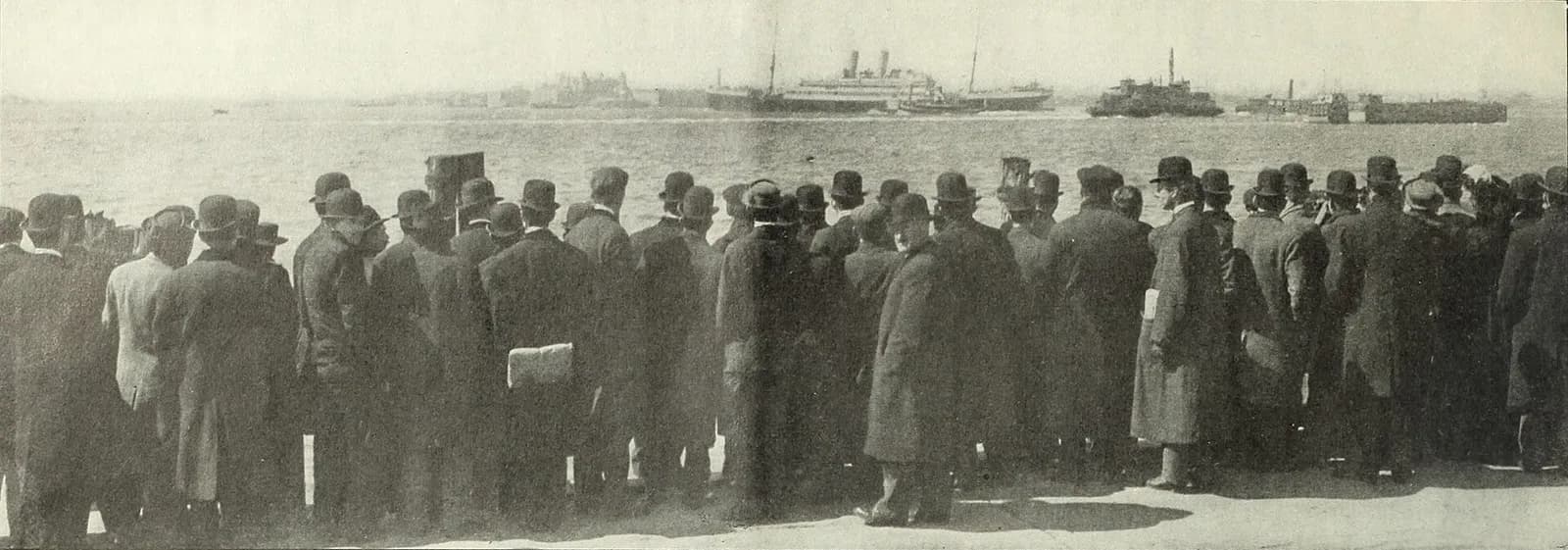
The Kaiser travelled on a passenger liner. For this, his second cruise to the Mediterranean in two years, he sailed from Cuxhaven on the Hapag liner Hamburg, with a large military suite and a party of personal friends. His suite rode in the first six coaches of the Lisbon procession, each with Portuguese escorts: generals von Plessen, von Scholl and Count Hülsen, the admirals von Müller and Baron von Senden, and Baron von Schoen, Germany's minister in Copenhagen, who sailed as the Foreign Office's representative.
Banquets, cavalry and Sintra
- Arrival
- Monday 27 March 1905, about 4.10 pm, at the Cais das Colunas
- Ship
- Hamburg, a liner of the Hamburg-America Line (Hapag)
- Host
- King Carlos I, with Queen Amélia and Queen Maria Pia
- Departure
- 30 March 1905, from the Cais das Colunas
- Next stop
- Tangier, Morocco, 31 March 1905
27 March, 4.10 pm
Landing
The Kaiser comes ashore at the Cais das Colunas and is greeted in the royal pavilion.
27 March, 6 pm
Belém
The coach procession reaches Belém, where Queen Amélia is waiting.
27 March, 7 pm
Diplomatic corps
Reception for the diplomatic corps.
27 March, 8 pm
Gala dinner at Ajuda
Dinner, a concert and supper; the concert ends at 2 am.
28 March
Cavalry and the Geographical Society
Barracks on the Calçada da Ajuda, where he gives his portrait in oils; exercises at the Belém racecourse; a speech at the Geographical Society.
29 March
Sintra
Excursion with the royal family and lunch at the palace in the town.
30 March
Departure
A visit to the royal coach collection at Belém, then embarkation at the Cais das Colunas.
31 March
Tangier
The Hamburg anchors off Tangier and the Kaiser rides into the town.
The first night belonged to the Ajuda palace. Carlos lived at the Necessidades, a converted convent with no room big enough for a state banquet, so large dinners were held at Ajuda, the home of his mother, Queen Maria Pia. The Diário Illustrado reported two long tables of 90 in the Sala da Ceia, the supper room, and a third table of 70 in the next room.
The household's own paperwork, studied by the architectural historian Ana Sofia Pinto, gives the scale. The pantry order for the night lists a state table of 220 covers and a second table for 600 more people, and 30 musicians of the royal orchestra played. The kitchen order ran to nearly 800 kilograms of beef, veal and pork, more than 300 birds and 3,600 eggs.
| Item | Quantity | Record |
|---|---|---|
| Covers at the state table (dinner) | 220 | Pantry order, Necessidades palace |
| Places at the second table | 600 | Pantry order, Necessidades palace |
| Places at supper (state table only) | 250 | Pantry order and Diário Illustrado |
| Musicians of the royal orchestra | 30 | Expenses list, Casa Real papers |
| Meat (beef, veal, pork) | Nearly 800 kg | Kitchen order |
| Poultry and game birds | 328 | Kitchen order |
| Eggs | 3,600 (300 dozen) | Kitchen order |
| Bottles of wine, beer and spirits for the state table | 305 | Pantry order |
| Bottles of ordinary Termo wine for the second table | 372 | Pantry order |
Figures from the documents analysed by Ana Sofia Pinto (2025). Sources differ on the head count: the pantry order gives 220 covers for dinner, Pinto estimates about 200 diners, and the Diário Illustrado's three tables seated 250. The 328 birds are 30 capons, 86 pullets and young cockerels, 56 hens, 68 guinea fowl, 24 partridges and 64 turkeys.
Bottles ordered for the state table, 27 March 1905
bottles
The 305 bottles requested for the dinner and supper at the Ajuda palace, from the pantry order transcribed by Ana Sofia Pinto. Other: 6 bottles of liqueurs, 4 of Martell cognac, 4 of white Colares and 1 of rum. Pinto notes that this was a sober order compared with Edward VII's lunch in 1903.
Show the data
| Bottles | |
|---|---|
| Beer | 63 |
| Bordeaux | 51 |
| Red Colares | 51 |
| Sparkling from Porto | 36 |
| Greno sparkling | 23 |
| Madeira | 20 |
| Champagne | 18 |
| Port | 18 |
| Moscatel | 10 |
| Other | 15 |
On 28 March the Kaiser, in the uniform of his Portuguese regiment, visited the cavalry barracks on the Calçada da Ajuda and presented the regiment with his portrait in oils. That day the cavalry, a rifle battalion and the artillery put on exercises for the two monarchs at the Belém racecourse. In the course of the visit he also went to the Casa Pia orphanage, the city hall, the Jerónimos monastery and the São Carlos opera house, and attended a gala dinner at the German legation.
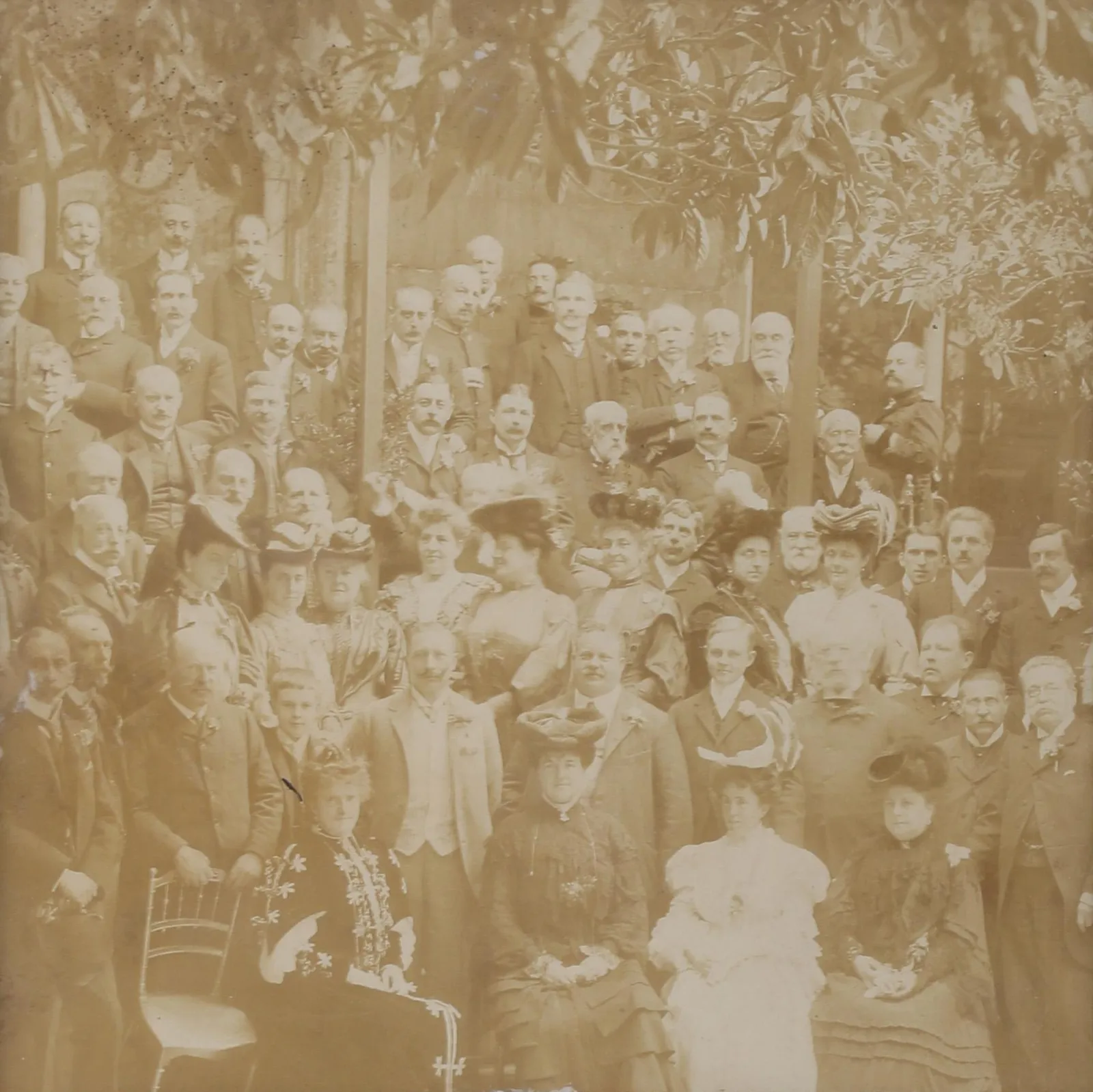
On the 29th the royal family took him to Sintra, in the hills west of Lisbon, and gave him lunch at the royal palace in the town. The guests included the Marquis of Soveral, Portugal's minister in London and a close friend of Edward VII. Soveral was on the quay again the next day, with Queen Amélia and Queen Maria Pia, when the Kaiser went back on board.
A toast in the wrong language
Not everything went smoothly. At dinner on the first night Carlos gave his speech in French. Wilhelm answered in German.
“This was received by the Portuguese with icy frigidity.”
Schoen blamed poor preparation. The two monarchs had been alone in the state coach for hours without settling the toasts, and the German legation had not found out in advance what the king meant to say, so the Kaiser had to reply on the spot. He may also have been irritated, Schoen thought, because a Portuguese wireless station had refused a German telegram to the Empress shortly before he arrived.
Schoen talked him into a repair. At the Geographical Society the next day the Kaiser gave a hastily composed speech in French about the great Portuguese navigators and the colonial achievements of Portugal and Germany. The coolness, Schoen wrote, then changed to southern warmth and enthusiasm, and the rest of the stay passed off quite harmoniously.
Second thoughts on the way to Tangier
The visit all Europe was discussing was the next one. Newspapers had been reporting that the Kaiser would land at Tangier, the Moroccan port where the foreign legations sat. On 22 March the French foreign minister, Delcassé, told the British ambassador in Paris that he could not understand what Germany wanted, and that the visit was raising expectations among the Moroccans.
Bülow wanted the landing. By his own account he advised the Kaiser by letter to go ashore and to say simply that he was visiting the Sultan as an independent sovereign and hoped Morocco would stay open to the peaceful competition of all nations. Wilhelm agreed without enthusiasm. Schoen, whose task on board was to keep him from wavering, found that he had meant only to give his guests a glimpse of Muslim life and to stay on the ship himself.
Lisbon added to his doubts. There he was told that Tangier's streets were too narrow for a carriage, so he would have to ride an unfamiliar horse from the harbour to the German legation on the far side of town, and that an east wind could make it impossible to land at all. His left arm was crippled, as he later wrote himself, and the strange horse worried him. Now and then, Schoen recalled, he seemed ready to back out.
“On his arrival at Lisbon, he had determined to give up his projected visit to Morocco, and that it was only in consequence of the reports from Berlin, which he received at Lisbon, that he decided to carry out his original intention.”
The man on hand to stiffen him was Count Tattenbach, Germany's minister in Lisbon. He had served in Morocco before, had fought diplomatic battles with the French there, and sailed on with the Kaiser as the expert on the place. On 30 March the Hamburg left Lisbon.
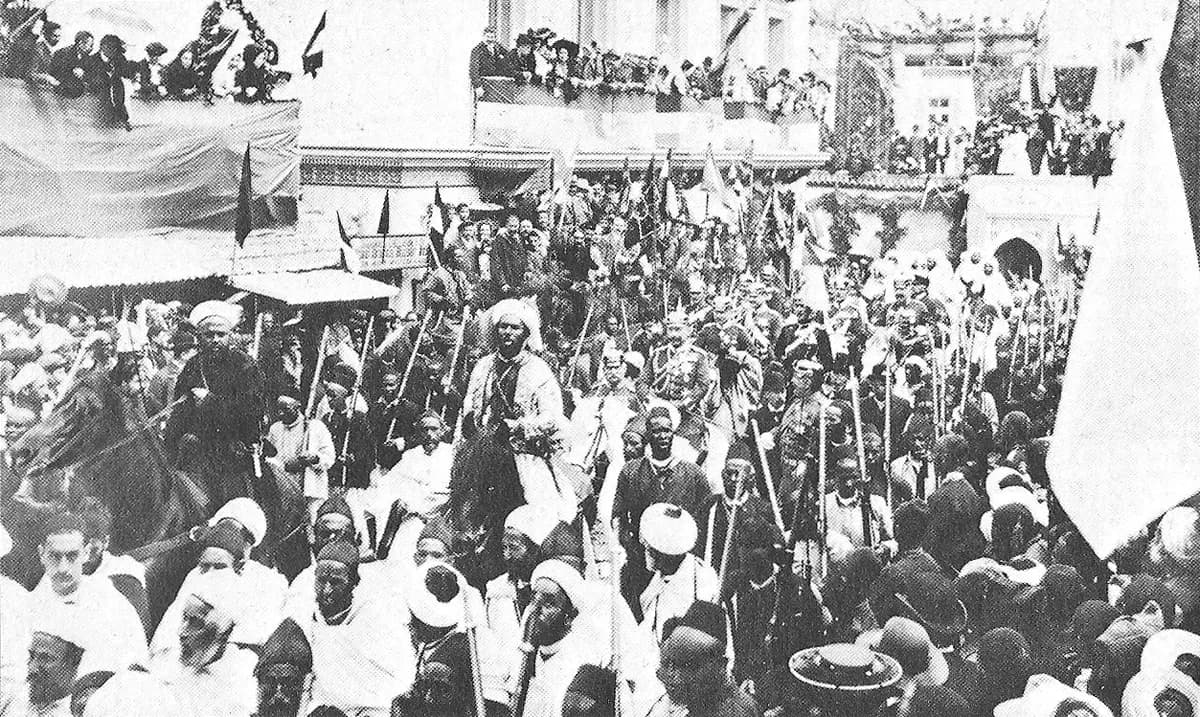
On 31 March the liner anchored off Tangier in a stiff east wind. The German chargé d'affaires, Kühlmann, came out in a sailing boat and climbed the rope ladder in full lancer's uniform. When an aide reported that anyone who did not mind getting wet could land, the Kaiser went ashore, mounted a white Arab horse that shied at his helmet, and rode through packed, noisy streets to the legation. Die Grenzboten put the visit at three hours.
“I do not acknowledge any agreement that has been come to. I come here as one Sovereign paying a visit to another perfectly independent sovereign. You can tell Sultan this.”
What Lisbon's press made of it
Lisbon's papers covered the two royal visits back to back, Britain and Germany separated by a single sheet of newsprint. Writing in the illustrated weekly Ilustração Portuguesa on 27 March, the journalist and historian Rocha Martins compared Portuguese hospitality to that of an Arab in his tent, who would spread on the ground the myrrh and aloes he meant to sell to honour a guest, even if it ruined him. He also remarked on the city's rush to redecorate.
“To replace in all haste the 'God Save the Queen' of the illuminated arches with 'Salve Germania'.”
O Occidente, the city's long-running illustrated review, preferred a flattering reading. In its issue of 20 March its founder, Caetano Alberto, wrote that the Kaiser wanted to know at close quarters this intimate ally of great England, which wished to cooperate with Britain in what it called the civilisation of Africa. In Porto, the Catholic fortnightly O Progresso Catholico called him the great military arbiter of Europe.
Memory was cooler. When Joshua Benoliel's photographs of these years were gathered in 1933 in the album Arquivo Gráfico da Vida Portuguesa, its text called the Kaiser a hard military figure who won no sympathy, and counted his visit among those that echoed furthest abroad, because of the visitor and of a politics in which the Great War was already taking shape.
From Tangier to Algeciras
Tangier turned a grievance into a crisis. Germany pressed for an international conference on Morocco, and in June 1905 Delcassé resigned. Bülow sent Count Tattenbach from Lisbon to Fez, the Sultan's capital, on a special mission to encourage him to refuse French demands and to invite the powers that had signed the Madrid convention to a conference.
Portugal was among those invited, and it looked to London. On 7 June 1905 its foreign minister, Villaça, told the British minister in Lisbon that he would give no view on the invitation until he had heard from Portugal's minister in London.
The conference met at Algeciras, in southern Spain, from 16 January to 7 April 1906. Portugal's delegation included its minister at Tangier, Count Martens Ferrão. In February the Portuguese representative told Britain's delegate, Sir Arthur Nicolson, that his instructions were to follow Britain on the police question and that he was ready to vote for the French proposal if asked. The General Act was signed on 7 April 1906. It kept Morocco formally independent, but Germany came out more isolated than before.
Wilhelm did not forget who had sent him ashore. On 11 August 1905, when Bülow offered to resign over the treaty Wilhelm had just signed with the Tsar at Björkö, the Kaiser wrote from Wilhelmshöhe begging him to stay, and reminded him of Tangier.
“For your sake, because the Fatherland demanded it, I landed and got on a strange horse, though my crippled left arm hampers my riding, and the horse came within a hair of killing me.”
In his memoirs Bülow called some of the letter pure invention, but wrote that the entire Tangier action had been done at his instigation. In Lisbon, Loubet's visit followed in October. Less than three years later, on 1 February 1908, Carlos and Luís Filipe were shot dead as their carriage turned out of the Terreiro do Paço, close to the quay where they had greeted the Kaiser.
Why it still matters
The visit sat inside a rivalry that outlived it. A British Foreign Office memorandum of January 1907 by Eyre Crowe looked back on the 1898 deal with open distaste, and Britain and Germany reopened talks on Portugal's colonies before the First World War. A new agreement was initialled in August 1913 but never signed.
“The manner in which Germany first bullied the Portuguese Government and then practically drove an indignant British Cabinet into agreeing in anticipation to this particular scheme of spoliation of England's most ancient ally, was deeply resented by Lord Salisbury.”
Portugal kept its colonies, and its choice of side held. When Germany declared war on Portugal in March 1916, Berlin accused the Portuguese government of regarding itself as Britain's vassal.
For Lisbon the visit also left a record. The minute of film in the Cinemateca and Benoliel's photographs of the arrival, the barracks, the racecourse and the quay show a court that could still stage a three-day pageant for an emperor, less than three years before its king was killed.
FAQs
Why did Kaiser Wilhelm II visit Lisbon in 1905?
Officially it was a return visit: King Luís of Portugal had called on Wilhelm in 1888 and King Carlos had visited Germany since. Lisbon was also a stop on a Mediterranean cruise whose next port was Tangier, where the Kaiser landed on 31 March to challenge France's position in Morocco.
How long did the Kaiser stay in Lisbon?
He landed on the afternoon of 27 March 1905 and spent that day and the next two in Lisbon and Sintra. He went back on board the Hamburg at the Cais das Colunas on 30 March and reached Tangier the next day.
What did the Lisbon visit have to do with the Tangier crisis?
Lisbon was the Kaiser's last stop before Tangier. According to Baron von Schoen, who sailed with him, he heard in Lisbon that he would have to ride a strange horse through narrow streets, and wavered. The British ambassador in Berlin later reported that he had decided at Lisbon to give up the landing and changed his mind after reports from Berlin.
Is there film of the Kaiser's visit to Lisbon?
Yes. The Cinemateca Portuguesa holds Visita do Imperador Guilherme II, a silent documentary of about one minute from 1905 showing his arrival, directed by Manuel Maria da Costa Veiga for Portugal Film. Joshua Benoliel also photographed the visit.
Which side did Portugal take in the Moroccan crisis?
Britain's. Portugal's foreign minister waited for London's view before answering the invitation to the conference, and at Algeciras in 1906 Portugal's delegate had instructions to follow Britain on the police question.
On the timeline
Open the timelineNearby moments from regeneration and the last kings (1851–1910).
At the Pembe ford on the Cunene River in southern Angola, Kwanyama (Cuanhama) warriors rout a Portuguese expeditionary column sent to impose colonial rule on the region, killing some 250 men, more than half the force — one of the rare outright African victories over a European army during the colonial wars of conquest.
Henrique de Barros, the agronomist who taught for decades at Lisbon's Instituto Superior de Agronomia, is born in Coimbra. Elected for the Socialist Party after the Carnation Revolution, he presided over the Constituent Assembly that drafted the democratic Constitution of 1976.
Rafael Bordalo Pinheiro dies in Lisbon aged 58. The caricaturist, illustrator and ceramicist created Zé Povinho, the shrugging everyman who still stands for the long-suffering Portuguese public, and helped found the Caldas da Rainha faience factory whose cabbage-leaf tableware and outsized animals remain coveted today.
Kaiser Wilhelm II in Lisbon
Kaiser Wilhelm II lands at Lisbon's Cais das Colunas from the liner Hamburg for a three-day visit hosted by King Carlos I, riding through streets decked out in his honour; a short film records his arrival. Four days later he goes ashore at Tangier, sparking the First Moroccan Crisis.
The café A Brasileira opens in Lisbon's Chiado, founded by Adriano Telles to sell coffee from Brazil. It became a meeting place for writers and artists, and since 1988 a bronze statue of its most famous regular, Fernando Pessoa, has sat at a table on the terrace.
Miguel Torga (Adolfo Correia da Rocha), doctor and writer regarded as one of the greatest Portuguese authors of the twentieth century, is born in São Martinho de Anta, Trás-os-Montes.
Hermínia Silva, the fado singer and revue actress whose humorous style made her one of the most beloved performers of Lisbon's stage in the 1930s and 1940s, is born at the Hospital de São José in Lisbon.
Coming up in history
All long reads 29 March 1809The Ponte das Barcas disaster: Porto's bridge of boats, 29 March 1809
 30 March 1904Alexandrina of Balasar: the bedridden mystic said to live without food
 31 March 1360Philippa of Lancaster, the English queen who raised Portugal's princes
 1 April 1996Mário Viegas, the actor who said Portugal's poems aloud, dies at 47
17 sources
Archives, scholarship and reporting this article was checked against.
- 1
Chronica quinzenal: the visit of Emperor Wilhelm II, O Progresso Catholico (Porto), year XXVII, no. 8, 15 April 1905Casa de Sarmento, Universidade do Minho (digitised copy)
- 2
A arquitetura de uma refeição. Palácios reais portugueses na aurora do século XX, Caderno 4: O jantar e ceia oferecidos pela família real portuguesa a Guilherme II a 27 de março de 1905 (Ana Sofia de Matos Pinto, PhD thesis)Faculdade de Arquitectura da Universidade do Porto, 2025
- 3
The Memoirs of an Ambassador: a Contribution to the Political History of Modern Times (Baron von Schoen, translated by Constance Vesey)George Allen & Unwin, London, 1922 (digitised by Internet Archive)
- 4
- 5
- 6
Arquivo Gráfico da Vida Portuguesa, 1903–1918, fascicle 2: 1905 (photographs by Joshua Benoliel)Hemeroteca Municipal de Lisboa
- 7
„Eine englisch-deutsche Verständigung“ (H. J.), Die Grenzboten, 1905, second quarterStaats- und Universitätsbibliothek Bremen, Die Grenzboten digital edition
- 8
Visita do Imperador Guilherme II (1905), film recordCinemateca Portuguesa-Museu do Cinema, via the European Film Gateway
- 9
- 10
British and Portuguese Attitudes Towards the British Ultimatum of 1890, by Maria Teresa Pinto CoelhoBritish Historical Society of Portugal, Report 21 (1994)
- 11
- 12
Das Vorspiel (Theodor Wolff, 1924), chapter on Björkö and MoroccoProjekt Gutenberg-DE
- 13
- 14
Minister Bryan to the Secretary of State, Lisbon, 3 February 1908 (No. 374)Office of the Historian, US Department of State: Papers Relating to the Foreign Relations of the United States, 1908, document 669
- 15
My Mission to London, 1912–1914, by Prince Karl Max LichnowskyProject Gutenberg
- 16
The Entry of Portugal into the European War (editorial comment)American Journal of International Law, vol. 10 (1916), Cambridge University Press
- 17O primeiro coche já mora no novo MuseuObservador, 23 March 2015
Image credits
- Wilhelm II and King Carlos I (centre) at a review of troops near Lisbon during the visit of March 1905. Both wear Portuguese uniform; behind them are mounted cavalrymen of the escort. Unknown author, Public domain, via Wikimedia Commons.
- The Hamburg-America liner Hamburg, the ship that carried the Kaiser to Lisbon, leaving New York harbour in March 1909 with Theodore Roosevelt aboard. Photograph published in Collier's. Unknown author, Public domain, via Wikimedia Commons.
- Group photograph at the palace in Sintra after the lunch King Carlos gave the Kaiser on 29 March 1905, as dated and captioned in Benoliel's 1933 album. Queen Amélia and Queen Maria Pia are seated in front; the Kaiser, Carlos, Prince Luís Filipe and the infantes Afonso and Manuel stand behind, with courtiers. Unknown author, Public domain, via Wikimedia Commons.
- The Kaiser's procession in Tangier on 31 March 1905, the day after he left Lisbon. He rode from the landing stage to the German legation through crowded streets. Unknown author, Public domain, via Wikimedia Commons.
- An eighteenth-century state coach ordered by João V, in the old royal riding school of the Museu Nacional dos Coches in Belém (photographed in 2013). The 1905 press says the Kaiser and Carlos rode in 'João V's coach'; which surviving coach that was is not recorded in the sources used here. Pedro Ribeiro Simões, CC BY 2.0, via Wikimedia Commons.