

Hanno, the white elephant Manuel I sent to the Pope: Rome, 12 March 1514
To announce Portugal's empire in Asia to a new pope, King Manuel I sent pearls, a hunting cat and a young white elephant. Rome had not seen an elephant since the days of the Roman empire, and the Pope adored it.
At a glance
- On Sunday 12 March 1514, an embassy from King Manuel I of Portugal, led by the navigator Tristão da Cunha, paraded through Rome to pay homage to the new Pope, Leo X.
- The gifts included vestments sewn with pearls and gems, a hunting cat riding a Persian horse, and a young white Indian elephant that the Romans called Annone, or Hanno.
- Before Castel Sant'Angelo the elephant knelt to the Pope and, according to the Portuguese chronicler Damião de Góis, sprayed the cardinals with water. Leo granted Manuel a series of bulls on his conquests in Africa and Asia.
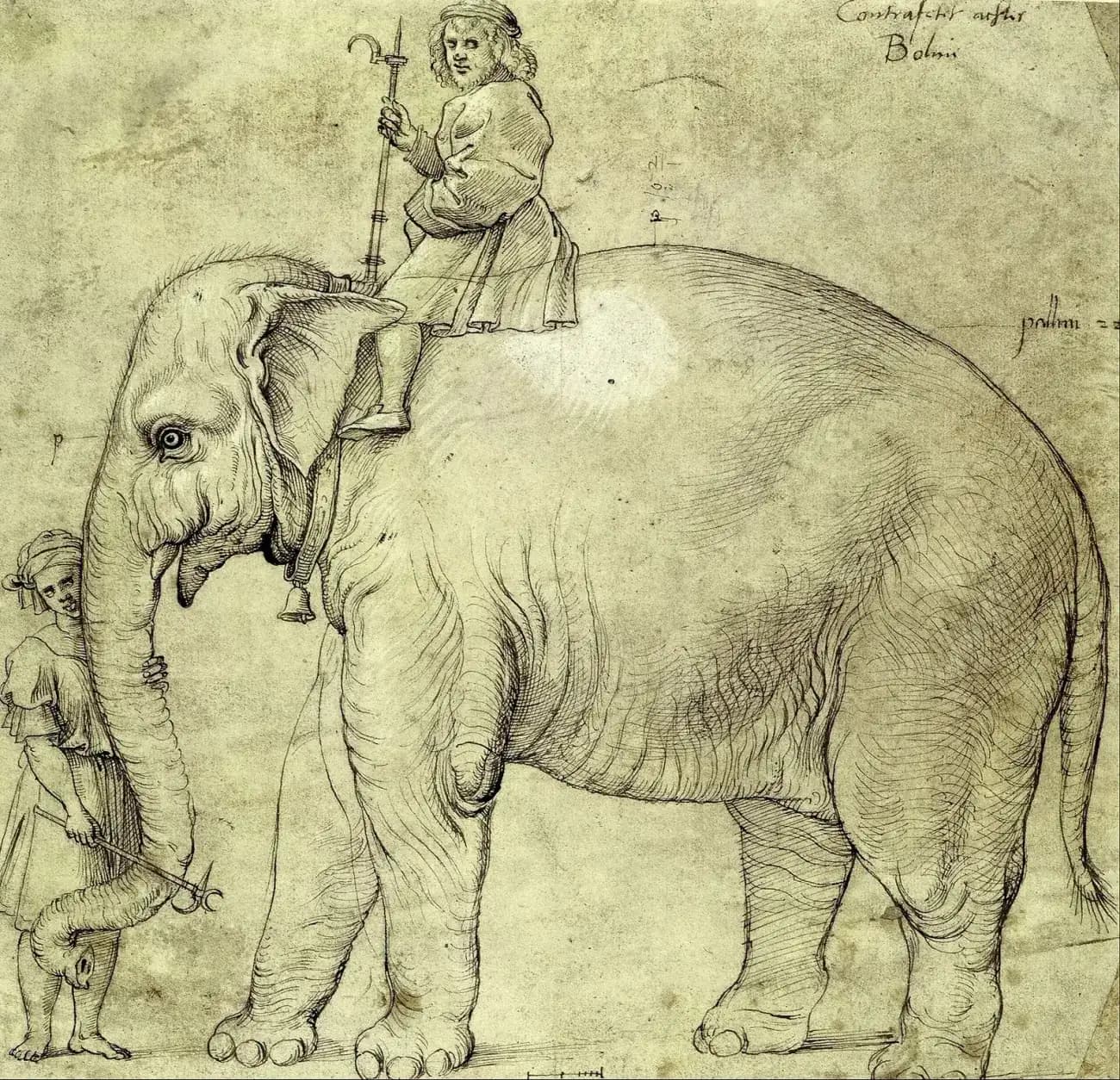
- Hanno lived about two years as the Pope's pet. He died on 8 June 1516, aged seven, after a purgative said to contain gold; Raphael painted a life-size memorial at the Vatican entrance.
- In 1515 Manuel sent a second wonder, a rhinoceros from Gujarat. It drowned in a shipwreck off the Italian coast in January 1516, but Albrecht Dürer's woodcut of it fixed how Europeans pictured rhinoceroses for centuries.
An elephant at the castle window
At two in the afternoon of Sunday 12 March 1514, the Portuguese set off from a house and garden belonging to Cardinal Adriano, just outside the walls of Rome. The ambassadors of Poland, England, France, the Emperor, Castile, Milan, Venice, Lucca and Bologna had ridden out to greet them, and before the gates the papal masters of ceremonies put the whole procession in order.
Six trumpeters and six shawm players led the Portuguese column. Then came a hunting cat sitting on the crupper of a Persian horse behind its huntsman, and then the animal everyone had come to see: a young elephant, scrubbed clean, under a crimson cloth embroidered with the royal arms of Portugal, with a silver tower on its back holding the presents for the Pope. An Indian trainer sat astride its neck.
According to the American historian Silvio Bedini, a thunderstorm broke just as the column passed the Porta del Popolo and stopped as suddenly once it reached the piazza. People crammed the windows and the rooftops; constables had to force a way through the streets.
Pope Leo X watched from Castel Sant'Angelo, the papal fortress by the Tiber, while its guns fired salutes. When the elephant reached the castle it bowed three times. Then, Damião de Góis wrote, it filled its trunk from a great tub of water set there for the purpose and sprayed it so high that it went over the Pope's window and soaked many cardinals at the windows above, before turning to give the crowd the same treatment.
“Rome in times past, when it possessed many provinces, though it saw some elephants from Ethiopia and Africa, never saw one from the Indies. This elephant, on arriving in front of the window where the Pope was, made him reverence, putting its knees on the ground.”
A new pope and a king with news to share
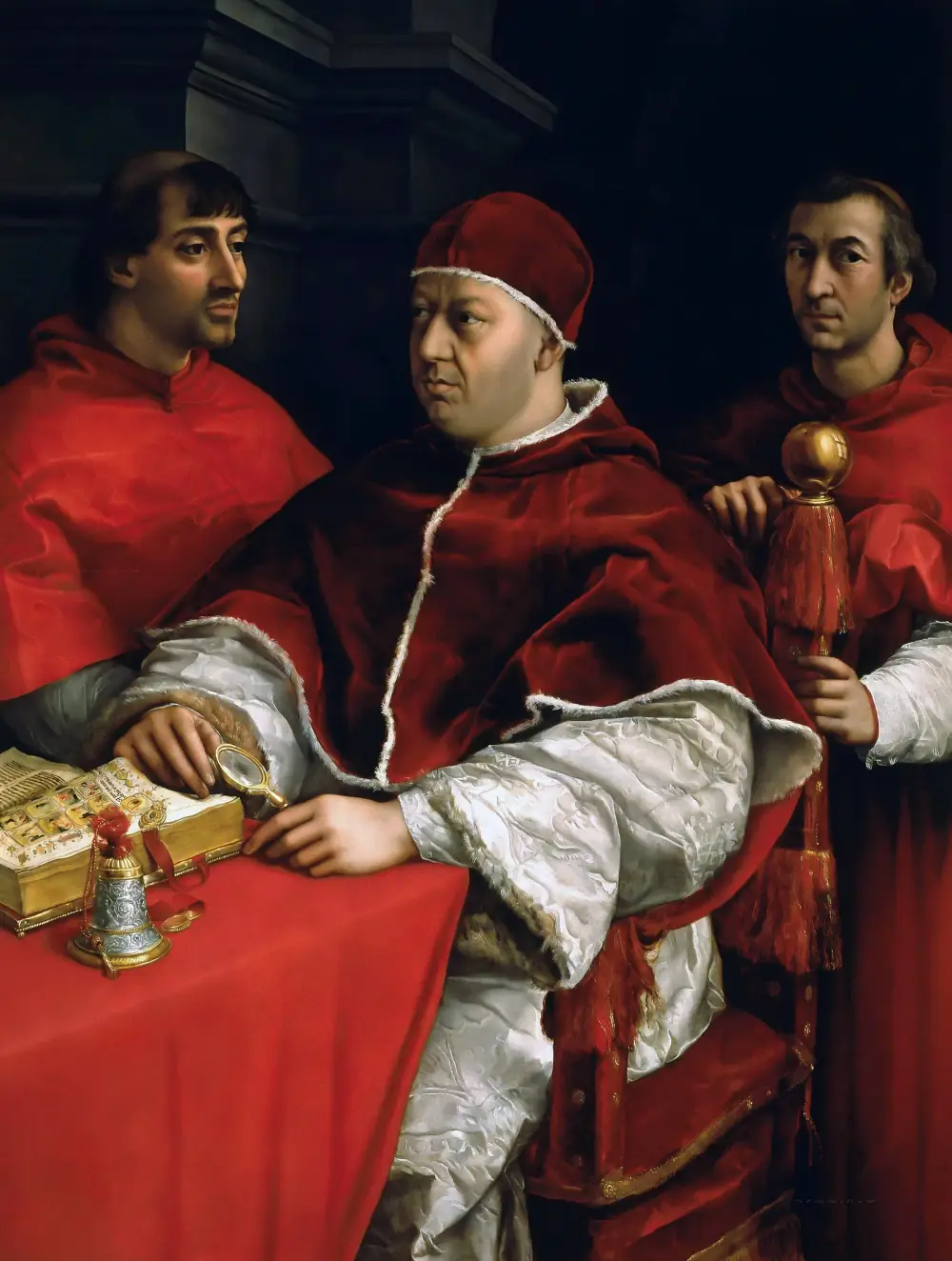
Giovanni de' Medici, son of Lorenzo the Magnificent of Florence, was elected pope on 11 March 1513 and took the name Leo X. He was a patron of scholars and artists, and under him Raphael finished the decoration of the Vatican rooms and directed the painting of the Loggia.
Manuel I had a great deal to announce. Portuguese ships had reached India in 1498, and in 1511 Afonso de Albuquerque had taken Malacca, the great market of the spice trade. On 6 June 1513 Manuel wrote to Leo about his successes in India, and the Pope's warm reply, along with news of victories in Morocco, persuaded the king to send an embassy of obedience grander than any before it.
There was business behind the show. Manuel wanted the new Pope to confirm his conquests and his rights over the churches of the lands he was taking, and Leo was known to love jewels and to keep a menagerie at the Vatican. The gifts were chosen with both facts in mind.
Pearls, a hunting cat and an elephant
To lead the embassy Manuel chose Tristão da Cunha, who in 1506 had commanded the fleet that took Afonso de Albuquerque to India. With him went two doctors of law, Diogo Pacheco, a celebrated Latin orator, and João de Faria, and the courtier Garcia de Resende as secretary. Tristão also brought three of his sons, among them Nuno da Cunha, later governor of Portuguese India.
| Gift | Details | Reported by |
|---|---|---|
| Vestments | A cope, mantle, dalmatics and altar frontal of gold brocade, sewn with pearls and precious stones; Bedini adds a mitre | Góis; Bedini |
| Jewels and plate | Jewels “of great value”; Bedini lists a gold chalice and a Chinese manuscript | Góis; Bedini |
| An elephant | A young white Indian elephant trained to perform, with its Indian trainer and a second keeper | Góis; Bedini |
| A hunting cat | An onça de caça, probably a cheetah, carried on the crupper of a Persian horse with a Persian huntsman; the horse had been sent to Manuel by the king of Hormuz | Góis; Bedini |
| Smaller animals | Parakeets, Indian fowl and Indian dogs | Bedini |
Góis, writing in the 1560s, gives the fullest list of the vestments. Bedini's 1981 study adds items from other accounts.
Damião de Góis later wrote that he was present when the elephant was embarked at the Cais da Pedra in Lisbon. It refused to step into the boat that would take it out to the ship. The king sent word twice to its Indian keeper, who told the animal, on the king's word, that it was going to a greater lord than Manuel and would be well treated, and that if it was not, it would be brought back to the same quay. Only then did it give two roars and go aboard, with tears running down its face.
Accounts of the embassy's size differ, depending on who was counted.
| Source | Figure | What it counts |
|---|---|---|
| Damião de Góis (1567) | About 20 | Kinsmen and friends of Tristão da Cunha serving as gentlemen of the embassy, besides the ambassadors and their households |
| Alberto Pio da Carpi (letter of 1514, printed by Góis) | 50 | Nobles in the procession, dressed in cloth of gold and silk |
| Silvio Bedini (1981) | 70 men and 43 animals | The whole entourage, including the horses and mules |
From Porto Ercole to the Porta del Popolo
The ship called at Alicante, Ibiza and Majorca and reached Porto Ercole, a small harbour on the Tuscan coast then belonging to Siena, at the end of January 1514. At each port, crowds rowed out to look at the elephant and tried to climb aboard.
Tristão da Cunha rode ahead, reaching Rome on 14 February, and left Nicolau de Faria, a junior equerry of the king, to bring the elephant and the cat on at their own pace. The walk of about 70 miles was slow. People came from the fields and the towns to see the animal, the roads filled, and the elephant's feet were worn raw by the hard old Roman road.
Near the city the party took shelter in a cardinal's villa. The crowd, refused a look, broke holes in the walls and trampled the vineyards, and the Portuguese moved to the papal cannon foundry nearby to wait for the day of the entry.
11 March 1513
Giovanni de' Medici is elected Pope Leo X
6 June 1513
Manuel I writes to Leo about his victories in India
End of January 1514
The embassy lands at Porto Ercole
The elephant walks the last stretch to Rome.
12 March 1514
The entry into Rome
The elephant kneels before the Pope at Castel Sant'Angelo.
20 March 1514
Audience with the Pope
Diogo Pacheco delivers the oration of obedience in Latin.
7 June 1514
Bull on church patronage
Benefices in lands taken overseas go to the king, under the Order of Christ.
3 November 1514
Bull Praecelsae devotionis
Renews the earlier papal grants to Portugal.
20 May 1515
A rhinoceros from Gujarat reaches Lisbon
3 June 1515
Rhinoceros against elephant in Lisbon
The elephant flees.
End of January 1516
The rhinoceros drowns
Shipwreck off La Spezia on the way to the Pope.
8 June 1516
Hanno dies in Rome, aged seven
February 1962
Elephant bones found in a Vatican courtyard
The audience, the gifts and the bulls
On Monday 20 March, the Pope received the ambassadors in the first hall of the palace, seated on a raised dais among the cardinals. The secretary read Manuel's letter aloud, and Diogo Pacheco delivered his oration of obedience in Latin, describing the Portuguese conquests in Africa and Asia. Leo answered in Latin, at greater length than popes usually did, all of it in praise of the king and the Portuguese.
The gifts were presented the next day in the Belvedere, the Vatican's garden courtyard, because the elephant could not climb up to the palace. The vestments were passed from hand to hand among the cardinals. Then the Pope went into the garden to watch the elephant's tricks and the cat at work: animals were brought for it to hunt, and it killed them.
Leo was generous in return. He sent Manuel the Golden Rose, a papal honour for Catholic rulers. A bull of 7 June 1514 gave the king the right to appoint to church benefices in Africa and every other land taken overseas, under the Order of Christ, the Portuguese military order that Manuel governed. On 3 November 1514 the bull Praecelsae devotionis renewed all the earlier papal grants to Portugal and extended them to lands won from non-Christians anywhere, even lands still unknown.
Not everything Manuel asked for came to pass. His general requests, for a church council, reform of the Church and a war against the Turks, came to nothing, Góis noted. As Tristão was about to leave, the Pope offered him command of a fleet against a Turkish armada said to be heading for Sicily. Tristão declined, since he had no licence from his king, and the embassy left Rome in late May or early June.
Two years as the Pope's pet
The elephant stayed. The Romans called him Annone, which English writers turned into Hanno. Bedini thought the name came from the trainer's answer when asked what the animal was called: ana, the Malayalam word for elephant.
A shelter was built for him against the wall of the Corridore, the raised passage from the Vatican palace to Castel Sant'Angelo, where the Borgo met St Peter's Square. The area became known as the Borgo del Lionfante, and an inn called At the Sign of the Elephant served pilgrims across the street for a century. Leo visited often and let the public in to see Hanno every Sunday. His keeper was the Pope's chamberlain, Giovanni Battista Branconio.
Hanno danced to music and performed tricks, and he took part in papal processions through the city. The most famous was a joke played on Giacomo Baraballo, abbot of Gaeta, a poor poet who believed himself a new Petrarch.
A second wonder: the rhinoceros
On 20 May 1515 a ship from India brought Lisbon an animal no European had seen alive since Roman times. The rhinoceros, called ganda in India, was a gift from Sultan Muzaffar II of Gujarat to Afonso de Albuquerque, governor of Portuguese India, who sent it on to the king.
Ancient writers said elephants and rhinoceroses were born enemies, and Manuel wanted to see for himself. On 3 June 1515 the two animals were brought into a walled yard in front of the Casa da Índia, the crown's trading house by the river. The elephant was not Hanno, who was in Rome, but a young animal from the king's menagerie with tusks barely three palms long. The rhinoceros strained at its chain towards it. The elephant turned, forced its head through the iron bars of a window, bending two of them, and fled back through the streets to its quarters.
Pleased with how the elephant had gone down in Rome, Manuel sent the rhinoceros to the Pope too, with a set of gilded silver plate. Its ship, under João de Pina, called at Marseille, where Pina landed the animal so that King Francis I of France could see it. Off the coast of Liguria a storm sank the ship with everyone on board. The rhinoceros was washed ashore dead, and its skin, stuffed with straw, went on to Rome, where it arrived in February 1516.
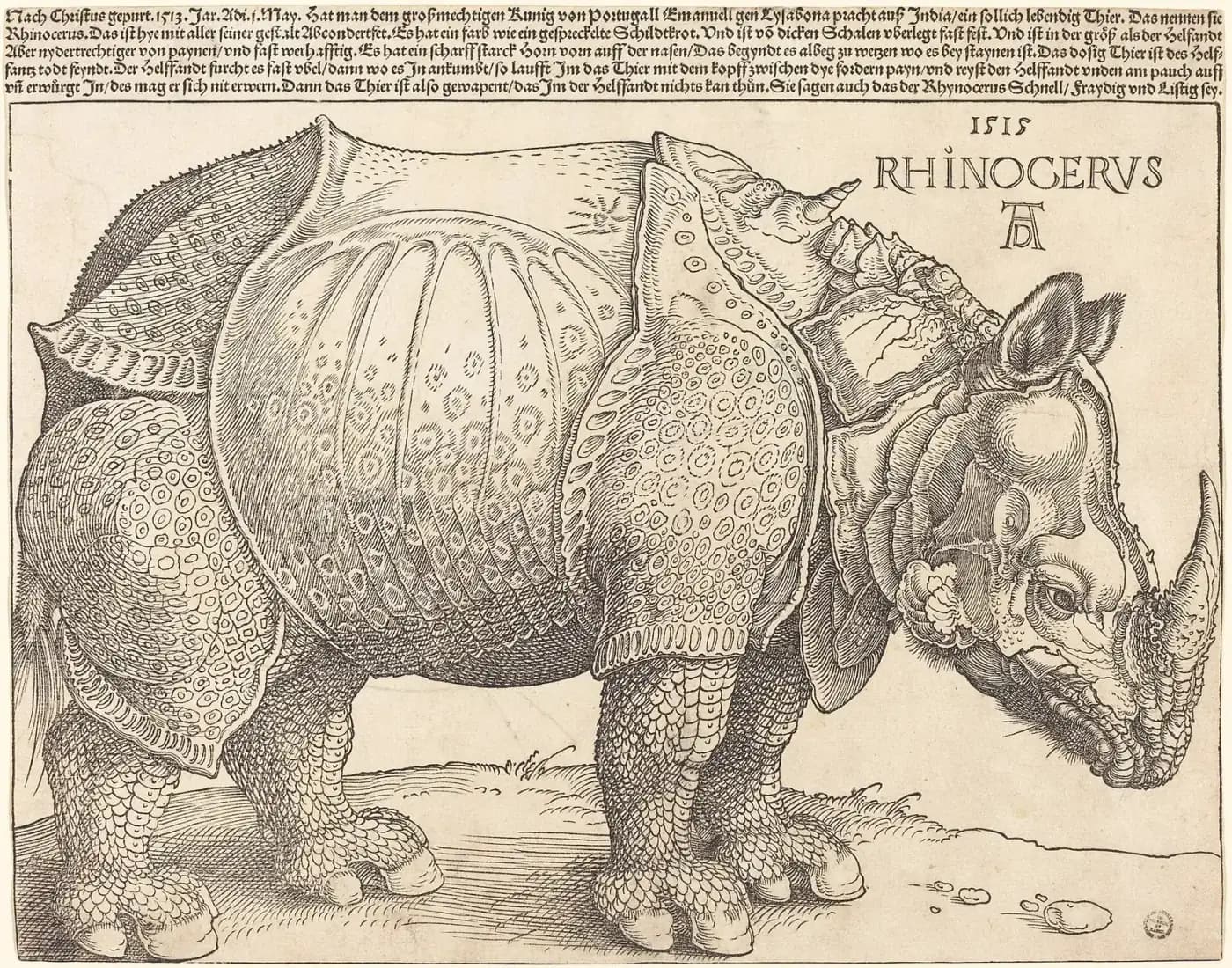
Its image survived it. Letters and a sketch from Lisbon reached Nuremberg, and Albrecht Dürer, who never saw the animal, made a drawing and then a woodcut. He gave it armour-like plates and a small twisted horn on the shoulders that most rhinoceroses do not have, and that the Lisbon animal very probably lacked. The woodcut was copied in books and artworks for more than two centuries and became the standard picture of a rhinoceros.
Death, an epitaph and a painted elephant
In the first week of June 1516 Hanno fell ill. The Pope's own surgeon and the court physicians examined his blood and urine and diagnosed angina, a choking disease of the throat. They gave him a strong purgative, reportedly containing gold, and he died on 8 June.
Leo, himself unwell, wrote an epitaph that the court poet Filippo Beroaldo put into Latin verse, and had it carved on a marble tablet at the entrance to the Vatican. He then ordered Raphael to paint the elephant beside it, life-size and in its natural colours, so that the people of Rome would still have him to look at.
“Under this great mound I lie buried, the mighty elephant, whom King Manuel, having conquered the East, sent captive to Leo the Tenth; whom the youth of Rome marvelled at, a beast not seen for a long time, and they saw human feelings in a brute's breast.”
- Lived
- 7 years
- Cause of death
- Angina (anginae morbo)
- Height
- 12 palms
- Set up by
- Giovanni Battista Branconio of L'Aquila, papal chamberlain and keeper of the elephant
- Date
- 8 June, in the fourth year of Leo X's pontificate (1516)
- Last line
- What nature had taken away, Raphael of Urbino restored by art
The painting and the inscription survived the sack of Rome in 1527. The Portuguese artist Francisco de Holanda sketched both on his visit to Rome in 1538 or 1539, and his copies are now in the library of the Escorial, near Madrid. The wall was demolished about a century after Hanno's death, when Pope Paul V rebuilt the entrance to the Vatican, and the gate that replaced it later gave way to Bernini's colonnade.
Bones in the courtyard
Almost nothing of the embassy's gifts survives. In the late 1790s Pope Pius VI had to raise the ransom demanded by Napoleon's France under the Treaty of Tolentino, and the pearls and stones were stripped from old papal vestments, Manuel's among them. In February 1798 a French commissioner had the bare cloth burned in the Belvedere courtyard to recover the gold and silver thread.
Hanno himself turned up in February 1962. Workmen digging a pit for an air-conditioning unit in a corner of the Vatican Library courtyard found bones they first took for a dinosaur's. Specialists at the Smithsonian Institution identified parts of a jaw and a cheek tooth of a young Indian elephant under fifteen years old, and tusks of an elephant of the same age were later found at the Vatican. Bedini concluded they were Hanno's.
Why it still matters
The embassy was a piece of political theatre with a legal purpose. Within eight months of the parade, Leo had confirmed Portugal's claims to lands taken from non-Christians anywhere on the eastern route, at a time when Portugal and Castile were arguing over whose side of the line the spice-rich Moluccas lay on.
Hanno also changed how Europeans drew elephants. Bedini found that the sketches made of him in Rome by Raphael and his assistants turned up for decades in the work of other artists, recognisable by the goad, the trainer, the ribbed ears and the short tusks. Dürer's rhinoceros, drawn from someone else's sketch, had an even longer life.
FAQs
Who was Hanno the elephant?
Hanno, or Annone, was a young white Indian elephant that King Manuel I of Portugal gave to Pope Leo X. He reached Rome with Tristão da Cunha's embassy on 12 March 1514, lived as the Pope's pet near the Vatican and died on 8 June 1516, aged seven.
Why did Portugal send an elephant to the Pope?
It was part of an embassy of obedience, the formal homage Catholic kings paid each new pope. Manuel I used it to show off his conquests in Asia and to win papal confirmation of them, which came in a series of bulls, among them Praecelsae devotionis of 3 November 1514.
How did Hanno die?
He fell ill in early June 1516. The papal physicians diagnosed angina and gave him a purgative reportedly containing gold, and he died on 8 June. Leo X wrote his epitaph and had Raphael paint a life-size memorial at the Vatican entrance.
What happened to the rhinoceros Manuel I sent to Rome?
The rhinoceros reached Lisbon from Gujarat on 20 May 1515. Manuel sent it to Leo X at the end of the year, but the ship sank in a storm off La Spezia in January 1516 and the animal drowned. Its stuffed skin reached Rome, and Dürer's woodcut made it famous.
Can you still see any trace of Hanno today?
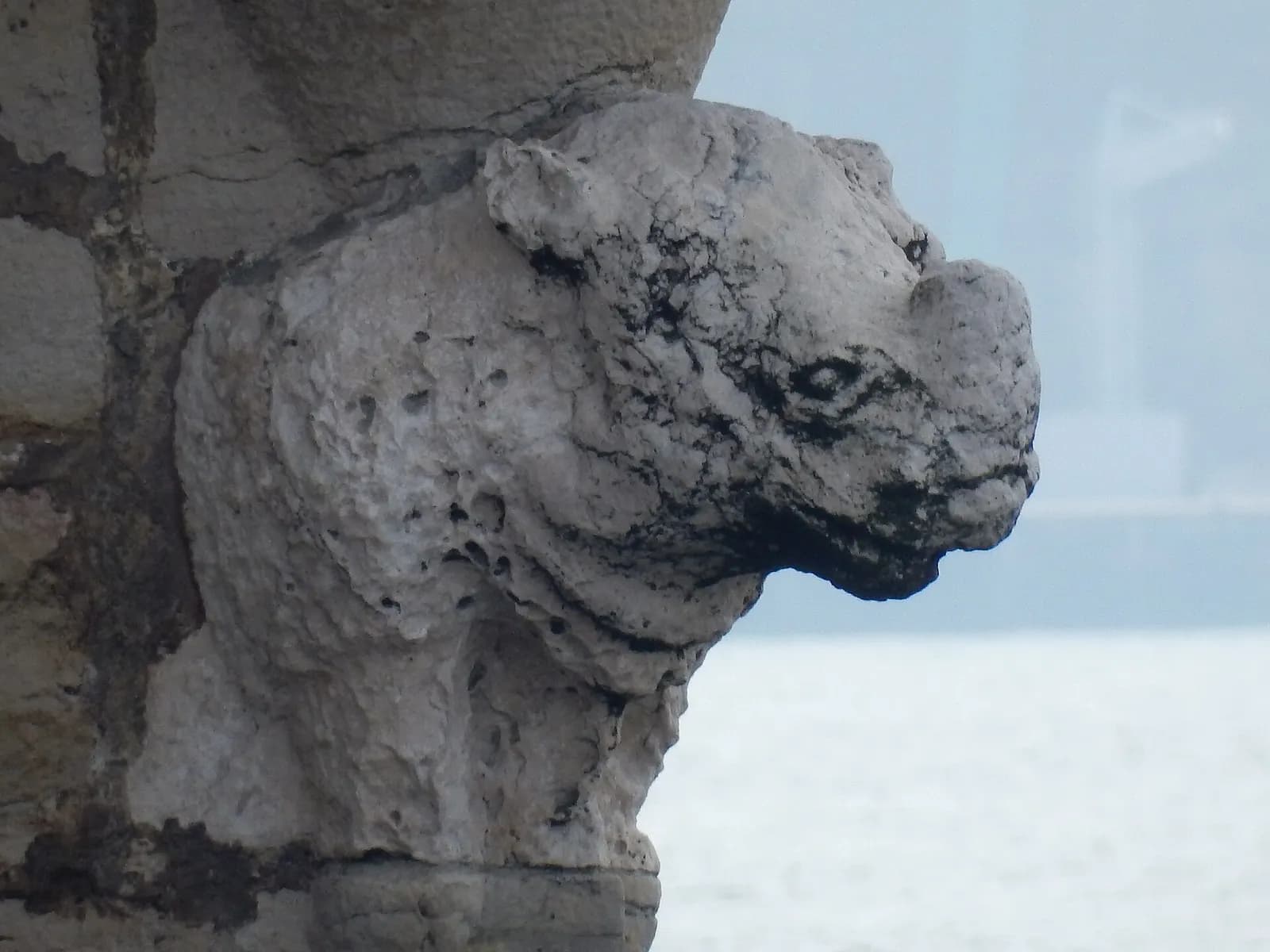
Parts of his jaw and a tooth were found in a Vatican Library courtyard in 1962, and the rest of the skeleton may still lie there. Drawings of him survive in Berlin and elsewhere. In Lisbon, the Belém Tower has a carved rhinoceros head linked to the 1515 rhinoceros.
On the timeline
Open the timelineNearby moments from the age of discoveries (1415–1580).
Days after his handful of ships destroyed the fleet of Hormuz, Afonso de Albuquerque has its young king, Seyf ad-Din, accept terms of submission: a yearly tribute of 15,000 xerafins, duty-free entry for goods from Portugal and a site for a fort. Mutiny among his own captains wrecked the plan within months, and Portugal only took the Gulf trading hub in 1515.
A Portuguese fleet under Viceroy Francisco de Almeida defeats the combined fleets of Mamluk Egypt, the Sultanate of Gujarat and the Zamorin of Calicut at the Battle of Diu, off western India, leaving Portugal the strongest naval power in the Indian Ocean.
By the date usually given today, the 'Flor de la Mar', the old carrack carrying Afonso de Albuquerque and the plunder of Malacca, is wrecked off Sumatra, though no sixteenth-century source gives the day and Gaspar Correia has Albuquerque leave Malacca only on 1 December. He escaped on a raft, but almost all the cargo was lost, and no find of the wreck has ever been confirmed.
Hanno the elephant in Rome
King Manuel I's embassy to Pope Leo X, led by Tristão da Cunha, parades through Rome to show off the riches of the East. The star is Hanno, a young white elephant who kneels before the Pope at Castel Sant'Angelo and lives on as his pet until he dies in 1516.
Ferdinand Magellan (Fernão de Magalhães), the Portuguese navigator sailing in the service of Spain, departs Seville with five ships on the expedition that would achieve the first circumnavigation of the globe.
Fernão de Magalhães, the Portuguese navigator sailing for Spain, reaches the cape at the eastern entrance of the strait that now bears his name, calling it the Cape of the Eleven Thousand Virgins for that day's feast. Three of his four ships reached the Pacific on 28 November; the San Antonio deserted.
Fernão de Magalhães's three remaining ships emerge from the strait that now bears his name into the ocean he called the 'Mar Pacífico', after weeks threading the channel at the southern tip of South America.
Coming up in history
All long reads 14 March 1923Celeste Rodrigues: the fado singer who sang for 73 years
 15 March 1147Two ladders and a broken gate: Afonso Henriques takes Santarém, 1147
 16 March 1974The Caldas uprising: a column marches on Lisbon alone, 16 March 1974
 17 March 1939The Iberian Pact: Salazar and Franco's treaty of 17 March 1939
12 sources
Archives, scholarship and reporting this article was checked against.
- 1
Chronica do felicissimo rei Dom Emanuel (Damião de Góis), parts III and IVFrancisco Correia, Lisbon, 1566–1567; John Carter Brown Library copy (Internet Archive scan)
- 2
The Papal Pachyderms (Silvio A. Bedini)Proceedings of the American Philosophical Society 125, no. 2 (April 1981), pp. 75–90 (PDF hosted by the Rhino Resource Center)
- 3
- 4
Early depictions of the first Lisbon rhinoceros in the 16th century (Kees Rookmaaker, Jim Monson and Emmanuel M. E. Billia)Pachyderm no. 65 (October 2023 to September 2024), IUCN Species Survival Commission
- 5
How Leo lionised a jumbo pet (Samuel Y. Edgerton, review of Silvio A. Bedini, The Pope's Elephant)Times Higher Education, 20 March 1998
- 6
Albrecht Dürer, The Rhinoceros, 1515 (woodcut, 1993.9)Cleveland Museum of Art
- 7
Pope Leo X (Johann Peter Kirsch)The Catholic Encyclopedia, vol. 9 (1910), New Advent
- 8
- 9
There's an elephant buried beneath the Vatican (Danny Lewis)Smithsonian Magazine, 21 October 2015
- 10
Fine dei rinoceronti romani (Michele Masneri)Il Foglio, 5 November 2018
- 11
portoghese (dictionary entry)Vocabolario Treccani, Istituto della Enciclopedia Italiana
- 12
Torre de BelémMuseus e Monumentos de Portugal
Image credits
- Hanno with a rider on his neck and a keeper at his trunk, in a pen-and-ink drawing attributed to Raphael or copied from a drawing by him, about 1514 to 1516. The notes in the margin record the elephant's measurements. Kupferstichkabinett, Berlin. Raphael, Public domain, via Wikimedia Commons.
- Raphael's portrait of Leo X with his cousins, Cardinal Giulio de' Medici (left) and Cardinal Luigi de' Rossi, painted about 1518. Uffizi Gallery, Florence. Raphael, Public domain, via Wikimedia Commons.
- Albrecht Dürer's woodcut of the rhinoceros that reached Lisbon in May 1515. Dürer worked from a description and a sketch sent to Nuremberg; the small twisted horn on its shoulders was almost certainly his own addition. Albrecht Dürer, CC0, via Wikimedia Commons.
- The rhinoceros head carved under a turret of the Belém Tower in Lisbon, built between 1514 and 1519. It is counted among the earliest likenesses of the 1515 rhinoceros. RimerMoshe, CC BY-SA 4.0, via Wikimedia Commons.