

Cristóvão da Gama storms Baçente: Portugal's war in Ethiopia, 1542
Ethiopia's Christian emperors had been losing to the Adal Sultanate for a decade when 400 Portuguese musketeers marched inland from the Red Sea. Their first fight was a climb up a mountain on the feast of Candlemas.
At a glance
- On 2 February 1542 about 400 Portuguese under Cristóvão da Gama, a son of Vasco da Gama, stormed Baçente, a fortified mountain in Tigray held for Imam Ahmad of Adal, and killed its garrison. Eight Portuguese died.
- From 1529 the Adal Sultanate's army under Imam Ahmad ibn Ibrahim, called Gragn, the left-handed, had overrun most of the Christian Ethiopian empire. Emperor Lebna Dengel died a fugitive in 1540.
- The force was landed at Massawa, on the Red Sea, by Cristóvão's brother Estêvão, governor of Portuguese India, and marched inland on 9 July 1541 with field guns and spare matchlocks.
- The Portuguese won two battles in April 1542 but were overrun at Wofla at the end of August. Cristóvão was captured, tortured and beheaded by the Imam.
- About 120 to 130 survivors fought beside Emperor Galawdewos at Wayna Daga on 21 February 1543, where the Imam was shot dead and his army scattered.
A climb on Candlemas morning
At dawn on 2 February 1542, the feast of the Purification of the Virgin, several hundred Portuguese soldiers made a general confession at the foot of a mountain in northern Ethiopia, before a crucifix held up by a priest. The patriarch who travelled with them gave absolution, and the men formed up in three columns, one for each path to the top.
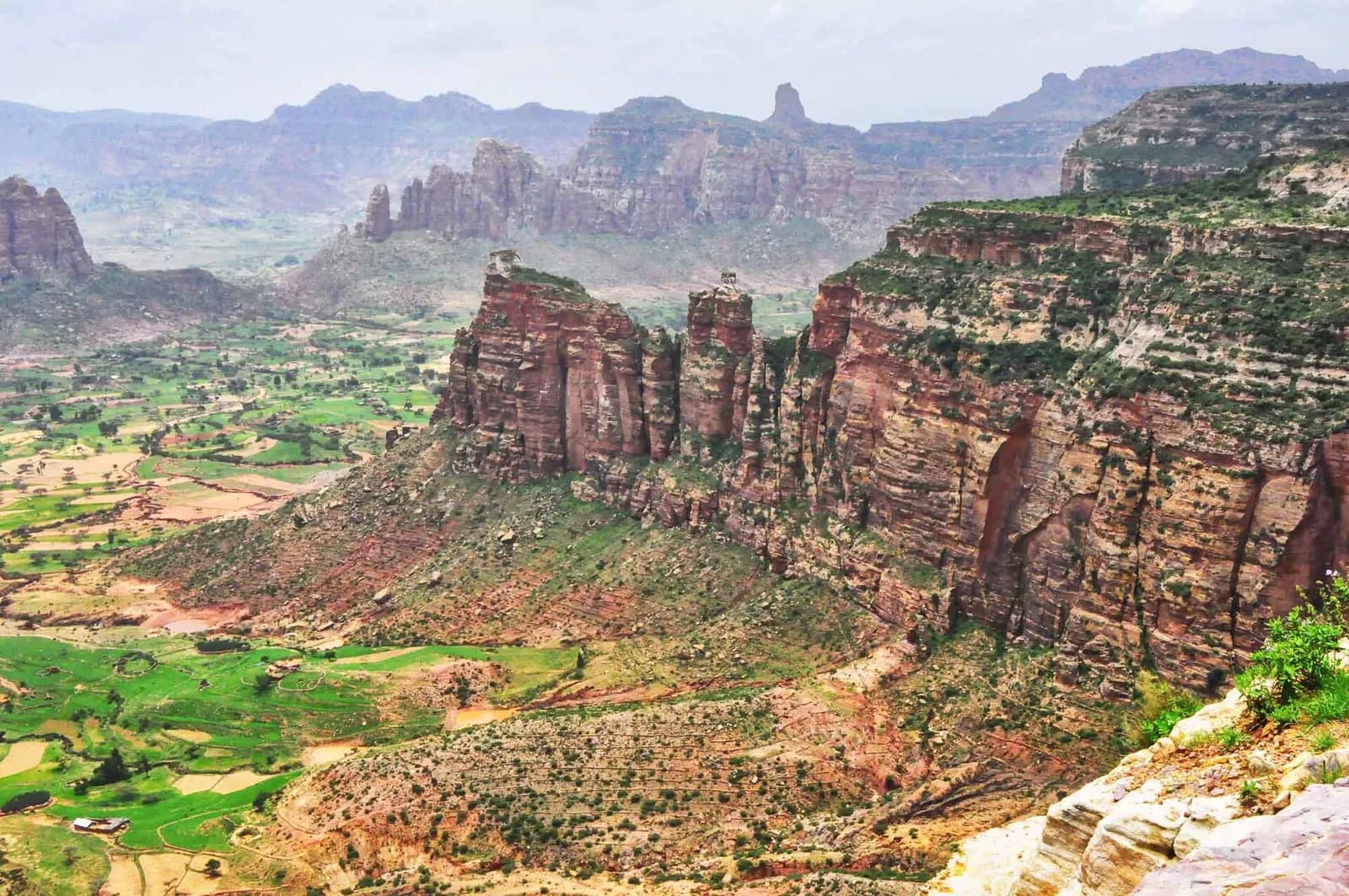
The mountain was called Baçanete, which modern writers spell Baçente. It rose alone from a plain, its summit a flat table about a league round, with a spring, fields and cattle. The Muslim garrison, about 1,500 archers and men with bucklers, raided the villages below. The chronicler Gaspar Correia says they had held the hill for eight years.
Cristóvão da Gama, the 25-year-old son of Vasco da Gama, took the steepest path himself. It ran over slippery rock to a scarp about four fathoms high, climbable only by chiselled holes and cracks. He went up it using his pike as a staff, while the Portuguese guns and matchlocks fired at the rim to keep the defenders from rolling rocks down.
The attackers were twice thrown back before they forced the gates. On the summit the garrison's commander ran one Portuguese through with a javelin before three men brought him down. The Ethiopians with the column killed those who hid in the houses; some defenders leapt from the cliffs. By evening eight Portuguese were dead and more than forty wounded.
Gama had the mosque on the summit, once a church, consecrated as Our Lady of Victory, and buried his dead there. The Ethiopian queen who travelled with him was invited up to see the place and declined: the path, she said, was too full of bodies.
An empire on the run
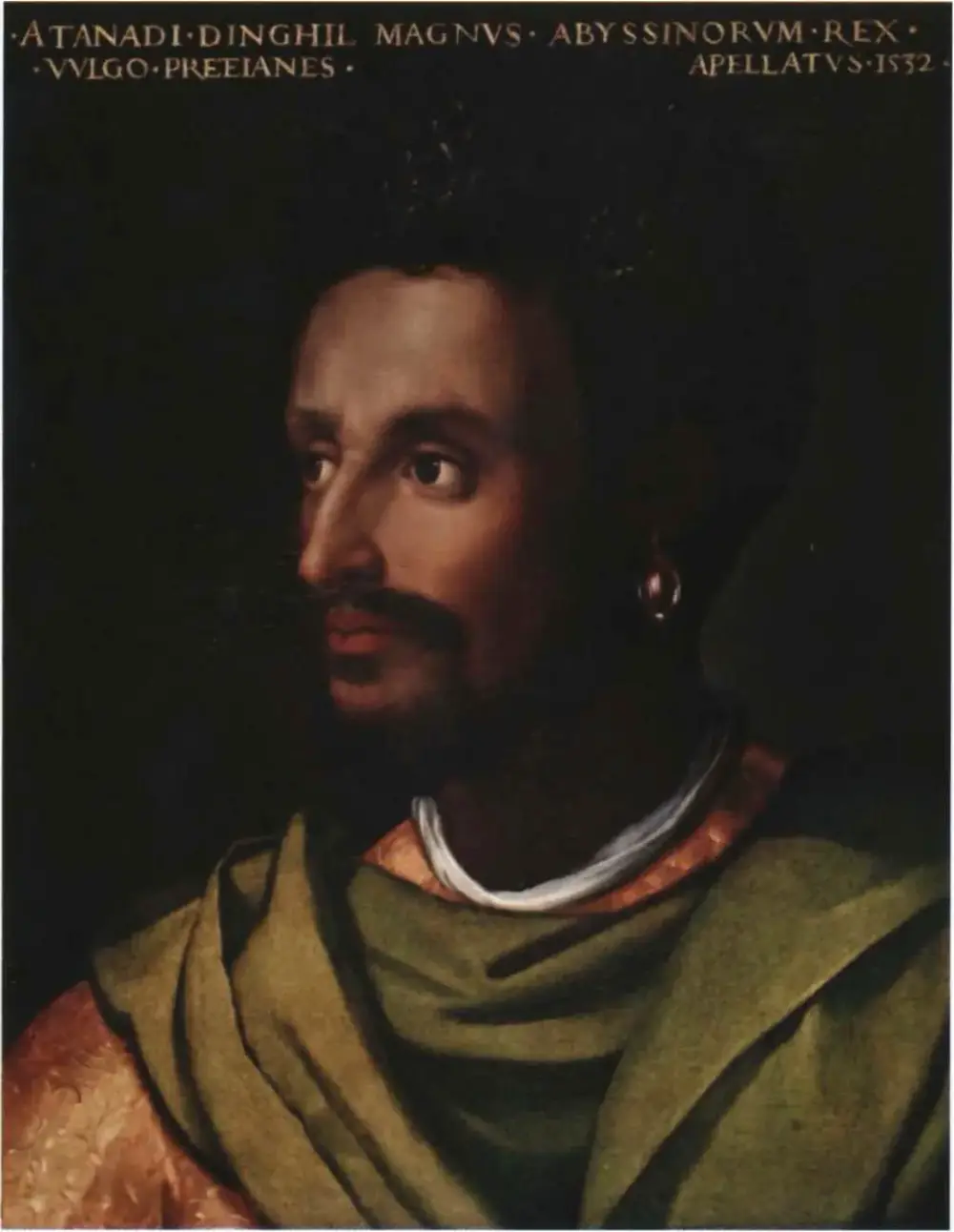
The queen was Sabla Wangel, widow of the emperor Lebna Dengel, who had ruled Christian Ethiopia from 1508. Europeans called the country Abyssinia and its ruler Prester John, after a legendary Christian king of the East. Its church was Orthodox, under the Coptic patriarch of Alexandria, and its emperors claimed descent from Solomon.
To the south-east lay Adal, a Muslim sultanate whose ports included Zeila on the Gulf of Aden. In the late 1520s Ahmad ibn Ibrahim, a soldier of obscure origin known as the Imam, began raiding the Christian highlands. Ethiopians called him Gragn, the left-handed. R. S. Whiteway, who translated Castanhoso in 1902, thought he was probably a Somali.
He had an edge the Christians lacked. Firearms reached Arabia around 1515 and passed through Zeila to Adal, and the Imam kept a regular corps of Turkish matchlockmen recruited from Zabid in Yemen. At Shimbra Kure, in March 1529, he routed Lebna Dengel's army. Both sides agreed the emperor's force was far larger, though Adal's chronicle, the Futuh al-Habasha, claimed 16,000 Christian horse where the Ethiopian accounts said just over 3,000.
Then the empire came apart. Debre Libanos, the most revered monastery, was burned in July 1530. In 1539 the Imam's men stormed Amba Geshen, the mountain prison where the royal princes were kept, and killed them. Churches were stripped of their gold. Lebna Dengel died on 2 September 1540 at Debre Damo, a monastery on a mountain top, with almost no followers left.
“All my chiefs have rebelled against me to help the Moors, and have wasted and violently taken possession of my countries.”
The four hundred
The plea for help went through João Bermudes, a barber-surgeon of the 1520 embassy who had stayed on and later called himself patriarch of Ethiopia, a title Whiteway doubted. In 1540 Lebna Dengel wrote that he had asked the King of Portugal for men, and had heard that three hundred trained men were promised.
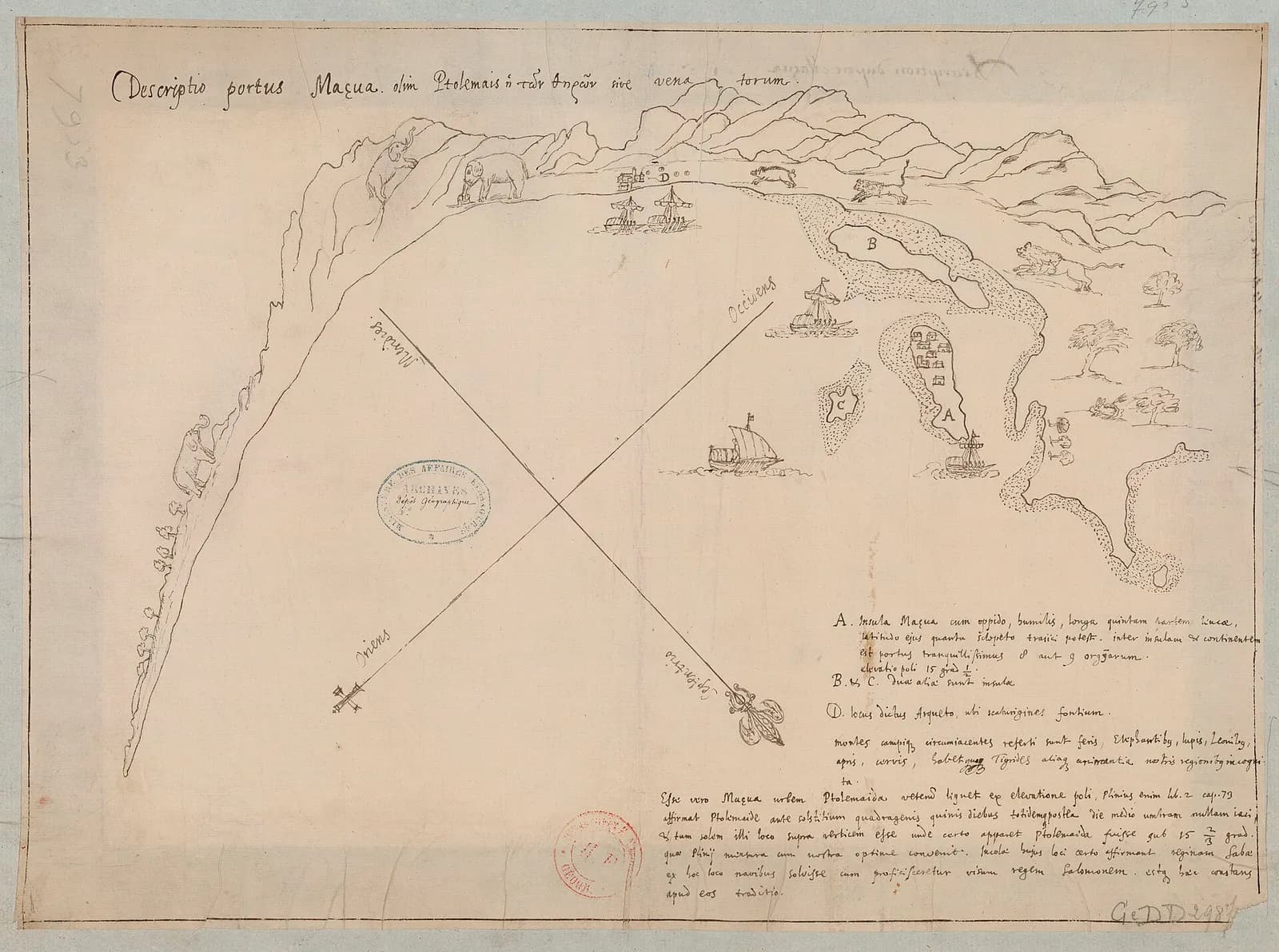
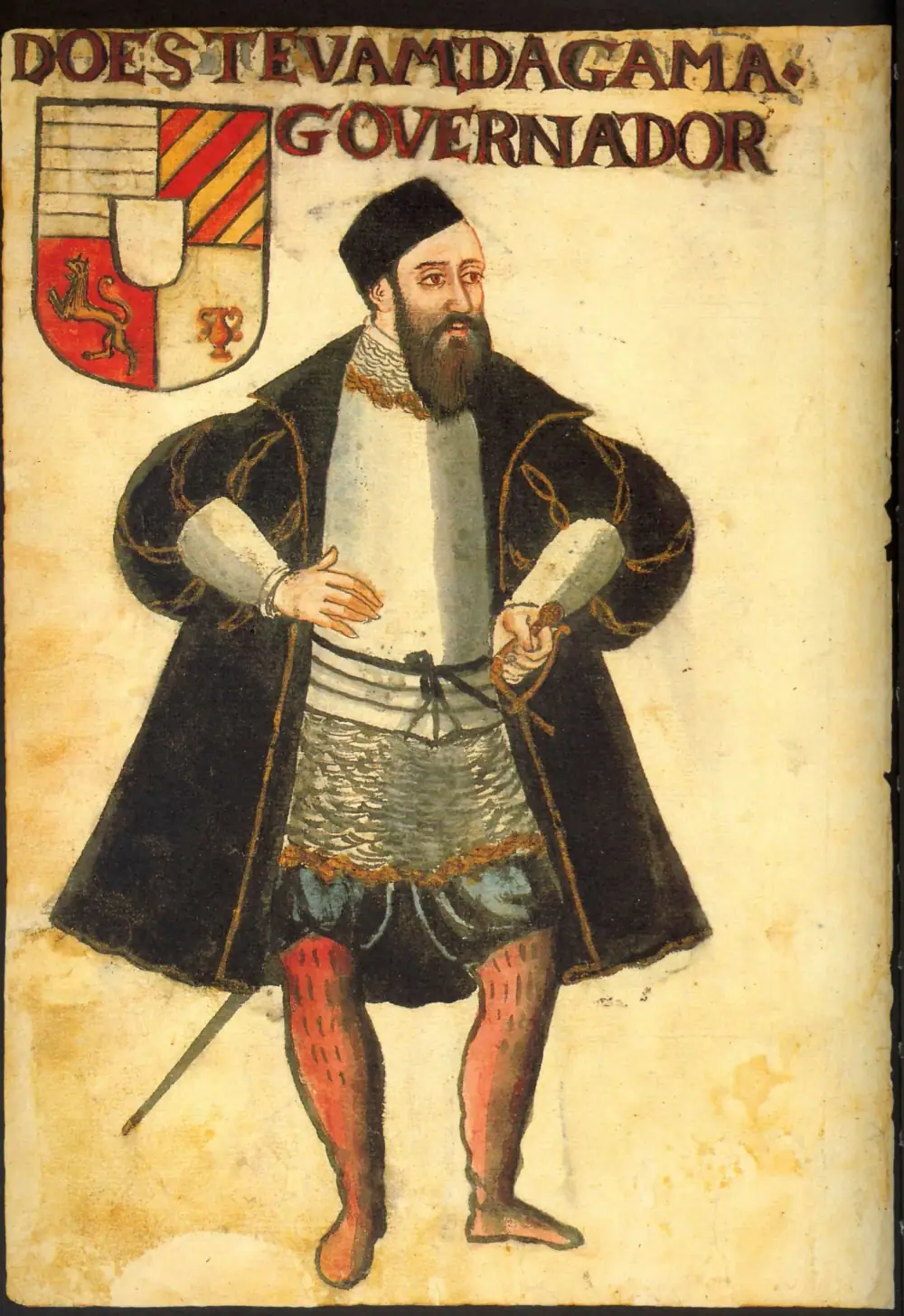
Help came on the back of another plan. Estêvão da Gama, Vasco's second son and governor of Portuguese India from 1540, sailed into the Red Sea to burn the Ottoman galleys at Suez. His fleet reached Massawa, on the coast of today's Eritrea, on 10 February 1541. He went on to Suez, found the Turks too strong, and was back at Massawa on 22 May.
At Massawa letters reached him from the Ethiopian court, and Isaac, the Bahar Negash or governor of the northern province, came to ask for help. Hunger and fever had broken discipline on the ships in his absence: a hundred sailors deserted inland and only two came back alive. Estêvão decided to send an army and gave the command to his younger brother Cristóvão, a choice the chronicler Diogo do Couto says was badly received because he was so young.
- Commander
- Cristóvão da Gama, about 25, fourth son of Vasco da Gama
- Men
- 400 Portuguese, about 70 of them craftsmen, plus about 130 armed slaves
- Arms
- About 1,000 matchlocks by Whiteway's count (Castanhoso counted over 600), field guns, a fife and drum band
- Set out
- 9 July 1541 (6 July in Correia and Couto), as the fleet sailed for India
- Chronicler
- Miguel de Castanhoso, a squire in the force, printed 1564
Cristóvão had first sailed to India at sixteen and had served at Malacca and Diu. On 9 July 1541 the brothers parted for the last time; Correia and Couto say 6 July, which Whiteway took to be the day the camp moved to the mainland. The force marched by night across the hot coastal plain and climbed to the plateau, then sat out the rains at Debarwa, the Bahar Negash's town, from July to December.
Why Gama attacked the hill
The new emperor, Lebna Dengel's son Galawdewos, was hundreds of kilometres south in Shoa with a handful of men. The Imam sat between him and the Portuguese, near Lake Tana. So the alliance was negotiated by the queen mother, Sabla Wangel, whom Gama fetched from her refuge at Debre Damo, and by the Bahar Negash.
After Epiphany the army moved south at two or three leagues a day. When Gama learned that a strong hill held for the Imam lay on his road, he resolved to take it rather than leave an enemy behind him. The queen told him to march on and join her son first.
“it was less difficult to fight twelve thousand men in a plain, and destroy them, than to capture that hill.”
Gama answered that they were Portuguese and would take it with little loss. On 1 February he camped below the hill and made a feint, to draw the defenders' fire and find where his guns would do most harm. The garrison celebrated all night with trumpets and drums; the queen, who had watched, lost heart. The next morning he attacked.
The victory paid at once. Local lords who had submitted to Adal came back to the queen, and Castanhoso claims forty leagues of country returned to her obedience. Whiteway thought the queen was probably right all the same: the news brought the Imam north before the Portuguese could join Galawdewos.
Two victories and a disaster
The Imam found them near Jarte, probably the district of Wajarat, at the start of April. He sent a herald with a friar's cowl and a rosary, mocking Gama as a mere boy misled by a woman, and offered to let the Portuguese go home. Gama sent back a small pair of tweezers for the eyebrows and a large mirror.
Castanhoso put the Imam's army at 15,000 foot, 1,500 horse and 200 Turkish matchlockmen; the Portuguese numbered about 350, as 40 had gone to the coast for supplies. Short of food, Gama marched out in a square on Tuesday 4 April 1542 with the queen in the centre. He was wounded, but a matchlock ball struck the Imam in the leg and his army broke.
On 16 April they fought again. The Imam's cavalry nearly broke the square until some gunpowder exploded and the horses would not face it. The Adal camp fell. The two battles cost the Portuguese about thirty dead. The Ethiopian chronicles date the first fight to 25 March and record that the Franks shot the Imam, but he did not die.
“They helped the church in her wars against the Muhamedans, and began with a success; but when they thought their victory was complete it was not granted to them.”
The Imam withdrew to Zabul, a hill country with a road to the Red Sea, and sent for help to the Ottoman governor at Zabid. The Portuguese wintered at Wofla, south of Lake Ashenge, where the hills hid what was coming. During the rains Gama took a hundred men to seize a mountain held by Adal troops above a population of Ethiopian Jews, and came back with horses and plunder.
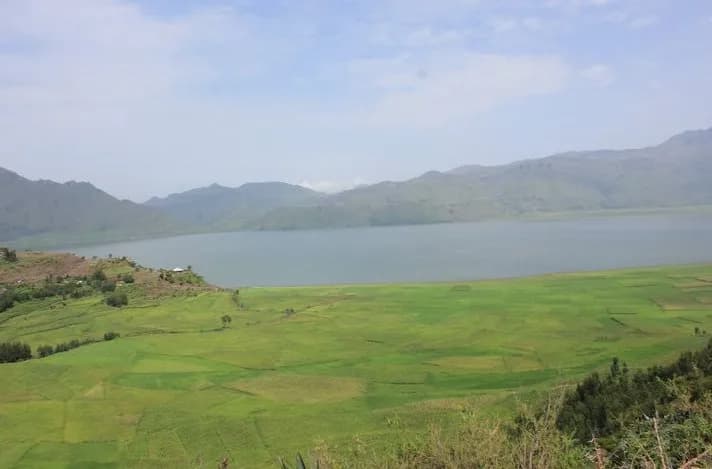
When he returned, the Imam's army was at the foot of his hill, reinforced by matchlockmen from Zabid. Castanhoso says 900 came and that over 1,000 took the field; Correia gives 800 and Galawdewos over 600. The battle came on 28 August by Castanhoso's date; Diogo do Couto says the 29th and the Ethiopian chronicles the 31st. Whiteway thought the 29th most likely.
Gama answered the Turkish fire with sallies, and each one cost men on the way back. He was hit in the leg, then a ball broke his right arm. Four of his five captains were killed. As the Turks broke into the camp, a wounded Portuguese crawled to the powder store and blew it up with those around him. At nightfall the survivors fled uphill with the queen.
Gama and fourteen companions hid in a wooded valley and were found at dawn. Castanhoso, who had the story from two Portuguese who got away, says the Imam showed him the heads of more than 160 Portuguese, had him flogged, burned his beard with wax and plucked his eyebrows with the tweezers he had sent. Then the Imam beheaded him with his own hand.
Revenge at Wayna Daga
The Imam thought the Portuguese finished. He sent the Turks home, kept his usual 200 matchlockmen and returned to Lake Tana. But about 170 had escaped, 120 with the queen and 50 with the captain Manuel da Cunha. Galawdewos came north from Shoa and joined them, in September by Castanhoso's account and in October by the Ethiopian chronicles.
The Portuguese rearmed from stores at Debre Damo and made new powder. Galawdewos wrote that he collected 130 of them and made their captain Ayres Dias, Gama's servant, a man of mixed descent whom Ethiopians called Marcos. Castanhoso tells it differently: the survivors, 120 by his count, would have no captain but marched under the banner of the Misericórdia.
The army set out on Shrove Tuesday, 6 February 1543, beat an Adal force at Woggera, and found the Imam near Lake Tana.
On 21 February 1543 the armies met at Wayna Daga. Castanhoso gives the Imam 200 Turks, 1,200 horse and 14,000 foot in two divisions. The Portuguese, 60 of them now mounted, led the Christian van with 250 Ethiopian horse and 3,500 foot; Galawdewos followed with 250 more horse and the rest of the infantry. The Portuguese made for the Imam and his Turks. A ball struck him in the breast, and when his men saw it they ran. Only 40 of the 200 Turks escaped.
Who fired the shot is disputed. Castanhoso says no one knew; Gaspar Correia names a soldier known as John the Galician, who died in the act. Galawdewos's chronicle gives the kill to one of the emperor's own men, while a fragment of another Ethiopian chronicle says a Frank killed him and cut off his ear.
A young Ethiopian captain, Azmach Calite, finished the Imam off and galloped to Galawdewos with his head. Galawdewos had it carried round the country on a spear. Four Portuguese died.
| Date | Battle | Enemy force, as reported | Result | Portuguese losses |
|---|---|---|---|---|
| 2 February 1542 | Baçente, Tigray | About 1,500 archers and buckler-men | Hill stormed, garrison killed | 8 killed, 40 to 50 wounded |
| 4 April 1542 | First battle near Jarte | 15,000 foot, 1,500 horse, 200 Turkish matchlockmen | Imam wounded, his army retreats | About 30 in the two April battles |
| 16 April 1542 | Second battle near Jarte | The same army, reinforced | Adal camp taken | Included above |
| 28, 29 or 31 August 1542 | Wofla | The Imam's army with 600 to 1,000 Turkish matchlockmen | Portuguese camp overrun; Gama captured and killed | 160 to 200 killed |
| 21 February 1543 | Wayna Daga, near Lake Tana | 200 Turks, 1,200 horse, 14,000 foot | Imam killed, his army scattered | 4 killed |
Enemy numbers are Castanhoso's estimates, except the Turks at Wofla, where Galawdewos gives over 600, Correia 800 and Castanhoso 900 arriving and over 1,000 in the field. Wounded at Baçente: over 40 in one text of Castanhoso, 50 in the other. Wofla losses: Castanhoso says more than 160 heads were shown to Gama, Correia 200; Whiteway gives some 200. The date of Wofla differs between sources.
“D. Christovão began and Ayres Dias ended it.”
Soldiers who stayed
No fleet came to bring them home. Most of the survivors married Ethiopian women and took the lands Galawdewos gave them; in his letter of 1550 he wrote that the Franks lived with him at their pleasure. Ninety-three were still alive in 1555. Henry Salt, in the nineteenth century, recorded a tradition that their descendants peopled the province of Wajarat.
Portuguese soldiers in Ethiopia, 1541 to 1555
men
Men who marched inland (400), fought at Jarte (about 350), escaped the defeat at Wofla (about 170, Whiteway), were collected by Galawdewos (130, his own letters) and were still alive in 1555 (93, Whiteway). The figures come from different sources and are approximate.
Show the data
| Portuguese | |
|---|---|
| July 1541 | 400 |
| April 1542 | 350 |
| Sept 1542 | 170 |
| Late 1542 | 130 |
| 1555 | 93 |
The war did not end with the Imam. In 1559 his successor, Nur, who had married the Imam's widow on condition that he avenge her husband, killed Galawdewos in battle. In Whiteway's judgement, Ethiopia was never again prostrate before a foreign conqueror while Galawdewos lived.
Miguel de Castanhoso reached Goa in April 1544 with his left arm crippled, carrying letters from Galawdewos and his own account of the campaign. In 1564 João de Barreira printed a reworked version in Lisbon. Its account of Gama's death reads like a saint's life: an old woman who led the Imam's men to Gama's hiding place and vanished, a healing spring where his blood fell, a monastery tree that uprooted itself at the hour of his death.
Luís André Nepomuceno argues that the Gama family may have hoped to have Cristóvão declared a martyr, and that the cause never advanced in Rome. João Bermudes, who was also at Wofla, wrote an account that blamed the defeat on Gama's failings and gave himself the credit for the successes; Whiteway found it unsupported by any other witness.
Jesuit missionaries followed the soldiers to Ethiopia. In 1626, at the request of Cristóvão's great-nephew Francisco da Gama, viceroy of India, a search party went to Wofla. The Jesuit Jerónimo Lobo wrote as if he had led it: relics from under a heap of stones, and teeth and a jaw from a spring where the head had been thrown with a dead dog. The relics reached India in 1627.
Whiteway doubted them. Lobo, he noted, was not with the searchers, and Castanhoso says the Turks took Gama's head back to Zabid.
The war year by year
March 1529
Imam Ahmad routs Lebna Dengel at Shimbra Kure
1539
Adal forces storm Amba Geshen, the royal prison mountain
2 September 1540
Lebna Dengel dies at Debre Damo; Galawdewos succeeds
10 February 1541
Estêvão da Gama's fleet reaches Massawa
9 July 1541
Cristóvão da Gama marches inland with 400 men
July to December 1541
The rains at Debarwa
2 February 1542
Baçente stormed
4 and 16 April 1542
Two victories over the Imam near Jarte
28, 29 or 31 August 1542
Defeat at Wofla; Gama captured the next morning and beheaded
September or October 1542
Galawdewos joins the surviving Portuguese
21 February 1543
Wayna Daga: the Imam is killed
1564
Castanhoso's account printed in Lisbon
Why it still matters
Portugal's empire is usually told as a story of ships and trading forts. The Ethiopian campaign was something else: a few hundred men marching hundreds of kilometres inland to fight for an African Christian king, in a war his mother had invited them into.
The sources remember it differently. Castanhoso wrote that the freed Christian women kissed the Portuguese's feet and credited them with the victory. The Ethiopian chronicles, Whiteway noted, say little of the Portuguese lest it reflect on Ethiopian glory, and Galawdewos's chronicle gives the victory to God and the emperor. Galawdewos's letters thank the King of Portugal for his men, but add that Gama with 400 could not destroy the Moors, while Ayres Dias with 130 did.
Adal had its own chronicler. Shihab al-Din Ahmad, known as Arab Faqih, wrote the Futuh al-Habasha, the conquest of Abyssinia, from the accounts of men who had fought beside the Imam. To him the burning of Ethiopia's churches was a triumph. Whiteway drew on the Futuh for the conquest years; his account of 1541 to 1543 rests on the Portuguese and Ethiopian writers.
“He was one of the swords drawn by the Most High to defend His religion, triumph over the infidels, tear to pieces the lying books, burn the temples of the idols and scatter the followers of Satan the accursed.”
FAQs
What was the Battle of Baçente?
On 2 February 1542 about 400 Portuguese under Cristóvão da Gama stormed Baçente, a fortified flat-topped mountain in Tigray, northern Ethiopia, held by about 1,500 men for Imam Ahmad of Adal. They took it in a morning, killing the garrison, for the loss of eight dead.
Why did Portugal send soldiers to Ethiopia?
The Christian Ethiopian empire was being overrun by the Adal Sultanate, whose army had firearms and Turkish matchlockmen. Lebna Dengel asked Portugal for men, and in 1541 the governor of India, Estêvão da Gama, landed 400 under his brother at Massawa. Portugal wanted a Christian ally on the Red Sea against the Ottomans.
How did Cristóvão da Gama die?
He was wounded twice when the Imam's army, reinforced by Ottoman matchlockmen, overran the Portuguese camp at Wofla at the end of August 1542. He was found hiding the next morning, tortured and beheaded by Imam Ahmad himself, according to Castanhoso.
Who killed Ahmad Gragn?
He was shot in the breast at Wayna Daga on 21 February 1543. Portuguese writers credit their matchlockmen, Gaspar Correia naming a soldier called John the Galician; Galawdewos's chronicle credits one of the emperor's men. An Ethiopian captain finished him off and brought his head to Galawdewos.
Who was Miguel de Castanhoso?
A squire who served in the expedition and was badly wounded. He reached Goa in 1544 and printed his account in Lisbon in 1564. It is the main eyewitness source for the campaign and is available in R. S. Whiteway's English translation of 1902.
On the timeline
Open the timelineNearby moments from the age of discoveries (1415–1580).
The Treaty of Baçaim (Bassein) is signed aboard the galleon São Mateus in Bassein harbour. Through his envoy, Sultan Bahadur of Gujarat cedes Bassein with its lands, islands and seas, among them the islands of Bombay, to make peace with Portugal while under Mughal pressure. Bombay later passed to England in Catherine of Braganza's dowry and is today the heart of Mumbai.
Pope Paul III issues the bull 'Cum ad nihil magis', establishing the Inquisition in Portugal at the insistence of King João III; the tribunal would shape Portuguese religious and cultural life for nearly three centuries.
Francis Xavier sails from Lisbon on his 35th birthday aboard the 'Santiago', sent east by João III as one of the first Jesuit missionaries to Portuguese Asia. He reached Goa 13 months later and went on to Malacca and Japan; his body still lies in Goa's Basilica of Bom Jesus.
Cristóvão da Gama in Ethiopia
Portuguese musketeers under Cristóvão da Gama, Vasco's son, storm a hillfort held by forces of the Adal Sultanate at the Battle of Baçente in northern Ethiopia, part of Portugal's military alliance with the Christian Ethiopian Empire.
By his comrade Castanhoso's date (others give 29 or 31 August), the Adal imam Ahmad Grañ overruns the camp of Cristóvão da Gama, Vasco da Gama's son, at Wofla in the Ethiopian highlands. Found wounded and hiding next morning, Gama is beheaded by the imam. Survivors of his 400 men helped defeat the imam, who was killed, the following year.
The mathematician and cosmographer Pedro Nunes is appointed to the chair of Mathematics at the University of Coimbra, the most prestigious post then open to a Portuguese mathematician. Inventor of the nonius, a scale for precise angle readings, and a pioneer of the mathematics of navigation, he held the chair until he retired in 1562.
Tomé de Sousa arrives at the Bay of All Saints (Baía de Todos os Santos) in Brazil as the first Governor-General, accompanied by approximately 1,000 settlers, soldiers, and six Jesuits. He founds the city of Salvador, establishing it as the capital of Portuguese Brazil.
Coming up in history
All long reads 4 February 1961The night Luanda's prisons were attacked: 4 February 1961
 5 February 1570Gaspar da Cruz, the plague friar who wrote Europe's first book on China
 6 February 1608António Vieira: the Lisbon-born Jesuit who preached to the fish
 7 February 1992Maastricht, 7 February 1992: Portugal signs the treaty that made the EU
10 sources
Archives, scholarship and reporting this article was checked against.
- 1
Miguel de Castanhoso, account of Dom Cristóvão da Gama's deeds in Ethiopia (1564), chapters I to XXIII, in Whiteway's translationHakluyt Society, London, 1902 (Internet Archive scan, pp. 3 to 84)
- 2
- 3
- 4
- 5
Miguel de Castanhoso e o martírio de D. Cristóvão da Gama (Luís André Nepomuceno)Alea: Estudos Neolatinos 24/2 (2022), Universidade Federal do Rio de Janeiro, via Redalyc
- 6
- 7
Abyssinia: History (Frank R. Cana)Encyclopædia Britannica, 11th edition (1911), on Wikisource
- 8
Chronicle of Galāwdewos (record LIT3122Galaw)Beta maṣāḥǝft, Hiob Ludolf Centre for Ethiopian Studies, Universität Hamburg
- 9
A Voyage to Abyssinia, by Father Jerome Lobo, translated from the French by Samuel Johnson (Cassell edition of 1887, introduced by Henry Morley)Project Gutenberg
- 10
O conjunto escultóricoPadrão dos Descobrimentos, EGEAC, Lisbon
Image credits
- The sandstone massifs of Gheralta, in Tigray, northern Ethiopia, in 2011. Baçente was a cliff-girt, flat-topped mountain of this kind, an amba, somewhere in Tigray; its exact site has never been identified. Rod Waddington from Kergunyah, Australia, CC BY-SA 2.0, via Wikimedia Commons.
- Lebna Dengel, emperor of Ethiopia from 1508 to 1540, painted by Cristofano dell'Altissimo between about 1552 and 1568, long after his death; it hangs in the Uffizi. The inscription calls him great king of the Abyssinians, commonly called Prester John. Cristofano dell'Altissimo, Public domain, via Wikimedia Commons.
- The harbour of Massawa as charted by João de Castro, who sailed with Estêvão da Gama's fleet in 1541. Island A is Massawa and its town; D marks Arkiko on the mainland, where the springs were. This Latin copy is dated 1542. João de Castro, Public domain, via Wikimedia Commons.
- Estêvão da Gama, governor of Portuguese India from 1540 to 1542, in the Livro de Lisuarte de Abreu, painted about 1560. He chose his younger brother to lead the expedition. Lisuarte de Abreu, Public domain, via Wikimedia Commons.
- Lake Hashenge, or Ashenge, in Ofla in southern Tigray, in 2018. The Portuguese camped through the rains of 1542 in Wofla, the district south of the lake, and were overrun there that August. Melakuweb, CC BY-SA 3.0, via Wikimedia Commons.
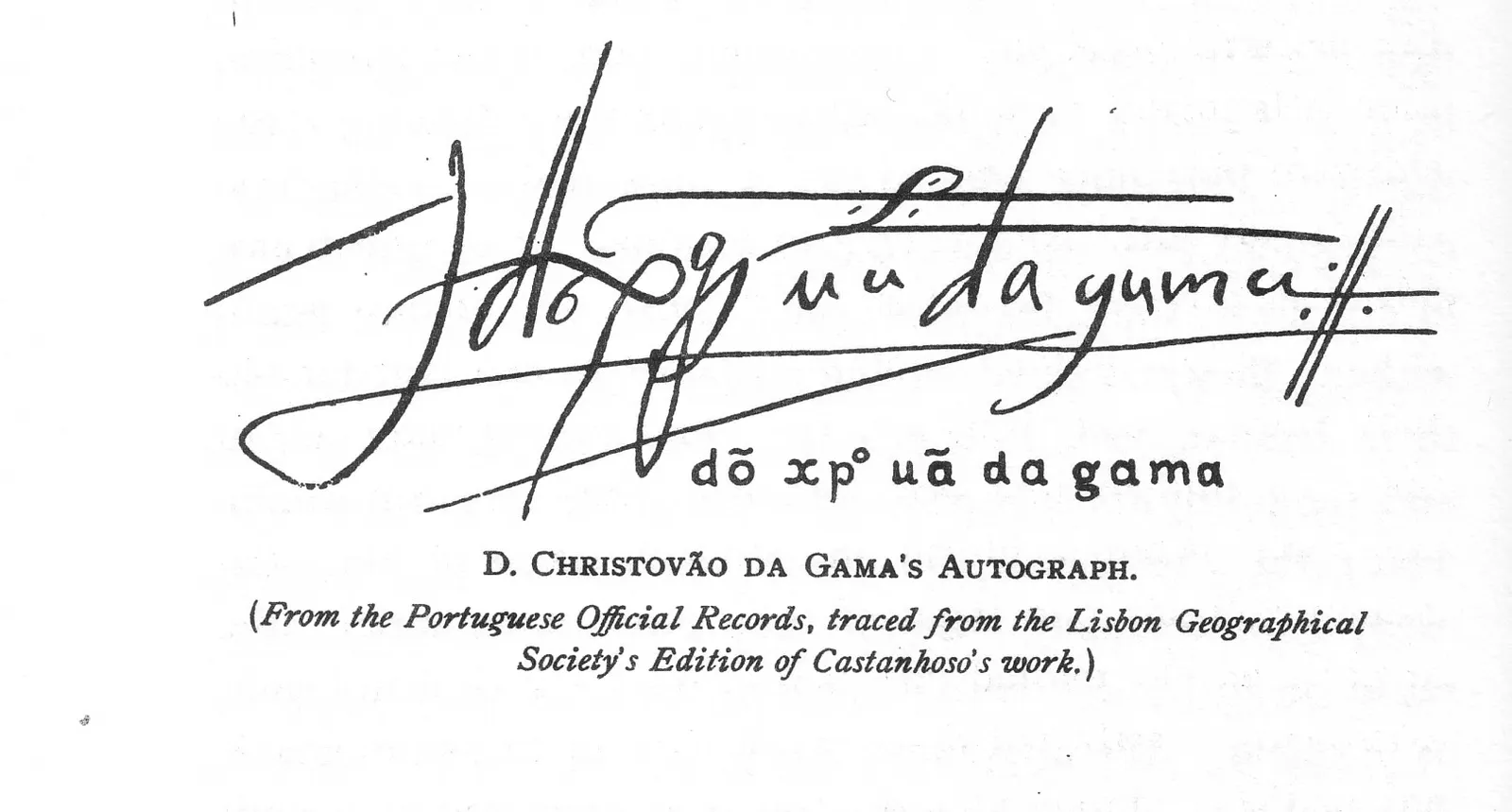
- Cristóvão da Gama's signature, traced from Portuguese official records for the Lisbon Geographical Society's 1898 edition of Castanhoso and reprinted by Whiteway in 1902. No portrait of him from life is known. Unknown author, Public domain, via Wikimedia Commons.