

After the Inquisition: the death of Damião de Góis, 30 January 1574
He had dined with Erasmus, talked with Luther and kept Portugal's royal archive for 23 years. At about 70 the Inquisition jailed him, and a little over a year after his sentence he was found dead at Alenquer, by most accounts beside a fire.
At a glance
- Damião de Góis, born at Alenquer on 2 February 1502, died there on 30 January 1574, a few days short of his 72nd birthday, according to the Torre do Tombo archive.
- Between 1523 and 1545 he lived abroad as secretary of Portugal's trading post in Antwerp, royal envoy to Poland and Denmark, and student in Padua and Louvain; he stayed with Erasmus at Freiburg in 1534 and met Luther and Melanchthon at Wittenberg.
- From 1548 to 1571 he was chief keeper of the Torre do Tombo, the royal archive, and in the 1560s he wrote the chronicles of King Manuel I and of Prince João, later João II.
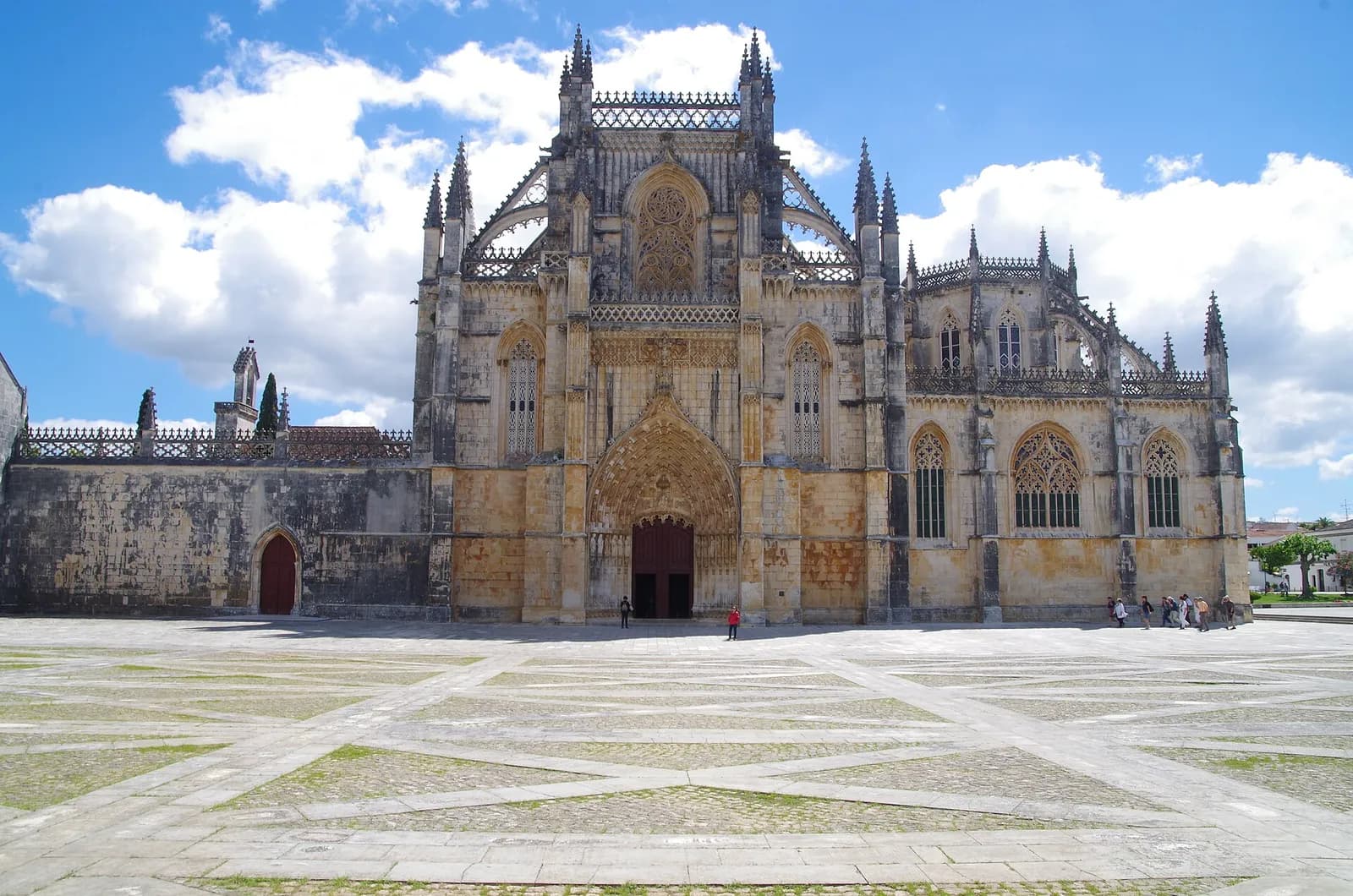
- The Inquisition arrested him on 4 April 1571 on a charge of Lutheranism first laid by the Jesuit Simão Rodrigues in 1545, confiscated his property and in December 1572 sent him to the monastery of Batalha for life.
- How he died is still unknown: old accounts say he collapsed into a fire, at home or at an inn, while a fractured skull seen when his bones were moved in 1941 started talk of murder.
A January night in Alenquer
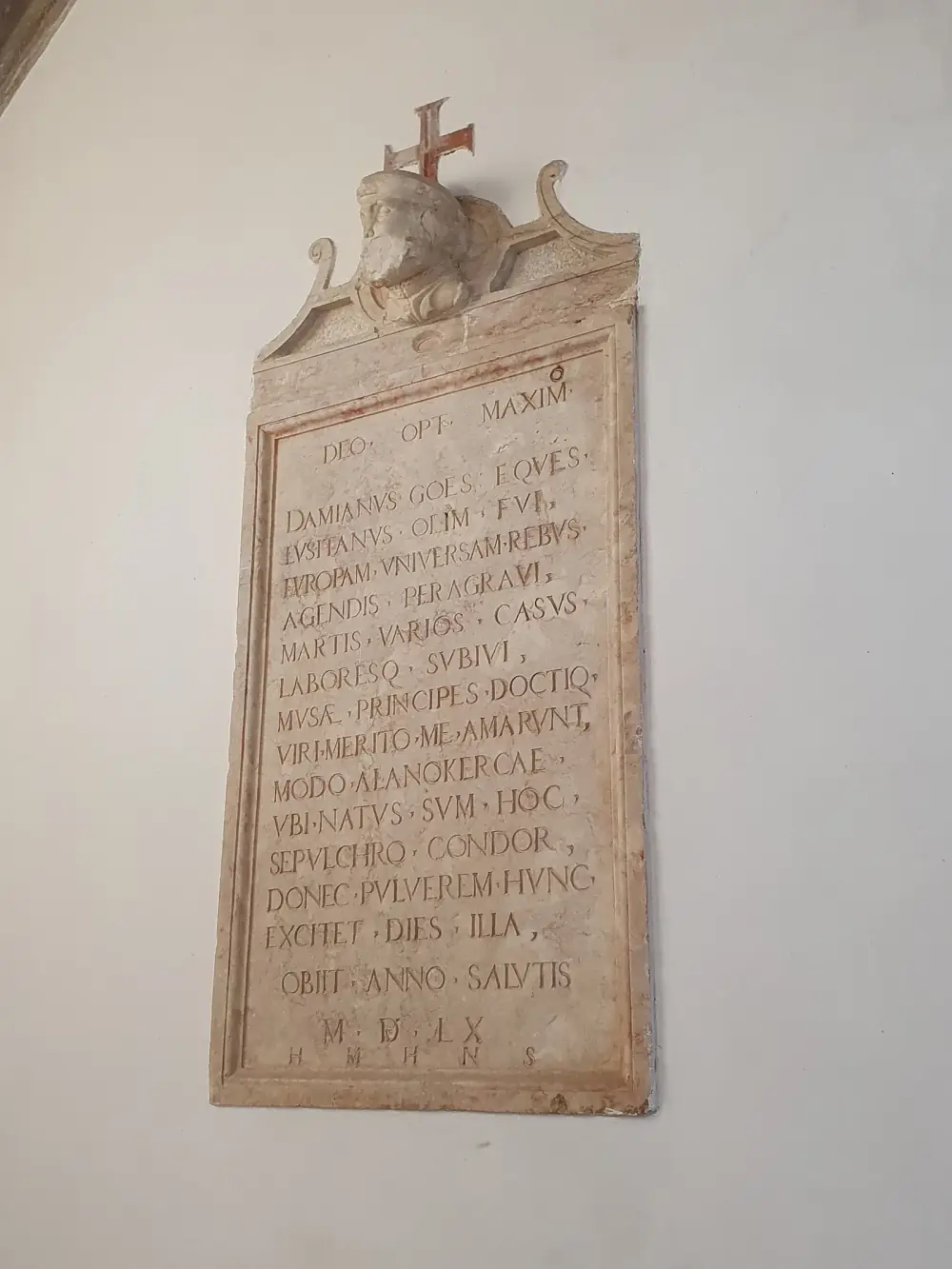
In the upper town of Alenquer, north of Lisbon, beside a stretch of the old castle wall, stands the church of Santa Maria da Várzea. Damião de Góis was baptised there in 1502. In 1560 he had a tomb built in it for himself and wrote a Latin epitaph to go on it. Fourteen years later, at the end of January 1574, he was buried in it.
The accounts of how he died do not agree. In the version told by the editor Gabriel Pereira in 1909, the old man sat down by his hearth on a cold January night and was found dead on the embers the next morning. Pereira added a question of his own, “congestion, apoplexy?”, and gave 30 January as the day Góis was buried.
Góis was about 71. He had spent the best part of two years in the cells of the Lisbon Inquisition, had seen everything he owned declared forfeit and had been sentenced to spend the rest of his life as a penitent in a monastery. He was also one of the best-known Portuguese in Europe: the friend and house guest of Erasmus, a composer printed in Germany and Italy, and the author of a book on the Ethiopians that was reprinted in Paris and translated in England.
A page at King Manuel's court
He was born at Alenquer on 2 February 1502, the son of Rui Dias de Góis, the crown's revenue officer in the town, and Isabel Gomes de Limi. Her grandfather, Nicolau de Limi, was a Flemish nobleman who had settled in Portugal. In 1511, aged nine, he joined the royal household as a page, and he grew up alongside the heir to the throne, Prince João, born the same year.
His father died in 1513, and by 1518 the boy was a groom of the chamber to King Manuel I. Góis was present when Manuel died on 13 December 1521.
Antwerp and the roads of northern Europe
In 1523 the new king, João III, made Góis secretary of the Portuguese factory at Antwerp. He stayed abroad, apart from a short visit home in 1533, for 22 years.
The secretary soon became an envoy. In 1529 the king sent him to Poland to arrange a marriage between Prince Luís and the Polish king's daughter, and he spent long periods in Vilnius and Danzig. Other missions took him to Denmark and Sweden. In 1531, travelling from the Danish court back to Poland, he spent two days at Wittenberg, where he met Martin Luther and Philip Melanchthon. The marriage never happened.
A guest of Erasmus
Góis had first made contact with Erasmus of Rotterdam in 1532, when he enrolled at the university of Louvain. In the early months of 1534 he moved into Erasmus's house at Freiburg, at the foot of the Black Forest, and stayed about five months. The two kept in close touch until Erasmus died in 1536.
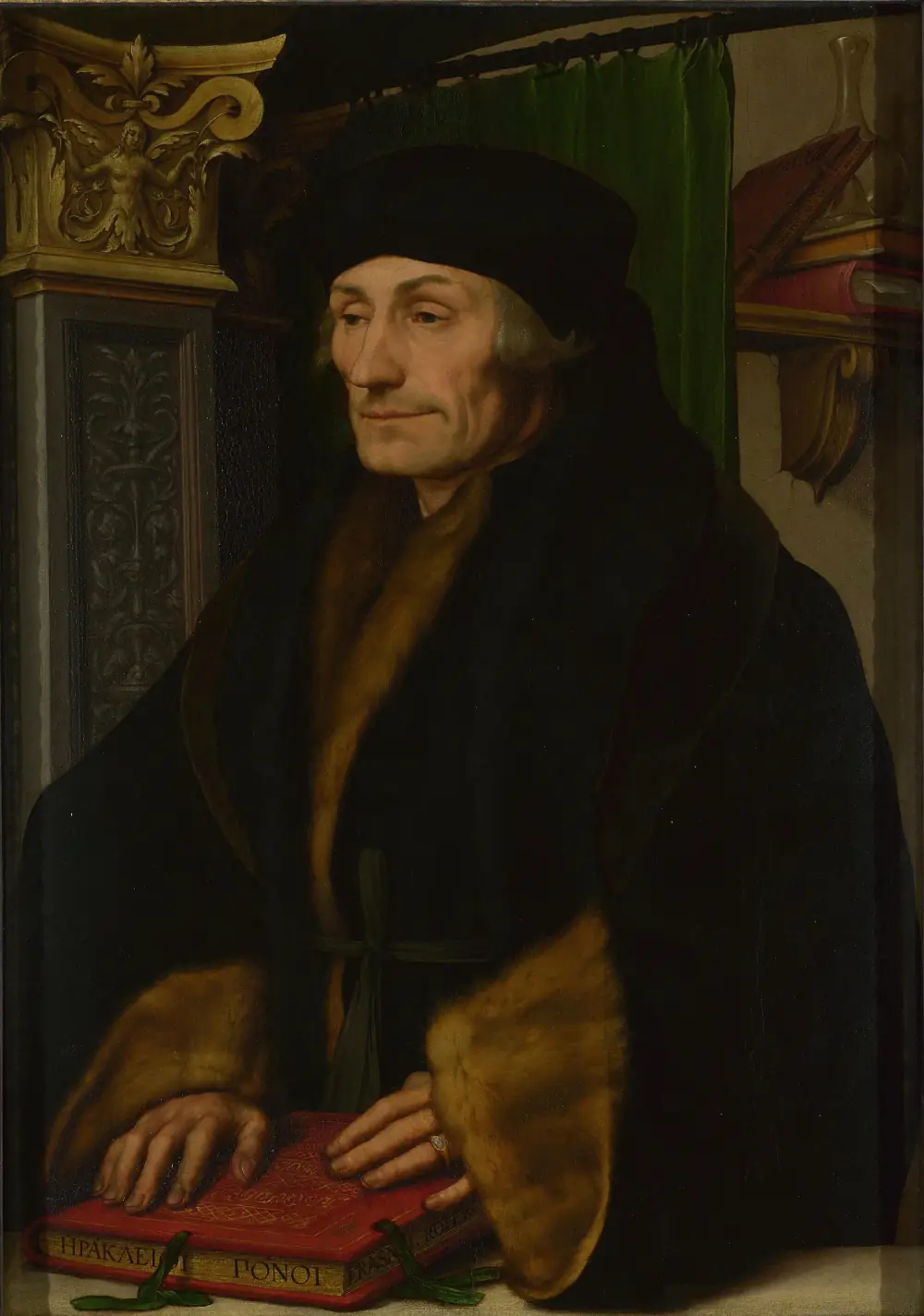
In Erasmus's house Góis met the Swiss music theorist Heinrich Glarean, who later printed one of Góis's three-part motets, Ne laeteris inimica mea, in his treatise Dodecachordon (Basel, 1547) as a model of the Aeolian mode. Only three of his pieces survive.
“our friend Damião de Góis, a Portuguese nobleman and an excellent composer, who after wandering across Europe came to this place at the foot of the Black Forest, to Erasmus, whose guest he was for several months.”
From Freiburg he went to Padua, where he studied at the university until 1538 or 1539 and came to know Cardinals Pietro Bembo and Jacopo Sadoleto. He also met Ignatius of Loyola, founder of the Jesuits, and a Portuguese member of Loyola's circle, Simão Rodrigues. Góis then settled in Louvain, in the Low Countries, where he finished his studies at the Collegium Trilingue and in 1538 married Johanna van Hargen, daughter of a Dutch counsellor at the court of Charles V.
In Louvain he wrote in Latin for a European readership. Fides, religio moresque Aethiopum (1540), on the faith and customs of the Ethiopians, argued that their different rites should not keep them out of communion with the Church, an Erasmian view. It was reprinted in Paris, Louvain and Brussels and translated in England by a son of Thomas More. In Portugal the censors banned it in 1541.
In 1542 a French army besieged Louvain. Góis helped lead the defence, was taken prisoner to France and was freed in 1543 against a ransom. The Emperor Charles V granted him a coat of arms for his services, and in 1545, at João III's call, he came home with his family.
Home, and a denunciation
Góis reached Évora in the middle of August 1545. The king and queen had summoned him to be tutor to their son and heir, Prince João. On 5 September, three weeks later, Simão Rodrigues, by then head of the Jesuits in Portugal and the prince's teacher of doctrine, went before the inquisitor of Évora and accused him of heresy.
Rodrigues said that about nine years earlier in Padua he and Góis had talked about Luther's errors for some two months, on the authority of the Pope and on confession, and that Góis praised Luther's doctrine. He recalled asking Góis whether, back in Portugal, he would go to Mass like other Christians.
“he would do as the others did, and in his heart he would keep and hold what he had to hold.”
The tutorship went to António Pinheiro, later Bishop of Miranda. Góis's standing abroad and his friends at court, Cardinal Henrique among them, kept the case from going further, and a second accusation by Rodrigues in 1550 also failed. In his written defence 27 years later, Góis said Loyola had rebuked Rodrigues for reports he made about Góis and had come from Venice to Padua to apologise in person. Rodrigues bore a grudge, he said, and hurried to the inquisitor to keep Góis from a post he wanted himself.
Keeper of the Torre do Tombo
On 13 June 1548 João III appointed Góis to serve as guarda-mor, chief keeper, of the Torre do Tombo, the royal archive kept in a tower of Lisbon's castle, while its keeper, the chronicler Fernão de Pina, was held by the Inquisition. Pina was sentenced in 1550 and never returned, and Góis held the post in full from then on. His work is documented in the archive until 4 March 1571.
He found documents, signed certified copies for the king and private petitioners, inventoried papers and papal bulls, and oversaw the illuminated copies of old records known as the Leitura Nova. On one register of inquiries made for Afonso II he left a note about the old books his predecessors had written off.
“I, Damião de Góis, had all the old books that I found in the said tower bound anew, even though the chief keepers my predecessors and other persons had marked them down as unnecessary and useless. This binding was done in May 1555.”
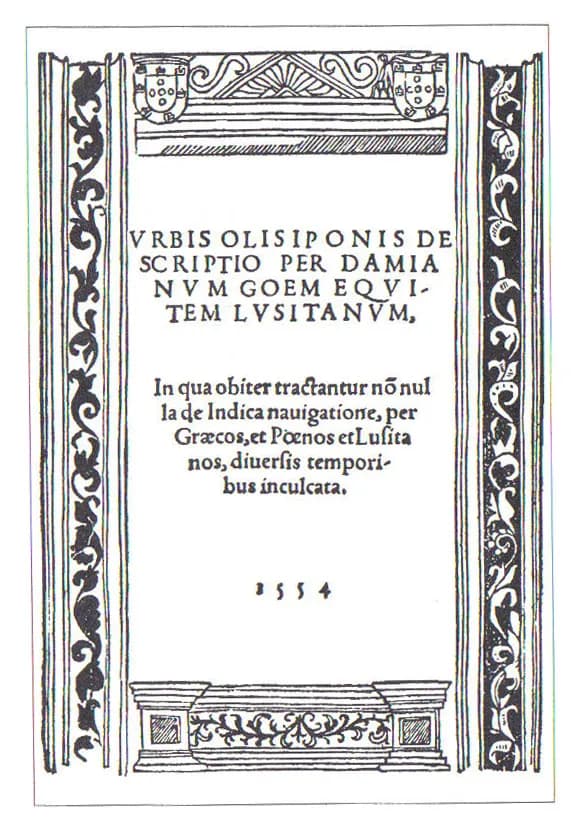
He lived in rooms at the castle palace and kept open house. In 1554 he published at Évora a short Latin description of his city, Urbis Olisiponis descriptio, which opens by setting Lisbon beside Seville as the two capitals of the new oceanic world.
“There are two cities in our time that may rightly be called mistresses and, as it were, queens of the Ocean, since under their direction and command ships now sail the whole of the East and the whole of the West.”
The Holy Office had not forgotten him. On 12 October 1556 a Flemish servant named Paulo accused his wife, Joana, of Lutheranism. Nothing came of it at the time, but the denunciations stayed on file.
Chronicles that made enemies
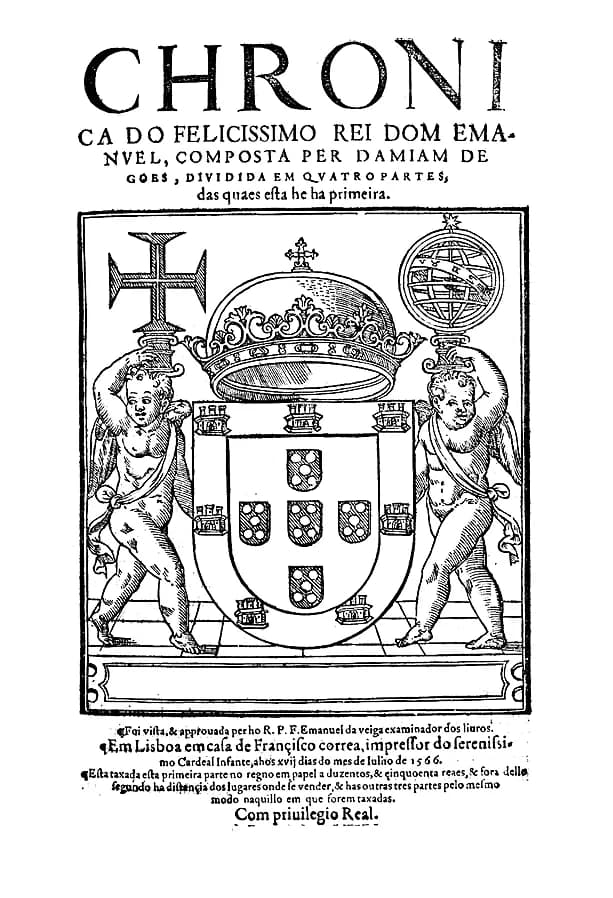
In 1558, after the death of João III, Cardinal Henrique asked Góis to write the history of the reign of his father, Manuel I. Góis was never the official royal chronicler, but the archive gave him the documents. The Chronica do felicissimo rei Dom Emanuel came out in Lisbon in four parts, the first two in September 1566 and the last on 25 July 1567. His Chronica do Principe Dom Joam, on João II as prince, came out on 11 April 1567.
The crown rewarded him in January 1566 with the habit of the Order of Christ and a pension of 20,000 réis, which he passed to his son-in-law. Some of the great noble families were less pleased. Góis had said he would spare neither praise nor blame, and the events were recent enough for powerful families to take offence. In 1567 the first part of the Manuel chronicle was revised and printed again.
He was also frank about the darkest episodes of Manuel's reign: the expulsion of the Jews, the seizure of their children and the riot against New Christians in Lisbon, all told in our article on Manuel I's expulsion decree. Although Góis was writing in 1566, Gabriel Pereira observed in 1909, he made the cruelty of those acts plain.
Arrest and trial, 1571 to 1572
On 24 September 1570 the Lisbon Inquisition called Góis in to confirm earlier statements. On 4 April 1571 it arrested him. His record gives him as a widower of 70, an Old Christian (of no Jewish descent), resident in Lisbon, accused of Lutheranism. The old denunciations by Simão Rodrigues were taken out of the files and joined to new ones.
Five days after the arrest his son-in-law, Luís de Castro, a gentleman and treasurer of Cardinal Henrique's household, came to the inquisitor unbidden to say what he knew against him. Guilherme Henriques, who published the trial in 1898, concluded that Castro had helped get the old denunciations reopened to protect his own interests after Joana's death, and noted that within seven months Castro was in a lawsuit with Góis's son Ambrósio.
The prosecutor charged that Góis had kept company with heretics abroad and, now that they were dead or far away, kept company with their books, which the index of the Council of Trent banned. Witnesses said he skipped fasts and called many clergy hypocrites, more tyrannical than laymen. One witness repeated a story she had heard from others: when his pregnant niece was served pork on a fish day, he took a slice from her plate and told her that what goes into the mouth does not kill the soul.
The inquisitors asked about the foreigners who came to his house, and about a storeroom of his above the castle chapel where, someone claimed, brine from his barrels of salted pork had dripped onto the crucifix. Góis said any drip must have been rainwater through the broken roof tiles. Of the foreigners he said, on 20 May 1572, that his house was an inn for them, and that after dinner they all sang Masses and motets in parts, because he loved music.
He wrote his defence in his own hand. He admitted that during his first years in Flanders he had come to think the Pope's indulgences were worth little and had doubted confession, but said he had been cured of it in Italy. He denied ever trying to win anyone over to Luther, and he answered the charge that he preferred foreigners to his own people.
“I wish well to all foreigners, because I was a pilgrim in many lands and always found very good company among them.”
The inquisitors had told him that if he confessed there would be no formal indictment and all would end in mercy. He confessed, and the indictment came anyway. “I have seen the indictment, and I am still waiting for the mercy,” he wrote. After nine months in the cells he complained that he was over 70 and ill, could barely stand and was so covered in sores and scabies that he could almost pass for a leper.
“I ask you to lend me a book in Latin, whichever you see fit, because I am rotting with idleness, and reading would take my mind off many thoughts.”
The sentence and Batalha
The inquisitors voted on 16 October 1572. They agreed unanimously to receive him back into the Church. By a majority they ruled that he should abjure in private before them, not in a public auto-da-fé, because he was so well known in the heretics' lands abroad, and serve perpetual imprisonment in a place assigned by “His Highness”. Henriques took that to mean the Cardinal; the Torre do Tombo summary says the king.
- Arrested
- 4 April 1571, Lisbon
- Charge
- Lutheranism
- Verdict agreed
- 16 October 1572
- Abjuration
- 6 December 1572, in a private auto-da-fé
- Penalty
- Confiscation of all property; perpetual penitential imprisonment
- Sent to
- Monastery of Batalha, 16 December 1572
Góis signed his abjuration on 6 December 1572. Three days later a certificate went to the treasury judge that his goods were forfeit to the treasury and the royal chamber, and on 16 December he was handed over to the monastery of Batalha.
What happened next is barely documented. At some point he was allowed to go home to Alenquer, old, poor and ill; the municipality's biography says on the king's orders. The archaeologist Conceição Machado, who studied his remains in 2002, pointed out that no known document covers his life between his arrival at Batalha and the record of his death in 1574.
A fall, a fit or a blow
The Torre do Tombo, drawing on its records, says simply that he died in his house at Alenquer on 30 January 1574 and was buried at Santa Maria da Várzea. RTP's history service adds that he was found dead, with suspicions of murder.
| Account | Where | What happened |
|---|---|---|
| Family genealogy by Bernardo Carneiro Vieira de Sousa, citing a notary's book at Alenquer (copied in Inéditos Goesianos) | An inn on the road to the monastery of Alcobaça | After supper he stayed by the chimney to read; he fell into the fire and was found burnt in the morning, part of the paper still in his hand, from sleep or a fit |
| Joaquim de Vasconcelos, late nineteenth century | By his hearth | A stroke (apoplexy), consistent with the dizzy spells Góis described in his letters from 1535 to 1537 |
| Gabriel Pereira, 1909 | His house at Alenquer | Sat by the fire on a cold night and was found dead on the embers; “congestion, apoplexy?” |
| Aubrey Bell, 1942 | Probably his house at Alenquer | Perhaps a brain haemorrhage; Bell notes the inn story as a second account |
| Observers at the transfer of his remains, 1941 | Not stated | A horizontal crack in the back of the skull, broken facial bones and a missing jaw, which raised the idea of a violent death |
The 1941 observations are as reported by Público in 2002, quoting the archaeologist Conceição Machado. The date of the genealogy is not given; Público also cites a version in the Enciclopédia Luso-Brasileira in which he fainted or fell asleep and fell into the fire of an inn on the way to Alcobaça.
The idea of opening the tomb is old. In 1898 Henriques proposed checking how many skeletons it held and whether any bones showed signs of burning. By 1941 Santa Maria da Várzea was in ruins, and that year his remains were moved to a side chapel of the church of São Pedro, which overlooks the town, decorated with his arms and his wife's.
On Friday 27 September 2002, the year of his 500th anniversary, a team led by the archaeologists Conceição Machado and Fernando Rodrigues Ferreira had the lead box in São Pedro opened. Inside were a small heap of yellowed bones, some of them not his, a green glass bottle holding a record of the 1941 transfer and an old shoe-polish tin containing a coin of King Sebastião.
The skull shown that afternoon had a horizontal crack across the occipital bone that could be read as the mark of a blow from behind. Machado said this, first noticed in 1941, was what raised the idea of a violent death. The team planned CT scans, digital X-rays and bone-density tests, and a descendant, Francisco Goes, offered a hair for DNA comparison.
His life at a glance
2 February 1502
Born at Alenquer
1511
Enters the royal household as a page
1523
Secretary of the Portuguese factory at Antwerp
1529 to 1531
Missions to Poland and Denmark; meets Luther and Melanchthon at Wittenberg
Early 1534
Guest of Erasmus at Freiburg
1534 to 1538
Studies at Padua
1538
Marries Johanna van Hargen; settles in Louvain
1540
Publishes Fides, religio moresque Aethiopum
1542
Defends Louvain against the French and is taken prisoner
5 September 1545
Denounced by Simão Rodrigues at Évora
13 June 1548
Appointed chief keeper of the Torre do Tombo
1554
Urbis Olisiponis descriptio printed at Évora
1566 to 1567
Chronicles of Manuel I and Prince João printed
4 April 1571
Arrested by the Lisbon Inquisition
6 December 1572
Abjures; property confiscated
16 December 1572
Delivered to the monastery of Batalha
30 January 1574
Dies at Alenquer
1941
Remains moved to the church of São Pedro, Alenquer
27 September 2002
Remains exhumed for study
Why he still matters
Góis left the Manuel chronicle, reprinted in 1619, 1749, 1790 and 1909, and a shelf of Latin works that reported Portugal's expansion to humanist Europe. As a historian, Ana Isabel Buescu writes, he was accurate and unbiased even when it made him enemies. The historian António José Saraiva summed him up in a phrase.
“a curious blend of humanism and business, of Latin and sugar”
By 1571, Buescu notes, Portugal's spiritual climate had changed completely since his brief visit home in 1533, and Góis was one of the last survivors of a bygone generation. Alenquer has taken him up as its own. On 20 May 2017 the town opened the Museu Damião de Góis e das Vítimas da Inquisição in Santa Maria da Várzea, the church where he was baptised and first buried. Every February, around his birthday, it holds a season of events in his name.
FAQs
When and where did Damião de Góis die?
He died at Alenquer, his birthplace north of Lisbon, on 30 January 1574, according to the Torre do Tombo. Gabriel Pereira gave 30 January as the day of his burial. An old family genealogy places the death at an inn on the road to Alcobaça instead.
Was Damião de Góis murdered?
Nobody knows. The traditional accounts say he collapsed into a fire, from sleep or a stroke. A cracked skull and broken facial bones seen when his remains were moved in 1941 led to talk of a blow, and his bones were exhumed for study in 2002, but what happened is still unknown and Alenquer describes the circumstances as never established.
Why did the Inquisition put him on trial?
For Lutheranism. The case began with Simão Rodrigues's denunciation of 1545 about talks in Padua, and in 1571 new witnesses added that he read banned books, ignored fasts, mocked the clergy and entertained foreigners. He was arrested on 4 April 1571 and sentenced in 1572 to confiscation and life confinement.
Did Góis really know Erasmus and Luther?
Yes. He stayed about five months in Erasmus's house at Freiburg in 1534 and corresponded with him until 1536. In 1531 he met Martin Luther and Philip Melanchthon at Wittenberg, a meeting noted in the archive's summary of his trial file.
Where is Damião de Góis buried?
In a funerary chapel at the church of São Pedro in Alenquer, where his remains were moved in 1941 from the ruined church of Santa Maria da Várzea. Santa Maria da Várzea is now the Museu Damião de Góis e das Vítimas da Inquisição.
On the timeline
Open the timelineNearby moments from the age of discoveries (1415–1580).
Portuguese captain Estácio de Sá founds the city of São Sebastião do Rio de Janeiro in Brazil, establishing a strategic settlement to expel French colonists from Guanabara Bay.
Dominican friar Gaspar da Cruz dies of plague in Setúbal, where he had carried on nursing the sick after Lisbon's epidemic of 1569. His 'Tratado das cousas da China', finished at the press in Évora two weeks later, is often called the first European book devoted entirely to China.
João de Barros, the humanist historian whose 'Décadas da Ásia' chronicled the Portuguese conquests in the East and earned him the title of the 'Portuguese Livy', dies at Ribeira de Litém near Pombal, aged about 74.
The death of Damião de Góis
Damião de Góis, the humanist chronicler of King Manuel I and friend of Erasmus, dies at Alenquer, just over a year after the Inquisition sent him to life confinement at Batalha. Whether he died from a fall into the fire, a fit or a blow, his death remains one of the mysteries of the Portuguese Renaissance.
King Sebastião I and much of the Portuguese nobility are killed at the Battle of Alcácer Quibir in Morocco, the 'Battle of the Three Kings'. The disaster triggered a succession crisis that led to Spanish rule over Portugal from 1580 and gave rise to the enduring myth of Sebastianism.
Pedro Nunes, royal cosmographer and one of Europe's foremost mathematicians, dies in Coimbra. Inventor of the nonius and pioneer of the loxodrome, he placed Portuguese navigation on a scientific footing.
Cardinal-King Henrique dies at Almeirim on his 68th birthday without naming an heir. His death opens the way for Philip II of Spain to claim the throne, beginning sixty years of Iberian Union.
Coming up in history
All long reads 1 February 1908Shots in the Terreiro do Paço: the Lisbon regicide of 1 February 1908
 2 February 1542Cristóvão da Gama storms Baçente: Portugal's war in Ethiopia, 1542
 3 February 1488Bartolomeu Dias passes the Cape unseen and lands at Mossel Bay, 1488
 4 February 1961The night Luanda's prisons were attacked: 4 February 1961
12 sources
Archives, scholarship and reporting this article was checked against.
- 1
Damião de Góis: um humanista na Torre do Tombo (virtual exhibition panels)Arquivo Nacional Torre do Tombo, 2021
- 2
Damião de Góis (1502-1574) (Ana Isabel Buescu)Encyclopaedia of Portuguese Expansion (EVE), CHAM, NOVA FCSH, 2009
- 3
Inéditos Goesianos, vol. II: O processo na Inquisição, documentos avulsos, notas (Guilherme J. C. Henriques, ed.)Lisbon, 1898 (Internet Archive scan)
- 4
- 5
- 6Esqueleto de Damião de Goes exumado em AlenquerPúblico, 29 September 2002
- 7
- 8
Alenquer, Terra de Damião de GóisCâmara Municipal de Alenquer
- 9Alenquer inaugura Museu Damião de Góis e das Vítimas da InquisiçãoLusa, in Diário de Notícias, 20 May 2017
- 10
O músico e humanista Damião de Góis (1502-1574) (Márcio Paes Selles)Mirabilia 27 (2018/2)
- 11
- 12
Damião de Góis, o humanistaRTP Ensina
Image credits
- The monastery of Santa Maria da Vitória at Batalha, where the Inquisition sent Damião de Góis on 16 December 1572 to serve a sentence of life confinement. Photographed in 2017. Cardilio, CC BY-SA 4.0, via Wikimedia Commons.
- Erasmus of Rotterdam painted by Hans Holbein the Younger in 1523, eleven years before Góis stayed in his house at Freiburg. Hans Holbein the Younger, Public domain, via Wikimedia Commons.
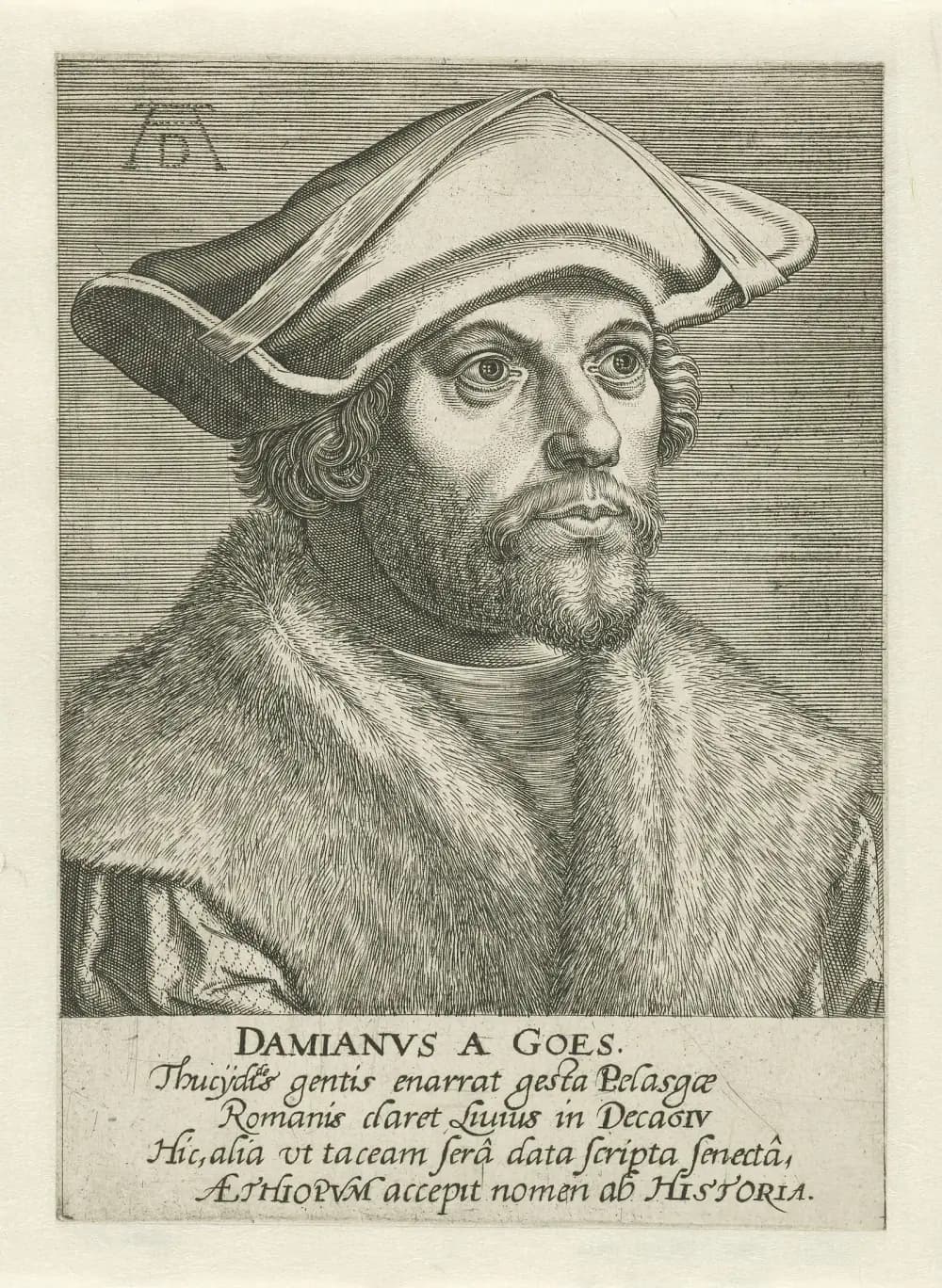
- Damião de Góis in an engraving by Philips Galle, printed between 1587 and 1612 after a portrait credited to Albrecht Dürer by the monogram at the top left. The Latin verse below sets him beside Thucydides and Livy and says his name was made by his book on the Ethiopians. Rijksmuseum, CC0, via Wikimedia Commons.
- Title page of Urbis Olisiponis descriptio, Góis's Latin description of Lisbon, printed at Évora in 1554. Damião de Góis, Public domain, via Wikimedia Commons.
- Title page of the first part of Góis's Chronica do felicissimo rei Dom Emanuel, printed in Lisbon in 1566. Damião de Góis, Public domain, via Wikimedia Commons.
- The Latin epitaph Góis composed for his own tomb, dated 1560, now in his funerary chapel at the church of São Pedro, Alenquer. It says he travelled all of Europe on business and rests in Alenquer, where he was born, “until that day awakens this dust”. Photographed in 2020. GualdimG, CC BY-SA 4.0, via Wikimedia Commons.