

The Monarchy of the North: Porto's 25-day kingdom of 1919
Five weeks after President Sidónio Pais was shot, an old colonial hero proclaimed King Manuel II in Porto. The king never came, Lisbon stayed republican, and within 25 days the last serious attempt to restore the Portuguese crown was over.
At a glance
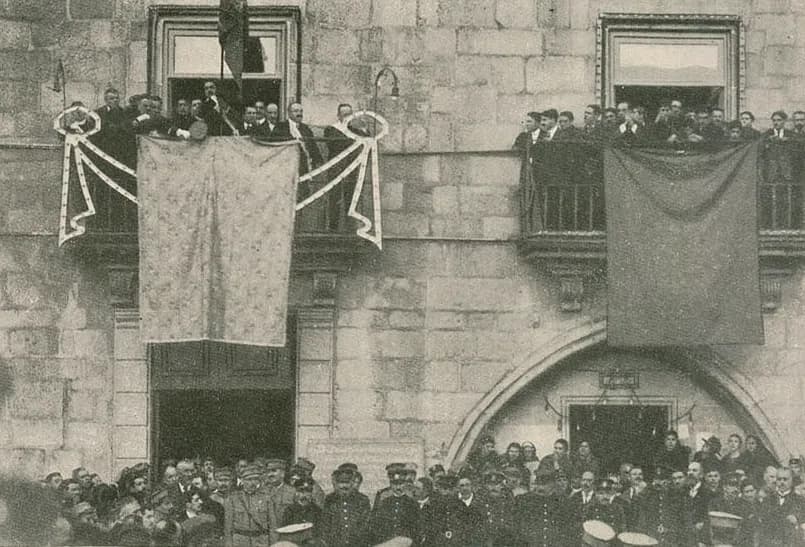
- On Sunday 19 January 1919, at about one in the afternoon, monarchist troops in Porto proclaimed the restoration of the monarchy in the name of the exiled King Manuel II.
- Henrique de Paiva Couceiro, a hero of the African colonial wars who had led two failed royalist incursions from Galicia in 1911 and 1912, headed a Junta Governativa do Reino that ruled most of the Minho, Trás-os-Montes and part of the Beiras.
- A parallel rising in Lisbon, on the heights of Monsanto, was crushed on 24 January after two days of artillery fire; 39 people died.
- On 13 February a republican counter-coup inside Porto ended the regime while Couceiro was away at the front. The last royalist fighters left for Galicia on 19 February.
- Manuel II had not authorised the rising and later called it a crime. No later monarchist movement tried to restore the crown by force on this scale.
A Sunday afternoon in Porto
At about one o'clock on the afternoon of Sunday 19 January 1919, the army commanders in Porto declared the monarchy restored. Manuel II, who had lived in exile in England since 1910, was again King of Portugal, at least in the north.
Their leader, Captain Henrique de Paiva Couceiro, tall, thin and fair, put on an old dress uniform and rode into the city on horseback to take over the military headquarters. Nobody in Porto resisted. Over the next hours other northern towns declared for the king.
A Junta Governativa do Reino, the Governing Junta of the Kingdom, took power with Couceiro at its head. Its own official gazette printed the proclamation that explained the rising.
“The struggle of factions, moved solely by ambition for power, has long been hindering the normal course of social life in all its forms and promoting an anarchy that spreads and takes root so gravely that, unless some force from within the Nation can dam the advance of so many growing dissolutions, the outcome can only be a shameful liquidation under the tutelage of foreigners.”
For the next 25 days Portugal had two governments: a republic in Lisbon and a kingdom in Porto. Republicans called it the Monarchy of the Trauliteiros, after the club-wielding militias that hunted their opponents. The name that stuck came later, from the title of a two-volume history by the monarchist journalist Rocha Martins in 1922: the Monarchy of the North.
Nine years of republic and one month of chaos
Portugal had been a republic since the revolution of 5 October 1910, which sent the young Manuel II into exile. The new regime was dominated by Afonso Costa's Democratic Party, which persecuted the Church, its own republican rivals and the monarchists alike. Many royalists emigrated; some prepared to fight.
Paiva Couceiro was the most stubborn of them. Born in 1861, he had made his name in the wars of conquest in Mozambique in the 1890s and had been governor-general of Angola from 1907 to 1909. In October 1910 he was the only commander who actually fought the republican revolution in Lisbon. The Republic tried to win him over; he refused and went into exile in Galicia, where other royalists were gathering.
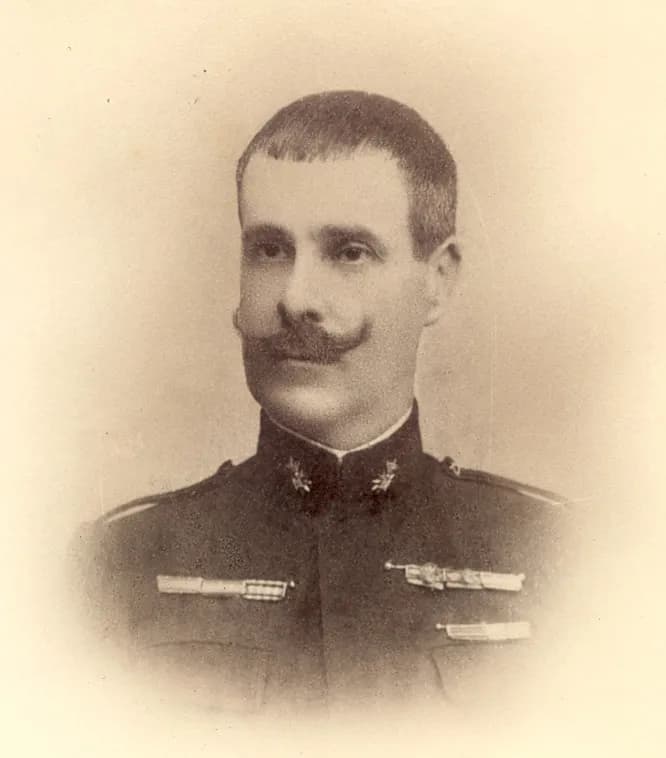
From there he led two armed incursions. At dawn on 5 October 1911 a column of about 950 exiles, only 250 of them armed, crossed the border and occupied Vinhais, near Bragança; republican troops retook it the next day. On 8 July 1912 a second attempt fell on Chaves and was beaten off after several hours. Each time Couceiro expected the countryside to rise, and each time it did not.
His chance came with the next crisis. In December 1917 Major Sidónio Pais overthrew the Democrats and opened his “New Republic” to conservatives, Catholics and monarchists; his assassination at Rossio station on 14 December 1918, told in a separate article, left that coalition without a leader.
On 10 January 1919 republican officers rose in Lisbon and at Santarém, claiming that a restoration was being prepared. The Santarém rebels surrendered in mid-January to a column of Sidónio's loyalists led by Teófilo Duarte. Each camp now feared the other would strike first. In Porto the plotting was barely hidden: the editor of Pátria, Porto's leading royalist daily, told the Spanish press during the rising that it had been hatched in his newsroom with the backing of the military juntas. The plotters' watchword was “now or never”.
The king's representative in Portugal, Aires de Ornelas, preferred to work with a conservative republic and let a restoration come by consent. On 14 January he scribbled “go on, words of the king” on a memorandum about the “possibility” of a monarchist military movement. He later said he was only commenting on a possibility; the plotters in Porto read it as royal consent. Couceiro told the Integralist writer António Sardinha the day before the rising that he had to act before the government replaced the monarchist officers of the Lisbon garrison.
A kingdom in the north
Couceiro presided over the Junta and styled himself regent. Its members included the Viscount of Banho, the Count of Azevedo, Captain Sollari Allegro at the interior ministry and, as foreign minister, Luís de Magalhães. José Relvas, soon to lead the government in Lisbon, read the list and remarked that the staff “is not numerous”.
The Junta legislated busily through its official gazette, the Diário da Junta Governativa do Reino de Portugal. It named civil governors for Porto, Aveiro, Braga, Bragança, Coimbra, Vila Real, Viana do Castelo and Viseu, the territory it claimed, and even for Portalegre in the south.
| Measure | What it meant |
|---|---|
| Republic abolished, Constitutional Charter of 1826 restored | A return to the constitutional monarchy that fell in 1910 |
| Catholicism made the official religion again | The Republic's separation of Church and State reversed |
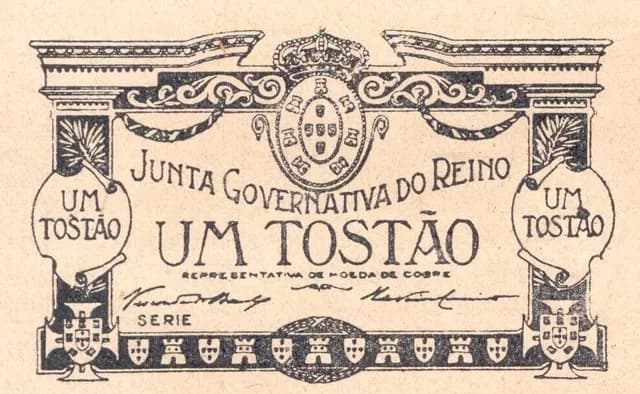
| The escudo replaced by the old currency, the real | Republican banknotes stamped for use in the kingdom |
| The GNR renamed the Guarda Real | The Republican National Guard became the Royal Guard |
| Royal postage stamps printed | A mark of sovereignty, later reproduced by the Lisbon press |
Some firms took back their royal names: the Companhia Vinícola do Norte de Portugal became the Real Companhia Vinícola do Norte de Portugal again.
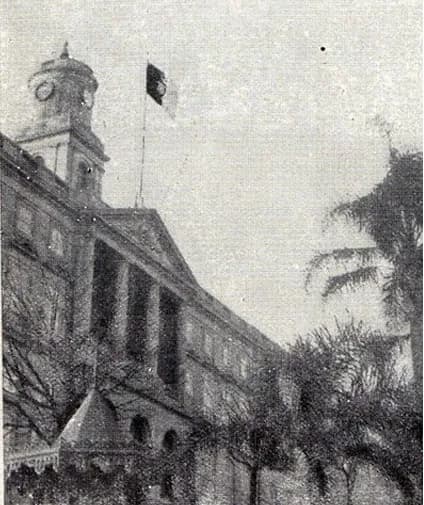
Public buildings across most of the Minho, Trás-os-Montes and part of the Beiras raised the blue and white flag of the old monarchy: in Viana do Castelo, Braga, Guimarães, Lamego, Viseu and Bragança. Many priests and their parishioners, angry at a decade of anticlerical laws, joined in. But the movement never spread south of Aveiro and Viseu, and its forces were halted near Aveiro, between Porto and Coimbra.
The kingdom needed friends abroad. Luís de Magalhães travelled to Madrid in early February, hoping Spain would recognise the Junta as a belligerent, and royalists marched through Porto with lanterns to cheer the Spanish, British, French and Brazilian consulates. Madrid ordered its border governors to intern émigrés who might help the rising, and no recognition came.
Lisbon: two days on Monsanto
In Lisbon the news from Porto broke the uneasy truce. Aires de Ornelas assured the government he had known nothing and that the king had told monarchists to back the authorities. But Prime Minister João Tamagnini Barbosa turned for help to the republican parties, and Lisbon filled with armed civilian volunteers of the old republican militias. On 22 January volunteers gathered at the Campo Pequeno bullring to receive rifles and training.
Frightened monarchists took refuge in the cavalry barracks at Belém. On the night of 22 to 23 January, Ornelas and Colonel Álvaro de Mendonça, Sidónio's former war minister, led about 800 soldiers, most of them cavalry, some 200 civilians and 28 guns up to Monsanto, the wooded heights west of the city. Rui Ramos describes the move as defensive: Ornelas told those who mentioned Couceiro that “we can have nothing in common with those people”. Once on the hill, he could not stop his men raising the blue and white flag.
Government forces under Lieutenant-Colonel Ernesto Vieira da Rocha surrounded the hill, reinforced by troops from the south, sailors and the armed volunteers, among them a battalion of Lisbon students. After two days of artillery duels they stormed the slopes on 24 January. A group of civilians under the former captain Júlio da Costa Pinto held out until about five in the afternoon.
Ornelas, Costa Pinto, João de Azevedo Coutinho and the cavalry commanders were taken prisoner. Rui Ramos gives 39 dead; Pedro Marçal Vaz Pereira, who gives the same toll, adds 330 wounded. The illustrated weekly Ilustração Portugueza wrote that Lisbon had spent two days in “the most mortifying disquiet”.
“The storming of Monsanto remains a historic date, and for me a greater one than the proclamation of the Republic itself.”
The defeat sealed the fate of the north, because without the capital a restoration was close to impossible. It also changed the government. Tamagnini Barbosa resigned on 26 January, and the next day José Relvas, finance minister in the provisional government of 1910, formed a cabinet of “republican concentration”. It took in every party from the Democrats to the socialists, Sidonists included, and brought the Republic back to the constitution of 1911.
The trauliteiros and the Eden-Teatro
Irregular gangs of club-men had appeared in Porto in October 1918, still under Sidónio, to beat up and intimidate the old republican politicians. Under the Junta they became volunteers attached to its interior ministry, in units with names such as Segurança Pública. Republicans called them a cudgel squad; Luís de Magalhães compared them to the somatén, the Catalan civic militia.
Republicans in the north were arrested, and the regional press reported many fleeing violence. In Porto, prisoners were held and beaten at the Eden-Teatro, a theatre turned into a detention centre. Protests by some officers over the treatment of prisoners forced out the police commissioner, José Baldaques.
Violence ran both ways. Rui Ramos judges that republican brutality in Lisbon was probably worse. On 7 February 1919 the monarchist Jorge Camacho, brought to the capital under arrest, was lynched by a crowd in the Terreiro do Paço, the great square on the river.
The republic strikes back
Some observers predicted a civil war of four years. It lasted weeks. Couceiro had few troops and struggled to supply them. The Republic held Lisbon, most of the country and the sea: two cruisers, three destroyers, three gunboats and four minesweepers cut off supplies to the north and harried its coast.
The navy's seaplanes flew for the Republic too; the Ilustração Portugueza photographed one moored at São Jacinto, near Aveiro. In Spain, Couceiro's agents were still trying in February to buy arms in quantity, even aeroplanes. Monarchists complained that republican warships shelling Viana do Castelo had killed a nine-year-old boy.
The fighting was mostly skirmishing, as the republican commander himself admitted. At Águeda, south-east of Aveiro, on 27 January seven hours of shooting left two dead and a few wounded. That setback and the news from Monsanto demoralised the royalists. Republican columns pushed north, and on 11 February they entered Estarreja, north of Aveiro on the road to Porto.
The end came from inside Porto. On 13 February Couceiro was away from the city with most of its troops. Captain João Sarmento Pimentel, ill with flu, took the chance: at the head of the Guarda Real, which became the Republican Guard again that day, he quietly restored the republic. Ramos writes that Sidonists and monarchists combined to end what had become an embarrassment to everyone.
Couceiro's forces fell apart. Leading royalists fled across the border; the interior minister, Sollari Allegro, had already reached Galicia. The last royalist fighters left Trás-os-Montes for Galicia on 19 February, and operations ended on the 20th. Couceiro was in exile in Spain once more.
5 October 1911
First incursion
Couceiro's column occupies Vinhais; republican troops retake it the next day.
8 July 1912
Second incursion
The royalists attack Chaves and are driven back; they cross into Galicia on 13 July.
14 December 1918
Sidónio Pais assassinated
The military juntas become the arbiters of power.
10–16 January 1919
Santarém revolt
A republican rising against the juntas is put down.
19 January
Proclamation in Porto
Monarchy proclaimed at about 1 pm; a Junta Governativa do Reino takes power.
22 January
Lisbon arms its volunteers
Civilians receive rifles at Campo Pequeno; that night monarchists move to Monsanto.
24 January
Monsanto stormed
The last defenders surrender in the late afternoon.
27 January
Relvas government; Águeda
A government of republican concentration takes office; skirmish at Águeda.
11 February
Estarreja retaken
Republican columns push north of the Vouga.
13 February
Republic restored in Porto
Sarmento Pimentel's counter-coup ends the Junta's rule.
19–20 February
Last fighters leave
Royalist remnants cross into Galicia; operations end.
9 April 1921
Amnesty
A law amnesties those accused of taking part.
| What | Figure | Source |
|---|---|---|
| Dead at Monsanto, Lisbon, 22 to 24 January | 39 | Rui Ramos; Pedro Marçal Vaz Pereira |
| Wounded at Monsanto | 330 | Pedro Marçal Vaz Pereira |
| Dead at Águeda, 27 January | 2, after seven hours of firing | Rui Ramos |
| Dead in all the military clashes, January and February 1919 | About 150 (estimate) | Rui Ramos |
| Held in prison for the revolt, September 1919 | 1,196, of whom 593 soldiers | Rui Ramos |
Ramos presents the total of about 150 as an estimate, and no second independent total was found. It covers the military clashes, so deaths in political violence away from the fighting, such as the lynching of Jorge Camacho, come on top. Vaz Pereira's 39 dead and 330 wounded are for the fighting in Lisbon.
Trials, purges and a king who said no
Leaders of the rising who had not escaped were arrested and brought before the courts, and many monarchists went into exile. In September 1919, 1,196 people were in prison accused of taking part in the revolt, 593 of them soldiers; many more faced suspicion, inquiries and purges. Suspected monarchists were removed from public office, and at the University of Coimbra four law professors were suspended, among them António de Oliveira Salazar, the future dictator. A law of 9 April 1921 finally amnestied them all.
Manuel II did not come. Spanish newspapers placed him in Madrid, Pontevedra or at the border, but he stayed in England, and he twice tried without success to get in touch with Couceiro's circle. According to Relvas's memoirs, days before the end the king sent a telegram, passed on by the foreign minister Egas Moniz, asking the government to send his own orders to the royalist forces, without Couceiro's knowledge, to stop fighting, in return for an amnesty for his followers. He later called Couceiro's rising a “nefarious crime” committed against his instructions.
“This movement of the monarchists at the present moment seems incredibly foolish as the political situation could not have been more favourable to them.”
The defeat deepened the splits among monarchists. The Integralists of Integralismo Lusitano, who wanted an authoritarian, anti-parliamentary monarchy, broke with Manuel II in October 1919, declaring themselves monarchists “because we are nationalists and not out of loyalty to the person of the king”. In Lisbon, the restoration scare had brought the Democrats back to power, which was what Manuel had feared.
Couceiro stayed a rebel. In 1937 he wrote to Salazar, by then dictator, complaining of a regime in which “the police and the censor's pencil keep watch”, and was arrested and deported to Spain. He died in 1944. By 1939 both he and Sarmento Pimentel, the man who had restored the republic in Porto, were living in exile.
Why it still matters
The Monarchy of the North was the last serious attempt to bring back the Portuguese crown by force. After those weeks no monarchist movement launched another rising on that scale, and Portugal has been a republic ever since, under the First Republic, the Estado Novo dictatorship and the democracy that followed it.
Rui Ramos reads it as a sign that crown or republic was ceasing to define the main political divide. Liberal conservatives in both camps, he argues, had more in common with each other than with the republicans and monarchists who now wanted a dictatorship. He also notes that fights between republican parties usually killed more people than this one: the real contest was moving inside the republican camp.
- Proclaimed
- 19 January 1919, Porto
- Ended
- 13 February 1919, counter-coup in Porto
- Leader
- Henrique de Paiva Couceiro (1861–1944)
- Lisbon rising
- Monsanto, 22–24 January 1919
- Estimated dead
- About 150 in the military clashes (Rui Ramos)
FAQs
What was the Monarchy of the North?
A royalist regime proclaimed in Porto on 19 January 1919 by army units led by Henrique de Paiva Couceiro. A Junta Governativa do Reino ruled much of northern Portugal in the name of Manuel II until a republican counter-coup in Porto on 13 February 1919.
Did King Manuel II support the rising?
No. He was not consulted, stayed in England, asked the republican government, by José Relvas's account, to pass on his order to the monarchists to stop fighting, and later called the rising a crime committed against his instructions. His representative in Lisbon, Aires de Ornelas, had written an ambiguous note that the plotters took as consent.
What happened at Monsanto in January 1919?
Lisbon monarchists under Aires de Ornelas occupied the heights of Monsanto on the night of 22 to 23 January. Government troops and armed volunteers stormed the hill on 24 January. Rui Ramos counts 39 dead, and the leaders were taken prisoner.
Who were the trauliteiros?
Monarchist militias of club-wielding volunteers in Porto. They detained and beat republicans, notably at the Eden-Teatro. Republican propaganda exaggerated some of their crimes, and some accusations proved false.
How many people died in the Monarchy of the North?
The figure usually given is an estimate. The historian Rui Ramos puts the dead of the military clashes of January and February 1919 at about 150, including 39 at Monsanto in Lisbon. Political killings away from the fighting, such as the lynching of the monarchist Jorge Camacho in Lisbon, come on top.
On the timeline
Open the timelineNearby moments from the first republic (1910–1926).
Battle of the Lys (La Lys): the Portuguese 2nd Division, about to be relieved after months in the trenches of French Flanders, takes the full force of the German spring offensive. Overrun in a single morning, it loses some 7,000 men, most of them taken prisoner — Portugal's worst defeat of the First World War. 9 April is now Portugal's official Veterans' Day (Dia do Antigo Combatente).
The painter Amadeo de Souza-Cardoso, pioneer of modernism in Portugal and friend of Modigliani and Brancusi in Paris, dies of Spanish influenza at Espinho, aged only 30.
President Sidónio Pais is assassinated at Lisbon's Rossio station as he arrives to catch the night train to Porto. José Júlio da Costa, a 25-year-old left-wing former army sergeant who has been waiting for him, shoots him in the chest. The charismatic 'President-King', who had seized power a year earlier, dies within minutes; four bystanders are killed in the shooting and panic that follow.
The Monarchy of the North
Monarchist troops under Henrique de Paiva Couceiro proclaim the restoration of the monarchy in Porto, the so-called Monarchy of the North, and a Junta Governativa do Reino takes power across much of northern Portugal. Never sanctioned by the exiled D. Manuel II, the rising collapses on 13 February, when a republican counter-coup inside Porto restores the Republic.
Death of Francisco Marto at age 10 in Aljustrel, one of the three shepherd children who reported the apparitions of Our Lady of Fátima in 1917. He died of the Spanish Flu and was canonised by Pope Francis in 2017.
The US Navy flying boat NC-4 takes off from Trepassey, Newfoundland, on the longest leg of the first transatlantic flight, reaching Horta in the Azores some 15 hours later. After a week's wait at Ponta Delgada, it lands on the Tagus at Lisbon on 27 May, the first aircraft to fly across the Atlantic.
Jorge de Sena is born in Lisbon. Poet, novelist, dramatist and essayist, he trained as a civil engineer, went into exile in Brazil in 1959 and from 1965 taught in the United States, at the universities of Wisconsin and California, leaving one of the most wide-ranging bodies of work in twentieth-century Portuguese letters.
Coming up in history
All long reads 21 January 1951Castelo do Bode, 1951: the dam that lit Lisbon and now fills its taps
 22 January 1961Operation Dulcineia: Galvão's rebels seize the liner Santa Maria
 23 January 1963The attack on Tite and Portugal's war in Guinea, 1963 to 1974
 24 January 1969António Sérgio dies in 1969: essayist, minister, exile, co-operativist
11 sources
Archives, scholarship and reporting this article was checked against.
- 1Sem rei nem roque? Os 100 anos da Monarquia do Norte, by Rui RamosObservador, 19 January 2019
- 2
¿Un Portugal con corona o gorro frigio? Perspectivas españolas de A Monarquia do Norte (1919), by Alfredo ComesañaCuadernos de Historia Contemporánea, vol. 44 (2022), Universidad Complutense de Madrid
- 3
A Monarquia do Norte (1919) no discurso iconográfico da Ilustração Portuguesa, by Jorge Pedro Sousa, Fátima Lopes Cardoso and Celiana AzevedoMATRIZes, vol. 18, no. 1 (2024), Universidade de São Paulo
- 4
A República e a Monarquia em confronto: a Guerra Civil portuguesa na raia galega (1911-1912), by Luís Miguel MoreiraRevista de Historiografía, 30 (2019), Universidad Carlos III de Madrid
- 5
Monarquia do Norte: a guerra civil entre monárquicos e republicanos, by Pedro Marçal Vaz PereiraAcademia Portuguesa da História, lecture of 19 October 2016
- 6
Da Monarquia do Norte à reinstauração da República em Portugal: actores e estratégias políticas, by Carla Sequeira and Otília LageBook chapter (CITCEM, Faculdade de Letras da Universidade do Porto), Repositório Aberto da Universidade do Porto
- 7
1919: da Traulitânia e Monsanto ao regresso da República Velha, by José Adelino MaltezRespublica, anuário político (José Adelino Maltez, ISCSP, Universidade de Lisboa)
- 8
Ilustração Portugueza, II série, no. 676, 3 February 1919Hemeroteca Digital, Hemeroteca Municipal de Lisboa
- 9
O discurso iconográfico da Ilustração Portuguesa sobre a Revolta Monárquica de Monsanto (1919), by Jorge Pedro Sousa, Fátima Lopes Cardoso and Celiana AzevedoDiscursos Fotográficos, vol. 19, no. 33 (2022), Universidade Estadual de Londrina
- 10
O governo de José Relvas: uma tentativa de equilíbrios no pós-guerra (Janeiro de 1919 – Março de 1919), by Vanessa BatistaA Grande Guerra (1914-1918): Problemáticas e Representações, Faculdade de Letras da Universidade do Porto
- 11
Image credits
- The restoration of the monarchy proclaimed from the balconies of the town hall of Viana do Castelo in January 1919. Viana was one of the northern towns that went over to the Junta in Porto. Unknown Portuguese photographer, Public domain, via Wikimedia Commons.
- Henrique de Paiva Couceiro in army uniform, photographed around 1896, the years of the Mozambique campaigns that made him famous. He was 57 when he led the rising of 1919. Unknown author, Public domain, via Wikimedia Commons.
- A one-tostão note of the Junta Governativa do Reino, printed, as its text says, to stand in for copper coin. A tostão was 100 réis. Unknown author, Portuguese Royal Government, Public domain, via Wikimedia Commons.
- The blue and white royal flag over the Palácio da Bolsa, Porto's commercial exchange, in January 1919. The palms are those of the garden in Praça do Infante D. Henrique. Unknown Portuguese photographer, Public domain, via Wikimedia Commons.
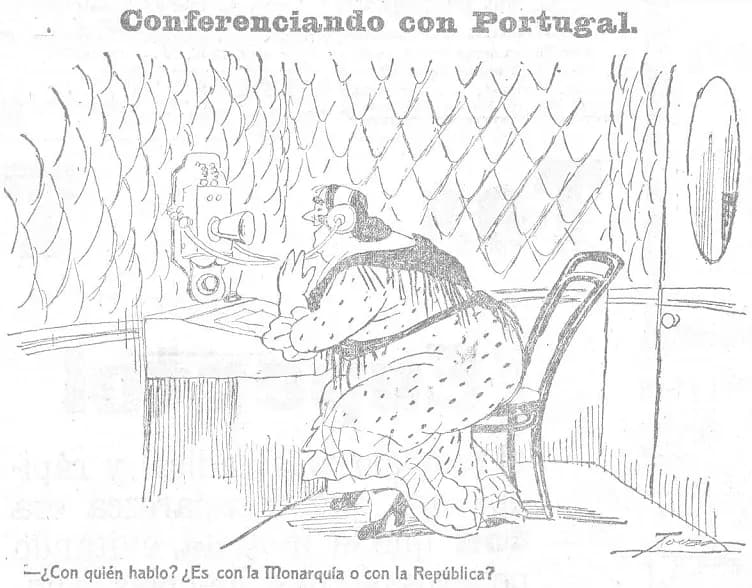
- “Who am I speaking to? Is it the Monarchy or the Republic?” A cartoon by Manuel Tovar in the Heraldo de Madrid of 22 January 1919, with Spain on the line to a divided Portugal. Manuel Tovar Siles, Public domain, via Wikimedia Commons.
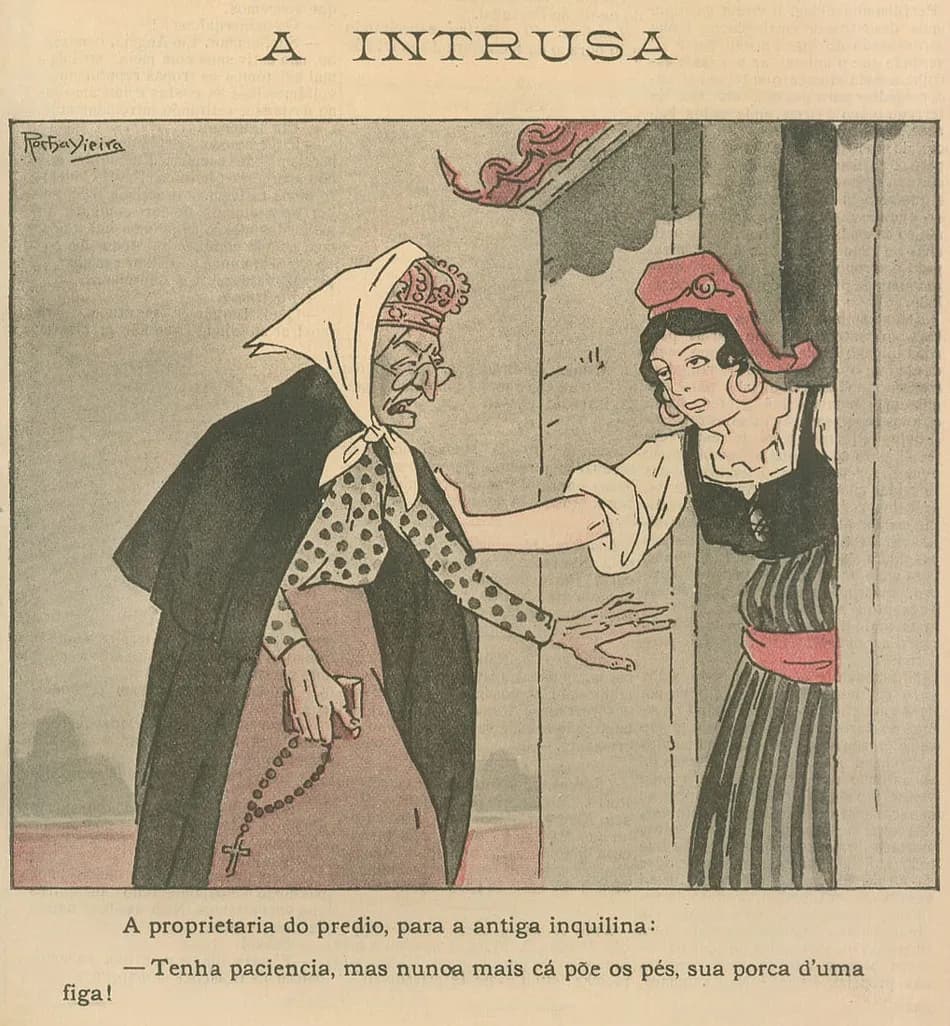
- “The Intruder”, by Rocha Vieira in O Século Cómico, 24 February 1919. The Republic shows the monarchy, an old woman with a crown, missal and rosary, the door: she will never set foot in the house again. Alfredo Carlos da Rocha Vieira (1883-1947), Public domain, via Wikimedia Commons.