

The killing of Inês de Castro: Coimbra, 7 January 1355
Prince Pedro's Galician lover was put to death on his father's authority. Pedro took revenge, swore he had married her and gave her a queen's tomb. The crowned corpse came two centuries later.
At a glance
- Inês de Castro, a Galician noblewoman who came to Portugal as a lady-in-waiting, was killed at Coimbra on 7 January 1355 by order, or with the consent, of King Afonso IV.
- She was the lover of the heir, Prince Pedro, and mother of his children João, Dinis and Beatriz; the court feared her brothers, powerful Castilian nobles, and the threat to Pedro's legitimate son Fernando.
- Pedro rebelled against his father in 1355, became king in 1357 and in June 1360 swore he had married Inês secretly at Bragança. The chronicler Fernão Lopes recorded the sceptics' case against the claim and would not decide.
- Two of the three men blamed, Pêro Coelho and Álvaro Gonçalves, were handed over by Castile and executed at Santarém; the third, Diogo Lopes Pacheco, escaped and was later pardoned.
- Pedro gave her a tomb at Alcobaça with a crowned effigy. No medieval source describes a crowned corpse: the coronation is in print by 1577, in a Spanish play, and the hand-kissing by 1628, in a history.
One line in a book at Santa Cruz
The canons of Santa Cruz, the great Augustinian house in Coimbra, kept a book in which they noted events worth remembering. Under the Era 1393 someone wrote a single line in Latin: on 7 January, Dona Enes was beheaded by order of King Afonso IV. The writer did not need to add her surname: readers would know who Dona Enes was.
“In the Era 1393, on the seventh day of January, Dona Enes was beheaded by order of the lord King Afonso IV.”
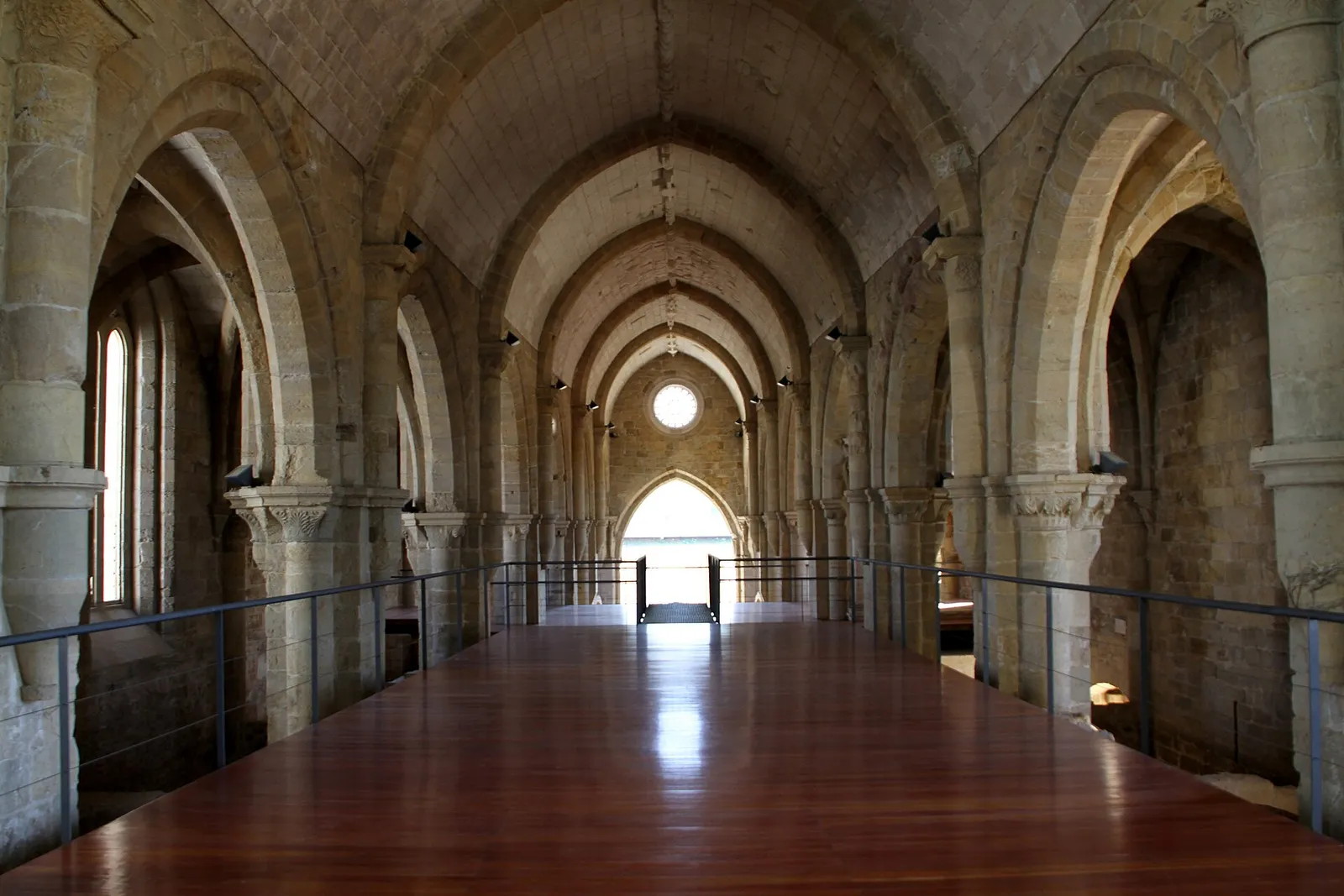
She was Inês de Castro, and she died in the houses of the Poor Clares' monastery of Santa Clara in Coimbra, where she lived with the king's son and heir, Pedro. Almost everything else about that morning, from the king's ride from Montemor-o-Velho to the children at the door, comes from chronicles written generations later.
A Galician lady at the Portuguese court
Inês was born around 1325, an illegitimate daughter of Pedro Fernández de Castro, called “of the War”, one of the greatest lords of Galicia and Castile, and of Aldonça Lourenço de Valadares (Soares in some accounts), from the Portuguese lesser nobility. She grew up at Peñafiel, near Valladolid, at the court of the writer and magnate Juan Manuel.
Juan Manuel's daughter Constança was promised to Pedro, heir of Afonso IV of Portugal. When she came to Portugal, in 1340 or 1341, Inês came with her as a lady-in-waiting and kinswoman. Rui de Pina, writing in the early sixteenth century, says it was soon noticed that the prince loved her, and that Inês was made godmother of Pedro and Constança's first son, Luís, who died in infancy.
Being godmother made Inês the prince's comadre, a spiritual kinship that the Church treated as a bar to marriage. Pina says it was done to head off the affair, and the historian Bernardo Vasconcelos e Sousa thinks Constança arranged it on purpose. Afonso IV then sent Inês away, to her aunt Teresa at the castle of Albuquerque in Castile, near the border. Distance did not end the affair.
Constança gave birth to the heir, Fernando, in 1345 and died young. The year of her death is uncertain: Aubertin's notes of 1878 give 1345, while Vasconcelos e Sousa thinks 1348 more likely. Pedro brought Inês back and lived with her openly. They had four children: Afonso, who died young, João, Dinis and Beatriz. Pedro did not remarry.
- Born
- Around 1325
- Father
- Pedro Fernández de Castro, a grandson of Sancho IV of Castile
- Kinship to Pedro
- Daughter of his first cousin; the chroniclers call her his “niece”
- Children with Pedro
- Afonso (died young), João, Dinis, Beatriz
- Killed
- 7 January 1355 (Era 1393), Coimbra
- Buried
- Santa Clara, Coimbra; moved to Alcobaça about 1360 or 1361
Why the king feared her
The danger, as the court saw it, was her family. Her brothers Fernando and Álvaro Pires de Castro were great lords in Castile, and Pina says that through Inês they began to gain a large following in Portugal. In 1354 Inês's half-sister Juana de Castro married King Pedro I of Castile, who left her the next day.
Castile was sliding into civil war, and the Castros were among the nobles in revolt. According to the historians José Mattoso and Armindo de Sousa, they tried to draw the Portuguese heir into their cause by offering him the throne of Castile, which would have meant broken treaties and war. Pedro of Portugal was himself a grandson of Sancho IV of Castile through his mother, Queen Beatriz.
Pina gives the councillors' second fear. Fernando, Constança's son, was the legitimate heir. If the Castros could arrange his death, one of Inês's sons might inherit Portugal and the Algarve. The king's advisers said there was no remedy except to press Pedro to marry and to keep Inês out of the kingdom, and, if he refused, to have her killed while Afonso IV still lived.
Pina says Pedro was warned. His mother, Queen Beatriz, the Archbishop of Braga, Gonçalo Pereira, and other prelates urged him to put Inês somewhere safe. He took it all for threats that would never be carried out.
The morning at Santa Clara
In Pina's chronicle, written between about 1514 and 1522 and printed in 1653, the king was at Montemor-o-Velho, west of Coimbra, when he agreed to the killing. He rode to Coimbra with many armed men. Inês, warned and unable to escape, met him at the door with her children, weeping, and begged for mercy. The king, moved, turned to leave.
Some of the knights who had come with him then made him say they could go back and kill her if they wished. Pina names three as the chief of them: Diogo Lopes Pacheco, son of the lord of Ferreira, Álvaro Gonçalves, the chief bailiff (meirinho-mor), and Pêro Coelho. They killed her. Pina adds that people held it against the king as abominable cruelty rather than justice.
Fernão Lopes, the royal chronicler commissioned in 1434, says he had already told the killing elsewhere, probably in a chronicle of Afonso IV that is now lost. In his chronicle of Pedro he names the same three as the men Pedro blamed most, but disagrees about one of them. Coelho and Gonçalves were guilty enough, he writes, but Pacheco was not, because he had often sent word through a friend warning the prince to guard Inês from his father's anger.
Father against son
Pedro went to war with his father. With his own men and those of Inês's brothers he raided the king's lands between the Douro and the Minho and in Trás-os-Montes, then tried to take Porto, where Archbishop Gonçalo Pereira shut himself in and defended the city. Pedro, who was fond of the archbishop, withdrew.
Peace was made at Canaveses in August 1355. Pina credits Queen Beatriz and the archbishop; Mattoso and Sousa credit mainly the Prior of the Hospitallers, Álvaro Gonçalves Pereira. Pedro pardoned everyone involved in the death of Inês, his father pardoned the prince's men, and Pedro was given wide powers of justice in his father's name. Both sides swore oaths.
Afonso IV knew his son still bore them ill will, oaths or no oaths. Dying in Lisbon in May 1357, he called Pacheco, Coelho and Gonçalves and told them to leave the kingdom, because he could no longer protect them. They fled to Castile while Pedro was hunting by the river Canha, about eight leagues away. Once king, at 37, Pedro declared the three traitors and gave away their lands.
c. 1325
Inês de Castro is born
1340 or 1341
She arrives in Portugal with Constança Manuel, Pedro's bride
1345
Fernando, Pedro's legitimate heir, is born
Constança dies in 1345 or, by another reckoning, 1348.
1353 or 1354
The marriage Pedro later claimed
At Bragança, on a 1 January according to one witness, about seven years before 1360.
1354
Pedro I of Castile marries Juana de Castro, Inês's half-sister, and abandons her
7 January 1355
Inês is killed at Coimbra
Spring to summer 1355
Pedro's revolt; Porto holds out against him
August 1355
Peace of Canaveses
May 1357
Afonso IV dies in Lisbon; Pedro becomes king
June 1360
Oath at Cantanhede; testimony and bull read at Coimbra
c. 1360 to 1361
Coelho and Gonçalves executed at Santarém; Inês moved to Alcobaça
18 January 1367
Pedro dies at Estremoz and is buried beside her
1385
The Cortes of Coimbra reject the claim of Inês's sons
The marriage nobody had seen
For as long as Inês lived, and well into his own reign, Pedro never called her his wife. Lopes says Afonso IV often sent to ask whether he had married her, offering to honour her as such, and Pedro always said no. Then, in June 1360, at Cantanhede near Coimbra, he called a notary before his chief nobles and swore on the Gospels that he had married her. Lopes gives only the month, some four years into the reign; the year comes from Pina and modern historians.
The wedding, he said, had taken place at Bragança about seven years earlier, by words of present consent; he could not remember the day or the month. He had kept it secret for fear of his father. Three days later, in Coimbra, two witnesses were examined: Gil, by then Bishop of Guarda, who said he had married them, and Estêvão Lobato, a royal servant, who said it was on a 1 January.
Before bishops, clergy and a crowd, Count João Afonso of Barcelos announced the marriage and read a bull of Pope John XXII, granted when Pedro was a boy, allowing him to marry a noblewoman related to him in certain degrees of kinship. A later summary chronicle, the Crónicas dos reis de Portugal, says plainly why Pedro did it: he wanted the children he had by her to be legitimate.
Lopes then gives a chapter to those who did not believe it. No sane man, they argued, forgets the day of so notable a wedding, least of all one held on New Year's Day. Why had he not said so as soon as his father was dead? And it all looked like Pedro of Castile, who after María de Padilla died declared before his Cortes at Seville, with four witnesses on oath, that he had married her first, and had her called queen though she was dead. Lopes says he will not decide, and leaves the reader to choose.
The question came back in 1385, when the Cortes of Coimbra chose a new king after the crisis that followed Fernando I's death. The lawyer João das Regras argued that the marriage was unproven and in any case invalid: Inês was Pedro's kinswoman and had been godmother to his son Luís. To make the point he named a witness sitting in the hall who had been one of the child's godparents: Diogo Lopes Pacheco.
Revenge at Santarém
Pedro of Portugal and Pedro of Castile then struck a secret bargain, which Lopes places in the same year: each would arrest and hand over the other's fugitives. Castilian nobles who had taken refuge in Portugal were seized and sent to Seville, where they were killed. In Castile, Coelho and Gonçalves were taken. Pacheco had gone partridge hunting that morning.
A lame beggar who was given alms at Pacheco's house slipped out of the guarded town, found him on the road and told him what had happened. Pacheco put on the beggar's rags, walked towards Aragon, hired himself to muleteers and escaped, eventually reaching Henry of Trastámara in France. He later called the whole exchange a trade of donkeys for donkeys.
The other two were brought to Santarém. Pedro had them tortured to make them name who else was guilty and what his father had plotted against him. They told him nothing he wanted to hear. When the king struck Coelho in the face, Coelho called him a traitor, a perjurer, a butcher of men.
“And the king, saying that they should bring onion, vinegar and oil for the rabbit, grew weary of them and ordered them killed.”
Coelho's heart was torn out through his chest, Gonçalves's through his back, and their bodies were burned in front of the palace, where the king could watch while he ate. Lopes, who otherwise admired Pedro's justice, says the king lost much of his good name by breaking his word to men who had been given safe refuge.
Two tombs at Alcobaça
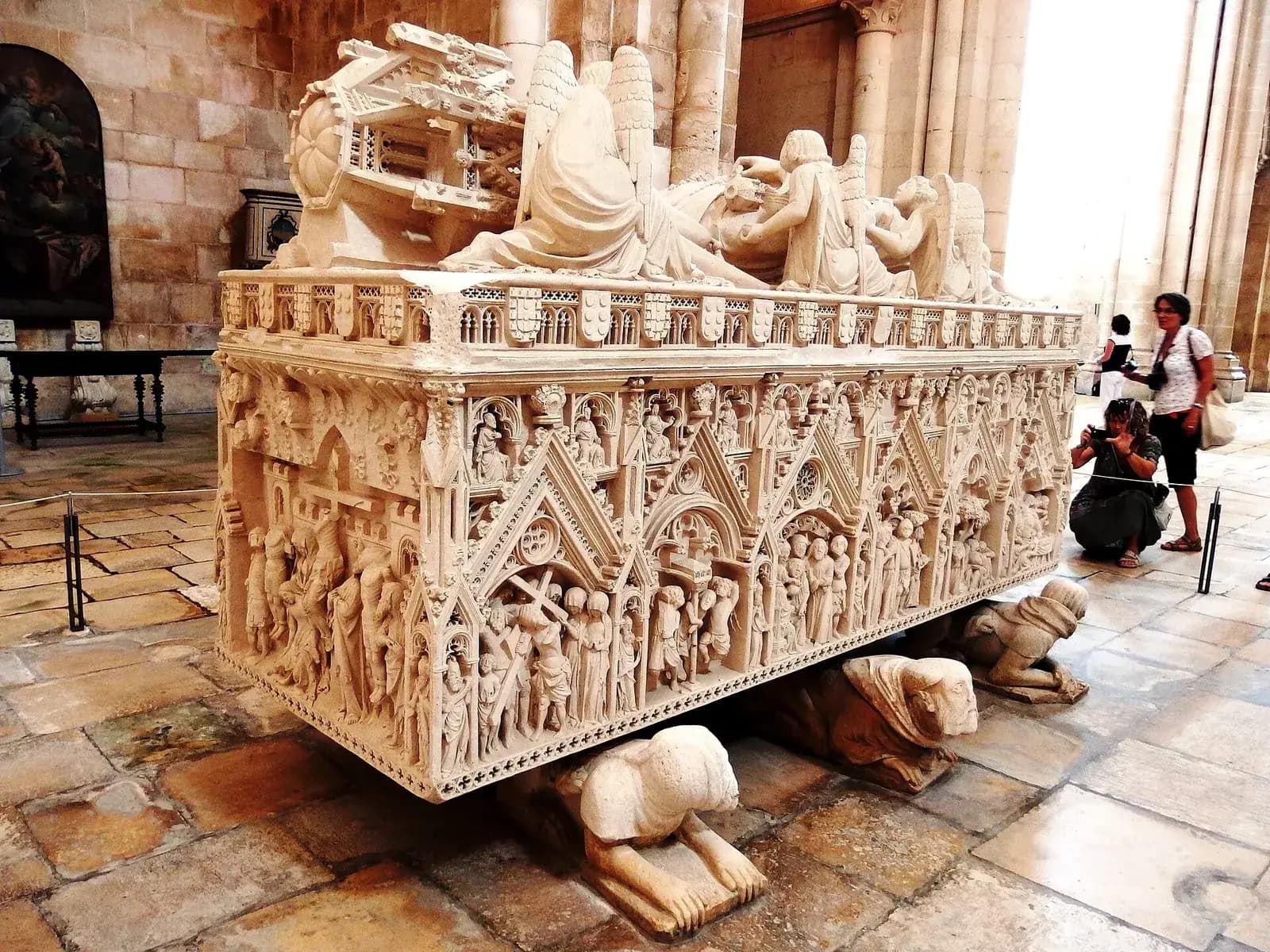
Pedro could do nothing more for Inês, Lopes writes, except honour her bones. He ordered a tomb of white stone, finely worked, with her image on the lid, and placed it in the church of the Cistercian monastery of Alcobaça. It did not stand at the entrance, where earlier kings lay, but inside, on the right, near the main chapel.
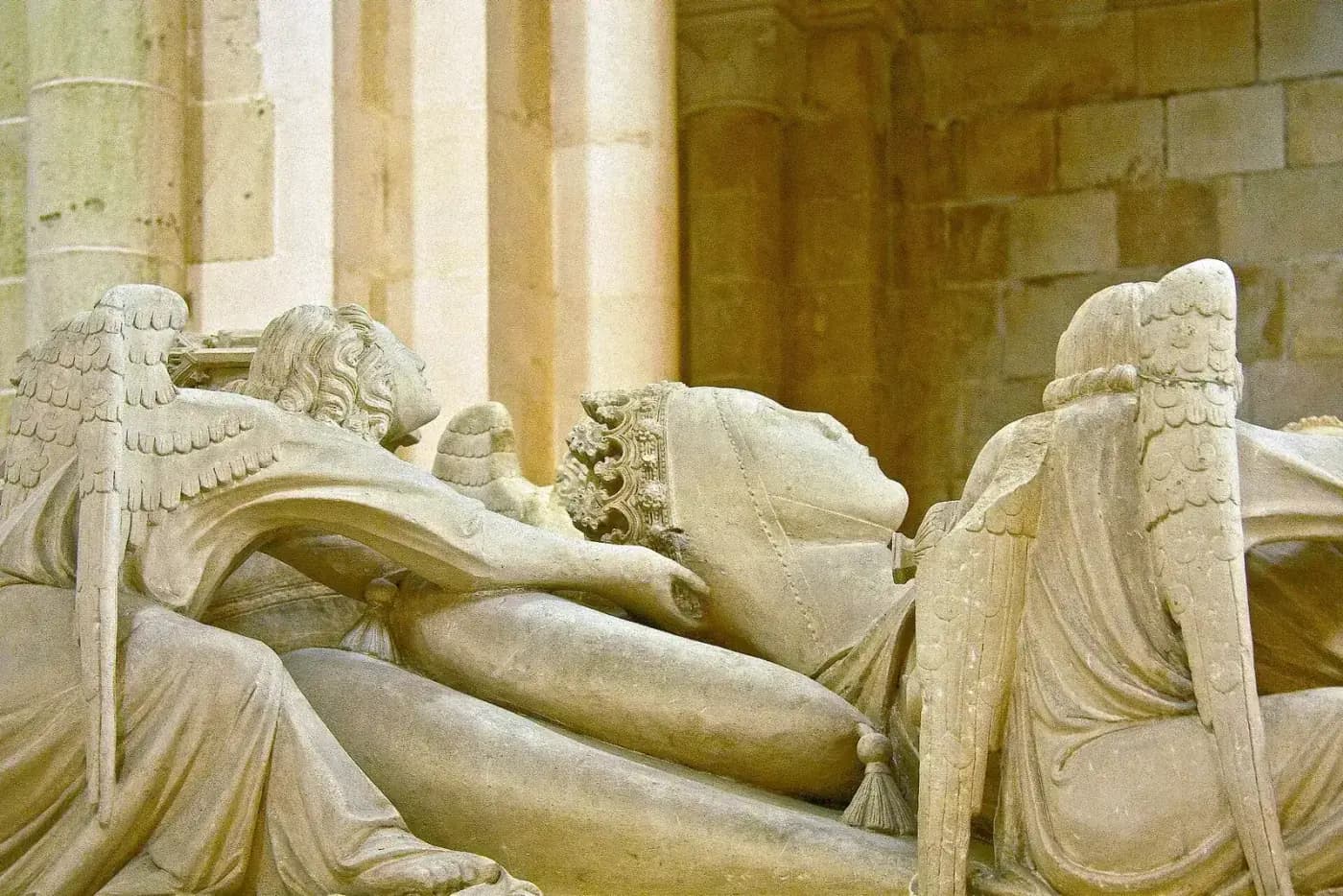
“Setting raised upon the lid her image, with a crown on her head, as if she had been queen.”
Her body came from Santa Clara on a bier carried by knights, followed by nobles, ladies and clergy, along roads lined with men holding lit candles for the 17 leagues to Alcobaça. Lopes calls it the most honoured translation of a body that Portugal had seen until then. Pina dates it to three years after Pedro became king, which means about 1360 or 1361.
Pedro had a matching tomb made for himself and set close to hers. He died at Estremoz before dawn on Monday 18 January 1367. On his deathbed he pardoned Diogo Lopes Pacheco, having become sure he had no part in the killing, and his son Fernando restored Pacheco's property. The body was taken to Alcobaça and laid in its tomb on the Wednesday, once Fernando arrived.
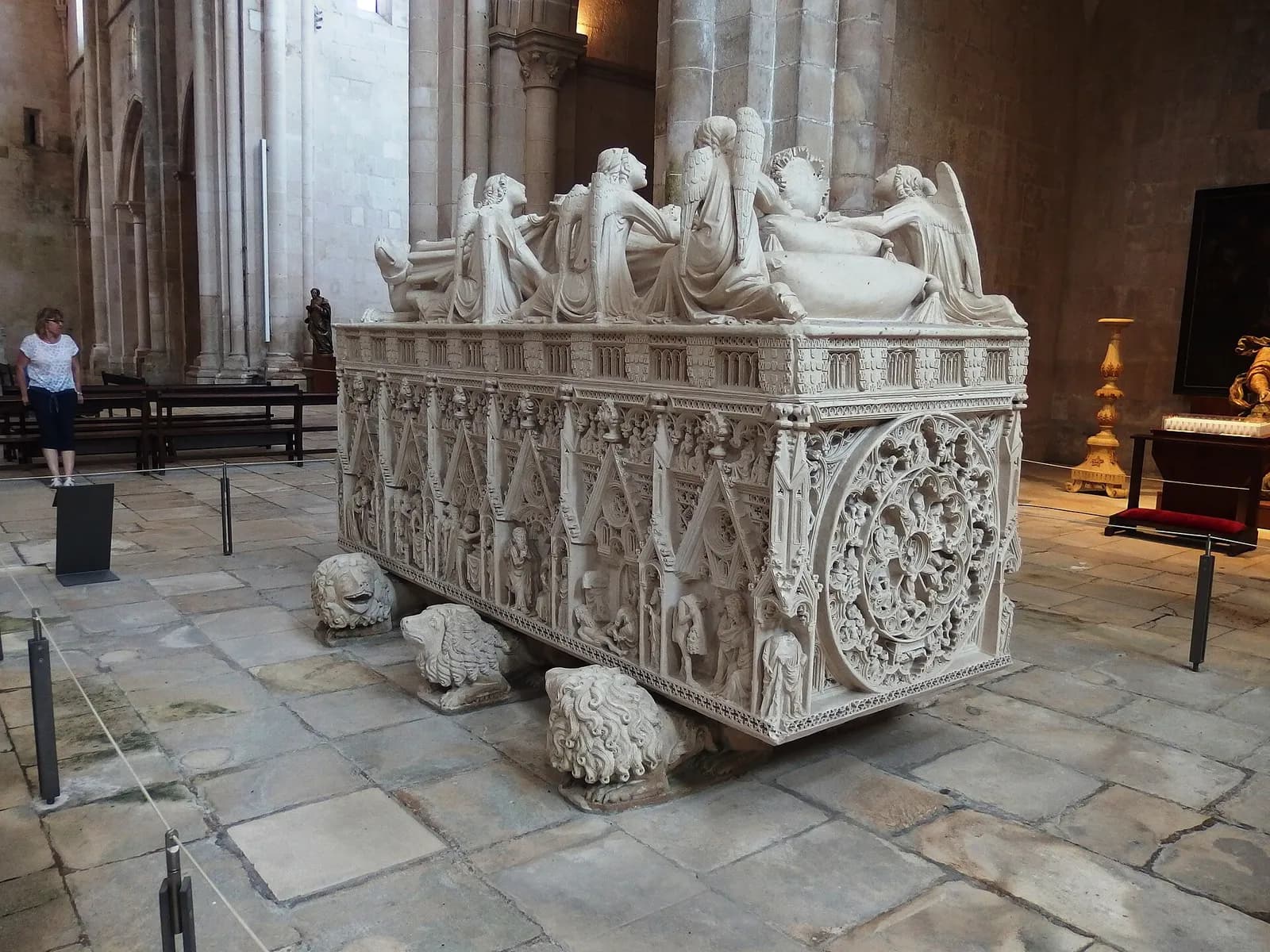
The monastery was added to UNESCO's World Heritage List in 1989. Its own account of the listing names the tombs of Pedro and Inês as examples of the finest Gothic funerary sculpture.
How a crowned effigy became a crowned corpse
The best-known version of the story says that Pedro had Inês dug up, dressed, crowned and seated on a throne, and made the nobles kiss her hand. Lopes, who describes the tomb and the procession in detail, mentions no such ceremony. The historian Ricardo Raimundo says no document proves it or even suggests it happened, and traces the episode to a Spanish play.
The pieces arrive one at a time. The Crónicas dos reis de Portugal, a summary chronicle attributed to the sixteenth-century writer Gaspar Correia, says Pedro had her body carried to Alcobaça “with a crown on her head”, which may mean the effigy. Camões, in 1572, called her the woman who was queen after she was dead. In 1577 the Galician friar Jerónimo Bermúdez, writing as Antonio de Silva, published two tragedies in Madrid; in the second, Nise laureada, Pedro exhumes her, marries her publicly and crowns her.
The hand-kissing is in print by 1628, in a work of history. In his Epitome of Portuguese Histories, printed in Madrid that year, Manuel de Faria e Sousa wrote that before the burial at Alcobaça Pedro ordered all his vassals to kiss her hand as their queen. The enlarged version, Europa Portuguesa, printed in Lisbon in 1679, moved the ceremony to Santa Clara: the corpse dressed, crowned and enthroned, the vassals kissing the bones that had been beautiful hands. Raimundo credits Faria e Sousa with bringing the episode to Portugal, after which it was retold as history.
| Source | Written or printed | Who decided | The plea at the door | Crown or hand-kissing |
|---|---|---|---|---|
| Livro da Noa, Santa Cruz de Coimbra | Annal entry; date of writing unknown | Afonso IV: “by order of the king” | Not mentioned | None; says she was beheaded |
| Fernão Lopes, Crónica de D. Pedro | After 1434 | Afonso IV had her killed | Unknown: his earlier account is lost | A crowned effigy “as if she had been queen”; no ceremony |
| Rui de Pina, Crónica de D. Afonso IV | About 1514 to 1522; printed 1653 | The king consents, relents, then lets the knights go back | Yes, with her children | None |
| Crónicas dos reis de Portugal (summary chronicle) | Sixteenth century; attributed to Gaspar Correia | Not checked | Not checked | Body carried to Alcobaça “with a crown on her head” |
| Camões, Os Lusíadas, Canto III | 1572 | Afonso IV, heeding the murmurs of the people | Yes, before the king, who wants to pardon her | “After being dead, was queen” |
| Bermúdez, Nise laureada | 1577 | Earlier play, Nise lastimosa | Earlier play | Exhumed, married publicly and crowned |
| Faria e Sousa, Epitome | 1628 | Envious courtiers win the king's leave to kill her | The king is moved; the three killers are not | Vassals kiss her hand before burial |
| Faria e Sousa, Europa Portuguesa | 1679 | The knights beg to be the executioners | Yes, at his feet, with her children | Exhumed, crowned and enthroned; vassals kiss her bones |
“Not checked”: the passage used here does not cover the point, and the rest of the work was not read for this table. Bermúdez's first play, Nise lastimosa, tells the killing.
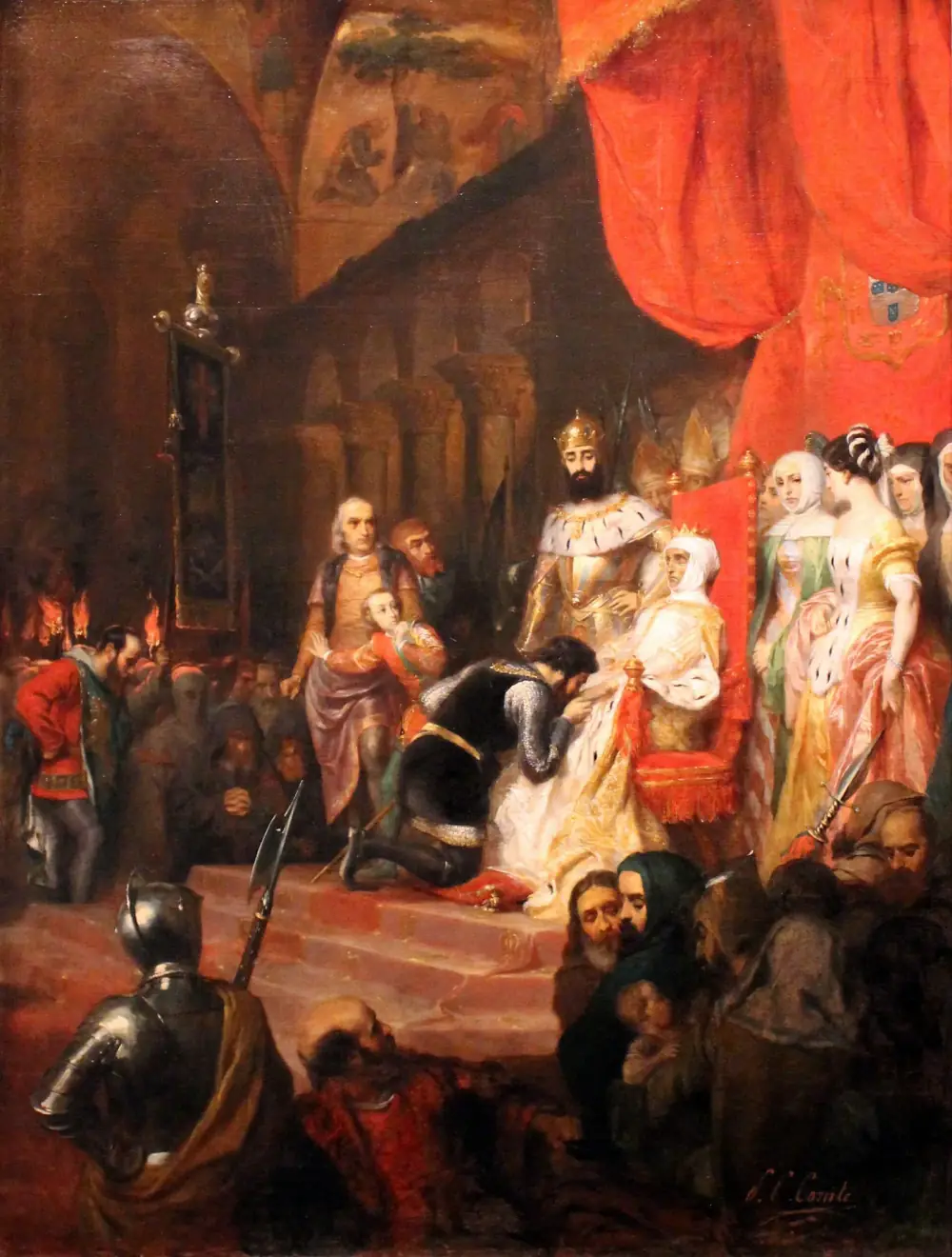
By the nineteenth century the ceremony was told as fact. J. J. Aubertin's English Lusiads of 1878 quotes in its introduction an earlier account in which Inês was placed on a throne and crowned and all present kissed her hand. His translation of Camões's line goes further than the Portuguese: “Who after being slain was crowned as Queen.” Camões wrote only that she was queen.
Camões and the Fountain of Tears
Camões gave Inês eighteen stanzas of Canto III of the Lusiads, from 118 to 135, straight after his account of Afonso IV's victory at Salado in 1340. His Inês is “fair Ignez” in the fields of the Mondego, teaching the hills Pedro's name. Brought before the king by her killers, she pleads for her children. The king wants to pardon her, but the people, whom Camões calls stubborn, and her fate do not.
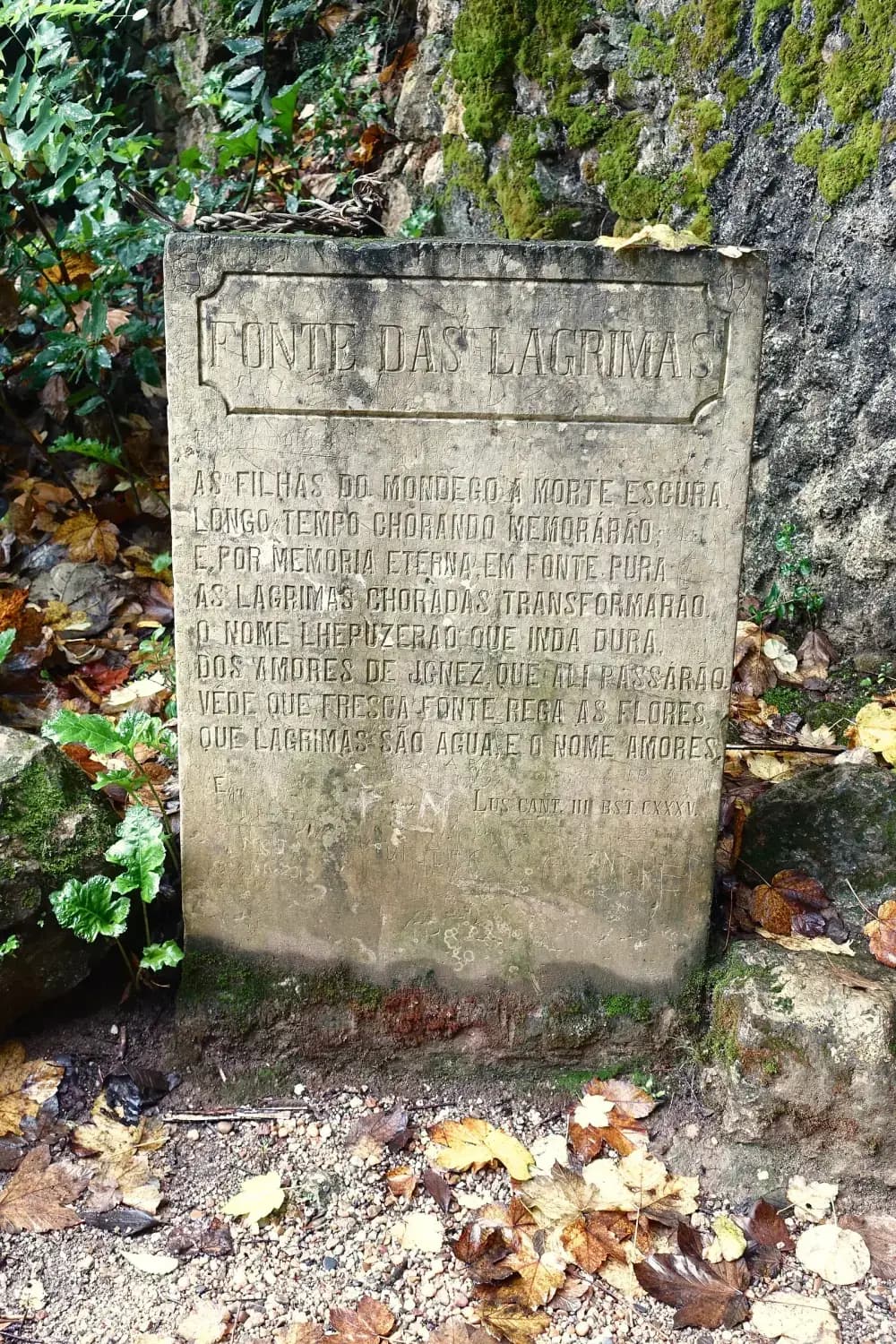
“Mondego's daughters this sad death obscure / Long time with weeping did commemorate, / And all the tears into a fountain pure / For everlasting record did translate.”
Tradition places that fountain in the Quinta das Lágrimas, an estate next to Santa Clara. Two springs there fed a channel that Queen Isabel, Pedro's grandmother, had built in 1326 to carry water to the convent. One is the Fonte dos Amores, said to be where Pedro and Inês met. The other is the Fonte das Lágrimas, the Fountain of Tears, where a stone is carved with Camões's stanza. Camões himself gave the fountain's name as “the loves of Inês”.
Local tradition adds more. Pedro is said to have floated letters to Inês in little wooden boats along the water channel, and the red algae on the stones of the Fonte das Lágrimas are said to be her blood. The estate is now a hotel. According to a history of it in the tourism trade magazine TNews, it has belonged to the same family since 1730, and the Duke of Wellington stayed there during the Peninsular War.
Why it still matters
The killing settled nothing it was meant to settle. Inês's sons fought for Castile against Portugal, João das Regras said, and so lost any right to reign. The crown passed instead to Fernando and then, in 1385, to another of Pedro's sons, João, Master of Avis, born to a Galician woman named Teresa.
Her story went further than any of them. Between Garcia de Resende's verses in the Cancioneiro Geral of 1516 and a 2018 film, there are plays, poems, novels and, by the count of the Spanish theatre company Nao d'Amores, 29 operas on 21 different librettos. Adrien Roig's bibliography of 1986, Inesiana, already listed more than 1,400 studies and adaptations.
FAQs
Who killed Inês de Castro?
The chroniclers name three of King Afonso IV's men: Pêro Coelho, Álvaro Gonçalves and Diogo Lopes Pacheco. The Coimbra annal says she was beheaded by the king's order; Rui de Pina says the king consented. Fernão Lopes thought Pacheco innocent.
Was Inês de Castro crowned after her death?
There is no evidence of it. Pedro gave her a tomb at Alcobaça with a crowned effigy. The historian Ricardo Raimundo traces the exhumation and coronation to Jerónimo Bermúdez's play Nise laureada (1577); the hand-kissing is in Manuel de Faria e Sousa's Epitome (1628).
Did Pedro really marry Inês?
Nobody knows. In June 1360 Pedro swore he had married her at Bragança about seven years before, and two witnesses backed him. Lopes recorded serious doubts, and in 1385 the Cortes of Coimbra treated the marriage as unproven.
Where is Inês de Castro buried?
In the church of the monastery of Alcobaça, near Pedro I's tomb. She was first buried at Santa Clara in Coimbra and moved to Alcobaça about 1360 or 1361.
Why did Afonso IV want Inês de Castro dead?
His advisers feared her brothers, Castilian nobles who were drawing Pedro into Castile's civil war, and feared for the succession of Fernando, Pedro's legitimate son. Pedro refused to marry anyone else or send her away.
On the timeline
Open the timelineNearby moments from the burgundian kings (1249–1383).
Pope Clement V dissolves the Knights Templar with the bull 'Vox in excelso'. No Templar is known to have been arrested in Portugal, where King Dinis has already claimed their castles for the Crown; in 1319 they pass to the new Order of Christ, whose red cross would later billow on the sails of the caravels.
King Dinis signs a contract with the Genoese mariner Manuel Pessanha, making him hereditary Admiral of the Kingdom and obliging him to bring twenty men 'skilled in the sea' to command the royal galleys — the charter regarded as the founding act of the Portuguese Navy.
Afonso IV of Portugal and his son-in-law Alfonso XI of Castile rout the Marinid army of Abu al-Hasan and the forces of Granada at the Battle of Salado near Tarifa, ending the last major Moroccan invasion of the Iberian Peninsula.
Inês de Castro, 1355
Inês de Castro, the Galician noblewoman loved by Crown Prince Pedro, is killed in Coimbra by courtiers acting with the consent of King Afonso IV, who feared Castilian influence over the succession. Once king, Pedro declared they had secretly married, and legend says he had her corpse crowned queen.
Birth of Philippa of Lancaster in Leicester, England. She would marry King João I of Portugal in 1387, becoming Queen consort and mother of the remarkable 'Illustrious Generation' (Ínclita Geração) including Prince Henry the Navigator.
Portugal and England sign the Treaty of Tagilde near Guimarães — a pact between King Fernando I and John of Gaunt, Duke of Lancaster, that prepares the ground for the 1373 Anglo-Portuguese Treaty and the Treaty of Windsor of 1386. It is the diplomatic seed of the longest-lasting alliance in the world.
Portugal and England sign the Anglo-Portuguese Treaty in London, a pact of perpetual friendship between King Fernando I and King Edward III. Renewed at Windsor in 1386, the treaty is the oldest still-active diplomatic alliance in the world.
Coming up in history
All long reads 9 January 1822The Dia do Fico: the day Prince Pedro refused to leave Brazil, 9 January 1822
 10 January 1430Isabel of Portugal and the Golden Fleece: Bruges, 10 January 1430
 11 January 1890The British Ultimatum of 1890: how Portugal lost its Pink Map
 12 January 1616A fort called the Nativity: the founding of Belém do Pará, 1616
18 sources
Archives, scholarship and reporting this article was checked against.
- 1
Chronica de el-rei D. Pedro I (Fernão Lopes, Crónica de D. Pedro)Bibliotheca de Classicos Portuguezes, Lisbon, 1895 (Project Gutenberg edition, from Biblioteca Nacional Digital scans)
- 2
Chronica de el rey Dom Afonso o quarto do nome, e settimo dos reys de Portugal (Rui de Pina)Lisbon, 1653 (Internet Archive scan)
- 3
De historia y leyenda. Un caso triste y digno de memoria: la muerte de Inés de Castro (Inés Velázquez Puerto)eHumanista 66 (2026), University of California, Santa Barbara
- 4
- 5
- 6
Nise laureada. Tragedia segunda de doña Inés de Castro y Valladares (Jerónimo Bermúdez)Biblioteca Antológica (modern text edition, PDF)
- 7Martim Moniz ficou entalado na porta? Talvez não tenha sido bem assim…Observador
- 8
- 9
Quinta das LágrimasTurismo Centro de Portugal
- 10
- 11
Documento do Mês – Julho: Lei de adoção do calendário gregorianoArquivo Nacional Torre do Tombo, 1 July 2011
- 12
Inês de Castro, in Fernão Lopes: People, Places and Events in the ChroniclesInstituto de Estudos Medievais, NOVA FCSH, Universidade Nova de Lisboa
- 13
- 14
Património Mundial da HumanidadeMosteiro de Alcobaça (Museus e Monumentos de Portugal)
- 15
NISE, la tragedia de Inés de Castro, de Jerónimo Bermúdez: dossierNao d'Amores (theatre company)
- 16
- 17
Fundação Inês de Castro: 700 anos da Fonte e do Canal dos AmoresFundação Inês de Castro, Coimbra
- 18
Há história no Hotel Quinta das Lágrimas (Jorge Mangorrinha)TNews (tourism trade magazine), 30 January 2025
Image credits
- The tomb of Inês de Castro in the church of the monastery of Alcobaça, made on the orders of Pedro I, who had her body brought there from Coimbra. Photographed in 2017. Palickap, CC BY-SA 4.0, via Wikimedia Commons.
- Inside the church of Santa Clara-a-Velha, the Poor Clares' monastery on the south bank of the Mondego in Coimbra. Inês lived in houses belonging to it and was first buried there. Photographed in 2011. Gerd Eichmann, CC BY-SA 4.0, via Wikimedia Commons.
- The effigy on Inês's tomb at Alcobaça, crowned and attended by angels. This crown in stone is the one Fernão Lopes describes. Photographed in 2009. Vitor Oliveira from Torres Vedras, PORTUGAL, CC BY-SA 2.0, via Wikimedia Commons.
- The tomb of Pedro I at Alcobaça, made to match hers. He was laid in it in January 1367. Photographed in 2017. Palickap, CC BY-SA 4.0, via Wikimedia Commons.
- Le Couronnement d'Inès de Castro en 1361, painted by Pierre-Charles Comte around 1849, photographed at the Musée des Beaux-Arts de Lyon in 2014. No medieval source describes this scene. Pierre Charles Comte, Public domain, via Wikimedia Commons.
- The stone at the Fonte das Lágrimas in the Quinta das Lágrimas, Coimbra, carved with stanza 135 of Canto III of the Lusiads. Photographed in 2019. Daderot, CC0, via Wikimedia Commons.