

Metro do Porto opens on old railway tracks: 7 December 2002
After 13 years of studies, tenders and tunnel collapses, Porto's first light-rail line opened on a Saturday in December. Much of the network that followed was laid on the beds of two old narrow-gauge railways.
At a glance
- On 7 December 2002 the Prime Minister, José Manuel Durão Barroso, inaugurated Line A of the Metro do Porto at Casa da Música station. It ran 11.8 km from Senhor de Matosinhos to Trindade, with 18 stations.
- Rides were free until the end of 2002, and commercial service began on 1 January 2003.
- The system is light rail: trains run in tunnels under the old centre, along streets, and on the old beds of the narrow-gauge Póvoa and Trofa railways, which closed in 2001 and 2002 to be converted.
- Eduardo Souto de Moura, who won the Pritzker Prize in 2011, was chief architect of the first phase from 1997 to 2005.
- By 2025 the network had six lines, 69.8 km of route and 85 stations, and recorded 94.5 million validations, against 6 million in 2003.
A Saturday at Casa da Música
On Saturday 7 December 2002 the Metro do Porto was officially opened at the new Casa da Música station. The Prime Minister, José Manuel Durão Barroso, presided. About a thousand people turned out for what the company called day one of the metro.
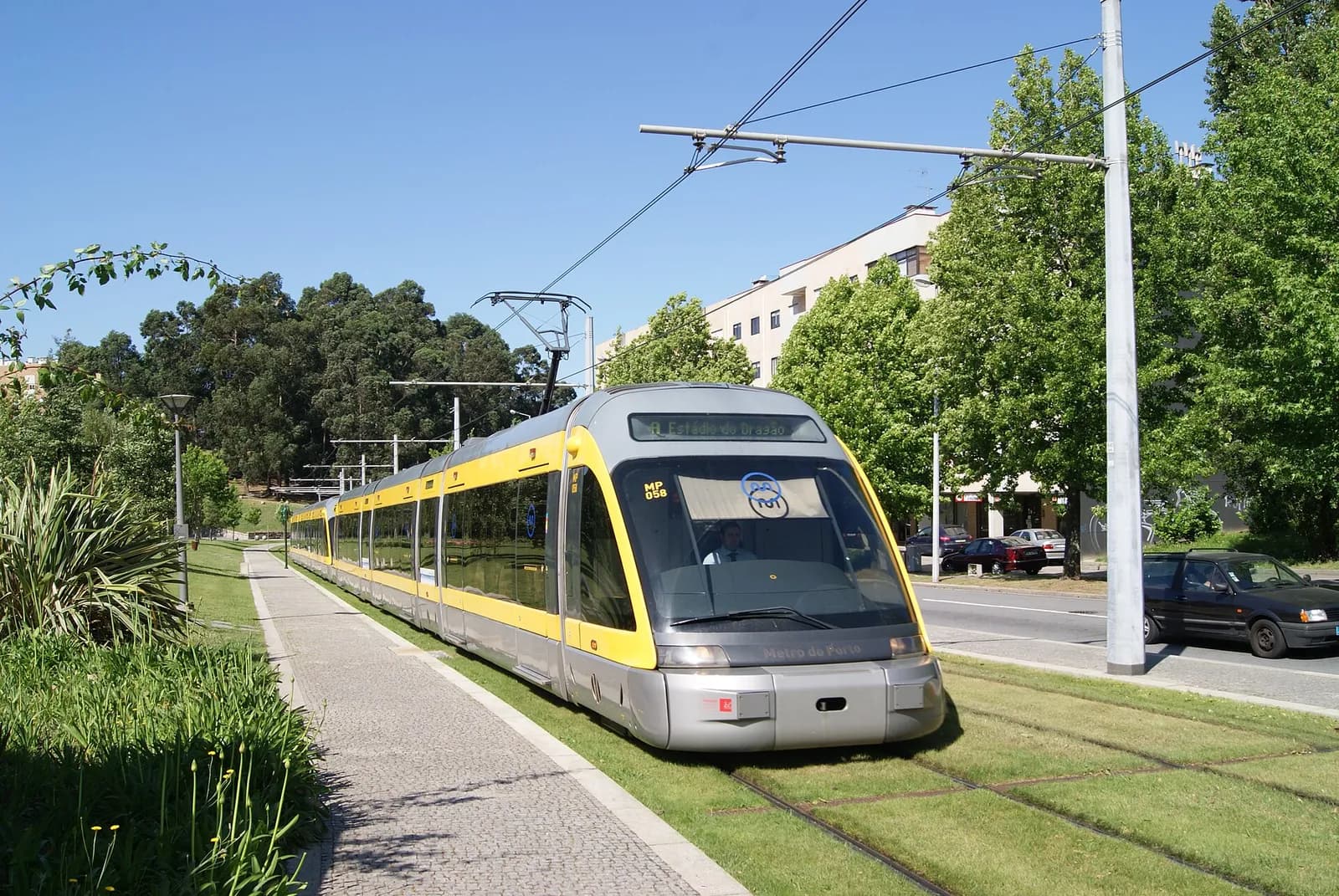
The line ran 11.8 kilometres, from Trindade in central Porto to Senhor de Matosinhos beside the port of Leixões, and had 18 stations. Its trains were Eurotrams, assembled by Bombardier at Amadora, near Lisbon, from parts made in Portugal, Italy and England. The board decided that nobody would pay to ride until the end of the year.
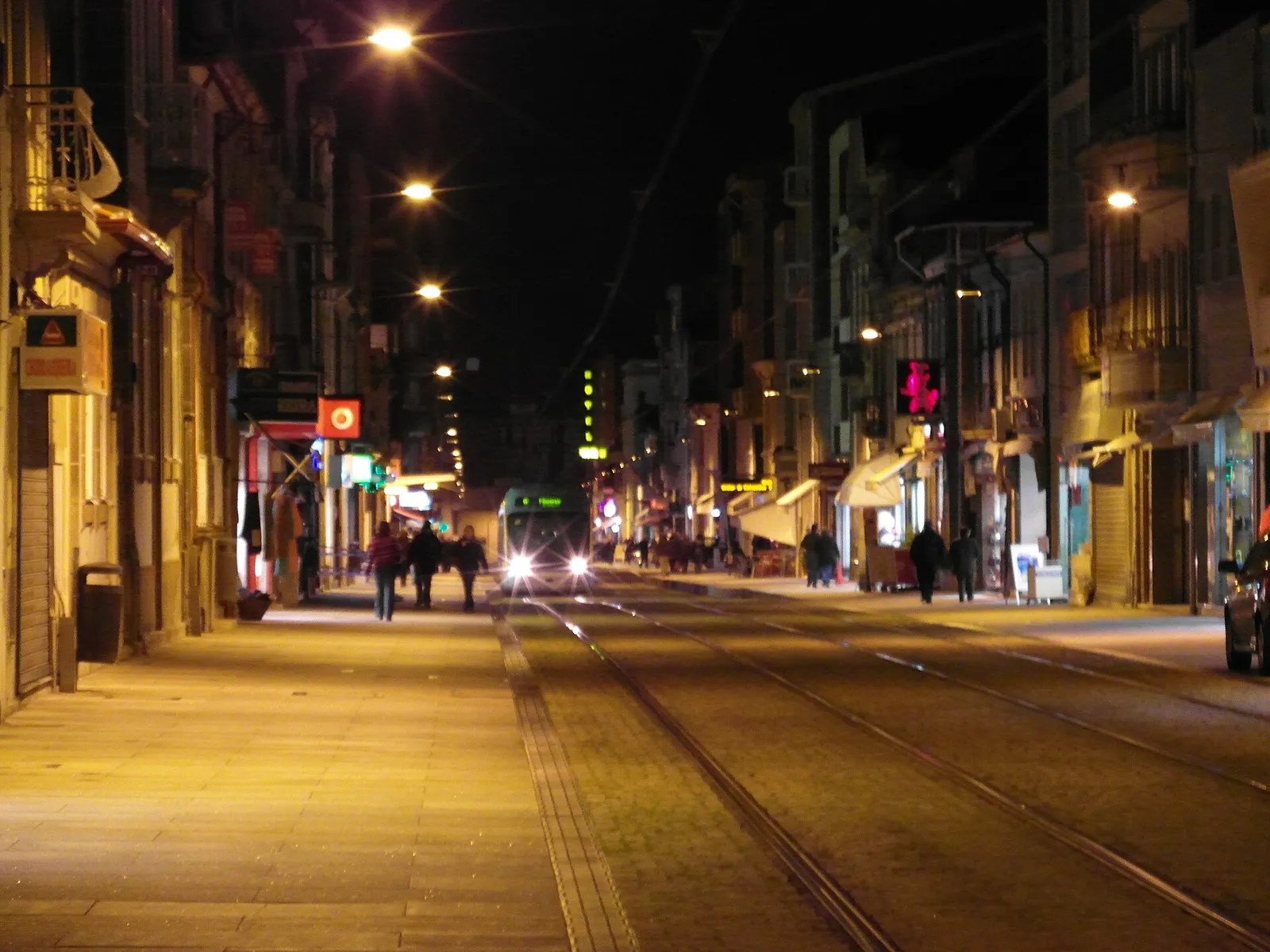
The trains were already familiar to some. Since 29 June 2002 they had carried passengers on trial between Câmara de Matosinhos and Viso, and in 19 weeks of experimental running about 700,000 people had tried them. In September the trial service reached Senhor de Matosinhos, running in the street along Rua Brito Capelo. Commercial service began on 1 January 2003, and at 6.55pm on 6 March the system recorded its millionth validation.
The man who had chaired the company for most of the building of the first line did not live to see it. José Vieira de Carvalho, chairman since October 1999, died on 1 June 2002, aged 64. Valentim Loureiro, mayor of Gondomar and president of the Porto Metropolitan Board, which represented the largest shareholder, took his place, at first on an interim basis.
A jammed city and two narrow-gauge railways
Porto at the end of the 1980s was choked with traffic. The inner ring road had no link to the Avenida da Boavista, the Freixo bridge existed only on paper, and trains to Vila Nova de Gaia still crossed the Douro on the single track of the Maria Pia bridge, opened in 1877. Carlos Brito, president of STCP, the city's bus and tram company, wrote that thousands of hours were lost in jams every day.
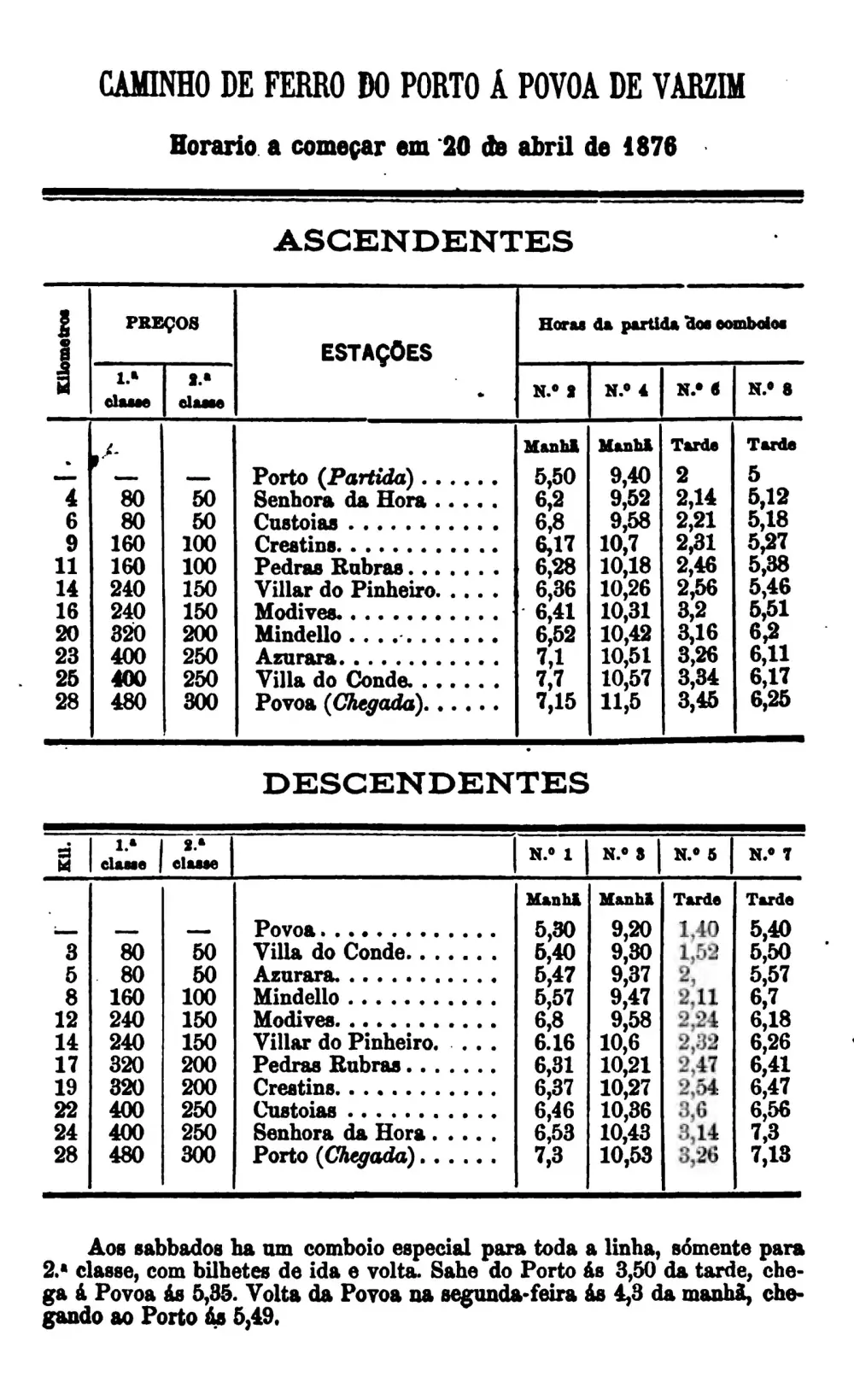
The city did have railways reaching into its northern suburbs. On 1 October 1875 a private company opened a 900 mm narrow-gauge line from Porto-Boavista to Póvoa de Varzim, and in April 1884 another company opened a line from Trofa to Guimarães. Under government pressure the two merged early in 1927, converted the Póvoa line to metre gauge and in 1932 opened a link from Senhora da Hora to Trofa. Work began at about the same time on a tunnel to a new terminus at Praça da Trindade, in the city centre.
Steam on these lines gave way to diesel only in 1976 and 1977, and the Póvoa to Famalicão branch closed at the end of 1995. Trains from Póvoa and Trofa kept running into Trindade until the metro works began.
From a bus company's study to a 50-year concession
The project began on paper in September 1989, when STCP published a study called Transporte Colectivo em Sítio Próprio, public transport on its own right of way. It proposed light rail for the Porto metropolitan area and spoke, for the first time, of a network of modern trams. In 1990 a survey for the city council found that only 4 per cent of Porto residents believed a metro would be built. The mayor, Fernando Gomes, said it would be running within ten years.
Decree-Law 71/93 of 10 March 1993 set out the legal framework and gave a public company, Metro do Porto, the exclusive right to run a light-rail system in the region. The company was formed that August. After a restructuring in 1999 the Porto Metropolitan Area held 60 per cent of the shares, STCP 25 per cent, the national railway CP 10 per cent and the state 5 per cent.
An international tender went out in December 1994 and drew four consortia. In January 1996 the company published its reference plan, four lines and about 70 kilometres, and in November 1997 it chose the Normetro consortium to design, build, equip and run the system. The contracts were signed on 16 December 1998, the day after the publication of Decree-Law 394-A/98, which set the terms of a 50-year concession for Metro do Porto. A month earlier the European Investment Bank had approved a loan of 109 million contos, about €544 million (a conto was a thousand escudos).
September 1989
STCP study proposes light rail for the Porto area
10 March 1993
Decree-Law 71/93 creates the legal framework and Metro do Porto
21 December 1994
International tender launched; four consortia bid
25 November 1997
Contract awarded to the Normetro consortium
16 December 1998
Contracts signed with the government, Normetro and the European Investment Bank
15 March 1999
First worksite opens at Campanhã
The date in the company's timeline; the 2008 evaluation gives December 1999.
14 July 2000
Tunnel-boring machine starts digging from Campanhã to Trindade
28 April 2001
Trains stop running between Trindade and Senhora da Hora
24 February 2002
CP closes the Póvoa and Trofa lines
29 June 2002
Trial passenger service begins in Matosinhos
21 October 2002
The tunnel-boring machine reaches Trindade
7 December 2002
Line A inaugurated at Casa da Música
1 January 2003
Commercial service begins
Turning a railway into a metro
The first phase reused the old lines wherever it could. From 28 April 2001 trains no longer ran between Trindade and Senhora da Hora, so that the track could be rebuilt for the metro. On 24 February 2002, according to Metro do Porto, CP closed the rest of the Póvoa and Trofa lines and the company laid on replacement buses. It called this the end of the train's era and the start of the metro's. A British railway archive dates the closure to 29 June 2002 instead.
Under a 1998 protocol between the state, the metropolitan area, CP and REFER, the rail infrastructure company, 255 railway workers from the two lines moved to Metro do Porto. The Póvoa line was doubled, which the original plan had not included, and reopened as Line B, the red line, in 2005 and 2006. The Trofa line became Line C, the green line, but was converted only as far as ISMAI, in Maia. Trofa itself still has no metro.
Tunnelling under the granite
Through the old centre the metro had to go underground. Porto stands on granite, but granite weathered to very different depths, from sound rock to something close to soil, crossed by old wells and hand-dug water galleries called minas. Under parts of the historic centre the tunnels passed only three or four metres below the surface.
The first tunnel-boring machine, a Herrenknecht earth-pressure shield nicknamed Micas, started from Campanhã towards Trindade on 14 July 2000, by the company's account (the trade journal Tunnels & Tunnelling says June). After about 400 metres, damage to buildings above stopped it. There were three major collapses, in October 2000, December 2000 and January 2001, and in December 2000 an elderly woman died when her house fell in.
The machine stood idle for about nine months. Contractors and designers then formed a joint team that met the client every day to go over the excavation data and the monitoring of the buildings near each face. Micas broke through at Trindade on 21 October 2002, watched by dozens of workers and passers-by. The company puts the drive at 2.3 kilometres, Tunnels & Tunnelling at 2.5.
A second machine set off from Salgueiros in June 2002 and reached Trindade on 16 October 2003. When the Trindade to Ponte tunnel was finished that November, all of the first phase's tunnels, almost 7 kilometres, had been dug. They carried their first passengers in June 2004, when Line A was extended east under the centre to the Estádio do Dragão. The extension was inaugurated on 5 June and opened to the public the next day.
One architect for a whole network
Metro do Porto put one architect in charge of the look of the whole system. Eduardo Souto de Moura, born in Porto in 1952, had worked for Álvaro Siza for five years as a student. He was chief architect of the first phase from 1997 to 2005, leading the other designers. The company credits him with getting them to talk problems through, always aiming at a solution.
At street level the metro corridor came first. The engineering fixed the level of the rails, and everything else, from traffic lanes to parking and pavements, was fitted into the space left between the tracks and the front doors. Streets were dug up and rebuilt with new sewers, gas pipes and cables, with granite setts, tarmac or grass between the rails, and with new squares and boulevards such as the Avenida da República.
“You can make transitions between materials, change gradients, but the doorsteps are “sacred”: it is like touching a stranger on the shoulder.”
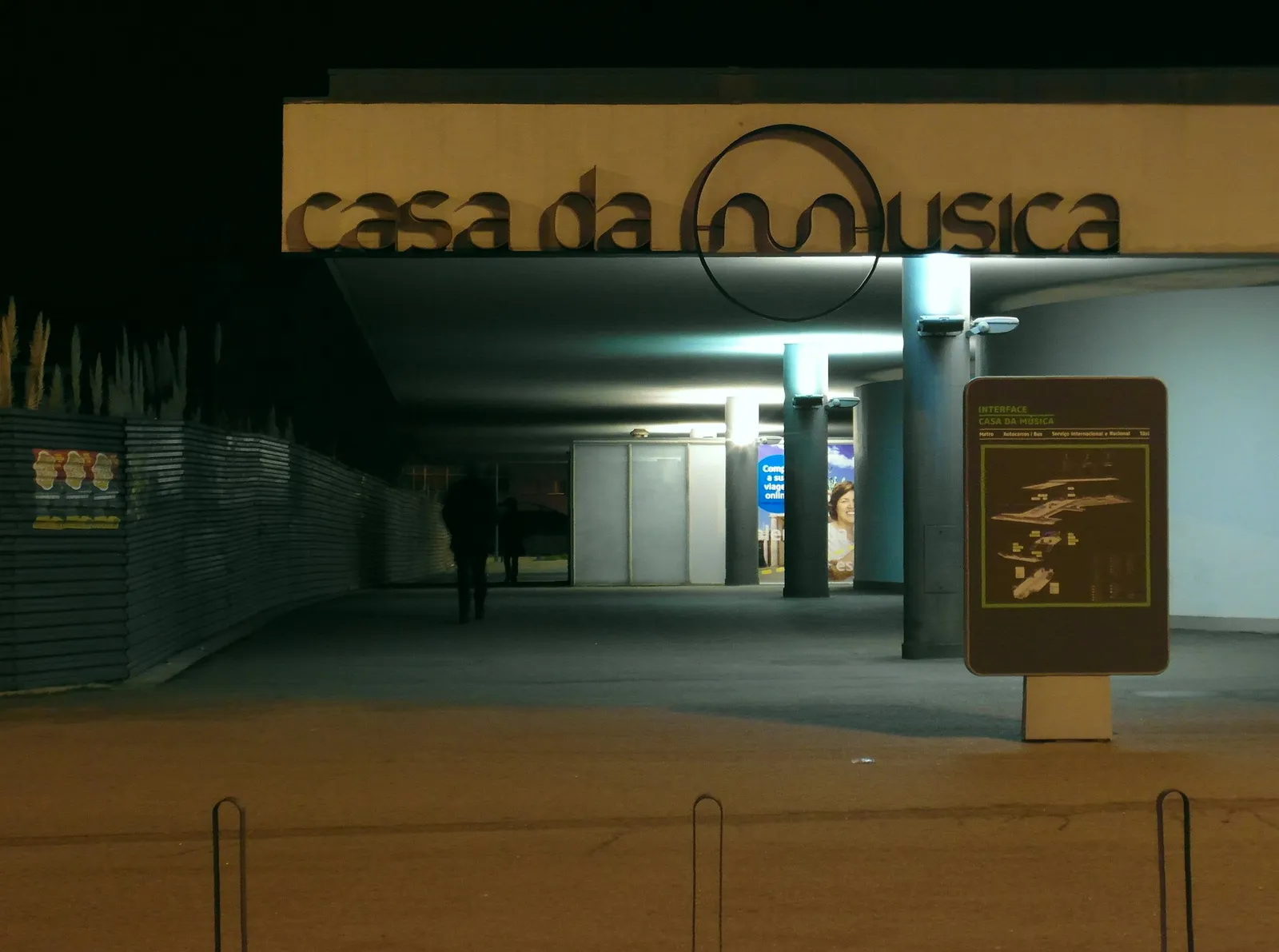
Underground, each station was shaped to its site. At Casa da Música a folded concrete roof doubles as a canopy for the bus station, and two round skylights bring daylight down to the lower levels. At Salgueiros a faceted skylight of blue glass colours the light on the lower platform, and Marquês is an ellipse in plan, extruded straight down.
When Souto de Moura won the Pritzker Prize in 2011, the jury mentioned the metro: by modifying pavements, textures, pathways and public spaces for it, they wrote, he had given public space new significance. In 2013 Harvard's Graduate School of Design gave its Veronica Rudge Green Prize in Urban Design jointly to the Porto metro and to a project in Medellín, Colombia.
The bill
The project was meant to be paid for largely with grants. In the original plan, subsidies from European funds and the Portuguese state were to cover 42 per cent of the investment. Then the design grew: the Póvoa line was doubled, a branch to the airport was added, Line A was extended to Antas and the crossing of the Avenida de França was redesigned. The work of fitting the metro into the streets grew too, and the road-safety and network-control systems were redesigned from scratch.
By 2006, according to the evaluation Metro do Porto published as its white paper in 2008, investment had almost doubled, to €2,071.7 million, and grants covered only 24 per cent of it. Three quarters was borrowed.
| Source | € million | Share |
|---|---|---|
| Loans and other liabilities | 1,569.3 | 75.7% |
| European Union funds | 376.0 | 18.1% |
| Portuguese public funds | 121.4 | 5.9% |
| Share capital | 5.0 | 0.2% |
| Total investment | 2,071.7 | 100% |
From the 2008 evaluation of the first phase, which drew on Metro do Porto's annual reports. The source prints share capital as 49.7, apparently a slip: only about 5.0 fits both its 0.2% share and the total. The original plan had subsidies covering 42 per cent.
The European Investment Bank lent €803.7 million in tranches signed between 1998 and 2008. By the end of 2012, after the extensions to Fânzeres and Santo Ovídio had been finished, cumulative investment had reached €2,633 million and the company's net interest-bearing debt about €2,710 million. Metro do Porto reckoned that, over the 19 years from 1994, about €1,755 million of that debt had paid for construction and about €750 million for interest and other financial charges.
What Metro do Porto's debt paid for, 1994 to 2012
€ million
Approximate figures from Metro do Porto's 2012 annual report, which attributes its net interest-bearing debt of about €2,710 million at the end of 2012 to these uses. Passenger services exclude vehicle lease payments; financial charges include those on the vehicle leases.
Show the data
| Approximate amount | |
|---|---|
| Construction | 1,755 |
| Interest and financial charges | 750 |
| Running passenger services | 130 |
| Project management | 75 |
Across the Douro: the network grows
Expansion came quickly. On 5 June 2004, a week before Portugal hosted the European Football Championship, Line A was extended through the new tunnel to the Estádio do Dragão, and during the tournament the metro carried about 30 per cent of the spectators at the Dragão and Bessa stadiums. Line B opened to Pedras Rubras in March 2005 and Line C to Fórum Maia in July.
The most striking addition opened on 17 September 2005. Line D, the yellow line, ran from Câmara Gaia to Pólo Universitário, and its trains crossed the Douro on the upper deck of the Luís I bridge of 1886, whose story is told in a separate article. To free the deck for the metro alone, Metro do Porto had built a new road bridge, the Ponte do Infante, which opened on 30 March 2003.
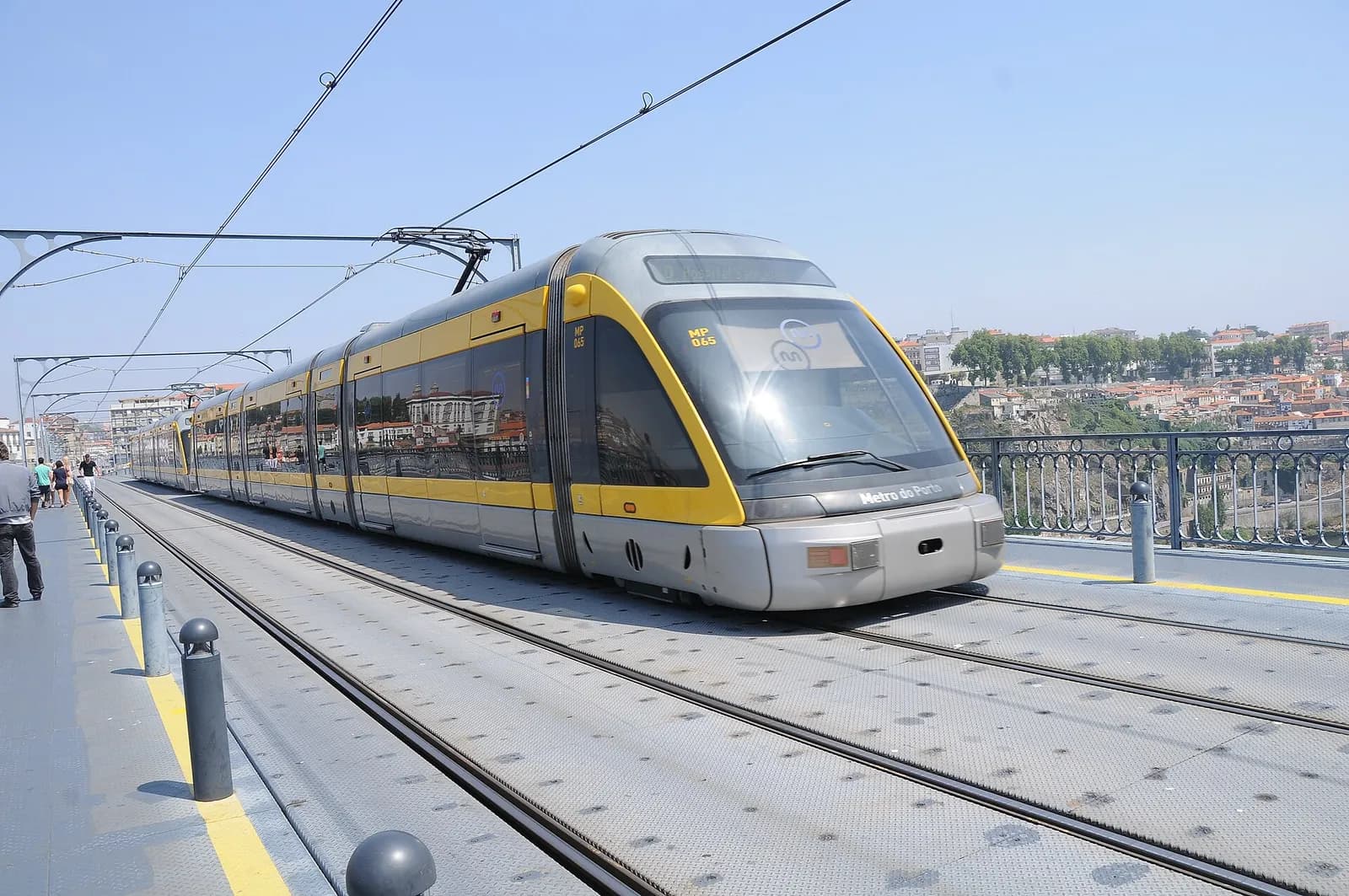
In 2006 Line B reached Póvoa de Varzim and Line C reached ISMAI, and on 27 May Line E made Porto's the first airport in Portugal served by a metro. By the end of that year the first phase was complete: 58.9 kilometres and 69 stations, 14 of them underground. Line F, to Fânzeres in Gondomar, followed on 2 January 2011.
| Line | Route | Length | First opened |
|---|---|---|---|
| A (blue) | Estádio do Dragão – Senhor de Matosinhos | 15.6 km | 2002 |
| B (red) | Estádio do Dragão – Póvoa de Varzim | 33.6 km | 2005 |
| C (green) | Campanhã – ISMAI | 19.6 km | 2005 |
| D (yellow) | Hospital de São João – Vila d'Este | 11.7 km | 2005 |
| E (violet) | Estádio do Dragão – Aeroporto | 16.8 km | 2006 |
| F (orange) | Fânzeres – Senhora da Hora | 16.4 km | 2011 |
Several lines share the trunk through the centre, so the network's route length is 69.8 km, not the sum of the lines. Line D reached Vila d'Este on 28 June 2024.
Why it still matters
Metro do Porto counts its traffic in validations, the number of times tickets and travel cards are validated, and treats each one as a passenger. Validations rose from 6 million in 2003 to 71.4 million in 2019, fell to 39.4 million in the first year of the pandemic and then passed the old peak, reaching 94.5 million in 2025. The company puts part of the latest rise down to fares: in December 2024 free travel passes, until then only for students, were extended to everyone aged 23 and under.
Annual validations on the Metro do Porto, 2003 to 2025
million validations
Figures from the annual validations chart in Metro do Porto's 2025 annual report. That chart labels 2019 as 71.5 million; the same report's table gives 71,356,000, used here. The first phase opened in stages between 2002 and 2006; 2020 and 2021 were cut by the Covid-19 pandemic. The regulator AMT gives 94,540,055 passengers for 2025.
Show the data
| Validations | |
|---|---|
| 2003 | 6 |
| 2004 | 9.8 |
| 2005 | 18.5 |
| 2006 | 38.6 |
| 2007 | 48.2 |
| 2008 | 51.5 |
| 2009 | 52.6 |
| 2010 | 53.5 |
| 2011 | 55.7 |
| 2012 | 54.5 |
| 2013 | 55.9 |
| 2014 | 56.9 |
| 2015 | 57.7 |
| 2016 | 58 |
| 2017 | 60.7 |
| 2018 | 62.9 |
| 2019 | 71.4 |
| 2020 | 39.4 |
| 2021 | 41.7 |
| 2022 | 65.2 |
| 2023 | 79.1 |
| 2024 | 89.8 |
| 2025 | 94.5 |
The network now serves seven municipalities, with 85 stations, 15 of them underground, and a fleet of 120 vehicles. It is still growing. The Pink Line, about three kilometres long between São Bento and Casa da Música, was tested end to end for the first time in October 2026 and is due to open at the end of the first quarter of 2027, about three years late, at a total cost close to €420 million against a contract of almost €190 million.
The Ruby Line, 6.4 kilometres from Casa da Música to Santo Ovídio in Gaia, will cross the Douro on a new bridge named after Antónia Ferreira, the nineteenth-century port wine businesswoman. Its schedule now runs to July 2028, at a cost of €487.9 million.
FAQs
When did the Porto metro open?
The first line, Line A from Senhor de Matosinhos to Trindade, was inaugurated on 7 December 2002 by the Prime Minister, José Manuel Durão Barroso. Travel was free until the end of that year, and commercial service began on 1 January 2003, which is why some sources date the opening to January 2003.
Is the Metro do Porto a metro or a tram?
It is light rail, a mix of both. Trains run in tunnels under the city centre, on their own tracks along the old Póvoa and Trofa railway corridors, and in the street in places such as Matosinhos. About 8 km of the roughly 70 km network is in tunnel.
How many lines and stations does the Metro do Porto have?
Six lines, A to F, with 85 stations and 69.8 km of route in 2025. The Pink Line between São Bento and Casa da Música is due to open in 2027, and the Ruby Line to Santo Ovídio in Gaia is scheduled for 2028.
Who designed the Porto metro?
The architect Eduardo Souto de Moura was chief architect of the first phase from 1997 to 2005. The system was designed, built and first operated by the Normetro consortium for Metro do Porto. Souto de Moura won the Pritzker Prize in 2011.
How much did the Porto metro cost?
Cumulative investment reached €2,071.7 million by 2006, when the first phase was complete, almost twice the original estimate. By the end of 2012, after the first extensions beyond it, it was €2,633 million. Most of it was borrowed: by 2006 grants covered about a quarter.
On the timeline
Open the timelineNearby moments from portugal in europe (1986–today).
Death of José Travassos, one of Sporting's 'Cinco Violinos' (Five Violins), the forward line that ruled Portuguese football in the 1940s. Nicknamed 'Zé da Europa', in 1955 he became the first Portuguese player picked for a Rest of Europe XI, against Great Britain.
Portuguese legislative elections are held, won by the PSD under José Manuel Durão Barroso, who would later become President of the European Commission (2004–2014).
Portugal crash out of the World Cup in Incheon, beaten 1–0 by co-hosts South Korea after finishing with nine men. Striker João Pinto, sent off for a lunge on Park Ji-sung, punches the Argentine referee Ángel Sánchez in the stomach and is banned by FIFA for four months — an inglorious end for the 'Golden Generation' at its first World Cup.
Metro do Porto opens
The first line of the Metro do Porto, running from Senhor de Matosinhos to Trindade, is inaugurated by Prime Minister Durão Barroso. Part metro, part street-running tram, the light-rail network has since grown to six lines and some 85 stations.
José Mourinho's FC Porto win the UEFA Cup, beating Celtic 3–2 in Seville with a silver-goal winner from Derlei late in extra time. It is the club's first European final win since the 1987 European Cup and launches Mourinho's rise to global fame.
FC Porto inaugurate the Estádio do Dragão, built for Euro 2004, with a 2–0 friendly win over Barcelona. Coming on as a second-half substitute for the visitors was a 16-year-old Lionel Messi, making his first appearance for Barcelona's first team.
Lisbon's Yellow Line is extended north from Campo Grande to Odivelas with five new stations (Quinta das Conchas, Lumiar, Ameixoeira, Senhor Roubado and Odivelas), taking the Metro beyond the city of Lisbon's boundaries for the first time.
Coming up in history
All long reads 9 December 1868Padre Himalaya, the priest who took a solar furnace to St Louis
 10 December 1616Diogo do Couto: the soldier who helped Camões home and kept Goa's archive
 11 December 1826The death of Empress Leopoldina in Rio de Janeiro, 11 December 1826
 12 December 1976Portugal elects its town halls: the first free local elections, 1976
20 sources
Archives, scholarship and reporting this article was checked against.
- 1
História (company timeline)Metro do Porto
- 2
- 3
Relatório e Contas 2012Metro do Porto (copy hosted by JPN, University of Porto)
- 4
- 5
Relatório anual relativo ao serviço público de transporte de passageiros, Metro do Porto, S.A., ano 2025Autoridade da Mobilidade e dos Transportes
- 6
- 7
Tunnelling in Porto graniteTunnels & Tunnelling International
- 8
The metre gauge lines of PortoThe Restoration & Archiving Trust
- 9
10 anos do Metro do Porto: uma década de históriaJPN – JornalismoPortoNet, University of Porto
- 10
Ponte Maria PiaInfraestruturas de Portugal
- 11
- 12
- 13
- 14
Eduardo Souto de Moura, 2011 laureateThe Pritzker Architecture Prize
- 15
Porto Subway, Porto (Eduardo Souto de Moura, 1997–2005)Arquitectura Viva
- 16
Veronica Rudge Green Prize in Urban DesignHarvard Graduate School of Design
- 17
- 18
- 19Metro do Porto arranca testes de circulação a quase meio ano da abertura da Linha RosaObservador
- 20Prazo das obras da Linha Rubi do Metro do Porto derrapa mais de um ano para 2028Observador
Image credits
- A Line A Eurotram, bound for Estádio do Dragão, on grassed track in Senhora da Hora, Matosinhos, in May 2011. The Eurotrams that opened the line in 2002 were assembled by Bombardier at Amadora. Alain GAVILLET from Chêne-Bougeries, Suisse, CC BY 2.0, via Wikimedia Commons.
- A metro train running in the street along Rua Brito Capelo in Matosinhos, at night in October 2012. The trial service reached this street in September 2002. IngolfBLN, CC BY-SA 2.0, via Wikimedia Commons.
- Timetable of the Porto to Póvoa de Varzim railway from 20 April 1876, published that year in Ramalho Ortigão's guide As Praias de Portugal. Four trains a day each way took between about 1 hour 25 minutes and 1 hour 45 minutes for the 28 kilometres, calling at stations such as Senhora da Hora, Pedras Rubras and Vila do Conde. Companhia do Caminho de Ferro do Porto à Póvoa, Public domain, via Wikimedia Commons.
- The entrance to Casa da Música station at night in December 2012, under the concrete roof that also shelters the bus interchange. Souto de Moura's team designed the station; the opening ceremony of 7 December 2002 was held here. IngolfBLN, CC BY-SA 2.0, via Wikimedia Commons.
- A Line D train on the upper deck of the Luís I bridge in July 2012. Metro trains have used the deck since 17 September 2005; pedestrians share it on walkways at the sides. Joseolgon, CC BY-SA 3.0, via Wikimedia Commons.