

Diogo do Couto: the soldier who helped Camões home and kept Goa's archive
He sailed for India as a teenager, found Luís de Camões penniless on Mozambique Island and came home with him. Then he went back to Goa for good, to guard the records of Portuguese Asia and write its history.
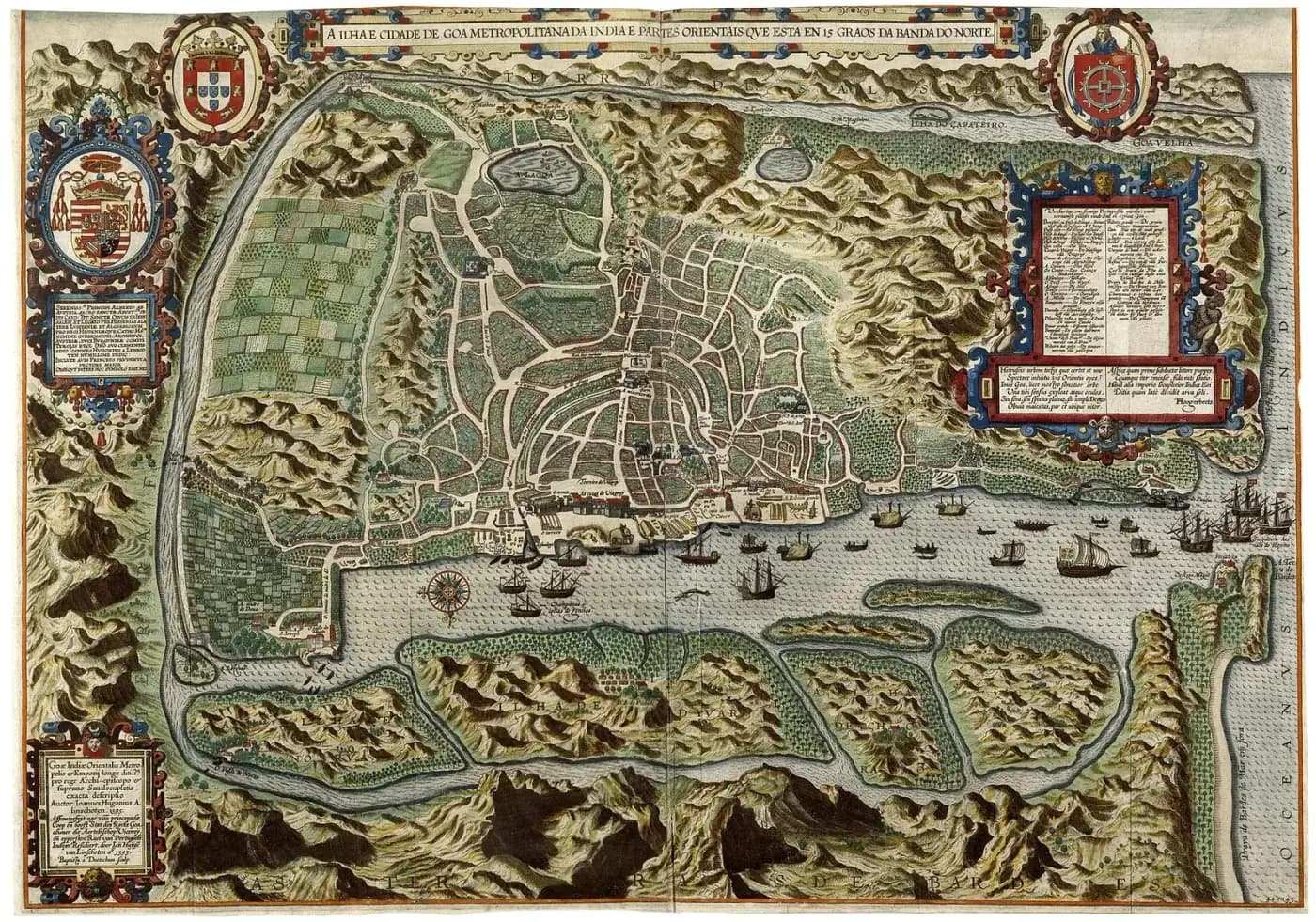
At a glance
- Diogo do Couto died in Goa on Saturday 10 December 1616, aged 74. He had lived in Portuguese India for most of the previous 57 years.
- Born in Lisbon in 1542 and schooled by Jesuits, he sailed for India as a soldier in March 1559, aged 15 by his own account and 17 by his birth year.
- Sailing home in 1569, he found his friend Luís de Camões so poor on Mozambique Island that he lived on his friends' charity. The two reached Portugal together on the Santa Clara in April 1570, and Os Lusíadas was printed in 1572.
- In 1595 the king named him chronicler of Portuguese India, to continue João de Barros's Décadas da Ásia, and keeper of a new archive in Goa, the Torre do Tombo of the Estado da Índia.
- He wrote nine Décadas, IV to XII, covering 1526 to 1600. Only four were printed in his lifetime; one print run burned, two volumes were stolen from his house and another was lost.
A chronicler dies in Goa
Diogo do Couto died in Goa on Saturday 10 December 1616. He was 74, a long life for the time, and he had spent almost all of his adult life there: first as a soldier, then as a married citizen of Goa, and for his last 21 years as the king's chronicler and the keeper of the city's state archive.
He was still writing. His last known text, a letter to King Philip dated Goa, 28 January 1616, complained that two of his books of history had been stolen from him. In Lisbon that same year, the printer Pedro Crasbeeck brought out his seventh Década da Ásia, the last of his histories to be printed in his lifetime.
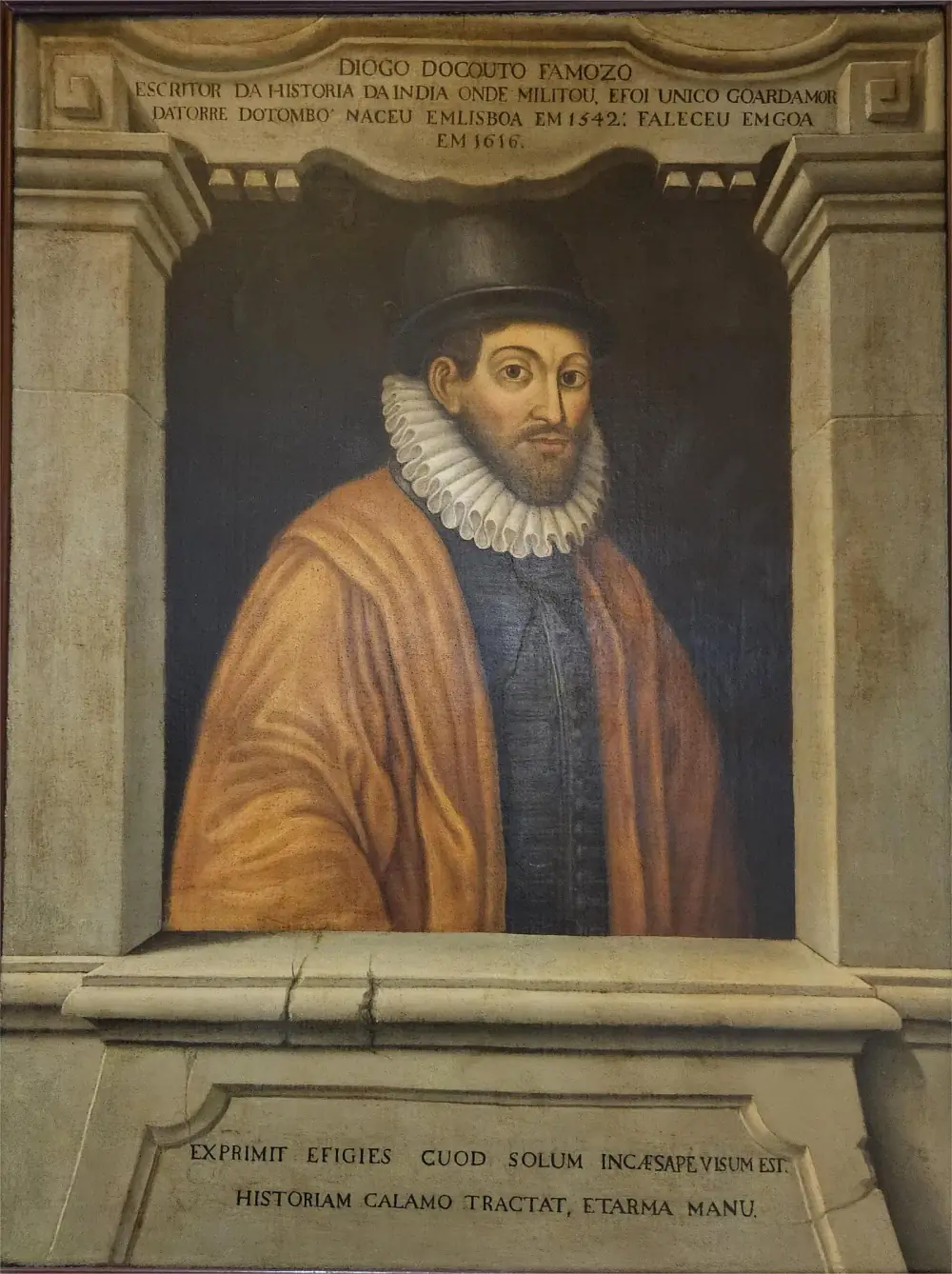
His correspondent and first biographer, Manuel Severim de Faria, described him as cheerful, hard-working and, unusually for someone who had lived so long in India, not greedy. Under his printed portrait went a Latin couplet: he handled history with the pen and arms with the hand.
Couto is remembered for two things. He continued, from Goa, the great history of the Portuguese in Asia that João de Barros had begun in Lisbon. And in 1569, on the Island of Mozambique, he found Luís de Camões, the poet of Os Lusíadas, stranded and penniless, and sailed home with him.
From the Infante's household to the India fleet
Couto was born in Lisbon in 1542, the son of Gaspar do Couto and Isabel Serrão de Calvos, a noble family. His father served the Infante D. Luís, a younger son of King Manuel I, and the boy entered the Infante's household as soon as he was old enough.
D. Luís paid for a fine education. At 11 Couto began Latin grammar at the Jesuit college of Santo Antão in Lisbon, under Manuel Álvares, author of the Latin grammar used in Jesuit schools, and studied rhetoric with Cipriano Soares. He then read philosophy at the Dominican house in Benfica with Frei Bartolomeu dos Mártires, the future Archbishop of Braga, as a fellow student of the Infante's son António, later Prior of Crato.
Then his patrons died. The Infante died in 1555 and Couto's father about two years later. With no protector at court, he gave up his books for a soldier's career in the East, as many Portuguese of noble but modest birth did.
In March 1559 he sailed with a fleet of nearly 3,000 men of arms, aboard the Flor de la Mar with D. Jorge Temudo, the new Bishop of Cochin. Writing in 1603, Couto said he was then 15 and had already served King João III for two years as a moço da câmara, a chamber page. Born in 1542, he was more likely 17.
He served as a soldier for about ten years, and his own Décadas, especially the seventh and eighth, draw on that experience. In 1603 he wrote that he had spent the years since in “other services of more risk and danger”, and that his present task, the history, brought so few favours that the pen often fell from his hand in disgust.
Camões on Mozambique Island
In early 1569 Couto set out for Portugal to ask the king for a reward for his service, a normal step for a veteran. He sailed from Cochin on 2 February in the fleet of the outgoing viceroy, D. Antão de Noronha, with a group of fidalgos and cavaleiros who all ate at the viceroy's table.
They left too late in the season. Only one ship rounded the Cape of Good Hope; the rest were driven back by storms to the Island of Mozambique, the Portuguese fort and port on the East African coast. Before they reached the Angoxe Islands the viceroy died at sea.
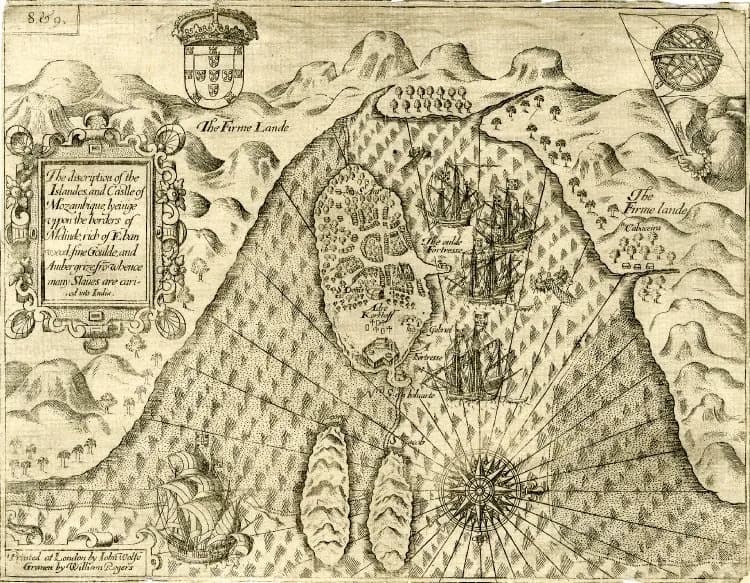
On the island Couto found an old friend. Luís de Camões had been in the East since 1553 and had reached Mozambique on his slow way home. Couto told what he saw in a short passage of the abridged eighth Década he finished in 1616.
“In Mozambique we found that prince of the poets of his time, my messmate and friend Luís de Camões, so poor that he ate at his friends' expense. To ship him home to the kingdom, we his friends collected all the clothes he needed, and there was no lack of people to feed him. That winter he spent in Mozambique he finished polishing his Lusíadas to have them printed.”
Couto added that Camões was also writing a book of “much learning, doctrine and philosophy” that he called his Parnaso, and that it was stolen from him. Couto searched for it in Portugal and never found it. The same passage ends with Camões dying “in pure poverty” in Portugal. Camões died in 1580, so these lines were written long after the voyage.
When the season came, in November 1569, the ships left Mozambique together. The Santa Clara, captain Gaspar Pereira, with Couto and Camões aboard, got ahead of the others and kept going. Couto named his messmates on the voyage as Heitor da Silveira and Fernão Gomes da Grã; Camões, too, he called “my messmate”.
The Santa Clara called at St Helena, waited 20 days for the rest of the fleet in vain, and anchored at Cascais in April 1570; José Manuel Garcia dates the arrival to 7 April. Lisbon had plague, and the king's orders were that India ships should anchor outside and send a man ashore with the letters. Couto was the man sent, and he went to Almeirim, where King Sebastião arrived two days later and questioned him about India. Heitor da Silveira died on the day they sighted the Rock of Sintra. The other ships did not arrive until the end of May or June.
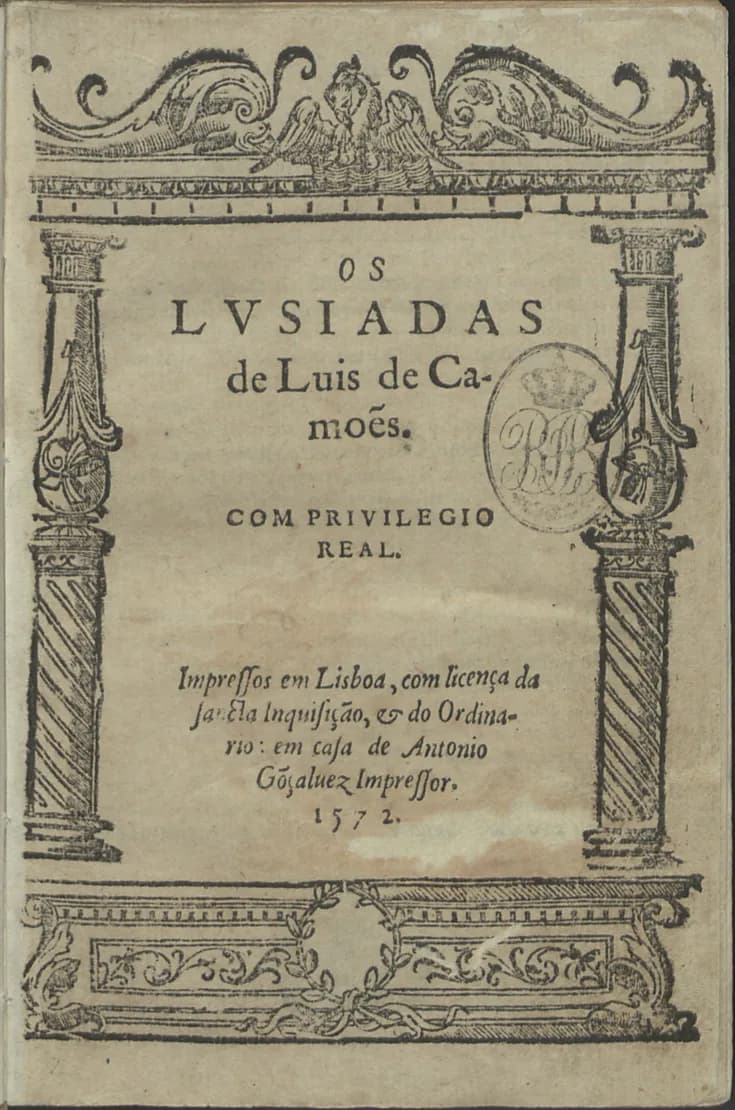
Os Lusíadas, the epic of Vasco da Gama's voyage to India, was printed in Lisbon in 1572. Couto's part in it did not end on the ship. Severim de Faria wrote that Camões consulted him often and took his advice on some passages, and that at the poet's request Couto began a commentary on the poem. He got as far as the fifth canto and sent the manuscript to a friend, D. Fernando de Castro Pereira. In the 1620s it belonged to a canon of Évora; it has since disappeared.
A chronicler for India, in India
Couto's months in Lisbon overlapped with the death of the man whose work he would continue. João de Barros, the court historian who wrote the history of Portuguese Asia without ever going there, had printed three Décadas in 1552, 1553 and 1563, and died at his country house near Pombal on 20 October 1570, leaving the fourth unfinished.
Couto got his reward and left again on 17 March 1571 with the new viceroy, D. António de Noronha. He reached Goa on 6 September and never saw Portugal again. In Goa he married Luísa de Melo, whose brother, the Augustinian friar Adeodato da Trindade, later acted as his agent and editor in Lisbon. They had one daughter, who died young. Couto left the army and was put in charge of supplying provisions for the ships.
The idea of a chronicler living in India was already in the air. In late 1569 D. Jorge Temudo, by then Archbishop of Goa, urged King Sebastião to appoint one, paid and sworn, to record the deeds of each viceroy and the services of soldiers as they happened. Historians writing in Portugal years after the events, he argued, had not known a quarter of it.
Nobody acted on it. Couto wrote to the king offering his services on 20 November 1589 and again on 15 November 1593. By then the king was Philip II of Spain, who had taken the Portuguese crown as Philip I in 1580, after King Sebastião died without an heir and the old Cardinal-King Henrique followed him.
Couto had begun with the years since Philip's accession. Philip's answer, dated Lisbon, 28 February 1595, asked for that volume but told him to go back and continue the history from where Barros had stopped. The same letter made him guarda-mor, chief keeper, of a new archive.
“And I charge you with being keeper of the Casa do Tombo, which I am ordering to be set up in Goa, to gather in it all the contracts, provisions, chancery registers and all other important papers that are held by the secretary of those parts and by other persons.”
Keeper of the Torre do Tombo of Goa
Torre do Tombo was the name of the royal archive in Lisbon, and the Goa archive borrowed it. On 25 February 1595 the king ordered the viceroy, Matias de Albuquerque, to fit out rooms in the viceroys' palace to hold the papers and for the chronicler to work in. Royal letters of 1597 and 1598 deal with finishing the room in the fortress of Goa and handing Couto the keys, books and papers.
The archive was largely his idea. Couto complained throughout his histories about documents rotting in officials' houses; in one chapter he could not even find the names of the captains of three armadas, because the books of appointments were ruined from being passed around the houses of the treasury clerks.
Keeping the archive was a working job. Couto issued certificates of service, the documents a soldier or captain needed to claim a reward in Lisbon. One surviving example, dated 10 December 1612, vouches for the services of Francisco Bernardes de Cabreira.
The papers also fed his history. Severim de Faria thought this gave Couto an advantage over earlier writers: in Goa he had the original treaties and registers at hand, and he could question the men who had fought, while other witnesses in the same city kept them honest. Couto made the same point himself in 1616.
“I have more experience, because I saw and dealt with everything; I am at the spring with my pitcher under the spout, collecting the fresh water and the news of things as they happen, which all those in Europe do not have, six thousand leagues away, where they draw this water so muddy and full of slime that it is not fit to look at.”
Goa also chose him to make its speeches of welcome to new viceroys and governors; his surviving orations run from 1597 to 1614. For the viceroy D. Francisco da Gama, Vasco da Gama's great-grandson and his regular correspondent, he wrote a history of the Gama family in 1599.
Nine Décadas, and the ones that went missing
Barros had organised his history in decades, after the Roman historian Livy: each Década was a volume of ten books. Couto kept the form and the title, starting at Década IV. Between 1595 and 1616 he wrote nine Décadas, IV to XII, which together cover the Portuguese in Asia from 1526 to 1600. Severim counted 90 books in all.
He worked fast. The fourth Década took him from 1595 to 1596 and the fifth from 1596 to 1597, and the two were sent to Lisbon together. The tenth, the one he had started first, went in 1600. He sent each manuscript to Frei Adeodato in Lisbon, who prepared it for the press and, in the process, changed spelling and wording, cut passages and added material of his own.
Then the losses began. The first copy of the seventh Década, sent in 1601, was on board the galleon Santiago when Dutch ships captured her, and Couto had to send it again in 1603. In 1614 the sixth was printed in Lisbon, and the printer's house caught fire with the finished edition inside. According to Severim, only six copies survived, because they had already been taken to the Augustinian convent in Lisbon.
The worst loss came next. Couto finished the eighth and ninth Décadas in 1614 and was about to send them when, Severim wrote, he fell so ill that he was not expected to live. While he lay sick the two volumes disappeared from his house, taken, Severim thought, by someone who meant to pass off the work as his own. Severim put the theft in 1614; Couto, writing in January 1616, said he had meant to send the volumes “last year”, which points to 1615.
Couto, 72 by Severim's count, recovered and rebuilt the story of both Décadas from his notes and memory as one shorter volume, “in the manner of an epilogue”. He dedicated it to the king from Goa on 28 January 1616.
| Década | Governors or years covered | First printed | What happened |
|---|---|---|---|
| IV | 1526 to 1536: Lopo Vaz de Sampaio and part of Nuno da Cunha's rule | Lisbon, 1602 | Printed in his lifetime |
| V | 1537 to 1545: Nuno da Cunha to Martim Afonso de Sousa | Lisbon, 1612 | Printed in his lifetime |
| VI | 1545 to 1554: D. João de Castro to D. Afonso de Noronha | Lisbon, 1614 | Most copies burned in a fire at the printer's |
| VII | D. Pedro Mascarenhas to João de Mendonça | Lisbon, 1616 | First copy captured by the Dutch with the Santiago; sent again in 1603 |
| VIII | D. Antão de Noronha and D. Luís de Ataíde | Lisbon, 1673 (abridged) | Full text stolen in 1614 or 1615; Couto wrote a summary |
| IX | D. António de Noronha to D. Luís de Ataíde's second term | Lisbon, 1736 (abridged) | Stolen with the eighth |
| X | 1581 to mid-1588 | 120 pages in 1736; complete in 1788 | Autograph manuscript survives in the Torre do Tombo |
| XI | Not known | Lisbon, 1786 to 1788 (summary) | Sent to Portugal around 1612 and later lost |
| XII | D. Francisco da Gama's first term as viceroy | Paris, 1645 (five books) | Published by the Portuguese consul in Paris |
Years for Décadas IV to VI from Avelar, period of Décadas X from Garcia, governors from the volumes' own titles. Couto's nine Décadas as a whole cover 1526 to 1600. The printed Década XI summary is usually attributed to its eighteenth-century editor, and sources differ slightly on the year it appeared.
The eleventh Década went missing after Couto sent it to Portugal around 1611 or 1612. In January 1616 he still believed it was safe there, but no copy of the full text has ever been found. Barbosa Machado, the eighteenth-century bibliographer, recorded that repeated searches had failed. The account of the wreck of the São Tomé that closes Couto's life of the captain D. Paulo de Lima Pereira is thought to come from it.
The practical soldier
Couto's other famous book is a dialogue. While King Sebastião still reigned, probably during his stay in Lisbon in 1570, he wrote one in which a newly chosen viceroy questions an old India soldier who is hanging about the court seeking his reward. The soldier explains what the viceroy needs to know about the royal treasury and the soldiery of India.
That manuscript was stolen too. Copies circulated in Portugal without his name. Around 1610, warned by a friend, Couto wrote it again almost from scratch, now as a conversation between a former governor of India and a practical soldier in the house of a despachador, the official who handled petitions. He dedicated it to the Marquis of Alenquer.
The soldier's complaints are pointed: he accuses governors and nobles, and exposes theft and corruption in the running of Portuguese India. The book stayed in manuscript until the Royal Academy of Sciences in Lisbon printed it in 1790, under the title Observations on the principal causes of the decline of the Portuguese in Asia. The literary scholar Manuel Rodrigues Lapa thought it among the most honest books in Portuguese literature and advised reading it alongside Os Lusíadas.
After 10 December 1616
The archive suffered first. D. Francisco da Gama, viceroy again, wrote from Goa to the king on 4 March 1626 that he had found the Torre do Tombo “notably wrecked”, because since Couto's death the people who served there had not cared for the books and papers. In 1631 the Archbishop of Goa complained that there was not a single paper in it fit to base a history on.
The books took centuries to appear. Couto's unpublished Décadas passed to Frei Adeodato. Royal letters of 1617 and 1620 deal with printing his History of India, but the twelfth came out only in Paris in 1645 and the abridged eighth in Lisbon in 1673. The Regia Officina Typografica finally printed Barros and Couto together in Lisbon between 1777 and 1788, with Severim's life of Couto at the head of his volumes.
Pieces kept turning up. In 1917 a longer manuscript version of the eighth Década was found in the municipal library of Porto, and a near-identical copy in Madrid in 1971. It says more about Camões than the printed summary, including that he escaped a shipwreck in Southeast Asia with his Lusíadas. Maria Augusta Lima Cruz published a critical edition in 1993 and 1994, and argues that the codices are working materials for a full Década, not the stolen text itself.
1542
Born in Lisbon
Son of Gaspar do Couto, a servant of the Infante D. Luís.
1555
The Infante D. Luís dies
His father dies about two years later.
March 1559
Sails for India
Aboard the Flor de la Mar, in a fleet of nearly 3,000 men of arms.
2 February 1569
Leaves Cochin for Portugal
The fleet is driven back to Mozambique, where he finds Camões.
April 1570
Reaches Cascais on the Santa Clara
With Camões; Garcia gives 7 April.
20 October 1570
João de Barros dies near Pombal
6 September 1571
Back in Goa for good
1572
Os Lusíadas printed in Lisbon
28 February 1595
Named chronicler and keeper of the Goa archive
1602
Década IV printed in Lisbon
1614
Década VI printed; most copies burn at the printer's
1614 or 1615
Décadas VIII and IX stolen from his house
10 December 1616
Dies in Goa, aged 74
Década VII is printed in Lisbon the same year.
1777 to 1788
Complete Lisbon edition of Barros and Couto
1790
O Soldado Prático first printed
Why he still matters
For the Portuguese in Asia between 1526 and 1600, Couto's Décadas are one of the main sources historians have. They draw on documents from the archive he kept and on oral testimony from many quarters; he marked the oral sources himself, with phrases such as “they told me” and “I heard it said”.
He was the first keeper of the Torre do Tombo of Goa, and his portrait in Lisbon calls him the only one. He also left a first-hand account of Camões on Mozambique Island, in the winter when, by Couto's account, the poet finished polishing Os Lusíadas.
- Born
- Lisbon, 1542
- Died
- Goa, Saturday 10 December 1616, aged 74
- Years in India
- About 57, from 1559, with a visit home in 1570 to 1571
- Offices
- Chronicler of the Estado da Índia and keeper of the Torre do Tombo of Goa, from 1595
- Main work
- Décadas da Ásia IV to XII, covering 1526 to 1600
- Other works
- O Soldado Prático (two versions), a history of the Gamas, a life of D. Paulo de Lima Pereira, speeches
FAQs
Who was Diogo do Couto?
A Portuguese soldier and historian, born in Lisbon in 1542, who went to India in 1559 and died in Goa on 10 December 1616. From 1595 he was the king's chronicler of Portuguese India and keeper of the Goa archive, and he wrote Décadas IV to XII of the Décadas da Ásia, continuing João de Barros.
How did Diogo do Couto help Camões?
In 1569 Couto's homeward fleet was forced back to the Island of Mozambique, where he found Camões so poor that he lived on his friends' charity. Couto and other friends collected the clothes he needed and fed him, and they sailed to Portugal together on the Santa Clara, arriving in April 1570. Couto later began a commentary on Os Lusíadas at the poet's request.
Which of Couto's Décadas were lost?
Most of the 1614 edition of the sixth burned at the printer's. The full texts of the eighth and ninth were stolen from his house in 1614 or 1615, and only his own abridgement survives. The eleventh was sent to Portugal around 1612 and later disappeared; only a summary was printed, in the 1780s.
What was the Torre do Tombo of Goa?
The state archive of the Estado da Índia, set up in Goa by order of King Philip I in 1595 to gather treaties, royal provisions, chancery registers and other important papers. Couto was its first keeper, and it declined after his death.
What is O Soldado Prático?
A dialogue in which an old India soldier explains to a governor what is wrong with the Estado da Índia, including theft and corruption. Couto wrote a first version around 1570 and a second around 1610 after the first was stolen. It was first printed in Lisbon in 1790.
On the timeline
Open the timelineNearby moments from the iberian union (1580–1640).
Bento de Góis, a Jesuit lay brother from the Azores, dies at Suzhou (now Jiuquan) on China's western frontier. Disguised as an Armenian merchant, he had trekked for three years from Agra across Afghanistan and the Pamirs, proving that Marco Polo's 'Cathay' and China were one and the same country.
Father António Vieira is born in Lisbon, in a house near the Sé. The Jesuit preacher, diplomat and royal adviser became the great prose stylist of the Portuguese Baroque — Pessoa's 'emperor of the Portuguese language' — and a fierce defender of Brazil's indigenous peoples.
Captain Francisco Caldeira Castelo Branco's expedition from São Luís founds the Forte do Presépio on Guajará Bay, near the mouth of the Amazon, the nucleus of Belém do Pará; 12 January is the traditional date, reckoned from a report that the voyage took 18 days.
Diogo do Couto, chronicler of Goa
Death in Goa of the chronicler Diogo do Couto, aged about 74. Sent to India as a teenage soldier, he found his friend Luís de Camões stranded and penniless on the Island of Mozambique in 1569 and, with others, helped him get home with the manuscript of 'Os Lusíadas'. Later keeper of the Goa archives, he continued João de Barros's 'Décadas da Ásia'.
Baruch (Bento) de Espinosa is born in Amsterdam to a family of Portuguese Jews who had fled the Inquisition. Expelled from the city's Portuguese-Jewish congregation in 1656 for his heterodox views, he became one of the great philosophers of the early modern age, author of the 'Ethics'.
Coming up in history
All long reads 12 December 1976Portugal elects its town halls: the first free local elections, 1976
 13 December 2007The Treaty of Lisbon: EU leaders sign at Jerónimos, 13 December 2007
 14 December 1918Murder at Rossio: the assassination of Sidónio Pais, 14 December 1918
 15 December 1885Fernando II, the King-Artist, dies in Lisbon: 15 December 1885
15 sources
Archives, scholarship and reporting this article was checked against.
- 1
Diogo do Couto: história e intervenção política de um escritor polémicoRui Manuel Loureiro and Maria Augusta Lima Cruz (eds), Húmus and CHAM, NOVA FCSH, 2019 (open-access PDF, Universidade NOVA de Lisboa repository)
- 2
Vida de Diogo de Couto, by Manuel Severim de Faria, with Diogo Barbosa Machado's catalogue of his works, in Da Asia de Diogo de Couto, Década IV, parte primeiraRegia Officina Typografica, Lisbon, 1778 (digitised by the Internet Archive)
- 3
- 4
Diogo do Couto e a Torre do Tombo de Goa (virtual exhibition)Arquivo Nacional Torre do Tombo
- 5
- 6
Camões e a moça china (Eduardo Ribeiro)Fénix, Universidade de Aveiro, 2021
- 7Diogo do Couto, o português da Índia há 500 anos (Carlos Maria Bobone)Observador, 16 December 2016
- 8
Os Lusiadas / de Luis de Camões, Lisboa, em casa de Antonio Gõçaluez, 1572Biblioteca Nacional de Portugal, Biblioteca Nacional Digital
- 9
Diogo do Couto (Musica Aeterna, presented by João Chambers)RTP Antena 2, December 2016
- 10
João de Barros (1496-1570)Ana Isabel Buescu, Encyclopaedia of Portuguese Expansion (CHAM, NOVA FCSH), 2009
- 11
Barros, João deEdgar Prestage, Encyclopaedia Britannica, 11th edition (1911), vol. 3, via Wikisource
- 12O dia em que Portugal perdeu a última batalha pela independênciaObservador
- 13
- 14
Diogo do CoutoAngkor Database
- 15
Image credits
- The island and city of Goa, capital of Portuguese Asia, in the bird's-eye view engraved for Jan Huyghen van Linschoten's account of the Indies in the mid-1590s. Linschoten lived in Goa in the 1580s, when Couto was a married citizen of the city. Jan Huyghen van Linschoten / Cornelis Claesz, Public domain, via Wikimedia Commons.
- The islands and castle of Mozambique, in an English engraving by William Rogers dated 1598, after a Dutch original by Joannes van Doetecum. Couto's fleet put back to the island in 1569 and spent the winter there. William Rogers, Public domain, via Wikimedia Commons.
- Title page of the first edition of Os Lusíadas, printed in Lisbon by António Gonçalves in 1572, two years after Camões and Couto came home on the Santa Clara. Unknown author, Public domain, via Wikimedia Commons.
- Portrait of Diogo do Couto by an unknown eighteenth-century painter, in the Torre do Tombo in Lisbon. The inscription calls him the famous writer of the history of India, where he served as a soldier, and the only keeper of its Torre do Tombo. The Latin couplet at the foot also ran under his printed portrait in the Décadas. GualdimG, CC BY-SA 4.0, via Wikimedia Commons.
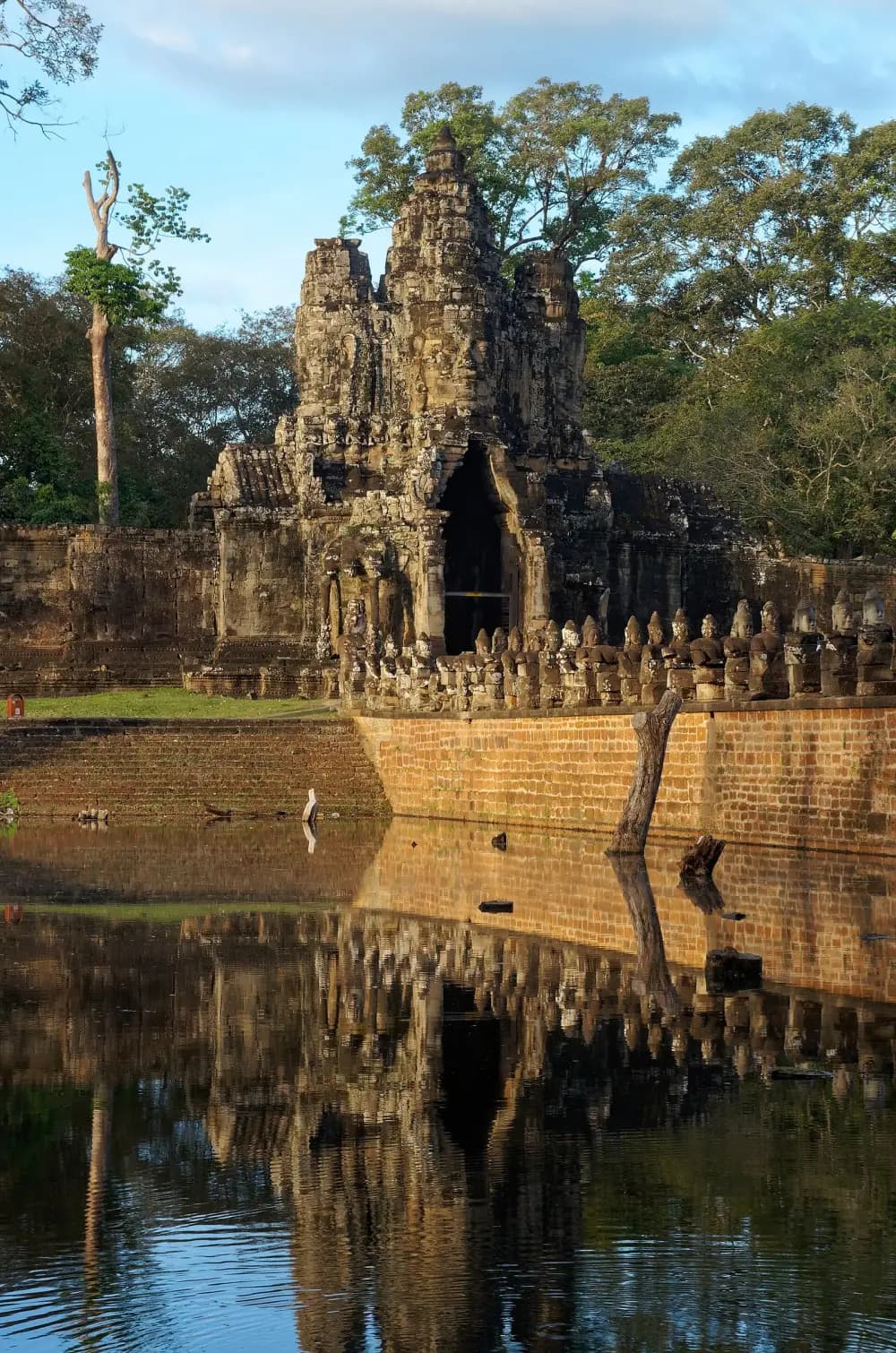
- The south gate of Angkor Thom, in Cambodia, photographed in 2017. Couto described the city from a friar's account without ever seeing it. Jakub Hałun, CC BY-SA 4.0, via Wikimedia Commons.