

Murder at Rossio: the assassination of Sidónio Pais, 14 December 1918
A year after seizing power in a coup, Portugal's soldier-president walked into Rossio station to catch the night train to Porto. A young army veteran from the Alentejo was waiting for him.
At a glance
- Sidónio Pais, Portugal's fourth president, was shot at Lisbon's Rossio station shortly before midnight on 14 December 1918, as he went to catch the night train to Porto. He died within minutes.
- His killer, José Júlio da Costa, was a 25-year-old former army sergeant from the Alentejo with left-wing sympathies. He was never tried and died in a Lisbon mental hospital in 1946.
- A mathematics professor and artillery major, Sidónio had seized power in a three-day coup in December 1917 and in April 1918 became the only president of the First Republic elected directly, by all adult men.
- His 'New Republic' ruled through personal charisma, military parades and soup kitchens, amid war, hunger, the 1918 flu and repression, and it did not survive him.
- Huge crowds mourned him, and in 1920 Fernando Pessoa's ode made him the 'President-King', a name that stuck. He has lain in the National Pantheon since 1966.
The night train to Porto
Late on the night of Saturday 14 December 1918, Sidónio Pais, President of the Republic, arrived at Rossio station in the heart of Lisbon to take the night train to Porto. Officially he was going to open an exhibition of fine art. The real purpose, it was said, was to calm a monarchist conspiracy among the army officers of the north.
His aide, Captain Eurico Cameira, had tried to get him to board at Alcântara instead, because a hostile demonstration was rumoured. Sidónio insisted on Rossio. Eight days earlier a young man had tried to shoot him, and the station was full of police. Struck by the display, he remarked that he was not the Tsar of Russia and would walk next time.
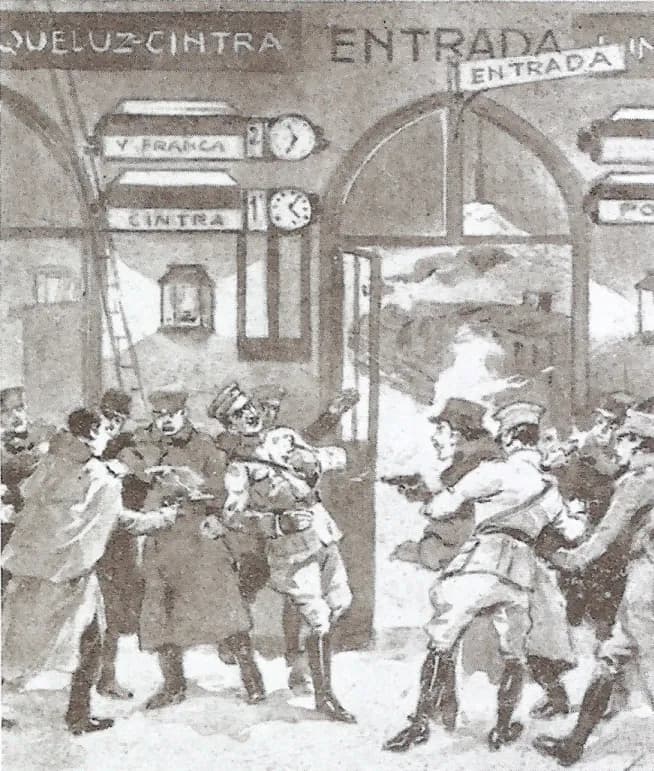
The band of the Republican National Guard (GNR) struck up the anthem. Sidónio walked towards the second passenger entrance with Cameira, his aides-de-camp, his brother Alberto and his son António, a little ahead of the escort. A man who had been waiting in the station shot him in the chest. The president fell at the feet of the station doorman, Anastácio Trindade.
Shooting broke out all round. When it stopped, four more men were dead or dying: a station porter, a labourer, a greengrocer and Luís Furtado Saraiva, a 33-year-old commercial traveller and fervent admirer of the president, who had come to tell a policeman on duty there about a burglary at a neighbour's house. He died, people said, cheering his idol.
The gunman, José Júlio da Costa, made no attempt to escape. Cadets from the Army School saved him from being lynched on the spot and drove him away. Sidónio was rushed to the São José hospital, where, according to the Museu da Presidência, he died. António Araújo, his most recent biographer, puts his death at about 23:50 at the station entrance itself. Ilustração Portugueza, the illustrated weekly of O Século, put the shooting at 23:45.
- Date
- Saturday 14 December 1918, shortly before midnight
- Place
- Rossio station, Lisbon, at the passenger entrance
- Victim
- Sidónio Pais, 46, fourth president of the Portuguese Republic
- Assassin
- José Júlio da Costa, 25, a former army sergeant from Garvão in the Alentejo
- Weapon
- A Browning pistol, according to the forensic report
- Other dead
- Four men killed in the shooting that followed
A month later the medical examiner Asdrúbal d'Aguiar examined the body in the lower cloister of the Jerónimos monastery. A bullet from a .32 Browning had entered the right side of the chest and torn through the lung, the liver and the inferior vena cava, the great vein that returns blood to the heart. Sidónio could have lived no more than ten or fifteen minutes. The examiners could not say whether one, two or three shots had hit him.
Two reporters, one of them Reinaldo Ferreira of O Século, invented a dying cry: 'I die well! Save the Fatherland!' A plainer version had him plead, 'Don't squeeze me, lads.' His son António, who was there, said years later that his father said nothing at all.
A republic at war, at home and abroad
Portugal had been a republic since the revolution of October 1910. Its constitution of 1911 kept the president weak and put power in parliament, which made and unmade governments at a dizzying rate: historians count 45 between 1910 and 1926. The dominant force was Afonso Costa's Democratic Party.
Germany declared war on Portugal on 9 March 1916, after Lisbon seized the German ships in its ports. By 1917 a Portuguese Expeditionary Corps (CEP) of about 50,000 men held a sector of the Western Front in Flanders. At home, prices rose by 22 per cent in 1916, 18 per cent in 1917 and 80 per cent in 1918, and food ran short. In May 1917 hungry crowds in Lisbon and Porto looted shops in the 'potato revolt', which Costa's government put down at the cost of more than 40 lives.
The professor nobody noticed
Sidónio Bernardino Cardoso da Silva Pais was born in Caminha, in the far north-west, on 1 May 1872, the eldest child of a notary who died when he was eleven. He enlisted as a volunteer at 16, trained as an artillery officer in Lisbon and took a doctorate in mathematics at Coimbra in 1898, with a thesis that, his biographer Armando Malheiro da Silva judged, broke no new ground. He taught calculus at the university and ran the city's industrial school.
He had kept out of politics and took no part in the revolution of October 1910, but he welcomed it, and posts followed fast. His patron, Brito Camacho, had him made minister of development in 1911, and he was then minister of finance until June 1912. Later that year he went to Berlin as Portugal's envoy. He tried to keep Portugal out of the war and stayed until Germany declared it.
On his way home he dined in Paris with João Chagas, the republican writer and diplomat, who wrote in his diary that Sidónio was 'thin as a dog', spoke deplorable French and was 'so insignificant'. Asked when he had last spoken to the Kaiser, Sidónio answered candidly that he had spoken to him only once. Being underestimated served him well. When someone suggested in 1917 that he was plotting a revolution, the foreign minister, Ernesto de Vilhena, scoffed: 'You gentlemen are mad. As if that man could make a revolution!'
Three days in December 1917
Sidónio began conspiring in the summer of 1917 with Camacho's officers, at the offices of the Unionist paper A Lucta and in the Farmácia Durão in the Chiado. On the afternoon of 5 December he put on a borrowed uniform with a major's braid and at 17:50 walked into the barracks of the 7th Cavalry. By nightfall about 1,500 men, most of them soldiers, held the high ground of the Parque Eduardo VII, the traditional rallying point of Lisbon revolutions.
For three days Lisbon was a battlefield. Warships loyal to the government shelled the city; aboard one of them, the Gil Eanes, Sidónio's brother António directed the fire against him. Sidónio watched, chain-smoking and eating chocolates. Mobs from the poorer quarters looted shops and sacked Afonso Costa's house. The government resigned on 7 December and the fighting ended on the 8th. António Araújo counts 109 dead and more than 500 wounded; Rui Ramos says the city morgue took in about 100 bodies.
Costa was arrested and the president, Bernardino Machado, was deposed and sent into exile. Sidónio led a revolutionary junta, became head of the government on 11 December and took the presidency as well on 27 December. A film crew recorded him at the Rotunda signing decree after decree; he had the scene shot three times until it looked right.
The New Republic
On 8 January 1918 sailors loyal to the Democrats rose and the cruiser Vasco da Gama trained its guns on the Terreiro do Paço. Sidónio went up to the São Jorge castle and directed the artillery himself; after three shells the crew surrendered. Then he toured the north, the south and the centre, and crowds filled the squares to see him.
At Évora he promised a 'New Republic' with room for everyone, monarchists and Catholics included. A decree of 30 March 1918, issued without parliament and known as the 'Constitution of 1918', had the president elected directly by every man over 21, whether or not he could read. The president would appoint and dismiss ministers freely and command the armed forces. Camacho's Unionists broke with him in April.
On 28 April Sidónio, the only candidate, was elected. The old republican parties told their supporters to stay at home and many did. Sources disagree on the numbers, as the table shows. On 9 May he was acclaimed from the balcony of Lisbon City Hall, where the Republic had been proclaimed, and that afternoon, on horseback with his sword drawn, he reviewed a military parade on the Avenida.
| Source | Votes for Sidónio | Share or turnout given |
|---|---|---|
| Presidency of the Republic website | 470,831 | Not given |
| Museu da Presidência da República | 468,275 | Not given |
| António Araújo (2025) | 470,831; other estimates 473,789 or 513,958 | 91%; turnout 57%, or 53.8% by another estimate |
| Rui Ramos (2017) | 513,958 | 58.4% of about 880,000 registered voters |
Turnout was lower in the parliamentary elections held the same day: Ramos gives 38.8% for the Chamber of Deputies, Araújo an abstention of about 61%. Sidónio's National Republican Party won 108 of the 155 seats, monarchists 37 and Catholics 5.
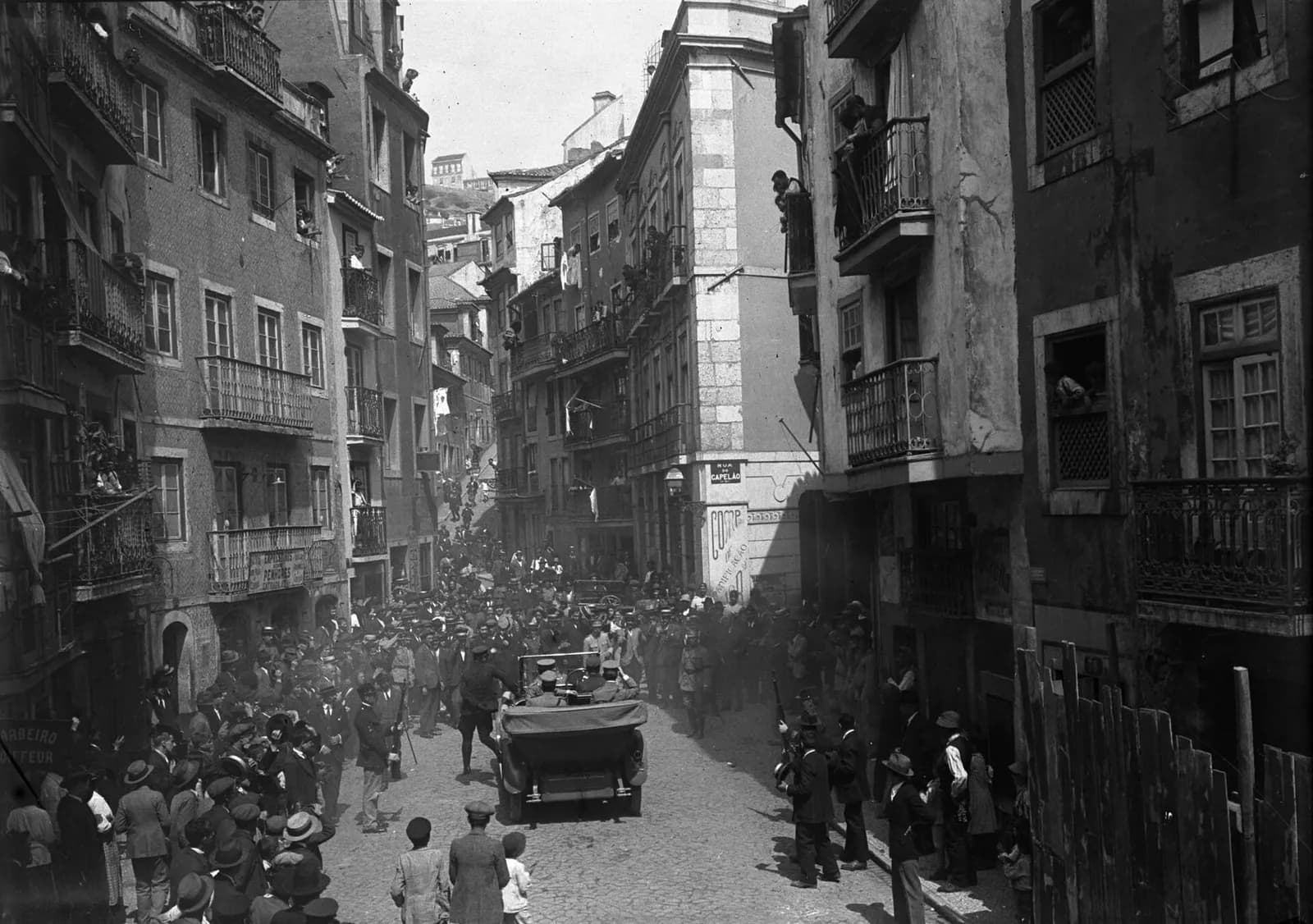
He governed as a personality. He seldom called the cabinet together. He visited slums, prisons and hospitals, entered typhus and flu wards to comfort the sick, and in May freed every prisoner in Porto's jail on the spot: 'Go. You are all free.' His charity, the Obra de Assistência 5 de Dezembro, opened soup kitchens across the country, remembered as the 'sopa do Sidónio'.
He was slim and always in uniform, and women adored him, as the papers noted. His estranged wife never set foot in the Belém palace until his body lay there. The writer Raul Brandão called him 'half prince, half condottiere'.
He also made peace with the Catholic Church. A decree of February 1918 softened Afonso Costa's Law of Separation of 1911; on 15 May he became the first republican head of state to attend Mass, for the soldiers killed in Flanders; and on 10 July relations with the Vatican were restored.
Flanders, flu and a winter of crisis
Sidónio sent no more troops to France; the British, short of shipping, had already stopped carrying the monthly drafts in 1917. On 9 April 1918 a German offensive on the Lys overran the Portuguese sector. Ramos gives about 614 dead and 6,535 prisoners; the official figures cited by Araújo give more than 400 dead and 6,000 prisoners. Opponents blamed Sidónio's supposed sympathy for Germany.
Then came the pneumónica, the 1918 flu. It reached Portugal in the spring and peaked in October, when 31,471 flu deaths were registered in mainland Portugal alone. The official total for 1918 was 53,975, but many victims died without a doctor and were recorded under unknown causes. Historians long put the real toll at 60,000 to 100,000; recent studies estimate 117,764 or 135,257.
Registered flu deaths in mainland Portugal, by month, 1918
deaths
Official death statistics as tabulated by J. A. David de Morais (2012), 53,975 in all. They exclude the Azores and Madeira and leave out the many flu deaths recorded under unknown causes, so the real toll was far higher.
Show the data
| Deaths officially attributed to influenza | |
|---|---|
| Jan | 132 |
| Feb | 86 |
| Mar | 103 |
| Apr | 65 |
| May | 66 |
| Jun | 137 |
| Jul | 372 |
| Aug | 370 |
| Sep | 2,250 |
| Oct | 31,471 |
| Nov | 17,094 |
| Dec | 1,829 |
Discontent grew with the dying. On 12 October Democrat officers rose in Coimbra and Évora and were crushed; thousands were arrested. Four days later shooting broke out round a column of about 140 to 150 political prisoners being marched through Lisbon to the Cais do Sodré station. Most accounts give three dead in this 'leva da morte', the 'death column'. The Museu da Presidência says the police killed seven republicans; José Luís Andrade suspects an attempt to free some of the prisoners. A general strike on 18 November fizzled out but led to more than 300 arrests.
“I feel alone. The obstacles grow. Support fails me with an insistence that distresses me. The conservatives applaud me, certainly, and warmly, but when I ask them to turn that applause into real help, into collaboration and action, they slip away.”
On 6 December, as he left a ceremony in Belém for survivors of the minesweeper Augusto de Castilho, sunk by a German submarine, an 18-year-old navigation student named Luís Maria Baptista (19, in one account) aimed a pistol at him. It jammed. Some accounts, among them the Presidency's own website, date the attempt to 5 December. Because Baptista's father belonged to a Masonic lodge, soldiers and civilians sacked the headquarters of Portuguese Freemasonry, the Grémio Lusitano, on the night of 8 to 9 December.
The man from Garvão
José Júlio da Costa came from Garvão, in the Alentejo, and was 25. A former army sergeant, he had fought at the Rotunda in the revolution of 1910 and served in Africa and in Timor, and his sympathies were on the left.
He always denied having accomplices. The motive usually given is revenge: a strike by farm workers at Vale de Santiago, near Odemira, inspired by anarchists, had ended with peasants deported to Africa. Rui Ramos describes him as one of the left-wing militants convinced that Sidónio was about to restore the monarchy, and says he left at home a file headed 'The death of Dr Sidónio'.
In the days before the shooting he had called once on Sebastião de Magalhães Lima, Grand Master of the Grande Oriente Lusitano, Portugal's main Masonic body, who was staying at the Hotel Francfort beside the station. After the murder Magalhães Lima was arrested there, with a harmless letter from the killer in his pocket, and narrowly escaped a mob shouting 'Kill him!'.
Costa was never tried. Held in the Lisbon penitentiary, he was freed during the revolt of October 1921 that ended in the Noite Sangrenta, the night of political murders in which two of Sidónio's former ministers, Machado Santos and Carlos da Maia, were killed. He hid in the north until he was caught in Matosinhos in January 1927. Diagnosed with schizophrenia, he spent his last years in Lisbon's Miguel Bombarda mental hospital and died on 16 March 1946, aged 52, still never brought to trial. His mother took his body home to Garvão.
The 'Great Dead'
The body was embalmed at Belém and laid out in the Louis XV room, where crowds broke down one of the palace gates to see it. On 18 December it was taken to Lisbon City Hall. The Red Cross post there treated 230 people for fainting by mid-afternoon and about 400 by the end of the day. One shop in the Rossio sold 2,000 pairs of black gloves and flowers doubled in price. The press called him the 'Grande Morto', the Great Dead.
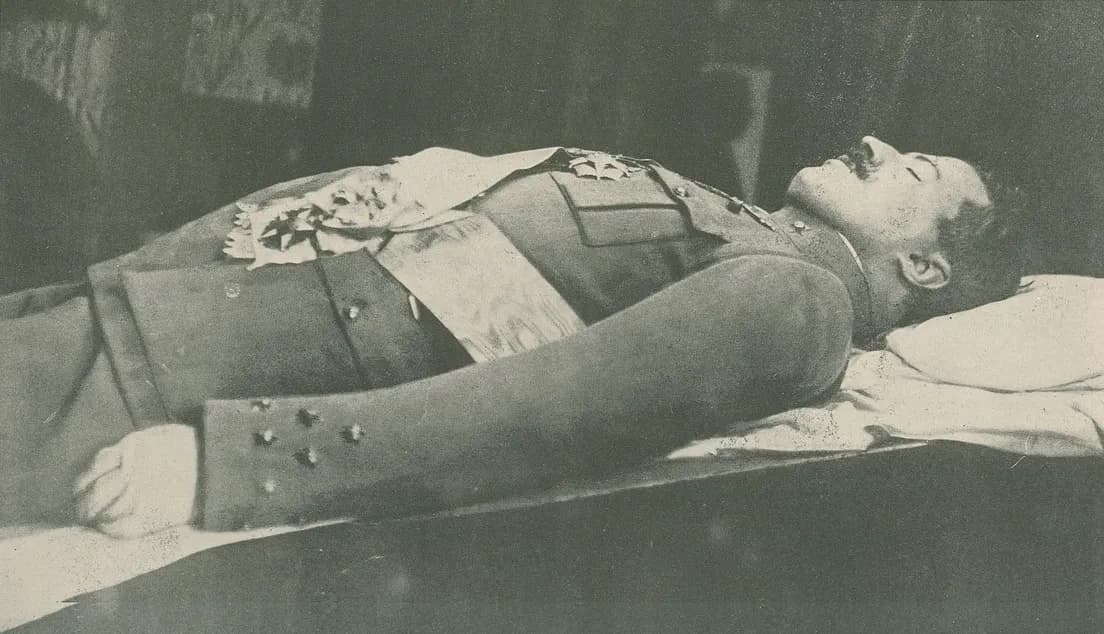
On 21 December the cortege wound from City Hall through the Chiado and along the river to the Jerónimos monastery. Newspapers claimed a million mourners, although Lisbon did not have half that many people. Some 300 or 400 beggars and cripples walked behind the coffin. In the Baixa the crash of a falling shop sign was taken for a bomb, panicking police opened fire and four people died, shot, crushed or of a heart attack.
“Perhaps the moment of greatest delirium that I witnessed in this frenzied twentieth-century homeland.”
In his will Sidónio, who said he was not religious, had asked for no pomp and a plain grave without a cross. He was buried at the Jerónimos with two crucifixes round his neck, to Beethoven's Eroica sung by pupils of the Casa Pia. A month of official mourning followed, and dozens, perhaps hundreds, of people were arrested for disrespecting his memory. In January 1919 Teófilo Duarte, one of his young officers, came back from Cape Verde, where Sidónio had made him governor, smashed the glass lid of the coffin with his sword to embrace the body, and fainted.
How he became the 'President-King'
Fernando Pessoa, then an office clerk in Lisbon, had admired Sidónio. He began an essay on 'the meaning of Sidonism' and a detective story in which his Dr Abílio Quaresma investigated the murder, and finished neither. Instead, on 27 February 1920, he published in issue 4 of the paper Acção a 240-line ode of 60 quatrains.
“Who he was, Fate knows, the Mystery knows and its law. Life made him a hero, and Death anointed him King!”
The poem fuses its 'soldier-king' with King Sebastian, the young king lost at Alcácer Quibir whom Portuguese legend says will one day return, the 'Desejado' or Desired One. 'In him, for one hour, King Sebastian took flesh,' Pessoa wrote.
In Acção the title read 'To the Memory of President Sidónio Pais'. Pessoa later added 'King' by hand to his own copy, and the 1940 edition, printed at the height of Salazar's Estado Novo, fixed 'Presidente-Rei' for good.
After Sidónio
On 16 December Congress, under the 1911 constitution now restored, elected Admiral João do Canto e Castro president, and on the 23rd João Tamagnini Barbosa became prime minister. The experiment with American-style presidential rule was over. Sidónio's followers split, and in January 1919 royalists proclaimed a Monarchy of the North in Porto.
In the 1919 elections the Democrats won 53 per cent of the vote. The Republic returned to its old instability until the military coup of 28 May 1926, which led to Salazar's dictatorship. That regime adopted Sidónio, naming an avenue after him in 1948 and moving his coffin in 1966 to the new National Pantheon in the church of Santa Engrácia.
5–8 December 1917
Sidónio leads a military coup in Lisbon
27 December 1917
He takes the presidency as well as the government
30 March 1918
Decree introduces direct election of the president
9 April 1918
The CEP is overrun on the Lys in Flanders
28 April 1918
Elected president as the only candidate
10 July 1918
Relations with the Vatican restored
October 1918
The flu peaks; a Democrat rising fails
6 December 1918
A first attempt on his life fails (5 December in some accounts)
14 December 1918
Shot dead at Rossio station
21 December 1918
Funeral procession to the Jerónimos
27 February 1920
Pessoa publishes his ode
16 March 1946
José Júlio da Costa dies, never tried
1966
Remains moved to the National Pantheon
The Museu da Presidência sees in his populism and personal rule an early sign of the totalitarian, fascist-leaning tendency of interwar Europe. Rui Ramos calls the fascist label a distortion, pointing out that Sidónio was a republican and a Freemason. António Araújo concludes that 'Sidonism' was so bound to one man that it could not outlive him, and all three agree that it died with him.
Flowers are still left on his tomb in the Pantheon, one of the few there that are regularly decorated, by anonymous visitors said to be spiritists.
FAQs
Who killed Sidónio Pais, and why?
José Júlio da Costa, a 25-year-old former army sergeant from Garvão in the Alentejo with left-wing sympathies, shot him at Rossio station on 14 December 1918. He denied having accomplices. The motive usually given is revenge for the deportation of striking farm workers from Vale de Santiago; some accounts say he believed Sidónio would restore the monarchy. Talk of a Masonic plot has never been proved.
How did Sidónio Pais come to power?
He led a military coup in Lisbon on 5 to 8 December 1917 that overthrew Afonso Costa's government and deposed President Bernardino Machado. He took the presidency on 27 December, changed the electoral rules by decree and was elected president, unopposed, by direct male suffrage on 28 April 1918.
Why was Sidónio Pais called the 'President-King'?
The name comes from Fernando Pessoa's ode to him, published in 1920 and titled 'To the Memory of the President-King Sidónio Pais' in later editions. It also fitted his style: uniforms, parades, crowds and a court of admirers that reminded contemporaries of a monarch.
Where is Sidónio Pais buried?
He was buried at the Jerónimos monastery in Belém in December 1918, moved to its Chapter House in 1953 and transferred to the National Pantheon in the church of Santa Engrácia, Lisbon, in 1966.
On the timeline
Open the timelineNearby moments from the first republic (1910–1926).
At the Cova da Iria near Fátima, a crowd estimated at 30,000 to 70,000 people witnesses the 'Miracle of the Sun' during the sixth and final apparition reported by the shepherd children Lúcia, Francisco and Jacinta, an event that made Fátima one of the great Catholic shrines of the world.
Battle of the Lys (La Lys): the Portuguese 2nd Division, about to be relieved after months in the trenches of French Flanders, takes the full force of the German spring offensive. Overrun in a single morning, it loses some 7,000 men, most of them taken prisoner — Portugal's worst defeat of the First World War. 9 April is now Portugal's official Veterans' Day (Dia do Antigo Combatente).
The painter Amadeo de Souza-Cardoso, pioneer of modernism in Portugal and friend of Modigliani and Brancusi in Paris, dies of Spanish influenza at Espinho, aged only 30.
The assassination of Sidónio Pais
President Sidónio Pais is assassinated at Lisbon's Rossio station as he arrives to catch the night train to Porto. José Júlio da Costa, a 25-year-old left-wing former army sergeant who has been waiting for him, shoots him in the chest. The charismatic 'President-King', who had seized power a year earlier, dies within minutes; four bystanders are killed in the shooting and panic that follow.
Monarchist troops under Henrique de Paiva Couceiro proclaim the restoration of the monarchy in Porto, the so-called Monarchy of the North, and a Junta Governativa do Reino takes power across much of northern Portugal. Never sanctioned by the exiled D. Manuel II, the rising collapses on 13 February, when a republican counter-coup inside Porto restores the Republic.
Death of Francisco Marto at age 10 in Aljustrel, one of the three shepherd children who reported the apparitions of Our Lady of Fátima in 1917. He died of the Spanish Flu and was canonised by Pope Francis in 2017.
The US Navy flying boat NC-4 takes off from Trepassey, Newfoundland, on the longest leg of the first transatlantic flight, reaching Horta in the Azores some 15 hours later. After a week's wait at Ponta Delgada, it lands on the Tagus at Lisbon on 27 May, the first aircraft to fly across the Atlantic.
Coming up in history
All long reads 16 December 1972Wiriyamu, 1972: the Mozambique massacre Portugal took 50 years to own up to
 17 December 1734Maria I, Portugal's first queen to reign in her own right, born 1734
 18 December 1914Naulila, 1914: Portugal's first battle with Germany, fought in Angola
 19 December 1961The end of Portuguese India: Goa, Daman and Diu, December 1961
14 sources
Archives, scholarship and reporting this article was checked against.
- 1
O Essencial sobre Sidónio Pais, by António AraújoImprensa Nacional, 2025
- 2
Sidónio Pais (biography)Museu da Presidência da República
- 3Sidónio, 100 anos depois do Presidente-Rei, by Rui RamosObservador, 8 December 2017
- 4Sidónio Pais: crónica de uma morte anunciada, by José Luís AndradeObservador, 14 December 2018
- 5
Sidónio e sidonismo entre a história e a literatura, by Armando Malheiro da SilvaRevista de História das Ideias, vol. 21 (2000); repository copy, Universidade do Porto
- 6
Surtos epidémicos ocorridos em Portugal na primeira metade do século XX. III: Gripe pneumónica, by J. A. David de MoraisMedicina Interna (Sociedade Portuguesa de Medicina Interna), vol. 19, no. 2, 2012
- 7
À Memória do Presidente-Rei Sidónio Pais, by Luísa MedeirosProjecto Modernismo, arquivo virtual da Geração de Orpheu
- 8
Ilustração Portugueza, II série, no. 670, 23 December 1918Hemeroteca Digital, Hemeroteca Municipal de Lisboa
- 9
Contributo para a sistematização dum aparente caos político: o caso da Primeira República Portuguesa, by Kathleen SchwartzmanAnálise Social, vol. XVII (65), 1981
- 10
Pais, Sidónio, by Sérgio Neto1914-1918-online. International Encyclopedia of the First World War, Freie Universität Berlin, 2019
- 11
Sidónio Pais (former presidents)Presidência da República Portuguesa
- 12
Revisitar a pneumónica de 1918-1919: introdução, by Laurinda Abreu and José Vicente SerrãoLer História, 73 (2018)
- 13
- 14
A Linha de SintraCP – Comboios de Portugal
Image credits
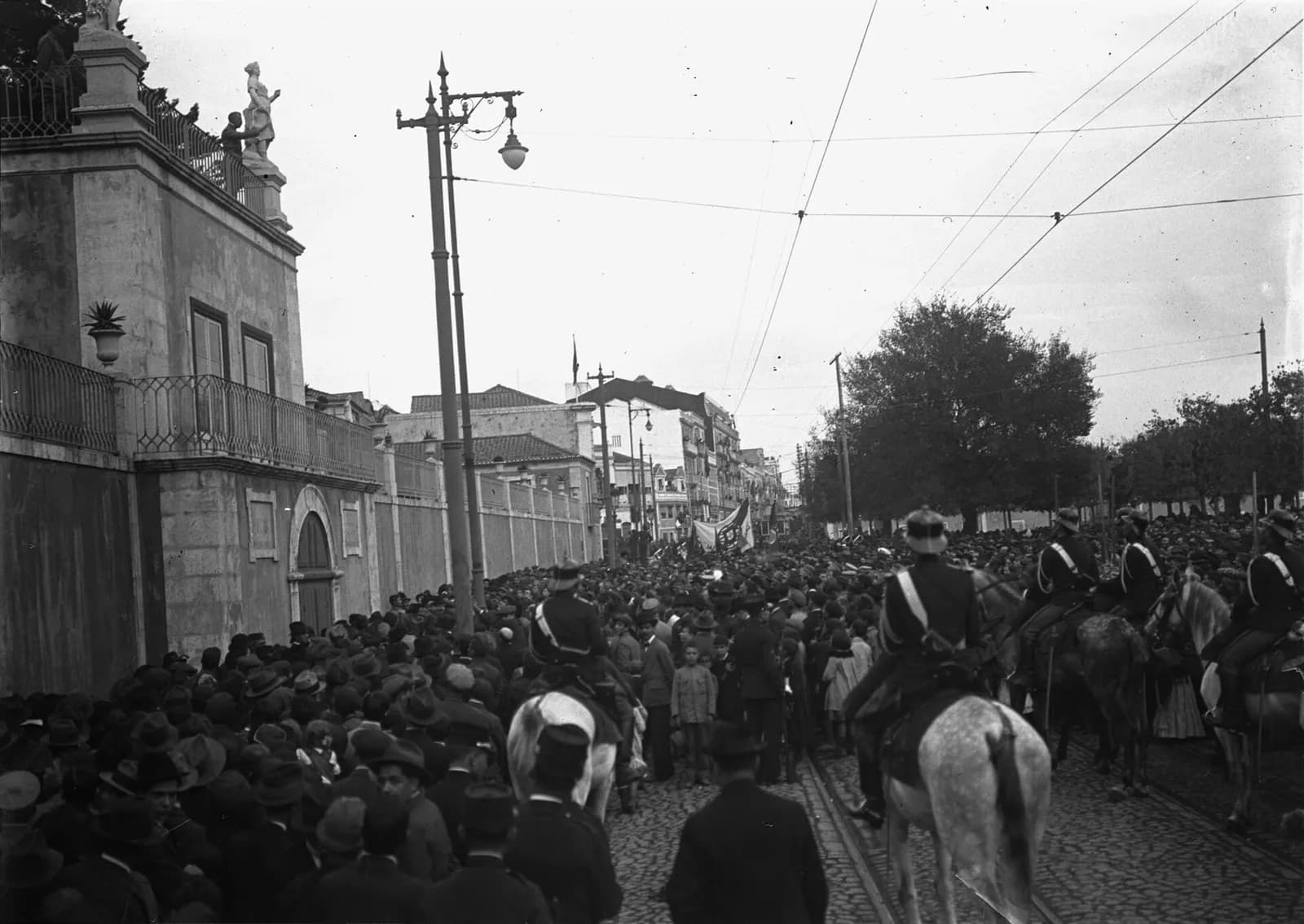
- The crowd outside the Belém palace in November 1918, when Sidónio Pais read it, from one of the palace balconies, King George V's telegram congratulating Portugal on its part in the Allied victory. A month later he was dead. Joshua Benoliel, Public domain, via Wikimedia Commons.
- The murder of Sidónio Pais as imagined on a postcard of about 1919. The station signs are Rossio's; the details of the shooting are the artist's. Unknown author, Public domain, via Wikimedia Commons.
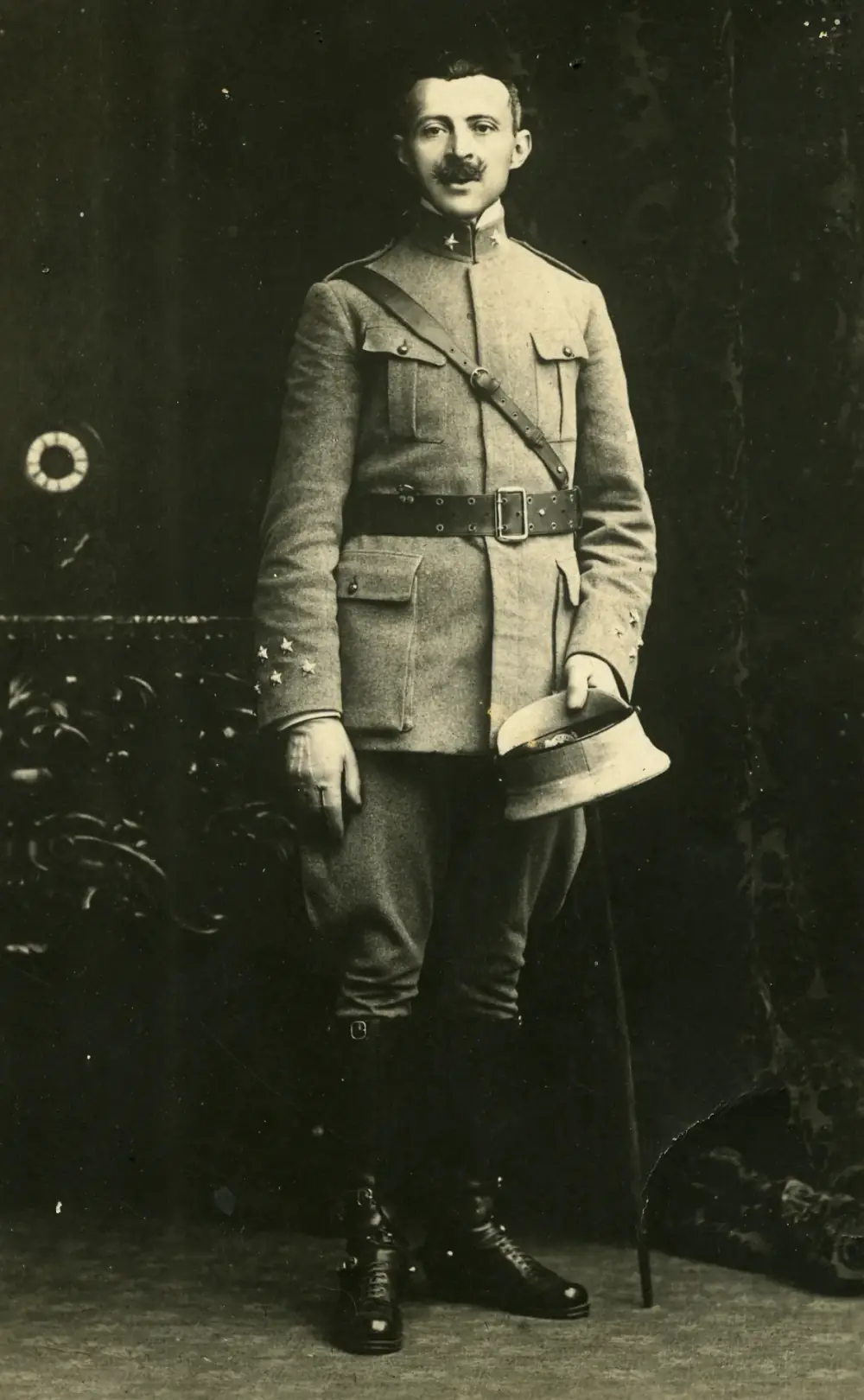
- Sidónio Pais in uniform, photographed by Octávio Bobone in 1918. A major who said he had not worn uniform for twenty years before his coup, he was rarely seen out of it as president. Octávio Bobone, Public domain, via Wikimedia Commons.
- Crowds round Sidónio's car in the Rua da Guia, in old Lisbon, in 1918, when he went to open a soup distribution for the poor run by his charity, the Obra de Assistência 5 de Dezembro. Joshua Benoliel, Public domain, via Wikimedia Commons.
- Sidónio Pais lying in state at the Belém palace, where his body was laid out in the Louis XV room, as printed in Ilustração Portugueza on 23 December 1918. Unknown author, Public domain, via Wikimedia Commons.