

Padre Himalaya, the priest who took a solar furnace to St Louis
Manuel António Gomes, a farmer's son from the Minho nicknamed for his height, spent his life trying to put the sun to work. His great mirror dazzled St Louis in 1904; his boldest claims have not aged as well.
At a glance
- Manuel António Gomes was born at Cendufe, in Arcos de Valdevez in the Minho, on 9 December 1868. Fellow seminarians in Braga nicknamed the tall boy “Himalaya”, and he kept the name.
- As a priest and science teacher he set out to concentrate sunlight hot enough for chemistry and industry, patenting a solar furnace in France in 1899 and testing machines in the Pyrenees and in Lisbon.
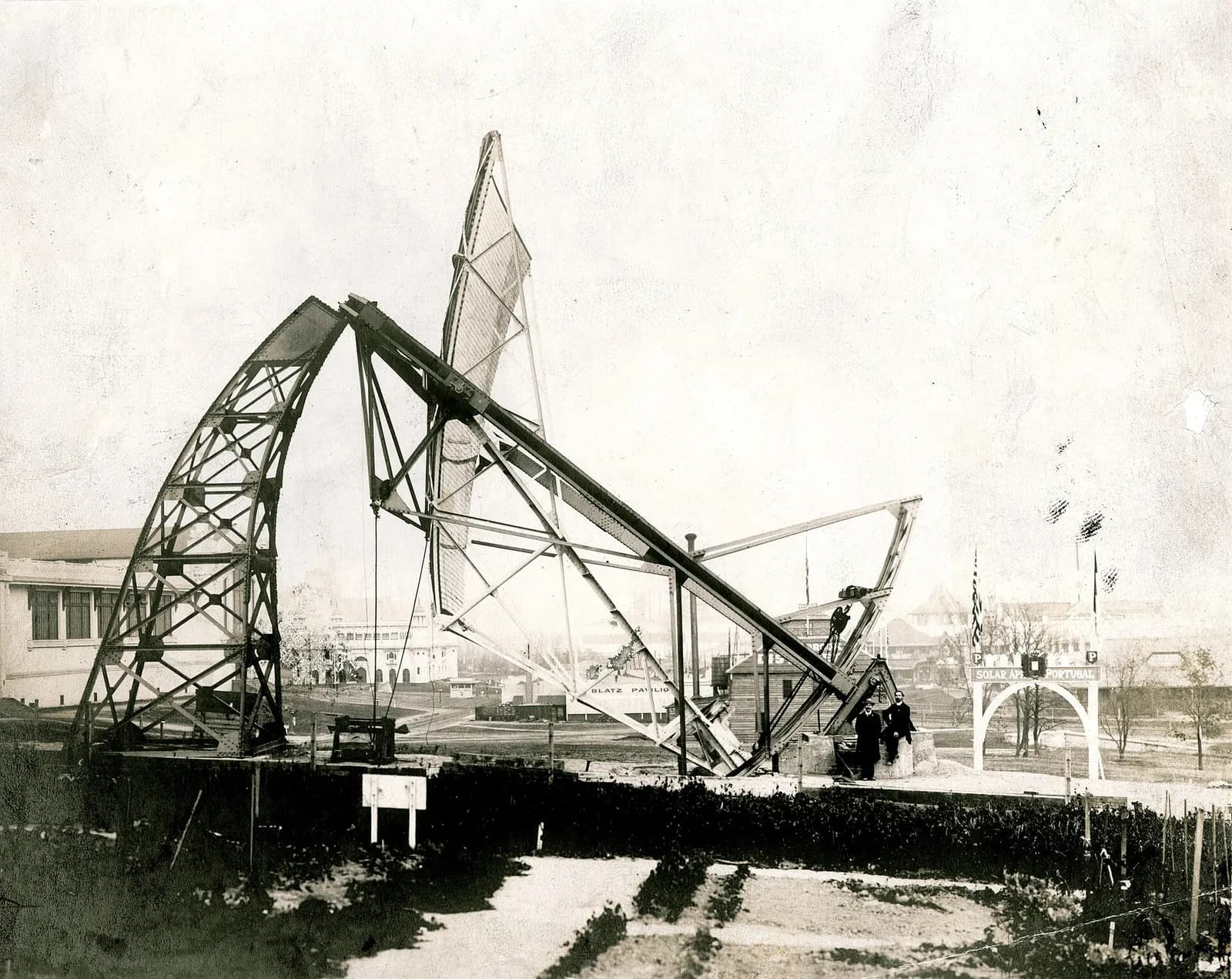
- His fourth machine, the pyrheliophor, stood about 13 metres tall at the 1904 St Louis World's Fair, with 6,117 small mirrors (one magazine counted 6,170) covering about 80 square metres.
- The New York Times reported in March 1905 that it had won a grand prize, two gold medals and a silver medal. Claims for its heat ran from 3,500°C to more than 7,000°F (about 3,870°C), and no independent measurement survives.
- He went on to patent a chlorate explosive, “himalayite”, and argued for tidal, hydroelectric and solar power. He died in Viana do Castelo on 21 December 1933, and few came to his funeral.
A blue machine on the hill
In the autumn of 1904, behind the Palace of Forestry, Fish and Game at the St Louis World's Fair, a steel frame 42 feet high and painted bright blue held a great tilted dish lined with little squares of looking glass. Visitors pressed against the wire fence around it. Some asked whether it was an airship, a “ducking machine” or a contraption for drying clothes.
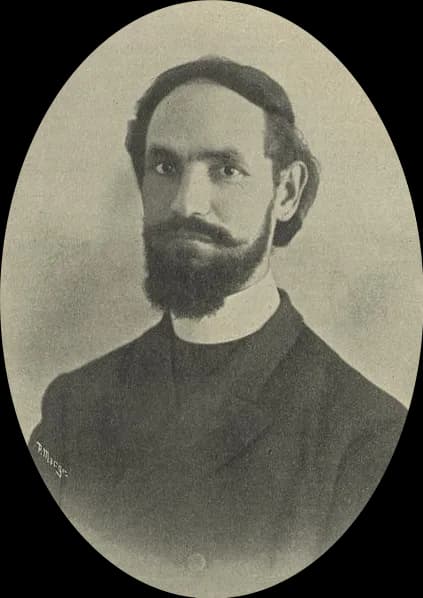
Its builder was a young, bearded Portuguese priest who called himself M. A. G. Himalaya. He and his workmen had spent more than five months putting it up. On 18 October he turned it to the sun for the first time. The day was foggy, but iron melted at the focus. The Times said magnesia crucibles melted too; a syndicated report said the magnesia was about to fuse when the sun went in and the trial was put off.
Smoke rose from the little furnace and the glare from the mirrors drew crowds. The New York Times gave him a long Sunday feature, headlined “Pyrheliophor, wonder of St. Louis Fair”, and reported, without saying who had measured it, that more than 7,000 degrees Fahrenheit had been generated. The inventor was more careful about money than about temperatures. He told the paper he had turned down capitalists who wanted to form a company.
“The sun machine is not yet in an industrial stage. It is in the scientific stage. I cannot lie to form a company, and it is necessary to lie, I am told.”
A farmer's son in the seminary
Manuel António Gomes was born on 9 December 1868 at Cendufe, a hill parish of Arcos de Valdevez in the Minho, in Portugal's far north-west. His parents farmed, and as a boy he worked the land and herded cattle.
At 14 he entered the seminary in Braga, where he read widely in science. He was very tall, so his classmates called him Himalaya. He kept the nickname for life and later used it as a surname. He was ordained a priest at about 22: in 1890 according to one account, in 1891 according to his biographer, Jacinto Rodrigues.
He became chaplain of an orphans' college in Coimbra and then a teacher. For years he taught natural science, physics and chemistry, in Coimbra and latterly in Porto. The farm boy never lost his interest in fertiliser and worn-out soil, and his admirers trace the solar machine back to that search for a way to make land more fertile.
While he was chaplain at the Visitation College in Porto, a Brazilian woman of Portuguese descent, Emília dos Santos, who studied natural science at the Sorbonne, took an interest in his ideas and paid for his first machine. In 1899, with the blessing of his superiors, he left for Paris. By 1904, the Times reported, the Archbishop of Braga had freed him from clerical duties so that he could give his life to science.
Paris, the Pyrenees and Lisbon
In Paris he attended lectures by the chemist Marcellin Berthelot and others, and worked on the geometry of an apparatus to gather sunlight to a point. In 1899 the French government granted him a patent for it. In 1900 he built a second machine and tested it high in the eastern Pyrenees, reaching, by his account, 1,100°C.
The site was on the slopes above the village of Sorède, not far from the ruined Château d'Ultrera. Equipment went up by mule, and he built a dish 7 metres across. Its circular rail can still be seen.
On 30 August 1901 he applied for a United States patent for a “solar apparatus for producing high temperatures”: a truncated paraboloid of mirrors that could be turned to follow the sun and throw its light into a furnace or crucible standing outside the mirror. It was meant for metallurgical and chemical research at temperatures beyond those of ordinary furnaces, including the electric furnace.
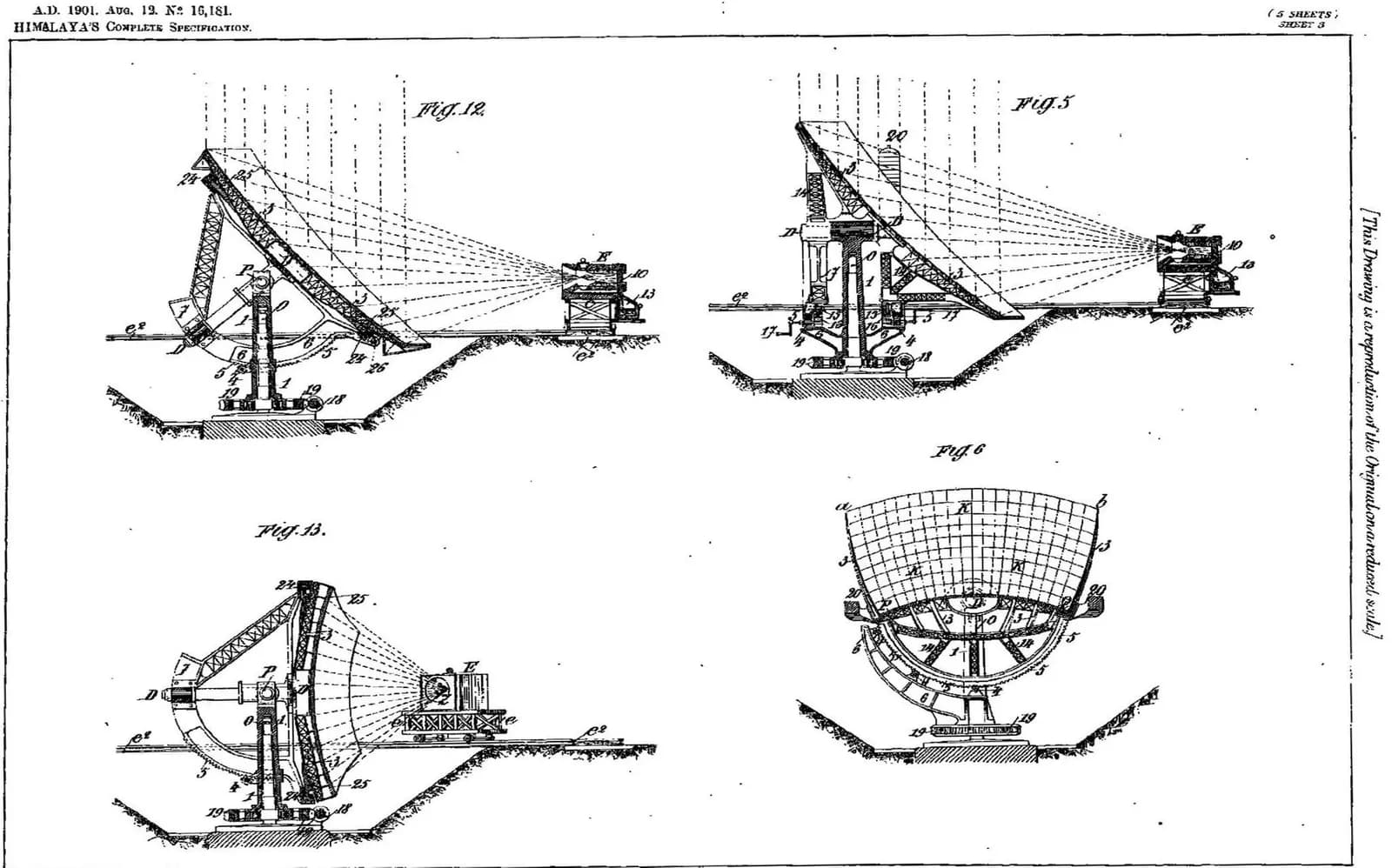
Back in Portugal in 1902 he built a third machine in Lisbon. With it, he reported, he reached 2,000°C and melted a large block of basalt. Scientific American, which gave the same figure, noted that the Lisbon apparatus was much smaller than the one he built next.
The pyrheliophor at St Louis
The Louisiana Purchase Exposition, which opened in St Louis on 30 April 1904, commemorated the United States' acquisition of the Louisiana Territory from France. By May Himalaya had arrived. The Iron Age announced that a Portuguese priest had come with an invention to melt anything by the sun's rays, and had been granted space outside the Palace of Liberal Arts. The fair's guides described a 30-ton apparatus on a plot of 100 by 60 feet, and the official one added: “It is claimed that the machine will melt anything.”
The official guide said the project would go up under the auspices of the Portuguese commission, and the official catalogue listed his “solar apparatus” in Portugal's section, among instruments of precision and scientific apparatus. Later Portuguese accounts say the official delegation was reluctant to back it, and that he got permission directly from the fair's management.
The Times called the sun machine practically Portugal's contribution to the fair, though the same catalogue lists Portuguese photographs, books and atlases in the exhibition palaces. The Portuguese minister in Washington, the Viscount of Alte, attended the experiments.
Building it was costly. The money came, the Times said, from a rich woman of the Portuguese royal court and a philanthropist in Paris, and a fair guide noted that “Pinto Leite of Lisbon” had come with the inventor. The Lisbon government gave what one later account calls only “moral support”. An officer of the Portuguese Royal Artillery, Captain Francis Xavier de Brito as the Times called him, took five months' leave to adjust the mirrors.
- Name
- Pyrheliophor, from the Greek for “I bring the fire of the sun”
- Height
- 42 feet (about 12.8 m) to the top of the reflector
- Mirrors
- 6,117 in the New York Times, Buel and O Occidente; 6,170 in Scientific American
- Mirror size
- 122 by 100 mm each in Scientific American; the Times gave 5 by 10 inches
- Mirror area
- 861 square feet, about 80 m²
- Focus
- A spot about six inches (15 cm) across, inside a magnesia-lined crucible
- Tracking
- A clockwork drive kept the mirror facing the sun
- Cost
- $4,000 to put up, according to the Times
- Claimed peak
- 6,800 to more than 7,000°F (about 3,760 to 3,870°C), in press reports; never independently measured
The mirror was not one piece of glass. Thousands of small flat squares were screwed to steel slats, each angled so that its reflection landed on the same small spot. A crucible about the size of a barrel sat at the focus, lined with magnesia because, the Times said, the graphite lining of his Paris machine had given way at 2,000°C.
Himalaya wanted winter sun, when the air was dry. In his view the machine could one day raise steam and drive engines in places such as Arabia or California, where the sun shone all year, but in cloudier St Louis he meant to use it for science only. The Times reported that birds flying 40 feet above the mirror were killed by the reflected heat.
A grand prize, and a temperature nobody measured
In March 1905 the Times reported that the international jury had given the pyrheliophor the grand prize, two gold medals and a silver medal, and that no other invention in its group, physical and astronomical instruments, was so honoured. The Lisbon magazine O Occidente reported a grand prix in 1906, and Portuguese historians repeat it.
Lisboeta could not find the award in the fair's official records available online. A multi-volume history of the fair, edited by J. W. Buel, praised the machine in its chapter on Catholic exhibitors and listed the grand prize won there by the Manila Observatory, but it mentions no award for Himalaya.
The temperatures are harder to take on trust. In late October, Scientific American recorded his view that 3,500°C, the boiling point of carbon as measured by the French physicist Jules Violle, was the highest temperature on record, and that he expected to beat it. Buel's chapter claimed over 6,000°F, and 6,800°F “registered” on clear days. The Times claimed more than 7,000°F in November and 6,800°F in March.
Peak temperatures claimed for Himalaya's solar furnaces, with Odeillo today
°C
The three Himalaya figures are claims of the time, as given by Ciência Viva (Scientific American also gave 2,000°C for Lisbon); none was independently measured. American press claims for St Louis ran higher still, 6,800 to more than 7,000°F, about 3,760 to 3,870°C. The Odeillo figure is the maximum given by France's CNRS for its 1 MW research furnace, which began operating in 1969.
Show the data
| Claimed peak (Odeillo: rated maximum) | |
|---|---|
| Pyrenees, 1900 | 1,100 |
| Lisbon, 1902 | 2,000 |
| St Louis, 1904 | 3,500 |
| Odeillo furnace, today | 3,300 |
His theories also ran ahead of his evidence. In St Louis he announced that the sun's heat was of electric origin. After the fair he told the Times that concentrated moonlight felt warmer on the skin than a thermometer showed, and that a sick person's thermometer could be pushed up by an abnormal flow of “vital fluid”.
| Machine | Concentrating surface | What it did, as reported |
|---|---|---|
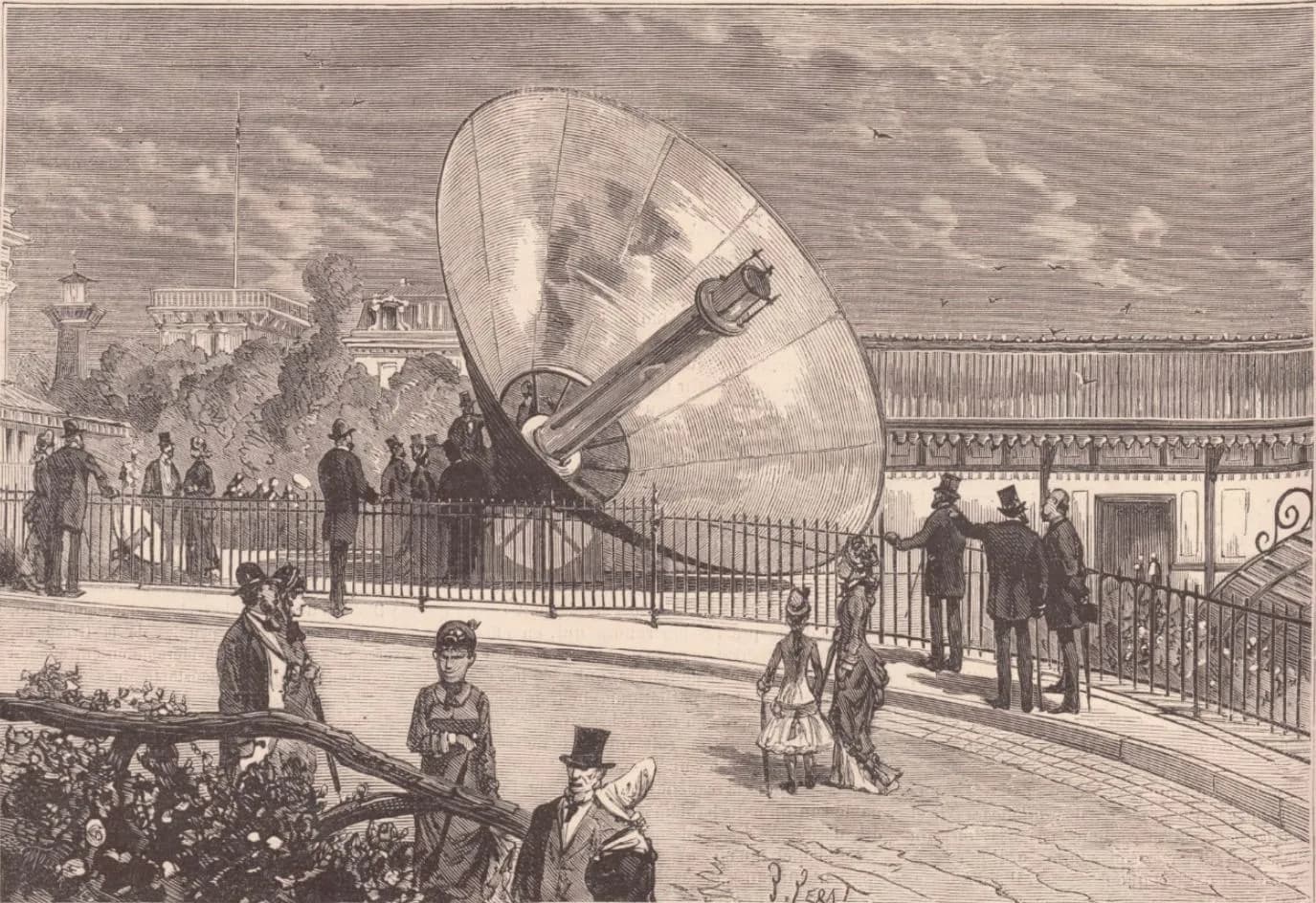
| Mouchot's solar engine, Paris, 1878 | One mirror, about 20 m² | Boiled water to run a small steam engine and pump |
| Himalaya's pyrheliophor, St Louis, 1904 | 6,117 small flat mirrors, about 80 m² | Melted iron; claimed 3,500°C to over 7,000°F |
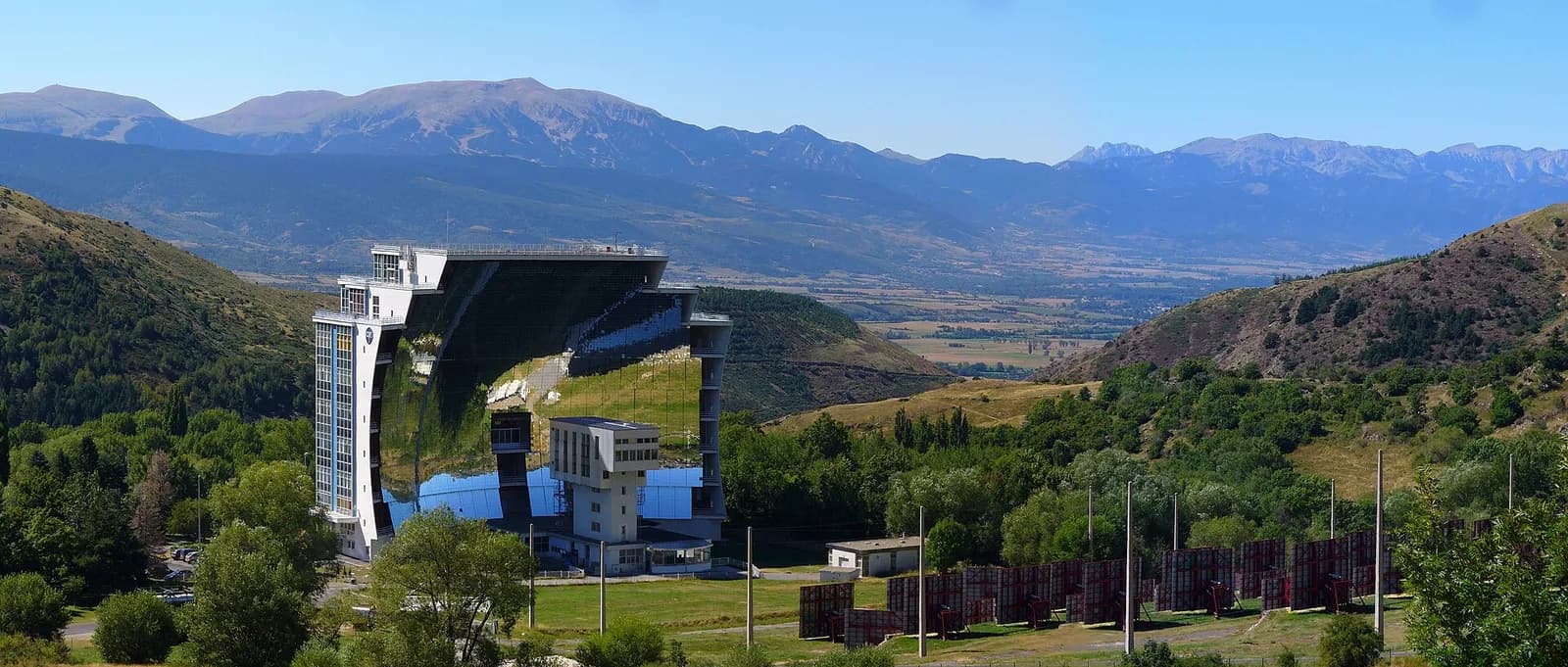
| CNRS solar furnace, Odeillo, from 1969 | 63 heliostats and a 54 m mirror-covered building | 1 MW of heat; up to 3,300°C |
Figures as given by the cited sources; the St Louis temperatures are the inventor's and the press's claims, not independent measurements.
Himalayite and other schemes
The pyrheliophor had cost $4,000 to put up, the Times reported in March 1905, and moving it would cost as much again, so it was left standing on its hill in St Louis. Speaking little English, Himalaya had been largely overlooked by the fair's scientific congress. On the advice of Dr Woodward of the Carnegie Institution he moved to Washington to write a book.
No investor took up the sun machine, and he turned to explosives. His “process of making smokeless powder”, filed in February 1906 and granted in May 1907, worked fine potassium chlorate into starch grains without breaking them and added a drying oil. He called the powder himalayite.
He claimed it was cheap, safe to handle and free of corrosive fumes. Back in Portugal in 1906, he repeated his tests near Sintra before King Carlos and the minister of war. A military review, cited by a German explosives journal, reported trials in 15 cm and 7.5 cm shells in which it was said to fragment better than melinite, a standard military explosive.
The same journal was less impressed by the Lisbon press, which reported that he had turned down several million dollars in America so that Portugal could have the honour of making the powder.
“Lisbon daily papers are currently advertising it with a grandiosity vividly reminiscent of the inventor's name.”
A company began making himalayite in 1911. It was not used as a weapon in Portugal but in mining, forestry and other work, including tree-planting campaigns in which it blasted the holes for saplings. His other inventions included a direct engine and a turbine, a food flour made from crustaceans and bran, and a scheme to turn sewage into fertiliser.
He also tried to make rain with cannon fire and designed turbines for tidal power and windmills. He urged that Portugal's many rivers be harnessed for hydroelectric power, and wrote about agriculture, irrigation and the economy. In 1908 he spoke on the country's economic, agricultural and commercial crisis at a congress of the Catholic Partido Nacionalista in Viseu.
“Father Himalaya was a mix of Jules Verne and Edison. Perhaps he lacked the capacity to make his inventions real, as the American inventor did. He certainly did not have the same economic means. But it may also be that his imagination was too fanciful to become workable!”
Viana do Castelo, 1933
His later life is less well documented, partly because many of his letters and papers were burned by a relative who did not know what they were. He lived for long spells abroad, in the United States and Argentina among other places, still chasing backers. He stayed a priest, though he criticised compulsory celibacy and fasting in letters to his brother Gaspar.
He died in Viana do Castelo on 21 December 1933, aged 65, with his housekeeper Rosa Cerqueira beside him. According to Lemos, he fell ill after testing one of his own remedies. Few people came to the funeral, and the Porto daily O Primeiro de Janeiro remarked on the absence of Catholic notables.
9 December 1868
Born at Cendufe, Arcos de Valdevez
c. 1882
Enters the seminary in Braga, aged 14
1890 or 1891
Ordained priest; chaplain in Coimbra, later a science teacher in Porto
1899
Moves to Paris and obtains a French patent for a solar furnace
1900
Tests a second machine in the Pyrenees, above Sorède
30 August 1901
Applies for a US patent, granted in 1905
1902
Third machine in Lisbon; 2,000°C reported
May 1904
Arrives at the St Louis World's Fair
18 October 1904
First trial of the pyrheliophor
March 1905
New York Times reports a grand prize, two gold and one silver medal
1906
Returns to Portugal and demonstrates himalayite
1911
Production of himalayite begins
21 December 1933
Dies in Viana do Castelo
Why he is remembered
For decades he was a footnote. His revival owes most to Jacinto Rodrigues, an emeritus professor of the University of Porto who taught in its architecture faculty, whose biography A Conspiração Solar do Padre Himalaya appeared in 1999. A documentary, A Utopia do Padre Himalaya, followed in 2004, and for the centenary of the St Louis award the science agency Ciência Viva named a solar competition after him.
In Sorède, an association of his admirers founded in 2005 rebuilt his 1900 furnace from photographs, and in 2013 the village put up a sundial in a square named Place Padre Himalaya. Rodrigues's research page records the association calibrating the replica's mirrors in November 2015. In August 2013 his home municipality, Arcos de Valdevez, unveiled a monument to him by the sculptor José Rodrigues, the biographer's brother.
He is often called Portugal's pioneer of renewable energy, and the country now gets most of its electricity from renewable sources. In 2024, according to the renewable energy association APREN, solar panels produced a record 4,898 GWh, 10.7% of the electricity generated in mainland Portugal, and renewables met 71.5% of consumption; the grid operator REN put that share at 71%.
The link is looser than it looks. His mirror furnace was built to make heat for chemistry and metallurgy. Today's solar panels turn light straight into electricity, something he only speculated about in St Louis in 1904.
What can be said with confidence is narrower than the legend. He built a solar concentrator with four times the mirror area of Mouchot's 1878 engine, ran it in public and won praise for it, and by the Times's account a grand prize and medals. The record temperatures, and the theories he drew from them, rest on his own word.
FAQs
Who was Padre Himalaya?
Manuel António Gomes (1868–1933), a Portuguese Catholic priest and self-taught inventor from Cendufe, in Arcos de Valdevez. His seminary classmates nicknamed him Himalaya for his height. He is remembered for his solar furnace, the pyrheliophor, shown at the 1904 St Louis World's Fair, and for an explosive called himalayite.
What was the pyrheliophor?
A steel-framed solar furnace about 13 metres tall. Some 6,117 small flat mirrors, covering about 80 square metres, focused sunlight onto a spot about 15 cm across inside a crucible, and a clockwork drive kept the mirror turned to the sun.
Did the pyrheliophor win the Grand Prize at St Louis?
The New York Times reported in March 1905 that it won the grand prize, two gold medals and a silver medal in the group of physical and astronomical instruments, and Portuguese sources from 1906 onwards say the same. Lisboeta could not find the award in the fair's official records available online, and J. W. Buel's history of the fair, which praised the machine, mentions no award for it.
How hot did Padre Himalaya's solar furnace get?
Claims range from 3,500°C to more than 7,000°F (about 3,870°C), but no independent measurement survives. On its first, foggy trial it melted iron. A Lisbon magazine explained a figure of 6,117 degrees as one degree per mirror. Today's 1 MW solar furnace at Odeillo reaches up to 3,300°C.
What was himalayite?
A chlorate explosive that Himalaya patented in the United States in 1907, made from potassium chlorate, starch and a drying oil. A Portuguese company produced it from 1911 for mining, forestry and other work, including blasting holes for tree planting.
On the timeline
Open the timelineNearby moments from regeneration and the last kings (1851–1910).
Birth at Seixas, near Caminha, of Miguel Ventura Terra, the Paris-trained architect who shaped belle-époque Lisbon. He redesigned the debating chamber of the parliament at São Bento, built the Shaaré Tikvá synagogue, the Liceu Camões and the Teatro Politeama, and won the city's Valmor architecture prize four times.
A landmark royal decree abolishes the death penalty for civil crimes in Portugal — one of the earliest abolitions in the world — and promulgates the new Civil Code drafted by Visconde de Seabra, a foundational text of modern Portuguese law.
António Nobre, whose only book 'Só' became a landmark of Portuguese symbolist and saudosista poetry, is born in Porto.
Padre Himalaya, solar pioneer
Birth of Manuel António Gomes, the 'Padre Himalaya', at Cendufe, Arcos de Valdevez. A priest so tall he was nicknamed after the mountains, he was a pioneer of solar power: his 'pyrheliophor', a 13-metre-high frame holding 6,117 small mirrors that melted metals with sunlight, was reported to have won a grand prize at the 1904 St Louis World's Fair and was hailed by the 'New York Times'.
Carlos Viegas Gago Coutinho is born in Lisbon. A naval officer and geographer who adapted the sextant for use in aircraft, he navigated the first aerial crossing of the South Atlantic with Sacadura Cabral in 1922, a feat celebrated on both sides of the ocean.
A decree championed by the Marquis of Sá da Bandeira abolishes slavery throughout the Portuguese empire. But the people it freed became 'libertos', still obliged to serve their former masters until a further law in 1875, and forced labour persisted in the African colonies well into the 20th century.
Óscar Carmona is born in Lisbon. The general who emerged as the leading figure of the military dictatorship after the 1926 coup, he remained head of state until his death in 1951, the figurehead under whom Salazar built the Estado Novo.
Coming up in history
All long reads 11 December 1826The death of Empress Leopoldina in Rio de Janeiro, 11 December 1826
 12 December 1976Portugal elects its town halls: the first free local elections, 1976
 13 December 2007The Treaty of Lisbon: EU leaders sign at Jerónimos, 13 December 2007
 14 December 1918Murder at Rossio: the assassination of Sidónio Pais, 14 December 1918
24 sources
Archives, scholarship and reporting this article was checked against.
- 1
“Pyrheliophor, wonder of St. Louis Fair: sun machine invented by Father Himalaya, a Portuguese priest, generates 7,000 degrees heat Fahrenheit”, The New York Times, 6 November 1904The New York Times, via Internet Archive
- 2
- 3
- 4
Concurso Solar “Padre Himalaya”Ciência Viva, Agência Nacional para a Cultura Científica e Tecnológica
- 5
Padre Himalaya: o retrato de um utopista português (Márcia Lemos)E-topia: Revista Electrónica de Estudos sobre a Utopia, no. 11 (2010), Faculdade de Letras da Universidade do Porto
- 6
- 7
- 8
O Padre Himalaya (1868–1933), pioneiro das energias renováveis (António Mota de Aguiar)De Rerum Natura (blog of science historians and teachers), 23 October 2011
- 9
- 10
Manuel António Gomes (Padre Himalaya)Utopia 500, CETAPS, Faculdade de Letras da Universidade do Porto
- 11
P. Himalaya (research page of Jacinto Rodrigues, his biographer)Jacinto Rodrigues, Itinerários, Encruzilhadas e Aproximações
- 12
- 13
Did you know that over a hundred years ago, Sorède was a pioneer village where solar energy was concerned?P-O Life (Pyrénées-Orientales magazine)
- 14
US Patent 797,891: Solar apparatus for producing high temperatures (Manuel Antonio Gomes Himalaya; filed 30 August 1901, granted 22 August 1905)United States Patent Office, via Google Patents
- 15
- 16
- 17
- 18
- 19
- 20
- 21
Odeillo: an instrument featured on stampsCNRS Images
- 22
- 23
- 24
Capacidade instalada de energias renováveis aumenta 8% em 2024Lusa, in DNOTICIAS.PT, 7 January 2025
Image credits
- The pyrheliophor at the Louisiana Purchase Exposition, St Louis, in 1904. The arch on the right announces the solar apparatus of Portugal. Unknown author, Public domain, via Wikimedia Commons.
- Manuel António Gomes Himalaya, printed in the Lisbon magazine O Occidente in November 1906, soon after his return from the United States. Unknown author, Public domain, via Wikimedia Commons.
- An engraving by Jules Férat of Augustin Mouchot's solar concentrator, published in 1878, the year Mouchot showed his sun-driven engine at the Paris Universal Exposition. Jules Férat, Public domain, via Wikimedia Commons.
- A sheet from Himalaya's British patent no. 16,181, filed on 12 August 1901, showing how the mirror tilts to follow the sun and sends the light into a separate furnace. Manuel António Gomes Himalaya, Public domain, via Wikimedia Commons.
- The CNRS solar furnace at Odeillo in the French Pyrenees, photographed in 2010, with its field of flat heliostats in the foreground. It is in the same French department as Sorède, where Himalaya tested his machine in 1900. H. Zell, CC BY-SA 3.0, via Wikimedia Commons.