

The death of Afonso Henriques, 1185: Portugal's first king and his legends
He took power in a skirmish near Guimarães in 1128 and died 57 years later as a king the pope had finally recognised. Much of what Portugal remembers about him was added afterwards, and his bones have never been studied scientifically.
At a glance
- Afonso Henriques, the first king of Portugal, died on 6 December 1185. Three days later his son Sancho entered Coimbra and began to reign, according to annals kept in Coimbra.
- He took control of the County of Portugal after beating his mother's party at São Mamede, near Guimarães, on 24 June 1128, and was calling himself king from about 1140.
- Alfonso VII of León accepted the new situation at Zamora in 1143, but the pope did not recognise him as king until the bull Manifestis probatum of 23 May 1179.
- He moved the frontier from the Mondego to the Tagus and beyond, taking Santarém and Lisbon in 1147, but was captured at Badajoz in 1169 with a broken leg.
- He lies in a tomb of about 1520 in Santa Cruz, Coimbra. A 2006 plan to study his bones was stopped as workmen were removing a stone panel, and his height remains a legend.
A December death in Coimbra
The Coimbra annals known as the Chronicon Conimbricense give the event a single line. On the eighth day before the ides of December, in the Era 1223, which is 6 December 1185, “King Ildefonsus of Portugal died” (translated from Latin). The next entry follows: three days later, on the feast of Saint Leocadia, King Sancho entered Coimbra and began to reign in his father's place.
The dead king was in his mid-seventies; the same annals date his birth to 1109, though other years have been proposed. He had held power for 57 years, most of them at war.
His last years were not triumphant. Sixteen years earlier he had broken a leg in a gate at Badajoz and been taken prisoner by the king of León. A Portuguese chronicle later claimed that he went back to Coimbra, never sat on a horse again and travelled in a cart. In the summer of 1184 the Almohad caliph himself had besieged Santarém for five weeks.
Yet when he died, the frontier lay beyond the Tagus, the pope had called him king, and he was buried in Santa Cruz, the monastery he had endowed and where he kept his treasure.
What you need to know first
In the early twelfth century there was no Portugal. There was a County of Portugal, held from the king of León by Teresa, a daughter of King Afonso VI, and her husband, Henry of Burgundy. Afonso Henriques, “Afonso son of Henry”, was their son.
Henry died young. Teresa governed and found a new ally in a Galician nobleman, the count of Trava. The historian José Mattoso explains how the young Afonso claimed royal rank through his mother, the daughter of a king, but in 1128 was in fact a lord chosen by other lords who had no wish to bow to a Galician count.
- Born
- 1109, according to the Coimbra annals (1106 and 1111 have also been proposed)
- Parents
- Count Henry of Burgundy and Teresa, daughter of Afonso VI of León
- Married
- Mafalda of Savoy, in 1146
- Died
- 6 December 1185, Coimbra
- Buried
- Monastery of Santa Cruz, Coimbra
- Successor
- His son Sancho I, born on 11 November 1154
From São Mamede to Ourique
The break came on 24 June 1128, the feast of Saint John. On the field of São Mamede, near the castle of Guimarães, Afonso defeated the supporters of his mother and the Trava family and drove them out. The Chronica Gothorum, a set of Latin annals from the twelfth century, says that on that day he entered upon the kingdom, “or rather the principality”, of Portugal.
Mattoso writes that São Mamede might have been no more than a feudal skirmish; it mattered because of what came after. Afonso settled in Coimbra, a frontier city facing Muslim al-Andalus, in 1131, and from 1135 raided south from there. There he backed a new house of canons, Santa Cruz, founded in 1131 by the archdeacon Telo, the cathedral schoolmaster João Peculiar and eleven other canons, on the site of royal baths he gave them.
On 25 July 1139, the feast of Saint James, he fought a large battle against a Muslim king the chronicles call Esmar, at a place they name Ouric or Aulic, “then the heart of the land of the Saracens”. The Chronica Gothorum describes the Portuguese camped on a height and surrounded from morning to evening, a charge by picked knights, and the flight of the enemy. It adds that Muslim women fought in the manner of the Amazons and were found among the dead.
That is all the twelfth-century record says. It counts the battle in the eleventh year of his reign, dated from 1128, and mentions no crown. Mattoso allows that his knights may have acclaimed him king on the field, as was the custom in Navarre, and that he was hailed again in a triumphal procession into Coimbra. What is documented is that from about 1140 his chancery began to give him the title of king.
A king waiting for Rome
A title needed recognition. In 1143 the papal legate, Cardinal Guido de Vico, travelled to Coimbra and Zamora, where Afonso met his cousin Alfonso VII of León and Castile, who styled himself emperor. Their meeting on 5 October 1143 is remembered as the Treaty of Zamora, which Mattoso puts in inverted commas. After it, the fighting between the two men stopped.
The Torre do Tombo, Portugal's national archive, notes the catch: the pope's representative at Zamora still called Afonso only dux portucalensis, duke of Portugal, and the pope's word counted for more than any neighbour's.
So Afonso went over Alfonso VII's head. In a letter known from its opening words as Claves regni coelorum, he declared himself a vassal of Saint Peter and promised a yearly payment in gold. João Peculiar, by then archbishop of Braga, carried the letter to Rome in 1144. Mattoso thinks it was Peculiar's idea.
Rome took 36 years to answer in full. Pope Alexander III signed the bull Manifestis probatum, “it is clearly shown”, on 23 May 1179, when Afonso was nearly 70. It called him king of the Portuguese, granted him the kingdom and confirmed his right to the lands he had taken or would take from the Muslims. Peculiar did not live to see it; he died in 1175.
“We grant and confirm by apostolic authority to your exalted dominion the kingdom of Portugal, with the full honours of a kingdom and the dignity that belongs to kings.”
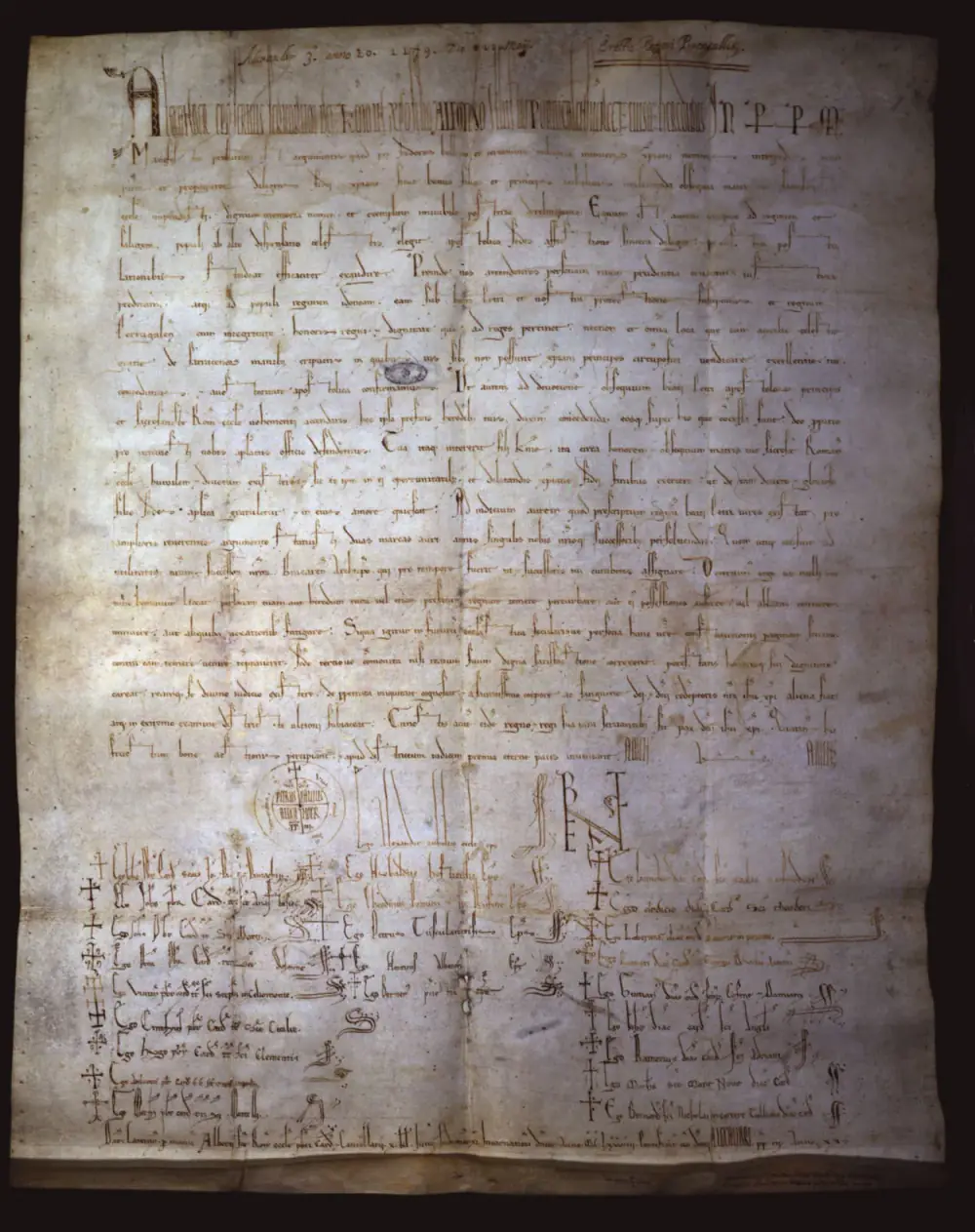
Mattoso reads the bull as Rome's final acceptance of a fact on the ground. The other Iberian kings already treated Afonso as one of them: his daughter Urraca married Fernando II of León, and in 1174 his son Sancho married Dulce, sister of the king of Aragon.
Pushing the frontier south
Afonso's reputation rests on war. In 1135 he began building the castle of Leiria to stop raiders reaching the fields of Coimbra. Then, in a surprise attack at dawn on 15 March 1147, he took Santarém on the Tagus with a small force; one copy of the annals gives a date in May instead. The siege of Lisbon followed that summer and autumn, with a fleet of northern crusaders on its way to the Holy Land; it has its own article.
The push continued into the Alentejo. Alcácer do Sal, on the Sado, fell on the feast of Saint John in June 1158 after a siege of about two months; two earlier attempts with the help of passing crusader fleets had failed. Beja was taken at night on 30 November 1162 by a band led by Fernando Gonçalves. Évora was surprised at night by Geraldo, nicknamed “the Fearless”, a freebooter who handed it to the king. The Coimbra annals put this in 1166; an Arabic chronicle quoted by the historian Guillermo Kurtz gives 1165.
Badajoz ended the run. In 1169 Afonso came to help Geraldo, who had entered the town but not its citadel, held for the Almohads. Fernando II of León, his son-in-law, marched to relieve it. According to the chronicles, as Afonso rode out through the gate he struck his leg on the iron bolt, broke it and was captured. The Portuguese annals date the disaster to 1168, but for almost a year afterwards Leonese charters of 1169 and 1170 were dated by the year in which King Fernando captured the king of the Portuguese at Badajoz.
To be freed he gave up the castles he had taken in Galicia. The Portuguese chronicles say he swore to present himself to Fernando as soon as he rode again, and so never mounted a horse again. Kurtz reads this as a face-saving story: a man near sixty with a bad fracture probably could not ride.
c. 1109
Birth
The Coimbra annals give 1109; 1106 and 1111 have also been proposed.
24 June 1128
São Mamede
Afonso defeats his mother's party near Guimarães and takes over the county.
1131
Coimbra
He settles in Coimbra; Santa Cruz is founded on land he gives.
25 July 1139
Ourique
Victory over the Muslim leader Esmar.
5 October 1143
Zamora
Meeting with Alfonso VII and the papal legate; Afonso then offers himself as vassal of the pope.
1146
Marriage
He marries Mafalda of Savoy.
15 March 1147
Santarém
Taken in a surprise attack at dawn. Lisbon falls in October.
June 1158
Alcácer do Sal
Taken after a two-month siege.
1162 to 1166
Beja and Évora
Beja on 30 November 1162; Évora in 1165 or 1166, by Geraldo the Fearless.
1169
Badajoz
Afonso breaks a leg and is captured by Fernando II of León (the Portuguese annals say 1168).
15 August 1170
Sancho knighted
His father arms the heir at Coimbra.
1179
Will and bull
Will in February; Manifestis probatum on 23 May.
June 1184
Santarém besieged
The Almohad caliph besieges the town for five weeks and is driven off.
6 December 1185
Death
Sancho enters Coimbra on 9 December and begins to reign.
The will, the heir and the last siege
Only one of his three legitimate sons survived. Born on the night of Saint Martin, 11 November 1154, he was baptised Martinho but known as Sancho. On 15 August 1170, a year after Badajoz, his father knighted him at Coimbra, and José Marques describes him as associated with his father's government in the years that followed.
In February 1179, three months before the papal bull, Afonso made his will, disposing of 22,000 maravedis, the coins of the day, deposited at Santa Cruz. Clerks drafted it, but Marques argues that it reflects the king's own concerns: the military orders, the churches being built, a bridge over the Douro and the poor of most dioceses.
Bequests in Afonso Henriques's will of February 1179
maravedis
Our grouping of the sums in the will, from the translation by Amadeu Torres printed by José Marques. “The poor” adds four gifts (Lisbon diocese, eight towns from Santarém to Pombal, Coimbra, and Braga, Porto and Tui); “Church building” adds Lisbon (1,000) and seven churches at 500 each. The Hospital also received 8,000 mozmodis and silver, and Santa Cruz 989.5 mozmodis with the king's horses, mules and Muslim captives. The bars add up to 24,970, more than the 22,000 named. The will says the Douro and Évora money had already been given, which leaves less than 22,000; Marques does not reconcile the figures.
Show the data
| Maravedis bequeathed | |
|---|---|
| Hospital of Jerusalem | 6,000 |
| The poor | 6,000 |
| Church building | 4,500 |
| Other monasteries | 3,210 |
| Douro bridge | 3,000 |
| Santa Cruz | 1,000 |
| Defence of Évora | 1,000 |
| Three hospitals | 260 |
The last great crisis of the reign came from the south. The Almohads, a North African dynasty that ruled al-Andalus, were striking back: in 1179 an army besieged Abrantes, and in 1180 another destroyed the castle of Coruche. On 23 June 1184, the eve of Saint John, their caliph Abu Yaqub Yusuf arrived before Santarém with his army, laid waste the surrounding country and stayed five weeks.
The siege failed and the caliph died during the campaign. The Chronica Gothorum calls it a very great victory for Afonso; later chroniclers gave the defence to Sancho, with the old king leading the relief army. Eighteen months later Afonso was dead.
Santa Cruz and the tomb
He was first buried in a plain grave at Santa Cruz. The seventeenth-century chronicler António Brandão, quoted by the Coimbra antiquarian Augusto Simões de Castro in 1885, wrote that it was covered with a simple cloth until King Duarte, in the fifteenth century, gave it a canopy of silk and gold.
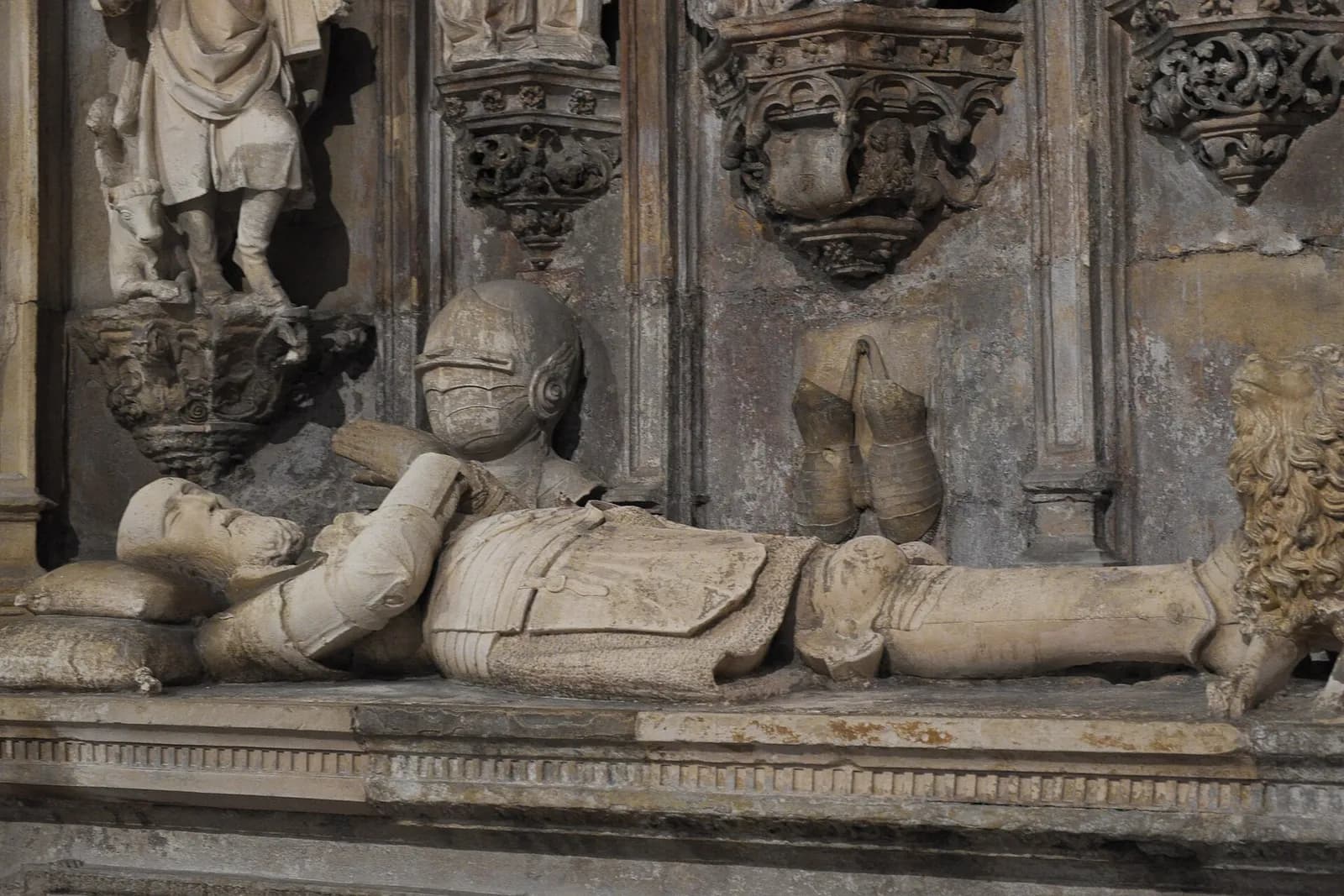
Manuel I visited in 1502 and found the graves of the first two kings unworthy of them. From 1507 he had the Romanesque church almost entirely rebuilt. The two royal tombs were made between 1518 and 1522 by Diogo de Castilho, probably to a design by his brother João, with effigies carved by the French sculptor Nicolau Chanterene. They first stood at the far end of the nave. Today they face each other across the chancel: Afonso on the left as you look at the altar, Sancho on the right.
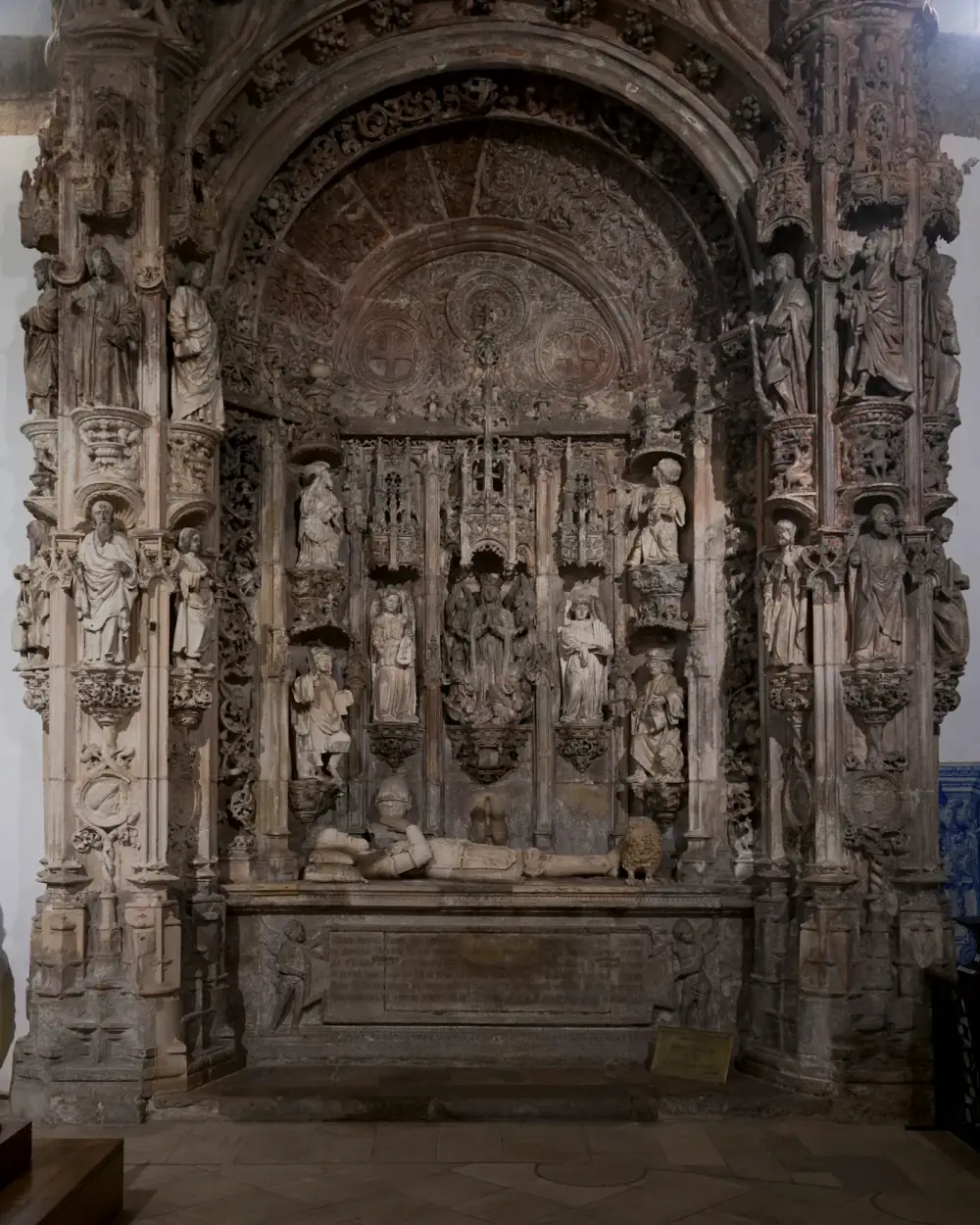
On the afternoon of 16 July 1520, according to the knight João Homem, who was there, Manuel had the old graves opened and showed the body to the nobles and people of Coimbra, with the lords holding torches and all the canons present. Homem said the body was found whole, in a long white woollen gown and a linen surplice, before it was laid in the new tomb. His account survives in a manuscript written at Santa Cruz around 1650 by the canon Timóteo dos Mártires. A rival chronicle of the canons gives another date, 25 October 1515, and a grander ceremony; Simões de Castro thought it unreliable.
“The king was ten palms tall and two and a half broad across the chest, and the leg he broke at the gates of Badajoz was three fingers shorter than the other.”
The tomb was opened twice more: in September 1732, probably for a canonisation case that kings pursued in Rome without success, and on 23 October 1832, when King Miguel, passing through Coimbra, wanted to see the remains.
The Gazeta de Lisboa reported what was inside. A small cedar box held a few bones that seemed to be a child's. A larger one, which the canons' records identified as that of Queen Mafalda, held decayed wood and bones. Below lay a third cedar coffer, about six palms long, with the bones of the king: a complete skull with every tooth but one, and arm and leg bones the paper judged proportionate to the ten-palm effigy above.
Legends and evidence
The epitaph on the tomb says that Afonso beat twenty Moorish kings with a small army, that Christ appeared to him, and that he died aged 91 after reigning 73 years. Brandão already knew this was wrong: the inscription followed Duarte Galvão's chronicle, and the king had probably lived no more than 75 or 76 and a half years, reigning 57 from Saint John's day in 1128.
The vision of Christ is the largest of the legends. In its developed form, Christ appeared to Afonso on the eve of Ourique and promised victory, echoing the vision of the Roman emperor Constantine; the next day Afonso beat five Moorish kings and was raised to king. The historian Matthias Gloël, summarising the research, shows that the chronicles of the twelfth, thirteenth and fourteenth centuries describe only the fighting. One Santa Cruz chronicle written soon after 1340 has him become king at Ourique, still with no miracle.
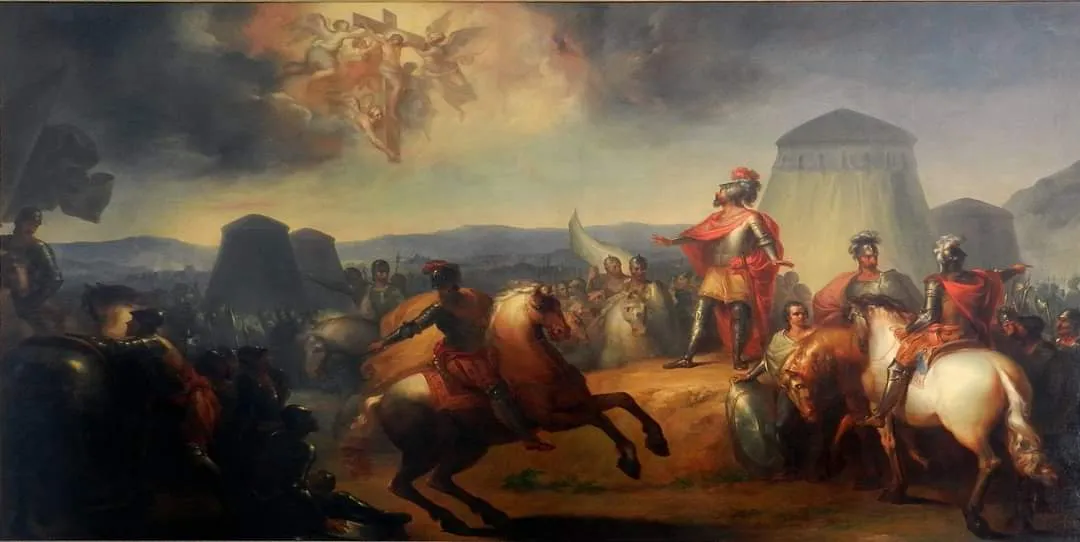
The miracle is absent from the arguments used during the succession crisis of 1383 to 1385, when a story of divine favour would have been useful, which suggests it did not yet exist. It first appears fully formed in the Crónica de 1419, often attributed to Fernão Lopes, and passed from there into Duarte Galvão's chronicle of the king, finished in 1505, and into Camões's Lusíadas.
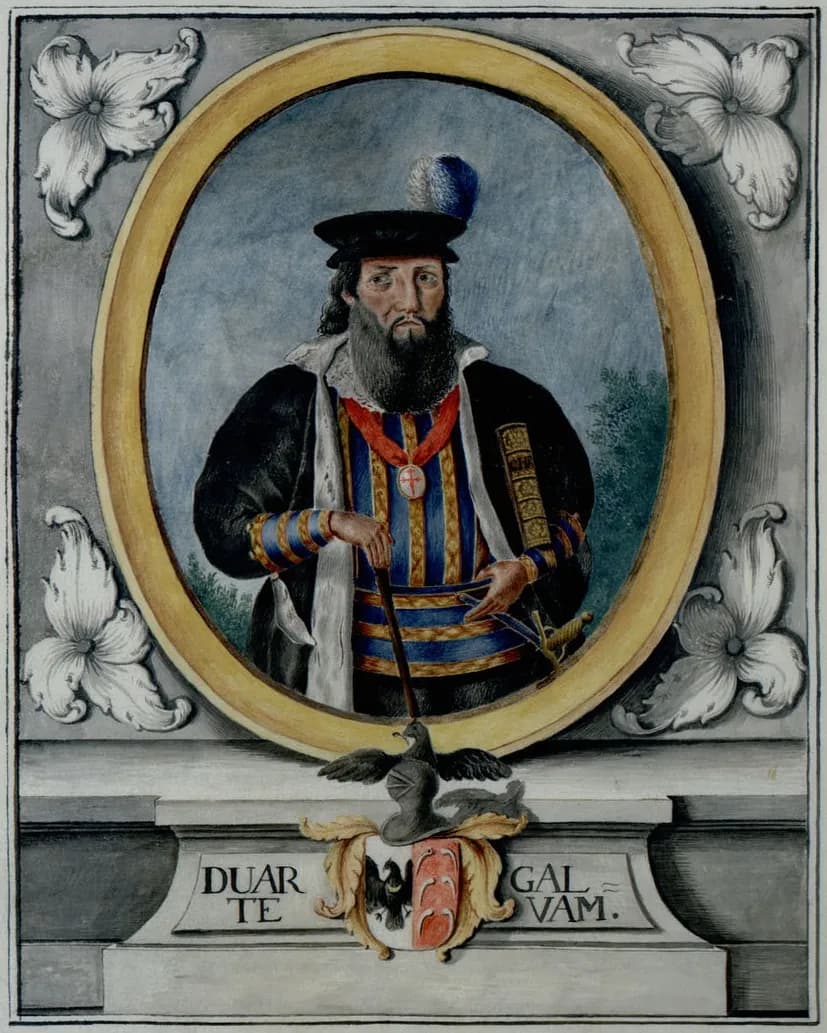
In 1632 the Alcobaça monk António Brandão added the Cortes of Lamego, an assembly supposedly held by the new king to bar foreigners from the throne, though he admitted he had seen no original. After 1640 it became a pillar of the case for the Bragança dynasty. Alexandre Herculano, the great nineteenth-century historian, rejected both the miracle and the Cortes, setting off a famous controversy. No historian has defended the Cortes as genuine for more than a century.
His height is a smaller but stubborn legend. João Homem's ten palms would make him about 2.2 metres tall if he meant the common medieval palm of about 22 centimetres, but other systems of measures were also in use. The effigy's length proves nothing, since Chanterene had no likeness to copy.
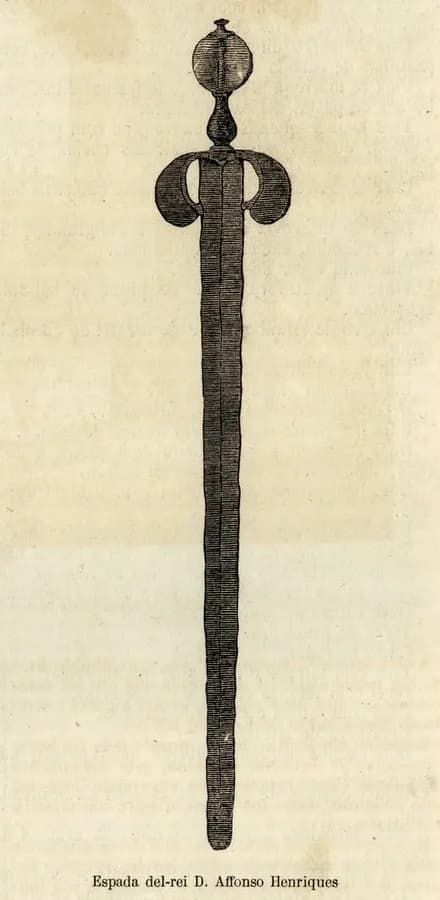
The sword is the one relic that survives. The canons' memoirs tell how King Sebastião borrowed it, with the king's shield, for his African campaign of 1578. The earliest known version of the story, in a 1604 life of Saint Anthony by the Spanish writer Mateo Alemán, claims both came back unused because their ship arrived after the defeat at Alcácer Quibir.
The sword reached the Museu Portuense in Porto in June 1834, after the religious houses were dissolved. Ana Paula Machado, a curator at the Museu Nacional de Soares dos Reis, notes that it was not listed among the relics when the case for the king's canonisation was assembled in the mid-sixteenth century, and catalogues it as a steel sword 99.5 centimetres long from the last quarter of the sixteenth century, with a question mark. It is now at the Museu Militar do Porto.
| Story | First known source | What the evidence says |
|---|---|---|
| Christ appeared to him before Ourique | Crónica de 1419; Duarte Galvão, 1505 | Twelfth- to fourteenth-century chronicles describe only the battle |
| He was made king on the field at Ourique | Later chronicles, such as a Santa Cruz chronicle of the 1340s | Possible acclamation; his charters use the royal title from about 1140 |
| The Cortes of Lamego fixed the succession in 1143 | António Brandão, 1632 | A forgery; Brandão saw no original |
| He died aged 91 after reigning 73 years | Epitaph on the tomb, c. 1520 | Born about 1109, so about 76; reigned 57 years from 1128 |
| He was ten palms tall | Account of the reburial in 1520 | Never measured scientifically; the palm used is unknown |
| His sword is in Porto | Santa Cruz relic tradition | Catalogued as possibly late sixteenth century |
The tomb that stayed shut
On 6 July 2006 a Portuguese and Spanish team led by the forensic anthropologist Eugénia Cunha, of the University of Coimbra, was at work in Santa Cruz. Workmen had begun easing out one of the limestone slabs of the tomb when word came through the university that the national directorate of the heritage institute, IPPAR, had stopped the work.
“We were already pulling,” Cunha told the news agency Lusa (translated from Portuguese), while denying that the tomb had been opened. IPPAR's regional directorate had approved the operation two weeks earlier, and so had the diocese of Coimbra. The national directorate overruled them: the authorisation of the culture minister, Isabel Pires de Lima, had not been given. Mortar had been taken from the joints and was put back.
The aims were specific: his stature, his age at death, the illnesses his bones recorded, a radiocarbon date, a genetic profile, his diet and a reconstruction of his face. Cunha pointed to similar studies of Columbus, Napoleon and Mozart.
The project became a quarrel. A monarchist deputy, Pignatélli Queiroz, said he had seen traces of fresh mortar and had heard that a slab had been sawn, and argued that only parliament should authorise an opening. The university then made a second request. At the end of March 2007 IPPAR's advisory council recommended refusal, saying the project did not guarantee the safeguarding of the heritage, and on 11 May the minister signed a decision endorsing that advice. Lusa reported applause from monarchists, from Duarte Pio of Bragança, pretender to the throne, and from the historian José Mattoso.
The university's rector contested the decision on 18 June 2007, but a year after the halted opening Cunha said she had lost hope. The art historian Carla Varela Fernandes adds a caution: the tomb also holds the remains of other men and women, so DNA results would be mixed.
Why it still matters
Portugal counts its independence from the reign of Afonso Henriques, but not from one agreed date. The museum service that runs Guimarães Castle dates independence to 1143. The annals count his reign from São Mamede in 1128, and tradition makes him king after Ourique in 1139. The Torre do Tombo calls the bull of 1179 Portugal's birth certificate and its Magna Carta.
His burial place has a formal status too. The church of Santa Cruz, where he and Sancho lie, has the status of a National Pantheon, like the Jerónimos monastery in Lisbon. And the question of what lies in the tomb remains open: as far as is known, the bones seen in 1832 have not been looked at since.
FAQs
When and where did Afonso Henriques die?
On 6 December 1185, in Coimbra, where the chronicles say he spent his last years; the Coimbra annals give the date. He was buried at Santa Cruz, and his son Sancho I entered Coimbra and began to reign on 9 December.
When did Portugal become a kingdom?
There is no single date. Afonso took over the County of Portugal in 1128, won at Ourique in 1139 and was using the title of king by about 1140. Alfonso VII of León accepted the situation at Zamora in 1143, and Pope Alexander III recognised him as king in the bull Manifestis probatum of 23 May 1179.
Was Afonso Henriques really over two metres tall?
Nobody knows. A witness to his reburial in 1520 said the body measured ten palms, which would be about 2.2 metres with the common 22-centimetre palm, and his effigy is the same length. His bones have never been measured by modern methods; a 2006 study that would have done so was stopped.
Why was his tomb not opened in 2006?
The national directorate of the heritage institute IPPAR stopped the work on 6 July 2006 because the culture minister had not authorised it, although its Coimbra office and the diocese had. The minister formally refused the project in May 2007 on IPPAR's advice.
Is the sword in Porto really his?
Probably not. The sword venerated at Santa Cruz came to Porto in 1834 and is now at the Museu Militar do Porto, but it is poorly documented as a relic and is catalogued as possibly made in the late sixteenth century.
On the timeline
Open the timelineNearby moments from from county to kingdom (1096–1249).
The Siege of Lisbon begins. King Afonso I, having struck a deal with Northern European crusaders bound for the Second Crusade, opens the assault on the great Almoravid city on the Tagus. After almost four months the city falls on 25 October, becoming the future capital of the Kingdom of Portugal.
After a siege of about four months, Afonso Henriques and his crusader allies enter Lisbon, whose starving Muslim defenders had agreed to surrender. The capture was the main success of the Second Crusade, and Sintra and Palmela soon surrendered too.
First naval battle in Portuguese history. Off Cape Espichel, a small fleet assembled by King Afonso Henriques and commanded by Dom Fuas Roupinho intercepts an Almohad squadron returning to Andalusia, kills its admiral and captures several of its galleys. The victory marks the modest birth of Portuguese seapower.
Death of Afonso Henriques, 1185
Death in Coimbra of Afonso Henriques, the first King of Portugal, who had ruled for more than half a century, first as prince of the County of Portugal and from about 1140 as king. He is buried in the Monastery of Santa Cruz in Coimbra; in July 2006 a scientific plan to open his tomb and study his remains was halted at the last minute by the state heritage institute, and the culture minister refused it in 2007.
Birth, probably in Coimbra, of Afonso III, the king who completed Portugal's share of the Reconquista by taking Faro in 1249 and fixed the Guadiana border with Castile in 1267. Under him Lisbon gradually became the court's main seat, though the king kept travelling.
King Sancho I of Portugal dies in Coimbra. Remembered as 'the Populator' (o Povoador) for resettling the frontier, he granted charters to towns such as Guarda (1199) and briefly took Silves from the Almohads in 1189.
Battle of Las Navas de Tolosa. The combined armies of Castile, Aragon and Navarre crush the Almohad Caliph al-Nasir on a plain in the Sierra Morena. Afonso II cannot come in person, but a Portuguese contingent fights in the Christian ranks, its town militias praised by the chronicler Rodrigo of Toledo; the victory tips the Iberian balance decisively against the Almohads.
Coming up in history
All long reads 8 December 1930Florbela Espanca dies in Matosinhos on her 36th birthday, 1930
 9 December 1868Padre Himalaya, the priest who took a solar furnace to St Louis
 10 December 1616Diogo do Couto: the soldier who helped Camões home and kept Goa's archive
 11 December 1826The death of Empress Leopoldina in Rio de Janeiro, 11 December 1826
21 sources
Archives, scholarship and reporting this article was checked against.
- 1
Portugaliae Monumenta Historica: Scriptores, vol. I (Lisbon, Academia das Ciências, 1856): Chronicon Conimbricense, Chronica Gothorum and De expugnatione ScalabisInternet Archive (scan of the 1856 edition)
- 2
Entre Oriente e Ocidente. Contactos de Portugal com o mundo nas origens da nacionalidade (José Mattoso), in No tempo de D. Afonso Henriques: reflexões sobre o primeiro século português, ed. Mário Jorge BarrocaCITCEM, Faculdade de Letras da Universidade do Porto (repositório Ler Letras)
- 3
- 4
António Brandão y la invención de las «Cortes de Lamego» de 1143 (Matthias Gloël)Revista de historiografía 33 (2020), Universidad Carlos III de Madrid
- 5
- 6
Badajoz 1169, almohades, leoneses y portugueses; variaciones sobre un tema (Guillermo S. Kurtz Schaefer)Revista de Estudios Extremeños, vol. LXXV, no. III (2019), Diputación de Badajoz
- 7
Guardar memórias, abrir caminhosArquivo Nacional Torre do Tombo
- 8Investigadora perde esperança de abrir túmulo de D. Afonso HenriquesRTP Notícias (Lusa), 5 July 2007
- 9
Afonso HenriquesPaço dos Duques, Castelo de Guimarães e Paço de Vila Flor (Museus e Monumentos de Portugal)
- 10
- 11
O Mosteiro de Santa Cruz de Coimbra: uma história arquitetónica (Rui Lobo), in Projetos para o Mosteiro de Santa Cruz de Coimbra e área envolventeDepartamento de Arquitetura, Universidade de Coimbra, 2022
- 12
- 13“Está claramente demonstrado.” Portugal independente faz hoje 840 anos (Miguel Marujo)Diário de Notícias, 23 May 2019
- 14
D. Afonso HenriquesCastelo de São Jorge (EGEAC, Câmara Municipal de Lisboa)
- 15
- 16
Length measures (Metrology Museum: weights and measures in Portugal)Instituto Português da Qualidade
- 17
A propósito de três itens de inventário (Ana Paula Machado)ARTis ON, no. 3 (2016), ARTIS, Faculdade de Letras da Universidade de Lisboa
- 18Deputado diz que túmulo de D. Afonso Henriques foi aberto, IPPAR e cientista negamRTP Notícias (Lusa), 10 July 2006
- 19Universidade de Coimbra vai contestar recusa da abertura do túmulo de D. Afonso HenriquesRTP Notícias (Lusa), 18 May 2007
- 20
Estudo forense a D. Dinis é projeto pioneiro em PortugalCâmara Municipal de Odivelas
- 21
O Rei Trovador já tem rosto: Medicina Legal reconstitui rosto de D. DinisMinistério da Justiça (Portugal)
Image credits
- The effigy of Afonso Henriques on his tomb in the church of Santa Cruz, Coimbra, carved by Nicolau Chanterene between 1518 and 1522. No likeness of the king survived for the sculptor to follow. GFreihalter, CC BY-SA 3.0, via Wikimedia Commons.
- The bull Manifestis probatum of 23 May 1179, in which Pope Alexander III recognised Afonso Henriques as king. The Torre do Tombo in Lisbon counts it among its treasures. Alexander III, Public domain, via Wikimedia Commons.
- The tomb of Afonso Henriques in the chancel of Santa Cruz, Coimbra, made between 1518 and 1522. The Latin epitaph on the front of the tomb chest says he died aged 91. Manuelvbotelho, CC BY-SA 4.0, via Wikimedia Commons.
- The miracle of Ourique as Domingos Sequeira painted it in 1793, with Christ in the clouds above the Portuguese camp. No twelfth-century source mentions the vision. Domingos Sequeira, Public domain, via Wikimedia Commons.
- Duarte Galvão, in a manuscript of his chronicle of Afonso Henriques kept in the library of the University of Coimbra. His chronicle carried the Ourique legend to a wide audience. Unknown author, Public domain, via Wikimedia Commons.
- “Espada del-rei D. Affonso Henriques”: the sword said to be his, as engraved for the Lisbon magazine Archivo Pittoresco in 1861, when it was kept in the museum in Porto. Unknown author, Public domain, via Wikimedia Commons.