

Manuel I orders the Jews and Muslims out of Portugal: Muge, 5 December 1496
To marry the daughter of Spain's Catholic Monarchs, King Manuel I signed a law at Muge expelling every Jew and free Muslim from Portugal. Within a year he had made it almost impossible for the Jews to go.
At a glance
- On 5 December 1496, at Muge, King Manuel I signed a letter ordering all Jews and free Muslims to leave Portugal by the end of October 1497, on pain of death and confiscation of their goods.
- The expulsion was the price set by Spain's Catholic Monarchs for his marriage to their daughter Isabella; the marriage agreement was signed on 30 November 1496.
- Few Jews were allowed to go. In 1497 their children were seized, and thousands of adults held in Lisbon were dragged to churches and baptised, becoming “New Christians”.
- In April 1506 Lisbon mobs killed New Christians over three or four days; estimates of the dead run from 1,000 to 4,000. The Inquisition, set up in 1536, pursued their descendants until it was abolished in 1821.
- From 2015 Portugal offered citizenship to descendants of Sephardic Jews. By the end of 2021 more than 137,000 applications had been filed; the route was repealed in May 2026.
A letter signed at Muge
In the first days of December 1496 the Portuguese court was staying at Muge, and King Manuel I, on the throne for just over a year, broke there with his predecessors' policy of tolerating Jews and Muslims. On 4 December, by one account, he ordered a sermon announcing that the Jews would be expelled. The letter patent itself is dated at Muge on 5 December 1496.
Its title left no room for doubt: “that the Jews and free Moors leave these kingdoms and neither live nor stay in them”. Every Jew, and every Muslim who was not a slave, had to be gone by the end of October 1497. Anyone found after that would be put to death and lose his goods to whoever denounced him. A Christian caught hiding one would lose his own property.
“We determine and order that, from the publication of this Our Law and Determination until the end of the month of October of the year of the Birth of Our Lord one thousand four hundred and ninety-seven, all the Jews and free Moors that there may be in Our Kingdoms shall leave them, on pain of natural death and loss of their goods to whoever accuses them.”
On paper the terms were mild. The Jews could leave with all their property, debts owed to them would be paid, and the king promised to help them on their way. Not everyone at court agreed with it. The Council of State warned that money would flee the country with them.
It did not work out that way. Within a year most of Portugal's Jews had been baptised by force, many of them dragged to the font, and the kingdom officially had no Jews left at all, only Old Christians and New Christians.
Jews in Portugal before 1496
Jews had lived in the Iberian Peninsula long before there was a Portugal. François Soyer, whose 2007 book is the first study of the 1496–7 persecution of both Jews and Muslims in Portugal, notes that their presence “predated both the Islamic conquest and the creation of Portugal by many centuries”.
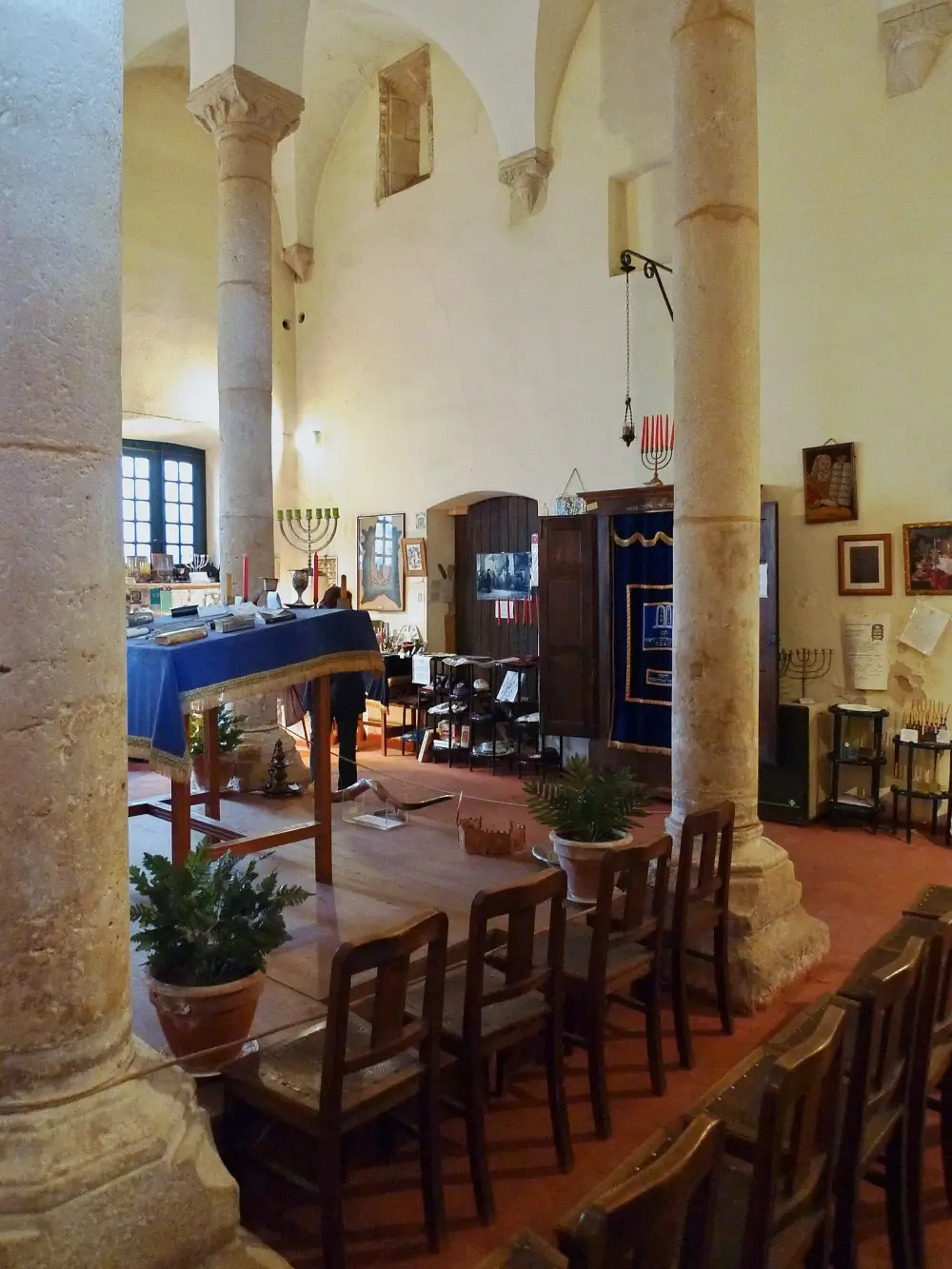
They lived in self-governing communities with their own officials and judges, synagogues, schools, cemeteries and butchers. In return for heavy taxes the crown took them under its protection. The law also kept them apart: Jews had to live in separate quarters called judiarias, as Muslims did in mourarias, and to wear badges on their clothes. Sex between a Christian and a Jew or Muslim carried the death penalty.
There were riots, but Soyer finds that anti-Jewish violence in Portugal never came close to what happened elsewhere in the peninsula, and Portuguese kings and clergy did not generally run campaigns of forced conversion. By his estimate Portugal had at most 30,000 Jews in the late fifteenth century, in a kingdom of barely a million people.
They left a mark on Portuguese culture. The first dated book printed in Portugal was a Hebrew Pentateuch, finished in Faro in the printing shop of Don Shmuel Gacon on 30 June 1487. Hebrew presses followed in Lisbon and Leiria, and Hebrew books made up about half of the roughly thirty titles printed in Portugal before 1500.
The refugees of 1492
On 31 March 1492 Isabella of Castile and Ferdinand of Aragon, the Catholic Monarchs, signed an edict ordering every Jew in their kingdoms to convert or leave by the end of July. Portugal, next door and close to Castile in culture and trade, took the largest share of the exiles.
Its king, João II, let them in at a price. Refugees crossed at set points such as Olivença, Arronches, Bragança and Melgaço, paid a toll and received a safe-conduct. Only 600 families were allowed to settle. The rest had eight months to move on and waited in camps near the border, where epidemics broke out. Those caught entering without paying were enslaved.
Leaving was no safer. Ships bound for North Africa sailed from Porto, Lisbon and Setúbal, and on board many refugees were robbed and the women raped; on landing they were attacked again by the garrisons of the Portuguese strongholds of Arzila and Tangier. In 1493 the king had perhaps as many as 2,000 Jewish children taken from their parents and sent to São Tomé, an equatorial island the crown wanted settled.
| What is counted | Estimate | Source |
|---|---|---|
| Jews living in Portugal, late fifteenth century | At most 30,000 | François Soyer (2007) |
| Jews living in Castile, same period | 60,000 to 70,000 | François Soyer (2007) |
| Jews from Castile and Aragon entering Portugal in 1492 | About 93,000 to 300,000 | Contemporary and early modern estimates |
| The same, including clandestine entries | Unlikely to have passed 30,000 | Soyer, following Maria José Ferro Tavares |
| Jews leaving Castile and Aragon in 1492, to all destinations | Possibly 40,000 to 50,000, perhaps fewer | Gretchen Starr-LeBeau, after Henry Kamen |
| Total population of Portugal, c. 1492 | Barely one million | Ariel Hessayon (2009) |
Soyer's figures as summarised, with page references, in Ariel Hessayon's 2009 review of his book. The high figures for the 1492 refugees are contemporary and early modern estimates; Soyer and Starr-LeBeau put the numbers much lower.
A king, a widow and a condition
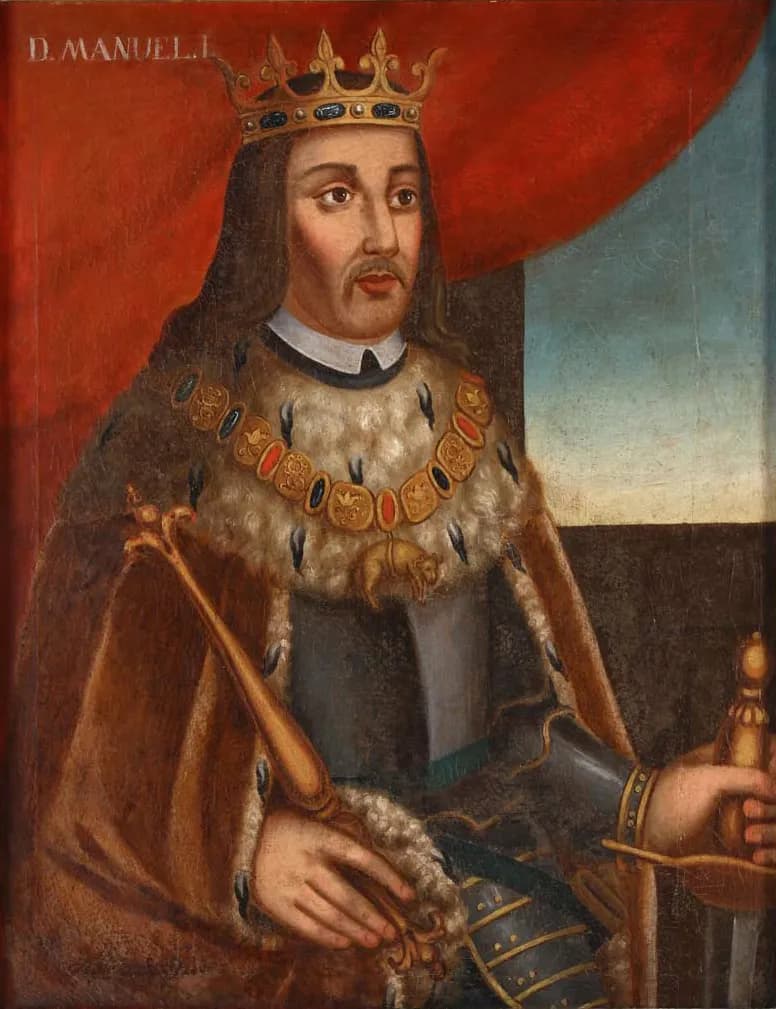
Manuel became king in October 1495. He wanted to marry Isabella, eldest daughter of the Catholic Monarchs. She knew Portugal already: she had married João II's son and heir Afonso, who died in 1491 after a fall from his horse at Santarém. Widowed, she had resolved never to marry again.
Her parents' price was the expulsion of Portugal's Jews. The marriage agreement was signed on 30 November 1496, and the decree followed five days later. Ha-Lapid, the newspaper of Porto's Jewish community, put it plainly in 1940: the expulsion “had been demanded by the Catholic Monarchs of Spain, in an express clause in the marriage contract”.
Since the nineteenth century historians have read the decree as the price of a dynastic dream: the marriage could put Manuel's heirs on every throne in the peninsula. Soyer accepts that Isabella and Ferdinand pressed him, but argues he gave way to buy “a long-lasting settlement with his powerful Castilian neighbours” and freedom to concentrate on expansion overseas and war in North Africa.
The Muslims are a separate case. Soyer, working from unpublished documents in the Portuguese national archives, argues that their expulsion was not forced on Manuel by inflexible Spanish demands, as modern historians had assumed. He wanted to boost his image as a crusading Christian king.
The wedding took place at Valencia de Alcántara, a Castilian town on the border, in October 1497. That same year Isabella's brother Juan, heir to Castile and Aragon, died, and the couple became heirs to the Spanish thrones. She died in childbirth at Zaragoza in 1498. Their son Miguel, who might have united the Iberian crowns, died in Granada in 1500, before his second birthday.
From expulsion to baptism by force
Manuel soon changed course. According to Soyer, he feared that “the kingdom would remain like an empty fishing net”, since the Jews held most of its wealth, and he issued orders that stopped them sailing without a royal licence. Jews who accepted baptism could stay, and the deadline for it was Easter 1497.
Meanwhile the crown took over synagogues, schools and the communities' common property. The Great Synagogue of Lisbon was given to the Order of Christ. Hebrew books were seized; some were sold off cheaply and others burned in Lisbon, and Hebrew printing in Portugal came to an end.
Then, around Easter 1497, the crown turned on the children. Jewish children under 14 were taken from their parents to be baptised and brought up in Christian homes, and the order was later stretched to young people of up to 20. Soyer dates the seizures to the week before Easter; Ha-Lapid gave 2 April. The chroniclers Damião de Góis and Jerónimo Osório, Bishop of Silves, recorded parents who killed their children, and themselves, rather than hand them over.
“All the learned, and I among them, can show by various authorities and legal decisions that the Jews cannot be forced to accept the Christian religion, which is a religion that requires freedom and not violence.”
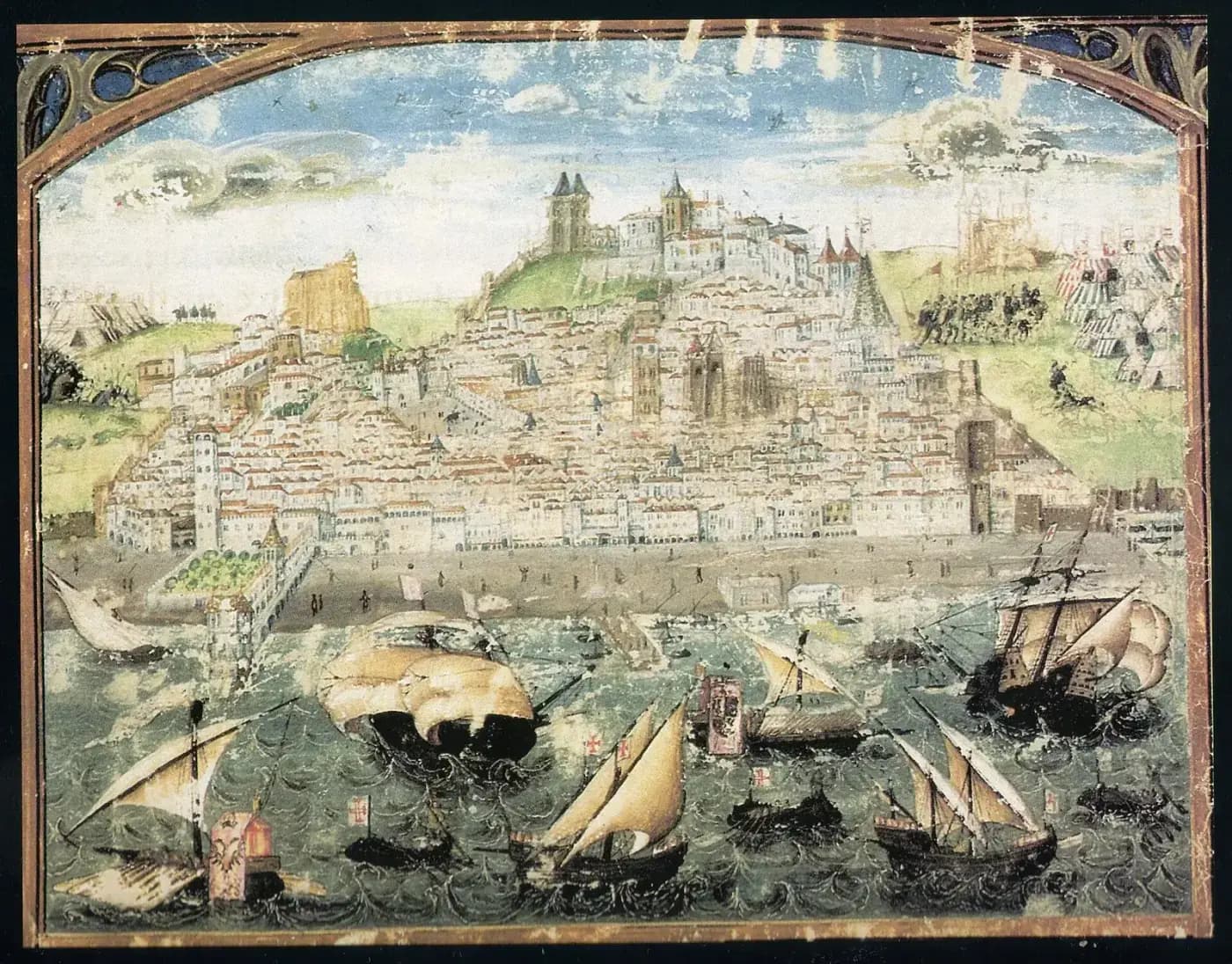
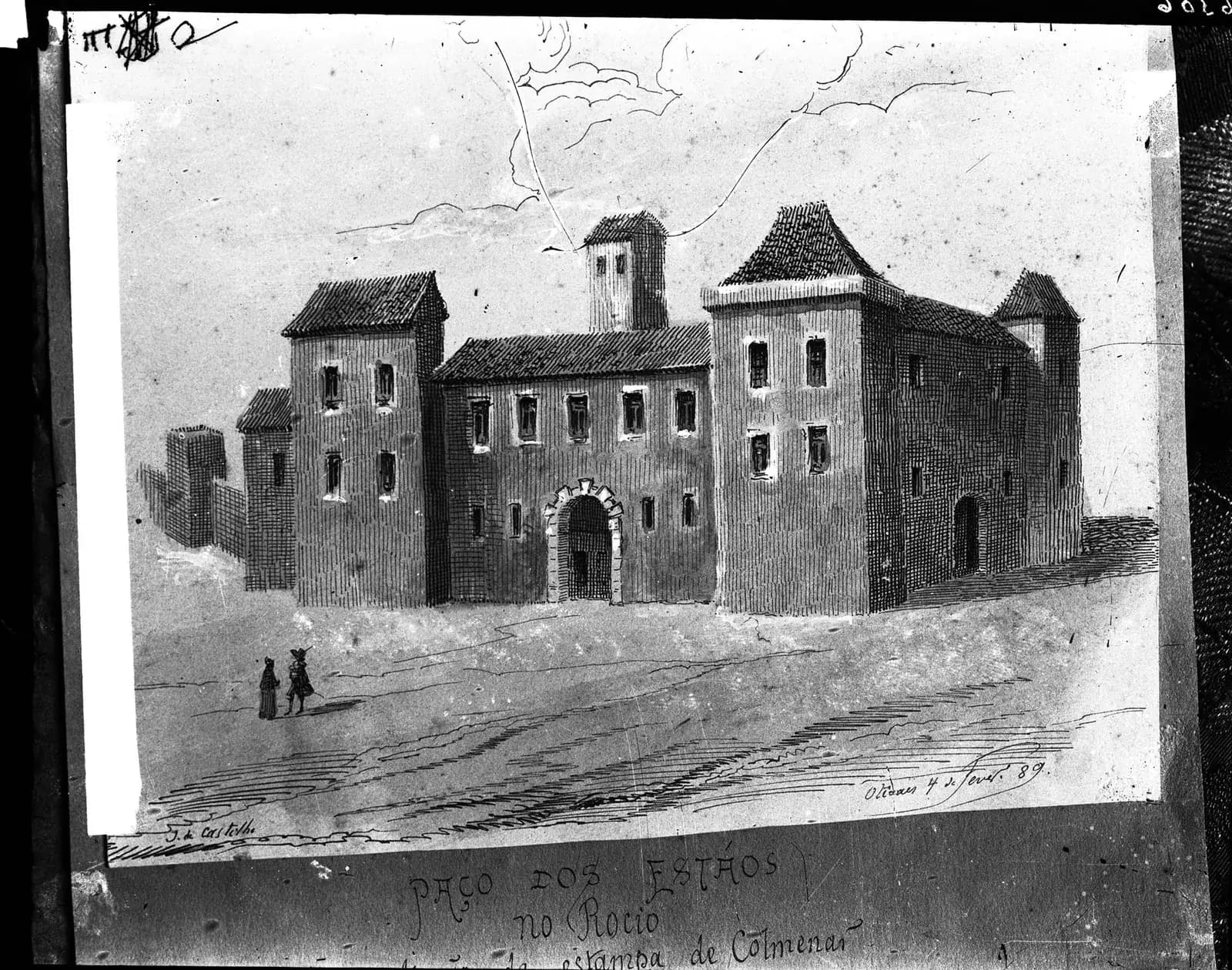
Most adults still refused. Departures, first allowed from three ports, were restricted to Lisbon, and those who came to the capital to embark were penned instead in the grounds of the Estaus, a palace at the top of the Rossio. The historian Jorge Martins puts their number at about 20,000. Reportedly kept without food or water, they were dragged to nearby churches and baptised.
Accounts differ on when this happened. Observador, like Hessayon's summary of Soyer, places it in the spring, before the converts were given guarantees on 30 May 1497. Gretchen Starr-LeBeau and Grayce Souza place it at the end of October, when the deadline for leaving ran out.
Samuel Usque, in an account quoted by Ha-Lapid, described how the king's men separated the young, up to the age of 25, from their elders and tried promises first. When that failed, they used force.
“Some by the legs and arms, and others by the hair and the beards, dragging them, they took them by force right into the churches, and there they threw their water over them.”
Rabbi Abraham Zacuto called it “a forced conversion on a scale never before witnessed”. In Portugal it became known as the conversão em pé, the conversion standing up. On 30 May 1497 the king promised the converts that for 20 years nobody would inquire into their beliefs.
The Muslims were treated differently. Portugal's Muslim minority was small, and Christian rulers feared reprisals against Christians living under Muslim rule, so most Portuguese Muslims were allowed to leave with their children. Some may have gone to Castile; others certainly went to North Africa.
31 March 1492
The Catholic Monarchs order Jews in Castile and Aragon to convert or leave
1492
João II admits Spanish Jews for a fee; 600 families may settle
1493
Jewish children are taken and sent to São Tomé
October 1495
Manuel I becomes king
30 November 1496
Agreement for Manuel's marriage to Isabella is signed
4–5 December 1496
Expulsion announced and decreed at Muge
Spring 1497
Jewish children seized and baptised
1497
Mass baptisms at the Estaus in Lisbon (spring or October; accounts differ)
30 May 1497
Converts promised 20 years free of inquiry into their faith
October 1497
Deadline expires; Manuel marries Isabella at Valencia de Alcántara
1499
New Christians barred from leaving without royal permission
19 April 1506
Massacre of New Christians begins in Lisbon
New Christians and the Lisbon massacre of 1506
The converts and their descendants were called New Christians, cristãos-novos, to set them apart from Old Christians. The decree of 30 May 1497 said they were not to be treated differently from other Christians. Two years later, as wealthy converts moved their money abroad, Manuel forbade them to leave the kingdom without royal permission, on pain of losing their goods.
In the spring of 1506 Lisbon was suffering from plague and hunger. On Sunday 19 April, at the Dominican church of São Domingos beside the Rossio, people claimed to have seen a miracle, a light shining on the crucifix. According to Damião de Góis, a New Christian said it was only the reflection of a candle. He was dragged out of the church by the hair, killed, and his body burned in the Rossio.
Two Dominican friars, João Mocho and Bernardo, urged the crowd on. For three or four days mobs hunted New Christians through the city, broke into their houses and burned the dead and the living on bonfires.
Nobody knows how many died. Soyer gives estimates of anywhere between 1,000 and 4,000 men, women and children. Góis, who was four years old at the time, counted more than 500 dead on the Sunday and more than 1,000 on the Monday alone. Garcia de Resende, who wrote that he saw it, put the dead at more than 4,000 in verse. The nineteenth-century historian Alexandre Herculano and the American historian Yosef Yerushalmi gave about 2,000, which Observador calls the figure most specialists accept.
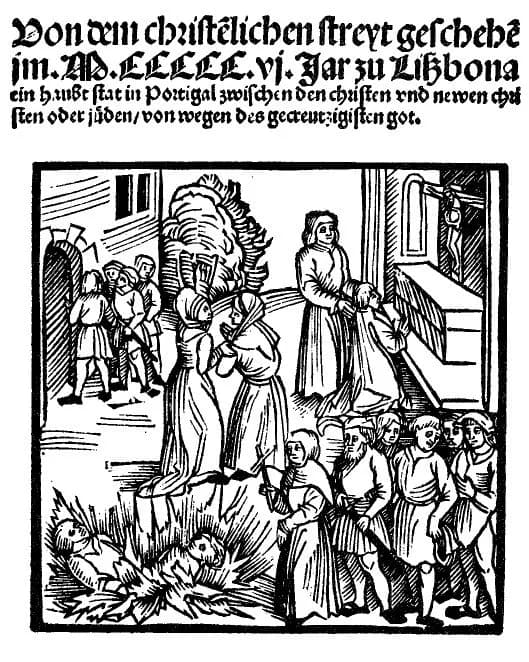
The killings shocked Europe. An anonymous German who was in Lisbon at the time wrote an eyewitness account that was printed in at least three German editions, and two Spanish chroniclers who had said nothing about the forced conversions of 1497 gave the massacre whole chapters.
The king punished the city. Those proven guilty lost all their property, bystanders who had done nothing lost a fifth of theirs, and elections to the Casa dos Vinte e Quatro, the body of the city's guilds, were suspended. Góis wrote that the two friars were burned; the historian António José Saraiva argued that they escaped. For a time the crown also let New Christians emigrate.
The Inquisition, in outline
Manuel asked Rome for an inquisition on the Spanish model as early as 1515. His son João III got one. Pope Paul III's bull Cum ad nihil magis, signed on 23 May 1536, was read out in Évora cathedral on 22 October. From the start its main target was Judaism among the New Christians.
- Requested
- 1515, by Manuel I
- Founded
- Bull of 23 May 1536, published at Évora on 22 October 1536
- Tribunals
- Lisbon and Évora (1536), Coimbra (1541), Goa (1560)
- People charged
- About 40,000, by António José Saraiva's count
- Burned at the stake
- 1,175 on the mainland, plus 633 burned in effigy
- Abolished
- 1821
The legal distinction between Old and New Christians was abolished in 1773, and the Inquisition itself in 1821. Its victims included the comic playwright António José da Silva, “o Judeu”, executed in Lisbon in 1739. Many New Christians escaped abroad, and their descendants founded Portuguese Jewish communities from Amsterdam to the Americas.
Five centuries later
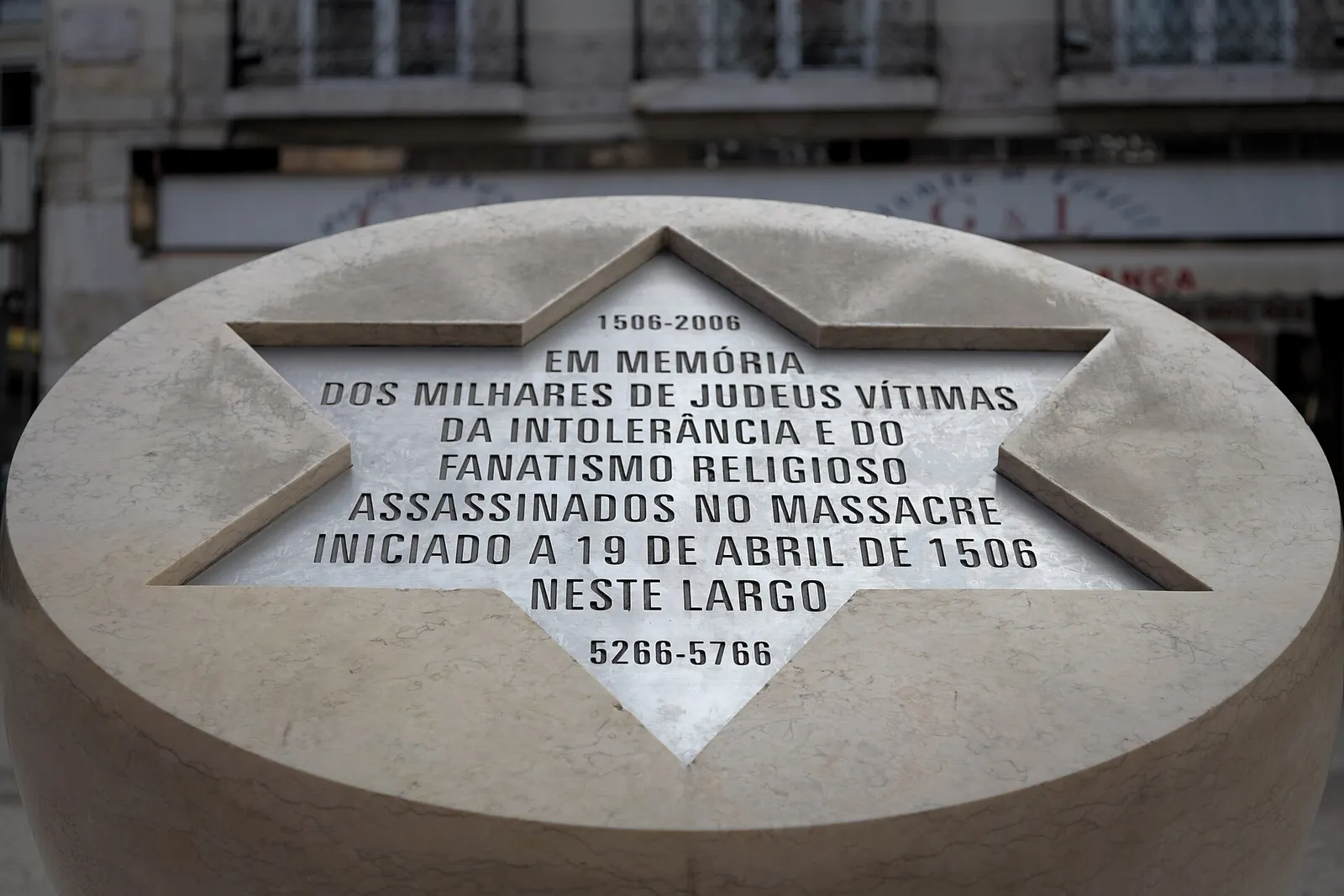
In front of the door of São Domingos stands a monument at the spot where, in 2000, the Cardinal Patriarch of Lisbon, José Policarpo, expressed shame for the Inquisition's persecution. Beside it, since 2008, has stood a memorial to the victims of 1506 by Graça Bachmann, proposed by Lisbon's Jewish community: a truncated stone globe carved with a Star of David, on a base inscribed with a line from the Book of Job.
The state went further. In 2013 parliament amended the nationality law so that the government could naturalise descendants of Portuguese Sephardic Jews, and the rules took effect on 1 March 2015. Their preamble tells the story in the state's own words, from Manuel's decree to the conversão em pé. Applicants normally presented a certificate from a Jewish community in Portugal confirming their descent, shown through surnames, family language, genealogy or family memory.
Demand was enormous. By the end of 2021, 137,087 applications had been filed and 56,685 approved, with only 300 refused. In 2022 another 124,663 arrived, and 18,121 people were approved that year.
Applications for Portuguese nationality as descendants of Sephardic Jews
applications
Figures from the Instituto dos Registos e do Notariado and the Ministry of Justice, reported by Lusa. The 2015–2020 bar is the 137,087 applications filed from March 2015 to the end of 2021, minus the 50,407 filed in 2021.
Show the data
| Applications filed | |
|---|---|
| 2015–2020 (six years) | 86,680 |
| 2021 | 50,407 |
| 2022 | 124,663 |
Then the rules tightened. From September 2022 applicants had to show a lasting link to Portugal, such as regular visits throughout their lives or an inheritance, and an amendment approved at the end of 2023 added three years of legal residence for new applicants. Finally Lei Orgânica n.º 1/2026, published on 18 May 2026, repealed the Sephardic clause altogether. Applications already lodged are decided under the old rules; Lisbon's Jewish community stopped accepting new ones from 4 May 2026.
FAQs
When were the Jews expelled from Portugal?
King Manuel I's letter ordering Jews and free Muslims to leave is dated at Muge on 5 December 1496 (some historians date the announcement to 4 December), with a deadline of the end of October 1497. In practice most Jews were not expelled: in 1497 they were baptised by force and became New Christians.
Why did Manuel I expel the Jews?
Spain's Catholic Monarchs made it a condition of his marriage to their daughter Isabella; the agreement was signed on 30 November 1496, five days before the decree. The historian François Soyer argues Manuel accepted it to secure a lasting settlement with Castile, and expelled the Muslims mainly to boost his image as a crusading king.
What were New Christians?
New Christians (cristãos-novos) were the Jews forcibly converted in 1497 and their descendants, as distinct from Old Christians. They were barred from leaving Portugal without permission from 1499, massacred in Lisbon in 1506 and pursued by the Inquisition from 1536. The legal distinction was abolished in 1773.
Can descendants of Portuguese Sephardic Jews still get Portuguese citizenship?
Not by new application. The special route opened on 1 March 2015 and was repealed by Lei Orgânica n.º 1/2026 of 18 May 2026. Applications already pending are decided under the previous rules.
Where did the 1506 Lisbon massacre take place?
It began on 19 April 1506 at the church of São Domingos, beside the Rossio, and spread across the city for three or four days. Estimates of the dead range from 1,000 to 4,000. A memorial in the Largo de São Domingos has marked the spot since 2008.
On the timeline
Open the timelineNearby moments from the age of discoveries (1415–1580).
The Treaty of Tordesillas is signed between Portugal and Spain, dividing newly discovered lands outside Europe along a meridian 370 leagues west of the Cape Verde islands. Portuguese diplomacy secures the shift of the line westwards from the 100 leagues set by the papal bull of 1493, a decision that would give Portugal its claim to Brazil after Cabral's 1500 landfall.
Birth of João Cidade (later Saint John of God / São João de Deus) in Montemor-o-Novo. He would found the Brothers Hospitallers religious order and become the patron saint of hospitals, the sick, and healthcare workers.
João II, 'o Príncipe Perfeito', dies at Alvor in the Algarve aged 40. The king who broke the power of the great nobles and drove exploration down the African coast towards India was succeeded by his cousin and brother-in-law Manuel I.
The expulsion of the Jews, 1496
At Muge, near Santarém, King Manuel I signs the decree ordering all Jews and Muslims to leave Portugal by the end of October 1497 — a condition of his marriage to Isabella of Aragon, daughter of the Catholic Monarchs. In practice few were allowed to go: most of Portugal's Jews were forcibly baptised the following year, creating the 'New Christians' later hunted by the Inquisition.
Vasco da Gama departs the Restelo, near Lisbon, with four small ships — São Gabriel, São Rafael, Berrio and a supply vessel — and roughly 170 men, in search of the sea route to India. Ten months later he would anchor off Calicut, fulfilling decades of Portuguese effort and rewriting the geography of world trade.
Vasco da Gama's four ships round the Cape of Good Hope after days of contrary winds and enter the Indian Ocean, on the voyage that would reach India the following May and open the first sea route from Europe to Asia.
Vasco da Gama's fleet arrives at Mozambique Island during his first voyage to India, encountering a prosperous Swahili trading town, the first Muslim port the expedition had reached on the East African coast.
Coming up in history
All long reads 7 December 2002Metro do Porto opens on old railway tracks: 7 December 2002
 8 December 1930Florbela Espanca dies in Matosinhos on her 36th birthday, 1930
 9 December 1868Padre Himalaya, the priest who took a solar furnace to St Louis
 10 December 1616Diogo do Couto: the soldier who helped Camões home and kept Goa's archive
21 sources
Archives, scholarship and reporting this article was checked against.
- 1
Review of François Soyer, The Persecution of the Jews and Muslims of Portugal: King Manuel I and the End of Religious Tolerance (1496–7) (Brill, 2007)Ariel Hessayon, Reviews in History (Institute of Historical Research), review no. 797, September 2009
- 2
V centenário. Os judeus portugueses em 500 anos de diáspora: herança de uma nação, esperança de um povoManuel Augusto Rodrigues (Universidade de Coimbra), Medievalismo, no. 6, 1996
- 3
Notas sobre a Inquisição portuguesa: história e historiografiaGrayce Mayre Bonfim Souza, Politeia: História e Sociedade (Uesb), v. 20, n. 1, 2021
- 4O dia em que os judeus foram expulsos de PortugalMaria José Oliveira, Observador, 29 December 2016
- 5
The Massacre of the New Christians of Lisbon in 1506: A New Eyewitness AccountFrançois Soyer, Cadernos de Estudos Sefarditas, no. 7, 2007, pp. 221–244 (repository record, University of New England)
- 6
Decreto-Lei n.º 30-A/2015, de 27 de fevereiroDiário da República, 1.ª série, n.º 41 (supplement), 27 February 2015
- 7
Lei Orgânica n.º 1/2026, de 18 de maio (Diário da República, 1.ª série, n.º 95)Assembleia da República, copy hosted by the Regional Government of Madeira
- 8
Os cristãos-novos no PôrtoHa-Lapid (Porto), year 14, no. 97, January–February 1940, via the Ben-Yehuda Project
- 9
Jews, Expulsion of (Spain; Portugal)Gretchen D. Starr-LeBeau, Europe, 1450 to 1789: Encyclopedia of the Early Modern World, via Encyclopedia.com
- 10
From Faro to Mantua to London: The Odyssey of Portugal's First Printed Book, the Faro Pentateuch of 1487Shlomo Pereira, Sephardic Horizons, vol. 16, nos. 1–2
- 11
Review of Ruth Martínez Alcorlo, Isabel de Castilla y Aragón: princesa y reina de Portugal (1470–1498) (Silex, 2021)Estudios de Historia de España (Universidad Católica Argentina), XXIII/1–2, 2021, pp. 329–332
- 12
- 13Marvão e Valência de Alcântara (Espanha) recriam Boda RégiaDiário de Notícias, 10 March 2012
- 14
Memorial às Vítimas do Massacre de 1506Visit Portugal (Turismo de Portugal)
- 15
Granting of Portuguese Nationality to descendants of Sephardic JewsComunidade Israelita de Lisboa (Jewish Community of Lisbon)
- 16
António José da Silva «O Judeu»: Cronologia da vida e obraBiblioteca Nacional de Portugal
- 17Mais de 74 mil pedem nacionalidade apesar da restrição das regras para descendentes de judeus sefarditasRTP Notícias, with Lusa, 2023 (figures from the Instituto dos Registos e do Notariado)
- 18Judeus sefarditas valem 72% dos pedidos de naturalizaçãoECO, with Lusa, 15 October 2022 (Ministry of Justice figures)
- 19Nova Lei da Nacionalidade limita acesso de sefarditas e facilita para imigrantesAmanda Lima, Diário de Notícias, 21 February 2024
- 20
HistóriaTeatro Nacional D. Maria II
- 21
Image credits
- Lisbon from the Tagus in the early sixteenth century, in a miniature from Duarte Galvão's Chronicle of Afonso Henriques. This was the city where, in 1497, thousands of Jews who had come to embark were baptised by force instead. Duarte Galvão (1435-1517), Public domain, via Wikimedia Commons.
- The synagogue of Tomar, built in the mid-fifteenth century and closed in 1496, is the only Jewish place of worship from that time to survive almost unchanged in Portugal. It now houses the Abraham Zacuto Luso-Hebrew Museum. Jl FilpoC, CC BY-SA 4.0, via Wikimedia Commons.
- Manuel I, who reigned from 1495 to 1521, in an eighteenth-century portrait by an unknown Portuguese painter. Escola Portuguesa (Portuguese School), Public domain, via Wikimedia Commons.
- The Estaus palace in the Rossio, Lisbon, as it looked before its eighteenth-century rebuilding: a pen drawing by Júlio de Castilho dated 4 February 1889, copied from an older engraving. Thousands of Jews were held in its grounds in 1497; the palace later became the seat of the Inquisition. Júlio de Castilho, Public domain, via Wikimedia Commons.
- Title page of a pamphlet printed in Nuremberg in 1506, “Of the Christian strife that took place in the year 1506 at Lisbon, a capital city in Portugal, between the Christians and New Christians or Jews, over the crucified God”. Unknown author, Public domain, via Wikimedia Commons.
- The memorial in the Largo de São Domingos, Lisbon, photographed in 2017. The inscription reads, in translation: “In memory of the thousands of Jews, victims of intolerance and religious fanaticism, murdered in the massacre that began on 19 April 1506 in this square.” Enrico Strocchi from Forlì, Italy, CC BY-SA 2.0, via Wikimedia Commons.