

The Macau handover: Portugal's last flag in China comes down, 1999
For four and a half centuries a Portuguese community ran a small port on the China coast with China's consent. On the night it ended, 19 to 20 December 1999, its last governor stood on a stage holding the folded flag in his arms.
At a glance
- At midnight on 19 to 20 December 1999, at a pavilion beside the Macao Cultural Centre, Portugal handed the administration of Macau to the People's Republic of China.
- Portuguese traders settled on the Macau peninsula in the 1550s with the consent of Chinese officials; 1557 is the traditional date, which gave the 442 years quoted in 1999, but 1553 and 1554 are also argued.
- China confirmed Portugal's “perpetual occupation and government” of Macau in 1887, but after riots in 1966 Portugal governed largely on Beijing's terms, and China turned down Portuguese offers to hand the city back in 1967 and 1975.
- The Joint Declaration, signed in Beijing on 13 April 1987, made Macau a Special Administrative Region under “one country, two systems”, with its capitalist system and way of life guaranteed for 50 years.
- Portuguese remains an official language and the Historic Centre of Macao joined the UNESCO World Heritage List in 2005, but in the 2016 by-census only 0.6 per cent of residents said Portuguese was their usual language.
A flag folded at midnight
The ceremony began at about eleven on the night of Sunday 19 December 1999, in a pavilion built for the occasion beside the Macao Cultural Centre. Some 2,500 invited guests sat under the flags of Portugal and China, which fans hidden in the flagpoles kept fluttering as if in a sea breeze. Outside, rain kept most of Macau's 430,000 or so residents at home.
Jiang Zemin, China's president, had flown in from Zhuhai, just across the border, while the last Mass under Portuguese administration was said in the cathedral. Jorge Sampaio, Portugal's president, spoke of the ties between the two countries. João de Pina-Cabral, an anthropologist who had written a book on Macau's Eurasians and sat among the guests, heard him call it the ceremony that marked the last of the Portuguese empire, ending a story that had begun in the early fifteenth century.
Then the Portuguese anthem played and the green and red flag came down for the last time. Pina-Cabral noticed that the Lisbon television commentator standing next to him was sobbing into a handkerchief. On the stage, General Vasco Rocha Vieira, the last governor, held the folded flag in his arms. When he died in January 2025, Portugal's parliament recalled that picture as the one the Portuguese remember.
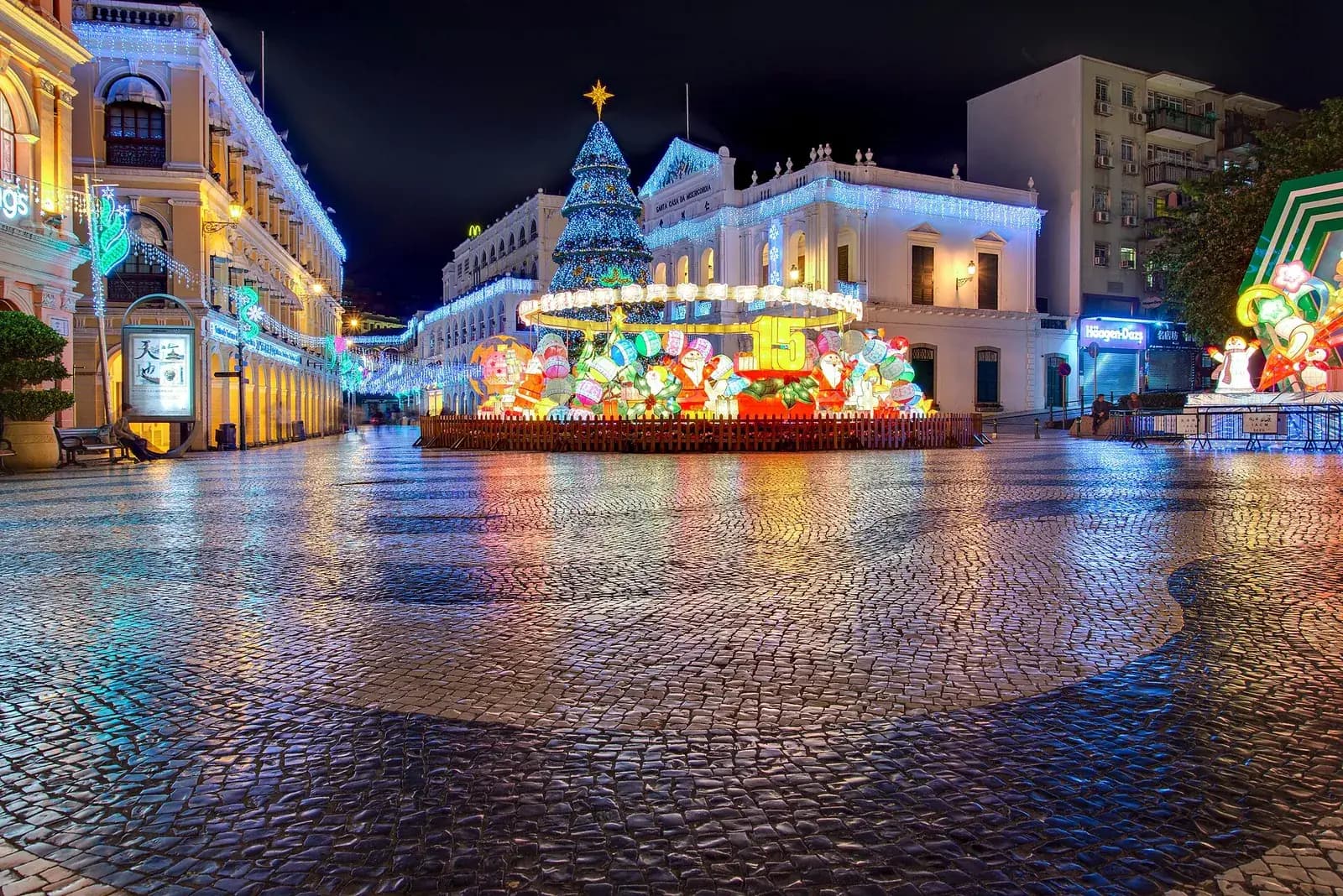
At midnight the red flag of the People's Republic went up, and Jiang stepped to the podium. A translucent building put up for the night glowed green, then turned red. In Senado Square, the old heart of the city, the crowd cheered as the Chinese anthem played.
“Our cordial greetings and good wishes to the Macau compatriots who are returning to the embrace of the motherland.”
Macau, a peninsula and two islands, Taipa and Coloane, on the south China coast, had been home to a Portuguese community for about four and a half centuries. Its handover, as Miguel Santos Neves wrote that month for Lisbon's Institute of Strategic and International Studies, closed Portugal's colonial cycle and ended the last colony in Asia.
A port on the China coast, and the question of 1557
Portuguese ships had been trading in the Pearl River estuary since Jorge Álvares reached the island of Tamão in 1513. Ming court records place some Portuguese at Haojing as early as 1535, though that name probably meant the nearby islands rather than the peninsula. The Chinese name Aomen, for the peninsula, first appears in a memorial to the emperor of 1564.
When the Portuguese moved onto the peninsula is still argued. A Ming gazetteer of 1602 gives 1553, and so does the Macao government's official history: local officials let the Portuguese stay, it says, after they claimed they needed land to dry out goods that had been soaked. The Chinese historian Tang Kaijian argues for 1554, with the stay becoming more official in 1557.
The earliest known use of the name Macau in a European language is in a letter dated 20 November 1555. Portuguese tradition settled on 1557, generally accepted as the year the Portuguese were allowed to settle, reportedly as a reward for helping Chinese officials against pirates. That date produced the “442 years” in the reports of 1999.
Sovereignty was never in doubt to the Chinese. From about 1573 the Portuguese paid an annual ground rent, usually given as 500 taels, and in 1583 they were allowed to form a Senate to run their own affairs. Ming and then Qing officials kept soldiers, customs posts and taxes in Macau. For nearly 300 years it was a Portuguese-run town on Chinese soil.
“Perpetual occupation”: the 1887 treaty
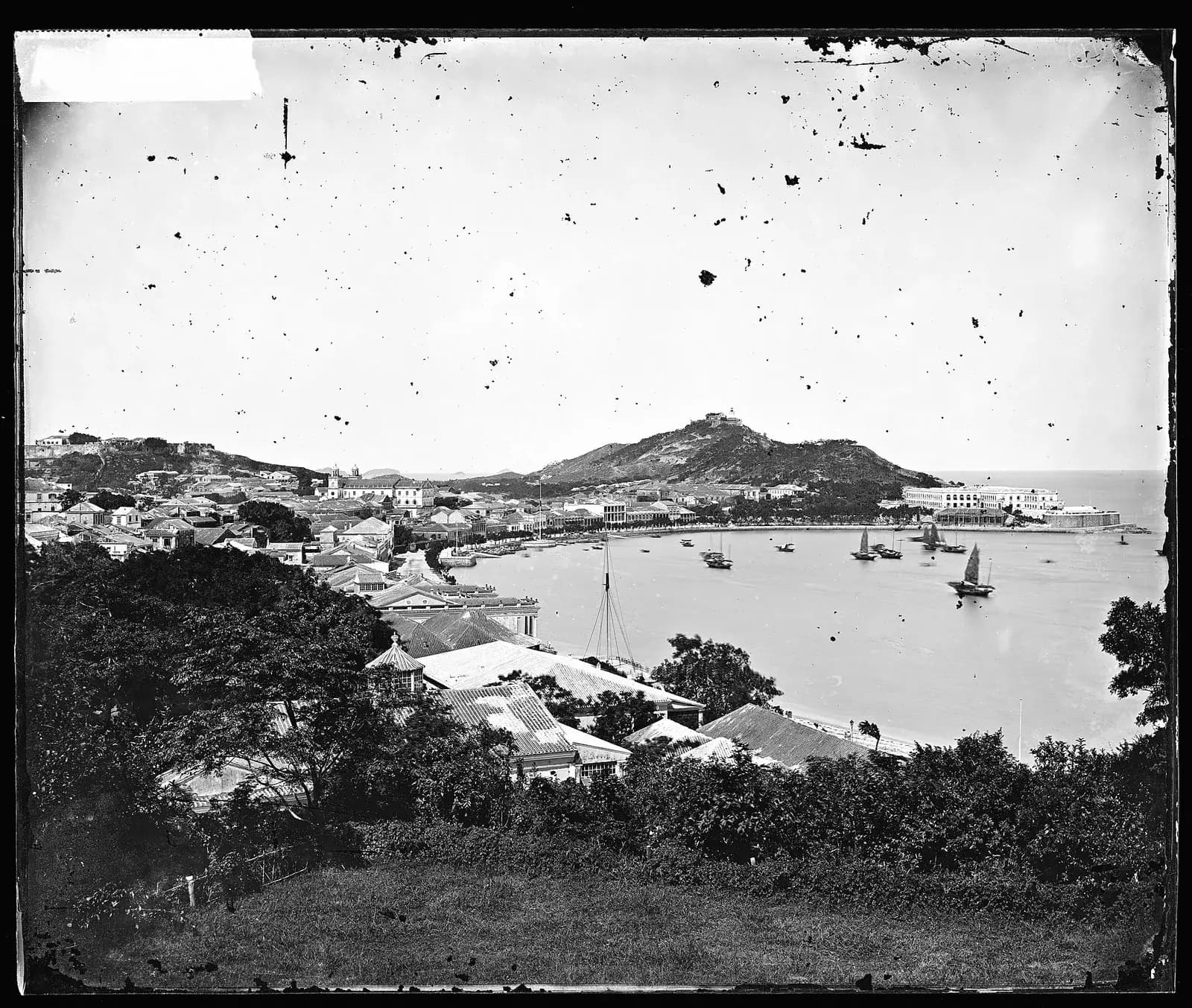
The balance shifted after Britain took Hong Kong in the Opium War. The Portuguese pressed for more, including an end to the ground rent, and gradually took control of the whole peninsula. João Maria Ferreira do Amaral, governor from 1846, closed Chinese customs houses and was assassinated on 22 August 1849. His statue would become one of the most disputed objects in the city.
Portugal got its legal title in 1887. A protocol agreed in Lisbon that March, signed by the foreign minister Henrique de Barros Gomes and by James Duncan Campbell for the Chinese government, stated in its second article that “China confirms the perpetual occupation and government of Macao and its dependencies by Portugal”. In the third, Portugal promised never to give Macau away without China's agreement.
A treaty signed in Peking that December, and ratified in 1888, confirmed the protocol. It never fixed Macau's borders: China always avoided defining what the “dependencies” were. Chinese accounts list it among the unequal treaties forced on the Qing dynasty.
China did not accept the arrangement for long. In 1928 its Nationalist government told Portugal it was ending the treaty, and after 1949 the People's Republic declared all such treaties void. Portugal stayed on regardless.
1966: the “12-3” riots
China's Cultural Revolution began in May 1966, and by November it had reached Macau. On 15 November, on Taipa, Rui de Andrade, the Macanese head of the islands' council, tried to stop pro-Communist residents building a primary school. Police were called and made arrests. On 30 November the People's Daily in Beijing and the Guangzhou press took up the cause.
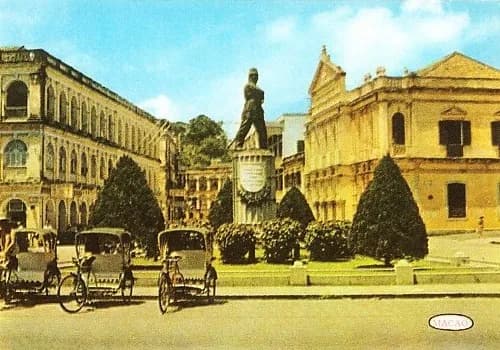
On 3 December 1966 protests in the city turned into riots against the Portuguese administration, and the next day against supporters of Taiwan's Nationalists. Eight Chinese died. The disturbances are known as “12-3” or “1-2-3”, after the month and day. Rioters toppled the bronze statue of the soldier Vicente Nicolau de Mesquita near the Leal Senado, the city hall.
Guangdong province put O Cheng-peng, chairman of Nam Kwong, a Chinese state trading company in Macau, in charge of negotiating with the Portuguese. On 29 January 1967 the governor, Brigadier Nobre de Carvalho, signed two accords, one with Guangdong's foreign affairs bureau and one with Macau's Communist leaders.
“In Macao in December, after two months of rioting, the Governor had been compelled to sign a confession of guilt, release arrested rioters, pay compensation, ban pro-Nationalist activities and hand over Nationalists agents. Macao never recovered.”
From then until 1999, the historian Moisés Fernandes argues, Portugal ran Macau on Beijing's terms, with Nam Kwong acting as a shadow government. A senior official in Lisbon's overseas ministry said as much in March 1967 to the man being sent out as the governor's deputy.
“We will always have to bear in mind that we stay in Macao, as long as China consents.”
Offers Beijing declined
Lisbon drew its own conclusion. According to Santos Neves, António de Oliveira Salazar's dictatorship quietly offered in 1967 to return Macau, to avoid a “second Goa”. China said no.
In 1971 the People's Republic took China's seat at the United Nations. On 9 March 1972 its ambassador, Huang Hua, wrote to the UN decolonisation committee that Hong Kong and Macau were Chinese territory occupied by the British and Portuguese, and that settling the question was China's business alone. That November the General Assembly took Macau off the list of colonies due for decolonisation.
Portugal's Carnation Revolution of 25 April 1974 ended the dictatorship and brought a sharp change in colonial policy. In 1975, as part of the general decolonisation, Lisbon offered Macau back again. Beijing refused again, Santos Neves writes, mainly for fear of shaking confidence in Hong Kong, China's main window on the world. Zhou Enlai and other moderates also judged that, with China in the turmoil of the Cultural Revolution, it was the wrong moment for such a decision.
So Portugal relabelled Macau instead. From 1975 both governments treated it as a “Chinese territory under Portuguese administration”, and the 1976 Portuguese Constitution said Macau was not part of Portugal's territory, only under its administration. When the two countries established diplomatic relations on 8 February 1979, a then-secret understanding added that the question would be settled “when appropriate”.
One country, two systems: the 1987 deal
Once Britain and China had settled Hong Kong in 1984, Macau was next. Formal talks opened on 30 June 1986, took four rounds, and produced an agreed text on 23 March 1987. Portugal had hoped for more time. Fernandes writes that President Mário Soares wanted the handover put back to 2007, 450 years after 1557, or even to 2057, and that the Chinese side rejected both.
Prime Minister Aníbal Cavaco Silva and Premier Zhao Ziyang signed the Joint Declaration in the Great Hall of the People in Beijing on 13 April 1987, with Deng Xiaoping looking on. It came into force on 15 January 1988.
“The Government of the Portuguese Republic and the Government of the People's Republic of China declare that the Macau region (including the Macau Peninsula, Taipa Island and Coloane Island, hereinafter referred to as Macau) form part of Chinese territory and that the Government of the People's Republic of China will resume the exercise of sovereignty over Macau with effect from 20 December 1999.”
The formula was “one country, two systems”, an idea Deng had designed for Taiwan and first applied to Hong Kong. Macau would become a Special Administrative Region with a high degree of autonomy, except in foreign affairs and defence. Its social and economic systems, its laws and its way of life would stay basically unchanged for 50 years.
Portuguese could still be used in government, the legislature and the courts, and the interests of inhabitants of Portuguese descent were to be protected by law. China's National People's Congress wrote all this into the Basic Law on 31 March 1993. Its Article 5 says the capitalist system and way of life “shall remain unchanged for 50 years”, and Article 9 makes Portuguese an official language alongside Chinese.
| Year | Document | What it said about Macau |
|---|---|---|
| 1887 | Lisbon protocol and Treaty of Peking | China confirmed Portugal's “perpetual occupation and government”; Portugal could not hand Macau to another power without China's agreement |
| 1928 | Note from China's Nationalist government | China told Portugal it was ending the 1887 treaty |
| 1976 | Constitution of the Portuguese Republic | Macau was not Portuguese territory, but was under Portuguese administration |
| 1979 | Secret understanding on diplomatic relations | A Chinese territory under Portuguese administration, its future to be settled “when appropriate” |
| 1987 | Joint Declaration | China would resume sovereignty on 20 December 1999; one country, two systems for 50 years |
| 1993 | Basic Law | No socialist system; capitalism and way of life unchanged for 50 years; Portuguese an official language |
The last governor and the transition years
Vasco Rocha Vieira, an army general from Lagoa with a degree in civil engineering, had served in Angola and in Macau before and had been army chief of staff from 1976 to 1978. He was minister of the Republic for the Azores from 1986 to 1991, then governed Macau until 1999.
A joint liaison group settled practical questions: a new international airport, the Bank of China as a note-issuing bank, the renewal of the casino franchise. The hardest were the three “localisations”: replacing Portuguese civil servants with local people, turning Portugal's laws into local law, and giving Chinese official status.
Symbols were negotiated too. Beijing's office for Hong Kong and Macau wanted Ferreira do Amaral's statue gone as a colonial symbol. On 28 October 1992 it came down and was shipped to Portugal.
Some questions were never settled. Macau's Justice Secretariat estimated that 110,000 people of Chinese origin held Portuguese citizenship, and the group most affected were the Macanese, who held both nationalities. China does not recognise dual nationality, so after the handover it would treat them as Chinese nationals.
The last years were violent. After Hong Kong's return in 1997, rival gangs fought over Macau, and the Associated Press reported that triads were blamed for at least 37 killings in 1999. The shooting stopped a month before the handover. On 15 May 1999 a 200-member selection committee chose the banker Edmund Ho Hau-wah, son of the business leader Ho Yin, as the first Chief Executive.
Handover night
- Date
- Night of 19 to 20 December 1999; sovereignty passed at midnight
- Venue
- Garden Pavilion of the Macao Cultural Centre, dismantled after the ceremony
- Portugal
- President Jorge Sampaio and Governor Vasco Rocha Vieira
- China
- President Jiang Zemin
- Guests
- About 2,500
- New government
- Edmund Ho Hau-wah, first Chief Executive of the Macao SAR
19 December, evening
Last Mass under Portugal
Jiang Zemin lands from Zhuhai while the last Mass under Portuguese administration is said in the cathedral.
c. 23:00
Ceremony opens
Sampaio and Jiang appear before about 2,500 guests.
Before midnight
Portuguese flag lowered
Sampaio speaks, then the Portuguese anthem plays and the flag comes down.
00:00, 20 December
Chinese flag raised
Jiang takes the podium just after midnight.
Within two hours
New government
Edmund Ho's administration takes control.
20 December
Troops arrive
Units of the People's Liberation Army enter Macau.
Pina-Cabral thought the politicians felt little for the city, with two exceptions: the outgoing governor and the incoming Chief Executive, in near-identical grey suits, for whom the night meant something personal. Macau's Portuguese-language paper Ponto Final described Rocha Vieira's last look at the governor's palace.
“Rocha Vieira, the last Portuguese governor of the territory, could barely hold back his tears and, with the flag close to his heart, looked for the last time at the Portuguese coat of arms in stone set into the façade of the building that had been his office for the past nine years.”
In Beijing, a selected crowd of 25,000 to 30,000 attended a midnight gala in Tiananmen Square, according to UPI and AP. In Macau police broke up a meditation protest by about 30 followers of Falun Gong outside the Hotel Lisboa and arrested four of them. Jiang used his speech to call for “complete national reunification” with Taiwan.
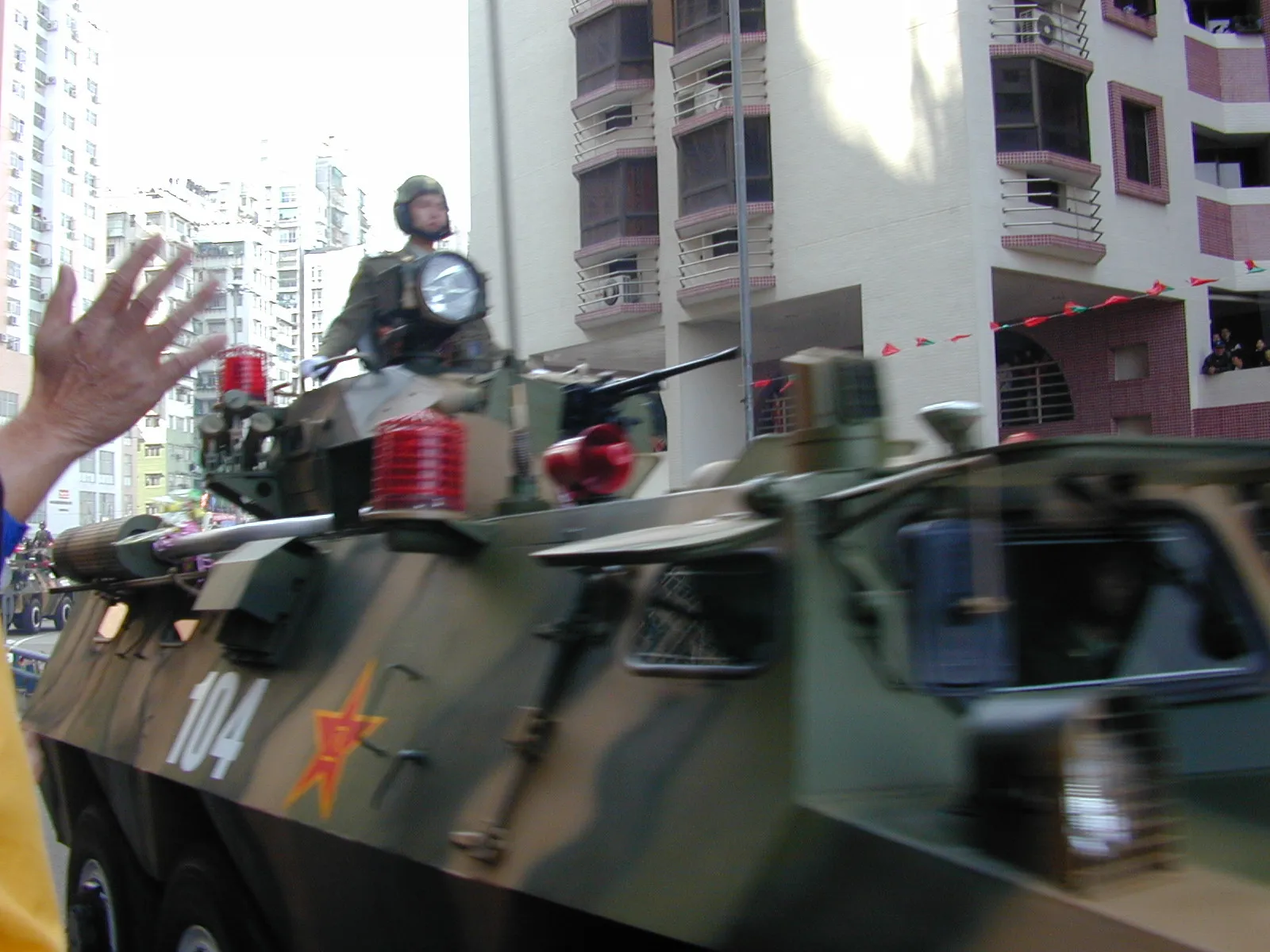
The garrison was a late sore point. Santos Neves noted that Beijing's decision to station troops in Macau, announced soon after Hong Kong's return, had caused a recent dispute with Portugal. The decision, he argued, had less to do with Macau than with Taiwan: it showed that the armed forces were a symbol of sovereignty China would not negotiate away.
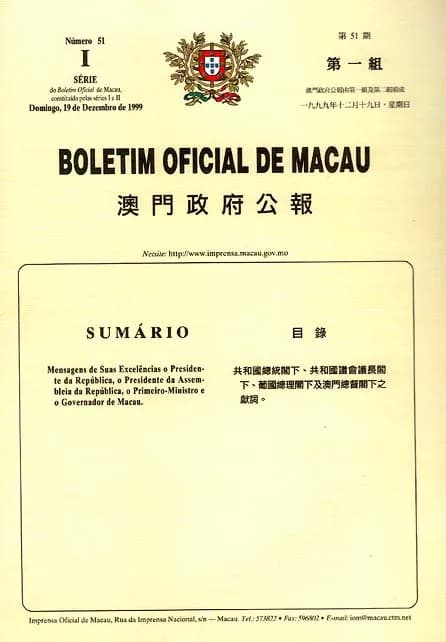
After the flag came down
Most of the Portuguese left with the administration. In the mid-1990s the Portuguese community had reached about 6,000 people, most of them civil servants. A year after the handover, Ponto Final reported, Portugal's consulate counted about 1,000 still there.
Macau itself grew. Its population rose from an estimated 430,500 in 1998 to 688,300 at the end of 2024, and land reclamation took its area from 23.6 to 33.3 square kilometres. Gambling tourism then remade the economy; Pina-Cabral dates the boom to 2002.
Portuguese kept its legal status but lost ground as a spoken language. In the 2001 census, 0.7 per cent of residents said it was their usual language; in the 2016 by-census, 0.6 per cent. Over the same years Mandarin rose from 1.6 to 5.3 per cent and English from 0.7 to 2.7 per cent, while Cantonese fell from 87.9 to 77.8 per cent.
Usual language of Macau residents, smaller languages
% of population
- 2001 census
- 2011 census
- 2016 by-census
Share of residents giving each language as their usual language. Cantonese (87.9, 83.3 and 77.8 per cent) is left out so the smaller languages can be read. Figures from Macau's 2001 and 2011 censuses and 2016 by-census, as tabulated by Macau Business.
Show the data
| 2001 census | 2011 census | 2016 by-census | |
|---|---|---|---|
| Portuguese | 0.7 | 0.7 | 0.6 |
| English | 0.7 | 2.3 | 2.7 |
| Mandarin | 1.6 | 5 | 5.3 |
| Measure | Around 1999 | Latest figure |
|---|---|---|
| Population | 430,500 (1998 estimate) | 688,300 (31 December 2024) |
| Land area | 23.6 km² | 33.3 km² |
| Portuguese nationals | About 110,000 Portuguese citizens of Chinese origin (1999 estimate) | 1.3 per cent of residents (2021 census) |
| Born in Portugal | Not available | 0.3 per cent of residents (2021 census) |
| Portuguese as usual language | 0.7 per cent (2001 census) | 0.6 per cent (2016 by-census) |
The two nationality figures measure different things: the 1999 estimate counts people of Chinese origin holding Portuguese citizenship; the census records the nationality people declared.
Why it still matters
The 50-year guarantee runs to 2049. Portuguese remains an official language, which the government, the legislature and the courts may use alongside Chinese.
On 15 July 2005 UNESCO inscribed the Historic Centre of Macao on its World Heritage List, China's 31st site. It covers eight squares, 22 historic buildings and the streets between them, where Chinese and Portuguese buildings, religious practices and customs mix, in a core zone of about 0.16 square kilometres.
The Macanese, the city's Eurasian community, have pushed to keep their own culture on the record. Their associations nominated Macanese cooking and theatre in Patuá, their Portuguese-based creole, to Macau's heritage list in 2011, and in June 2021 China added both to its national list. Patuá itself is considered almost extinct.
Portugal approached the transition, Santos Neves argued in 1999, with a “zero risk” strategy, because it saw Macau as a last chance to lay to rest the traumas of decolonisation in Africa.
FAQs
When did Portugal hand Macau over to China?
At midnight on the night of 19 to 20 December 1999. The ceremony began at about 11pm on 19 December at a pavilion beside the Macao Cultural Centre, with Portugal's President Jorge Sampaio and China's President Jiang Zemin. Under the 1987 Joint Declaration, China resumed sovereignty from 20 December 1999.
How long was Macau Portuguese?
Portuguese traders settled there in the 1550s. Portuguese tradition dates the settlement to 1557, which gives the 442 years quoted in 1999, but a Ming gazetteer of 1602 and the Macao government give 1553, and the historian Tang Kaijian 1554. For most of that time China kept sovereignty and the Portuguese paid rent; Portugal's 'perpetual occupation' was confirmed only in 1887.
Did Portugal try to give Macau back earlier?
Yes. Portugal offered to return Macau in 1967, after the riots of December 1966, and again in 1975, after the Carnation Revolution. China refused both times, mainly to avoid unsettling Hong Kong.
What does 'one country, two systems' mean for Macau?
Macau is a Special Administrative Region of China with a high degree of autonomy, except in defence and foreign affairs. Under the Joint Declaration and Article 5 of the Basic Law, its capitalist system and way of life are to remain unchanged for 50 years from 1999.
Is Portuguese still spoken in Macau?
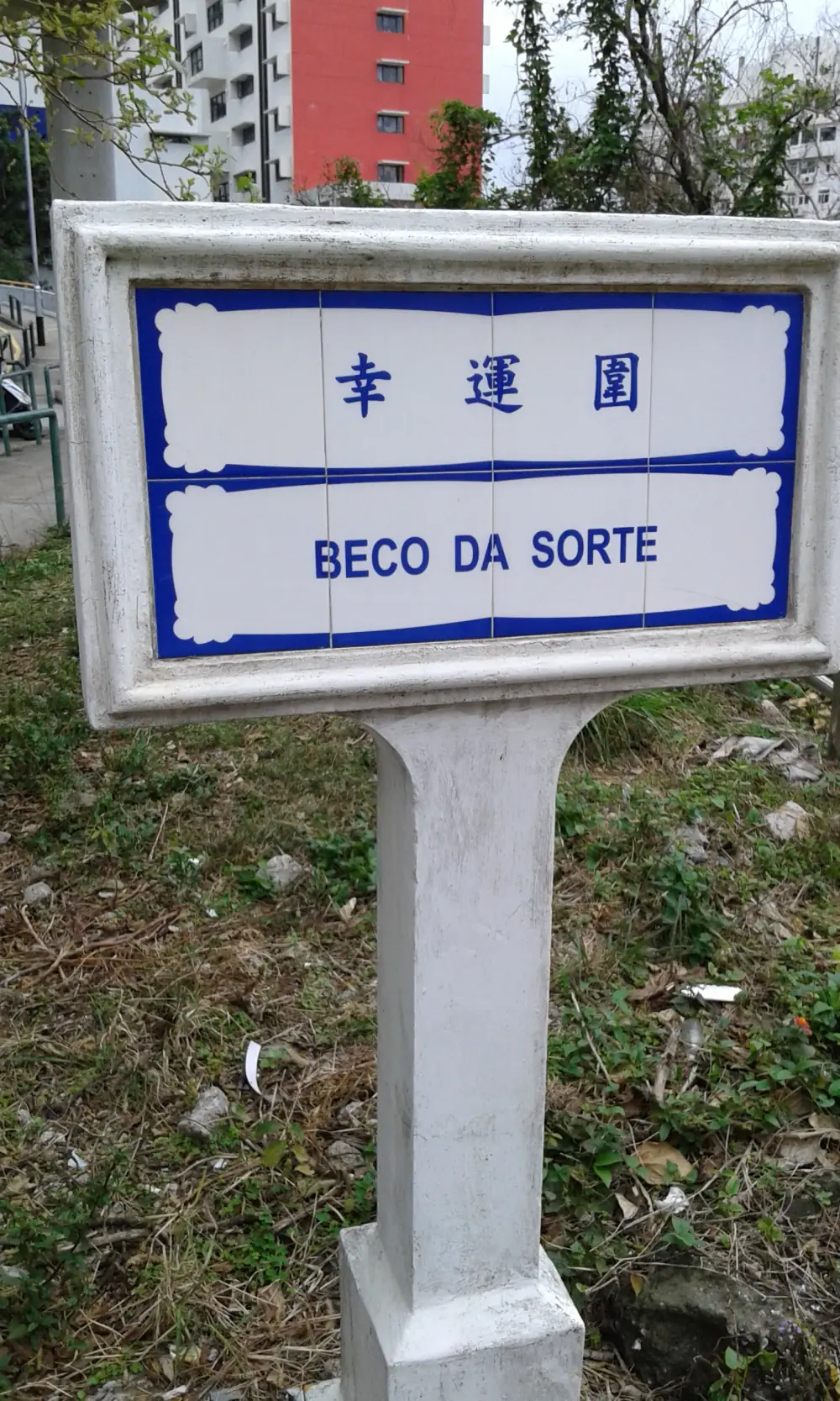
Portuguese is an official language alongside Chinese under Article 9 of the Basic Law, and street signs use both. As a home language it is rare: 0.6 per cent of residents gave it as their usual language in the 2016 by-census.
On the timeline
Open the timelineNearby moments from portugal in europe (1986–today).
Amália Rodrigues, the queen of fado, dies at her home in Lisbon's Rua de São Bento aged 79. The government declares three days of national mourning, the parties suspend campaigning for the general election four days later, and in 2001 she becomes the first woman laid in the National Pantheon.
António Guterres's Socialist Party wins the legislative election with exactly half the seats in parliament, 115 of 230, one short of an absolute majority, in a vote held days after the death of Amália Rodrigues had paused the campaign.
SATA Air Açores Flight 530M, a turboprop on the inter-island route from Ponta Delgada to Horta and Flores, flies into the slopes of Pico da Esperança on São Jorge in heavy rain and cloud, killing all 35 people on board. It remains the deadliest accident involving the BAe ATP and the worst in SATA's history.
The Macau handover, 1999
At midnight, in a temporary pavilion beside the Macao Cultural Centre, Portugal hands Macau over to China, ending Portuguese administration of a settlement traditionally dated to 1557, 442 years earlier. Macau becomes a Special Administrative Region of China, promised its own system and way of life for 50 years under 'one country, two systems'.
Death in Lisbon of José Águas, aged 70. Born in Luanda and spotted in Lobito, he became Benfica's prolific centre-forward and captain, five times the league's top scorer. He scored Benfica's first goal in both European Cup finals, 1961 and 1962, and lifted the trophy each time; Eusébio joined him for the second.
Death of Marshal Francisco da Costa Gomes in Lisbon, aged 87. Career soldier, Chief of Staff of the Armed Forces and President of the Portuguese Republic from 1974 to 1976, he was — alongside António de Spínola — the senior military figure of the Carnation Revolution and the man who guided Portugal through the most turbulent phase of decolonisation and the transition to democracy.
UNESCO inscribes the Alto Douro Wine Region on its World Heritage List as an 'evolving, living cultural landscape'. Its steep schist terraces, carved by hand over centuries along the Douro and its tributaries, produce port wine in a region demarcated in 1756, often called the world's first officially demarcated wine region.
Coming up in history
All long reads 22 December 1761One treasury, one set of books: Pombal's Real Erário of 1761
 23 December 1534The Treaty of Bassein, 1534: how Portugal came to hold Bombay
 24 December 1524Vasco da Gama dies in Cochin, three months into his viceroyalty
 25 December 1968Christmas 1968: RTP's second channel goes on air in Lisbon
24 sources
Archives, scholarship and reporting this article was checked against.
- 1
Joint Declaration on the question of Macao (with annexes), signed at Beijing on 13 April 1987United Nations Treaty Series, vol. 1498, No. 25805
- 2
History (Macao Yearbook 2023)Government Information Bureau of the Macao SAR
- 3
An asymmetrical relationship in Macao from 1966 and 1999 (Moisés Fernandes)Anais de História de Além-Mar XXV (2025): 119-143
- 4
As prioridades pós-transição (Miguel Santos Neves)O Mundo em Português 3, Instituto de Estudos Estratégicos e Internacionais, December 1999
- 5
- 6
Macau's handover: a personal account (João de Pina-Cabral)Portuguese Literary and Cultural Studies 17/18 (2010), University of Massachusetts Dartmouth
- 7
Macau is handed back to ChinaUnited Press International, 20 December 1999
- 8
Macau: Human rights challenges for transition (AI Index ASA 27/03/99)Amnesty International, 15 December 1999
- 9
Handover Gifts Museum of MacaoCultural Affairs Bureau of the Macao SAR
- 10Parlamento unânime no pesar pela morte do general Rocha VieiraObservador, 24 January 2025
- 11
Portugal returns Macau to Chinese control (Associated Press)Deseret News, 20 December 1999
- 12
- 13
Ruins of Macau in Historical Photographs of China collections, part two (Helena F. S. Lopes)Visualising China, University of Bristol, 24 September 2020
- 14
Mr. Denby to Mr. Bayard, Peking, 31 May 1887, enclosing the Lisbon protocolForeign Relations of the United States, 1887, Office of the Historian
- 15
- 16
200th anniversary: Colonel whose name is everywhere is recalled by few (Daniel Beitler)Macau Daily Times, 9 July 2018
- 17
The Basic Law of the Macao Special Administrative Region of the PRCCongressional-Executive Commission on China (English text)
- 18
Narrativas da Transição: a transferência de poderes de Macau vista pelo jornal Ponto Final, 1996-2001 (Maria Leonor Machado, MA thesis)Escola Superior de Comunicação Social, Instituto Politécnico de Lisboa, 2013
- 19
- 20
Special report: 澳门 or 澳門? (João Paulo Meneses)Macau Business, 20 February 2021
- 21
20th anniversary of successful inscription of “Historic Centre of Macao” on UNESCO World Heritage ListGovernment Information Bureau of the Macao SAR, 15 July 2025
- 22
- 23
- 24
Museu de Macau, Centro Científico e Cultural de MacauOpen House Lisboa, Trienal de Arquitectura de Lisboa
Image credits
- Senado Square, in the Historic Centre of Macao, lit for Christmas in January 2015. The white building at the back is the Santa Casa da Misericórdia. On handover night in 1999 crowds gathered in this square to cheer the Chinese anthem. kewl, CC BY 2.0, via Wikimedia Commons.
- The Praia Grande bay, the most fashionable address in nineteenth-century Macau, photographed by John Thomson from Penha Hill in 1870. From the 1820s a view of the Praia Grande was the standard souvenir of Macau. John Thomson, CC BY 4.0, via Wikimedia Commons.
- The statue of Vicente Nicolau de Mesquita in Senado Square on a postcard of about 1955. Rioters pulled it down in the 12-3 disturbances of December 1966. The World Art Co. - Macau, Public domain, via Wikimedia Commons.
- An armoured vehicle of the People's Liberation Army drives into Macau on 20 December 1999, the first day of Chinese rule. The stationing of Chinese troops in Macau had been a late point of dispute with Portugal. US Department of State, Public domain, via Wikimedia Commons.
- The last issue of the Boletim Oficial de Macau, the Portuguese administration's official gazette, dated Sunday 19 December 1999. It carried farewell messages from Portugal's president, the speaker of parliament, the prime minister and the governor. Imprensa Oficial de Macau, Public domain, via Wikimedia Commons.
- A Macau street sign in Chinese and Portuguese, made of blue and white tiles: Beco da Sorte, Alley of Luck. Photographed in 2018. Pauloleong2002, CC BY-SA 4.0, via Wikimedia Commons.