

One treasury, one set of books: Pombal's Real Erário of 1761
Before 1761 the Portuguese crown's revenues were scattered among many offices and strongboxes. A law of King José I, countersigned by his minister, the future Marquis of Pombal, sent every coin of revenue into one treasury and ordered its books kept the way merchants kept theirs.
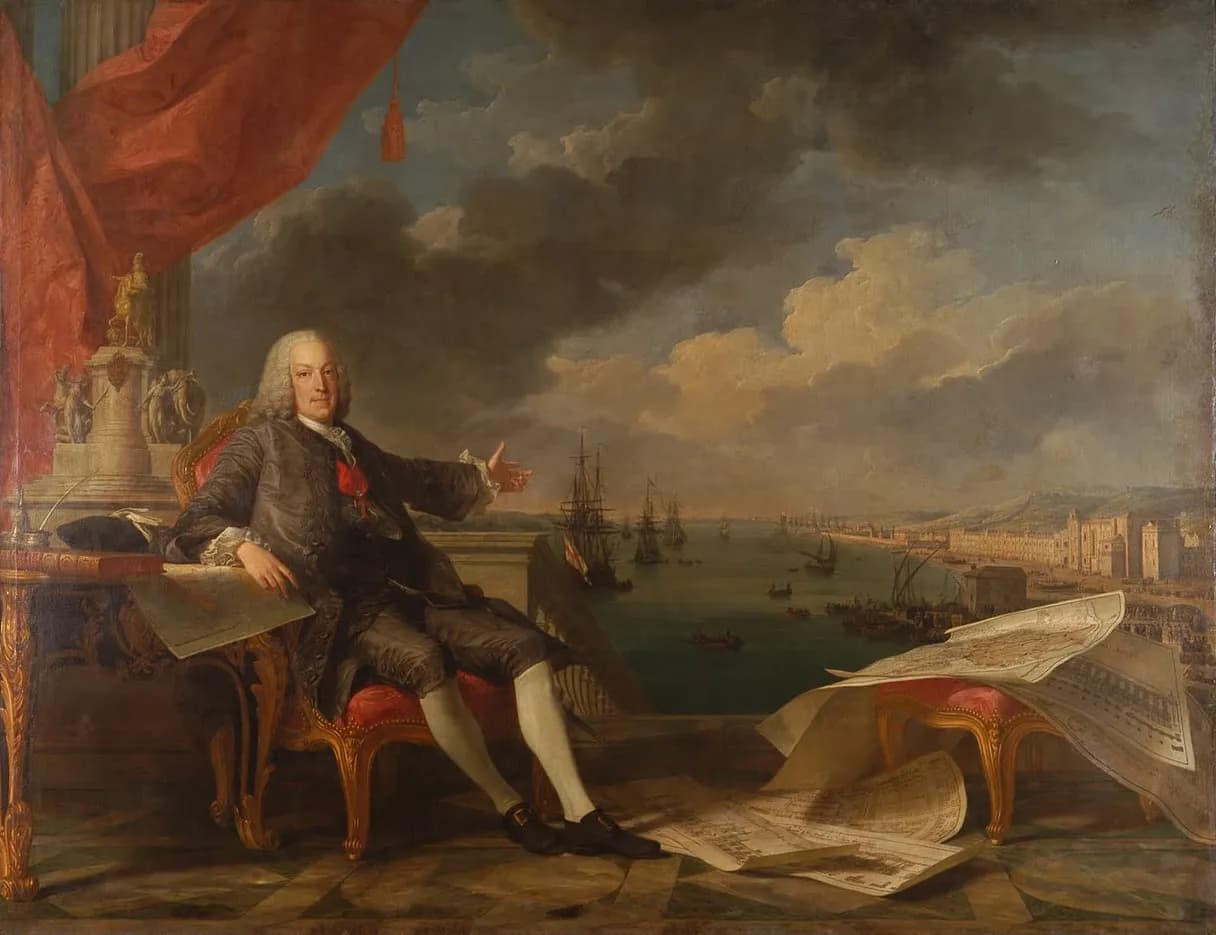
At a glance
- A Carta de Lei (charter law) of King José I, dated 22 December 1761 and countersigned by the Count of Oeiras, the future Marquis of Pombal, abolished the Contos do Reino e Casa and created a single General Treasury, the Real Erário.
- Every tax farmer, customs house and royal receiver now had to pay into one General Treasury in Lisbon, and every payment came out of it, recorded by a scrivener at the mouth of the chest.
- The law made the treasury's four accounting offices keep their books in double entry, "the shortest, the clearest and the most conclusive" method, as merchants did. It was the first body of Portugal's central government to do so.
- Thirty-eight officials took office on 11 January 1762, with Pombal as unpaid Inspector-General. The heads of the accounting offices were merchants, because few Portuguese clerks knew double entry; the Aula do Comércio, a state school of commerce opened in 1759, began training more.
- Liberals abolished the Erário by decrees of 1832 and 1833. Its control functions passed through the Tesouro Público to the Tribunal de Contas, created in 1849, which still audits Portugal's public accounts.
A chest, three keys and a book
On 11 January 1762, thirty-eight men took office in the new Real Erário, the Royal Treasury of Portugal. At their head stood Sebastião José de Carvalho e Melo, Count of Oeiras, the king's chief minister, who took the post of Inspector-General without pay. Below him were a Treasurer-in-Chief and his scrivener, three general treasurers with their scriveners, four general accountants with sixteen clerks, four tellers, four ushers and a porter.
Their rules had been printed a few weeks earlier. Money came in and went out only "at the mouth of the chest", the law said. The moment a tax farmer or royal receiver handed over a sum, the Treasurer's scrivener wrote it on the left-hand page of a numbered book, with the date in the margin, the payer's name and where the money came from. Payments out went on the right-hand page. The strongroom had three keys: the Treasurer kept the first, his scrivener the second and the general accountant for Lisbon and Estremadura the third.
Every Saturday the Treasurer drew a summary from the accountants' books and took it to the Inspector-General, so that the king could be shown the state of the treasury every week. Under the old system nobody could even work out how much of the crown's money was free to spend, so this was new.
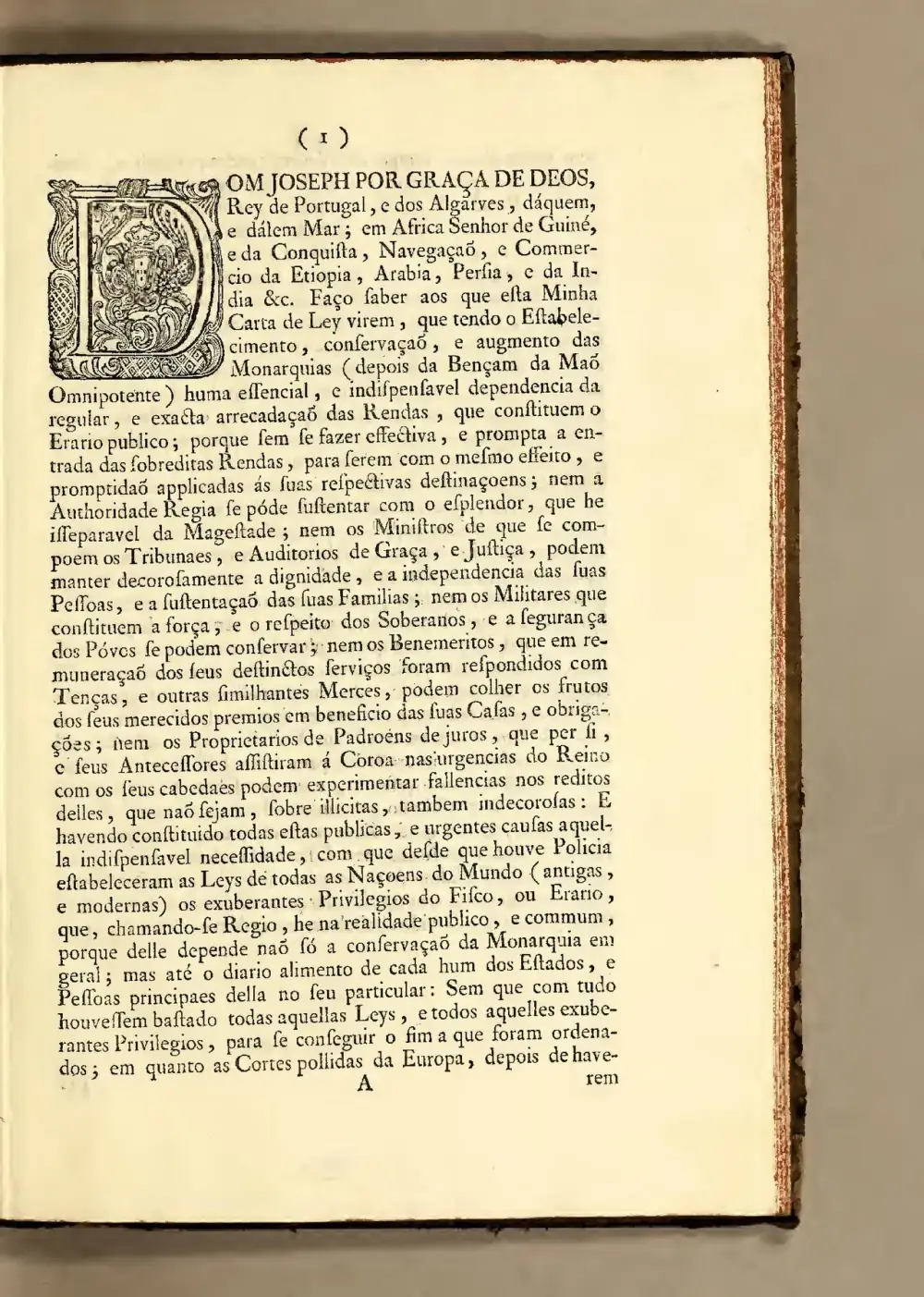
A treasury in pieces
Portugal's crown accounts had been kept since the Middle Ages by the Contos, later called the Casa dos Contos. Its roots went back to the reign of King Dinis in the late thirteenth century, and it received its first regulations in 1389 under João I. By 1761 it employed 102 people at the Terreiro do Paço, the riverside square of the royal palace.
Its problems were old ones. Particular revenues were assigned to particular expenses, so only scattered leftover balances ever reached the centre, at different times. Pensions, favours and grants were handed out by several councils with no central control. Different bodies sent payment orders to different treasurers, so nobody could work out how much money was actually free. Many posts were owned as property and passed down in families.
The earthquake of 1 November 1755 brought things to a head. The shaking, the tsunami and the fires that followed (told in our article on the earthquake) destroyed most of the Contos' records; some accounts say all of them. Raising money to rebuild Lisbon then showed how little the old office could do to stop unauthorised payments.
The disaster also made Carvalho e Melo. Appointed Secretary of State for Foreign Affairs and War in 1750, he took over the Secretariat of the Kingdom in 1756 and in practice ran the government. By the end of the decade he had crushed his opponents: rioters in Porto in 1757, the Távora and Aveiro nobles executed in January 1759, and the Jesuits expelled that September. King José I made him Count of Oeiras in 1759.
Reform of commerce and teaching came first. A Board of Trade, the Junta do Comércio, was set up in 1755, merchants' books were regulated in 1756 and a school of commerce opened in 1759. The treasury came last. As one historian of the reforms put it, with internal opposition brutally crushed, Carvalho e Melo now had time to change the country's administrative machine.
The law of 22 December 1761
The Carta de Lei was dated at the Palace of Nossa Senhora da Ajuda on 22 December 1761, signed by the king and countersigned by the Count of Oeiras. It was registered the next day and published in Lisbon on 29 December. A second law of the same date redefined the Conselho da Fazenda, the council that leased out the crown's taxes and contracts.
Its preamble argued that the courts of Europe had learned, from many grim experiences, that splitting revenues among many offices only served to annihilate them. It blamed the long lawsuits that delayed every receipt while the palace, judges and soldiers had to be paid on time, and the many receivers and treasurers who hid their frauds in the confusion.
Title I then abolished the office of Contador-Mor and the Contos do Reino e Casa "as if they had never existed", with all their posts, procedures and strongboxes. From then on every tax farmer, receiver and collector had to bring what he collected to the new General Treasury and hand it to the Treasurer-in-Chief, on pain of losing his contract or office.
A decree of 30 December 1761 dealt with the leftovers. Receivers' accounts opened since the earthquake were to be settled under the Inspector-General, and every book and paper still in the Contos was to be inventoried and moved to the new treasury's archive. The old office's staff were not simply sacked: they kept their salaries until they found other posts or retired.
- Law
- Carta de Lei of 22 December 1761, in fifteen titles, with an annexed list of ledgers
- Signed
- King José I, countersigned by the Count of Oeiras (Pombal)
- Abolished
- The office of Contador-Mor and the Contos do Reino e Casa
- Created
- A single General Treasury, the Real Erário, under an Inspector-General answering only to the king
- Bookkeeping
- Double entry in the four general accounting offices
- Staff
- 38 posts, filled on 11 January 1762; the Casa dos Contos had 102 staff
The Inspector-General was to preside "in my place, as my lieutenant", in the law's words, answering directly to the king. Below him the treasury was split by geography into four contadorias, or accounting offices, each run by a general accountant with four clerks. Each had a daybook, a ledger and subsidiary books for every customs house, tax and contract it supervised.
| Contadoria (accounting office) | First general accountant | Subsidiary ledgers |
|---|---|---|
| The Court and the province of Estremadura | António Caetano Ferreira | 28 |
| The other provinces of the kingdom, the Azores and Madeira | Baltazar Pinto de Miranda | 32 |
| West Africa, Maranhão and the district of the Bahia high court | Manuel Pereira de Faria | 27 |
| The district of the Rio de Janeiro high court, East Africa and Portuguese Asia | Luís José de Brito | 21 |
Ledger counts from the schedule annexed to the law, 108 books in all, as tallied by Benavente Rodrigues and recounted from the printed schedule. Collectors such as almoxarifes (district revenue officers) and treasurers kept only simple books of receipts and expenses.
The schedule of ledgers reads like a map of the empire's economy. It lists books for duties on slaves and ivory in Angola and on slaves sent inland to the mines, the fishery in Pará, sugar in Pernambuco, cattle tithes in Rio Grande do Norte and whaling off Bahia, Rio de Janeiro and São Paulo. The Rio de Janeiro office also kept the books for the royal fifth of the gold and for the diamond contract.
Title XII set the method. The handling of such large sums, the law said, could not be left to the habits of whoever ran each office.
“I determine that the method of the said collection shall be the mercantile one, and within it that of double entry, which is now followed by all the polished nations of Europe, as the shortest, the clearest and the most conclusive for governing the administration of great sums, without subterfuges in which malice might find a place to hide.”
Twice a year, by 10 July and 10 January, each general accountant had to deliver a balance of what his office had received, spent and held in cash, on pain of suspension. The Inspector-General then had the Treasurer's cash book balanced against the four accounts and watched the tellers count the coins in the strongroom. If all was correct, the record went to the king.
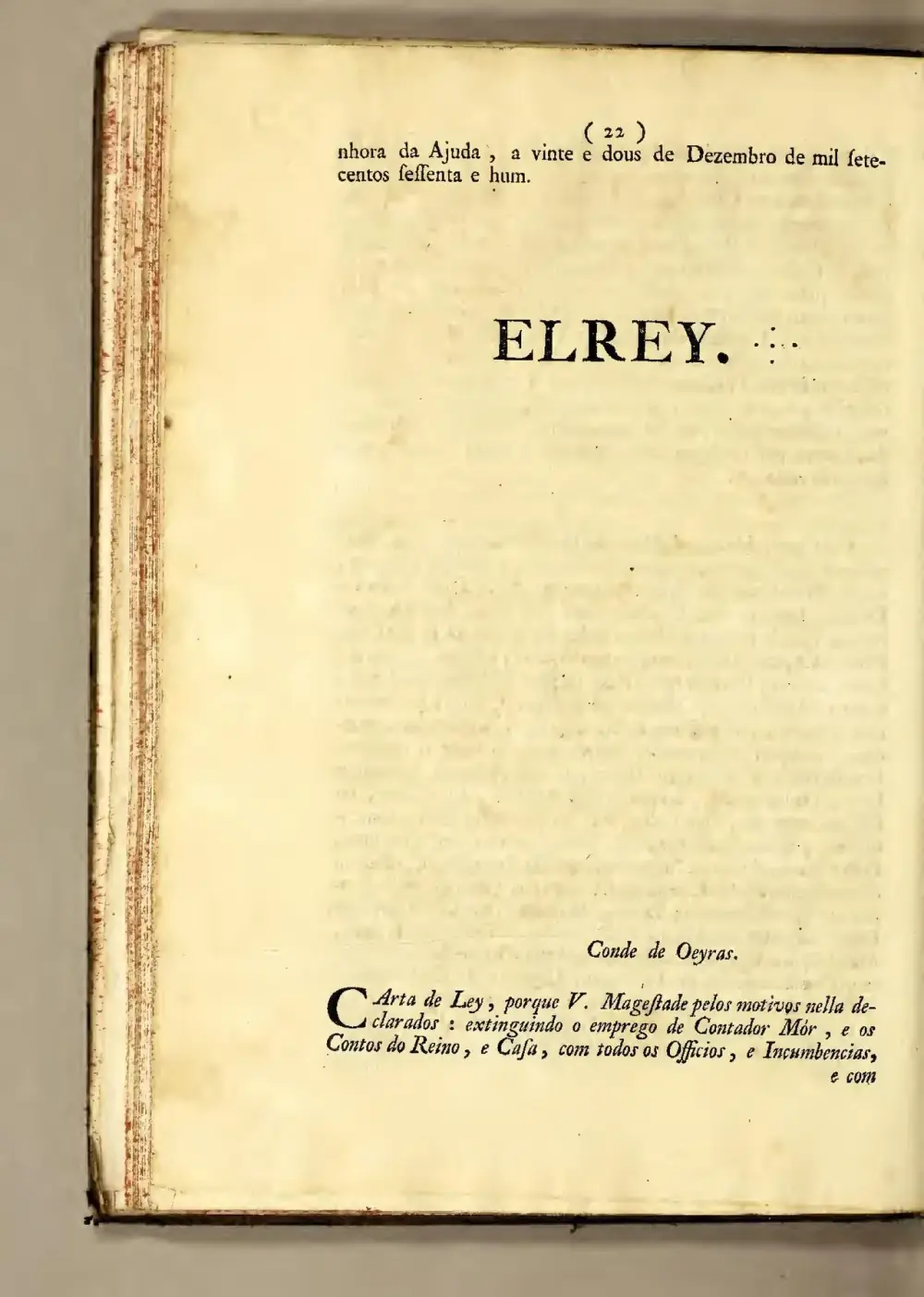
Finding men who could keep the books
The law demanded general accountants with "the indispensable science of mercantile calculation", who understood and practised double entry. Their clerks needed only to write the books cleanly, in the hope that they would learn enough to succeed their chiefs. Such people were scarce in Portugal.
Jácome Ratton, a merchant whose memoirs were published in 1813, recalled that in the mid-eighteenth century only three Portuguese firms kept double-entry books, each with a foreign partner. Two of the Erário's first accountants, António Caetano Ferreira and Luís José de Brito, came from those firms. All four general accountants were merchants Pombal trusted, though three of the twelve senior officials below Pombal came from the old Contos.
Pombal himself had probably met double entry in London, where he was envoy from 1738 to 1743. In a letter of 1742 to Cardinal da Mota, then the leading minister of João V, he discussed the method and its advantages for English trade. The statutes of the trading companies he founded around 1760 required double-entry books.
His longer answer was a school. The Aula do Comércio, paid for by the Junta do Comércio, took its first students on 1 September 1759. Boys over fourteen who could read, write and count sat an entrance exam, with preference for merchants' sons. The three-year course covered arithmetic, exchange, weights and measures, insurance and, last of all, double-entry bookkeeping.
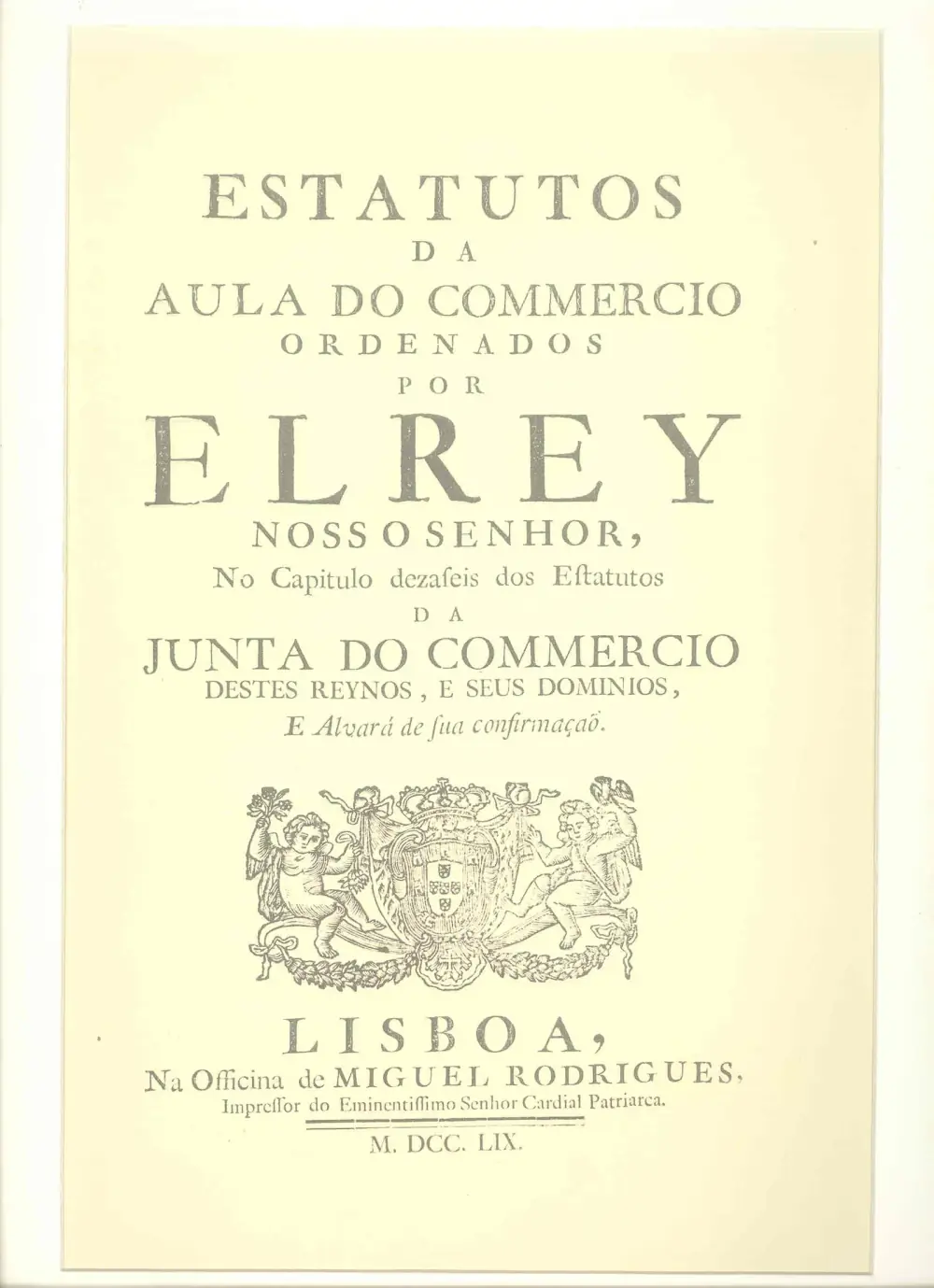
Its first teacher, João Henrique de Sousa, was a tailor's son from Setúbal who had learned bookkeeping in the Lisbon houses of two Florentine merchants and worked in Buenos Aires and Rio de Janeiro. He taught only the first course. In January 1762 Pombal made him scrivener to the Treasurer-in-Chief, the post that set up the Erário's bookkeeping.
| Course | Began | Enrolled | Completed |
|---|---|---|---|
| 1st | 1 September 1759 | 61 | 30 |
| 2nd | 11 July 1763 | 109 to 116 | 52 |
| 3rd | 11 June 1767 | 288 | 155 to 161 |
| 4th | 15 February 1771 | 224 | 203 |
| 5th | 21 August 1776 | 307 | 54 to 87 |
Figures include students from Brazil. Where two numbers are shown, the source gives both. A law of 30 August 1770 made the course compulsory for bookkeepers, cashiers, ships' clerks, employees of the chartered companies and posts in the administration of the royal finances.
Graduates went on to the Junta do Comércio, the chartered companies and the Real Erário itself. One modern study concludes that without them Pombal could not have organised the public accounts at all.
What the new treasury changed
The Erário was tested at once. In May 1762, during the Seven Years' War, a Spanish army invaded Portugal; French troops joined it in the summer. That September the crown revived the décima, a tax of a tenth on incomes first levied in 1641 to defend the Restoration, and the Erário collected and accounted for it.
Main sources of crown revenue, average per year, 1762 to 1776
contos de réis (one conto = 1,000,000 réis)
Annual averages of four of the main revenue heads in 1762 to 1776, from Fernando Tomaz's study of public revenue (1988) as tabulated by Rita Martins de Sousa. Over the whole period customs and consulados brought in 18,919 contos, tobacco 13,310, gold 11,055 and the décima 8,725.
Show the data
| Average annual revenue | |
|---|---|
| Customs and consulados | 1,261 |
| Tobacco | 887 |
| Gold | 737 |
| Décima (income tax) | 582 |
In those years customs duties made up about a quarter of crown revenue, the crown's own property and rights about two-fifths, and the décima about an eighth. Whether the new system raised more money than the old one would have is much harder to say. The Contos' records were lost in 1755, Brazilian gold output had been falling since mid-century, and the war of 1762 changed the crown's needs at a stroke.
The crown, at least, was pleased with its method. A law of 21 February 1766 opened by praising "the notorious usefulness" of the new method to the royal treasury and placed under it the property confiscated from the Távora conspirators of 1759 and from the expelled Jesuits, which had been scattered among other offices. Pombal later wrote that running the treasury had required, in great part, "the mercantile style observed in the houses of great commerce".
The model spread, though rarely in full. Treasury boards in Bahia (1765) and Rio de Janeiro (1768) adopted new accounting rules, and officials and copies of the 1761 law were sent out from Lisbon. Most colonies used a simplified receipts-and-expenses system; only Angola had full double entry imposed, after 1772. The royal mint in Lisbon switched to double entry in 1773.
| Country | First adopted | Abandoned | Reintroduced |
|---|---|---|---|
| Spain (Real Hacienda) | 1592 | 1621 | Not given |
| Dutch Republic | 1604 | Not given | Not given |
| Sweden | 1623 | 1654 | 1659 |
| Austria (imperial treasury) | 1703 | 1715 | 1760 |
| France | 1716 | 1726 | 1815 |
| Portugal (Real Erário) | 1761 | 1832 | Not given |
| England | 1831–32 | Not given | Not given |
Dates as compiled by Delfina Gomes from the accounting-history literature.
Control, though, ran in one direction only. Just four people could see the whole picture: the king, the Inspector-General, the Treasurer-in-Chief and his scrivener. The general accountants knew only their own office, and officials were forbidden to reveal what moved through their chests.
Manuel Benavente Rodrigues, who rebuilt the Erário's balances for 1765, 1798, 1816 and 1823 from its ledgers, concludes that accounting was put at the service of centralism and secrecy. He found the books far better kept while João Henrique de Sousa was there than without him. He also doubts the Pombaline story of accounting darkness before 1759: the men appointed in 1762 had learned double entry in merchant houses long before the Aula or the Erário existed.
From the Erário to the Tribunal de Contas
Pombal left office in March 1777, after José I died, but the Erário outlived him. João Henrique de Sousa drew up a reform plan for Queen Maria I and became Treasurer-in-Chief in 1781. Accused of embezzlement in 1786, he was tried and cleared, but his enemies had him dismissed in 1787, and he died the next year.
War with revolutionary France strained it badly. From 1796 the treasury borrowed from the public through small bonds, the apólices do Real Erário, which from 1797 circulated as Portugal's first state paper money. When the court fled to Brazil, a law of 28 June 1808 created an Erário in Rio de Janeiro "with the same prerogatives" as those set out in the law of 22 December 1761.
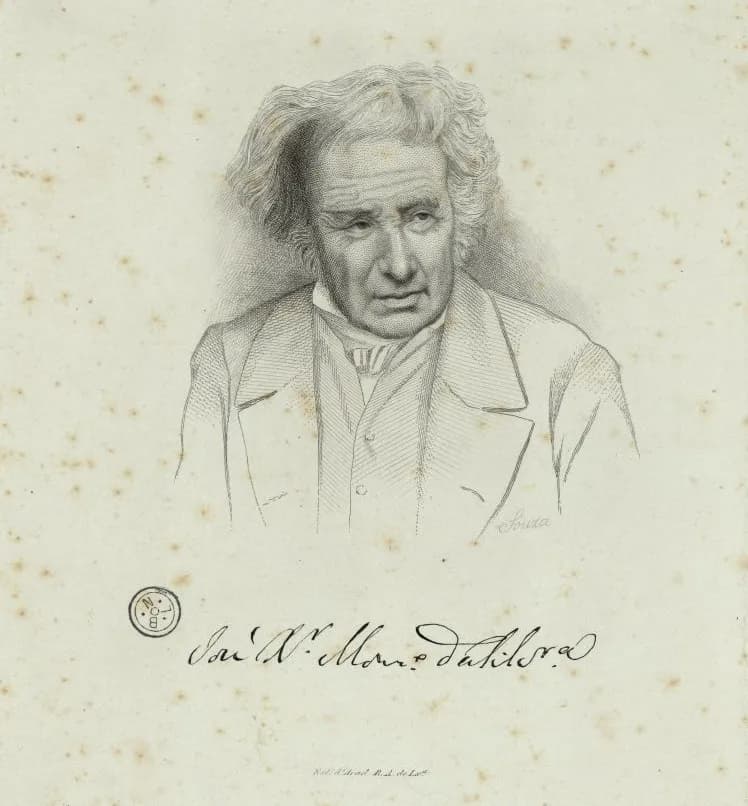
The liberals ended it. During the civil war between the liberal Pedro IV and his absolutist brother Miguel, Mouzinho da Silveira, Pedro's minister of finance, abolished the Erário by Decree no. 22 of 16 May 1832 and replaced it with a Tesouro Público. Lisbon was still held by Miguel's forces, so the old treasury carried on until a decree of 14 September 1833, after the liberals took the capital.
“As for the organisation of the treasury… the old and monstrous Erário could not continue.”
With the Erário went its bookkeeping. Portuguese public accounts went back to single entry in the nineteenth century, and the Aula do Comércio was closed in 1844 and folded into the Lisbon lyceum.
1389
First regulations of the Casa dos Contos, under João I
1 November 1755
Earthquake destroys most of the Contos' records
1 September 1759
The Aula do Comércio begins its first course
22 December 1761
Carta de Lei creates the Real Erário
11 January 1762
Thirty-eight officials take office; Pombal is Inspector-General
5 March 1777
Pombal leaves the post after the death of José I
1797
Apólices do Real Erário begin to circulate as paper money
28 June 1808
An Erário modelled on the 1761 law is set up in Rio de Janeiro
16 May 1832
Mouzinho da Silveira decrees the Erário's abolition
14 September 1833
The abolition takes effect in liberal Lisbon
1844
Conselho Fiscal de Contas set up
1849
Creation of the Tribunal de Contas
Why it still matters
Portugal's Court of Auditors, the Tribunal de Contas, counts the Erário in its own family tree: Casa dos Contos from 1389 to 1761, Erário Régio from 1761 to 1832, then the Tesouro Público, the Conselho Fiscal de Contas and, from 1849, the Tribunal de Contas. Under different names since, it still checks how public money is spent.
The bookkeeping argument of 1761 came back too, slowly. For most of the twentieth century public accounting was mainly a matter of tracking the budget. The POCP plan of 1997 combined budget, asset and cost accounting in one system, and Decree-Law 192/2015 created the SNC-AP, adapted from international public-sector standards, to put the state's accounts on an accrual basis.
Portuguese historians of accounting call the eighteenth century the golden age of their subject, for the first book on double entry in Portuguese, the Aula do Comércio and the Erário. They weigh the Erário differently. Delfina Gomes and her co-authors see it as the first step in bringing double entry into Portuguese public administration; Benavente Rodrigues stresses an absolute monarchy keeping its accounts where only four men could read them.
FAQs
What was the Real Erário?
The Real Erário, or Erário Régio, was Portugal's central Royal Treasury from 1761 to 1832–33. Created by a law of King José I on 22 December 1761, it replaced the medieval Casa dos Contos and made all crown revenue flow into one treasury in Lisbon, with its books kept in double entry.
Who created the Real Erário?
The law was issued by King José I and countersigned by his chief minister Sebastião José de Carvalho e Melo, then Count of Oeiras and from 1770 Marquis of Pombal. Pombal was its first Inspector-General, without salary, from 11 January 1762 until 5 March 1777.
Why did the treasury adopt double-entry bookkeeping?
The law said double entry, already used by merchants and by other European treasuries, was the shortest, clearest and most conclusive method for large sums and left no room for fraud to hide. Historians also point to the destruction of the old accounts in the 1755 earthquake and the government's power to impose change.
What replaced the Real Erário?
Mouzinho da Silveira abolished it by decree on 16 May 1832 and replaced it with a Tesouro Público; the abolition took effect in Lisbon with a decree of 14 September 1833. Audit functions later passed to the Conselho Fiscal de Contas (1844) and the Tribunal de Contas (1849).
On the timeline
Open the timelineNearby moments from earthquake and enlightenment (1750–1807).
King José I survives an assassination attempt when horsemen ambush his carriage outside Lisbon, wounding him in the arm and shoulder; the affair leads to the trial and brutal execution of the Távora family, strengthens the hand of the future Marquês de Pombal and paves the way for the expulsion of the Jesuits a year later.
The Duke of Aveiro and leading members of the Távora family, condemned for the September 1758 attempt on King José I's life, are executed on a scaffold at Belém, most of them broken on the wheel. Many historians doubt the Távoras' guilt, and some suspect the future Marquis of Pombal of using the case to break the old aristocracy.
The Jesuit priest Gabriel Malagrida is garrotted in Lisbon's Rossio square and his body burned, hours after his sentence was read at an Inquisition auto-da-fé in the cloister of São Domingos. He had been condemned as a heretic at the instigation of Carvalho e Melo, the future Marquis of Pombal, whom he had enraged by preaching that the 1755 earthquake was God's punishment for Lisbon's sins.
Pombal's Real Erário
A charter law of King José I, countersigned by the future Marquis of Pombal, creates the Real Erário (Royal Treasury), abolishing the medieval Contos do Reino e Casa and channelling all crown revenue into a single treasury kept by double entry. Portugal's Court of Auditors, the Tribunal de Contas, counts it among its direct ancestors.
Birth in Lisbon of Marcos Portugal, the most internationally successful Portuguese composer of his age. He premiered at least 21 operas in Italian theatres in the 1790s, then joined the exiled court in Rio de Janeiro in 1811 and stayed on in Brazil until his death in 1830.
The Treaty of Paris ends the Seven Years' War. Britain, France and Spain sign it and Portugal accedes the same day. Spain, which had invaded Portugal in 1762, must hand back its conquests, among them Almeida and the colony of Sacramento on the River Plate.
The poet Manuel Maria Barbosa du Bocage, the finest Portuguese exponent of Arcadian verse and a celebrated satirist and improviser, is born in Setúbal.
Coming up in history
All long reads 24 December 1524Vasco da Gama dies in Cochin, three months into his viceroyalty
 25 December 1968Christmas 1968: RTP's second channel goes on air in Lisbon
 26 December 2022António Mega Ferreira and Expo '98: how Lisbon rebuilt its eastern riverside
 27 December 1703Cloth for wine: the Methuen Treaty, Lisbon, 27 December 1703
17 sources
Archives, scholarship and reporting this article was checked against.
- 1
Carta de Lei of 22 December 1761 instituting the Thesouro Geral (Real Erário) and abolishing the Contos do Reino e Casa, printed by Miguel Rodrigues, LisbonJohn Carter Brown Library copy, digitised by the Internet Archive
- 2
Os homens do Erário Régio, by Manuel Benavente RodriguesPecvnia, no. 13 (2011), pp. 59–81, via Dialnet
- 3
Finanças públicas e contabilidade por partidas dobradas: uma visita guiada pela literatura sobre as três figuras cimeiras do Erário Régio português, 1761, by Miguel Gonçalves, Miguel Lira and Maria da Conceição da Costa MarquesRevista Universo Contábil, vol. 9, no. 2 (2013), FURB
- 4
Accounting change in central government: the adoption of double entry bookkeeping at the Portuguese Royal Treasury (1761), by Delfina Gomes, Garry D. Carnegie and Lúcia Lima RodriguesAccounting, Auditing & Accountability Journal, vol. 21, no. 8 (2008), record on IDEAS/RePEc
- 5
Inovações contabilísticas na esfera pública, by Rita Martins de Sousa (ISEG, Universidade de Lisboa)Ordem dos Contabilistas Certificados, conference slides, 2013
- 6
Evolução histórica do Tribunal de ContasTribunal de Contas (Portugal)
- 7
Aula do Comércio (1759–1844): primeiro estabelecimento governamental de ensino de contabilidade, by Lúcia Lima RodriguesOrdem dos Contabilistas Certificados, conference slides
- 8
- 9
- 10
- 11
- 12
- 13
Review of O Erário Régio: as contas e o poder 1762–1833, by Manuel Benavente Rodrigues (Edições MGI, 2022)De Computis, vol. 20, no. 2 (2023), pp. 48–59, review by Carlos Ferraz
- 14
Apólices do Real Erário: história, valores faciais e estampagem, by Nuno Fernandes CarvalhoCaixa Geral de Depósitos, Gabinete de Património Histórico, October 2013
- 15
Alvará of 28 June 1808 creating the Erário Régio and Conselho da Fazenda in Rio de JaneiroCâmara dos Deputados (Brazil), Legislação Informatizada
- 16
- 17
Nascimento de D. José IArquivo Nacional Torre do Tombo
Image credits
- Sebastião José de Carvalho e Melo, Count of Oeiras and later Marquis of Pombal, painted in 1766 by Louis-Michel van Loo and Claude Joseph Vernet. From 1762 to 1777 he was also the first Inspector-General of the Real Erário. The painting belongs to Oeiras City Hall. Louis-Michel van Loo / Joseph Vernet, Public domain, via Wikimedia Commons.
- The first page of the printed Carta de Lei of 22 December 1761. It opens with the king's titles and the claim that monarchies depend on the regular and exact collection of the revenues that make up the public treasury. This copy is in the John Carter Brown Library. Portugal. Sovereign (1750-1777 : Joseph); Pombal, Sebastião José de Carvalho e Melo, Marquês de, Public domain, via Wikimedia Commons.
- The closing page of the law: dated at the Palace of Nossa Senhora da Ajuda on 22 December 1761, signed ElRey (the king) and countersigned Conde de Oeyras, the title Carvalho e Melo held until he became Marquis of Pombal in 1770. Portugal. Sovereign (1750-1777 : Joseph); Pombal, Sebastião José de Carvalho e Melo, Marquês de, Public domain, via Wikimedia Commons.
- Facsimile of the title page of the statutes of the Aula do Comércio, printed in Lisbon in 1759 by Miguel Rodrigues, who also printed the treasury law two years later. SID ISCAL, CC BY-SA 3.0, via Wikimedia Commons.
- José Xavier Mouzinho da Silveira (1780 to 1849), the liberal finance minister who abolished the Real Erário in 1832, in an engraving by Joaquim Pedro de Sousa from the 1860s. Joaquim Pedro de Sousa (1818-1878), Public domain, via Wikimedia Commons.