

Christmas 1968: RTP's second channel goes on air in Lisbon
Portugal's only broadcaster switched on a second programme on 25 December 1968. For years it reached little beyond Lisbon and mostly showed repeats, but it outlived the regime that launched it and is still on air as RTP2.
At a glance
- On Wednesday 25 December 1968 RTP, Portugal's only television broadcaster, began a second programme from a new UHF transmitter at Monsanto, in Lisbon, on channel 25.
- Only viewers in the Lisbon area with suitable sets and aerials could watch it. Most of what it showed was repeated from the main channel, and it was on air for 1,012 hours in all of 1969.
- The second programme reached Porto on 1 October 1970 and Montejunto on 21 November 1970; the Lousã and Muro transmitters followed in April 1971. The 1970 dates are often given as the start of regular service.
- It launched three months after Marcelo Caetano replaced Salazar, under censorship: in 1968 there were 305,623 registered sets in Portugal, and RTP reckoned about one million people watched each day.
- The channel won its own programming on 16 October 1978. Colour arrived in 1980, private stations SIC and TVI in 1992 and 1993, and the second channel survives as RTP2.
Christmas night on channel 25
On Christmas Day 1968, a Wednesday, a new transmitter came on at Monsanto, the wooded hill on the western edge of Lisbon. RTP's engineers had added 20 metres to the station's steel tower and strengthened it to carry another seven tonnes of aerials. The new set sent out a second television programme on UHF channel 25, with an output of 10 kilowatts.
Few households could see it. The signal covered only the area served by Monsanto, and viewers needed a set and an aerial that could receive UHF. Those who could tuned in to the new programme from studios in Lumiar, in the north of the city, where RTP had squeezed in a small studio of 38 square metres with two cameras and a new continuity control room.
On the opening night the engineer Matos Correia, one of RTP's two deputy directors-general, explained to the camera what the new programme was for.
“The 2nd Programme, which has entered its experimental phase, has as its fundamental aim, in a future we hope will be near, to offer viewers a programme of broadcasts that complement the existing ones, or are of a different nature… We will try to offer the possibility of choosing between different genres…”
That December RTP was also showing the best of the Mundovisão pictures of Apollo 8, relayed worldwide by satellite. The spacecraft had been launched on 21 December and was orbiting the Moon by Christmas Eve. Portuguese viewers had another reason to watch the news: three months earlier, they had seen on RTP the President of the Republic dismiss António de Oliveira Salazar and swear in Marcelo Caetano.

A television service for a dictatorship
Portugal was ruled by the Estado Novo, the authoritarian regime Salazar had built in the early 1930s. There were no free elections and the press was censored. Television arrived late and stayed in a single company's hands for 35 years.
On 15 December 1955 the government set up RTP, Radiotelevisão Portuguesa, as a limited company with a capital of 60,000 contos, split between the state, the private radio stations and private shareholders. Its concession contract, signed on 16 January 1956, was signed for the government by Marcelo Caetano, then Minister of the Presidency.
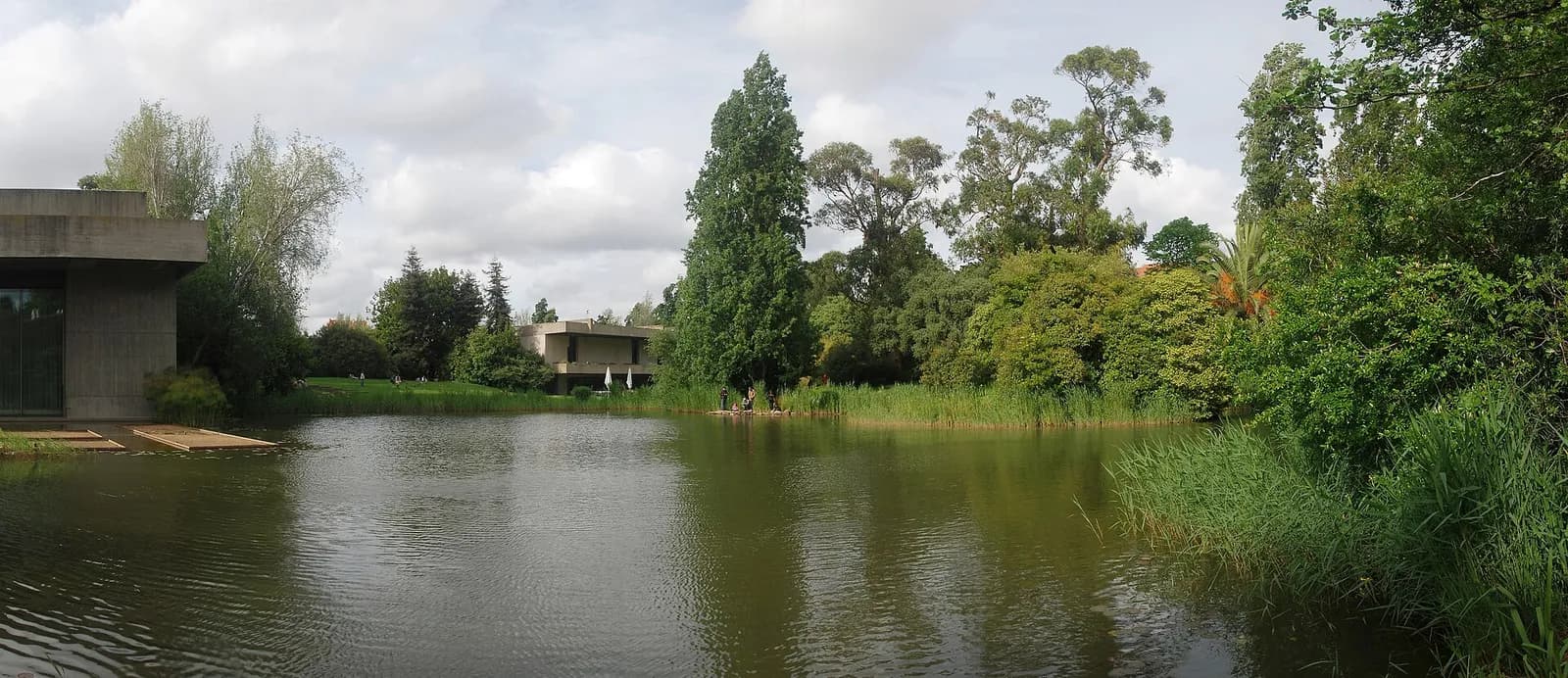
The first pictures went out at 9.30 pm on 4 September 1956 from the Feira Popular, the fun fair the newspaper O Século ran in the Palhavã park, where the Gulbenkian Foundation stands today. A 50-metre mast and a prefabricated pavilion with a partly glass-walled studio stood beside the shooting galleries, and more than 20 sets around the fair showed the result. The trials ran until 30 September, every day except Wednesday.
Regular broadcasting began at 9.30 pm on 7 March 1957 from the Lumiar studios, through a small 1-kilowatt transmitter installed provisionally in a navy building at Monsanto. The comic Raul Solnado was paid 1,000 escudos to appear on that first night. The Telejornal, the main news, followed on 18 October 1959.
A network across the mainland
The first transmitters were placed to reach Lisbon, Coimbra and Porto. The Monsanto and Lousã stations entered service on 23 November 1957 and Monte da Virgem, across the river from Porto, on 31 December. Montejunto followed in March 1958 and the Fóia relay, high in the Algarve's Serra de Monchique, in April, completing the first phase. Those four main stations covered 44 per cent of the mainland's area and 58 per cent of its people. Smaller relays then filled in the gaps, region by region.
By 1964 the signal covered 57.6 per cent of the country's area and 71.5 per cent of its population. By 1968 RTP put its potential audience at about seven million, more than 90 per cent of the population. Every set had to be registered and pay a licence fee, introduced on 1 January 1958.
Registered television sets in Portugal, 1960 to 1971
registered sets
Sets registered for the licence fee, from RTP's own figures: 1960, December 1962 and the ends of 1966, 1968, 1970 and 1971 from Vasco Hogan Teves's history of RTP; 1964 and 1968 from Francisco Rui Cádima. RTP estimated another 10,000 to 20,000 unregistered sets in 1968.
Show the data
| Registered sets | |
|---|---|
| 1960 | 47,372 |
| 1962 | 88,993 |
| 1964 | 150,319 |
| 1966 | 219,117 |
| 1968 | 305,623 |
| 1970 | 388,776 |
| 1971 | 476,961 |
Registered sets were far fewer than viewers. At the end of 1968 there were 305,623, with about 3,000 more registered each month, yet RTP estimated that about a million people watched each day. The media historian Francisco Rui Cádima calls the link between registered sets and audience extremely loose. Sets were watched in public too: for the 1956 trials RTP had placed them in shop windows, cafés and recreational clubs across Lisbon.
Broadcasting under the censor
Salazar never took to the medium. RTP staff who recorded him said he confessed his ignorance of the machines, and Cádima writes that he left the stage without ever having used television assertively to promote himself, or even the regime. RTP's own chronology dates his first live televised speech to June 1958, given at the headquarters of the single party, the União Nacional.
The news was controlled all the same. Cádima finds that under Salazar the Telejornal kept to the official agenda and protocol, left out the empire and the colonies, and censored Humberto Delgado's opposition campaign in the 1958 presidential election. After the colonial war began in Angola in 1961, its editorials turned openly militant.
Film from Africa reached the Lumiar editing rooms under tightening censorship. After the failed Beja revolt at the turn of 1962, a confidential circular from the armed forces' public information service, dated 10 January, ruled that reports, films and photographs of the forces overseas could be shown only after military censorship.
In 1968, according to Vasco Hogan Teves, who ran RTP's news from 1969 and later wrote its history, the censors went easy on the Telejornal's scripts, already filtered through the news agencies, and hard on the pictures. Almost no images of the Paris student revolt of May or the Soviet invasion of Prague in August reached the screen.
Caetano had always seen television differently. He was on screen as early as 5 June 1957, three months after regular broadcasting began, speaking for nine minutes on ten years of the Marshall Plan. As head of government he made RTP an open instrument of his politics, and Cádima concludes that its news was more plainly used for propaganda under Caetano than under Salazar.
On 8 January 1969, two weeks after the second channel opened, Caetano gave the first of his Conversas em Família on RTP and radio. In his memoir he said he wanted to set out to the country, “in plain and clear language”, the ideas that guided him, the facts that constrained him and the reasons for his decisions. Ramiro Valadão, who became RTP's chairman in April 1969, later claimed the idea as his own.
Caetano gave 16 of these talks before his fall in 1974, by Teves's count. They looked like openness, but the historian Ana Cabrera, quoted in a 2022 study, points out that the regime's whole apparatus of repression carried on until April 1974. The same mix showed in entertainment. Zip-Zip, the talk show Raul Solnado, Carlos Cruz and Fialho Gouveia first broadcast on 26 May 1969, was a hit and a headache for the censors.
“We permanently had a censor sitting in the audience, who took note of everything that happened and then gave us the list of cuts.”
The second programme: repeats for Lisbon
RTP had studied a second programme through 1967. Its board's report for that year said a second chain of transmitters would be needed, working on UHF, the ultra-high frequencies, with a basic network already defined at the Stockholm conference of 1961. The report for 1968 gave the reason: the VHF bands used by the first programme were crowded, and in some seasons signals from the rest of Europe and North Africa interfered with reception.
- First broadcast
- Wednesday 25 December 1968, described as an experimental phase
- Transmitter
- Monsanto, Lisbon: UHF channel 25, 10 kW output, 405 kW effective radiated power
- Studio
- A new 38 m² studio with two cameras at Lumiar, shared by both channels
- Coverage
- The Lisbon area only, for viewers with UHF sets and aerials
- Content
- Mostly repeats of studio shows from the first programme, some filmed series, and the Telejornal shown on both channels at once at 9.30 pm
- Names
- 2º Programa, Segundo Programa, Segundo Canal, Canal 2 or RTP 2 in documents of the time; RTP2 today
Matos Correia's promise of choice took a long time to arrive. The experimental broadcasts leaned on videotaped repeats of the first programme's studio shows, with a few filmed series shown for the first time. Viewers learned to look on the second channel for what they had missed on the first, and critics complained that there was still no real alternative at the same hour.
The new channel also changed how programmes were vetted inside RTP. With it in service, the board replaced its old reading committee and film-selection department with a Programme Appraisal Service, which read outside proposals and previewed films and series before the programme director made his choice.
| Year | Hours on air | Where it could be seen |
|---|---|---|
| 1968 | From 25 December | Lisbon area (Monsanto) |
| 1969 | 1,012 | Lisbon area only |
| 1970 | 888.5 | Porto added on 1 October, Montejunto on 21 November |
| 1971 | 1,233 | Lousã (centre) added on 19 April, Muro (Alto Minho) on 25 April |
Hours from RTP's annual reports as given by Vasco Hogan Teves. For comparison, the first programme was on air for 3,126 hours in 1968 and 3,166 hours in 1969. From the winter schedule of 1970 to 1971 the second programme opened at 8.30 pm and so gained an hour a day.
Money was the brake. In May 1970 Valadão said the second channel cost RTP 5,000 contos a year in programmes alone, and that independent programming would need advertising to pay for it. From February 1971 the company that sold the first programme's advertising slots sold the second's as well.
25 April 1974: the transmitter that would not switch over
When the Armed Forces Movement (MFA) overthrew the regime on 25 April 1974, it spoke first through the radio. At 4.26 am the journalist Joaquim Furtado read its first communiqué on Rádio Clube Português. Shortly after 3 am a unit from the army's Practical School of Administration had occupied the RTP studios at Lumiar without a fight.
The soldiers had forgotten Monsanto. RTP's security officer, Captain Eduardo Alarcão, went to the transmitter and took it off the air by removing one of its valves, which the porter hid in the guard dog's kennel. At 12.45 pm the lunchtime programme came on from the Porto studios instead, with an episode of the American series Daktari, another filmed series and slides of the city, until commandos from Lamego took the Monte da Virgem station at about 3 pm.
Staff at Monsanto finally switched their circuits over to Lumiar. At 6.41 pm the announcer Fernando Balsinha appeared on screens across the country: from that moment, he said, the MFA controlled RTP's entire transmitter network. Earlier the soldiers holding the studios had refused to let a crew out, but at about 4 pm two RTP cameramen, João Rocha and José Manuel Tudela, had got their cameras into the streets. They reached the Carmo barracks in time to film Caetano's surrender.
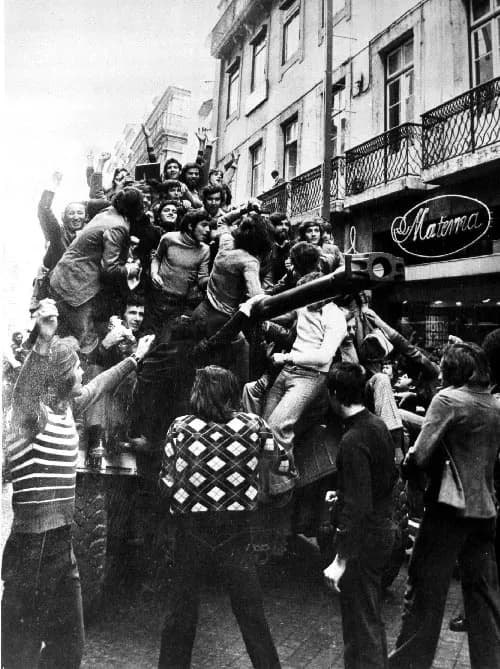
The broadcast ran on past midnight, with classical music, Michel Giacometti's films of rural work songs and repeated news bulletins. At 1.23 am on 26 April Fialho Gouveia introduced the officers of the Junta of National Salvation, and General António de Spínola read their proclamation to the country. Balsinha closed the transmission at 1.57 am.
In May 1974 RTP's concession was suspended and the government took over the service. A decree of 2 December 1975 nationalised the private shareholdings and turned the company into Radiotelevisão Portuguesa, EP, a public enterprise.
Colour, competition and RTP2 today
15 December 1955
RTP founded as a limited company
4 September 1956
Trial broadcasts begin at the Feira Popular, Lisbon
7 March 1957
Regular broadcasts begin from Lumiar
18 October 1959
First Telejornal
25 December 1968
Second programme begins from Monsanto on UHF
8 January 1969
Caetano's first Conversa em Família
1 October 1970
Second programme reaches Porto
6 August 1972
RTP Madeira begins regular broadcasts
25 April 1974
MFA takes control of RTP
10 August 1975
RTP Açores begins regular broadcasts
2 December 1975
RTP nationalised
16 October 1978
Second channel gets its own programming
7 March 1980
Regular colour broadcasts begin
6 October 1992
SIC, the first private channel, goes on air
20 February 1993
TVI goes on air
The second channel became a real alternative only in 1978. From 16 October that year it planned its own schedule in open competition with the first, under the film director Fernando Lopes, an RTP veteran back after 14 years away. RTP's historian calls it the event of the year. The second channel then reached 40 per cent of the mainland, against 82 per cent for the first.
“We have done everything, and will do everything, so that the 2nd Programme can really be a true alternative for Portuguese viewers, even when, as for now, it covers only a restricted area of the country.”
Colour came next. RTP tested it during the three elections of 1976, and regular colour broadcasting began on 7 March 1980, the 23rd anniversary of the first regular broadcast, with the Festival RTP da Canção live from Lisbon's São Luís municipal theatre. José Cid won with “Um grande, grande amor”.
The state monopoly ended after the constitutional revision of 1989 opened television to private companies. SIC began broadcasting on 6 October 1992 and TVI, linked to Catholic institutions and promising programming inspired by “Christian humanism”, on 20 February 1993. Portugal was then the European country that watched most television: 3 hours and 44 minutes a day per person in 1990.
Competition pushed the two public channels apart. RTP1 took a more commercial line, while the second deepened its role as a cultural complement for what Cádima calls “qualified minorities”. Under an agreement signed by RTP, SIC and TVI in August 2003, the second channel kept its ban on commercial advertising and could carry only sponsorship credits of up to five seconds.
Its audience is small. In 2024 RTP2 had a 1 per cent share and an average of 19,700 viewers, against 11.4 per cent and 234,100 for RTP1, according to Mediamonitor/GfK data analysed by Dentsu for ECO's media site +M.
See it today
FAQs
When did RTP2 start broadcasting?
On 25 December 1968, as RTP's second programme, from a UHF transmitter at Monsanto in Lisbon. It was described as experimental and reached only the Lisbon area at first; it was extended to Porto and Montejunto in 1970 and to Lousã and Muro in 1971.
What did the second channel show in its first years?
Mostly repeats of the first programme's studio shows, some filmed series, and the Telejornal broadcast on both channels at once. It was on air for 1,012 hours in 1969. It got its own programming, competing with the first channel, from 16 October 1978.
When did television begin in Portugal?
RTP made trial broadcasts at the Feira Popular in Lisbon from 4 to 30 September 1956, and regular broadcasts began on 7 March 1957. The company itself had been founded on 15 December 1955.
When did Portugal get colour television and private channels?
Regular colour broadcasts began on 7 March 1980, after tests in 1976. RTP's monopoly ended with private channels SIC on 6 October 1992 and TVI on 20 February 1993.
On the timeline
Open the timelineNearby moments from dictatorship and the estado novo (1926–1974).
During the night of 25 to 26 November, torrential rain sets off flash floods across the Lisbon region, sweeping away shanty towns and villages in Loures, Odivelas, Vila Franca de Xira and Alenquer. The censored official count stopped at 462 dead, though historians estimate about 700, in Portugal's deadliest storm since at least the early nineteenth century. Students' relief work fuelled opposition to the regime.
António de Oliveira Salazar falls from a deckchair at his summer residence in Estoril, striking his head. The resulting brain injury led to his replacement as Prime Minister by Marcello Caetano the following month, ending his decades-long rule.
Marcelo Caetano takes office as President of the Council of Ministers, succeeding António de Oliveira Salazar, who had been incapacitated by illness. Caetano would be the Estado Novo's last leader, governing until the Carnation Revolution of 1974.
RTP's second channel, 1968
RTP's second channel, the 'Segundo Programa', goes on air on Christmas Day from a new UHF transmitter at Monsanto, reaching only the Lisbon area for a few hours each evening, mostly with repeats. It reached Porto in 1970; today it is RTP2.
Essayist and educationalist António Sérgio dies in Lisbon aged 85. Born in Damão, in Portuguese India, he was briefly education minister in 1923–24, was jailed and twice exiled by the dictatorship, championed the co-operative movement, and through his eight volumes of 'Ensaios' shaped generations of Portuguese democrats.
In the early hours, a magnitude 7.8 to 8.0 earthquake under the Atlantic southwest of Cape São Vicente shakes Lisbon and the Algarve, the strongest to hit the mainland in the 20th century. It cuts power and phone lines and raises a small tsunami. At least 13 people die on the mainland, most of them in the panic.
Birth in Montijo of Dulce Pontes, whose soaring reworkings of traditional song helped drive the 1990s revival of Portuguese music. Her 'Canção do Mar' found its way onto the soundtrack of the Hollywood film 'Primal Fear', and she later recorded and toured with Ennio Morricone.
Coming up in history
All long reads 27 December 1703Cloth for wine: the Methuen Treaty, Lisbon, 27 December 1703
 28 December 1989Salvador Sobral and Portugal’s first Eurovision win, 53 years on
 29 December 1959Lisbon goes underground: the Metro opens on 29 December 1959
 30 December 1958Pedro Costa, the Lisbon film-maker who stayed with Fontainhas
19 sources
Archives, scholarship and reporting this article was checked against.
- 1
Década de 60: “Do 2º Programa à Lua e ao Zip-Zip”RTP 50 Anos de História (text by Vasco Hogan Teves, 2007), Museu Virtual RTP
- 2
- 3
Imagens e representações da ditadura portuguesa na televisão (1957-1974) (Francisco Rui Cádima)Logos 32, Universidade do Estado do Rio de Janeiro, 2010
- 4
- 5
Televisão em contexto português: uma abordagem histórica e prospetiva (Filomena Antunes Sobral)Millenium 42, Instituto Politécnico de Viseu, 2012
- 6
A televisão e a invenção da democracia em Portugal (Carla Baptista)Transatlantic Studies Network 17, 2024
- 7
- 8
Apollo 8NASA
- 9
- 10
- 11
- 12
- 13
- 14
Imaginar Angola: o nascimento de uma nação no cinema (Maria do Carmo Piçarra)Observatorio (OBS*) Journal, 2020
- 15
Mário Mesquita: a importância da palavra. Jornalismo e censura no final da Ditadura (Maria Constança Castanheira, MA dissertation)Escola Superior de Comunicação Social, Instituto Politécnico de Lisboa, 2022
- 16
- 17
Protocolo de 21 de Agosto de 2003 sobre a publicidade na RTPEntidade Reguladora para a Comunicação Social (ERC)
- 18TVI fecha 2024 na liderança e vantagem de 0,8 pontos em relação à SICECO / +M, 6 January 2025 (data: Mediamonitor/GfK)
- 19
Image credits
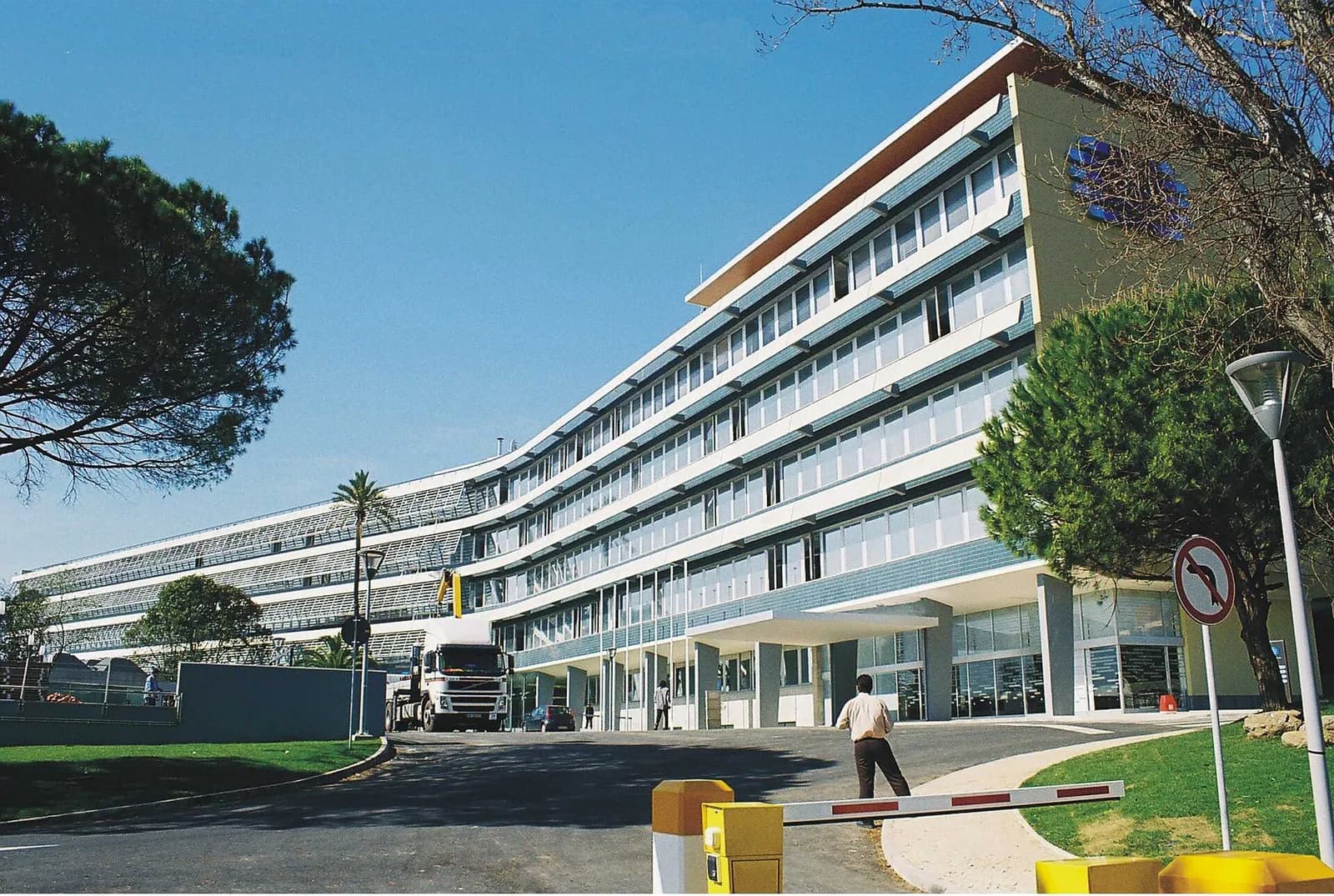
- RTP's headquarters in Lisbon, photographed in 2007. The public broadcaster that opened its second channel in 1968 still runs it, as RTP2. Itisa, Public domain, via Wikimedia Commons.
- Earthrise, photographed by the astronaut Bill Anders from lunar orbit on 24 December 1968, the day before RTP's second programme went on air. That month RTP showed Mundovisão pictures of the Apollo 8 mission. NASA/Bill Anders, Public domain, via Wikimedia Commons.
- Lisbon residents celebrate on an armoured car on 25 April 1974. Shortly after midnight RTP showed its own film of the day. Unknown author, CC BY 4.0, via Wikimedia Commons.
- The Gulbenkian Foundation's garden in 2009. This is the old Palhavã park, where RTP made its first broadcasts at the Feira Popular in September 1956. Alvesgaspar, CC BY-SA 3.0, via Wikimedia Commons.