

Lisbon goes underground: the Metro opens on 29 December 1959
After some seventy years of schemes, Lisbon opened a 6.5-kilometre underground line with eleven stations and two-carriage trains. The next morning, people were queueing at three o'clock to ride it.
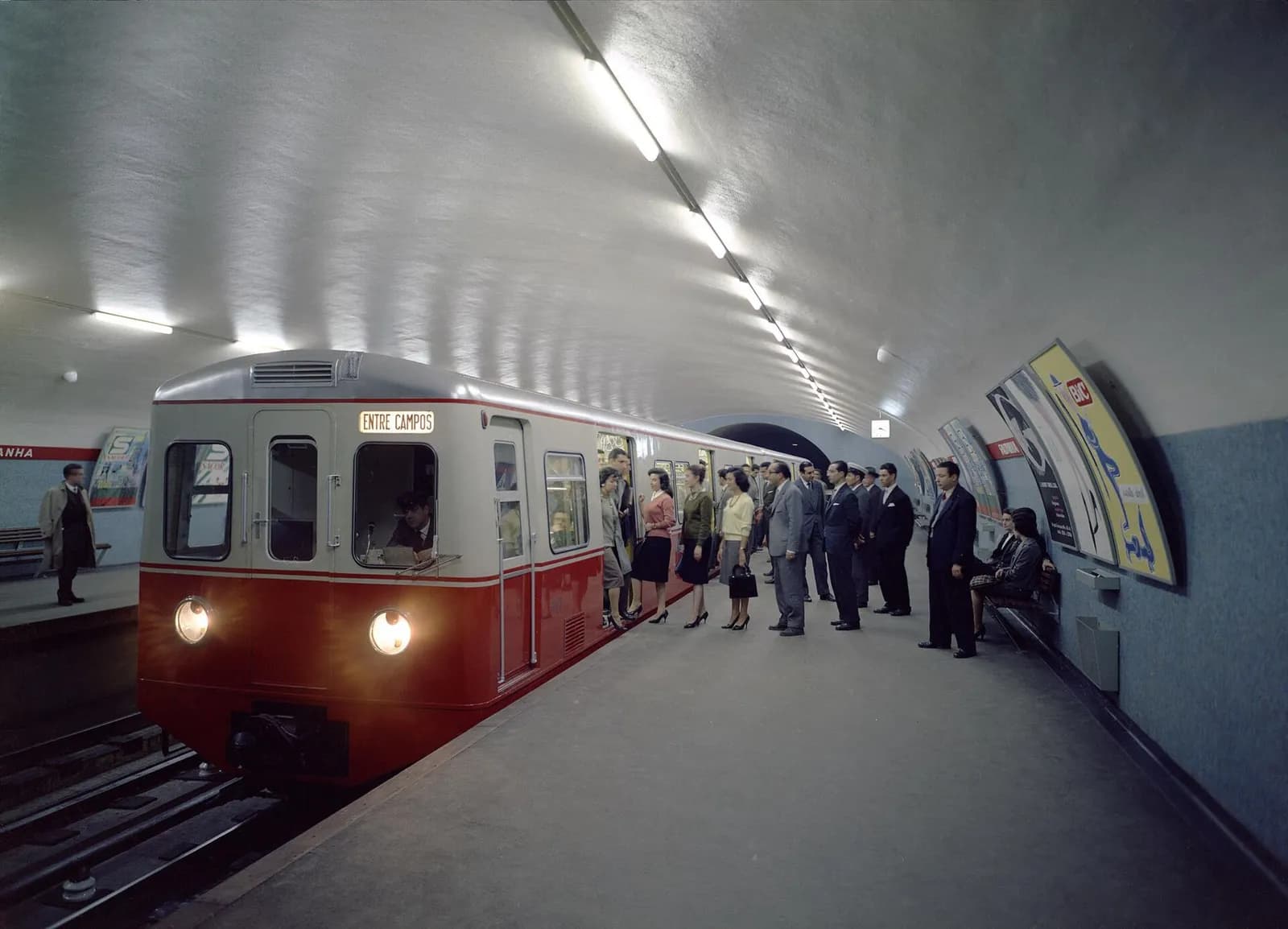
At a glance
- The Lisbon Metro was inaugurated on Tuesday 29 December 1959 at Restauradores station and opened to the public the next morning; in its first two days it carried about 216,000 passengers.
- The first network was a Y-shaped line of 6.5 km with 11 stations: a common stretch from Restauradores to Rotunda (now Marquês de Pombal), splitting there for Sete Rios (now Jardim Zoológico) and Entre Campos.
- Proposals for a Lisbon underground date back to the 1880s. The company Metropolitano de Lisboa was set up on 26 January 1948, and construction began in August 1955.
- The architect Francisco Keil do Amaral designed a standard station, and his wife, the painter Maria Keil, covered ten of the first eleven in patterned azulejos, without being paid.
- Today the network has four lines, 56 stations and 44.5 km of line. It carried 173.5 million passengers in 2025, and a circular line is due to open in early 2027.
Queues before dawn
On Tuesday 29 December 1959 the President of the Republic, Américo Tomás, and the Cardinal Patriarch of Lisbon, Manuel Gonçalves Cerejeira, went down into Restauradores station in the centre of Lisbon. The newsreel of the day, the Noticiário Nacional, showed them arriving for a blessing on the platform, a formal session in the ticket hall and a ride in one of the new carriages. The Metro's chairman, the engineer Francisco de Mello e Castro, presided over the opening.
Everyone else had to wait until the next day. By three in the morning of 30 December there were long queues at the station entrances. Some stations stopped selling tickets for a while so that the crowds would not spill onto the platforms, and at Parque the escalators became an attraction in their own right.
In its first two days the Metro carried about 216,000 passengers. With a single line of 6.5 kilometres, Lisbon had the fourteenth underground railway in Europe and the twenty-fifth in the world. London had opened the first in 1863.
The line had taken four years to build. Agreeing to build it had taken about seventy.
Seventy years of schemes
In the 1950s Lisbon got about by tram, by bus and on foot. Artur Machado, who was 13 in 1959 and lived in Rua Augusta, remembered green double-decker buses and the many carts that still brought vegetables into the city. The trams belonged to the Companhia Carris de Ferro de Lisboa. Portugal was ruled by the Estado Novo, the authoritarian regime founded by António de Oliveira Salazar under the constitution of 1933.
The Metro's own chronology records a first proposal in 1885, for a line from Santa Apolónia to Algés by way of the Rossio. On 5 May 1888 the military engineer Henrique de Lima e Cunha presented a detailed project, published in the Revista de Obras Públicas e Minas, in which double-track trains would run “now on viaducts above the streets, now in long tunnels” (translated from Portuguese). It had about 14 stations over 5 kilometres by the Metro's account (RTP's history gives 14 kilometres), and it went no further for lack of money.
In the 1920s Lisbon City Council received several proposals, from local merchants in 1922 and from other promoters in 1923. A public tender in 1924 drew a single bid, from two businessmen from Madrid, for eight lines totalling 26.8 kilometres. The tender was annulled, run again and awarded to them in 1925, but they asked to change the contract, were refused, and withdrew on 24 May 1926.
The idea came back after the Second World War. A decree-law of 24 November 1947 had the state promote feasibility studies, and on 26 January 1948 the company Metropolitano de Lisboa, SARL, was formally set up. The city council held most of the shares, and Carris and private investors held the rest. The company's 2011 sustainability report links the timing to Portugal's economic cooperation agreement with the United States and its entry into the Marshall Plan.
On 1 July 1949 the company was granted the concession to build and run the system. Money was still the obstacle. The share capital was not enough. The way out was a decree-law of 28 August 1954 that allowed the company to issue state-guaranteed bonds worth up to 150,000 contos, or 150 million escudos, which the Metro calls decisive in getting construction started.
1885
First proposal
A line from Santa Apolónia to Algés via the Rossio.
5 May 1888
Lima e Cunha's project
About 14 stations on 5 km, in tunnels and on viaducts. Not built, for lack of money.
1924–1926
The Madrid concession
A tender for eight lines of 26.8 km is awarded in 1925; the bidders withdraw in May 1926.
24 November 1947
Decree-Law 36,620
The state orders feasibility studies for a metro.
26 January 1948
Company founded
Metropolitano de Lisboa, SARL, with the city council as majority shareholder.
1 July 1949
Concession signed
Exclusive rights to build and run the system.
28 August 1954
State-guaranteed bonds
Up to 150,000 contos, which made construction possible.
August 1955
Work begins
Contracts signed on 11 July; digging starts on 1 or 7 August, depending on the source.
29 December 1959
Inauguration
The line opens to the public on 30 December.
Windows in the hoardings
The contracts for the first stage were signed on 11 July 1955. The Metro's chronology of milestones dates the start of work to 1 August 1955, while its company history and later reports give 7 August. The plan was a network of lines running into the heart of the city and out towards its edges, with trams and buses connecting the rest.
The digging drew crowds. People queued to peer over the hoardings into the huge holes, so the company cut windows in the boards for them. From 1957 it also handed out leaflets called the Manual do Mirone, the onlooker's handbook, which described the future metro and the building methods used.
The works were almost finished by October 1959. To teach the public how to use the Metro and how to stay safe on it, RTP and the Tóbis Portuguesa studio made a short film directed by Artur Duarte, with the broadcaster Artur Agostinho and the actors Gina Mayo and Francisco Calado. It was shown in cinemas.
A Y-shaped line and eleven stations
The line was shaped like a Y. From Restauradores, beside the Rossio, it ran north through Avenida to the Rotunda, the roundabout now called Marquês de Pombal. There it split. One branch went through Parque, São Sebastião and Palhavã to Sete Rios, by the zoo, and the other through Picoas, Saldanha and Campo Pequeno to Entre Campos.
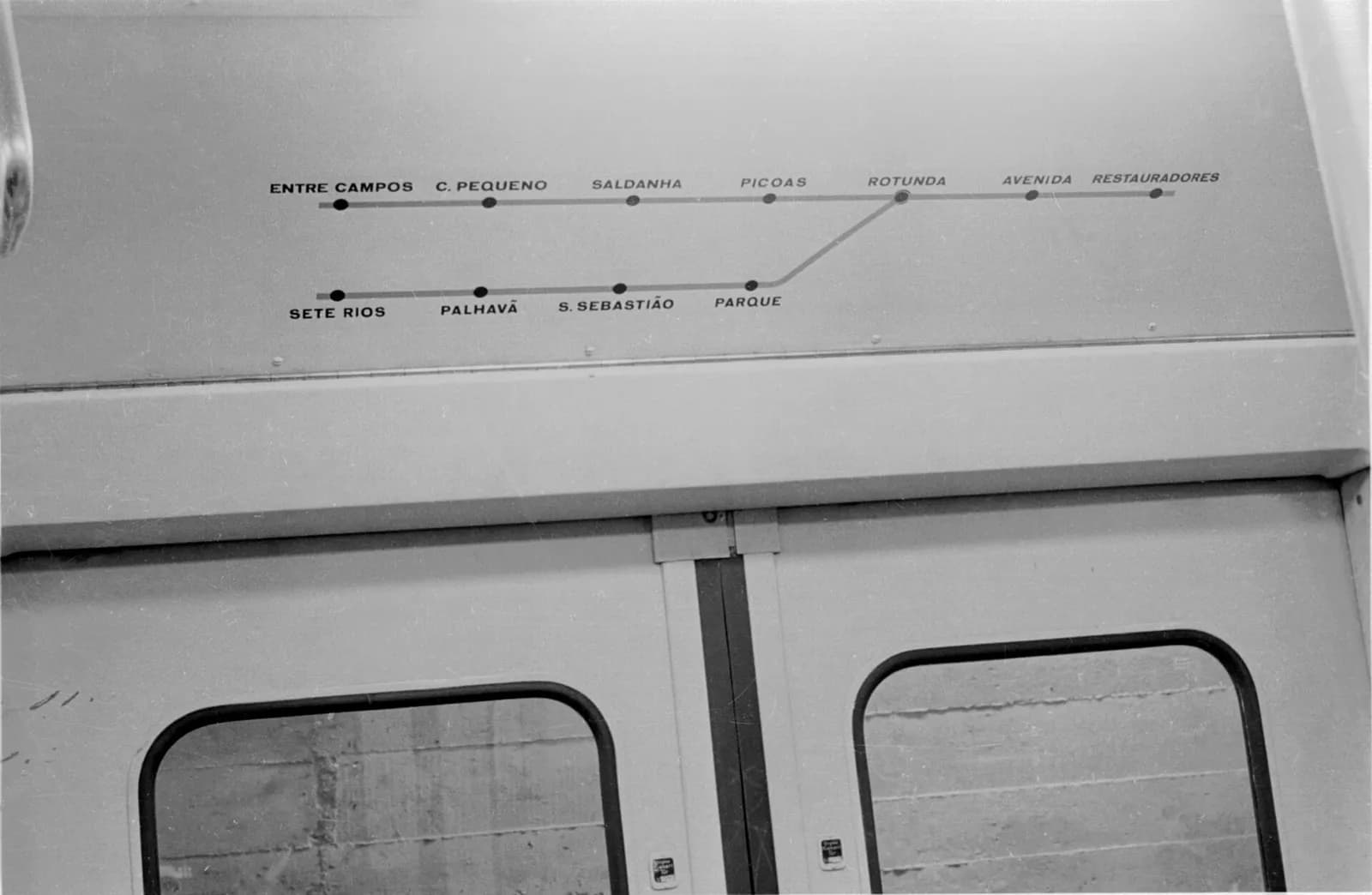
| Name in 1959 | Name today | Position on the Y | Tiles by |
|---|---|---|---|
| Restauradores | Restauradores | Southern terminus of the common section | Maria Keil |
| Avenida | Avenida | Common section | Rogério Ribeiro |
| Rotunda | Marquês de Pombal | Junction of the two branches | Maria Keil |
| Parque | Parque | Sete Rios branch | Maria Keil |
| São Sebastião | São Sebastião | Sete Rios branch | Maria Keil |
| Palhavã | Praça de Espanha | Sete Rios branch | Maria Keil |
| Sete Rios | Jardim Zoológico | Terminus | Maria Keil |
| Picoas | Picoas | Entre Campos branch | Maria Keil |
| Saldanha | Saldanha | Entre Campos branch | Maria Keil |
| Campo Pequeno | Campo Pequeno | Entre Campos branch | Maria Keil |
| Entre Campos | Entre Campos | Terminus | Maria Keil |
Rotunda, Palhavã and Sete Rios were renamed on 1 March 1998, when Socorro (opened in 1966) also became Martim Moniz.
The trains were the ML7 series. The first order was for 12 two-car units, 24 carriages numbered A-1 to A-24, and every carriage had its own motors. Trains of two carriages ran at up to 60 km/h, with a driver at the front and a guard, the fator, at the back, who warned passengers and driver when the doors opened and closed. By 1975 the fleet had grown to 84 carriages.
A single ticket cost 1$50, one and a half escudos, when a tram ride cost 80 centavos. A cheaper 1$00 ticket, meant for working people, was valid on weekdays at the busiest hours: 6 to 10 am, noon to 3 pm and 5 to 8 pm. Tickets bought in books of ten cost 1$35.
- Inauguration
- Tuesday 29 December 1959, Restauradores station
- Open to the public
- Wednesday 30 December 1959
- Length
- 6.5 km, in a Y with branches to Sete Rios and Entre Campos
- Stations
- 11
- Trains
- Two-carriage ML7 units, up to 60 km/h; 24 carriages at the start
- First-year passengers
- 15.3 million
- Construction
- August 1955 to October 1959
Tiles instead of bare concrete
Francisco Keil do Amaral, the architect of the first stage, designed a standard station: one or two ticket halls linked by stairs to a platform under a low vault. The Metro's station pages credit several of the 1959 stations to the architect Falcão e Cunha, working to that model. The budget kept the spaces small, and Keil do Amaral feared that repeating one design eleven times would make them monotonous. There was no money for decoration.
“My husband was designing the stations and there was little money to build them. They were all going to be left in cement, a poor and ugly piece of work. He was sad about it and asked me for help.”
Maria Keil (1914–2012), a painter and illustrator, suggested patterned azulejo, the glazed tile Portuguese builders had used to line churches and palaces since the sixteenth century. In another account she gave, the idea came up between the two of them. “It's ours, it's washable, it's durable, you can give it whatever colour you like, and it was very cheap,” she told Mantas in 2009 (translated from Portuguese).
The couple went to the Viúva Lamego factory, which at the time made mostly copies for restoring old panels. Its staff dug out techniques nobody had used for years.
An order from above banned figurative images, on the grounds that pictures would distract hurrying passengers, especially on the stairs. So Keil designed abstract compositions, a different one for each station, built from a module of one or a few tiles varied in scale, proportion and colour. At Palhavã, now Praça de Espanha, she set white and yellow against green and grey in a diamond-point module, so that the flat wall seems to stand out in relief.
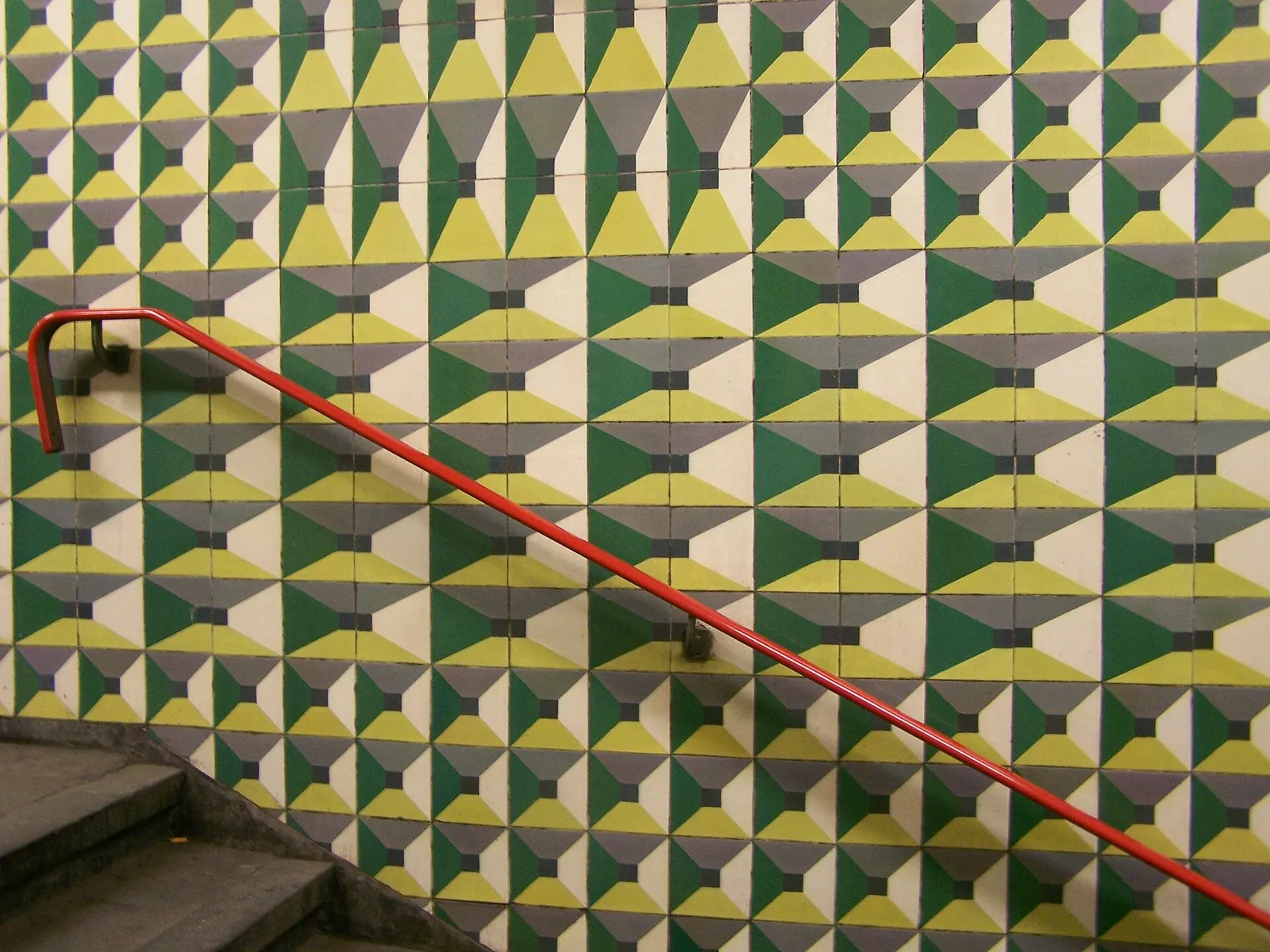
She passed the eleventh station, Avenida, to the painter Rogério Ribeiro, at her own suggestion, and she was paid for none of it. “They didn't pay me anything, nineteen stations for love of the architect!” she told the weekly Expresso in 2004, counting the stations she tiled up to 1972 (translated from Portuguese).
Much of that first work has gone. Panels were partly or wholly removed when stations were enlarged in the 1970s and remodelled in the 1990s, notably at Restauradores, São Sebastião and Saldanha, on the assumption that keeping a sample of a “pattern” was enough. The Museu Nacional do Azulejo holds a large collection of her drawings and tiles for the Metro.
From a Y to four lines
The network grew in steps. Rossio station opened on 27 January 1963, and Socorro, Intendente and Anjos on 28 September 1966. On 18 June 1972 five more, from Arroios to Alvalade, completed what the company calls the first stage of the network: 20 stations and 12 kilometres. Maria Keil tiled those too, and the extension to Alvalade raised passenger numbers by 35 per cent on the same half-year a year earlier.
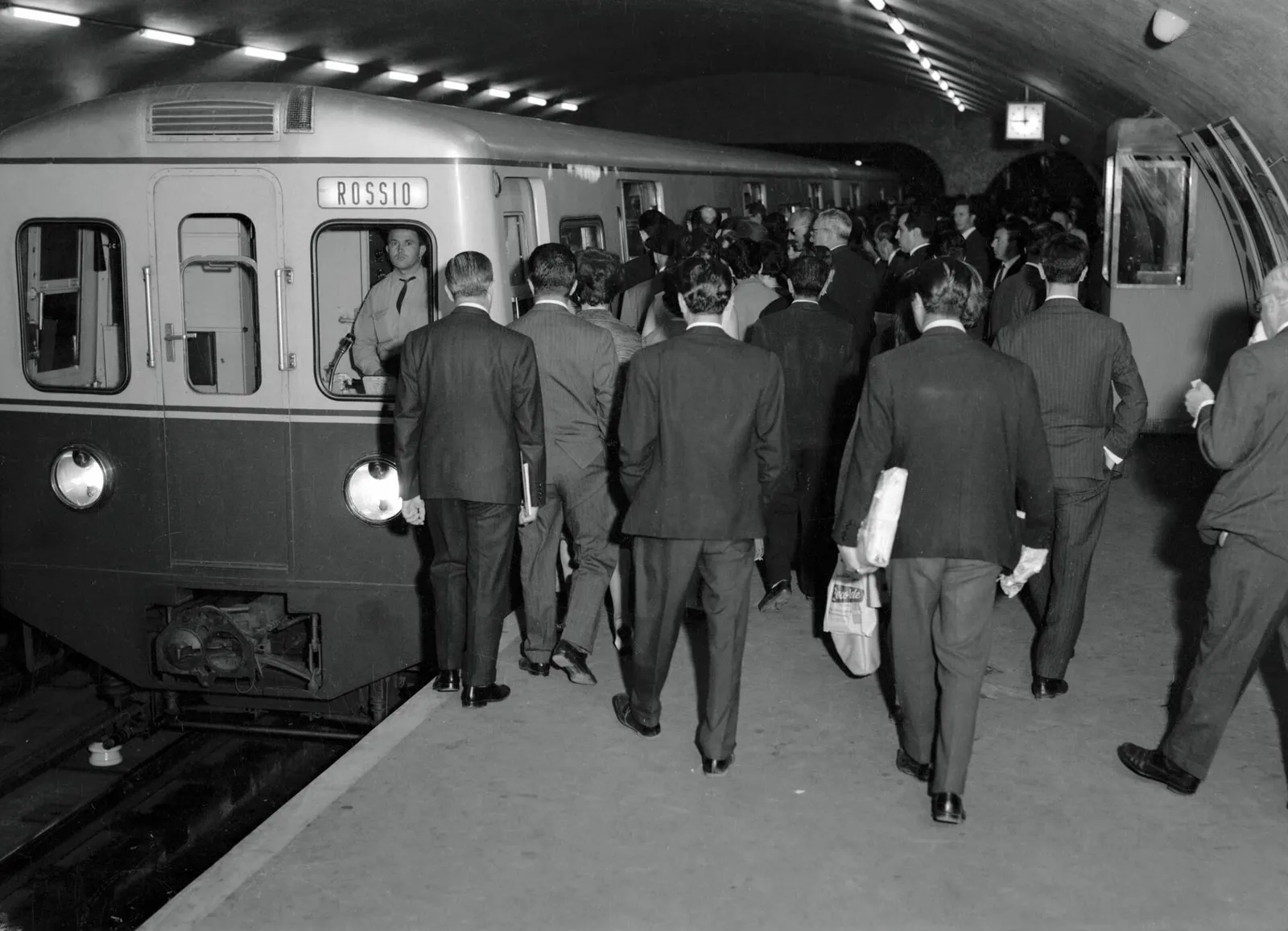
Then construction stopped for sixteen years, for economic reasons. After the revolution of 25 April 1974 the company was nationalised, on 5 June 1975, and it became a state enterprise in 1978. Money went instead into lengthening platforms built for two carriages, so that longer trains could run. In 1979, its twentieth year, the Metro passed 100 million passengers a year.
New stations opened again in October 1988, four of them, giving 24 stations and about 16 kilometres. In 1993 Campo Grande became the first station above ground, on a viaduct. Then the Y was undone. The last train through the Rotunda junction ran in the early hours of 14 April 1995, and by the summer (RTP dates the separation to July) the network ran as two separate lines, the Blue and the Yellow.
The biggest leap came in 1998. A fire at Alameda station on 19 October 1997 had halted part of the network until March. In April the Green Line reached Cais do Sodré, on the river, and on 19 May the Red Line opened from Alameda to Oriente, the station for Expo '98, the world exhibition in eastern Lisbon. It was the first wholly new line since 1959 and the first to run six-carriage trains.
In August the Blue Line reached Baixa-Chiado, which gave the Metro four separate lines linked to each other, to the suburban railways and to the river ferries. Baixa-Chiado was designed by Álvaro Siza, who was also rebuilding the Chiado district after the fire of 1988.
In 2004 the Metro crossed the city boundary for the first time, reaching Odivelas on the Yellow Line in March and Amadora Este on the Blue Line in May. The Blue Line reached Santa Apolónia station in 2007, the Red Line reached São Sebastião in 2009 and the airport in July 2012, and in April 2016 the Blue Line was extended to Reboleira. The network now has 56 stations and 44.5 kilometres of line.
| Year | What opened | Stations | Length |
|---|---|---|---|
| 1959 | The Y: Restauradores to Sete Rios and Entre Campos | 11 | 6.5 km |
| 1963 | Rossio | 12 | n/a |
| 1966 | Socorro, Intendente, Anjos | 15 | n/a |
| 1972 | Arroios to Alvalade; end of the first stage | 20 | 12 km |
| 1988 | Extensions to Colégio Militar/Luz and Cidade Universitária | 24 | about 16 km |
| 1998 | Red Line to Oriente, Cais do Sodré, Baixa-Chiado: four lines | n/a | n/a |
| 2004 | Odivelas and Amadora Este, outside Lisbon | 48 | 35.6 km |
| 2012 | Red Line to the airport | 55 | 43.2 km |
| 2016 | Blue Line to Reboleira | 56 | 44.5 km |
The 1963 and 1966 station counts add the stations opened to the 1959 total. The Metro's English-language history gives 44.2 km for 2016.
An underground gallery
Until the early 1970s Maria Keil was almost the only artist working in the stations. The chairman appointed in 1988, José Manuel Consiglieri Pedroso, brought in a new approach to art in the Metro, and from 1991 the company invited many architects and artists, Portuguese and foreign, to design and decorate stations, still with a strong preference for azulejo.
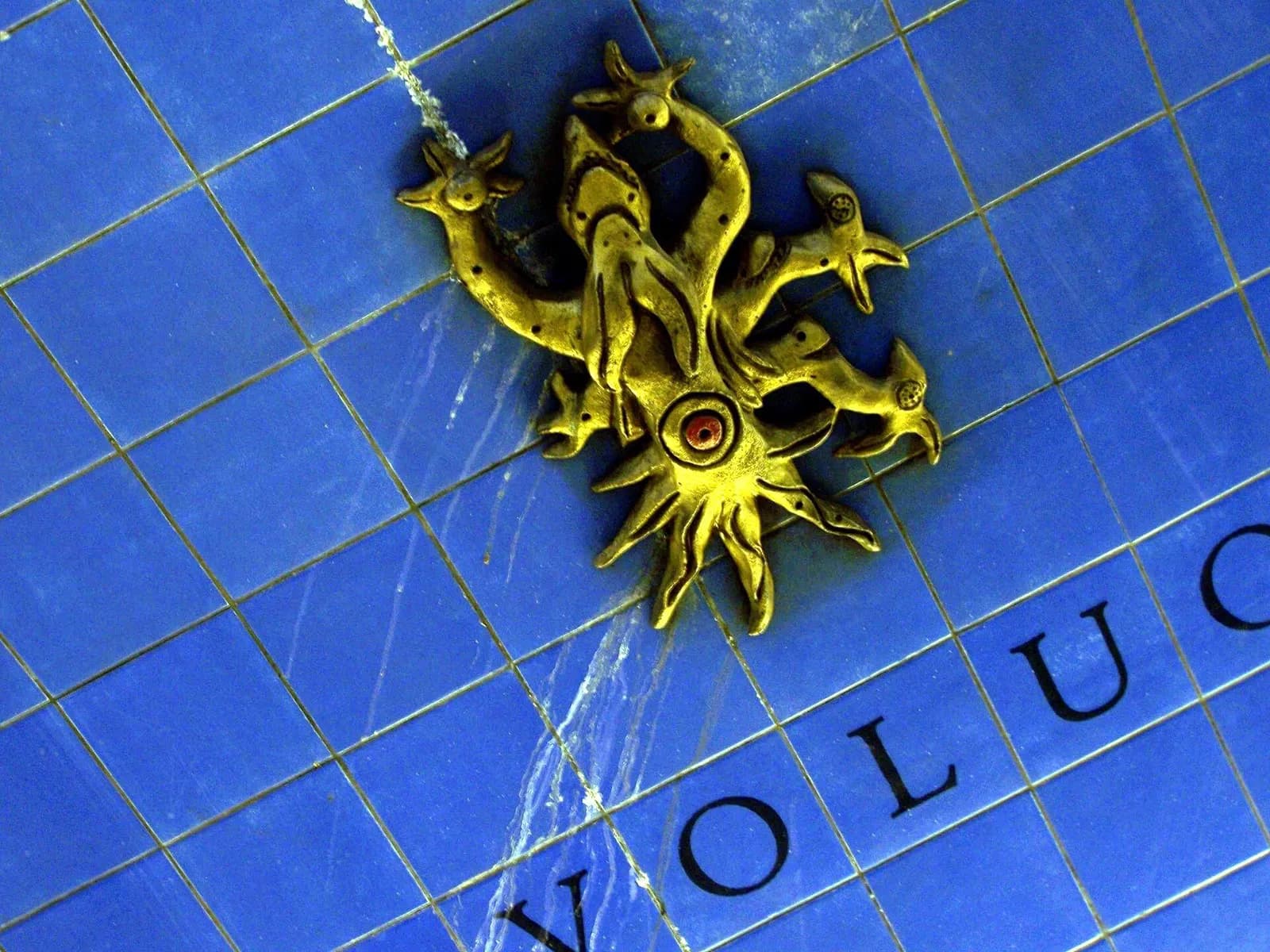
At Cidade Universitária, opened in 1988, Manuel Cargaleiro turned a 1940 gouache by Maria Helena Vieira da Silva into the tile panel Le Métro. At Parque, redecorated in 1994, the Belgian artist Françoise Schein lined the station in cobalt-blue tiles carrying the thirty articles of the Universal Declaration of Human Rights and maps of the Portuguese voyages, with sculptures by the French artist Federica Matta.
When Jardim Zoológico was rebuilt in 1995, the painter Júlio Resende spent two years at the Viúva Lamego factory painting tropical animals and plants for its walls. For Oriente, the Expo station, the Metro invited eleven artists from five continents to work on the theme of the oceans, among them Friedensreich Hundertwasser, Yayoi Kusama, Erró, Zao Wou-Ki and Magdalena Abakanowicz.
Olaias, designed by the architect Tomás Taveira, has bright polychrome finishes and a monumental colonnade over the platforms. Exchanges with other metro systems brought a Hector Guimard Art Nouveau entrance, a gift from the Paris metro, to Picoas in 1995.
From 15 million riders to 173 million
In its first year of operation the Metro carried 15.3 million passengers by the company's count; the Diário de Notícias has put the figure for 1960 at nearly 16 million. By 1979 the yearly total had passed 100 million, and in 1988 it was about 136 million.
Since 2000 ridership has been highest in 2005, at 185.4 million. It fell during the economic crisis to about 135 million in 2013 and 2014, and climbed back to 183.1 million in 2019. The pandemic halved it in 2020 and 2021. In 2025 the Metro carried 173.5 million passengers, 1.8 per cent fewer than in 2024.
Lisbon Metro passengers per year, 2000–2025
million passengers
Passengers carried each year, including fare evasion and free travel, from Metropolitano de Lisboa annual and sustainability reports. The method changed: from 2015 the count was based on ticket validations (the 2014 figure is restated on that basis), and from 2016 fare evasion was measured rather than estimated at a fixed rate. Later reports also restate some years, such as 2015 (139.0 or 142.7 million) and 2019 (183.1 or 183.8 million), so small differences between years are not strictly comparable.
Show the data
| Passengers carried | |
|---|---|
| 2000 | 173.8 |
| 2001 | 178.4 |
| 2002 | 180.4 |
| 2003 | 176.1 |
| 2004 | 179.7 |
| 2005 | 185.4 |
| 2006 | 184 |
| 2007 | 179.7 |
| 2008 | 178.4 |
| 2009 | 176.7 |
| 2010 | 182.6 |
| 2011 | 180.2 |
| 2012 | 154.5 |
| 2013 | 135.7 |
| 2014 | 135 |
| 2015 | 142.7 |
| 2016 | 153.2 |
| 2017 | 161.5 |
| 2018 | 169.2 |
| 2019 | 183.1 |
| 2020 | 90.6 |
| 2021 | 83.7 |
| 2022 | 136.7 |
| 2023 | 165.9 |
| 2024 | 176.7 |
| 2025 | 173.5 |
The next change will reshape the map again. Two new stations, Estrela and Santos, and about two kilometres of line between Rato and Cais do Sodré will join the Yellow and Green lines into a circular line around central Lisbon. In 2019 the Metro expected to open the new stations in 2024. In March 2026 its chair, Cristina Vaz Tomé, told parliament the line would open in the first quarter of 2027, putting the delay at three years and three months. The company's 2025 report, signed in June 2026, gives the same date.
A Red Line extension from São Sebastião to Alcântara and a light-rail Violet Line between Odivelas and Loures are also planned. Porto, the country's second city, has had its own metro, a light-rail network, since December 2002.
See it today
FAQs
When did the Lisbon Metro open?
It was inaugurated on Tuesday 29 December 1959 at Restauradores station, in the presence of President Américo Tomás and Cardinal Cerejeira, and opened to the public the next morning, 30 December 1959. Construction had begun in August 1955.
What were the first Lisbon Metro stations?
Eleven: Restauradores, Avenida and Rotunda (now Marquês de Pombal) on the common section; Parque, São Sebastião, Palhavã (now Praça de Espanha) and Sete Rios (now Jardim Zoológico) on one branch; and Picoas, Saldanha, Campo Pequeno and Entre Campos on the other. The line was 6.5 km long.
Who designed the tiles in the Lisbon Metro stations?
The painter Maria Keil designed the azulejos for ten of the eleven original stations, and for later ones up to 1972, without payment; Rogério Ribeiro tiled Avenida. Since 1988 the Metro has commissioned many other artists, from Júlio Pomar and Manuel Cargaleiro to Hundertwasser and Yayoi Kusama.
How big is the Lisbon Metro today?
It has four lines (Blue, Yellow, Green and Red), 56 stations and 44.5 km of line, reaching Odivelas, Amadora and the airport. It carried 173.5 million passengers in 2025.
When will the Lisbon Metro circular line open?
The Metro said in March 2026 that the circular line, with new stations at Estrela and Santos between Rato and Cais do Sodré, would open in the first quarter of 2027, more than three years late.
On the timeline
Open the timelineNearby moments from dictatorship and the estado novo (1926–1974).
The Cristo Rei monument in Almada is inaugurated, nearly ten years after its first stone was laid, before a crowd the Church put at 300,000. Overlooking the Tagus opposite Lisbon, the statue by the Madeiran sculptor Francisco Franco (no relation to the Spanish dictator) fulfils the bishops' 1940 vow to build it if Portugal was spared the Second World War.
Birth in Lisbon of Pedro Ayres Magalhães, guitarist and founder of Madredeus. Built around the voice of Teresa Salgueiro, the group fused fado, folk and classical music into a sound that made it Portugal's most internationally successful act of its generation, immortalised in Wim Wenders's film 'Lisbon Story' (1994).
RTP broadcasts the first edition of the Telejornal at half past eight in the evening, presented by the journalists Mário Pires and Alberto Lopes. Subject to the Estado Novo's censors in its early years, it is today the longest-running programme in the history of Portuguese television.
The Lisbon Metro opens
The Lisbon Metro is inaugurated after more than four years of work, opening to the public the next day. The first network had 11 stations on a Y-shaped line running from Restauradores, splitting at Rotunda towards Sete Rios and Entre Campos, served by two-carriage trains. Almost every station carried azulejos by the painter Maria Keil.
Cotton growers in the Baixa de Cassanje, in Angola's Malanje region, rise against the forced-cultivation regime of the Cotonang company, refusing to work and burning their seed. The colonial repression that follows kills hundreds, by some estimates thousands, and 4 January is now marked in Angola as the Day of the Martyrs of Colonial Repression.
Exiled opposition leader Henrique Galvão and a band of Portuguese and Spanish rebels seize the liner 'Santa Maria' in 'Operation Dulcineia', killing one officer. Broadcasting denunciations of Salazar's dictatorship from the ship, they hold the world's attention for eleven days before landing at Recife on 2 February and receiving asylum in Brazil.
About 200 men armed mostly with machetes attack the São Paulo prison, the military prison and a police barracks in Luanda, trying to free political prisoners. Claimed by the MPLA, whose role historians dispute, the attack is regarded as the start of the Angolan War of Independence and of Portugal's 13-year Colonial War.
Coming up in history
All long reads 31 December 1998200.482: the day the escudo's rate against the euro was fixed for ever
 1 January 1962The Beja revolt: a New Year's night attack on Salazar's army, 1962
 2 January 1955Norton de Matos, the general who founded Huambo and defied Salazar
 3 January 1917The convention that sent Portugal to the trenches of Flanders, 1917
53 sources
Archives, scholarship and reporting this article was checked against.
- 1
História do Metro: história, datas marcantes, presidentes e evolução da redeMetropolitano de Lisboa
- 2
- 3
Maria Keil, uma “operária das artes” (1914-2012): arte portuguesa do século XX, vol. I (Helena Mantas, doctoral thesis)Faculdade de Letras, Universidade de Coimbra, 2012
- 4
- 5
- 6
- 7
Arquivo RTP: lá vai Lisboa nestes cinco vídeos históricosTime Out Lisboa, 2017
- 8A curiosidade que serpenteia o subsolo de Lisboa há 55 anosObservador, 29 December 2014
- 9Os 55 anos do Metro de LisboaRTP Notícias, December 2014
- 10
- 11
- 12
- 13
O Estado Novo (1933-1974)Assembleia da República
- 14
- 15
- 16
- 17
- 18
- 19
- 20
- 21
- 22
- 23
- 24
- 25
- 26
- 27
- 28
- 29
- 30
- 31
- 32
- 33
- 34
- 35
- 36
- 37
Álvaro Siza, 1992 laureate: biographyThe Pritzker Architecture Prize
- 38
- 39
- 40
- 41
- 42
- 43Metro de Lisboa comemora 60 anos. Obras de expansão atrasadasDiário de Notícias, December 2019
- 44
- 45
- 46
- 47
- 48
- 49
Relatório anual do serviço público de transporte de passageiros 2025: Metropolitano de Lisboa, EPEAutoridade da Mobilidade e dos Transportes
- 50
- 51
- 52
Abertura da linha circular do metro de Lisboa no primeiro trimestre de 2027Sábado (Lusa), 31 March 2026
- 53
10 anos do Metro do Porto: uma década de históriaJPN – JornalismoPortoNet, University of Porto
Image credits
- Saldanha station on 30 December 1959, the first day the Metro carried paying passengers. Carriage A-13 of the ML7 series is on the branch to Entre Campos. Horácio Novais, Public domain, via Wikimedia Commons.
- The network diagram above the doors of an ML7 carriage, photographed before Rossio station opened in January 1963: eleven stations on two branches meeting at Rotunda. Virgílio Prazeres, Public domain, via Wikimedia Commons.
- Maria Keil's diamond-point tiles beside the stairs at Praça de Espanha, the station opened as Palhavã in 1959, photographed in 2007. Jcornelius, CC BY-SA 3.0, via Wikimedia Commons.
- Passengers boarding an ML7 train for Rossio, which was the end of the line from January 1963 to September 1966. Unknown author, Arquivo do Metropolitano de Lisboa, Public domain, via Wikimedia Commons.
- Detail of the 1994 decoration at Parque, photographed in 2007: Françoise Schein's blue tiles and lettering, with one of Federica Matta's gilded sculptures. Jcornelius, CC BY-SA 2.0, via Wikimedia Commons.