

The convention that sent Portugal to the trenches of Flanders, 1917
A convention signed on 3 January 1917 put a Portuguese army corps inside the British line in northern France. Fifteen months later, on the morning of 9 April 1918, a German offensive overran the one Portuguese division left in the line.
At a glance
- On 3 January 1917 Portugal and Britain signed a convention fixing how the Corpo Expedicionário Português (CEP) would serve on the Western Front, inside the British army. By one account of its terms, Britain was to carry the troops to France by sea at its own cost.
- Article 2 promised the CEP would fight, “subject to tactical considerations, always as a whole under the command of a Portuguese General”; in practice it took its orders from British corps and army commanders.
- The first contingent sailed from Lisbon on 30 January 1917. Some later accounts say 26 January. One tally gives 59,388 men shipped to France by 28 October; other counts of the whole corps are lower, at about 55,000 to 57,000. It held a sector of 12 to 14 kilometres in French Flanders.
- After December 1917, by Luís Alves de Fraga's account, no more reinforcements reached the CEP. On 9 April 1918 a German offensive on the Lys fell on a single, worn-out Portuguese division; estimates give 398 to 614 dead and about 6,585 prisoners.
- Over the whole campaign the CEP lost 2,160 dead, 5,224 wounded and 6,678 prisoners, by the count published in the Revista Militar. Two unknown soldiers lie in the chapter house of the Batalha monastery.
Three days at sea
The first contingent of the Corpo Expedicionário Português left Lisbon on 30 January 1917, the day RTP and the Museum of the Presidency give for General Gomes da Costa's departure with the 1st Division. Some later accounts say 26 January. The men took mules and carts, cavalry horses, motor ambulances, even mattresses for their bunks. Women carried artillery shells down to the ships on their heads, like baskets of fish, and stacked them for the crossing.
Spain was neutral, so the troops could not go by land. They went by sea to Brest, in Brittany, a voyage of three days. The British ships had been built for the three-hour run across the English Channel, with nowhere for men to sleep and no way to serve anything more than tea and biscuits. Soldiers crowded the decks beside the animals and the baggage.
They found snow and cold at Brest. Several accounts date the first arrival to 2 February; the historians Luís Alves de Fraga and Carlos Lopes say January. From Brest a train took another three days to carry the men to the CEP's concentration area around Aire-sur-la-Lys, behind the British front in French Flanders.
The rules for all of this had been set a few weeks earlier. On 3 January 1917 Portugal and Britain signed a convention that laid down how a Portuguese army would be carried, armed, trained and commanded on the Western Front.
A war the Republic went looking for
Portugal had been a republic since October 1910, and an unstable one. When war broke out in 1914 Britain, its oldest ally, asked Lisbon not to declare neutrality but to stay out of the fighting as a non-belligerent. In Africa the war came anyway: German forces attacked Portuguese posts on the Rovuma in northern Mozambique in August 1914, and at Naulila and Cuangar on the southern border of Angola that autumn.
The interventionists, led by Afonso Costa's Democratic Party, wanted Portugal in the European war. They hoped it would secure the colonies at a peace conference, strengthen the young regime at home and let Portugal step out of Britain's shadow. Many others disagreed. Much of the public and a large part of the officer corps were against sending troops to Europe.
“Portugal's enemy in this war is England. It would be most convenient for England if Portugal were to have, at this time, no personality, as was the case in Napoleon's time. We must fight this objective, affirming, even if against her will, our personality.”
London began to change its mind from late 1915, as German submarines sank more and more Allied shipping. Dozens of German merchant ships had sheltered in Portuguese harbours since 1914: 76 by the Navy museum's count, two of them Austro-Hungarian, though Carlos Lopes gives 72 and Fraga almost 60.
At Britain's request Portugal seized them. At 5.50 pm on 23 February 1916 the cruiser Vasco da Gama fired a 21-gun salute on the Tagus while the German flags came down.
At six in the evening of 9 March the German minister, Baron Rosen, called on the foreign minister, Augusto Soares, and handed him a declaration of war. The meeting lasted under 20 minutes. Rosen left for Madrid the next night on a special train. A coalition of the main republican parties, the União Sagrada, then took office under António José de Almeida, with Costa as finance minister.
“The seizure of the ships was carried out in forms in which an intentional provocation of Germany must be seen. The German flag was lowered and the Portuguese flag with the war pennant was put in its place.”
The “miracle of Tancos”
Declaring war was easier than putting an army in the field. In the spring and summer of 1916 about 20,000 men were called up and sent to the firing range at Tancos, between the Tagus and the Zêzere, to be trained as a division in three months. The camp of flimsy shelters was nicknamed the city of Paulona. Tent material was bought in Spain, 300 lorries in the United States and 4,000 horses in Argentina.
The war minister, José Norton de Matos, ran the effort with General Fernando Tamagnini de Abreu e Silva. The newspapers hailed the result as “the miracle of Tancos”, a phrase RTP traces to Norton's own reports. The showpiece was a parade at the Montalvo camps on 22 July 1916, filmed and photographed in what the historian Helena Pinto Janeiro calls the largest propaganda operation the Portuguese army had ever organised.
The reality was rougher. About 48 per cent of the men mobilised could not read, and many officers resisted the whole idea of fighting in Europe. Letters stopped by the censors that summer show that public opinion was not won over. And after the parade the men went home: they were not called back to embark until six months later.
What the convention said
The terms took months of bargaining. In the summer of 1916 Afonso Costa led a government mission to London to settle how the seized ships would be chartered to Britain and on what terms Portugal could borrow to go to war. After his return, he told the journalist João de Barros that the Portuguese army would have its own sector and its own command.
“The Portuguese army, within the confines of its sector, will enjoy perfect independence. It will be subordinated only to whatever arrangements are reached between its General Staff and those of the allies.”
The convention signed on 3 January 1917 wrote part of that promise into Article 2: the CEP would operate “subject to tactical considerations, always as a whole under the command of a Portuguese General”. The historian Filipe Ribeiro de Meneses quotes it from a 1997 Foreign Ministry collection of documents; the other terms usually cited come from summaries.
The Momentos de História site, quoted by RTP, says Britain was to carry the troops by sea at its own cost, and adds that this was not honoured: from October 1917 only Portuguese ships carried them. A summary by EuroDefense-Portugal says Britain undertook to take the CEP to Brest, complete its armament, train it further and then accept it into a sector of the front.
- Signed
- 3 January 1917, between Portugal and the United Kingdom
- Article 2
- The CEP to operate, subject to tactical considerations, as a whole under a Portuguese general
- Transport
- By sea, at Britain's cost, according to Momentos de História (via RTP); not honoured
- Other terms
- Brest as the port, British arms, further training, then a sector of the front (EuroDefense summary)
- Size
- Britain first accepted one division; Portugal sent two
- Decree
- Decree 2,938 of 17 January 1917 ordered the corps to concentrate under Tamagnini
The small print counted for more. The British had at first accepted a single division, and sending two made the logistics far harder. The CEP depended on the British army for most of its supplies and even for the soldiers' pay, and Portugal ran up a large bill. Tactically it took its orders first from General Richard Haking's XI Corps and later from General Henry Horne's First Army.
The convention said nothing about the British Military Mission that GHQ attached to the Portuguese, and the CEP's chief of staff, Major Roberto Baptista, fought to keep it at arm's length. Its head, Lieutenant Colonel C. A. Ker, complained that by the terms of the convention there should be no more British officers attached to the Portuguese.
Into the line in French Flanders
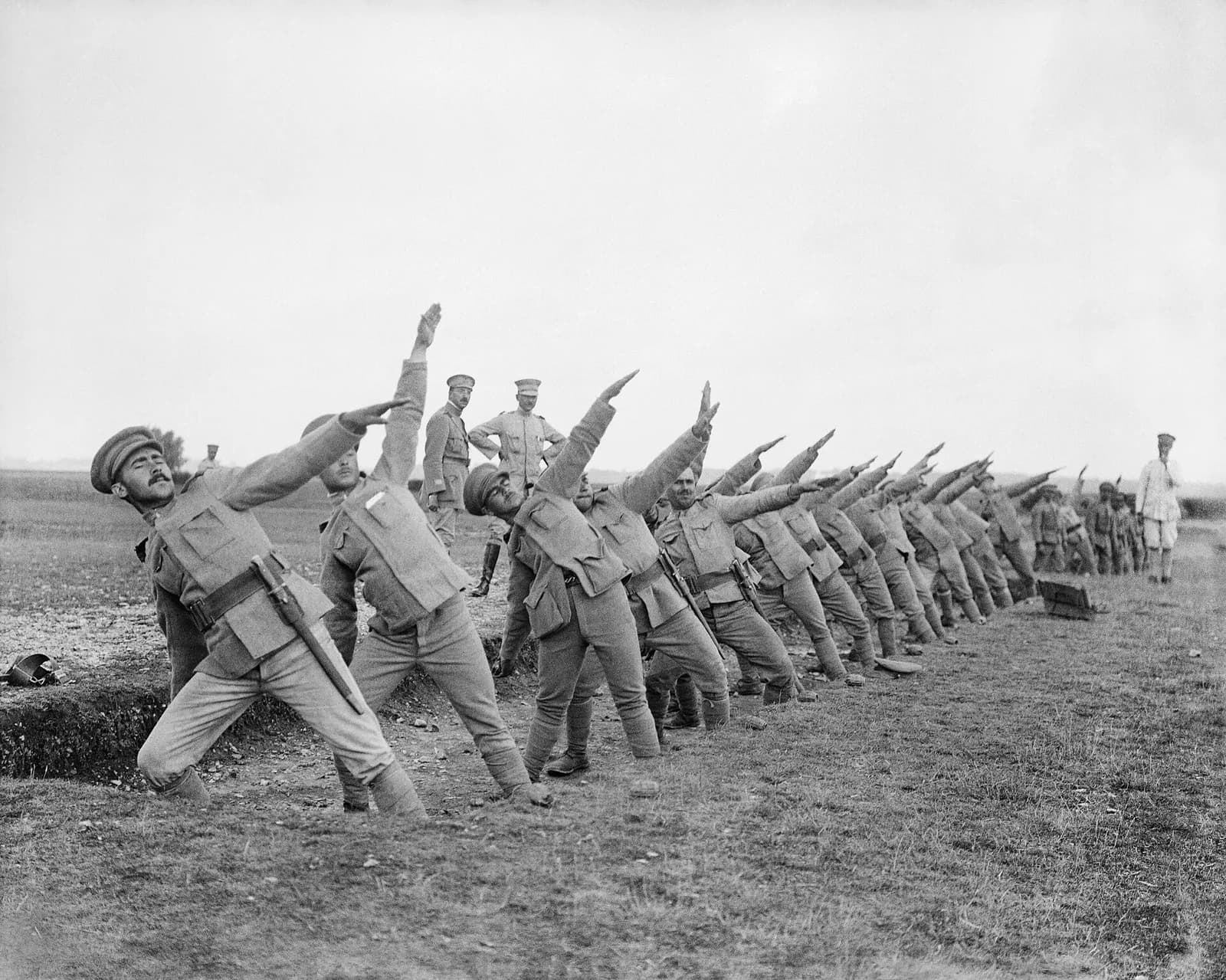
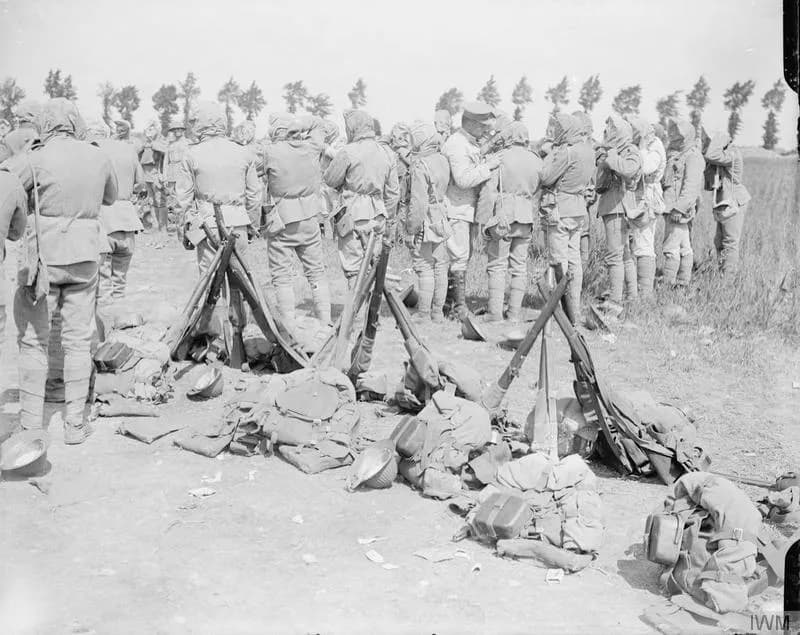
In France the Portuguese were issued Lee-Enfield rifles, Lewis and Vickers machine guns and British helmets, and trained in trench and gas warfare. They entered the line a step at a time: a company spent about two weeks inside a British battalion, then whole battalions joined British brigades, then brigades joined British divisions. The first Portuguese soldier killed in Flanders, António Curado of Infantry Battalion 28, died on 4 April 1917.
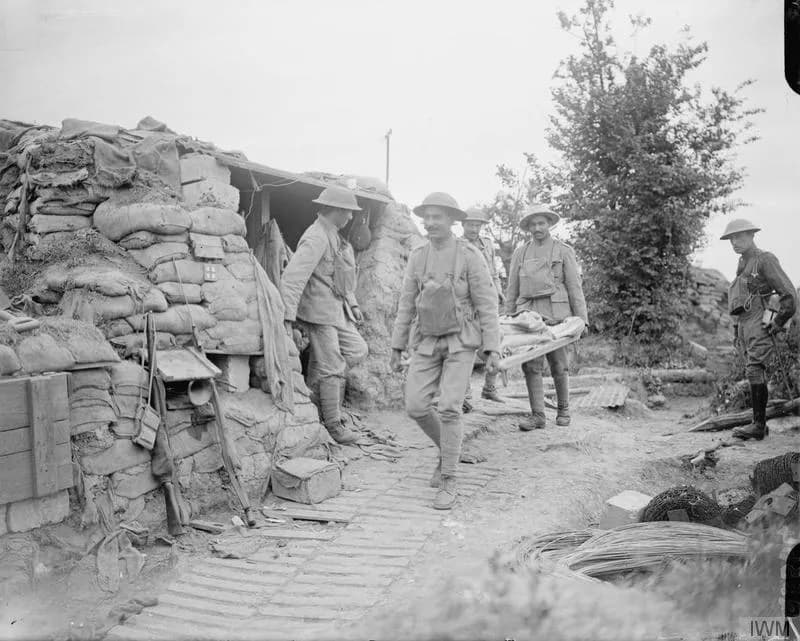
Their sector lay on flat, waterlogged ground between Armentières and Béthune, around Neuve-Chapelle, Ferme du Bois and Fauquissart, about 12 to 14 kilometres long. Water lay so close under the surface that the trenches could rarely be dug more than half a metre deep. Most were breastworks of sandbags built up above the plain, which rain and shellfire kept knocking down.
The men lived in mud. They wore rubber boots that reached the hips, and against the cold they were given sheepskin jackets and leggings like a shepherd's, until lice made the sheepskins unwearable. By Fraga's count, between April 1917 and early April 1918 there were eleven trench raids on the Portuguese lines, eight of them German, and some 20 smaller clashes. Together they cost the CEP 764 casualties, about 200 of them prisoners.
Washing was a problem of its own. General Manuel Gomes da Costa, who sailed with the first transport and commanded the 1st Division, later wrote that it was not the custom in the Portuguese army for soldiers to wash, and that the CEP had to learn bath-houses and laundries from the British.
Seventeen convoys carried the corps to France, the last in October 1917. A tally on the Momentos de História site, quoted by RTP, counts 59,388 men sent by 28 October. In November the 2nd Division, under General José Augusto Simas Machado, joined the 1st in the line, and the CEP became an army corps under Tamagnini, answering to the British First Army.
Where Portugal's soldiers were sent, 1914–1918
men mobilised
Figures from F. A. da Costa Lobo (1922), tabulated by Carlos Lopes (2012). Counts vary between sources: the Revista Militar gives about 55,000 for France, while a tally on the Momentos de História site, quoted by RTP, gives 59,388 men shipped by 28 October 1917, more than Costa Lobo's total for the whole war.
Show the data
| Men mobilised by November 1918 | |
|---|---|
| France (CEP) | 57,178 |
| Africa | 50,150 |
| Mainland defence | 40,000 |
| Atlantic islands | 12,383 |
Left in the trenches
The lifeline was shipping, and it was British. By the late spring of 1917 Britain was pulling out the ships it had lent, and Norton de Matos had to go to London to keep them. From October 1917 only Portuguese ships carried troops, and only two Portuguese transports, the Pedro Nunes and the Gil Eanes, ran regularly to France.
On 5 December 1917 Sidónio Pais seized power in Lisbon. Eager to avoid sending more troops, before the year was out he accepted a British plan, rejected by Norton de Matos that September, to keep only one division in the line. By Fraga's account no more reinforcements reached the CEP after December. Officers who went home on leave were allowed to stay. Simas Machado, the 2nd Division's commander, went to Lisbon in February 1918 and did not come back.
The men expected to be relieved after a year, as troops in Africa were. Instead they stayed. Units ran short of officers, sickness thinned the ranks, and by early April 1918, Lopes writes, the troops' physical endurance had been exceeded. On 4 April 1918 men of three battalions of the 1st Division, from Leiria, Coimbra and Aveiro, refused to go back into the front line at Ferme du Bois.
“No other army but ours inflicts on its soldiers the untranslatable torment of telling them that they are there for ever, until a bullet, a shell splinter or tuberculosis takes them out of this war, whose length no one can foresee.”
The morning of 9 April 1918
In early April the British took the 1st Division out of the line. The 2nd, now under Gomes da Costa and attached to Haking's XI Corps, was left alone to hold the whole sector until its own relief, due on the night of 9 to 10 April. Portuguese accounts give Haking's orders as to die on Line B, the second of its trench lines, and hold it to the last man. Lopes dates them to 7 April.
The German bombardment began shortly after four in the morning, part of Operation Georgette, the second blow of Ludendorff's spring offensive. Some 1,500 guns fired on a front of about 15 kilometres, with gas. In thick fog, between 8 and 8.45 depending on the account, eight German infantry divisions under General Ferdinand von Quast came across no man's land, aiming at the joins between the Portuguese and the British 40th and 55th Divisions on either side.
By the end of the morning the Portuguese sector had ceased to exist. Pockets of men held out until their ammunition ran out.
Among them was Private Aníbal Milhais, a farm labourer from Murça, in Trás-os-Montes, who covered the retreat of Portuguese and British soldiers with his Lewis gun and wandered behind the lines for days with only a packet of sugared almonds. He was given the Tower and Sword, Portugal's highest military decoration, and a nickname from his commander's pun: “Tu és Milhais, mas vales milhões” (“You are Milhais, but you are worth millions”). He is still remembered as Soldado Milhões.
Most of the losses were prisoners. The Revista Militar gives 398 dead and 6,585 prisoners, and the Assembleia da República gives the same figures, citing Fraga (2015). Carlos Lopes, also citing Fraga, gives 614 dead (30 officers and 584 sergeants and men) and the same number of prisoners, many of them wounded, out of about 7,199 men lost between 9 and 12 April. Nobody knows how many were wounded, because both armies collected them.
| Period | Dead | Wounded | Prisoners | Source |
|---|---|---|---|---|
| To 6 April 1918 (before La Lys) | 1,044 | 2,183 (plus 1,594 gassed) | 102 | Revista Militar, 2014 |
| La Lys, 9 April 1918 | 398 | Not counted | 6,585 | Revista Militar, 2014; Assembleia da República, after Fraga, 2015 |
| La Lys, 9 to 12 April 1918 | 614 | Not counted | 6,585 | Fraga, cited by Lopes, 2012 |
| Whole campaign, June 1917 to November 1918 | 2,160 | 5,224 | 6,678 | Revista Militar, 2014 |
The Revista Militar table splits the La Lys dead into 29 officers and 369 other ranks, and the whole-campaign dead into 74 officers and 2,086 other ranks. Before La Lys it also lists 403 injured in accidents and 94 missing.
The end of the corps
The CEP never fought again as a corps. The British spread the survivors and the 1st Division among their own divisions as labourers, digging and repairing rear defences, and split up the artillery. There were serious mutinies, among them one at Croix Marmuse on 15 October 1918. General Tomás Garcia Rosado replaced Tamagnini on 24 August 1918, and only then did a real effort to rebuild Portuguese combat units begin.
Fraga credits a group of officers, among them Augusto Casimiro and Hélder Ribeiro, with getting Garcia Rosado leave to reorganise some units in October. Only three battalions were made ready, parcelled out among British brigades. They were in the line when the armistice came on 11 November 1918.
23 February 1916
German ships in Portuguese ports seized
9 March 1916
Germany declares war on Portugal
22 July 1916
Parade at Montalvo, the showpiece of the Tancos training
3 January 1917
Anglo-Portuguese convention on the CEP signed
30 January 1917
First contingent sails from Lisbon
4 April 1917
First Portuguese soldier killed in Flanders
28 October 1917
59,388 men shipped to France so far, by one tally
November 1917
Both divisions in the line as a Portuguese army corps
5 December 1917
Sidónio Pais takes power; reinforcements soon stop
9 April 1918
German offensive overruns the Portuguese sector
11 November 1918
Armistice; three Portuguese battalions back in the line
How the war is remembered
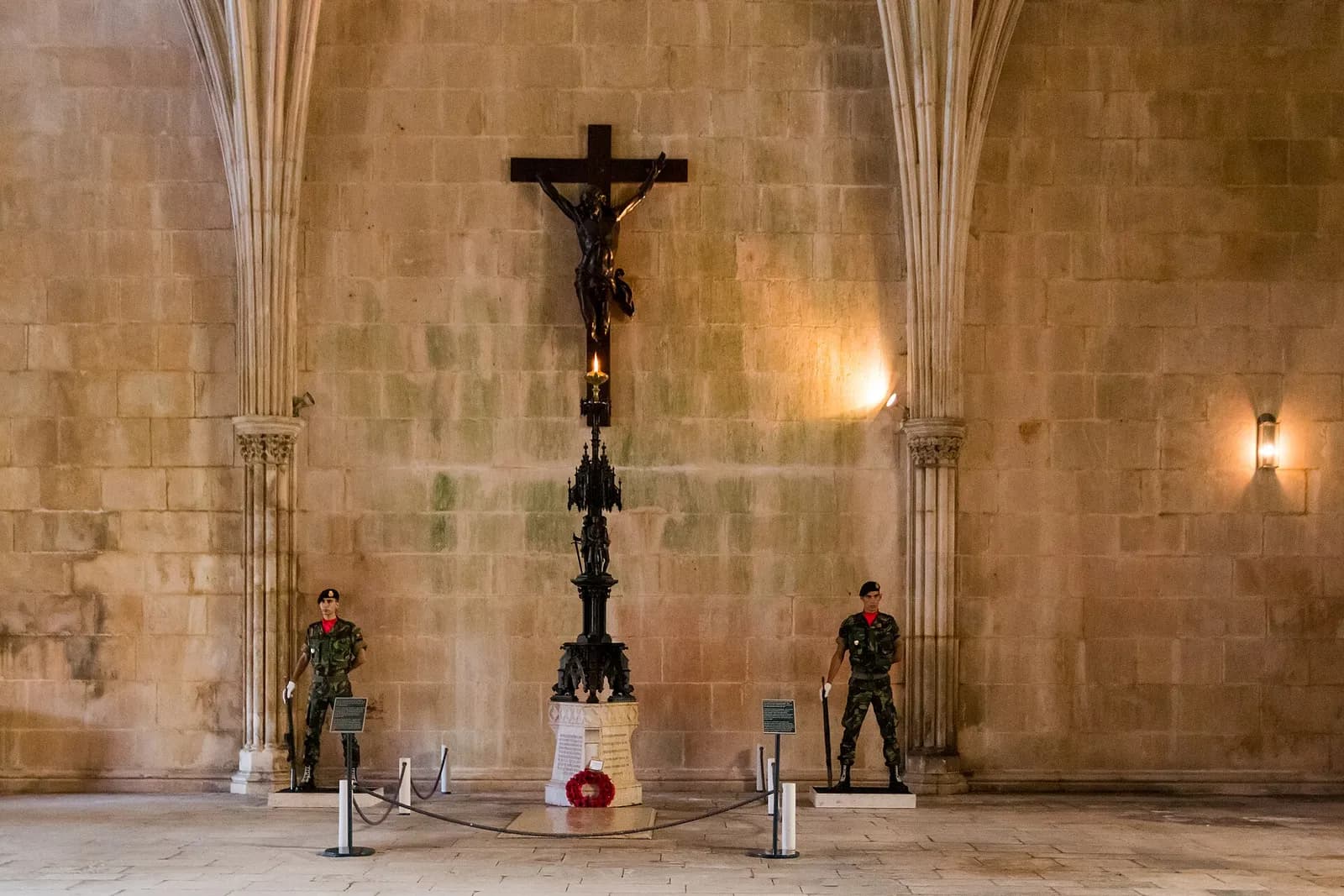
La Lys became the date Portugal remembers. On 9 April 1921, declared a national holiday, two unknown soldiers, one from Flanders and one from Africa, were carried through Lisbon and taken to Leiria. The next day they reached the monastery of Batalha, built by João I after the victory of Aljubarrota, and were laid in its chapter house.
The memory was political from the start. On the sixth anniversary, in 1924, the deputy Carlos Olavo, a veteran of Flanders, called the abandonment of the troops “a crime without a name”. The prime minister, Álvaro de Castro, refused to call the battle a disaster. The Liga dos Combatentes, founded in 1922, still marks 9 April and the armistice every year.
In France, the Portuguese military cemetery at Richebourg holds 1,831 Portuguese soldiers, 238 of them unknown, brought there between 1924 and 1938. In nearby La Couture a memorial by the sculptor António Teixeira Lopes was unveiled on 10 November 1928. The names of 2,266 Portuguese are among those on the ring memorial at Notre-Dame-de-Lorette.
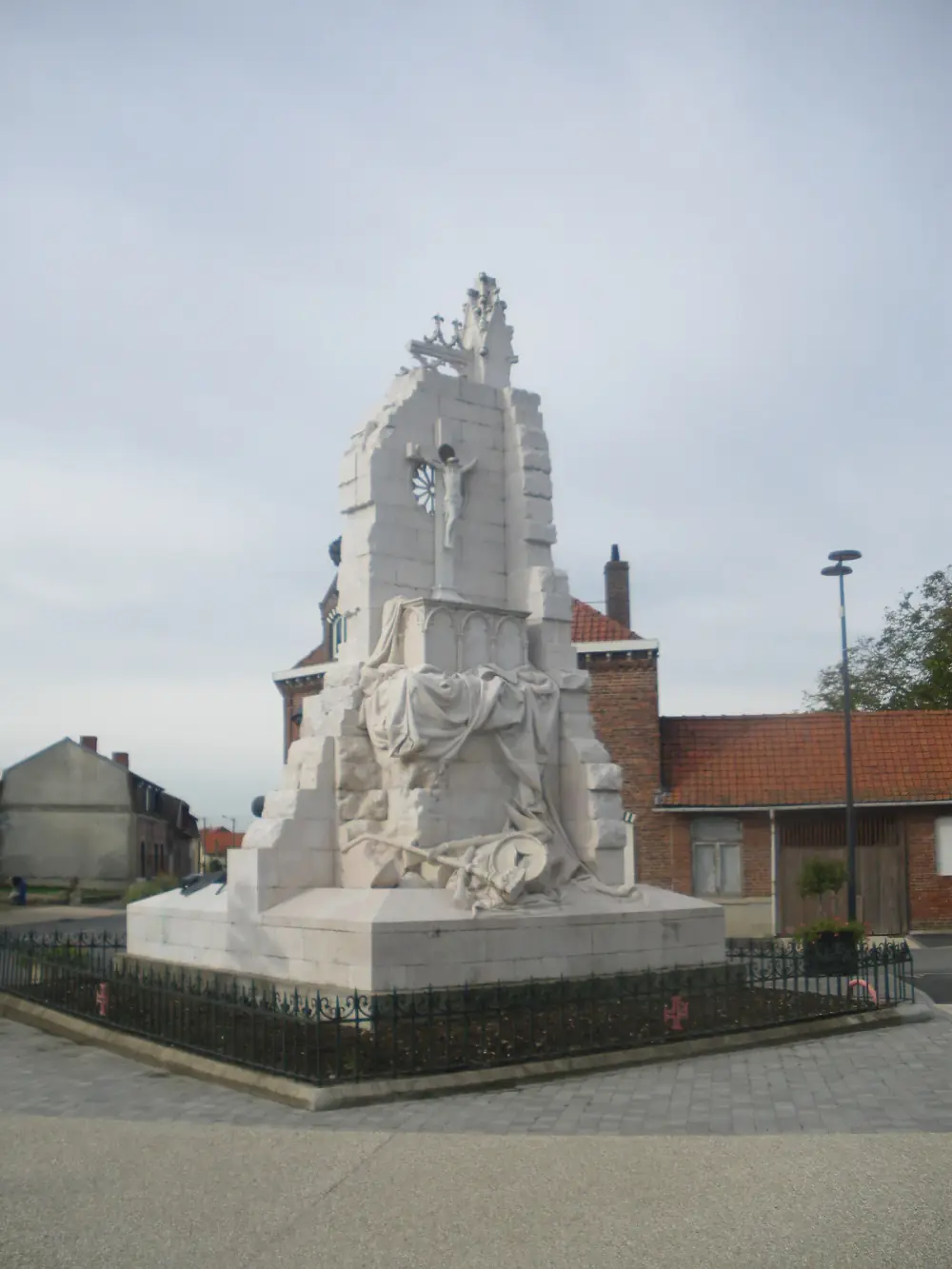
Each April the cemetery, the chapel of Our Lady of Fátima opposite it and the La Couture memorial host a ceremony for the battle. Historians still argue over how many died on 9 April and who was to blame. What the Portuguese had insisted on in 1917, an army corps of their own in a Portuguese sector, counted for little after that morning.
FAQs
What was the Anglo-Portuguese convention of 3 January 1917?
It was the agreement that set how the Corpo Expedicionário Português would serve on the Western Front, inside the British army. Its Article 2 said the CEP would operate, subject to tactical considerations, as a whole under a Portuguese general. Published summaries add that Britain was to ship it to France at its own cost, finish arming it and train it before giving it a sector of the front.
How many Portuguese soldiers went to the Western Front?
Between about 55,000 and 59,000, depending on the count. The Revista Militar gives about 55,000, and Costa Lobo's 1922 tally gives 57,178 sent to France by the end of the war. A tally on the Momentos de História site, quoted by RTP, gives 59,388 men shipped between February and 28 October 1917.
How many Portuguese died at the Battle of La Lys?
Estimates range from 398 dead (the Revista Militar, and the Assembleia da República citing Luís Alves de Fraga) to 614 (Fraga as cited by Carlos Lopes), with about 6,585 taken prisoner. The number of wounded is unknown because both armies collected them.
Why did Portugal enter the First World War?
Germany declared war on 9 March 1916 after Portugal seized the German ships in its ports at Britain's request. The interventionist government of Afonso Costa wanted a seat at the peace table to protect the colonies, a stronger Republic at home and more independence from Britain.
Where is Portugal's Unknown Soldier buried?
Two unknown soldiers of the First World War, one from Flanders and one from Africa, lie in the chapter house of the Batalha monastery. They arrived there on 10 April 1921, the day after the third anniversary of La Lys.
On the timeline
Open the timelineNearby moments from the first republic (1910–1926).
The German Empire declares war on Portugal, following Portugal's seizure of German and Austro-Hungarian ships sheltering in Portuguese ports. Portugal formally enters World War I on the side of the Allies.
Death of Mário de Sá-Carneiro in Paris at age 25. He was a leading Portuguese modernist poet, a key figure of the 'Geração d'Orpheu' movement, and Fernando Pessoa's close friend and literary collaborator.
The Portuguese Parliament approves Portugal's active participation in the First World War alongside the Allies, following Britain's formal invitation, paving the way for the Portuguese Expeditionary Corps to fight on the Western Front.
Portugal on the Western Front
Portugal and Britain sign a convention setting out how the Corpo Expedicionário Português (CEP) will serve on the Western Front, within the British army. The first contingent sailed from Lisbon on 30 January; by late October one tally counted 59,388 men sent to France, though other counts of the whole corps are lower, at about 55,000 to 57,000.
Three shepherd children — Lúcia Santos, Francisco Marto, and Jacinta Marto — report the first apparition of Our Lady of Fátima in the Cova da Iria. The events of 1917 would make Fátima one of the most important Catholic pilgrimage sites in the world, drawing millions of visitors annually.
Birth in Luanda of José Baptista Pinheiro de Azevedo, the admiral who led Portugal's Sixth Provisional Government through the revolutionary 'Hot Autumn' of 1975. Besieged by protesters and short of military backing, he suspended his own government's work on 20 November that year, saying he was 'tired of being kidnapped' — in effect putting the cabinet on strike.
The third of six apparitions of the Virgin Mary to the three shepherd children of Fátima — Lúcia, Francisco and Jacinta. It is on this day that, according to the seers, Our Lady entrusts them with the famous 'Three Secrets', the third of which would not be made public by the Vatican until the year 2000.
Coming up in history
All long reads 5 January 2014Eusébio: from Mafalala to the National Pantheon, 1942–2014
 6 January 1973Expresso's first issue: a weekly that tested Caetano's censors, 1973
 7 January 1355The killing of Inês de Castro: Coimbra, 7 January 1355
 8 January 1455Romanus Pontifex: the papal bull that gave Portugal the African coast
21 sources
Archives, scholarship and reporting this article was checked against.
- 1
The Portuguese Expeditionary Corps in France (1917-18) and the Long Shadow of the Peninsular War against Napoleon (Filipe Ribeiro de Meneses)e-Journal of Portuguese History 16 (2), 2018; author's copy, Maynooth University Research Archive Library
- 2
Portugal e a Primeira Guerra Mundial (Luís Alves de Fraga)Janus 1999-2000, Universidade Autónoma de Lisboa
- 3
Os portugueses na Grande Guerra: uma experiência de combate e de cativeiro (Carlos Jorge Alves Lopes, MA dissertation)Universidade Aberta, 2012
- 4
Portugal na I Guerra Mundial (João José Brandão Ferreira)Revista Militar no. 2553, October 2014, pp. 879-892
- 5Postal da Grande Guerra: Partidas e Logística (Graça Andrade Ramos)RTP, Portugal na I Grande Guerra
- 6
Evocação da Batalha de La Lys (1924)Assembleia da República, Comunicar
- 7
Portugal e os Soldados Desconhecidos da Grande Guerra (Margarida Portela)Portugal 1914-1918, Instituto de História Contemporânea
- 8
A primeira partida para FrançaRTP Ensina (Graça Andrade Ramos, Postal da Grande Guerra, 2017)
- 9
Destaques Arquivo MPR #22: Nas trincheirasMuseu da Presidência da República
- 10
Desporto em tempo de guerra: os Jogos Interaliados (Rita Nunes)Nação e Defesa no. 145, Instituto da Defesa Nacional, 2016
- 11Cemitério português de Richebourg em lista para candidatura à UNESCODiário de Notícias (Lusa), 1 February 2017
- 12
A participação portuguesa na Batalha de La LysEuroDefense-Portugal
- 13Entre a aliança e o protectorado britânico (António Louçã)RTP, Portugal na I Grande Guerra
- 14A Alemanha declara guerra a Portugal (Graça Andrade Ramos)RTP, Portugal na I Grande Guerra
- 15
Efeméride: Apresamento de navios alemãesDireção Cultural da Marinha, Museu de Marinha
- 16
Afonso Costa e Manuel Teixeira Gomes na missão que negociou em Londres, no verão de 1916, as condições financeiras para a participação de Portugal na I Guerra Mundial (Jorge Pais de Sousa)Revista Universitaria de Historia Militar 3 (5), 2014
- 17Como se faz uma trincheira (Graça Andrade Ramos)RTP, Portugal na I Grande Guerra
- 18
Norton de Matos e o milagre de Tancos: entre o mito e a realidade (Helena Pinto Janeiro)Instituto de História Contemporânea, NOVA FCSH (Ponte de Lima: do passado ao presente, no. 3, 2018)
- 19
CEP em França, 1917-1918Momentos de História (Grande Guerra)
- 20
- 21
Uma “Luisinha” e um pacote de amêndoas fizeram um herói português (Olímpia Mairos)Renascença, 21 October 2015
Image credits
- Portuguese soldiers rehearse the throwing movement at grenade practice at the Infantry Training School at Marthes, in the Pas-de-Calais, on 23 June 1917. John Warwick Brooke, Public domain, via Wikimedia Commons.
- Portuguese troops putting on gas masks during an anti-gas exercise at the Infantry Training School at Marthes, 23 June 1917. John Warwick Brooke, Public domain, via Wikimedia Commons.
- Portuguese stretcher-bearers bring a wounded man to a regimental aid post in a trench near Neuve-Chapelle, 25 June 1917. The walls are sandbags piled above ground level. John Warwick Brooke, Public domain, via Wikimedia Commons.
- The tomb of the Unknown Soldier in the chapter house of the Batalha monastery, with its honour guard, the eternal flame and the Christ of the Trenches, in 2014. Daniel Villafruela, CC BY-SA 3.0, via Wikimedia Commons.
- The Portuguese memorial at La Couture, in the Pas-de-Calais, by António Teixeira Lopes, unveiled in 1928, photographed in 2013. Floflo62, CC BY-SA 3.0, via Wikimedia Commons.