

Vasco da Gama dies in Cochin, three months into his viceroyalty
The man who opened the sea route to India died there at three in the morning on 24 December 1524, viceroy for barely three months. His bones reached the Jerónimos in 1880, or, if a leading historian is right, only in 1898.
At a glance
- Vasco da Gama died in Cochin (Kochi), in south-west India, at about three in the morning of 24 December 1524, according to the chronicler Gaspar Correia.
- He had come back to India that September as viceroy, 25 years after his first voyage of 1497 to 1499 opened the sea route from Portugal round Africa to Calicut.
- Correia describes painful, hard boils on the back of his neck. The malaria named in many modern summaries is not in his account.
- On his second voyage, in 1502, his fleet burned a ship returning from Mecca with its passengers aboard; the sources range from 240 men plus women and children to more than 700 people.
- His bones went from Cochin to Vidigueira in 1538 and to the Jerónimos in Lisbon in 1880, but the historian José Manuel Garcia says the right bones only arrived in 1898.
Christmas Eve in Cochin
In December 1524 the viceroy of Portuguese India lay in a house beside a church in Cochin, on the Malabar coast. He had moved there from the fortress when he felt death coming. For days his neck had been twisted with pain, and hard boils had risen on the nape that no remedy would bring to a head. By the end he could not speak.
He used his last days on paperwork. He made two officials swear to change nothing he had ordered until his successor arrived, and sealed the royal papers in a box for his son Estêvão to hand over. Then he confessed, took the sacrament and made his will. His sons were to sail home with the next ships; his silk clothes and furnishings went to the churches and the hospital.
“He delivered up his soul in the night of Christmas of the holy birth of Christ, at three o'clock after midnight, on the twenty-fourth day of December of this present year of 1524.”
The household kept the death quiet and the doors shut all day. Only at the evening Ave Maria did his sons and servants raise the lament. The body, dressed in silk under the mantle of the Order of Christ, with sword, gilt spurs and a dark cap, was carried by gentlemen of the order to the Franciscan friary church of Santo António and buried in its main chapel. The man was Vasco da Gama, Count of Vidigueira and Admiral of India.
From Sines to the Restelo
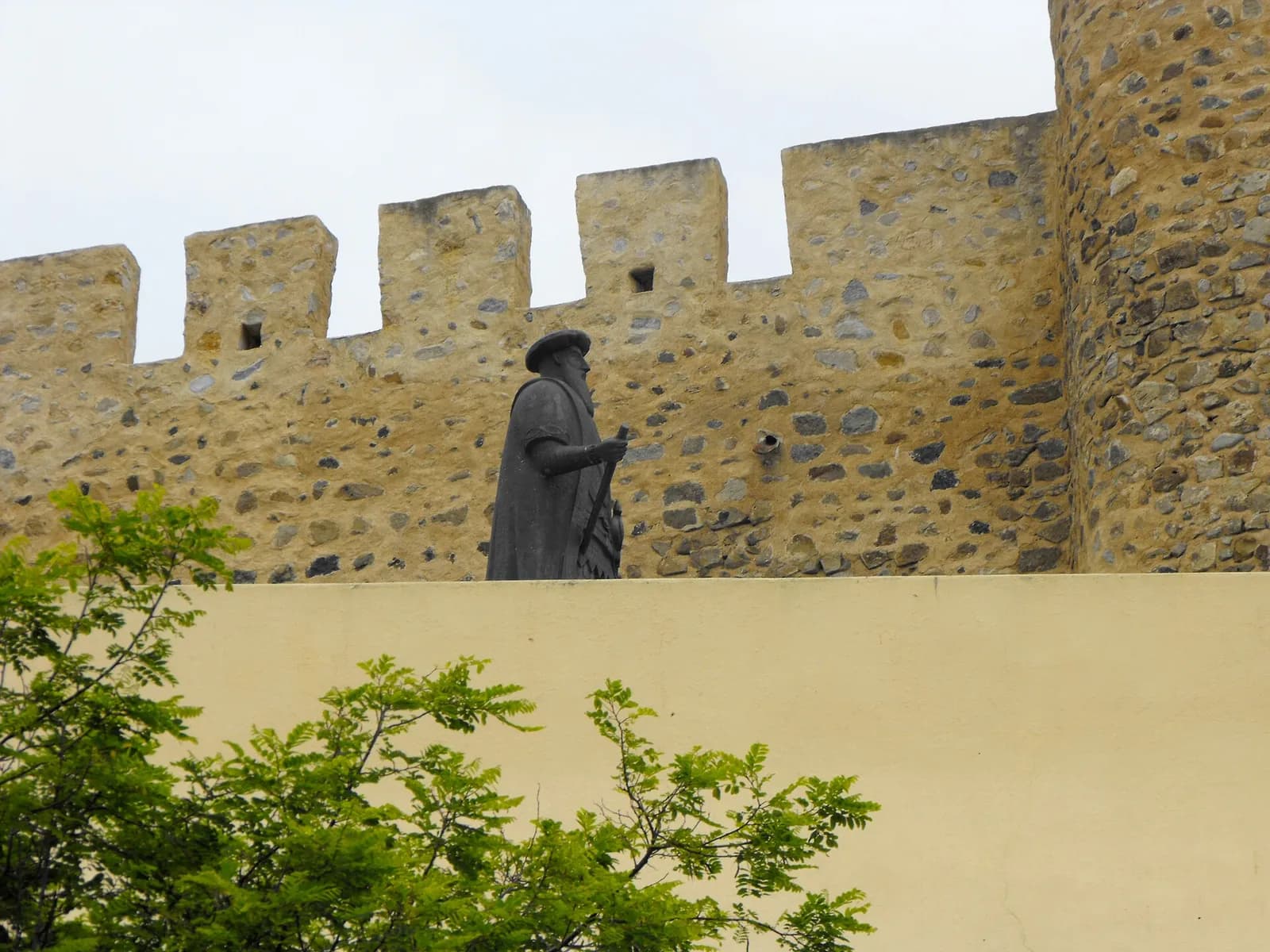
Gama was born in Sines, a fishing town on the Alentejo coast, where his father Estêvão da Gama was alcaide-mor, the royal commander of the castle. His mother was Isabel Sodré. The year usually given is 1469, but it rests on the word of the priest and geographer António Carvalho da Costa, writing two centuries later, that he was 28 in 1497. Ravenstein called that unsupported: in 1478 Queen Isabella of Castile gave a safe-conduct to Vasco da Gama and Fernão de Lemos to pass through Castile to Tangier, and if that was him, he was born around 1460.
Little is known of his early career. Royal letters of 1484 and 1496 show him as a knight of the king's household with minor posts and property at Olivença, on the border with Castile, and the chronicler Garcia de Resende says King João II had employed him at sea. In 1497 King Manuel I gave him command of the fleet that was to sail round Africa to India, the goal Portuguese captains had been working towards along the African coast for most of the century.
The first voyage, 1497 to 1499
“We left Restello on Saturday, July 8, 1497,” begins the only surviving journal of the voyage, written by an unnamed man aboard the São Rafael. There were four ships: the flagship São Gabriel, the São Rafael under Gama's brother Paulo, the caravel Berrio under Nicolau Coelho and a store-ship. After the Cape Verde islands they swung far out into the South Atlantic and were out of sight of land for 93 days.
Contrary winds held them off the Cape of Good Hope for days. “At last, on Wednesday, at noon, having the wind astern, we succeeded in doubling the Cape,” the journal records; Ravenstein dates that Wednesday to 22 November 1497. The store-ship was emptied and broken up in the bay of São Brás, and the three remaining ships worked up the east coast of Africa to Mozambique Island and Mombasa, where the welcome turned hostile.
At Malindi, a rival of Mombasa, the ruler gave them a pilot. The Portuguese chroniclers called him Malemo Cana or Canaqua and said he came from Gujarat; Malemo comes from the Arabic mu'allim, a ship's master. With the monsoon behind them they left on 24 April 1498 and sighted the Indian coast on 18 May. On 20 May they anchored a few miles north of Calicut, at a place the chroniclers call Capocate.
“May the Devil take thee! What brought you hither?”
The stay at Calicut went badly. The Zamorin received Gama, but the presents he had brought were poor, the Muslim merchants worked against him and trade came to little. The fleet left at the end of August and sailed from the Anjediva islands on 5 October, weeks before the north-east monsoon set in. The crossing back to Africa took until 2 January 1499. Scurvy killed 30 men, after as many had died earlier, and only seven or eight in each ship could still work.
Short of hands, they burned the São Rafael off the African coast in January 1499. Coelho's Berrio reached Lisbon on 10 July. Gama turned aside to Terceira in the Azores, where Paulo died, and reached Lisbon himself later in the summer.
Barros, Góis and Barreto de Resende give 29 August, Castanheda 8 September and a manuscript in the Torre do Tombo 18 September; Ravenstein thought he arrived on 29 August and made his formal entry on 8 September. How many came home is unknown, because the sources disagree on how many left.
How many men sailed with Gama in 1497? The sources disagree
men
Galvão's 120 excludes the store-ship's crew. Sernigi says 55 died and 63 returned; Castanheda and Góis say 55 returned; San Román says 93 died. Ravenstein thought Barros's 170 nearest the truth and Correia's 260 an exaggeration.
Show the data
| Men on departure, as given by each source | |
|---|---|
| Sernigi | 118 |
| Galvão | 120 |
| Castanheda, Góis | 148 |
| Faria y Sousa, San Román | 160 |
| Barros | 170 |
| Correia | 260 |
8 July 1497
Four ships leave the Restelo, below Lisbon
3 August to 4 November 1497
93 days out of sight of land in the South Atlantic
22 November 1497
The fleet rounds the Cape of Good Hope
2 March 1498
Arrival at Mozambique Island
14 April 1498
Arrival at Malindi; a pilot is provided
20 May 1498
Anchors a few miles north of Calicut
Late August 1498
Leaves Calicut
5 October 1498 to 2 January 1499
Crossing of the Arabian Sea; 30 die of scurvy
January 1499
The São Rafael is burned for lack of crew
10 July 1499
Coelho's Berrio reaches Lisbon
29 August 1499
Gama reaches Lisbon after burying Paulo on Terceira
The date most sources give; others say 8 or 18 September.
The second voyage and the Miri, 1502
Manuel made him Admiral of India and gave him the title of Dom and incomes from Sines. The king also promised him the lordship of Sines itself, but the town belonged to the Order of Santiago and the exchange never happened; from 1501 he was paid 1,000 cruzados a year instead. Meanwhile Pedro Álvares Cabral's fleet of 1500 had left a trading post at Calicut, which was attacked; the factor, Aires Correia, and a number of his men were killed.
Gama sailed again in 1502, on 10 February according to Barros and Osório (Correia says 25 March), with about 20 ships. He forced the ruler of Kilwa, in today's Tanzania, to pay tribute; Barros and San Román say the gold was made into the monstrance Manuel gave to the monastery at Belém. Then he waited off Mount Eli, near Cannanore, for the ships coming back from the Red Sea.
On 29 September his ships took a large vessel returning from the pilgrimage to Mecca. Barros names her the Merim, usually written Miri today. Tomé Lopes, a clerk in one of the ships, wrote that a rich merchant aboard offered to load the whole fleet with spices in exchange for the ship and his passengers. Gama refused, took what valuables the passengers handed over and ordered the ship towed away and burned.
The passengers put the first fire out and fought with stones and the few weapons left to them. Lopes saw women on deck holding up gold, jewels and their small children, begging the admiral, who watched through a port, to spare them.
On Monday 3 October the passengers boarded Lopes's own ship and nearly took it. Gama's ships then chased the Miri for four days and nights, until a man swam over and offered, in return for his life, to tie a rope to her rudder so she could be fired. Before the end, Lopes says, the passengers threw their gold and jewels into the sea.
“The Admiral had that ship set on fire, and it burned with all the people who were in it, with much cruelty and without any pity.”
| Source | Who wrote it | People aboard | Date given | Survivors |
|---|---|---|---|---|
| Tomé Lopes | Clerk in the fleet, eyewitness | 240 men, plus many women and children | Taken 29 September; fight on 3 October, then a chase of four days | The swimmer who helped fire the ship; some children, implied in a later chapter (editor's note) |
| Calcoen | Anonymous sailor, printed in Antwerp about 1504 | 380 men and many women and children | Burned 1 October | None mentioned |
| João de Barros | Royal historian, Décadas, 1552 | About 260 fighting men and more than 50 women and children | Not stated | Twenty-odd children, baptised, and a hunchbacked pilot |
| Jerónimo Osório | Later chronicler | 300 men killed | Fight lasted into the next day | A few children |
| Gaspar Correia | In India from 1512 or 1514, writing decades later | More than 700 | Not stated | None; swimmers were lanced in the water |
Correia tells the story differently, as a Calicut merchant's ship taken at Marabia; Stanley treats it as the same episode. The sources also disagree on the owner: the brother of Coja Kasim, a leading Calicut merchant (Correia), the Sultan of Egypt (Barros, Osório) or a factor of the 'Sultan of Mecca' (Lopes).
At Calicut, at the start of November, Gama demanded compensation for the trading post. When no answer came, Lopes says, 34 captured men were hanged from the yardarms in sight of the crowd on the beach. The ships fired into the crowd and kept up their fire on the town until dark. At nightfall the heads, hands and feet of the hanged were cut off and sent ashore in a boat with a letter, and on 2 November the bombardment began again. Correia's later version is worse, with more than 800 men mutilated and burned.
Gama loaded spices at Cochin and Cannanore, left a squadron under his maternal uncle Vicente Sodré to patrol the coast and was back in Lisbon in 1503, on 1 September according to Osório and 10 November according to Barros. Camões's epic Os Lusíadas leaves the burning of the Miri out; Stanley noted that Barros, Osório and San Román told it without a word of disapproval.
Twenty years ashore
For the next 20 years Gama stayed in Portugal. By October 1501 he had married Catarina de Ataíde, and they lived mostly in Évora, in a house said to have been painted with Indian trees and animals. They had six sons. Correia says Gama drew up the instructions for the India fleets of 1505 and was consulted on everything to do with India.
He wanted more. A draft letter from Manuel survives in which the king tells his admiral that the title of count had been promised but that Gama had pursued it in ways he should not, and refuses him leave to go abroad before December, while saying he could then leave with his wife, children and property. Gama, in other words, had asked to quit the kingdom.
The Duke of Bragança, Jaime, solved it. He sold Gama his towns of Vidigueira and Vila de Frades, in the Alentejo, for 4,000 cruzados in cash and an annuity of 400,000 reais that Gama held. The deed was signed in Évora on 7 November 1519 and confirmed by the king on 17 December, and a royal letter of 29 December made Gama Count of Vidigueira. Manuel died in 1521; his son João III would send Gama back to India.
Viceroy, 1524
Portuguese India was in disorder under the governor Duarte de Meneses, with whom the king was furious. João III appointed Gama viceroy, only the second man to hold that title, by a letter that Teixeira de Aragão dates to 27 February 1524, and Gama swore homage on 28 February, signing himself “the count admiral”. He sailed on 9 April with 14 ships, about 3,000 men and his sons Estêvão and Paulo.
He took office at Chaul and reached Goa on 23 September, according to a letter from the city council to the king. The council counted nine ships with him and five missing. Correia describes a viceroy with a royal household, a guard of 200 men and a temper to match: “a very disdainful man, and ready to anger, very rash, much feared and respected”.
He set about the abuses with the same hardness. He reclaimed royal artillery that had passed into private hands, put the factors of Cochin under investigation and refused to let Duarte de Meneses land. Three women found aboard the fleet, against his orders, were publicly flogged in Goa, though the bishop, the friars and the Misericórdia begged for them; from his deathbed he sent each of them a dowry.
- Appointed viceroy
- 27 February 1524; homage sworn 28 February
- Sailed from Lisbon
- 9 April 1524, with 14 ships
- Reached Goa
- 23 September 1524, with nine ships
- Died
- Cochin, about 3 a.m. on 24 December 1524
- Time in India as viceroy
- About three and a half months
- Successor
- Henrique de Meneses, captain of Goa
Illness and death
By the end of November he was ill in Cochin. Correia, whose account is the fullest, blames the pain in his neck and the boils on the nape, made worse by fits of anger and the weight of work, until he took to his bed and lost his voice. He still sent a ship home with his letters on 1 December and ordered the arrest of a captain accused of cutting off a man's arm in Ceylon.
He died on Christmas Eve. Castanheda, Barros and San Román agree on the date. He was succeeded by Henrique de Meneses, the captain of Goa, who had come out in the same fleet. Estêvão and Paulo da Gama sailed for Lisbon in a merchant's ship, as their father had ordered, and were received by the king with honour.
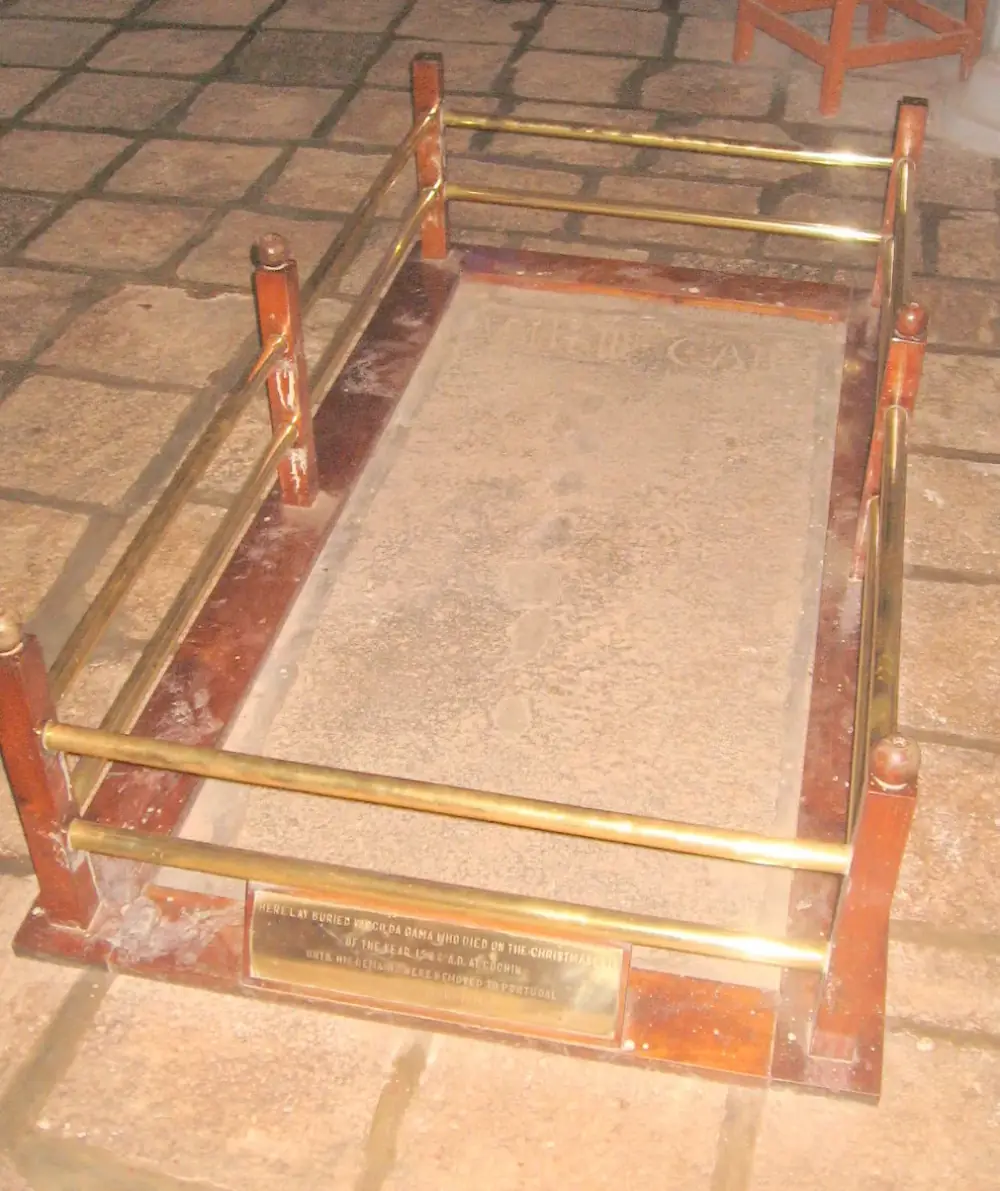
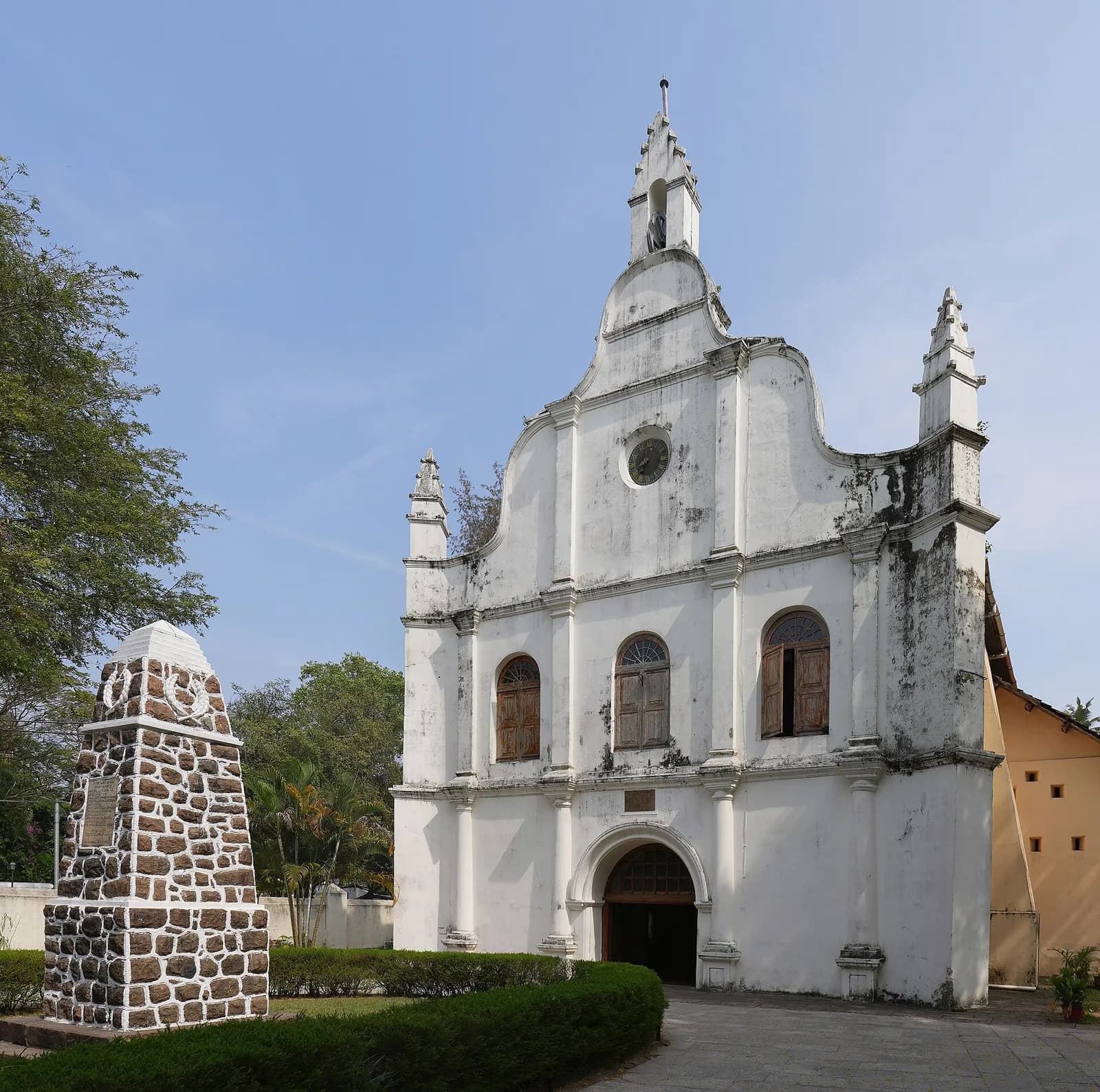
Even the first grave is uncertain. Correia names the Franciscan church of Santo António and Barros the church of St Francis, but Castanheda says the cathedral of Cochin. The British blew up most of Cochin's public buildings in 1806, and a visitor in 1857 was told the grave lay somewhere near the lost cathedral. The one Portuguese church spared is the one now called St Francis, where a railed slab marks the spot today.
The journey of the bones
Gama had asked for his bones to go home, and 14 years later they did. His son Pedro da Silva da Gama took them to the church of Nossa Senhora das Relíquias, a Carmelite convent near Vidigueira. Stanley, Ravenstein and José Manuel Garcia give the year as 1538; the 1539 found in some modern summaries has no support in these sources. The grave in the chancel had no epitaph at first, and later writers did not agree on which side of the altar it lay.
The convent was closed with the other religious houses in 1834. In 1840 the Gama vault was broken open by looters, the coffin forced and some bones smashed; in 1841 the state auctioned the building without a thought for who was buried in it. Teixeira de Aragão, writing in 1871, found the bones still lying where the district governor had had the vault resealed.
A decree of 24 February 1871 ordered them moved to the church of the Jerónimos at Belém, but nothing happened until 1880, when the remains of the poet Luís de Camões were being moved there for the 300th anniversary of his death. Gama's exhumation was recorded at Vidigueira on 7 June 1880, and on 8 July his urn was handed to the prior of Santa Maria de Belém. The monastery's own account gives 1880 as the year he came to the Jerónimos.
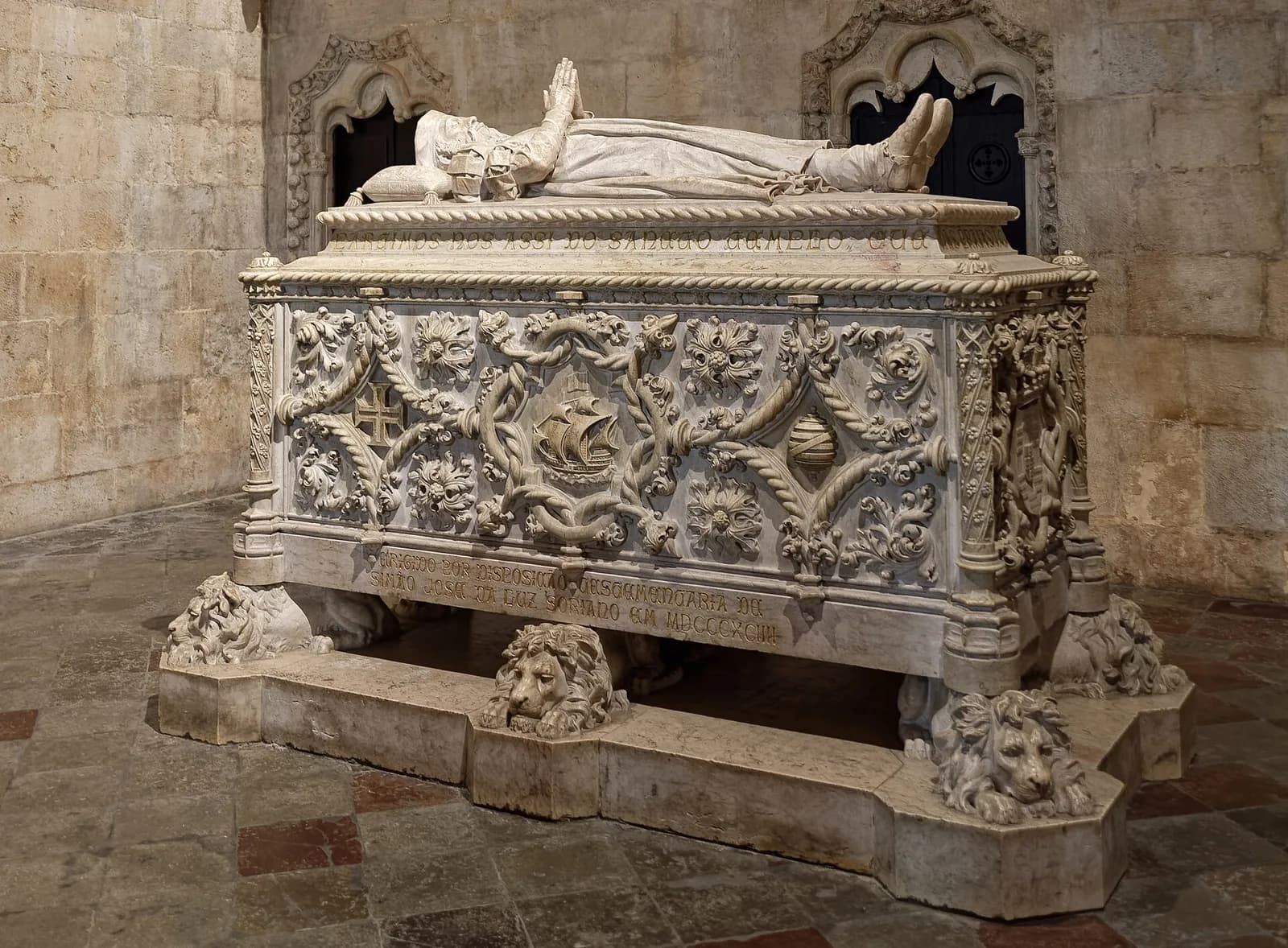
Doubts followed. The historian José Manuel Garcia says the bones taken in 1880 were not Gama's, and that the true remains were brought to the Jerónimos in 1898, the fourth centenary of the voyage, and placed in the tomb made in 1894. A popular account by Peter Booker, which gives no references, adds that when the tomb was opened again it held eight thighbones and two skulls, and that the family who now own the old convent estate believe the 1898 commission took the wrong Gama too.
| Date | Place | What the record says |
|---|---|---|
| 24 December 1524 | Franciscan church of Santo António, Cochin | Buried in the main chapel (Correia) |
| 1538 | Nossa Senhora das Relíquias, near Vidigueira | Brought from India by his son Pedro |
| 1834 | Same | Convent closed with the other religious houses |
| 1840 | Same | Vault broken open and bones damaged |
| 24 February 1871 | Lisbon | Decree orders transfer to Belém |
| 7 June to 8 July 1880 | Vidigueira to Belém | Exhumation and handover of the urn, with Camões's coffin |
| 1894 | Jerónimos | Tomb carved by Costa Mota |
| 1898 | Vidigueira to Jerónimos | Second transfer of what Garcia calls the true remains |
| 1940 | Lower choir of the Jerónimos church | Gama's and Camões's tomb chests placed where they stand today |
The 1898 transfer rests on the historian José Manuel Garcia's account; the archive records cited here stop in 1880, and the monastery's own account gives only 1880.
Why it still matters
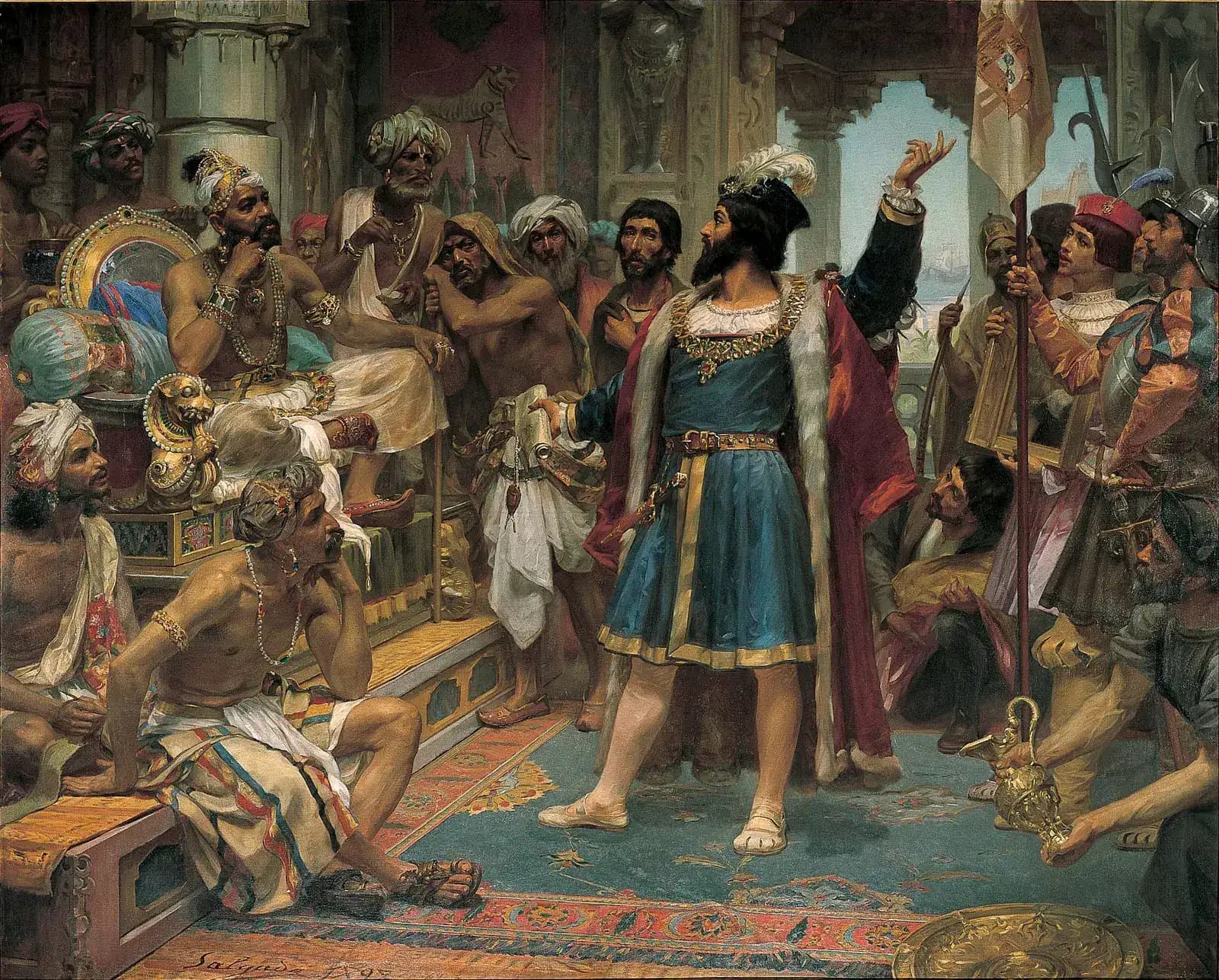
Each centenary has brought Gama back. The fourth centenary of the voyage in 1898 produced paintings such as Veloso Salgado's at the top of this page and, if Garcia is right, the second transfer of his bones. On 25 December 1924, for the fourth centenary of his death, Sines laid the first stone of a monument to him.
For the 500th anniversary of his death the government announced a concert, lectures and publications, to open on 16 December 2024 with a wreath laid on his tomb by the prime minister, Luís Montenegro. In Fort Kochi the priest of the church that keeps his first grave said in 2023 that its own anniversary ceremonies would be agreed with the archaeology department.
The government said its programme would celebrate, study and “demystify” him. The chronicles that tell of the voyage of 1498 also tell of the Miri and the hanged men of Calicut. Even the bones in the Belém tomb rest on exhumation papers from 1880 and on one historian's word that those were the wrong ones.
FAQs
How and where did Vasco da Gama die?
He died in Cochin (Kochi), in south-west India, at about three in the morning of 24 December 1524, after some weeks of illness. Gaspar Correia describes severe pain and hard boils on the back of his neck. Malaria is often given as the cause, but no early source says so.
Where is Vasco da Gama buried?
His tomb is in the Jerónimos Monastery in Belém, Lisbon. He was first buried in the Franciscan church in Cochin, moved to Vidigueira in 1538 and to the Jerónimos in 1880. The historian José Manuel Garcia says the 1880 bones were the wrong ones and the true remains came in 1898.
Why was Vasco da Gama in India in 1524?
King João III appointed him viceroy of India on 27 February 1524 to restore order after the governorship of Duarte de Meneses. He sailed on 9 April with 14 ships and reached Goa on 23 September.
What happened to the Miri in 1502?
Gama's fleet captured the Miri, a ship returning to Calicut from the pilgrimage to Mecca, off Mount Eli in late September 1502, took its valuables and burned it with its passengers. The eyewitness Tomé Lopes counts 240 men plus women and children; other sources give 380 or more than 700. About 20 children were spared, according to Barros.
When did Vasco da Gama reach India?
His fleet anchored a few miles north of Calicut on 20 May 1498, ten months after leaving the Restelo near Lisbon on 8 July 1497. It had rounded the Cape of Good Hope on 22 November 1497.
On the timeline
Open the timelineNearby moments from the age of discoveries (1415–1580).
The Trinidad and the Victoria, the surviving ships of the Spanish expedition led by the Portuguese navigator Fernão de Magalhães until his death in the Philippines, drop anchor at Tidore in the Moluccas — the Spice Islands that had been the voyage's goal, where Portuguese traders were already active.
Death of King Manuel I, 'o Venturoso' (the Fortunate), in Lisbon, aged 52. His 26-year reign saw Vasco da Gama reach India and Cabral land in Brazil, and a share of the trade with Africa and the East, above all in spices, paid for the Jerónimos Monastery, a showpiece of the exuberant Manueline style. He is buried there.
The Victoria, sole surviving ship of the expedition led by the Portuguese navigator Fernão de Magalhães (Ferdinand Magellan), reaches Sanlúcar de Barrameda in Spain, completing the first circumnavigation of the globe three years after setting out.
Death of Vasco da Gama
Vasco da Gama dies in Cochin (Kochi) after a short illness, on his third voyage to India, barely three months after arriving as viceroy. He was buried in Cochin, probably in the Franciscan church now called St Francis; his remains were taken home to Vidigueira in 1538, and bones believed to be his were moved to Lisbon's Jerónimos Monastery in 1880, though the historian José Manuel Garcia says the true remains arrived only in 1898.
The Treaty of Zaragoza is signed between Portugal and Spain, fixing a demarcation line in the Pacific 17 degrees east of the Moluccas. Charles V pledges Spain's claim to the Spice Islands to Portugal for 350,000 ducats, keeping a right to buy it back that Spain never used.
A powerful earthquake strikes Lisbon and the Tagus valley before dawn, bringing down more than 1,500 of the city's houses as the river draws back and surges. When friars in Santarém preached that it was God's wrath and New Christians fled in fear, the playwright Gil Vicente rebuked them.
In a chapel on the hill of Montmartre in Paris, Ignatius of Loyola and six companions — among them Simão Rodrigues, a young Portuguese nobleman from Vouzela — take vows of poverty and chastity, forming the nucleus of the Society of Jesus. Rodrigues went on to establish the Jesuits in Portugal, the springboard for their missions across the Portuguese empire.
Coming up in history
All long reads 26 December 2022António Mega Ferreira and Expo '98: how Lisbon rebuilt its eastern riverside
 27 December 1703Cloth for wine: the Methuen Treaty, Lisbon, 27 December 1703
 28 December 1989Salvador Sobral and Portugal’s first Eurovision win, 53 years on
 29 December 1959Lisbon goes underground: the Metro opens on 29 December 1959
13 sources
Archives, scholarship and reporting this article was checked against.
- 1
The Three Voyages of Vasco da Gama, and his Viceroyalty, from the Lendas da India of Gaspar CorreaHenry E. J. Stanley (trans. and ed.), Hakluyt Society, London, 1869 (Burt Franklin reprint, digitised by the Internet Archive)
- 2
- 3
- 4
Vasco da Gama: mais alguns documentos da Torre do TomboArquivo Nacional Torre do Tombo, February 2025
- 5
- 6"Gama, Albuquerque e Magalhães tinham grandes capacidades de chefia, tenacidade, coragem e resiliência"Leonídio Paulo Ferreira, interview with historian José Manuel Garcia, Diário de Notícias, 29 March 2025
- 7
David Lopes (1867-1942)Dicionário de Historiadores Portugueses, Biblioteca Nacional de Portugal
- 8
- 9
Vasco da Gama's tomb marks five centuries; historical commemoration of St. Francis church in Fort KochiKerala Kaumudi, 29 January 2023
- 10
Vasco da Gama: Where are you now?Peter Kingdon Booker, Algarve History Association, March 2013
- 11
Fort Kochi: St Francis ChurchRené ten Dam, Shared Cemeteries, 29 January 2022
- 12
Who rests in the tombs of the monastery?Mosteiro dos Jerónimos, on Google Arts & Culture
- 13Governo assinala 500 anos da morte de Vasco da Gama para celebrar, estudar e "desmistificar" o homem que mudou a HistóriaAntónio Moura dos Santos, Observador, 26 November 2024
Image credits
- Vasco da Gama before the Zamorin of Calicut, painted by José Veloso Salgado in 1898, the fourth centenary of the voyage; it hangs in the Sociedade de Geografia de Lisboa. It is an imagined scene; no picture of the meeting was made at the time. Veloso Salgado, Public domain, via Wikimedia Commons.
- The statue of Vasco da Gama in Sines, with the walls of the castle his father commanded behind it. Hugo Henrique, CC BY-SA 3.0, via Wikimedia Commons.
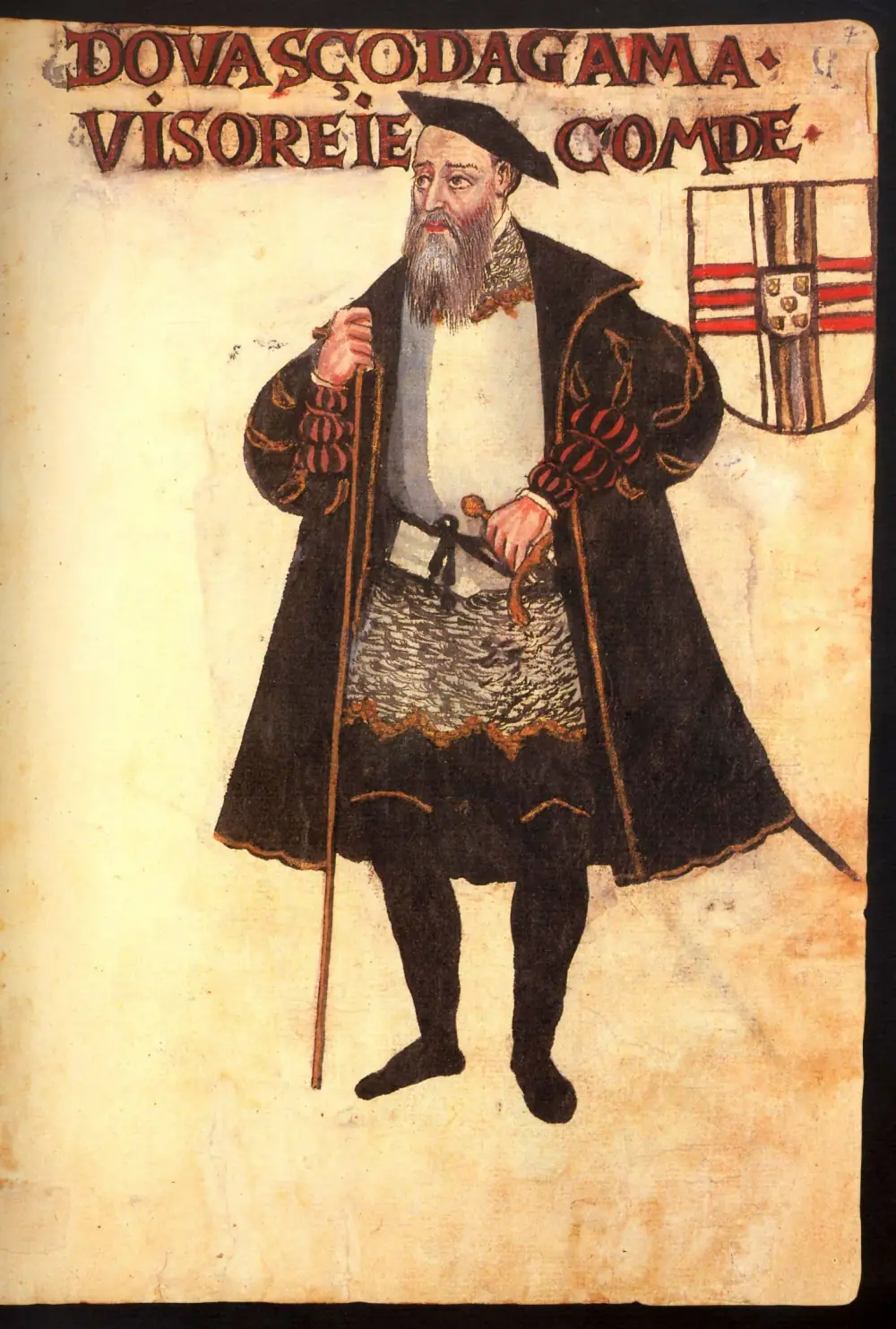
- Vasco da Gama as viceroy and count, from the Livro de Lisuarte de Abreu, about 1560, painted more than 30 years after his death. Lisuarte de Abreu, Public domain, via Wikimedia Commons.
- The railed-off slab in St Francis Church, Fort Kochi, that a plaque identifies as Vasco da Gama's first grave. Whether it marks the original spot is not known. P.K.Niyogi at English Wikipedia, Public domain, via Wikimedia Commons.
- Vasco da Gama's neo-Manueline tomb by Costa Mota under the choir of the Jerónimos church in Belém, photographed in 2025. Jakub Hałun, CC BY 4.0, via Wikimedia Commons.
- St Francis Church in Fort Kochi, the Portuguese church of 1516 that survived the demolitions of 1806. A slab inside is shown as Gama's first grave. Ingo Mehling, CC BY-SA 4.0, via Wikimedia Commons.