

Cloth for wine: the Methuen Treaty, Lisbon, 27 December 1703
An English envoy and a Portuguese marquis signed a treaty of three short articles in Lisbon. It helped make port England's wine, and for 300 years people have argued over whether it cost Portugal its industry.
At a glance
- On 27 December 1703 John Methuen, Queen Anne's ambassador, and the Marquis of Alegrete, for King Pedro II, signed a commercial treaty in Lisbon. In England, still on the Julian calendar, the date was 16 December.
- The treaty had three articles. Portugal would again admit English woollen cloth, shut out by its own laws in the late seventeenth century, and English duties on Portuguese wine would always be a third lower than on French wine.
- It was the third treaty of 1703 to carry the Methuen name: two military treaties signed in Lisbon on 16 May had brought Portugal into the war against France and Bourbon Spain.
- Port flourished under the treaty. By the late 1790s port alone was about a quarter of Portugal's trade, and around 1800 Portuguese wine was about three-quarters of Britain's wine imports.
- Adam Smith judged the treaty good for Portugal and bad for Britain; Friedrich List blamed it for ruining Portuguese manufacturing. Recent research points to Brazilian gold as the deeper cause.
Two signatures, two copies
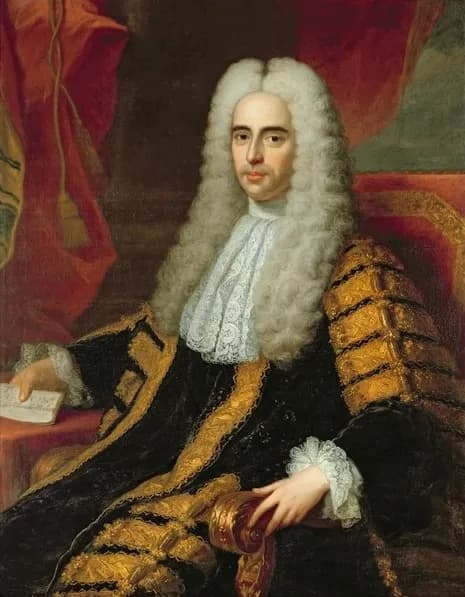
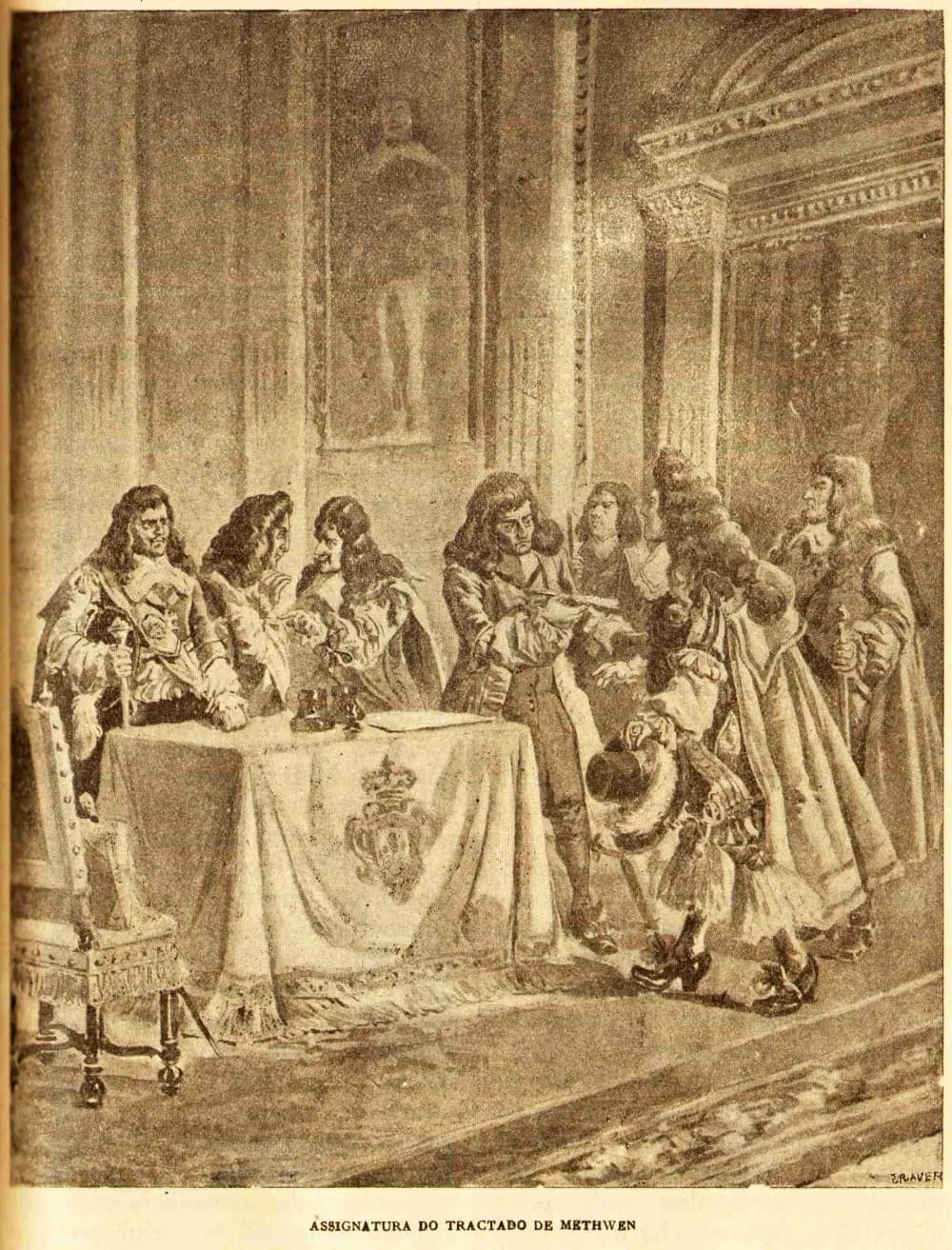
The two men who made the treaty did not sign the same sheet of paper. In Lisbon on 27 December 1703, John Methuen, a member of the English Parliament and Queen Anne's ambassador extraordinary to Portugal, put his name and the seal of his arms to one copy. Manuel Teles da Silva, Marquis of Alegrete and Count of Vilar Maior, signed another copy of the same terms for King Pedro II. To avoid a quarrel over which crown took precedence, each envoy signed his own instrument.
The text was short: a preamble and three articles, the last of which only set two months for the ratifications. The other two traded cloth for wine. Portugal would again let in English woollen cloth, which its own laws had shut out. In return England would tax Portuguese wine at a third less than French wine, for ever, whether it was at peace or at war with France.
“at no time, whether there shall be peace or war between the kingdoms of Britain and France, any thing more shall be demanded for these wines by the name of custom or duty, or by whatsoever other title, directly or indirectly, … than what shall be demanded for the like quantity or measure of French wine, deducting or abating a third part of the custom or duty.”
In London the date was not 27 December at all. England still used the Julian calendar, by then 11 days behind the Gregorian calendar used in Portugal, so English records date the treaty 16 December 1703. The National Archives at Kew, which holds Portugal's ratification, gives both dates, and dates Portugal's ratification 2 May 1704, or 21 April in England.
Hardly anyone noticed. The diarist Narcissus Luttrell noted the treaty's arrival in London in January 1704 and added no comment. That winter the news from the peninsula was about the war, and about Archduke Charles of Austria's storm-tossed voyage to Lisbon to open a campaign in Spain. The treaty was ratified with, in the historian Paul Duguid's words, “as little fanfare as difficulty”.
A war over the Spanish throne
The treaty grew out of a war. By 1701 Charles II of Spain was dead, without children, and two princes claimed his empire: Philip of Anjou, grandson of Louis XIV of France, and Archduke Charles, the younger son of the Emperor Leopold. England, the Dutch Republic and the Emperor backed Charles, fearing that France and Spain would become, in the words of their alliance treaty of 1701, “one and the same kingdom”.
Portugal had first sided with the Bourbons. The alliance treaty of May 1703 admits as much in its preamble, which mentions Pedro II's “late alliance” with Louis XIV and his grandson and explains the change of heart: Louis, it says, meant to annex the kingdoms of Spain to France “as so many provinces”. For the allies, Portugal offered safe harbours for their fleets and a back door into Spain.
Two treaties were signed in Lisbon on 16 May 1703, the 5th in England. John Methuen had negotiated them but had gone back to London in April, so his son Paul signed for Queen Anne. These military treaties drew far more attention at the time than the commercial one, and the three are easily confused, even by specialists.
| Treaty | Signed in Lisbon | Parties | Main terms |
|---|---|---|---|
| Offensive and defensive alliance | 16 May 1703 (5 May in England) | The Emperor Leopold, Queen Anne, the Dutch Republic and Pedro II | Portugal joins the war to put Archduke Charles on the Spanish throne. It fields 12,000 foot and 3,000 horse at its own cost and raises 13,000 more men, for whom the allies pay a million patacoons (a silver coin) a year. The allies also keep 12,000 veteran soldiers of their own in Portugal. |
| Perpetual defensive alliance | 16 May 1703 (5 May in England) | England, the Dutch Republic and Portugal | Earlier treaties confirmed; England and the Dutch promise to help Portugal if France or Spain threatens it. |
| Commercial treaty | 27 December 1703 (16 December in England) | England and Portugal | Portugal readmits English woollens; Portuguese wine pays a third less duty in England than French wine. |
Paul Methuen signed the May treaties for England and John Methuen the December one. Portugal's signatories in May included the Duke of Cadaval and the Marquis of Alegrete.
Portugal's own cloth
English cloth needed a treaty because Portugal had shut it out. Between 1672 and 1698 a series of sumptuary laws, the pragmáticas, restricted imports of foreign manufactures. Behind them was Luís de Meneses, 3rd Count of Ericeira, the crown's finance chief from 1675, who backed woollens, silks, glass and ironworking and gave large workshops monopoly status as royal factories.
In 1677 the crown set up a manufactory in the wool town of Covilhã, with a fulling mill, a dye works and a press, run under contract by two New Christians of Covilhã (descendants of converted Jews) and a Lisbon-born captain. Eleven wool-combers, weavers and spinners were hired in Ireland to teach new methods. A decree of 9 August 1686 banned foreign cloth outright.
In England the bans hurt. In his pamphlet Britannia Languens (1680), William Petyt complained that England had once had the sole trade in woollens to Portugal, but that Portugal had prohibited the wearing of English cloth and set up its own manufacture. Ericeira died in 1690, and his policy was abandoned after 1700.
By then Portugal had found something better than cloth to pay with. Around 1694 prospectors struck alluvial gold in what is now Minas Gerais, in Brazil, and by 1697 the news was out. When Methuen signed in December 1703, it was already clear that gold would reach Lisbon in large quantities for decades.
What the articles actually said
The first article promised to admit English woollens “as was accustomed, till they were prohibited by the laws”. Adam Smith read it closely in 1776. Portugal, he wrote, became bound to admit English cloth on the same footing as before the prohibition, that is, not to raise the duties, but not on better terms than cloth from France or Holland. Britain was bound to charge Portuguese wine only two-thirds of the French duty.
The cloth side worked at once. Methuen's friends in the wool trade had shipped banned goods to Lisbon in advance, and their warehouses were full when the ban was lifted. On 27 May 1704, by the English calendar, Luttrell recorded letters from Oporto reporting the end of “the prohibition upon English cloth”.
The wine side mattered less at first. England and France were at war, French wine was already banned, and trade between the two countries was almost at a standstill from 1689 to 1714. English merchants looking for other wine had already found a steady supply in the Douro.
Port and the Portugal trade
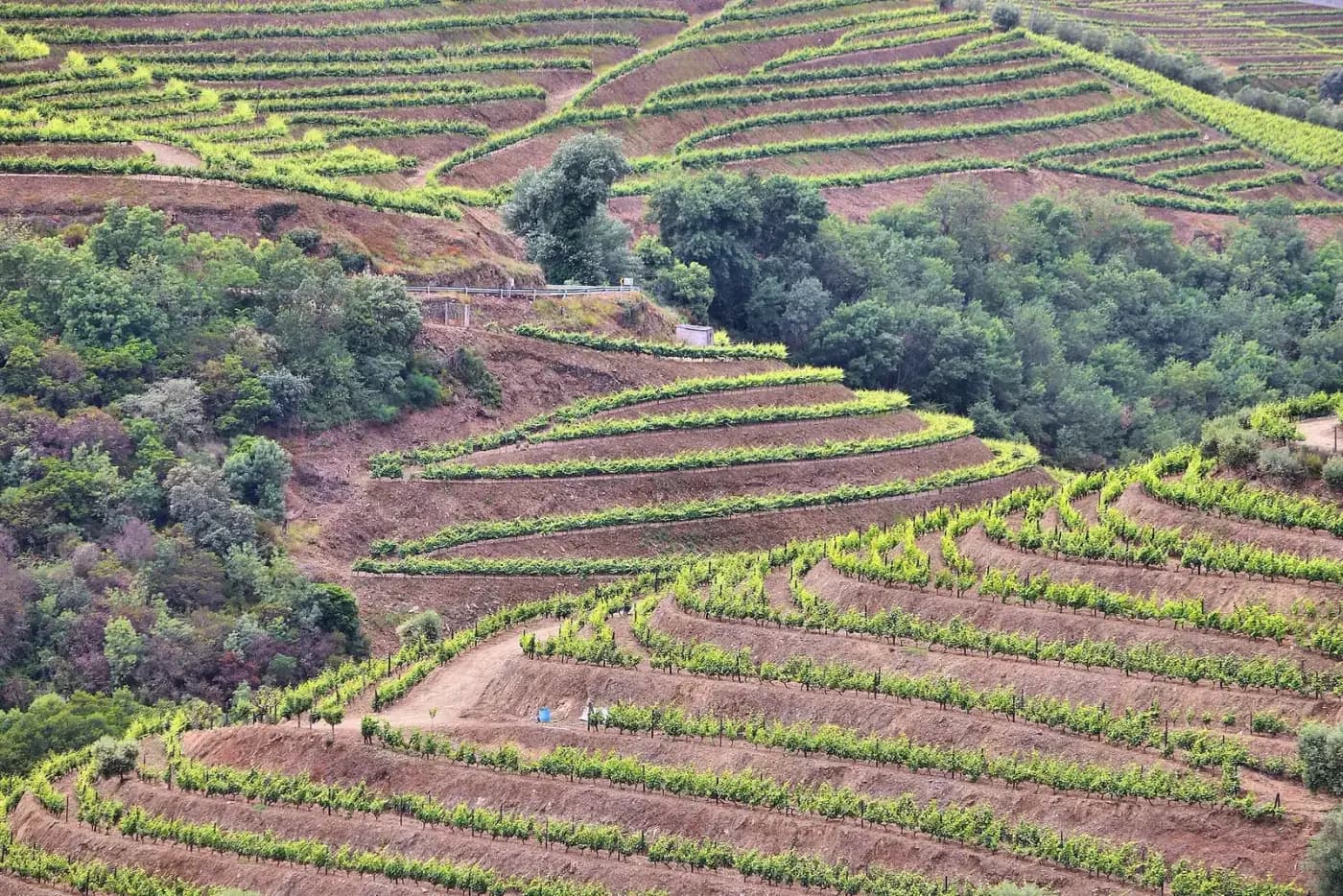
Port was older than the treaty. Fortified with brandy to survive the voyage, Douro wine became an export in the seventeenth century, and the first customs record to call it “vinho do Porto” dates from 1678. António Barreto, writing in Análise Social in 1988, found that the treaty seems to have made little particular difference to the Douro at first. It helped Portuguese wines in general, and wines from the south were shipped from Porto, Figueira and Viana alongside Douro wine.
Over the century, though, Britain's sales to Portugal boomed. Charles Whitworth's tables of British trade, printed in 1776, show exports to Portugal more than tripling from £336,357 in 1700 to over a million pounds a year in most years from 1730 to 1761. Imports from Portugal, mainly wine and fruit, moved between about £170,000 and £550,000 a year from 1700 to 1773.
Britain's trade with Portugal, 1700–1770
£ thousand
- British exports to Portugal
- British imports from Portugal
Every fifth year from Charles Whitworth's table “Trade of Great Britain with Portugal” (1776), rounded to the nearest £1,000. The figures come from customs-house entries, which Whitworth admitted could sometimes overstate real values. In 1703 itself exports were £714,241 and imports £257,180; the peak was £1,587,989 of exports in 1757. The gap was settled largely in Brazilian gold.
Show the data
| British exports to Portugal | British imports from Portugal | |
|---|---|---|
| 1700 | 336 | 279 |
| 1705 | 819 | 223 |
| 1710 | 615 | 192 |
| 1715 | 625 | 333 |
| 1720 | 776 | 319 |
| 1725 | 781 | 411 |
| 1730 | 1,016 | 228 |
| 1735 | 1,046 | 358 |
| 1740 | 789 | 202 |
| 1745 | 1,065 | 418 |
| 1750 | 1,208 | 244 |
| 1755 | 1,073 | 263 |
| 1760 | 1,292 | 299 |
| 1765 | 679 | 354 |
| 1770 | 535 | 330 |
Most of what Britain sent was cloth. Textiles made up 75 to 85 per cent of English exports to Portugal from 1715 to at least 1770, and by 1741–45 Portugal took 23 per cent of England's woollen exports. Portugal could not pay for all of it with wine, and the difference went to London in gold.
- 1678
- First customs record naming “vinho do Porto”
- 1798
- Port alone is almost 26 per cent of Portugal's trade
- About 1800
- Portuguese wine, mostly port, is almost 76 per cent of British wine imports
- 1801
- 78,606 pipes of port exported, a record until 1918
- One pipe
- 128 imperial gallons, about 580 litres
The vote that saved it
The treaty nearly died at ten years old. In 1713, making peace with France at Utrecht, the Tory ministers Robert Harley and Henry St John agreed a commercial treaty with France whose eighth and ninth articles promised French goods the treatment of the most favoured nation. Equal duties on French and Portuguese wine would have broken Methuen's promise, and MPs warned that Portugal would then ban English cloth again, as the treaty allowed.
Clothiers, weavers and merchants petitioned against the bill. On 18 June 1713 (by the English calendar) the House of Commons debated it from three in the afternoon until eleven at night and threw it out by 194 votes to 185. After that, Duguid writes, the obscure commercial treaty became “the Methuen treaty”, an untouchable centrepiece of English trade policy for a century and a half.
Crisis in the Douro and the company of 1756
Success brought fraud. Wine from all over Portugal was sold as port as long as it left through the bar of the Douro, and some was doctored with elderberries for colour, Spanish wine or sugar. By about 1750 English buyers were complaining about quality. In 1754 they bought no wine from the growers, in the second of two years of poor harvests.
The government of Sebastião José de Carvalho e Melo, the future Marquis of Pombal, answered on 10 September 1756 with the Companhia Geral da Agricultura das Vinhas do Alto Douro. The company registered vineyards, judged each year's wine, fixed prices and controlled shipments downriver. Between 1758 and 1761 it marked out the region with boundary posts, the marcos pombalinos. The Douro is often called the world's first demarcated wine region.
1678
First customs record of “vinho do Porto”
1689–1714
Anglo-French trade almost at a standstill during two wars
16 May 1703
Military treaties bring Portugal into the Grand Alliance
27 December 1703
Commercial treaty signed in Lisbon (16 December in England)
2 May 1704
Portugal ratifies the commercial treaty
18 June 1713
Commons rejects the Anglo-French commercial articles, 194 to 185
1754
English shippers refuse to buy Douro wine
10 September 1756
Douro wine company founded
1776
Adam Smith attacks the treaty in The Wealth of Nations
1817
Ricardo uses English cloth and Portuguese wine to explain trade
1860
Britain's new wine duties leave port paying more than French wine
The argument over Portuguese industry
The case against the treaty was made most forcefully by the German economist Friedrich List in 1841. He credited Ericeira's policy with real success and blamed the treaty for wrecking it, though he named the wrong Methuen, Paul instead of his father John, as its author.
“Directly after the conclusion of this treaty, Portugal was deluged with English manufactures, and the first result of this inundation was the sudden and complete ruin of the Portuguese manufactories.”
Portuguese voices had made similar points long before. Luís da Cunha, Portugal's envoy in London, favoured laws against imported manufactures and wrote that wine exports profited a few leading men, while more factories were “the remedy of countless people” (translated from Portuguese).
The story of Covilhã shows how many forces were at work. The contract for its royal factory ended abruptly in 1703. Besides the treaty's effects, the museum historian Elisa Calado Pinheiro argues, it was the Inquisition that dealt the fatal blow: between 1700 and 1705 it jailed 18 Covilhã merchants, including the New Christian families who ran the factory. From 1710 João V gave the town's clothiers a monopoly on army uniforms.
Recent research points to the gold. Brazil produced about 40,000 kilograms of gold a decade in the first two decades of the century, 100,000 in the 1720s and over 140,000 in the 1730s, and more than 80 per cent of it reached Portugal. Kedrosky and Palma argue that this flood raised prices at home, made imports cheap and undercut Portuguese producers, the pattern economists call Dutch disease. By 1769 only four textile factories were working in the whole country.
“The Methuen Treaty thus contributed to the de-industrialization of Portugal's economy, but it was merely a mechanism, not the ultimate cause.”
Smith, Hume and Ricardo
In England the treaty was praised as a masterpiece of commercial policy because it brought in Brazilian gold. Adam Smith disagreed. He judged it “evidently advantageous to Portugal, and disadvantageous to Great Britain”, since Britain gave a real tax preference and got none in return, and he doubted the story that the Lisbon packet boat brought more than £50,000 in gold a week, which would be more than £2.6 million a year.
“The Portuguese, it is said, indeed, are better customers for our manufactures than the French, and should therefore be encouraged in preference to them. As they give us their custom, it is pretended we should give them ours. The sneaking arts of underling tradesmen are thus erected into political maxims for the conduct of a great empire.”
David Hume had made the same complaint in 1752 about England's barriers against France: “We lost the French market for our woollen manufactures, and transferred the commerce of wine to Spain and Portugal, where we buy much worse liquor at a higher price.”
David Ricardo took the same two goods in 1817 and drew a different lesson. In his example England needs the labour of 100 men a year to make a quantity of cloth and 120 to make a quantity of wine; Portugal needs 90 and 80. Portugal is better at both, yet both countries gain if Portugal makes wine and England cloth. Ricardo never named the treaty, but his cloth and wine are its cloth and wine, and the idea he drew from them is known today as comparative advantage.
Why it still matters
Historians disagree on when the treaty lapsed: A. D. Francis thought the Anglo-Portuguese treaty of 1810 replaced it, others say 1813 or 1840. Its advantage ended for good in 1860, when the Cobden–Chevalier treaty with France and Gladstone's budget taxed fortified wines such as port more heavily than claret, burgundy or champagne.
Its traces are easy to find. The port trade stayed largely in British hands: in 1777, 42 British firms out of 73 exporters shipped 77 per cent of all port. The demarcated Douro region of 1756 set a principle that, Barreto noted in 1988, almost every wine policy had adopted, the European Community's included. And whenever Portugal's long economic lag is discussed, the cloth-for-wine bargain of 1703 still comes up.
FAQs
What was the Methuen Treaty?
A three-article commercial treaty signed in Lisbon on 27 December 1703 by John Methuen for Queen Anne and the Marquis of Alegrete for King Pedro II. Portugal agreed to admit English woollen cloth again, and England agreed that Portuguese wine would always pay a third less duty than French wine. Two military treaties signed in May 1703 also carry Methuen's name.
Was the Methuen Treaty signed on 27 or 16 December 1703?
Both, depending on the calendar. Portugal used the Gregorian calendar and the treaty is dated at Lisbon on 27 December 1703. England still used the Julian calendar, 11 days behind, so English records give 16 December 1703.
Did the Methuen Treaty make English cloth duty-free in Portugal?
No. It lifted Portugal's ban on English woollens and restored the duty they had paid before, put by Kedrosky and Palma at 23 per cent. Adam Smith stressed that the treaty gave English cloth no better terms than cloth from other countries.
How did the Methuen Treaty affect port wine?
By guaranteeing Portuguese wine a lower duty than French wine, it helped port become Britain's main wine. Around 1800 Portuguese wine, mostly port, was almost 76 per cent of British wine imports, and port alone was about a quarter of Portugal's trade. The advantage ended in 1860.
Did the Methuen Treaty destroy Portuguese industry?
That was the classic charge, made forcefully by Friedrich List in 1841. Historians now see a wider picture: Ericeira's industrial policy was abandoned after 1700, the Inquisition hit the merchant families who ran factories such as Covilhã's, and the flood of Brazilian gold made imports cheap. Kedrosky and Palma call the treaty a mechanism of Portugal's de-industrialisation, not its ultimate cause.
On the timeline
Open the timelineNearby moments from restoration and the gold of brazil (1640–1750).
Death in Óbidos of Josefa de Óbidos, the Seville-born painter who became one of the very few women to make a professional career in 17th-century European art. Over nearly four decades she produced more than 100 works — luminous still lifes, devotional paintings and altarpieces — most of them signed and dated.
Zumbi, the last leader of the Quilombo dos Palmares — the largest community of escaped slaves in Portuguese Brazil, which held out in the hills of what is now Alagoas for most of the century — is ambushed and killed by colonial forces. Brazil marks the date as its Day of Black Consciousness.
An Omani army lays siege to Fort Jesus, Portugal's stronghold at Mombasa in today's Kenya. The siege lasts 33 months; hunger and disease kill thousands of defenders and refugees, and the fort's fall in December 1698 all but ends Portuguese power on the Swahili coast north of Mozambique.
The Methuen Treaty
Portugal and England sign the Methuen Treaty in Lisbon. Portugal lifts its ban on English woollen cloth, while Portuguese wine is to pay a third less duty in England than French wine. It helped make port Britain's wine, though critics blamed it for ruining Portugal's own textile industry.
Birth in Coimbra of Carlos Seixas, the outstanding Portuguese keyboard composer of the 18th century. Cathedral organist at 14 and later organist of the royal chapel in Lisbon, he is said to have been sent to Domenico Scarlatti for lessons, only for the Italian to reply: 'You can give me lessons.' Most of his reputed 700 sonatas were lost in the 1755 earthquake.
Birth in Rio de Janeiro of António José da Silva, 'O Judeu' ('the Jew'), whose witty comic operas, performed by puppets at Lisbon's Bairro Alto theatre, were a great success. Condemned by the Inquisition as a relapsed Judaiser at an auto-da-fé in 1739, he was handed to the secular courts, strangled and burned.
Joseph Vaz (José Vaz), a priest from Portuguese Goa, dies in Kandy after more than two decades secretly ministering to the Catholics of Ceylon, who were persecuted under Dutch Calvinist rule. Revered as the 'Apostle of Ceylon', he was canonised by Pope Francis in Colombo in 2015.
Coming up in history
All long reads 29 December 1959Lisbon goes underground: the Metro opens on 29 December 1959
 30 December 1958Pedro Costa, the Lisbon film-maker who stayed with Fontainhas
 31 December 1998200.482: the day the escudo's rate against the euro was fixed for ever
 1 January 1962The Beja revolt: a New Year's night attack on Salazar's army, 1962
15 sources
Archives, scholarship and reporting this article was checked against.
- 1
A Collection of All the Treaties of Peace, Alliance, and Commerce, between Great-Britain and Other Powers, vol. 1 (ed. Charles Jenkinson, 1785)J. Debrett, London; digitised copy at the Internet Archive
- 2
Ratification by Portugal of the treaty of commerce with Great Britain, concluded 1703 Dec 16 OS / 27 NS (SP 108/393)The National Archives (UK), State Papers Foreign, Treaties
- 3
The Making of Methuen: The Commercial Treaty in the English ImaginationPaul Duguid, University of California, Berkeley (author's text of an article published in the Porto journal História)
- 4
An Inquiry into the Nature and Causes of the Wealth of Nations (1776), Book IV, chapters 3 and 6Adam Smith; Project Gutenberg
- 5
The Cross of Gold: Brazilian Treasure and the Decline of PortugalDavis Kedrosky and Nuno Palma, The Journal of Economic History 85, no. 3 (2025), Cambridge University Press (open access)
- 6
- 7
- 8
O vinho do Porto e a intervenção do EstadoAntónio Barreto, Análise Social XXIV, no. 100 (1988), pp. 373–390
- 9
- 10
A Real Fábrica de Panos, um marco histórico na paisagem industrial e cultural da CovilhãElisa Calado Pinheiro, UBImuseum no. 4, Museu de Lanifícios da Universidade da Beira Interior
- 11
História do vinho do PortoInstituto dos Vinhos do Douro e do Porto (IVDP)
- 12
- 13
- 14
Jorge Borges de Macedo: Problems of the History of Portuguese Economic and Political Thought in the Eighteenth CenturyJosé Luís Cardoso, e-Journal of Portuguese History 11, no. 2 (2013)
- 15
Image credits
- Terraced vineyards at Peso da Régua in the Alto Douro, photographed in 2018. The Douro's fortified wine, shipped from Porto, became the best-known product of the trade the treaty protected. Marek Ślusarczyk (Tupungato), CC BY 3.0, via Wikimedia Commons.
- John Methuen (1650–1706) in the robes of Lord Chancellor of Ireland, an office he held while also serving as envoy to Portugal. The portrait, by Adrien Carpentiers, was painted after Methuen's death, around the middle of the eighteenth century. Adrien Carpentiers, Public domain, via Wikimedia Commons.
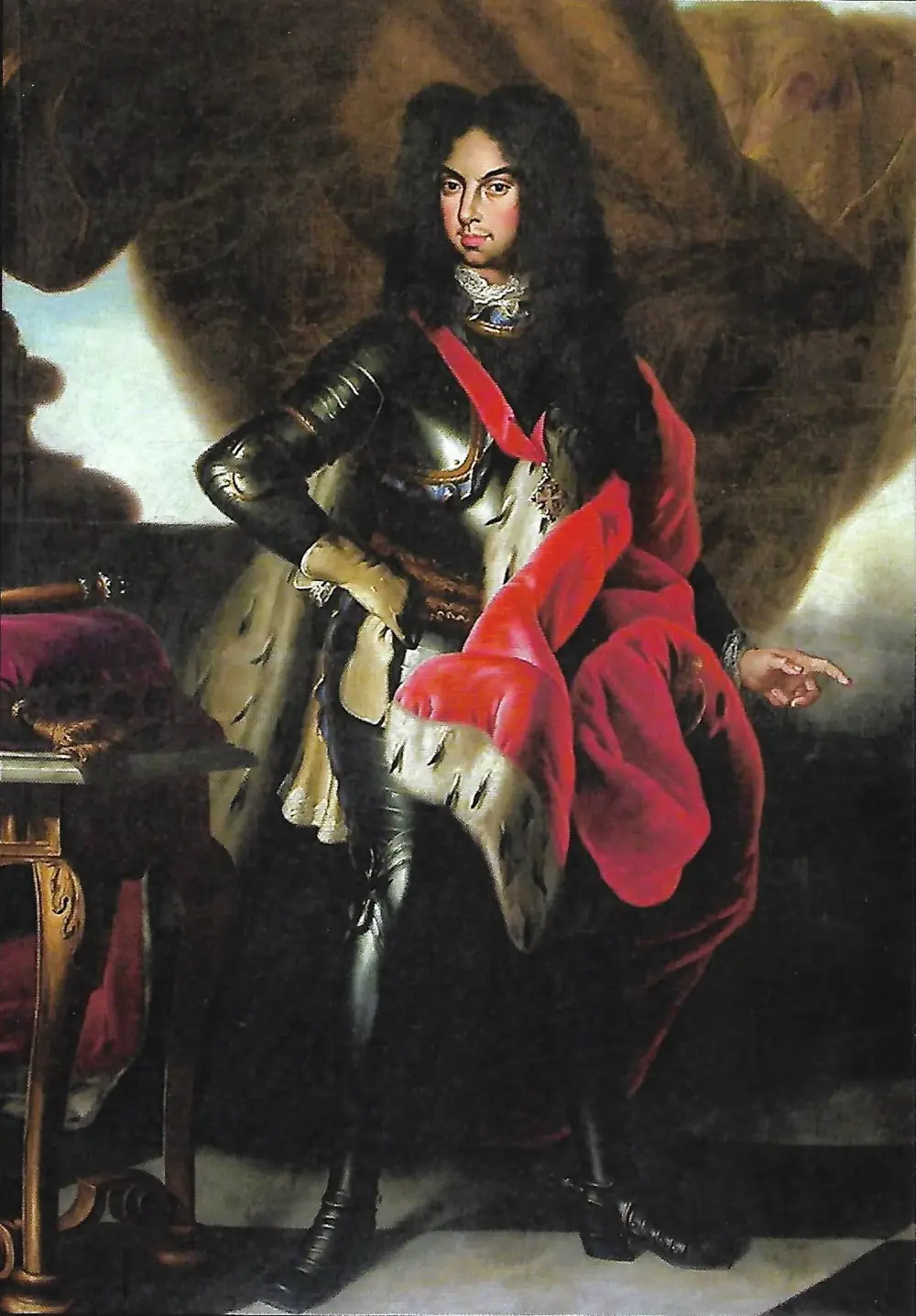
- Pedro II, king of Portugal from 1683 to 1706, in a portrait by Domenico Duprà painted about 1729, after the king's death. It hangs in the Sala dos Tudescos of the Ducal Palace at Vila Viçosa. Domenico Duprà, Public domain, via Wikimedia Commons.
- “Assignatura do Tractado de Methwen”: the signing as imagined by Alfredo Roque Gameiro around 1900 for the História de Portugal, Popular e Ilustrada. The scene is imagined: according to the treaty text, each envoy signed his own copy. Roque Gameiro, Public domain, via Wikimedia Commons.
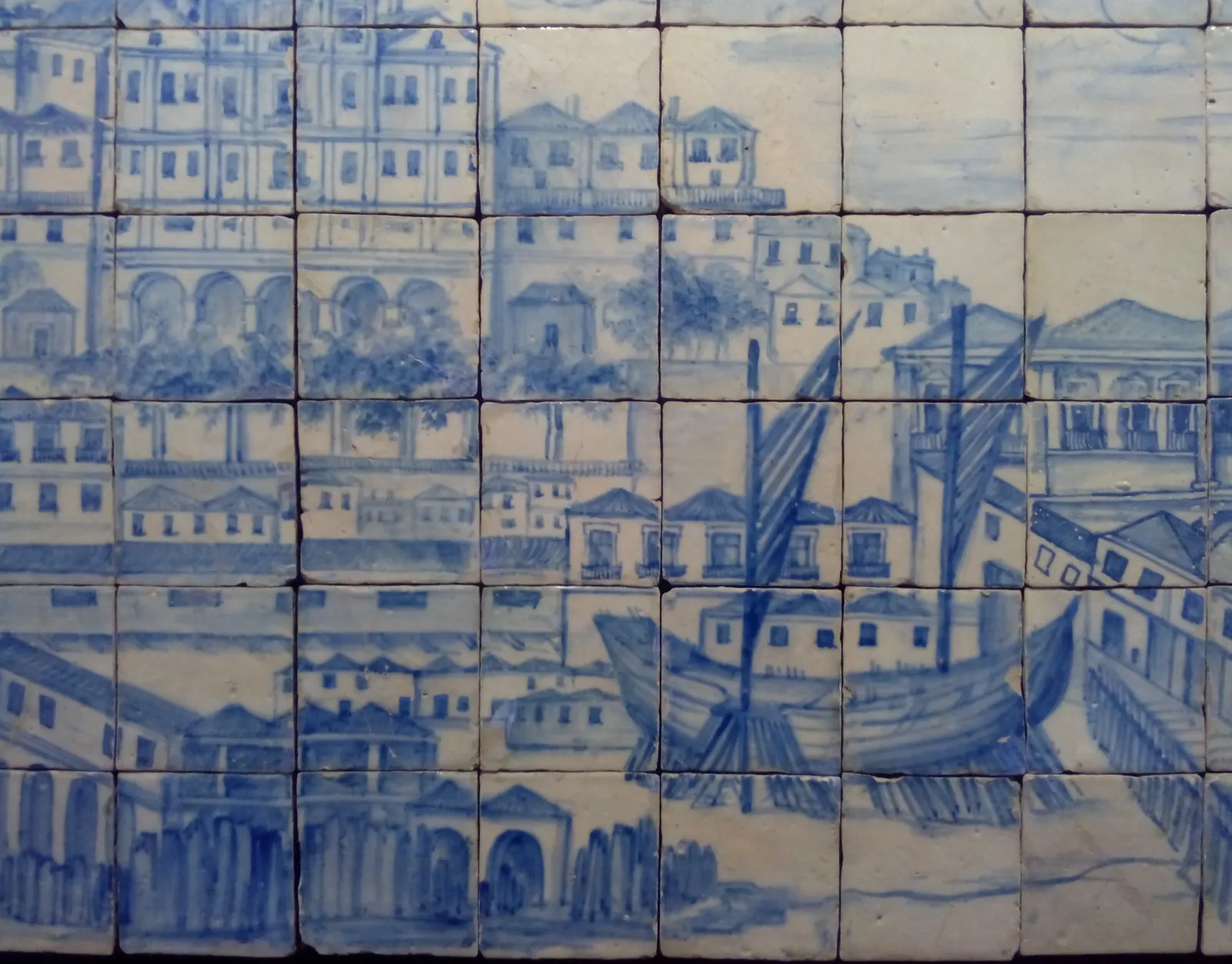
- The royal shipyard, the Ribeira das Naus, on Lisbon's waterfront, in the Grande Panorama de Lisboa, a tile panel of the early eighteenth century now in the Museu Nacional do Azulejo. This was the city where the treaty was signed, before the earthquake of 1755. RickMorais, CC BY-SA 4.0, via Wikimedia Commons.
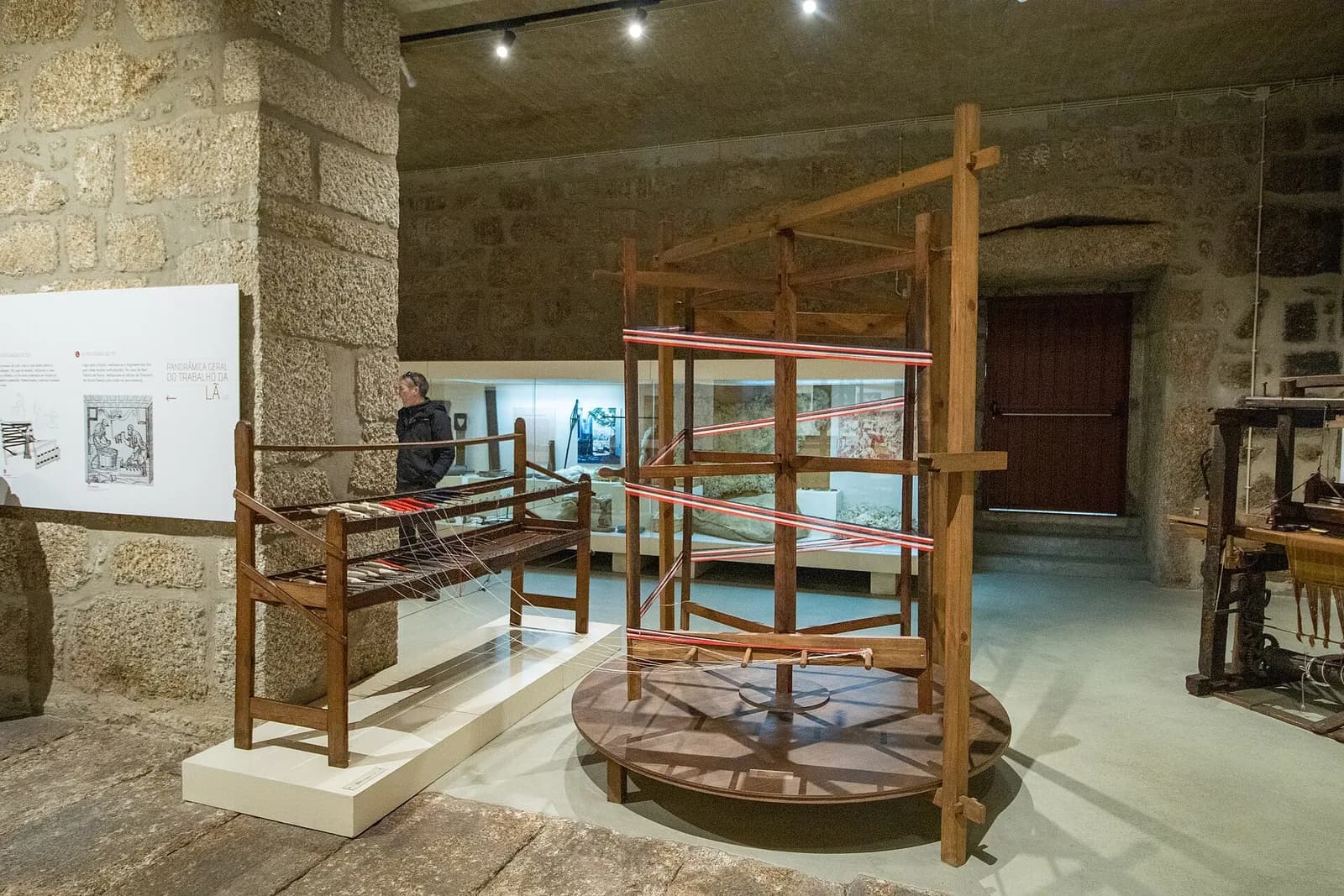
- Wooden textile equipment in the Museu de Lanifícios at Covilhã, inside the building of the Real Fábrica de Panos, the royal cloth factory founded in 1764. Photographed in 2025. Hipersyl, CC BY 4.0, via Wikimedia Commons.