

Santa Cruz, 12 November 1991: the Dili massacre the world saw
A memorial procession for a young activist ended in gunfire at a cemetery gate in East Timor. A British cameraman filmed it and hid the tape in a grave, and Portugal's case at the UN suddenly had evidence on film.
At a glance
- On the morning of 12 November 1991, Indonesian troops opened fire on a crowd of mostly young East Timorese gathered at the Santa Cruz cemetery in Dili after a memorial mass at the Motael church.
- The march honoured Sebastião Gomes, an activist killed when Indonesian forces raided the Motael church on 28 October. The International Commission of Jurists put the crowd at the cemetery at about 3,000, within estimates that ran from 800 to 6,000.
- Death tolls run from the Indonesian government's 19 to the 271 names on a list compiled by two Portuguese organisations in 1993. Indonesia's own inquiry said about 50, and the Portuguese list also named 250 missing.
- The British cameraman Max Stahl filmed the shooting and hid his tape in the cemetery. Some tapes were smuggled out to Amsterdam, and the footage was broadcast around the world and was the core of a Yorkshire Television film in January 1992.
- Portugal, still the territory's administering power in the eyes of the UN, pressed its case harder. A UN-run ballot on 30 August 1999 gave 78.5% against autonomy within Indonesia, and Timor-Leste became independent on 20 May 2002.
From the Motael church to the cemetery gate
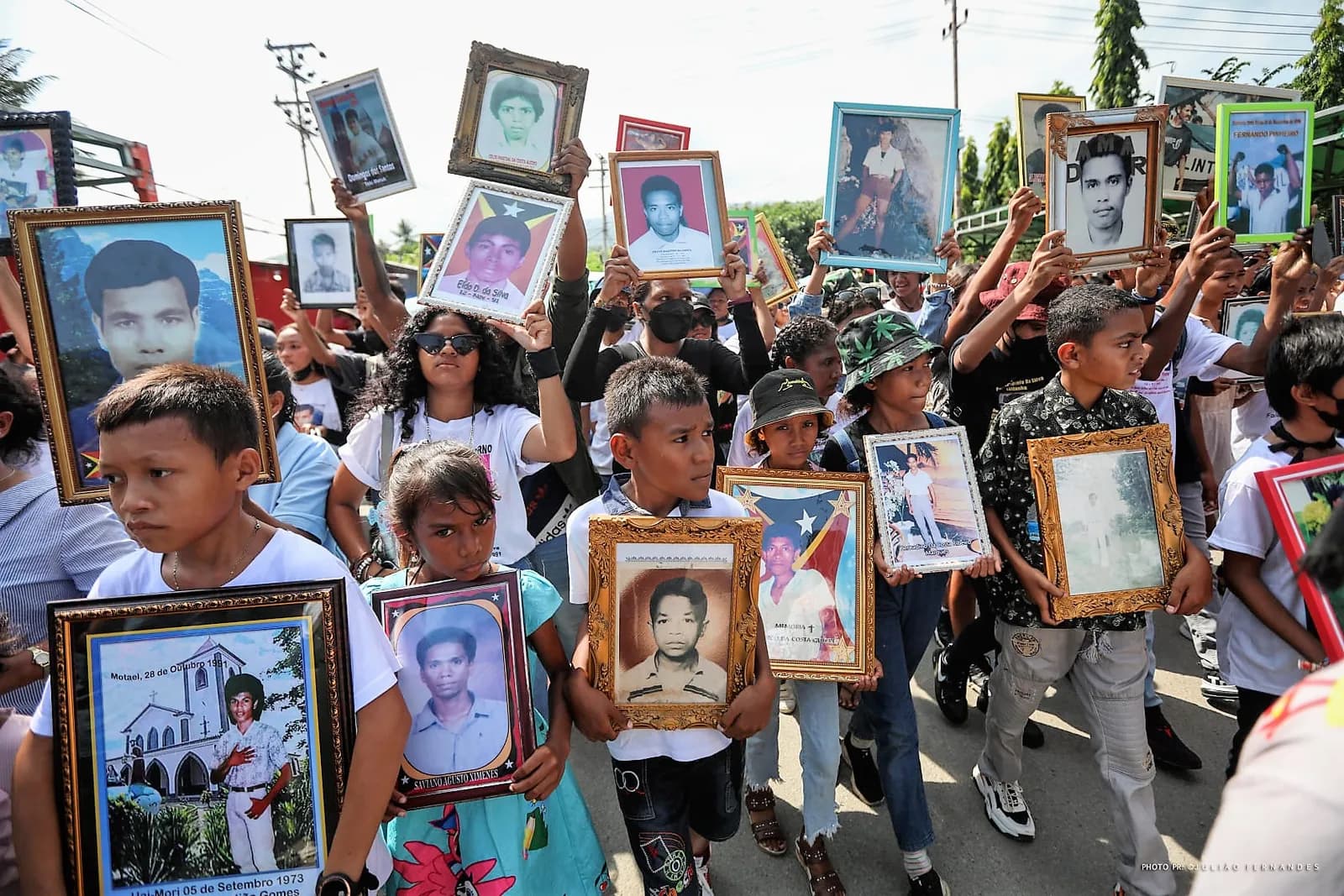
The mass for Sebastião Gomes began at the Motael church, on Dili's waterfront, between six and seven on the morning of 12 November 1991. So many people came that the priest said it outdoors. Gomes, a young member of the clandestine resistance, had been shot dead by Indonesian forces in a raid on the church two weeks earlier, and the mass was the start of a flower-laying ceremony at his grave in the Santa Cruz cemetery.
About 3,500 people had attended, by the truth commission's count. The mass ended at about seven, and the crowd set off on foot for the cemetery. The procession turned into a demonstration almost at once, the largest against Indonesian rule since 1975. Hidden T-shirts were uncovered and Fretilin flags unfurled. One banner read “Portugal we are your responsibility”. Marshals with megaphones kept the ranks tight, shouting “Disciplina! Disciplina!”
Soldiers, police and plain-clothes intelligence agents lined the route and watched. On the way there was a scuffle in which an Indonesian officer, Major Andi Gerhan Lantara, was stabbed, and a few marchers threw stones. The march went on and reached Santa Cruz at about 7.50, where some 500 more people were already waiting.
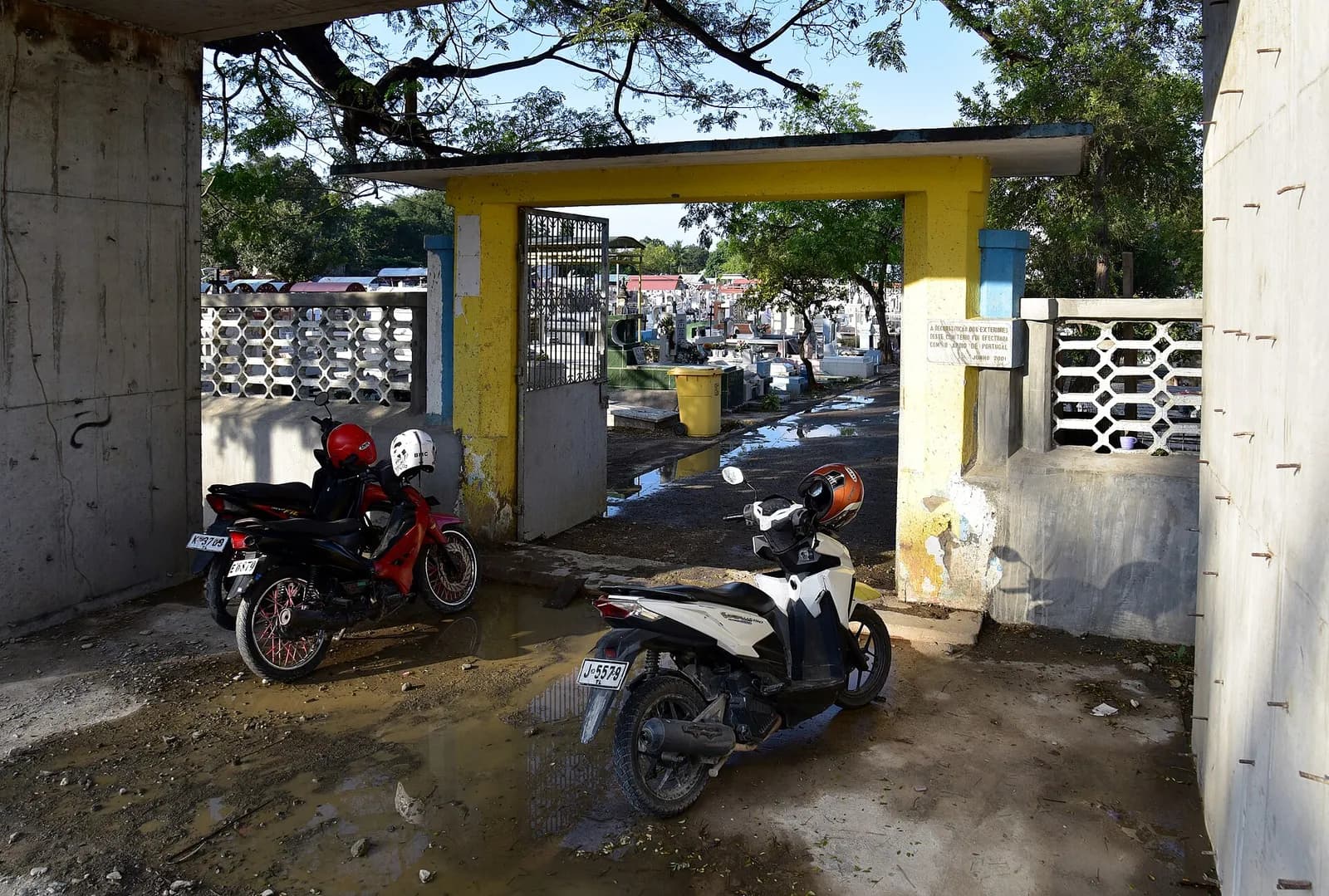
Some marchers climbed the cemetery wall to hang banners. About 50 people went inside to pray at Gomes's grave, while most stood in the street outside the gate, and some had begun to drift away. Then a column of soldiers in brown uniforms came up the road behind them, ten to fifteen abreast, rifles held in front of them. Two American journalists, Amy Goodman and Allan Nairn, stepped between the troops and the crowd. They thought soldiers would be less likely to do anything rash in front of Westerners with headphones, microphones and a camera.
“As the soldiers rounded the corner, 12 to 15 of them lined up in front of the crowd and, without missing a beat, began firing into the crowd, their automatic weapons spraying bullets from right to left and back again, mowing everyone down in front of them.”
A Portuguese colony Indonesia had annexed
East Timor is the eastern half of the island of Timor, at the far end of the Indonesian archipelago, and it was a Portuguese colony. In 1974 Portugal set out to create a provisional government and a popular assembly to decide its status. In August 1975 fighting broke out between the main Timorese parties, and on the night of 26 August the Portuguese administration withdrew to the island of Ataúro, never to return to Dili.
Fretilin declared independence on 28 November 1975, and Indonesia launched a full-scale attack on Dili on 7 December, a story told in a separate article. In 1976 Jakarta declared East Timor its 27th province. The occupation that followed was brutal: the truth commission estimated at least 102,800 conflict-related deaths between 1974 and 1999, most of them from hunger and illness.
In August 1991 a visit by a Portuguese parliamentary delegation was announced for 4 November, and the clandestine resistance prepared a large demonstration to greet it, at the risk of exposing its networks to Indonesian intelligence. On 25 October the Portuguese parliament suspended the trip, because Jakarta refused to let journalists including Jill Jolliffe and Rui Araújo travel with it.
Harassment of activists grew. In the early hours of 28 October soldiers raided the Motael church, where young people had been painting banners for the visit. Two men died: Sebastião Gomes Rangel and an East Timorese informer. With the delegation gone, the resistance decided to turn the ceremony for Gomes on 12 November into a protest, while the UN Special Rapporteur on Torture, Peter Kooijmans, was in Dili. The organisers worked hard to keep it peaceful.
Minutes of automatic fire
An Indonesian military police inquiry later named First Sergeant Udin Syukur as the first soldier to fire. An officer ordered two warning shots, but by the second the troops, from Battalion 303 and including three East Timorese auxiliaries, were already shooting into the crowd. Other soldiers fired from inside the Indonesian military Heroes' Cemetery across the road.
“Suddenly a few shots rang out, continued by an explosive volley of automatic rifle fire that persisted for two to three minutes. It sounded like the whole 15 in the front row had their fingers pressed firmly on the trigger. They were firing directly into the crowd.”
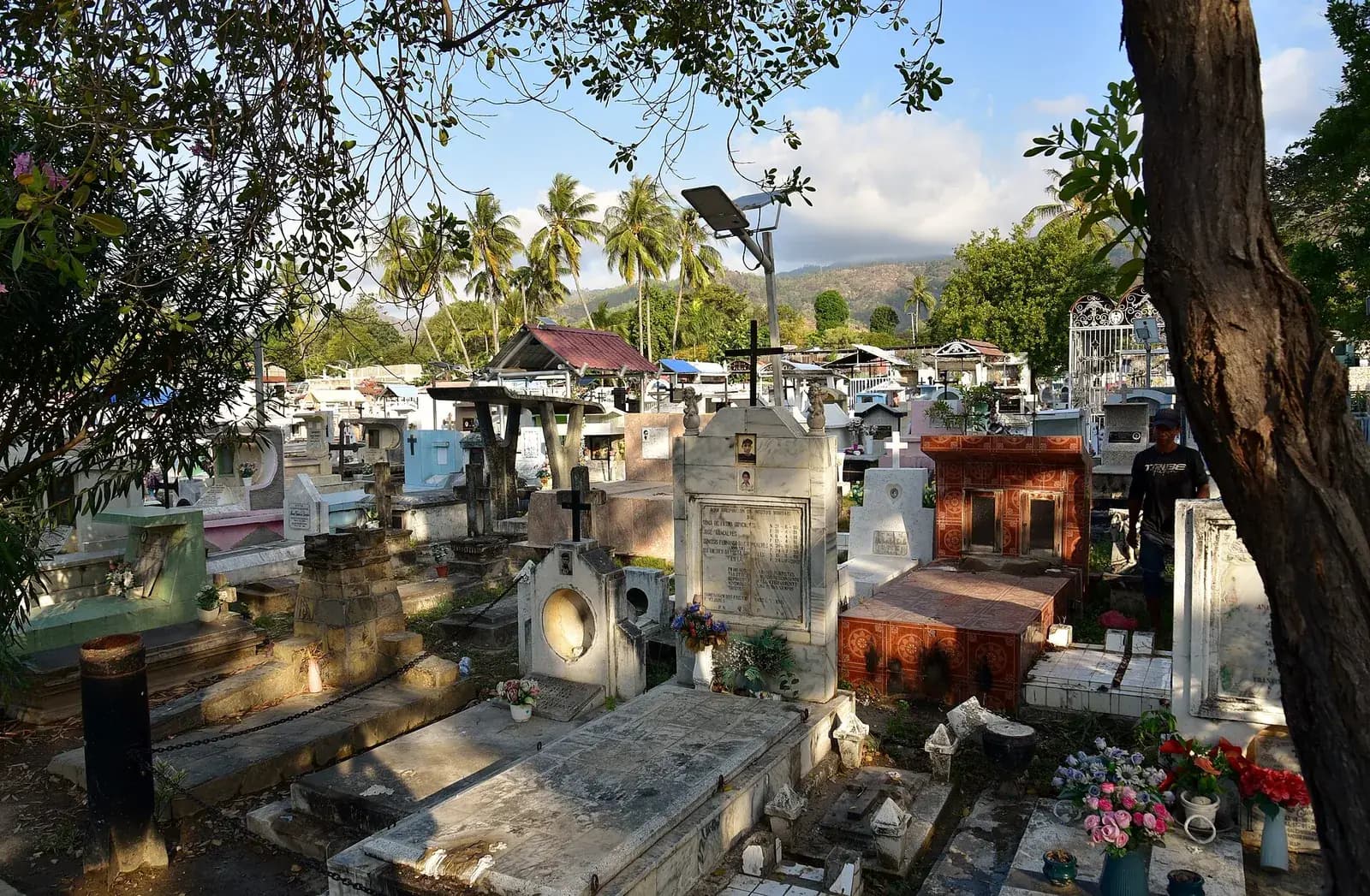
The crowd was trapped between the high wall of Santa Cruz and the walled military cemetery opposite. Many fled into the cemetery itself; others ran through the yards of the houses to the north. Survivors told the truth commission that soldiers then surrounded and entered the cemetery and bayoneted people who were unhurt or only lightly wounded.
Medical files later produced at the trial of one of the organisers listed 17 people shot at the cemetery, six of them hit in the upper body from the front. Of 91 wounded, 43 had bullet wounds, and 21 of those had been shot from behind, in the back, buttocks, legs or neck.
Kamal Bamadhaj, a 21-year-old New Zealander studying in Australia, was the only foreigner who died. He got away from the cemetery but was shot by a passing patrol on Bispo Medeiros Avenue. A Red Cross delegate tried to take him to the civilian hospital, was refused entry and had to drive on to the military one, where he died from loss of blood. Soldiers beat Goodman and Nairn and fractured Nairn's skull.
Trucks carried the dead, the wounded and the arrested away, to the Wira Husada military hospital in Lahane, to interrogation centres, or to be killed. Hundreds of young people ran to Bishop Belo's residence for refuge. Witnesses told the commission of a series of killings in the days that followed, as the security forces hunted down people they suspected of taking part.
“Many were killed in the cemetery but many more were killed outside the cemetery while they were running away or were taken from their hiding places in homes and other places, and murdered.”
How many died
Nobody knows exactly. Even Indonesia's own inquiry admitted that the dead were not properly identified and that families had little chance to see the bodies, and the official count moved more than once. On 13 November the armed forces commander, General Try Sutrisno, spoke of at most 50 dead; the regional commander, Major General Sintong Panjaitan, then gave 19 dead and 91 wounded. On 14 November Try Sutrisno was quoted as telling military graduates, in the truth commission's translation: “Delinquents like these have to be shot, and we will shoot them.”
Under foreign pressure, President Suharto appointed a seven-member National Commission of Inquiry on 18 November. Its advance report of 26 December 1991 blamed the demonstrators for much of what happened and concluded that the dead “totalled about 50”, without naming any of them. The International Commission of Jurists, twice refused permission to visit East Timor, called the figure “seemingly arbitrary” and noted that the commission had exhumed a single body and ordered no autopsy.
| Source | Date | Killed | Notes |
|---|---|---|---|
| General Try Sutrisno, armed forces commander | 13 November 1991 | At most 50 | Also gave 20 wounded |
| Indonesian army (Maj. Gen. Sintong Panjaitan) | 14 November 1991 | 19 | 91 wounded |
| Indonesian Bishops' Conference fact-finding team | Late November 1991 | Over 100 | Reported by the Associated Press, 29 November |
| Indonesian government | 29 November 1991 | 19 confirmed | 56 missing |
| National Commission of Inquiry, advance report | 26 December 1991 | About 50 | Wounded “exceed 91”; no names given |
| Amnesty International list | By February 1992 | At least 60 | Dead, or missing and feared dead |
| International Commission of Jurists | February 1992 | 50 to 200 | Most sources then gave 50 to over 200 |
| List by two Portuguese NGOs, published in Lisbon | January 1993 | 271 | Also 382 wounded and 250 missing |
| CAVR truth commission | 2005 | Not settled | 72 named missing; 200 missing “not an unreasonable estimate” |
Chega! names the compilers of the Portuguese list as the Lisbon groups Oikoumene and A Paz é Possível em Timor Leste. An internal Indonesian military investigation put the wounded taken to the Wira Husada hospital at about 400, close to that list's count.
The figure most often quoted today, 271, is the number of names on the Portuguese list. The truth commission, which surveyed only a few Dili neighbourhoods, collected the names of 72 people still missing and thought the real number of missing much higher. It found credible reports of at least one mass grave, at Tibar, and possibly another at Hera, but it lacked the resources to exhume them.
Justice ran one way. In 1992 ten low-ranking members of the security forces were court-martialled and given eight to 18 months. Panjaitan and the commander in East Timor, Brigadier General Rudolf Warouw, were moved from their posts. The Timorese organisers fared worse: twelve trials began in March 1992, and sentences ran from five years and eight months to life imprisonment for Gregório da Cunha Saldanha.
The tape in the grave
What set Santa Cruz apart from earlier killings in East Timor was the camera. Foreign journalists and aid workers had come to Dili for the Portuguese visit, and for the first time since 1975 the Indonesian army's violence against civilians was caught on film.
Max Stahl, born Christopher Wenner in Britain in 1954, kept filming as the soldiers fired. Knowing he would be arrested, he hid the cassette in the cemetery, in a freshly dug grave by one account and under a gravestone by another, and went back for it that night. A Dutch reporter, Saskia Kouwenberg, carried some of the tapes to Amsterdam in her clothing; Stahl took others out himself, and at least one could never be recovered from its hiding place.
Within days the pictures were on television around the world. In Portugal, the sight of young Timorese praying in Portuguese among the graves moved many. In January 1992 Yorkshire Television screened In Cold Blood: The Massacre of East Timor, a 51-minute film by Stahl and Peter Gordon built around the footage. The British photographer Steve Cox, who was badly beaten, brought out still pictures.
“It was the first time our message broke through to the world.”
Governments had to respond. The Netherlands, Denmark and Canada suspended some aid to Indonesia, and the US Congress voted to bar some military training for it. Indonesia's foreign minister, Ali Alatas, later called the massacre a turning point in his country's diplomacy on East Timor. Australia, by contrast, worked to support Jakarta's line that “rogue elements” in the army were to blame.
Solidarity groups multiplied. The East Timor Action Network was founded in the United States straight after the massacre, and the East Timor Ireland Solidarity Campaign was founded in Dublin after the Yorkshire film was screened. In many countries 12 November became a day of vigils and demonstrations every year until 1999.
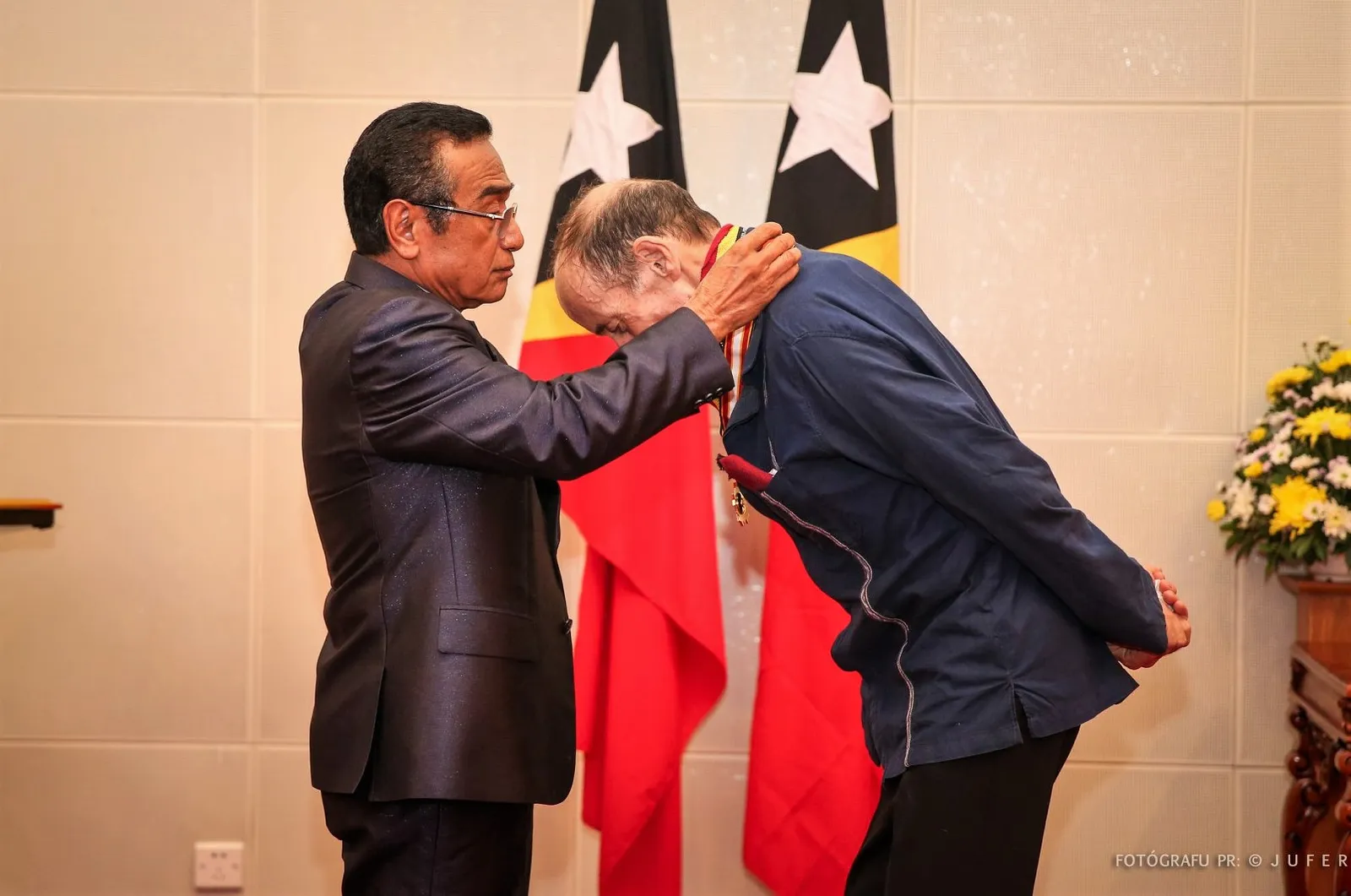
Stahl went back in 1999 and was one of a handful of journalists who stayed to film the violence after the referendum. He made Timor-Leste his home and set up an audiovisual centre for an archive he built over three decades; in 2013 UNESCO added it to the Memory of the World register as On the Birth of a Nation: Turning Points. He became a Timorese citizen in 2019 and died in Brisbane in October 2021, aged 66.
Lisbon's campaign
In Portugal the images landed hard. The country held a national day of mourning on 19 November 1991, and there were mass protests and calls for the United Nations to act. Portugal broke off its UN-sponsored talks with Indonesia and went back to them only in late 1992.
“The Santa Cruz incident was a major historical event for East Timor and brought the whole issue of East Timor back to the political scene at the United Nations.”
Students linked to the magazine Fórum Estudante raised money to charter a Portuguese ferry, the Lusitânia Expresso. In March 1992 it sailed from Darwin, in northern Australia, with activists and journalists who meant to lay a wreath at Santa Cruz. Indonesian frigates shadowed it and it was ordered to turn back.
Portugal was also in court. On 22 February 1991, months before the massacre, it had sued Australia at the International Court of Justice over the Timor Gap treaty that Australia had signed with Indonesia in 1989. Portugal argued that the treaty carved up natural wealth that belonged to the people of East Timor. On 30 June 1995 the court declined to rule, because it could not judge Indonesia's conduct without Indonesia's consent. It did call Portugal's argument that the right of self-determination is owed to the whole international community “irreproachable”.
At the UN Commission on Human Rights in 1993, Portugal was largely responsible for a resolution on East Timor and, with help from its former colonies, won over the United States, Canada and Australia. The American mission in Geneva sent home a frank verdict.
“The passage of the East Timor resolution represents the successful culmination of a tremendous effort by the Portuguese Government, which played a very tough role in the EC-Indonesia dialogue fending off considerable pressures – including from its closest friends – to accept compromise language.”
Portugal also took in people. Scores of survivors of the massacre later found refuge there. On 12 November 1994, the third anniversary, 29 East Timorese students climbed into the US embassy in Jakarta while President Clinton was nearby for an Asia-Pacific summit; they were granted political asylum in Portugal, as were five men who entered the French embassy a year later.
From the ballot to a new state
The resistance took a heavy blow when its leader, Xanana Gusmão, was captured in Dili on 20 November 1992. Sentenced to life imprisonment, he went on directing the struggle from Cipinang prison in Jakarta. In October 1996 the Nobel Peace Prize went to Bishop Belo and José Ramos-Horta, the resistance's envoy abroad, and from January 1997 the new UN Secretary-General, Kofi Annan, gave the talks fresh energy.
The opening came from Jakarta. Suharto fell in May 1998, and in June his successor, B. J. Habibie, offered East Timor limited autonomy within Indonesia. On 5 May 1999 Portugal and Indonesia signed agreements in New York asking the UN to hold a “popular consultation” in which the East Timorese would accept or reject that autonomy. The UN envoy Jamsheed Marker recalled that Prime Minister António Guterres and Foreign Minister Jaime Gama would accept no solution that was not based on the East Timorese people's freely expressed choice.
The UN mission, UNAMET, registered 451,792 voters in East Timor and abroad. On 30 August 1999 about 98% of them voted. 344,580 voters, 78.5% of valid votes, rejected autonomy, which meant a transition to independence; 94,388 (21.5%) accepted it.
The popular consultation of 30 August 1999
votes
Official result announced by the UN: 78.5% of valid votes rejected the proposed special autonomy and 21.5% accepted it. About 98% of the 451,792 registered voters took part.
Show the data
| Votes cast | |
|---|---|
| Accept autonomy within Indonesia | 94,388 |
| Reject autonomy (independence) | 344,580 |
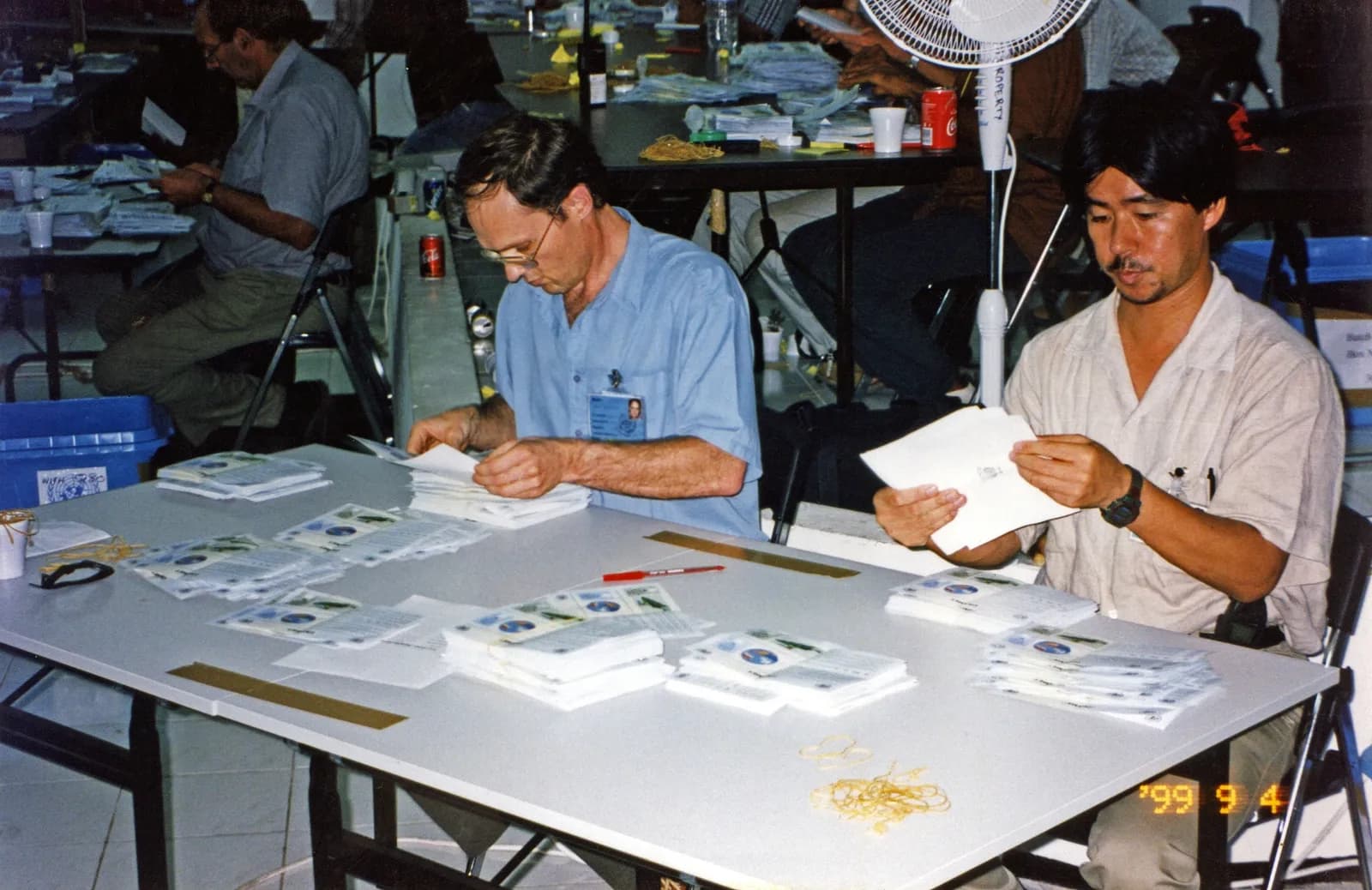
Pro-Indonesian militias, at times backed by elements of the Indonesian security forces, answered with killing, looting and arson across the territory. The truth commission put the number of East Timorese killed by the military and militias in 1999 at between 1,200 and 1,500, about 900 of them after the ballot. The UN says as many as 500,000 people were driven from their homes, about half of them out of the territory.
Portugal had called for an international peacekeeping force before the vote and again on 1 September, and there were mass protests in Portugal and Australia. On 12 September Indonesia accepted outside help, and the Security Council authorised an Australian-led force, INTERFET. On 25 October it set up the UN Transitional Administration in East Timor (UNTAET) to run the territory until independence.
An elected assembly signed the country's first constitution into force on 22 March 2002, and Xanana Gusmão won the presidential election on 14 April. Timor-Leste became independent on 20 May 2002 and on 27 September joined the United Nations as its 191st member state.
28 October 1991
Raid on the Motael church
Sebastião Gomes is killed.
12 November 1991
Santa Cruz massacre
Troops fire on the memorial procession in Dili.
19 November 1991
National day of mourning in Portugal
26 December 1991
Indonesian inquiry reports
It says about 50 people died.
January 1992
In Cold Blood broadcast
Yorkshire Television's film uses Max Stahl's footage.
March 1992
Lusitânia Expresso turned back
20 November 1992
Xanana Gusmão captured
30 June 1995
World Court judgment
The court declines to rule on Portugal's case against Australia.
October 1996
Nobel Peace Prize
Awarded to Bishop Belo and José Ramos-Horta.
May 1998
Suharto falls
5 May 1999
New York agreements
Portugal and Indonesia ask the UN to hold a ballot.
30 August 1999
Popular consultation
78.5% reject autonomy.
25 October 1999
UNTAET set up
20 May 2002
Independence of Timor-Leste
27 September 2002
Timor-Leste joins the UN
Why it still matters
In Timor-Leste, 12 November is National Youth Day. On the anniversary in 2019, a mass was said at the Motael church, students retraced the 1991 march to Santa Cruz, and President Francisco Guterres Lú Olo called the dead “national heroes and martyrs”. On 9 April 2005 Susilo Bambang Yudhoyono became the first Indonesian head of state to visit the cemetery.
The massacre is also unfinished business. The truth commission called it an unresolved matter of great significance to families and to the nation, and asked for a fuller investigation than its own. In 1994 a court in the United States ordered Sintong Panjaitan to pay $14 million in damages to Kamal Bamadhaj's mother, Helen Todd; the money was never paid. The commission found that the officers who fired or commanded the troops who fired were protected, and only a few low-ranking men ever faced a court martial.
For Portugal, Santa Cruz turned a legal position, that the people of East Timor had never been allowed to choose their future, into a public cause. It brought a day of national mourning, a protest ship and eight years of diplomacy that ended in the New York agreements of 1999.
FAQs
What happened at the Santa Cruz cemetery on 12 November 1991?
Indonesian troops opened fire with automatic weapons on a crowd of East Timorese, most of them young, who had marched from a memorial mass at the Motael church in Dili to the grave of the activist Sebastião Gomes. The procession had become a peaceful pro-independence demonstration. Survivors said soldiers then beat and stabbed the wounded inside the cemetery.
How many people died in the Santa Cruz massacre?
The exact number is unknown. Indonesian official figures ranged from 19 to about 50. The International Commission of Jurists estimated 50 to 200 in 1992, and a list compiled by two Portuguese organisations in 1993 named 271 dead, 382 wounded and 250 missing. Timor-Leste's truth commission thought around 200 people might still be missing.
Who filmed the Santa Cruz massacre?
Max Stahl, a British cameraman born Christopher Wenner, filmed the shooting from among the graves and hid his tape in the cemetery. Some tapes were smuggled to Amsterdam by the Dutch reporter Saskia Kouwenberg. The footage was broadcast worldwide and used in Yorkshire Television's film In Cold Blood in January 1992.
What did Portugal do about East Timor after Santa Cruz?
Portugal, which the UN still treated as the territory's administering power, held a national day of mourning on 19 November 1991, suspended its talks with Indonesia, pushed a resolution through the UN Commission on Human Rights in 1993 and pursued a case against Australia at the International Court of Justice. In 1999 it signed the New York agreements that led to the UN ballot.
When did East Timor become independent?
After 78.5% of voters rejected autonomy within Indonesia in the UN ballot of 30 August 1999, the UN ran the territory through UNTAET. Timor-Leste became independent on 20 May 2002 and joined the United Nations on 27 September 2002.
On the timeline
Open the timelineNearby moments from portugal in europe (1986–today).
President Mário Soares is re-elected for a second term as President of Portugal.
Angolan President José Eduardo dos Santos and UNITA leader Jonas Savimbi sign the Bicesse Accords in Portugal, mediated by the Portuguese government with US and Soviet observers. The deal briefly halts Angola's civil war and paves the way for multi-party elections in 1992.
Portugal wins the FIFA World Youth Championship (under-20) on home soil at the Estádio da Luz in Lisbon, defeating Brazil on penalties. Back-to-back champions after their 1989 win in Saudi Arabia, the 'Golden Generation' of João Pinto, Rui Costa and Luís Figo heralds a new era of Portuguese football.
The Santa Cruz massacre
Indonesian troops open fire on a peaceful procession of more than 2,000 people at the Santa Cruz cemetery in Dili, East Timor, killing scores of young Timorese. Footage smuggled out by the British cameraman Max Stahl was shown around the world and revived the cause of independence for Portugal's former colony.
A month into Portugal's first presidency of the European Community, foreign minister João de Deus Pinheiro and finance minister Jorge Braga de Macedo sign the Maastricht Treaty for Portugal. The treaty created the European Union and set the course for the euro, which Portugal adopted in 1999.
Death of Captain Fernando José Salgueiro Maia, hero of the Carnation Revolution. On 25 April 1974 he led the armoured column from the Santarém cavalry school to Lisbon, occupied the Terreiro do Paço and surrounded the Carmo barracks, where Marcelo Caetano surrendered. He died of cancer aged 47.
Martinair Flight 495, a DC-10 carrying 340 people, mostly Dutch holidaymakers from Amsterdam, crashes while landing at Faro Airport in a thunderstorm with strong, shifting winds. It hits the runway so hard that the fuselage splits in two and catches fire. Fifty-six people are killed and 106 badly injured.
Coming up in history
All long reads 14 November 1887Amadeo de Souza-Cardoso: Portugal's lost modernist, born 1887
 15 November 1924Lost in the fog: Sacadura Cabral's last flight, 15 November 1924
 16 November 2003The Estádio do Dragão opens, and a 16-year-old Messi comes off the bench
 17 November 1717A vow in stone: the first stone of Mafra is laid, 17 November 1717
16 sources
Archives, scholarship and reporting this article was checked against.
- 1
Chega! Chapter 7.2: Unlawful Killings and Enforced DisappearancesCommission for Reception, Truth and Reconciliation in Timor-Leste (CAVR), final report, 2005 (ETAN copy)
- 2
- 3
Blaming the victims: the 12 November 1991 massacre in Dili, East Timor, and the response of the Indonesian government (fact-finding mission report)International Commission of Jurists, Geneva, February 1992
- 4
- 5
East Timor: UNTAET backgroundUnited Nations Department of Public Information, May 2002
- 6
British filmmaker and war correspondent Max Stahl dies after long illness (Lindsay Murdoch)ABC News (Australia), 28 October 2021
- 7
East Timor (Portugal v. Australia)International Court of Justice
- 8
- 9
- 10
Santa Cruz victims remembered as national heroes and martyrs 28 years onTatoli, Agência Noticiosa de Timor-Leste, 12 November 2019
- 11
- 12
In cold blood: the massacre of East Timor (Yorkshire Television, 1992)ACMI collection, Melbourne
- 13
On the Birth of a Nation: Turning pointsUNESCO Memory of the World Register
- 14
Timor-Leste's 'true hero' cameraman Max Stahl who exposed Indonesian atrocities diesAsia Pacific Report, 29 October 2021
- 15Uma ilha atravessada na gargantaDiário de Notícias, 29 August 2019
- 16
UN General Assembly admits Timor-Leste as 191st MemberUN News, 27 September 2002
Image credits
- Children and young people carry portraits of victims at the 30th anniversary of the Santa Cruz massacre in Dili, 12 November 2021. The frame at bottom left is labelled “Motael, 28 de Outubro 1991”, the date Sebastião Gomes was killed. Juliao Fernandes, Média Presidência da República Democrática de Timor-Leste, Public domain, via Wikimedia Commons.
- The main gate of the Santa Cruz cemetery in Dili, photographed in 2023. Most of the crowd was standing in the street outside the gate when the soldiers opened fire. Bahnfrend, CC BY-SA 4.0, via Wikimedia Commons.
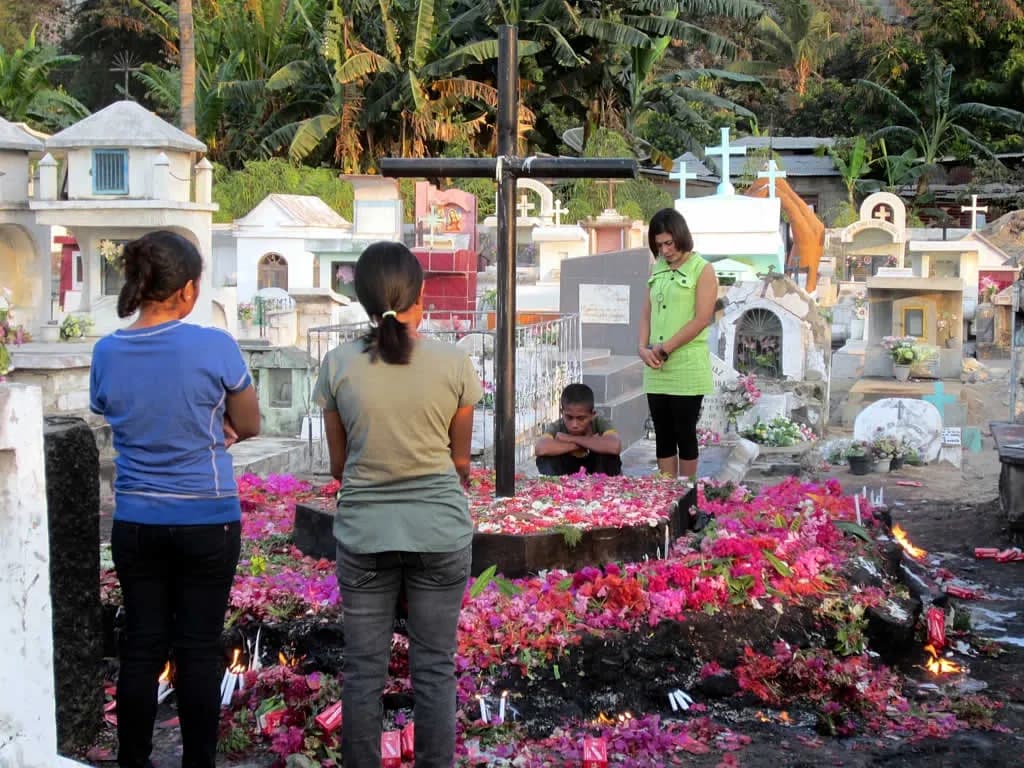
- Petals and candles on a memorial to the victims of the 1991 massacre in the Santa Cruz cemetery, November 2011. David Stanley from Nanaimo, Canada, CC BY 2.0, via Wikimedia Commons.
- Max Stahl (right) bows to receive the Order of Timor-Leste from President Francisco Guterres Lú Olo on 22 November 2019. Ju. Fernandes, Presidency of East Timor, Public domain, via Wikimedia Commons.
- Counting ballot papers from the popular consultation in East Timor, 1999. The camera's date stamp reads 4 September 1999. Anna Voss, Watch Indonesia!, CC BY-SA 3.0, via Wikimedia Commons.
- Inside the Santa Cruz cemetery in 2023, with the hills behind Dili in the background. Bahnfrend, CC BY-SA 4.0, via Wikimedia Commons.