

A vow in stone: the first stone of Mafra is laid, 17 November 1717
The patriarch blessed a block of Carrara marble, and the king carried stones in a gilded basket. What began as a small friary for thirteen Franciscans became a palace, basilica and convent so large that at its peak some 50,000 people were at work there.
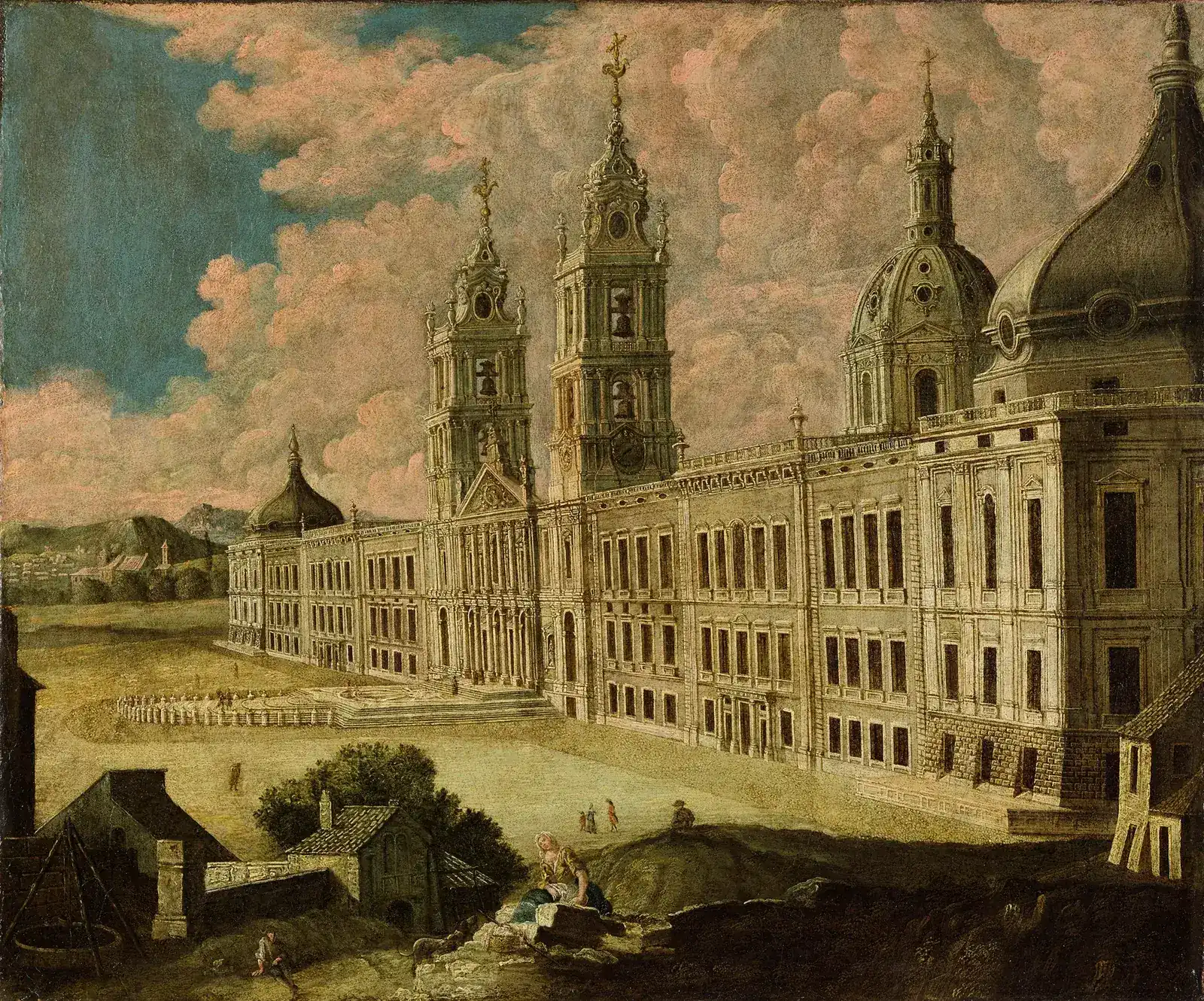
At a glance
- On 17 November 1717 the Patriarch of Lisbon blessed and laid the first stone of a church dedicated to St Anthony at Mafra, about 30 kilometres north-west of Lisbon, in the presence of King João V and his court.
- The stone's Latin inscription said the king had founded the church after his vow was answered with children. A Franciscan chronicle of 1751 adds the story of a friar's prophecy; the king's licence of 1711 speaks only of “just motives”.
- Planned in 1711 as a friary for thirteen Franciscans, the project grew to eighty friars and then, around 1721–22, to 300 friars inside a royal palace. The German-born goldsmith João Frederico Ludovice drew the plans.
- In 1730 some 45,000 workers and 7,000 soldiers were on site, according to the art historian António Filipe Pimentel; another study gives more than 50,000 people in 1729–30. The basilica was consecrated on 22 October 1730, the king's 41st birthday.
- Portugal's culture ministry says only the flow of gold from Brazil made it possible. The Royal Building of Mafra was added to UNESCO's World Heritage List on 7 July 2019.
A church blown down, a stone laid
Two days before the ceremony, the wind knocked the church down. It was only a temporary church of wood, put up over the spot where the real one would stand on a low rise just east of the town of Mafra, but it had been dressed for a king. João V ordered another built and decorated in the time that was left, and it was ready.
On the morning of 16 November 1717 Filipe de Sousa, precentor of the patriarchal see, blessed a cross sixteen palms high, and four priests raised it where the high altar stands today. The next day, 17 November, the friars fetched the patriarch from the tent where he had put on his vestments, and a procession made its way to the site on foot: the parish cross of Mafra with all the clergy from a league around, the clergy of the patriarchate, the canons in their mitres, the patriarch, the town council and, last of all, the king and his noblemen.
Inside the wooden church, Tomás de Almeida, the first patriarch of Lisbon, blessed the foundation stone, a block of white Carrara marble with a Latin inscription. He blessed twelve medals of gold, silver and base metal, struck with the king and queen, the pope, the patriarch, and the church and convent that were to rise. They went into the foundations in gold boxes, with a small gold chest holding the king's deed. In it, João bound himself to build the church to St Anthony “in satisfaction of the vow he had made to him”.
“To God, best and greatest, and to St Anthony the Portuguese, this temple is dedicated. João, king of the Portuguese, his vow answered by the children he received, founded it; and Tomás I, patriarch of Western Lisbon, consecrated and laid the first stone with solemn rite, in the year of the Lord 1717, on the fourteenth day before the Kalends of December.”
Counted the Roman way, the date at the end of the inscription as Prado printed it works out as 18 November, a day after the ceremony that Prado himself dates to the 17th.
After Mass, sung by the musicians of the patriarchal chapel, thirteen baskets of stones and carts of lime were waiting. The king picked up his basket, which was gilded, and his courtiers took theirs, which were silvered, and they carried the stones to the foundations. The Franciscan who described the scene in 1751 wrote that everyone present wept. The historian António Filipe Pimentel calls the pomp of the day unequalled and puts its cost at 200,000 cruzados.
A king without an heir
João V became king at 17, when his father Pedro II died in December 1706. It was the first peaceful succession in more than sixty years of the young Bragança dynasty. In 1708 he married Maria Ana, an archduchess of Austria, but by early 1711 the couple had no child.
That mattered. Portugal was fighting in the War of the Spanish Succession, a European war over who should inherit the Spanish throne. A crisis had surrounded his own father's rise to power, and João's brother Francisco made little secret of his ambitions. A king without children risked a repeat.
The best-known account of what happened next comes from Frei João de São José do Prado, a Franciscan of the Arrábida province and the basilica's first master of ceremonies, who described the building and its consecration in a book of 1751, Monumento Sacro. In his telling, Nuno da Cunha, then the king's chief chaplain and later a cardinal, asked a friar known for his holiness, Frei António de São José, to pray that the king might have children. The friar answered twice, “He will have them, if he wishes.” Pressed to explain, he said the king would have children if he made a vow to God to found a convent of St Anthony at Mafra.
According to Prado, the king and queen made the vow, Frei António died on 9 March 1711 as news spread that the queen was pregnant, and on 4 December 1711 she gave birth to a daughter, Maria Bárbara, who later became queen of Spain. Five sons followed in the next years, which gave the Bragança throne a secure line.
From thirteen friars to a royal city
The licence of 1711 was modest. It allowed a convent at Mafra for the Arrábida friars, an austere branch of the Franciscans, staffed by “thirteen religious only”. The king sent a trusted official, António Rebelo da Fonseca, to choose a site, then went to see it himself. The land on the hill called Alto da Vela was valued on 21 January 1713, and a treasurer, a clerk and a superintendent for the works were appointed on 19 July 1714. Every document still described a house for thirteen friars.
Digging began only in 1716, with 600 workmen, and the foundations were already so large that people said all the money in Spain would not finish them. The ceremony had first been set for 17 October 1717 and was put back a month. By then, Pimentel argues, the plan was probably for some eighty friars, and the church that rose from the foundations was far grander than a friary needed. The War of the Spanish Succession had ended in 1714, and remittances of gold from Brazil were starting to restore the king's finances.
The plans were by João Frederico Ludovice, born Johann Friedrich Ludwig in 1673 at Honhardt, in south-western Germany. He had trained as a goldsmith and had lived at the Lisbon court for years. In 1730 the Duke of Cadaval described him as “German by nation, a silversmith by trade” and, through his curiosity, a notable architect (our translation). Since 1707 he had coordinated the king's works in the royal chapel and the royal palace on the Lisbon waterfront. On 26 April 1718 the Milanese master mason Carlos Baptista Garvo signed a contract to build the convent and church following “the plan of the architect João Frederico Ludovice”.
Around 1721–22 the king changed his mind again, and this time radically. The friary would house 300 friars, and it would be wrapped inside a royal palace, with matching wings for the king and the queen on either side of the church and a great library at the back. The church was nearly finished and had to stay, but the convent was moved, foundations already dug were abandoned, and a hill south of the church had to be levelled.
Pimentel links the change to the collapse of João V's real dream: a vast royal palace and patriarchal cathedral on a hill above the Tagus in Lisbon, for which he had brought the celebrated architect Filippo Juvarra from Rome in 1719. When the Lisbon project failed, Mafra got its ambitions. A chronicler wrote that the king also meant to make the convent a university of all the sciences, and classes in grammar, logic, physics, mathematics, theology and music began soon after the friars moved in.
Tens of thousands on the hill
For most of the 1720s the work went slowly. The Swiss naturalist David-François de Merveilleux, who lived in Portugal from 1723 to 1726, saw the church built up as far as the nave and claimed to have seen 12,000 workmen there, busy, Pimentel thinks, levelling the hill. Soldiers helped, and the rubble filled a valley in front of the building to make the great square that lies before it today. The foundations of the new convent were only opened in September 1728.
Then the king fixed a date. In 1730, 22 October, his 41st birthday, fell on a Sunday, the day the Roman rite set for consecrating churches, and he wanted the basilica consecrated and the friars installed by then. From June 1729 workers were rounded up across the whole kingdom. Between June and October 1730, by Pimentel's account, 45,000 people worked at Mafra, joined by 7,000 cavalry and infantry, all lodged in a temporary town around the site nicknamed the ilha da madeira, the island of wood.
Workers on the Mafra site, 1716–1733
workers
Figures from António Filipe Pimentel's history of the building: 600 workmen opened the foundations in 1716; Merveilleux reported 12,000 in 1724; 45,000 worked between June and October 1730, with 7,000 soldiers; about 10,000 remained in 1731, with some 6,000 soldiers; after the works were contracted out in 1733, little more than 3,000. Gerhard Doderer gives more than 50,000 people gathered at Mafra in 1729–30. The sources give no figures for the years in between.
Show the data
| Workers (soldiers not included) | |
|---|---|
| 1716 | 600 |
| 1724 | 12,000 |
| 1730 | 45,000 |
| 1731 | 10,000 |
| 1733 | 3,000 |
Estimates differ with the source and with what is counted. Pimentel's 45,000 workers plus 7,000 soldiers comes to 52,000 people; Doderer gives “more than 50,000” gathered in and around Mafra in 1729–30. Both describe the peak. In most years the site was far smaller, and after the consecration it shrank to about 10,000 workers and 6,000 soldiers in 1731.
The rush showed. The towers were finished on 1 September 1730, thanks to hoisting machines invented by the Portuguese architect Custódio Vieira, and the first bells were hung on St Michael's day, 29 September. During the consecration the towers were still wrapped in lifting gear, the dome stopped at its drum and was closed with timber covered in lead, and the niches for statues stood empty. On the south side workers were still blasting rock.
The consecration of 22 October 1730
Two cardinals, Nuno da Cunha and João da Mota e Silva, reached Mafra on 18 October with their retinues, and bishops came to consecrate the altars. On 22 October 1730 the basilica was consecrated to Our Lady and St Anthony, and an octave of ceremonies followed. Some 210 friars moved into the convent, in rough conditions.
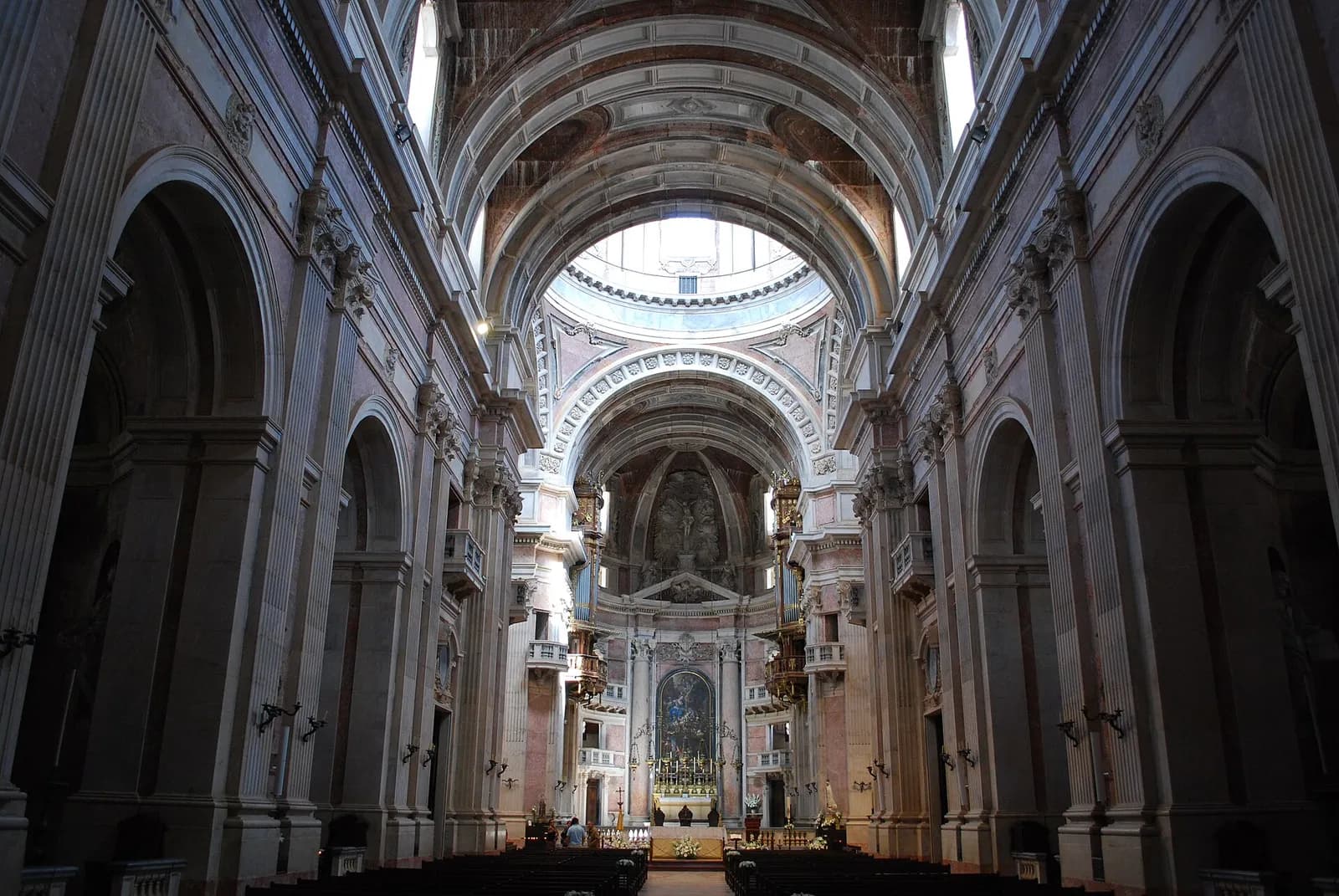
The building itself was not even half done, Pimentel writes. In 1733 the king had the rest contracted out in two lots, one for the building and one for the dome, with three years to finish. The outside of the convent and the dome were done in 1735, and by 1744, with many details still missing, the Real Edifício, the Royal Building, was complete. That year 342 friars lived at its heart. Doderer notes that the works were officially declared finished in 1750, the year João V died.
1708
João V marries Maria Ana of Austria
September 1711
Licence for a friary at Mafra for thirteen Arrábida friars
4 December 1711
Birth of Maria Bárbara, the couple's first child
1716
600 workmen begin the foundations
17 November 1717
Foundation stone laid by the patriarch of Lisbon
26 April 1718
Contract with Carlos Baptista Garvo to build to Ludovice's plan
c. 1721–22
Plan enlarged to 300 friars and a royal palace
June 1729
Workers levied across the kingdom
22 October 1730
Basilica consecrated on the king's 41st birthday
1733
Remaining works contracted out
1744
Building complete; 342 friars in residence
1750
Death of João V; works officially closed
Gold, bells and books
Portugal's own guide to the palace says its magnificence was made possible only by the flow of gold from Brazil, then Portugal's colony. The scale of that flow is now well measured. Using the records of a 1 per cent tax charged on gold landed in Lisbon from 1720, the economic historians Leonor Freire Costa, Maria Manuela Rocha and Rita Martins de Sousa counted 557 tonnes arriving between 1720 and 1807, about a third of all the gold mined in colonial Latin America.
- Gold registered in Lisbon, 1720–1807
- 557 tonnes
- Morineau's estimate from Dutch gazettes, 1720–1785
- 650 tonnes
- Decade of peak arrivals
- 1740s (Morineau: 1730s)
- Share sent to the crown
- 22%; the rest to private recipients
Most of that gold went to private individuals; only 22 per cent was shipped to the state. The bills for Mafra, Pimentel notes, were paid through the House of Bragança, the royal family's own estate, which gave the king a free hand. His biggest orders, placed between 1728 and 1735 mostly with Italian artists, included 58 marble statues for the façade, paintings and church plate; vestments came from France and Flanders.
The most famous purchase hangs in the towers. Two carillons, sets of tuned bells played from a keyboard, came from the Low Countries, made by two bell-founders, Willem Witlockx of Antwerp and Nicolas Levache of Liège, and were already mounted on temporary scaffolds for the consecration in 1730. Counts of the bells vary. Prado counted 114 in 1751 and another eighteenth-century account 122; the culture ministry's guide gives 92 in the two carillons; reports on the 2020 restoration counted 119 bells for the hours, the liturgy and the carillons.
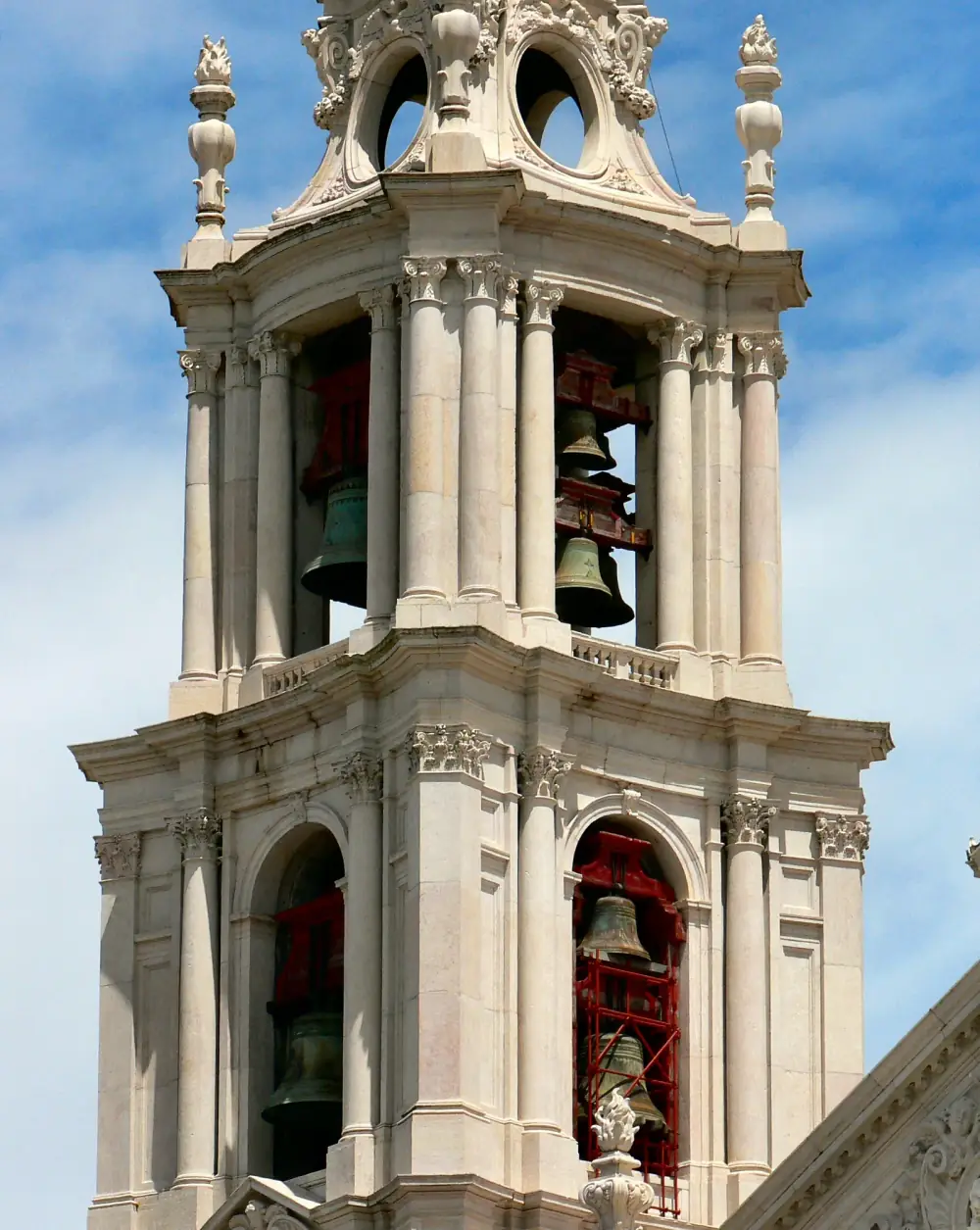
The carillons fell silent in 2001. Their wooden frames had rotted, and from 2004 the bells were held up by scaffolding. Europa Nostra, the European heritage federation, put them on its list of the seven most endangered sites in Europe. A €1.5 million restoration began in the summer of 2018. The carillons were due to be heard again from 1 February 2020, though only the south tower's was to be kept playing.
The basilica also has six organs, an unusual number for one church. The instruments heard today come from a remodelling carried out between 1792 and 1807 under the royal organ-builder António Xavier Machado e Cerveira, with Joaquim António Peres Fontanes, and were restored between 1998 and 2010.
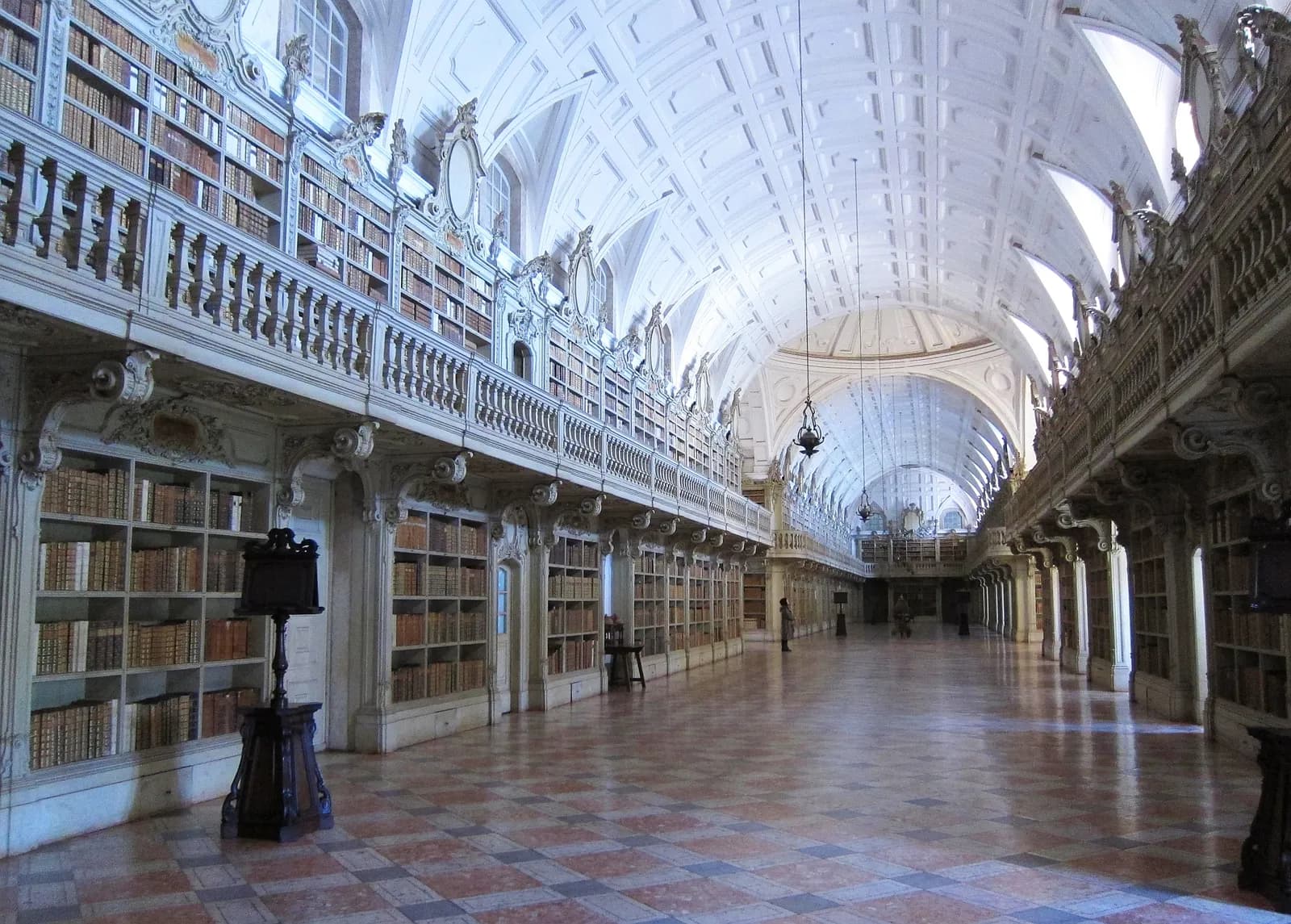
At the far end of the building, balancing the basilica, is the library. Pimentel describes it as the largest and noblest room in the whole building, a long hall laid out as a cross under a hemispherical dome, where the royal apartments meet again at the back. UNESCO puts its collection at 36,000 volumes; the culture ministry's guide says about 38,000.
| Measure | Figure | Source |
|---|---|---|
| Floor area | 38,000 m² | Culture ministry guide; Doderer (2002) gives almost 38,000 |
| Floor area | About 40,000 m² | Pimentel (2017) |
| Rooms | 1,200 rooms; 4,700 doors and windows | Culture ministry guide |
| Rooms | 880 halls and rooms, plus 300 cells and 29 courtyards | Doderer (2002) |
| Staircases | 156 | Culture ministry guide |
| Staircases | 154 | Doderer (2002) |
| Main façade | 232 m long | Doderer (2002) |
| Library | 36,000 volumes | UNESCO (2019) |
| Library | About 38,000 volumes | Culture ministry guide |
| Bells | 92 in the two carillons | Culture ministry guide |
| Bells | 119 of all kinds | Observador, on the 2020 restoration |
| Bells | 114: two carillons of 51 bells and 12 service bells | Prado (1751) |
| Bells | 122, adding 8 inside the friars' enclosure | Doderer (2002), citing eighteenth-century accounts |
The differences come mostly from what is counted: rooms or all spaces, the carillons alone or the clock and liturgical bells too.
After João V
Mafra was never the royal family's usual home. Kings came for religious feasts and to hunt in the Tapada, the royal hunting park behind it. In 1771 the Marquis of Pombal, the all-powerful minister of the next reign, moved the Franciscans out and gave the convent to the Augustinian canons; the Franciscans returned in 1791 in smaller numbers.
The prince regent, the future João VI, lived at Mafra with the court in 1806–07 and had many rooms redecorated. When the court sailed for Brazil ahead of the French invasion of 1807, it took most of the palace's valuables with it. General Junot's troops entered Mafra on 8 December 1807, when only twenty elderly friars remained. The last Franciscans fled in 1833, during the civil war between liberals and absolutists.
Saramago's convent
For many Portuguese readers, Mafra means a novel. In Memorial do Convento (1982), published in English as Baltasar and Blimunda, José Saramago set a love story among the builders of João V's convent: Baltasar Sete-Sóis, a soldier who lost his left hand in the war, Blimunda, who can see inside people's bodies, and a priest, Bartolomeu, building a flying machine powered by human will. The Swedish Academy called it his breakthrough when it gave him the Nobel Prize in 1998, and the Italian composer Corghi based an opera, Blimunda, on it.
The novel gives as much space to the workers as to the king, and Saramago returned to them in his Nobel lecture in Stockholm.
“Here also comes a crowd of thousands and thousands of men with dirty and callused hands, exhausted bodies after having lifted year after year, stone-by-stone, the implacable convent walls, the huge palace rooms, the columns and pilasters, the airy belfries, the basilica dome suspended over empty space.”
In the same lecture he put the building down to the vanity and megalomania of a king. That is a novelist's verdict, not a historian's. The story of Saramago's prize is told in a separate article.
Why it still matters
On the morning of 7 July 2019, meeting in Baku, UNESCO's World Heritage Committee inscribed the Royal Building of Mafra, with its palace, basilica, convent, Cerco garden and Tapada hunting park, on the World Heritage List. The Sanctuary of Bom Jesus do Monte in Braga was inscribed in the same session. UNESCO described Mafra as a building conceived by João V in 1711 as a tangible representation of his idea of the monarchy and the state, and as an exceptional example of Italian Baroque.
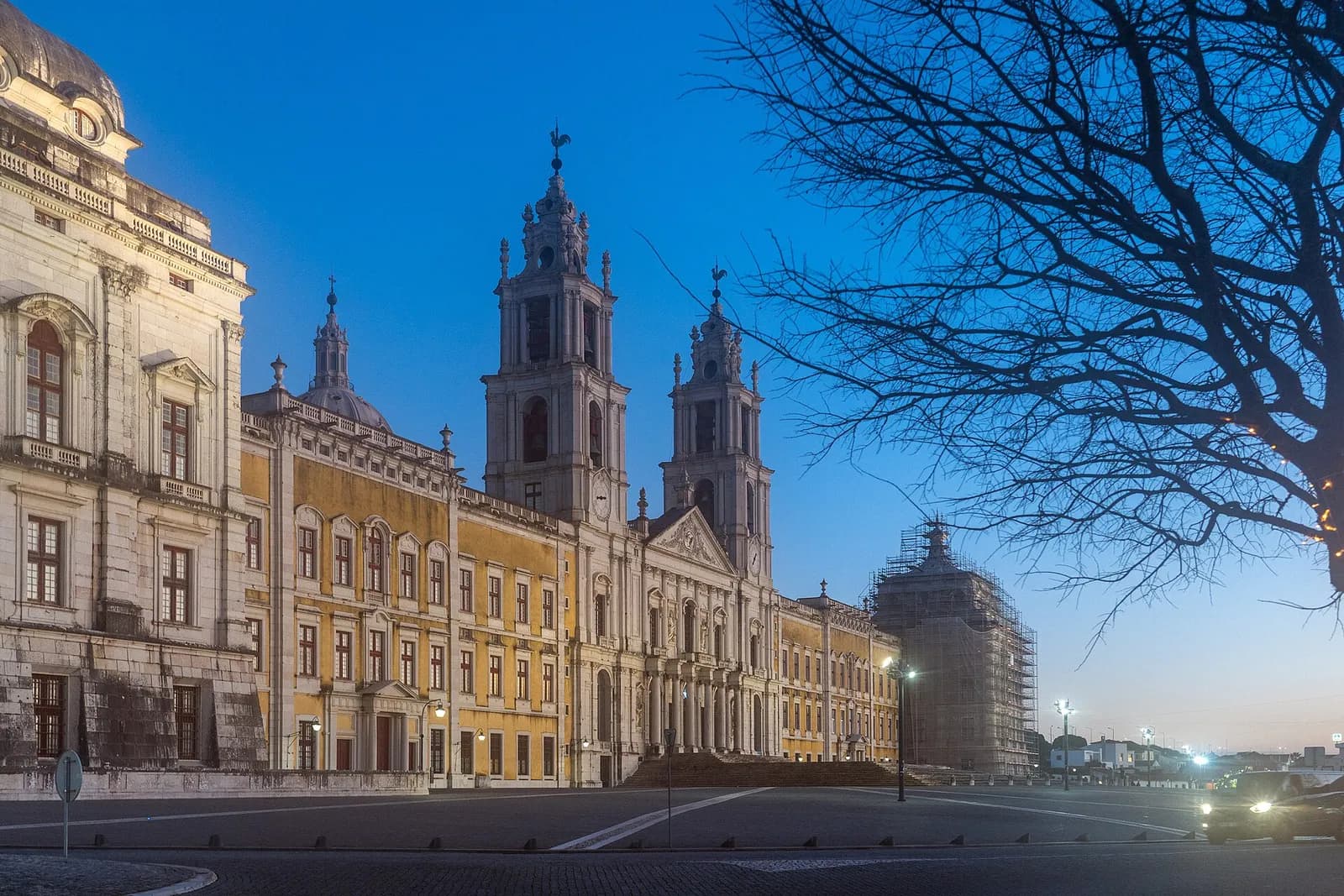
The church whose first stone was laid in 1717 is still the centre of everything. When the plan grew, it was kept, and the palace was arranged around it: the king's wing to the north, the queen's to the south, their two tribunes looking down on the high altar, and a balcony over the entrance from which blessings could be given to the square, as in Rome. Pimentel reads the whole building as the absolute monarchy drawn in stone, with the church, the convent and the library held inside the king's house.
FAQs
When was the Palace of Mafra founded?
The foundation stone of the basilica was laid on 17 November 1717 by the patriarch of Lisbon, in the presence of King João V. Digging had begun in 1716, and the licence for the original friary dates from September 1711.
Why did João V build Mafra?
Tradition says he vowed to build a Franciscan convent at Mafra if he had children, and his first child, Maria Bárbara, was born in December 1711. The foundation stone of 1717 refers to that vow. The project then grew far beyond a friary into a palace, basilica and convent that displayed the power of the monarchy.
How many people built the Palace of Mafra?
Numbers changed from year to year. At the peak, between June and October 1730, António Filipe Pimentel counts 45,000 workers and 7,000 soldiers; Gerhard Doderer gives more than 50,000 people. In 1716 there were 600 workmen, and after 1733 little more than 3,000.
Who was the architect of Mafra?
João Frederico Ludovice, born Johann Friedrich Ludwig at Honhardt, in south-western Germany, in 1673, a goldsmith who became João V's leading architect. A contract of 1718 already required the builders to follow his plan.
Is the Palace of Mafra a UNESCO World Heritage Site?
Yes. The Royal Building of Mafra, with its palace, basilica, convent, Cerco garden and Tapada hunting park, was inscribed on 7 July 2019.
On the timeline
Open the timelineNearby moments from restoration and the gold of brazil (1640–1750).
Joseph Vaz (José Vaz), a priest from Portuguese Goa, dies in Kandy after more than two decades secretly ministering to the Catholics of Ceylon, who were persecuted under Dutch Calvinist rule. Revered as the 'Apostle of Ceylon', he was canonised by Pope Francis in Colombo in 2015.
Birth in Lisbon of the Infanta Maria Bárbara, daughter of João V. A gifted keyboard player, she was taught by the Neapolitan composer Domenico Scarlatti, who followed her to Spain when she married the future Fernando VI in 1729 and remained her music master for the rest of his life. She became Queen of Spain in 1746.
Battle of Cape Matapan. A Portuguese squadron under Lopo Furtado de Mendonça, Count of Rio Grande, fights alongside the Venetian fleet and its Papal and Maltese allies against the Ottoman navy off the southern tip of the Peloponnese. Sent in answer to Pope Clement XI's appeal for aid, the squadron bore the brunt of the fighting and raised King João V's standing with the Holy See.
The foundation of Mafra
The first stone of the Palace-Convent of Mafra is laid in the presence of King João V, in fulfilment of a vow he had made for children. Paid for with Brazilian gold and raised by tens of thousands of workers, the vast Baroque complex was consecrated in 1730 and later inspired Saramago's 'Memorial do Convento'.
Death at the Convent of the Conception in Beja of Sister Mariana Alcoforado, 83, the nun traditionally identified as the author of the 'Letters of a Portuguese Nun', five anguished love letters to a French officer published in Paris in 1669. Whether she wrote them is still debated, but they became a European classic.
On his forty-first birthday, João V attends the consecration of the basilica of the Palace-Convent of Mafra, begun in 1717 in fulfilment of a vow he had made for children; the ceremonies lasted eight days. The vast building was paid for with gold from Brazil.
Birth in Coimbra of Joaquim Machado de Castro, Portugal's leading sculptor of the 18th century. His masterpiece, the bronze equestrian statue of King José I unveiled in 1775, still presides over the rebuilt Praça do Comércio — the symbolic centrepiece of Pombal's Lisbon after the earthquake.
Coming up in history
All long reads 19 November 1977TAP Flight 425: the night a Boeing 727 ran off Madeira's runway
 20 November 1511The wreck of the Flor de la Mar and the lost plunder of Malacca, 1511
 21 November 1857Columbano Bordalo Pinheiro, the painter of Portugal’s thinkers, born 1857
 22 November 1970Operation Green Sea: Portugal's secret night raid on Conakry in 1970
10 sources
Archives, scholarship and reporting this article was checked against.
- 1
Do Convento de Mafra ao Real Edifício (António Filipe Pimentel), Monumentos 35, 2017, pp. 38–51Monumentos (Portuguese state heritage review), via Estudo Geral, University of Coimbra
- 2
Monumento sacro da fabrica, e solemnissima sagração da Santa Basilica do Real Convento, que junto à villa de Mafra (Frei João de São José do Prado, Lisbon, 1751)Internet Archive (digitised by the Getty Research Institute)
- 3
Subsídios novos para a história dos órgãos da Basílica de Mafra (Gerhard Doderer), Revista Portuguesa de Musicologia 12, 2002, pp. 87–127Revista Portuguesa de Musicologia
- 4
O ouro do Brasil (1700–1807) (Leonor Freire Costa, Maria Manuela Rocha and Rita Martins de Sousa), Anais de História de Além-Mar XIII, 2012, pp. 541–548CHAM, Universidade NOVA de Lisboa
- 5
Six cultural sites added to UNESCO's World Heritage List (7 July 2019)UNESCO World Heritage Centre
- 6
Palácio Nacional de MafraCultura Portugal (Government of Portugal)
- 7
Ludovice, João Federico (1673–1752), index entryDeutsche Biographie (Historical Commission, Bavarian Academy of Sciences)
- 8Carrilhões do Palácio Nacional de Mafra voltam a ouvir-se no dia 1 de fevereiro (21 January 2020)Observador
- 9
Press release: The Nobel Prize for Literature 1998, José Saramago (8 October 1998)Swedish Academy, via NobelPrize.org
- 10
Image credits
- The palace-convent of Mafra in an eighteenth-century painting by an unknown artist, dated to the first half of the century. The basilica stands between its bell towers in the middle of the long west front. Unknown author, Public domain, via Wikimedia Commons.
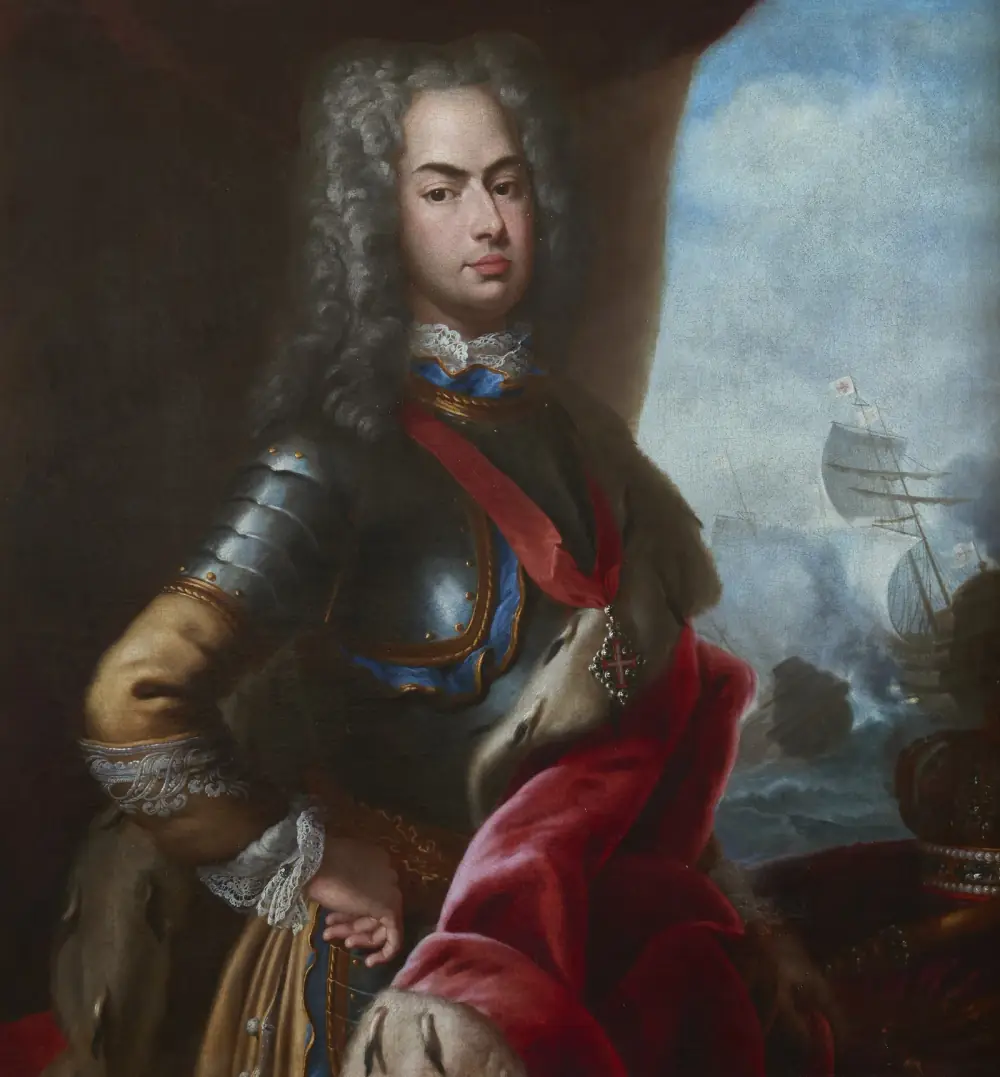
- João V painted by the Italian Domenico Duprà. The sea battle behind him alludes to the Battle of Cape Matapan, fought against the Ottoman fleet in 1717, the year of the Mafra foundation stone. Museu Nacional de Arte Antiga, Lisbon. Domenico Duprà, Public domain, via Wikimedia Commons.
- The nave of the basilica in 2009. The church consecrated in 1730 was the one begun in 1717; its dome was finished only in 1735. Concierge.2C, CC BY-SA 3.0, via Wikimedia Commons.
- One of the two bell towers in 2006. The wooden frames that held the bells had rotted, and the bells were held up by scaffolding from 2004 until the restoration of 2018–20. Paulo Juntas, CC BY-SA 2.5, via Wikimedia Commons.
- The library in December 2013. Its collection is put at 36,000 to 38,000 volumes. Bosc d'Anjou from New York, NY, USA, CC BY 2.0, via Wikimedia Commons.
- The main façade in December 2025, with the basilica between its two bell towers. The church begun in 1717 still sets the axis of the whole building. Alexkom000, CC BY 4.0, via Wikimedia Commons.