

Columbano Bordalo Pinheiro, the painter of Portugal’s thinkers, born 1857
He painted his friends in near darkness, was turned down by Lisbon juries and ignored in Paris, then became the Republic’s official portraitist. He helped choose the flag and ran the national museum of contemporary art until a decree retired him at 71.
At a glance
- Columbano Bordalo Pinheiro was born in Cacilhas, across the Tagus from Lisbon, on 21 November 1857, the son of the painter Manuel Maria Bordalo Pinheiro and the younger brother, by 11 years, of the caricaturist Rafael.
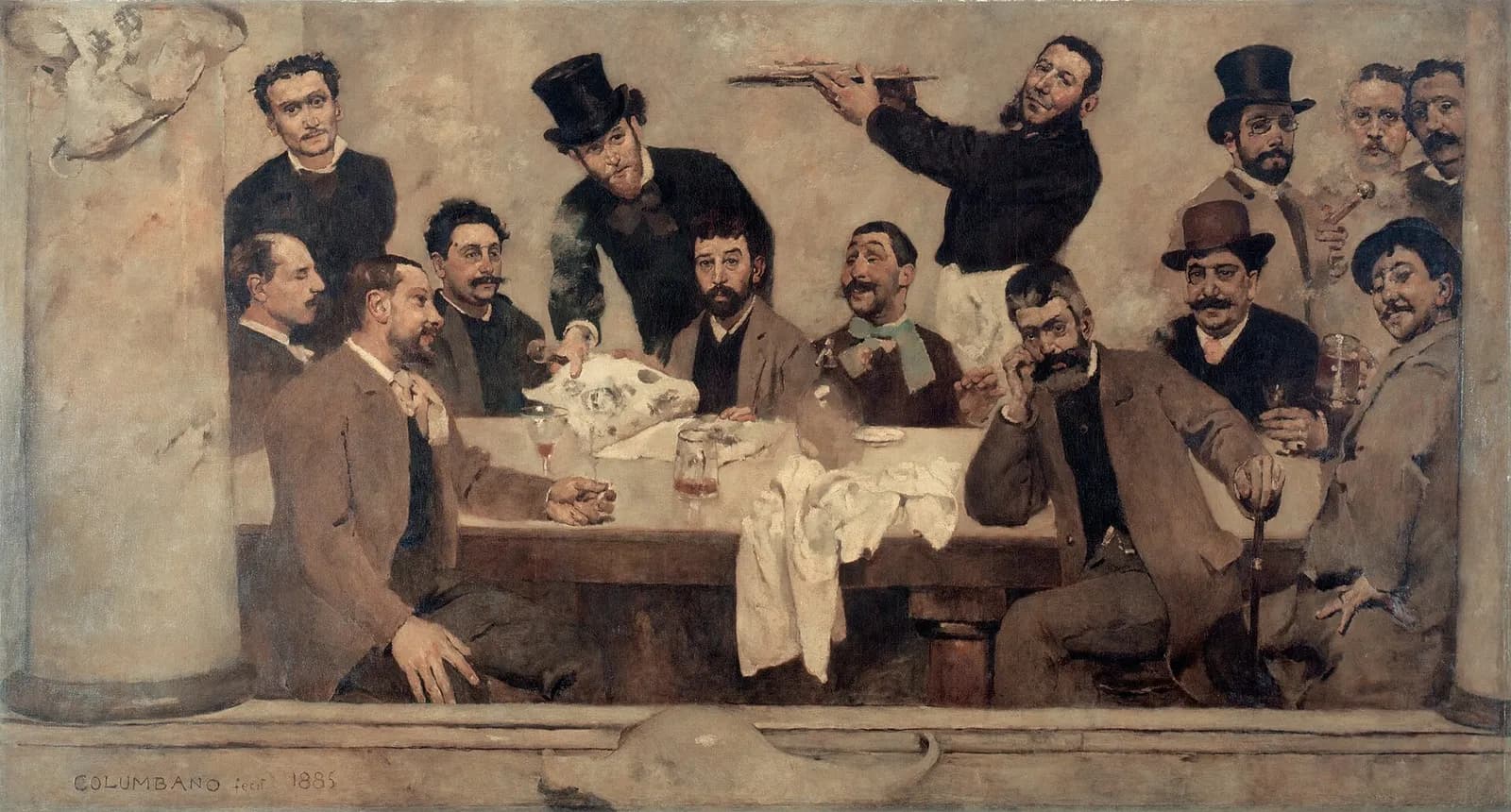
- His large Concerto de amadores was shown at the Paris Salon of 1882 and then rejected by a Lisbon jury in 1884. In 1885 he painted O Grupo do Leão, the only group portrait of Lisbon’s naturalist painters.
- His dark, ghostly portrait of the poet Antero de Quental (1889) began two decades of portraits of Portuguese writers and politicians, including official portraits of three presidents of the Republic.
- After the revolution of 5 October 1910 he sat on the five-man commission that proposed the green and red flag, approved by the government on 29 November 1910 and ratified on 19 June 1911.
- He ran the Museu Nacional de Arte Contemporânea in the Chiado from 1914 until a 1929 age-limit decree removed him. He died in Lisbon on 6 November 1929; the museum holds about 200 of his works.
A crate from Le Havre
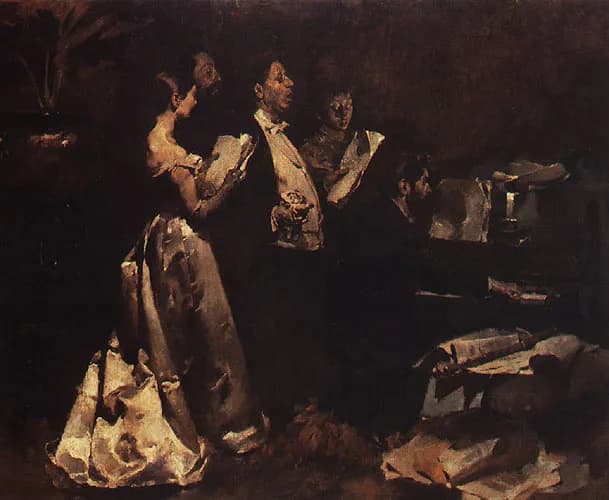
Some time after the Paris Salon of 1882, a painting three metres wide was shipped from Le Havre to Lisbon. It showed five people making music in a dim drawing room: a young woman in a satin skirt, two men singing, a second woman reading from a score and a man at the piano, beside a candle whose flame is hidden from view. Its painter, Columbano Bordalo Pinheiro, was in his mid-twenties.
He had shown it at the Salon as Soirée chez lui, and hardly anyone noticed. He was now sending it home as a thank-you to the Countess of Edla, the second wife of King Fernando II, who had paid for his studies in Paris. He insured it for 60,000 francs, and Portuguese customs claimed a share of that figure. The crate sat in customs for a year before the valuation came down to 225 francs.
When it was finally entered for the 1884 exhibition of Lisbon’s Sociedade Promotora de Belas-Artes, under the title Concerto de amadores, the jury refused it. It hung in the back room with the other rejected works, though in a prominent place. One critic, Monteiro Ramalho, complained of patches of terrible, opaque blackness. Another, Jaime Batalha Reis, called it the only powerful and original work of art that painting had produced in Portugal.
The pattern held for much of his life. Critics found his work unfinished or too dark, and the public took years to catch up. By 1900 the critics agreed on him, and after 1910 the Republic commissioned its official portraits from him. The museum he later ran calls him Portugal’s greatest painter of the nineteenth century.
A family of artists
Columbano Augusto Prostes Bordalo Pinheiro was born in Cacilhas, the riverside village in Almada facing Lisbon, on 21 November 1857. His father, Manuel Maria Bordalo Pinheiro (1815 to 1880), was a painter of small scenes of daily life in the Dutch seventeenth-century manner. His elder brother Rafael, born in Lisbon on 21 March 1846, became the country’s best-known caricaturist. His sister Maria Augusta posed for two of the pictures he later painted in Paris.
Most of his training happened at home. His father gave him lessons at family gatherings in the evenings. He enrolled at Lisbon’s Academy of Fine Arts, where his teachers included the portraitist Miguel Ângelo Lupi and the sculptor José Simões de Almeida. He finished the painting course in 1876 with low marks, the museum notes, for poor attendance and lack of application.
He first exhibited in 1874, with anecdotal scenes of popular life, and was rewarded from that year on. By 1880 his genre scenes had turned to the small comedies of Lisbon’s lower middle class, painted with a gentle irony. He applied for a state scholarship to study in Paris in 1879, for landscape, and again in 1880, for history painting. The jury turned him down both times.
21 November 1857
Born in Cacilhas, Almada
1874
First exhibits at the Sociedade Promotora de Belas-Artes
1881 to 1883
Studies in Paris on a grant from the Countess of Edla
1882
Soirée chez lui (Concerto de amadores) at the Paris Salon
1885
Paints O Grupo do Leão
1889
Portrait of Antero de Quental; first visit to the Prado in Madrid
1891
Full-length portrait of his brother Rafael
1901
Professor of history painting at the Lisbon school of fine arts, until 1924
15 October 1910
Named to the commission for a new national flag
14 August 1914
Appointed director of the Museu Nacional de Arte Contemporânea
1914, 1917, 1925
Official portraits of presidents Arriaga, Teófilo Braga and Teixeira Gomes
2 March 1929
Age-limit decree ends his directorship
6 November 1929
Dies in Lisbon
Paris, 1881 to 1883
Turned down by the state, Columbano used his connections. King Fernando II, through the Countess of Edla, offered him a grant generous enough to pay for his sister to go with him. He left for Paris in 1881 and stayed until 1883. The French portraitist Carolus-Duran, who had admired his work in Lisbon, was to take him into his studio, but that never happened.
Paris did not charm him. He made little effort to meet young artists and complained that the city smelled of rice powder and oil. He did gain a friend in the American painter John Singer Sargent, who tried and failed to get him into the Academy of Fine Arts in Paris. The Louvre became his main interest. The ten or so paintings he made there have darker backgrounds and a narrower range of ochres.
The museum counts Concerto de amadores the finest of them, and its size was deliberate. According to the sculptor and art historian Diogo de Macedo, who later ran the same museum as Columbano, he wanted the picture to be seen among the hundreds hanging at the Salon. The subject was intimate: his own sister in the satin skirt, Adolfo and Josefa Greno, an Italian singer, and the painter Artur Loureiro at the keyboard. Only the critic Louis Fourcaud, a friend of Sargent, wrote about it.
How wide six of Columbano’s paintings are
cm
Widths from the Museu do Chiado’s catalogue entries. Heights: 201 cm, 220 cm, 92 cm, 73 cm, 73 cm and 46 cm. The two big canvases were made to be seen in a crowded Salon and at a brewery entrance; the four portraits here are all under a metre across.
Show the data
| Width of the canvas or panel | |
|---|---|
| O Grupo do Leão (1885) | 376 |
| Concerto de amadores (1882) | 300 |
| Unfinished self-portrait (c. 1929) | 69 |
| A luva cinzenta (1881) | 54 |
| Antero de Quental (1889) | 53.5 |
| Manuel Gustavo (1884) | 36 |
The Grupo do Leão
While he was away, a group of young Lisbon painters had found a home. They met at the Leão de Ouro, a brewery and beer cellar on what was then Rua do Príncipe, now Rua 1.º de Dezembro, and took its name. Their leader was Silva Porto, who had introduced open-air landscape painting to Portugal in 1880. From 1881 they held annual exhibitions they called Modern Painting.
Columbano painted people rather than landscapes, but he joined them and exhibited with the group between 1882 and 1887. When the brewery was refitted with a new restaurant, each artist contributed a work to the decoration. Columbano was given the group portrait for the entrance.
The finished canvas of 1885 is nearly four metres wide. Fourteen men sit and stand along a white table between two pale columns. Silva Porto is at the centre, the place of the head of a school. Some came to Columbano’s studio to pose for it; others he took from earlier portraits, sketches and photographs. Pedro Lapa, who wrote the museum’s catalogue entry, thinks this mix explains why the figures sit a little apart, as if pasted in. The story goes that he added the brewery’s owner to bring the number to 14 and avoid the 13 of the Last Supper.
| Position | Sitter | Who he was |
|---|---|---|
| 1, seated | Henrique Pinto (1853 to 1912) | Landscape painter |
| 2 | João Ribeiro Cristino (1858 to 1948) | Painter |
| 3 | José Malhoa (1855 to 1933) | Painter |
| 4 | João Vaz (1859 to 1931) | Marine painter |
| 5 | Alberto de Oliveira | Man of letters; shows Silva Porto a catalogue he compiled for a group show |
| 6, centre | Silva Porto (1850 to 1893) | Painter and leader of the group |
| 7 | António Ramalho (1859 to 1916) | Painter |
| 8 | Manuel Fidalgo | Waiter at the brewery |
| 9 | Moura Girão (1840 to 1916) | Painter |
| 10 | Rafael Bordalo Pinheiro (1846 to 1905) | Caricaturist, the painter’s brother |
| 11, top hat | Columbano Bordalo Pinheiro (1857 to 1929) | The painter himself |
| 12 | António Monteiro | Owner of the brewery |
| 13 | Cipriano Martins | Landscape painter |
| 14, seated | José Rodrigues Vieira (1856 to 1898) | Sculptor |
Order as given in the Museu do Chiado’s catalogue entry. The Centro Nacional de Cultura’s analysis lists the same 14 sitters, grouped by who stands and who sits.
The painting hung at the brewery until 1945. In 1953 the state bought it from its owner, Ramos da Costa, for 400,000 escudos from a special Finance Ministry grant, after it had nearly been sold to the Brazilian collector Assis Chateaubriand or to Artur Cupertino de Miranda. The Centro Nacional de Cultura gives 1945 as the year the museum acquired it.
An inventory of spirits
At the end of the 1880s his painting changed again. In 1889 he saw Velázquez and the Spanish masters of shadow at the Prado in Madrid for the first time, and in Paris the Symbolists were in fashion. The first result was a portrait of the poet and philosopher Antero de Quental, whom the museum calls the symbol of a generation.
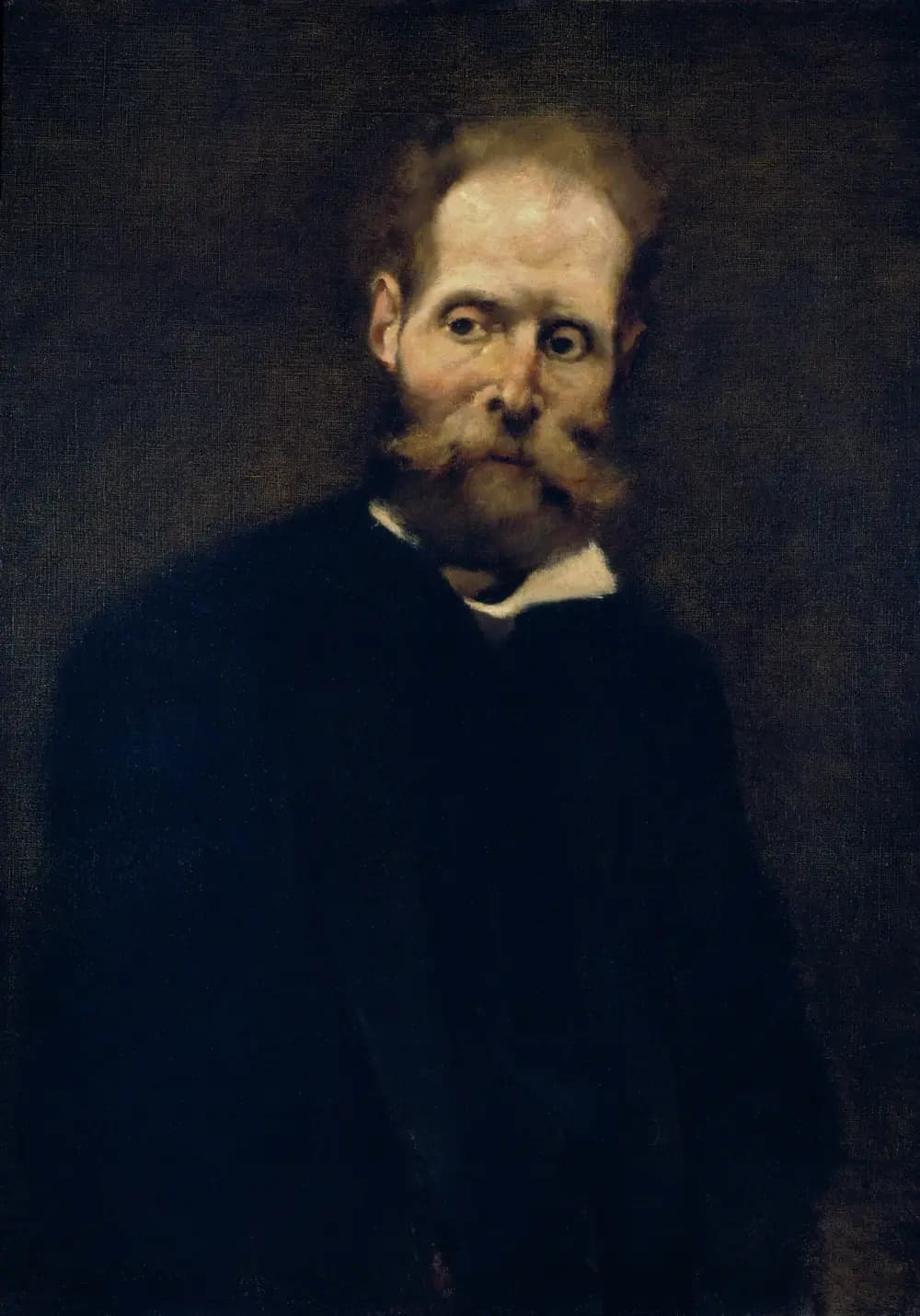
The background is completely dark. The paint is thin, the outline of the shoulders melts into shadow, and a pale light from above picks out the forehead, the cheekbones and the sunken eyes, so that the skull seems to show through the skin. Two years later Antero killed himself, and most readings of the portrait have treated it as a premonition. Columbano did not see it that way.
“Calm, delicate, affable. No tragedy showed through his almost cheerful mask. That is why the news of his suicide came to me as something unexpected, and the grief worked away in my mind for a long time.”
In the 1890s he invited a whole intellectual generation to sit for him, and he kept at it for three decades. His sitters included Eça de Queirós, Ramalho Ortigão, Oliveira Martins, Fialho de Almeida, Bulhão Pato and Jaime Batalha Reis, and later Teixeira de Pascoais and Raul Brandão.
The early portraits caught Portugal in a bad decade. In the British Ultimatum of 1890 Britain forced Portugal to pull its troops out of lands in central Africa that it claimed, and a deep economic and political crisis followed. The curators read the portraits as a record of a pessimistic age, each sitter standing for a body of work outside the frame.
Recognition came at last. By the end of the century the critics agreed on him, and in 1901 he became professor of history painting at the Lisbon school of fine arts, where he had been a poor student. He taught there until 1924, leaving because he could not accept the modernist taste of the younger artists, and was twice president of the Sociedade Nacional de Belas-Artes, in 1902 and 1914.
Two brothers
Rafael Bordalo Pinheiro was 11 years older. His weekly O António Maria, a humorous paper on politics that ran from 1879 to 1885 and again from 1891 to 1898, counted Columbano among its contributors, alongside Ramalho Ortigão, the painters António Ramalho and Ribeiro Cristino, and Rafael’s son Manuel Gustavo.
The brothers moved in the same circle, and Columbano painted his family again and again. In 1884 he painted his nephew Manuel Gustavo, a small panel with a red sock and clasped hands that the museum calls an extreme moment in his modernity. In O Grupo do Leão he put Rafael directly below himself.
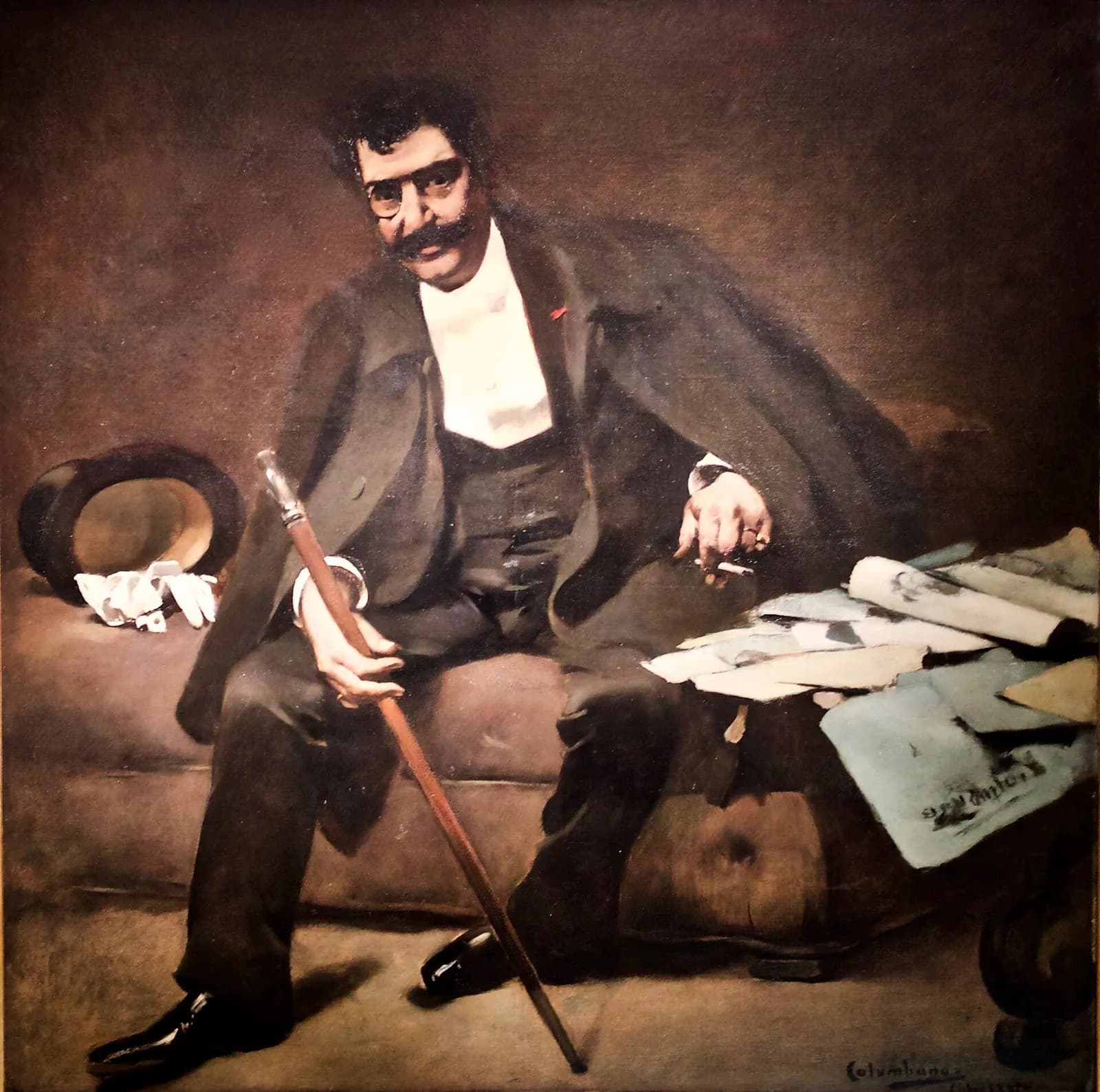
In the full-length portrait of 1891 the caricaturist sits forward on a sofa with his cane, his top hat and gloves thrown down beside him and a pile of papers at his elbow. It stayed in the family until Manuel Gustavo bequeathed it to the museum founded in Rafael’s name. Rafael died in 1905, and Columbano outlived him by 24 years.
Green and red: the flag of 1910
On 5 October 1910 a revolution in Lisbon ended the monarchy. The new rulers wanted new symbols, and on 15 October the Provisional Government named a commission to design a national flag to replace the blue and white of the Braganza kings. Columbano was its painter. The other members were the writer Abel Botelho, the journalist and politician João Chagas, and two officers who had fought in the revolution, Lieutenant Ladislau Pereira and Captain Afonso Palla.
- Commission named
- 15 October 1910, by the Provisional Government
- Members
- Columbano Bordalo Pinheiro, Abel Botelho, João Chagas, Lt Ladislau Pereira, Capt Afonso Palla
- Report finished
- 29 October 1910
- Approved by the government
- 29 November 1910, after changes to the first proposal
- First Flag Day
- 1 December 1910
- Ratified
- By the Constituent Assembly at its first session, 19 June 1911
The commission’s report of 29 October rejected blue because it was tied to the cult of Our Lady of the Conception. Green was the colour of hope and, for the positivist philosopher Auguste Comte, whose ideas shaped Portuguese republicanism, of progress. Above all it had been flown in the revolution. Red was described as combative, warm and virile. White stayed for the sake of tradition, and the armillary sphere of the Age of Discovery and the old shield of castles and quinas kept a link with the past.
“For us, historically and morally, blue is a condemned colour.”
The government approved the final design on 29 November, after some changes, and made 1 December a Flag Day. That did not settle the matter. For months the newspapers carried a “quarrel of the flag”, with rival designs mixing the old and new colours. Teófilo Braga, head of the Provisional Government, was the chief defender of green and red. The poet Guerra Junqueiro, the historian Braamcamp Freire and the philosopher Sampaio Bruno wanted to keep blue and white.
The government refused the plebiscite that the blue-and-white camp demanded, and the Constituent Assembly confirmed the flag at its first session on 19 June 1911. The decree appeared in the official gazette, the Diário do Governo, the next day.
The museum in the Chiado
A decree of 26 May 1911 split the old national fine arts museum in two. Works made before 1850 stayed at the Janelas Verdes palace in what became the Museu Nacional de Arte Antiga. Later works went to a new Museu Nacional de Arte Contemporânea in the former Convent of São Francisco in the Chiado, next door to the school of fine arts. Its first director was the painter Carlos Reis.
Columbano was appointed in his place on 14 August 1914, and the ministry confirmed the appointment on 17 December. He redesigned the galleries with the architect José Luís Monteiro, down to the benches, had the main works photographed for a catalogue, and reopened the museum on 4 April 1916. A paper praised him in 1923 for turning three filthy friars’ cells, a choked staircase and a revolting courtyard into a museum.
His taste was conservative. Under him the museum bought mainly Romantic and naturalist painting, though more modern sculpture got in. The modernists who met at the café A Brasileira in the Chiado complained, and he ignored them. He judged only one younger painter, Adriano de Sousa Lopes, fit to succeed him.
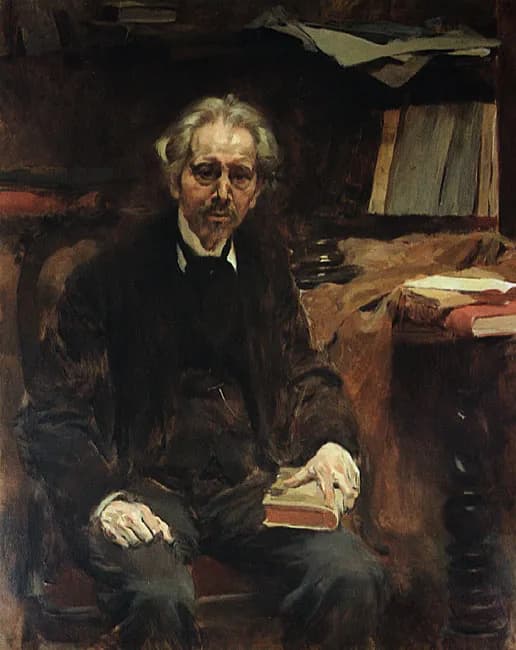
He was also the Republic’s painter of record. In 1910 he sat on a commission listing the contents of the royal palaces, and in 1914 he painted Manuel de Arriaga, the first elected president, in the Lions’ Chair at Belém. Teófilo Braga’s portrait was commissioned in 1917, two years after his few months as president, and shows him among his books. Manuel Teixeira Gomes, a friend since Columbano had painted him as ambassador in London in 1911, was painted in office in 1925.
| President | Term | Portrait |
|---|---|---|
| Manuel de Arriaga | August 1911 to May 1915 | 1914, the first in the gallery |
| Teófilo Braga | 29 May to 5 October 1915 | Commissioned 1917 |
| Manuel Teixeira Gomes | October 1923 to December 1925 | 1925 |
All three hang in the portrait gallery of the Museu da Presidência da República in Belém.
Last years
In July 1927 the board of the Sociedade Nacional de Belas-Artes attacked his running of the museum, and the state’s art council defended him. Sources differ on when he left: the museum’s 2010 exhibition text says he was director until 1927, while its 2007 exhibition text, its history page and Margarida Elias, who wrote her doctoral thesis on him, give 1929. Elias found that a decree of 2 March 1929 setting an age limit removed him, at 71.
On 21 March 1929 the council paid him tribute. It was announced that he would be made honorary director, and a decree published on 30 April gave him a pension for life. The writer Raul Brandão, whose portrait he had painted, wrote in his memoirs that the loss of the museum killed him.
“[He died] on the day they took away … his post as director of the Museum, to which he had devoted himself passionately, spending even his savings on it. He could never sleep again …”
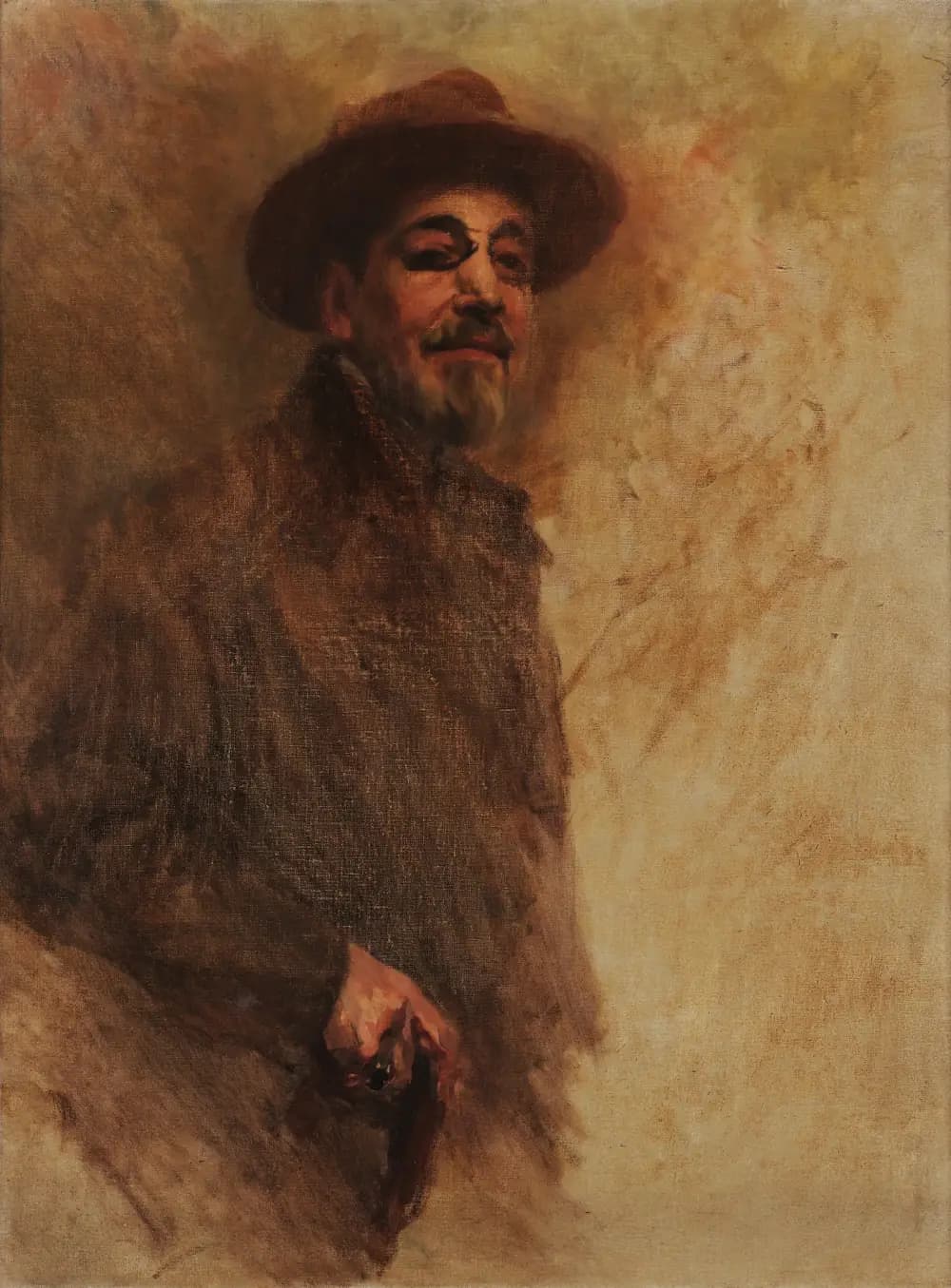
Columbano died in Lisbon on 6 November 1929, two weeks before his 72nd birthday. One of his last works was an unfinished self-portrait in a hat and monocle. He had meant to add his wife, Emília, in the empty pale space on the right. She left it to the museum in 1945.
Why he still matters
His portraits of Antero de Quental, Eça de Queirós, Ramalho Ortigão and Teófilo Braga are still his best-known works. The museum he ran still holds about 200 of his works, and under his successor it took over his studio next door and opened a room in his name.
His work also travelled. The Musée d’Orsay in Paris, the Palazzo Pitti in Florence and the national fine arts museum in Rio de Janeiro own his paintings, and lent them to Lisbon for the museum’s 2010 exhibition, part of the centenary of the Republic. The flag he helped choose has flown over Portugal, unchanged in its colours, since December 1910.
FAQs
Where and when was Columbano Bordalo Pinheiro born?
In Cacilhas, in the municipality of Almada on the south bank of the Tagus opposite Lisbon, on 21 November 1857. He died in Lisbon on 6 November 1929.
Did Columbano design the Portuguese flag?
He was the painter on the five-member commission named on 15 October 1910 to propose a new flag, and the museology dictionary credits him with its drawing. The government changed the commission’s first proposal before approving the green and red design on 29 November 1910, and the Constituent Assembly ratified it on 19 June 1911.
How was Columbano related to Rafael Bordalo Pinheiro?
Rafael, the caricaturist and ceramicist, was his elder brother, born in 1846. Columbano contributed to Rafael’s paper O António Maria, painted him into O Grupo do Leão in 1885 and made a full-length portrait of him in 1891.
What is O Grupo do Leão?
A group of Lisbon naturalist painters led by Silva Porto, named after the Leão de Ouro brewery where they met in the early 1880s, and the 1885 painting Columbano made of them for the brewery’s entrance. It shows 14 men and is now in the Museu do Chiado.
Where can I see Columbano’s paintings in Lisbon?
Mainly at the Museu Nacional de Arte Contemporânea do Chiado, which he directed and which holds about 200 of his works. The Museu Bordalo Pinheiro has his portrait of Rafael, and the Museu da Presidência in Belém has his presidential portraits.
On the timeline
Open the timelineNearby moments from regeneration and the last kings (1851–1910).
Cesário Verde is born in Lisbon's Madalena parish. He worked in the family hardware business, died of tuberculosis at 31 and never saw a book of his own in print, yet poems such as 'O Sentimento dum Ocidental', a dusk walk through gas-lit Lisbon, made him a master of modern Portuguese poetry, championed by Pessoa.
Birth in Caldas da Rainha of José Malhoa, a leading painter of Portuguese naturalism. His 'O Fado' (1910), showing a guitarist singing to his lover in a humble Lisbon room, became a defining image of the genre. Caldas da Rainha's art museum bears his name.
King Pedro V rides the inaugural train of Portugal's first railway, a 36-kilometre line from Lisbon to Carregado. It was the first stretch of what became the Linha do Norte, which would eventually link the capital with Porto.
Columbano Bordalo Pinheiro
The painter Columbano Bordalo Pinheiro is born in Cacilhas, younger brother of the caricaturist Rafael. His group portrait of the 'Grupo do Leão' and his sombre portraits of Antero de Quental and Teófilo Braga made him the leading portraitist of his generation; he later directed the National Museum of Contemporary Art and helped design the republican flag.
Death in Lisbon of Queen Estefânia, the German-born wife of King Pedro V, from diphtheria at just 22, barely a year after her wedding. Known as the 'angel of the poor' for her charitable work, she is remembered in the Hospital de Dona Estefânia, the Lisbon children's hospital that bears her name, and her death left the young king inconsolable.
Portugal and the Tokugawa Shogunate sign a Treaty of Peace, Amity and Commerce in Edo (present-day Tokyo), establishing formal diplomatic relations and reopening trade more than two centuries after the Portuguese were expelled from Japan in 1639.
King Pedro V dies of typhoid fever at the Necessidades Palace in Lisbon, aged just 24, after a reign of eight years. Two of his brothers, the infantes Fernando and João, also died that year, plunging the country into mourning.
Coming up in history
All long reads 23 November 1930Herberto Helder: the Funchal-born poet who said no
 24 November 1632Spinoza, born to Amsterdam's Portuguese Jews on 24 November 1632
 25 November 197525 November 1975: the paratroopers' revolt that ended the revolution
 26 November 1967The Lisbon floods of November 1967: a night of rain and a censored toll
23 sources
Archives, scholarship and reporting this article was checked against.
- 1
Pinheiro, Columbano Bordalo (Margarida Elias), in Dicionário Quem é Quem na Museologia Portuguesa, 2nd edition, pp. 448-451Instituto de História da Arte, NOVA FCSH, 2022
- 2
Columbano Bordalo Pinheiro, 1874-1900 (exhibition texts, 2007)Museu Nacional de Arte Contemporânea do Chiado
- 3
- 4
- 5
Bandeira NacionalMuseu da Presidência da República
- 6
- 7
- 8
- 9
Rafael Bordalo PinheiroMuseu Bordalo Pinheiro (EGEAC, Câmara Municipal de Lisboa)
- 10
94th anniversary of the death of Columbano Bordalo PinheiroMuseu Nacional Soares dos Reis, 6 November 2023
- 11
- 12
- 13
- 14
- 15
“Grupo do Leão” de Columbano Bordalo Pinheiro (analysis by Rui-Mário Gonçalves)Centro Nacional de Cultura, Obras de referência da cultura portuguesa (e-cultura)
- 16
British and Portuguese Attitudes Towards the British Ultimatum of 1890, by Maria Teresa Pinto CoelhoBritish Historical Society of Portugal, Report 21 (1994)
- 17
Ficha histórica: O António Maria (1879-1885; 1891-1898) (Rita Correia)Hemeroteca Municipal de Lisboa, 2006
- 18República: “Adesivos”, “thalassas” e heróis esquecidosDiário de Notícias (archive section), 4 October 2023
- 19
- 20
Em torno de duas Repúblicas (Luís da Cunha Pinheiro and Maria Manuel Marques Rodrigues, eds.)LusoSofia Press, Universidade da Beira Interior, 2013
- 21
- 22
- 23
Image credits
- O Grupo do Leão (1885), Columbano’s portrait of the Lisbon naturalist painters and their friends, made for the entrance of the Leão de Ouro brewery. Columbano stands at the right in a top hat; his brother Rafael sits just below him. Museu Nacional de Arte Contemporânea do Chiado. Joaomacdonald, CC BY-SA 4.0, via Wikimedia Commons.
- Concerto de amadores (1882), shown at the Paris Salon as Soirée chez lui. From left: the painter’s sister Maria Augusta, Adolfo Greno, an Italian singer, Josefa Greno and the painter Artur Loureiro at the piano. Museu Nacional de Arte Contemporânea do Chiado. Columbano Bordalo Pinheiro, Public domain, via Wikimedia Commons.
- Retrato de Antero de Quental (1889). Columbano gave it to the poet, who gave it to the historian Oliveira Martins; it reached the Museu do Chiado in 1945. Columbano Bordalo Pinheiro, Public domain, via Wikimedia Commons.
- Columbano’s portrait of his brother Rafael (1891), photographed at the Museu Bordalo Pinheiro in Lisbon. Rafael’s son Manuel Gustavo left it to the museum in 1920. Pedro Ribeiro Simões from Lisboa, Portugal, CC BY 2.0, via Wikimedia Commons.
- Columbano’s official portrait of Teófilo Braga, commissioned in 1917. Braga had led the Provisional Government that adopted the green and red flag. Museu da Presidência da República. Columbano Bordalo Pinheiro, Public domain, via Wikimedia Commons.
- Columbano’s unfinished last self-portrait, about 1929. He planned to paint his wife in the blank area on the right. Museu Nacional de Arte Contemporânea do Chiado. Columbano Bordalo Pinheiro, Public domain, via Wikimedia Commons.