

Spinoza, born to Amsterdam's Portuguese Jews on 24 November 1632
His father was born in Vidigueira, in the Alentejo, and his family spoke Portuguese at home. Twenty-three years after his birth, the Portuguese-Jewish congregation of Amsterdam cursed him in Portuguese and cast him out.
At a glance
- Bento de Espinosa, known to the world as Baruch or Benedictus Spinoza, was born in Amsterdam on 24 November 1632, the son of a merchant in the city's community of Portuguese Jews.
- His father, Michael, was born in Vidigueira, in the Alentejo, around 1587. Inquisition records show relatives arrested there and burned at Évora, and the family left Portugal for Nantes between the early 1590s and 1605, depending on the source.
- On 27 July 1656 the leaders of the Talmud Torah congregation issued a herem, a writ of expulsion, against him in Portuguese. It was the harshest such ban the community ever pronounced, and it was never lifted.
- Spinoza left Amsterdam, published his Theological-Political Treatise anonymously in 1670 and died in The Hague on 21 February 1677. His friends published the Ethics after his death.
- The Portuguese-Jewish congregation of Amsterdam still exists, and its synagogue still makes some announcements in Portuguese.
A curse read in Portuguese
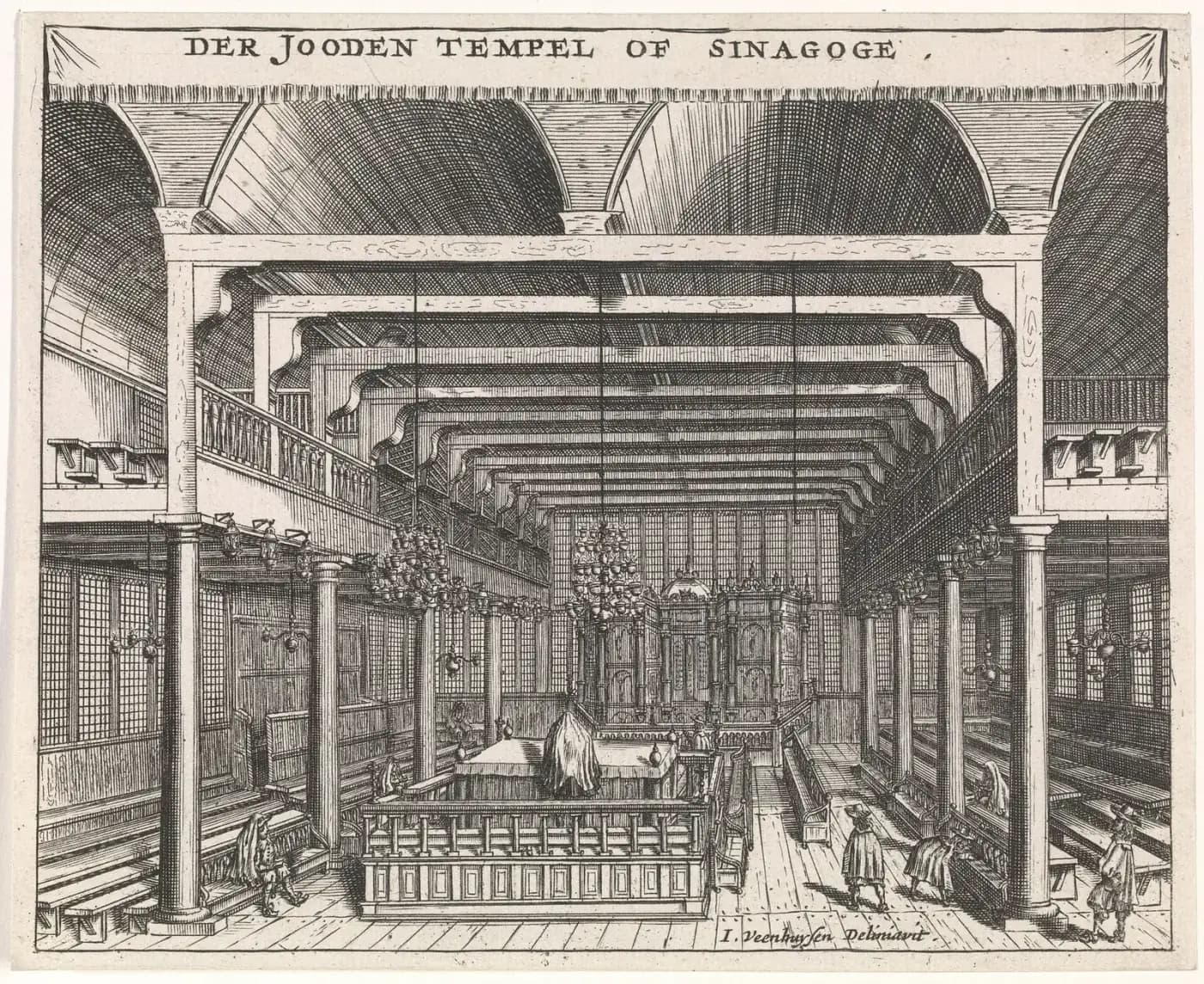
On 27 July 1656, the sixth of Av 5416 in the Jewish calendar, the leaders of Amsterdam's Talmud Torah congregation issued a proclamation from in front of the ark of their synagogue on the Houtgracht. It was written in Portuguese, the everyday language of the congregation, and it named one of their own: Baruch de Espinoza, a 23-year-old merchant who had been running his late father's dried-fruit business with his brother Gabriel.
The lay board that governed the congregation, the ma'amad, said it had long known of his “evil opinions and acts” and had tried “by various means and promises” to turn him back. Instead it kept receiving reports of the “abominable heresies which he practiced and taught” and of his “monstrous deeds”. With the consent of the rabbis, it expelled him from the people of Israel.
“Cursed be he by day and cursed be he by night; cursed be he when he lies down and cursed be he when he rises up. Cursed be he when he goes out and cursed be he when he comes in.”
Nobody was to speak to him or write to him, do him any favour, stay under the same roof or come within four cubits of him, or read anything he had written. Spinoza was not in the synagogue to hear it. It was the harshest writ of herem the Portuguese Jews of Amsterdam ever pronounced, and it was never rescinded.
The young man it cursed had been born a few streets away. His father and grandparents had come from Portugal, and the community that expelled him had been founded by people who, like them, had fled the Inquisition.
A Portuguese nation on the Amstel
Spinoza was born on 24 November 1632. No birth record survives, but he was almost certainly born in or near Vlooienburg, an artificial island raised in the bed of the Amstel in the 1590s, where most of Amsterdam's Sephardic Jews lived and where their congregations built their synagogues. The Stopera, the city hall and opera house, stands on the site today.
He was named Bento in Portuguese, Baruch in Hebrew and later Benedictus in Latin; all three mean “blessed”. Baruch was also the Hebrew name of his maternal grandfather, Henrique Garces, from Porto, who had settled in Amsterdam between 1598 and 1605 and was known there as Baruch Senior.
Amsterdam was one of the few places in Europe where Jews were not prevented from practising their religion privately. Portuguese New Christians are recorded there from 1592, and by 1618 they had formed three congregations: Beth Jacob, Neve Shalom and Beth Israel. On 3 April 1639 the three merged into one, Kahal Kadosh Talmud Torah, which began building its new synagogue on the Houtgracht that year.
The community called itself Portuguese, not Spanish, probably because the Dutch were then fighting for independence from Spain. Its members spoke Portuguese in daily life and business and used Spanish for scholarship, prose and poetry. Its charity reached far beyond the city: a dowry society founded in 1615 helped poor girls of the Nation living “from Saint-Jean-de-Luz to Danzig”, including places where Judaism was banned.
| Estimate | Period | Source |
|---|---|---|
| About 3,300 Sephardim | First half of the seventeenth century, before the 1648 peace with Spain brought more | Dicionário do Judaísmo Português (2009), cited by Duarte |
| About 4,500 members, its largest size | Second half of the seventeenth century | Carsten Wilke, História dos Judeus Portugueses (2009), cited by Duarte |
| 450 families of Portuguese and Spanish Jews, besides a few poor ones | Late seventeenth century | Gregorio Leti, Teatro Belgico, quoted by David Franco Mendes, cited by Duarte |
| 672 married and single individuals listed | 1675 | List in the congregation's rules, published by Mendes dos Remédios, cited by Duarte |
| 4,300 Portuguese Jews, of whom 3,700 were murdered | Second World War | Portuguese Jewish community of Amsterdam |
| About 630 members in about 250 families | Today | Portuguese Jewish community of Amsterdam |
Nobody took a census of the community. Duarte notes that it is unclear how the family count used by Franco Mendes relates to Wilke's figure, and the 1675 list names individuals in the congregation's register, not every man, woman and child.
From Vidigueira to Amsterdam
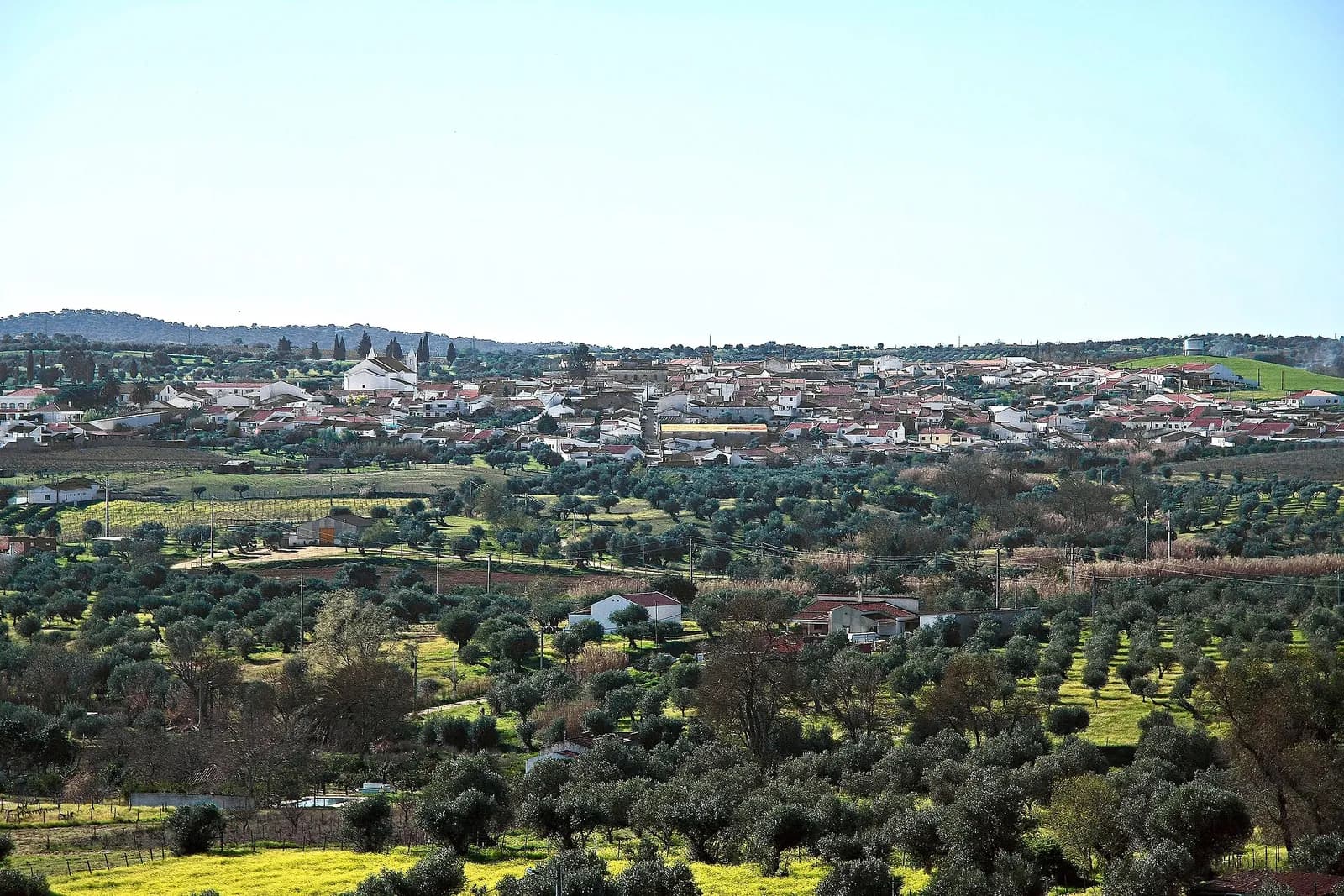
Spinoza's father, Michael d'Espinosa, was born in about 1587 or 1588 in Vidigueira, a wine town in the Alentejo north of Beja, near Évora. Its seigneurial rights had belonged to Vasco da Gama and then to his descendants. Michael was probably the second son of a prosperous merchant, Pedro Rodrigues Espinosa, and his wife, Mor Alvares.
Mor Alvares came from a New Christian family the Inquisition knew well. According to the historian Jonathan Israel, drawing on studies of the Inquisition's records, her grandfather Manoel Alvares was arrested in Vidigueira with several relatives in 1570, and several of her cousins were burned for “judaizing” at the auto-da-fé, the Inquisition's public ceremony of sentencing, in Évora in 1574.
In 1597 a new round of arrests took more of the family, among them Gabriel Alvares, secretary of an orphanage and a local tax collector, who was imprisoned with two of his sons and other relatives. They were tortured and stripped of their possessions. That year, Israel writes, Pedro fled Portugal with his son Michael, then about ten, to join relatives already settled in Nantes, in western France.
The dates are not settled. The Spinoza Web, a database run by Utrecht University, gives the early 1590s for the family's flight in one entry and 1605 in another, and has Pedro born in Vidigueira around 1550 to 1560; Israel says he was born in Lisbon around 1559. In Nantes the family lived outwardly as Catholics, in a tiny New Christian community that never numbered more than a dozen families.
Some of the Espinosas had moved on to Amsterdam by late October 1621, and Michael is documented there from the end of 1623. Pedro, who took the Jewish name Isaac de Espinosa, died in Rotterdam in 1627 and was buried in the Portuguese-Jewish cemetery, Beth Haim, at Ouderkerk aan de Amstel. Michael built up an import business in subtropical fruit and other foodstuffs and became a respected member of the community.
Spinoza's mother's family came from the north of Portugal. Her father, Henrique Garces, was from Porto, and her mother, Maria Nunes Garces, from Ponte de Lima. Where Hanna Deborah herself was born is uncertain. She married Michael in 1628, after the death of his first wife and cousin, Rachel.
1570
Arrests in Vidigueira
Manoel Alvares, grandfather of Spinoza's paternal grandmother, is arrested by the Inquisition with several relatives.
1574
Auto-da-fé at Évora
Several cousins of Mor Alvares are burned for judaizing.
c. 1587–88
Michael born
Spinoza's father is born in Vidigueira.
1590s–1605
Flight to Nantes
Sources give the early 1590s, 1597 or 1605.
1598–1605
Garces in Amsterdam
Henrique Garces of Porto, Spinoza's maternal grandfather, settles in the city.
By October 1621
To Amsterdam
Members of the Espinosa family leave Nantes for Amsterdam.
1628
Second marriage
Michael marries Hanna Deborah.
24 November 1632
Bento born
Probably in or near the Vlooienburg quarter.
3 April 1639
One congregation
Beth Jacob, Neve Shalom and Beth Israel unite as Talmud Torah.
Bento, the merchant's son
Bento grew up with four siblings, Mirjam, Isaac, Rebecca and Gabriel. By the early 1650s the family rented a brick house at the corner of the Houtgracht and the Leprozengracht; both canals were filled in in 1882, and the Mozes en Aäronkerk now stands on the spot. His mother died on 5 November 1638, when he was nearly six. His father married a third time, and his stepmother, Hester, from Lisbon, brought him up from the age of about eight.
He went to the congregation's Talmud Torah school and was clearly gifted. He may have been groomed for the rabbinate, but he never reached the advanced study of the Talmud. At seventeen he left school to help run the family's importing business.
“I wish that I could write you in the language in which I was raised. Perhaps I could express my thoughts better.”
Michael d'Espinosa died on 28 March 1654, aged about 65, and was buried at Beth Haim. Bento and Gabriel took over the firm, but it carried heavy debts. In March 1656 Bento turned to the Dutch authorities. On 16 March the Amsterdam Orphan Chamber declared him a minor and appointed a guardian, the lawyer Louis Crayers, who two years later would protect Rembrandt's son Titus.
Crayers argued that Bento was owed his mother's share of the estate ahead of his father's creditors, and on 23 March the Hoge Raad, the supreme court of Holland, released him from his father's inheritance. Going to a Dutch court broke a rule of the Portuguese community, which required its members to settle disputes among themselves.
The herem of 1656
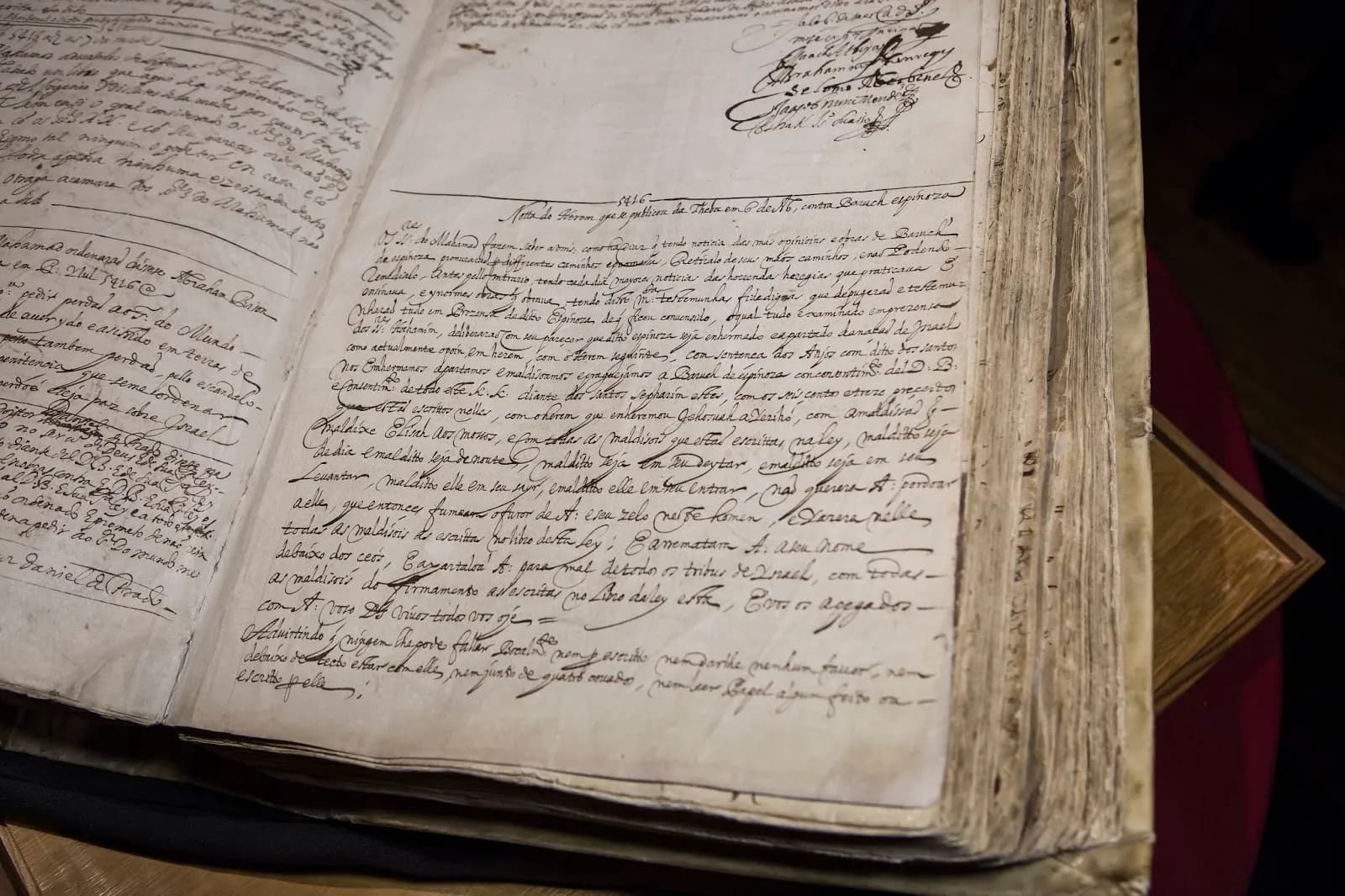
The ban came four months later. The ma'amad that year was six parnassim, the elected lay leaders, and a treasurer, the gabbai. The herem names no specific heresy and no specific deed, and Spinoza never mentions the episode in any surviving letter. Its full Portuguese text was copied onto page 408 of the congregation's register of resolutions, the Livro dos Acordos de Nação e Ascamot, now in the Amsterdam City Archives.
The entry raises questions of its own. Unlike similar records it is unsigned, and it comes after an entry dated weeks later. The eighteenth-century chronicler David Franco Mendes wrote that the public ceremony was not held until 22 Elul, about six weeks after the date on the writ. Kasher and Biderman suggest the community waited for him to recant before making the expulsion final.
Bans were common. The historian Yosef Kaplan counts forty people put under herem by the Portuguese Nation between 1622 and 1683, for offences from skipping synagogue to unpaid taxes. Most were worded in a matter-of-fact way. In 1639 Isaac de Peralta was banned for defying the ma'amad, insulting one of its members and, it was reported, attacking him in the street. He was readmitted after he asked forgiveness and paid a fine.
The curse formula used against Spinoza was old. Its Hebrew original was well known, and a Spanish translation had reached Amsterdam from Venice in 1618. Yet it is known to have been used only once more, against three alleged Karaites, followers of a Jewish movement that rejects rabbinic tradition, in 1712 according to Kasher and Biderman or 1718 according to the historian Natalia Muchnik.
The community had dealt with a dissenter before. Uriel da Costa, born Gabriel da Costa to a New Christian family in Porto, studied at Coimbra and came to Amsterdam with his family in 1614. He attacked rabbinic Judaism and was banned twice. In 1640 he submitted to a humiliating public penance in the synagogue, wrote an account of his life and killed himself.
Why Spinoza was punished so severely is still argued over. Some scholars point to the debt case. The biographer Steven Nadler takes the writ at its word: Spinoza was already voicing the ideas of his later books. Spanish travellers questioned by the Inquisition after returning from Amsterdam in the late 1650s said he told them he had been expelled for saying that the Law was not true, that God existed only “philosophically” and that the soul died with the body.
Denying that the soul survives death was especially dangerous, Nadler argues, for a community of former conversos who were not Dutch citizens and wanted to reassure their Calvinist hosts that it sheltered no such heretics. Muchnik places Spinoza among a wider current of doubt that ran through the Nação, fed by the experience of generations who had lived as Christians in public and Jews in private. In 1658 the community expelled Juan de Prado, a former New Christian physician who seems to have encouraged Spinoza's doubts.
“All the better; they do not force me to do anything that I would not have done of my own accord if I did not dread scandal.”
After Amsterdam: the Ethics
Spinoza studied Latin with Franciscus van den Enden, a former Jesuit, and read Descartes. By about July 1661 he had left Amsterdam for rented rooms in Rijnsburg, near Leiden. In 1663 he moved to Voorburg, outside The Hague, and between 1669 and 1671 to The Hague itself, where he lodged first on the Stille Veerkade and later with the decorative painter Hendrick van der Spijck on the Paviljoensgracht.
The only book he published under his own name was an exposition of Descartes's Principles of Philosophy, in 1663. His Theological-Political Treatise came out anonymously in 1670. It argued that the Bible was a human work and defended freedom of thought, and one critic called it “a book forged in hell by the devil himself”.
His masterpiece, the Ethics, is laid out like a geometry textbook, with definitions, axioms and propositions, each proved from what comes before. Its God is not a person who plans, commands or judges. What Spinoza called “God or Nature” is the single, infinite substance of which everything is a part. There are no miracles and no purpose in nature, and the soul does not survive death as a person. Happiness, he argued, lies in a life guided by reason, not by fear and hope.
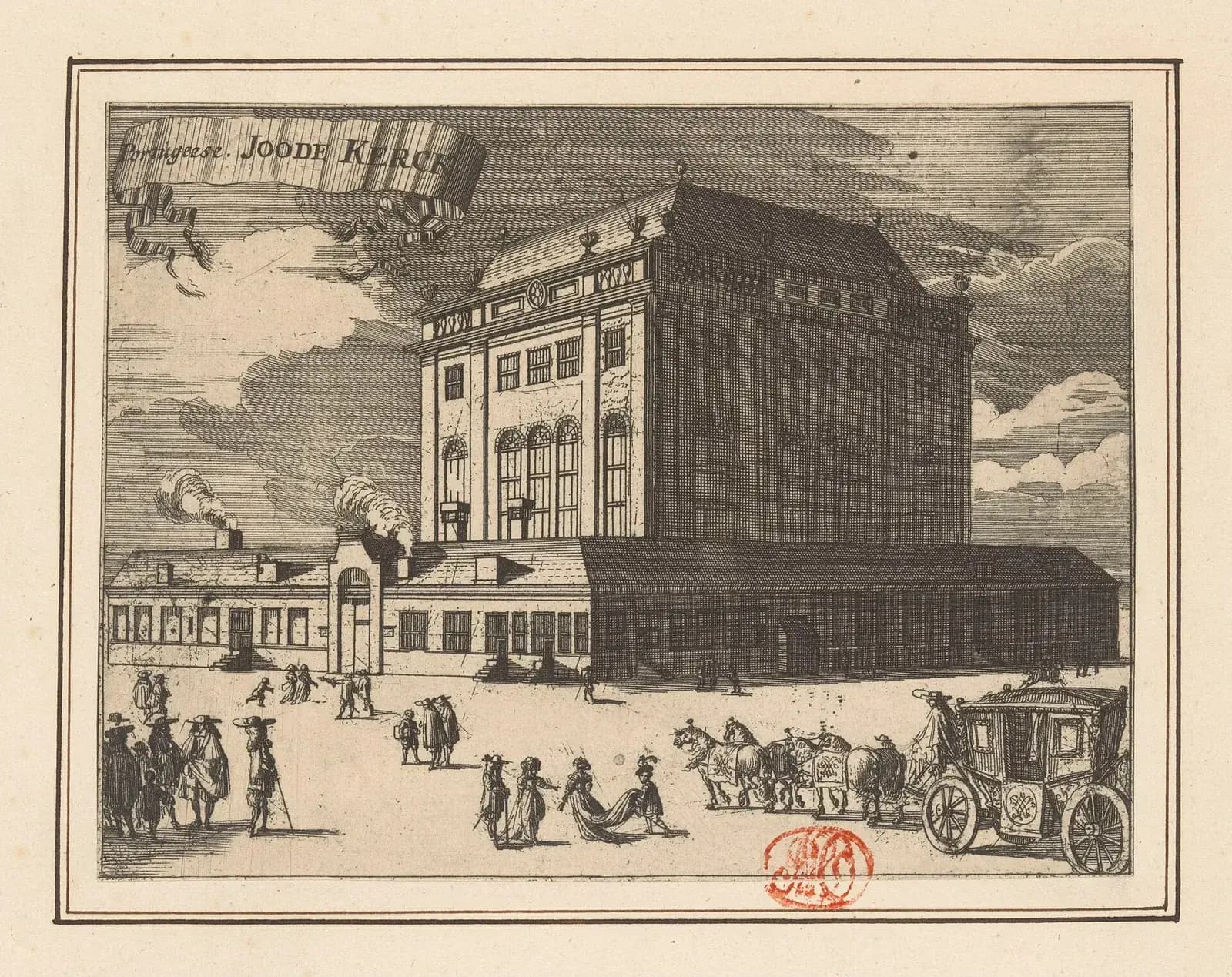
In the summer of 1675 he went to Amsterdam to have it printed. A rumour spread that he had written a book proving there was no God, theologians complained about him to the Prince of Orange and the magistrates, and he put the publication off. That same year the Portuguese Jews finished building their great new synagogue, the Esnoga, a short walk from his family's old house.
Spinoza died in his room on the Paviljoensgracht on 21 February 1677, of a lung disease, at the age of 44, and was buried in a churchyard in The Hague. His friends soon published his unpublished writings, the Ethics among them, as the Opera Posthuma, with a preface by Jarig Jelles, and in a Dutch translation, De nagelate schriften. In 1678 the Dutch authorities banned his works and set heavy penalties for anyone selling them.
- Born
- 24 November 1632, Amsterdam
- Names
- Bento (Portuguese), Baruch (Hebrew), Benedictus (Latin)
- Father
- Michael d'Espinosa, born in Vidigueira around 1587; died 1654
- Herem
- 27 July 1656, Talmud Torah congregation, Amsterdam
- Main works
- Theological-Political Treatise (1670, anonymous); Ethics (published after his death in 1677)
- Died
- 21 February 1677, The Hague, aged 44
Why it still matters
The congregation that cursed Spinoza still meets in the Esnoga. Of the community's 4,300 Portuguese Jews, 3,700 were murdered in the Holocaust, but services resumed in the Esnoga on 9 May 1945, four days after the liberation of the Netherlands. Today about 630 people belong to the community, and announcements on everyday matters are still made in Portuguese.
Portuguese editions call him Bento de Espinosa. Joaquim de Carvalho's Portuguese translation of the Ethics was reissued in 1992. Portuguese scholars, Carvalho and António Borges Coelho among them, helped trace the family back to Vidigueira.
Portugal has also tried to make amends to the descendants of the Jews it drove out. In 2013 parliament voted unanimously to let descendants of Sephardic Jews expelled from Portugal apply for citizenship, as a historical reparation. The rules took effect in 2015, and applications rose quickly.
Citizenship applications from descendants of Sephardic Jews
applications
2015 counts from late March, when the rules took effect. Figures for 2015 to 2017 are from the Instituto dos Registos e do Notariado, reported by Diário de Notícias; the 2019 figure of about 25,000 is the foreign minister's, reported by Lusa in 2020. No figure for 2018 was found in these sources.
Show the data
| Applications | |
|---|---|
| 2015 | 466 |
| 2016 | 5,100 |
| 2017 | 7,044 |
| 2019 | 25,000 |
By April 2020 there had been 52,440 applications, and claims of abuse led to proposals to tighten or end the scheme. Lei Orgânica n.º 1/2026 of 18 May 2026 repealed the provision, article 6(7) of the Nationality Law, from the following day. Applications already pending are decided under the old rules.
FAQs
Was Spinoza Portuguese?
He was born and lived his whole life in the Dutch Republic, but his family was Portuguese. His father was born in Vidigueira, in the Alentejo, his maternal grandparents came from Porto and Ponte de Lima, and he grew up in Amsterdam's Portuguese-Jewish community, where Portuguese was spoken at home. His Portuguese name was Bento de Espinosa.
When and where was Spinoza born?
On 24 November 1632 in Amsterdam, probably in or near the Vlooienburg quarter, where most of the city's Sephardic Jews lived. No birth record survives.
Why was Spinoza excommunicated?
The writ of 27 July 1656 speaks of “evil opinions”, “abominable heresies” and “monstrous deeds” without naming them. Steven Nadler and many other historians think he was already expressing the views of his later books: that God is Nature, that the Law of Moses is no longer binding and that the soul does not survive death. He had also broken a community rule by taking a debt case to a Dutch court.
Has Spinoza's excommunication been lifted?
No. The herem was never rescinded. In 2015 the chief rabbi of Amsterdam's Portuguese Jewish community declined calls to revoke it, while noting that the synagogue's own shop sells Spinoza's books.
When was Spinoza's Ethics published?
After his death. Spinoza tried to have it printed in Amsterdam in 1675 but held back when rumours spread that he had written a book denying God. He died on 21 February 1677, and his friends published it with his other unpublished writings later that year, in the Opera Posthuma.
On the timeline
Open the timelineNearby moments from the iberian union (1580–1640).
Father António Vieira is born in Lisbon, in a house near the Sé. The Jesuit preacher, diplomat and royal adviser became the great prose stylist of the Portuguese Baroque — Pessoa's 'emperor of the Portuguese language' — and a fierce defender of Brazil's indigenous peoples.
Captain Francisco Caldeira Castelo Branco's expedition from São Luís founds the Forte do Presépio on Guajará Bay, near the mouth of the Amazon, the nucleus of Belém do Pará; 12 January is the traditional date, reckoned from a report that the voyage took 18 days.
Death in Goa of the chronicler Diogo do Couto, aged about 74. Sent to India as a teenage soldier, he found his friend Luís de Camões stranded and penniless on the Island of Mozambique in 1569 and, with others, helped him get home with the manuscript of 'Os Lusíadas'. Later keeper of the Goa archives, he continued João de Barros's 'Décadas da Ásia'.
Spinoza and the Portuguese Nation
Baruch (Bento) de Espinosa is born in Amsterdam to a family of Portuguese Jews who had fled the Inquisition. Expelled from the city's Portuguese-Jewish congregation in 1656 for his heterodox views, he became one of the great philosophers of the early modern age, author of the 'Ethics'.
Coming up in history
All long reads 26 November 1967The Lisbon floods of November 1967: a night of rain and a censored toll
 27 November 2011Fado becomes world heritage: UNESCO's verdict in Bali, 27 November 2011
 28 November 1975Fretilin proclaims East Timor's independence, 28 November 1975
 29 November 1807The day the Portuguese court sailed for Brazil: 29 November 1807
30 sources
Archives, scholarship and reporting this article was checked against.
- 1
Why Spinoza Was Excommunicated (Steven Nadler, Humanities 34, no. 5, September/October 2013)National Endowment for the Humanities
- 2
Baruch Spinoza (Steven Nadler, revised 8 November 2023)Stanford Encyclopedia of Philosophy
- 3
Why Was Baruch de Spinoza Excommunicated? (Asa Kasher and Shlomo Biderman)Tel Aviv University (author's page)
- 4
King Philip II of Spain as a symbol of 'Tyranny' in Spinoza's Political Writings (Jonathan Israel, Co-herencia 15, no. 28, 2018)Universidad EAFIT, via Redalyc
- 5
Michael d'Espinosa (database entry)The Spinoza Web, Utrecht University
- 6
La mise au ban de Spinoza : délitement communautaire ou sécularisation du judaïsme ? (Natalia Muchnik, in Histoire des Juifs, PUF, 2020)Éditions Chandeigne
- 7
Joaquim de Carvalho: Spinoza pensava em português (Emanuel Angelo da Rocha Fragoso)Universidade Estadual do Ceará, published by Santa Barbara Portuguese Studies (UC Santa Barbara)
- 8
History of the communityPortugees-Israëlietische Gemeente Amsterdam
- 9
- 10
- 11
- 12
Roteiro da Inquisição em Lisboa: uma possibilidade cultural?João Miguel Cabral Borges Capela, master's dissertation, Iscte – Instituto Universitário de Lisboa, 2021
- 13
De fio a pavio: a história da Inquisição Portuguesa revisitada (review of Marcocci and Paiva, 2013)Georgina Silva dos Santos, Tempo (Universidade Federal Fluminense), 2014
- 14
Judeus portugueses em Amesterdão no século XVII: fluxos de emigração e níveis de integração (Cláudia Sofia Nunes Duarte, In Omni Tempore, 2019)Faculdade de Letras da Universidade do Porto
- 15
- 16
- 17
- 18
Spinoza, Correspondence, letters 1661–1665 (translated by Jonathan Bennett)Early Modern Texts
- 19
- 20
- 21
Uriel da Costa, 1585–1640The Posen Library of Jewish Culture and Civilization
- 22
- 23
- 24
- 25
- 26
Amsterdam's Portuguese Jews banned philosopher Baruch Spinoza. 360 years later, could the ban be lifted? (Cnaan Liphshiz, 10 December 2015)Jewish Telegraphic Agency
- 27
PSD “aperta” lei para dar nacionalidade a descendentes de judeus sefarditas (6 July 2020)24 Notícias (Lusa)
- 28Mais de 2100 sefarditas adquiriram nacionalidade portuguesa (27 February 2018)Diário de Notícias
- 29
Cessação de vigência do regime de concessão da nacionalidade portuguesa a descendentes de judeus sefarditas (18 October 2023)Ordem dos Advogados
- 30
Lei Orgânica n.º 1/2026, de 18 de maio (Diário da República, 1.ª série, n.º 95)Assembleia da República, copy hosted by the Regional Government of Madeira
Image credits
- The Talmud Torah synagogue on the Houtgracht in Amsterdam, begun in 1639 for the newly united Portuguese-Jewish congregation and demolished in 1931. The herem against Spinoza was proclaimed here in 1656. Print after a drawing by Jan Veenhuysen, published in 1664. Rijksmuseum, CC0, via Wikimedia Commons.
- Vidigueira, in the Alentejo, seen across olive groves in 2013. Spinoza's father was born in the town around 1587. Vitor Oliveira from Torres Vedras, PORTUGAL, CC BY-SA 2.0, via Wikimedia Commons.
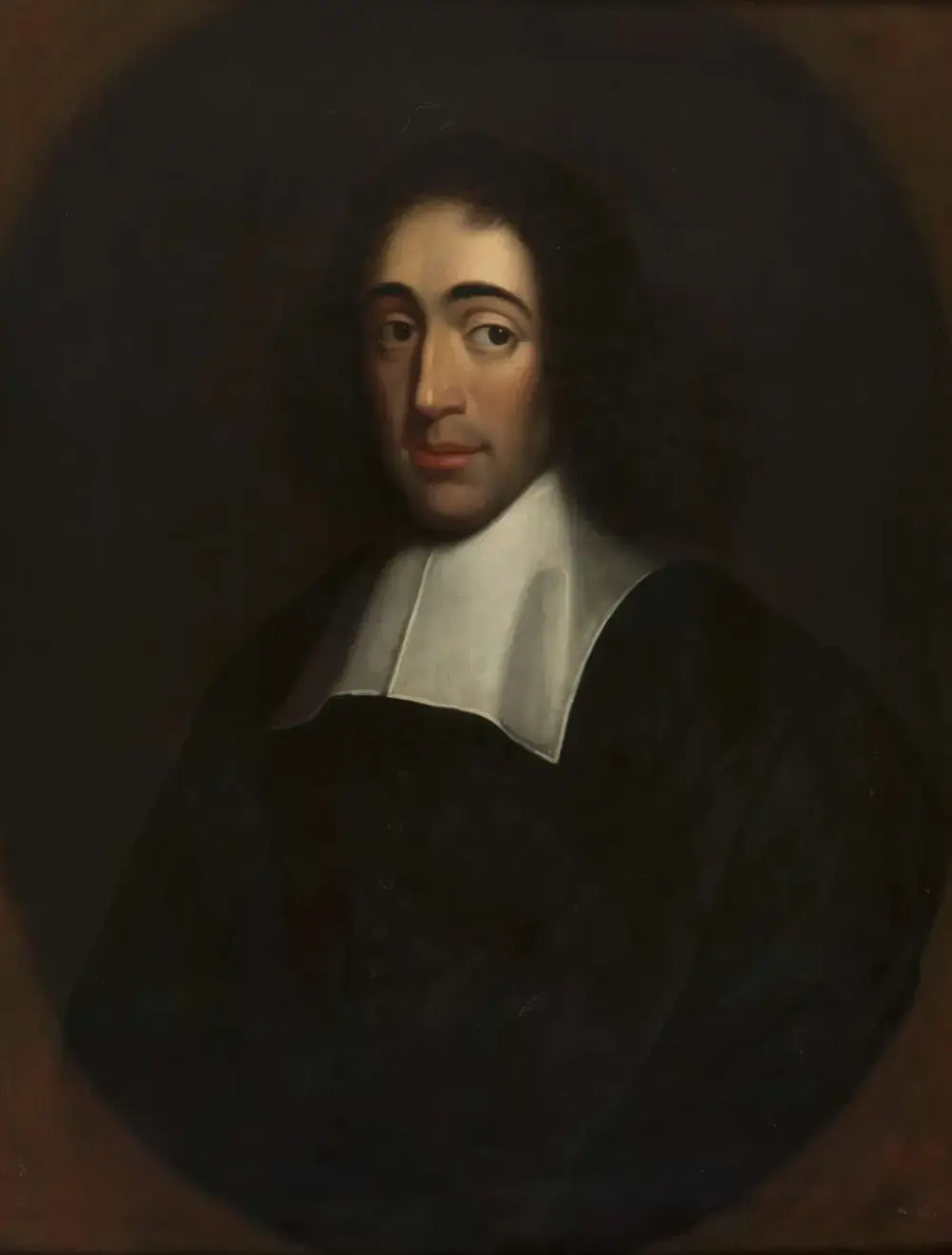
- Portrait of Spinoza by an unknown painter, about 1665, in the Herzog August Bibliothek, Wolfenbüttel. anonymous, Public domain, via Wikimedia Commons.
- The herem against Spinoza in the Talmud Torah congregation's register of resolutions, the Livro dos Acordos de Nação e Ascamot, dated 6 Av 5416 (27 July 1656). Unknown author, Public domain, via Wikimedia Commons.
- The new Portuguese Synagogue, or Esnoga, built between 1671 and 1675 and still in use. Etching titled Portugeese Joode Kerck, possibly by Romeyn de Hooghe, made between 1675 and about 1725. Rijksmuseum, CC0, via Wikimedia Commons.