

The day the Portuguese court sailed for Brazil: 29 November 1807
With a French army four days' march away, the Prince Regent put his mother, his family, his treasury and as many courtiers and officials as the ships would hold aboard a fleet in the Tagus. They crossed the Atlantic under the British flag, and the monarchy governed from Rio de Janeiro for the next thirteen years.
At a glance
- On the morning of 29 November 1807 a Portuguese fleet carrying Queen Maria I, the Prince Regent João and the whole royal family left the Tagus for Brazil, escorted by a British squadron under Sir Sidney Smith.
- General Jean-Andoche Junot entered Lisbon the next day, 30 November, at the head of about 1,500 exhausted French soldiers by the historian Charles Oman's count, and found the court gone.
- About 36 Portuguese ships sailed. How many people went is disputed: the figure most often repeated is 10,000 to 15,000, while lower estimates run from about 6,000, not counting the court, down to a few hundred.
- The Prince Regent reached Salvador on 22 January 1808 and opened Brazil's customs houses to the ships of friendly nations on 28 January. He entered Rio de Janeiro harbour on 7 March 1808.
- The court stayed in Rio for thirteen years. Brazil was raised to a kingdom in 1815, João VI sailed home in April 1821, and Brazil declared independence in 1822.
A beija-mão on the quay at Belém
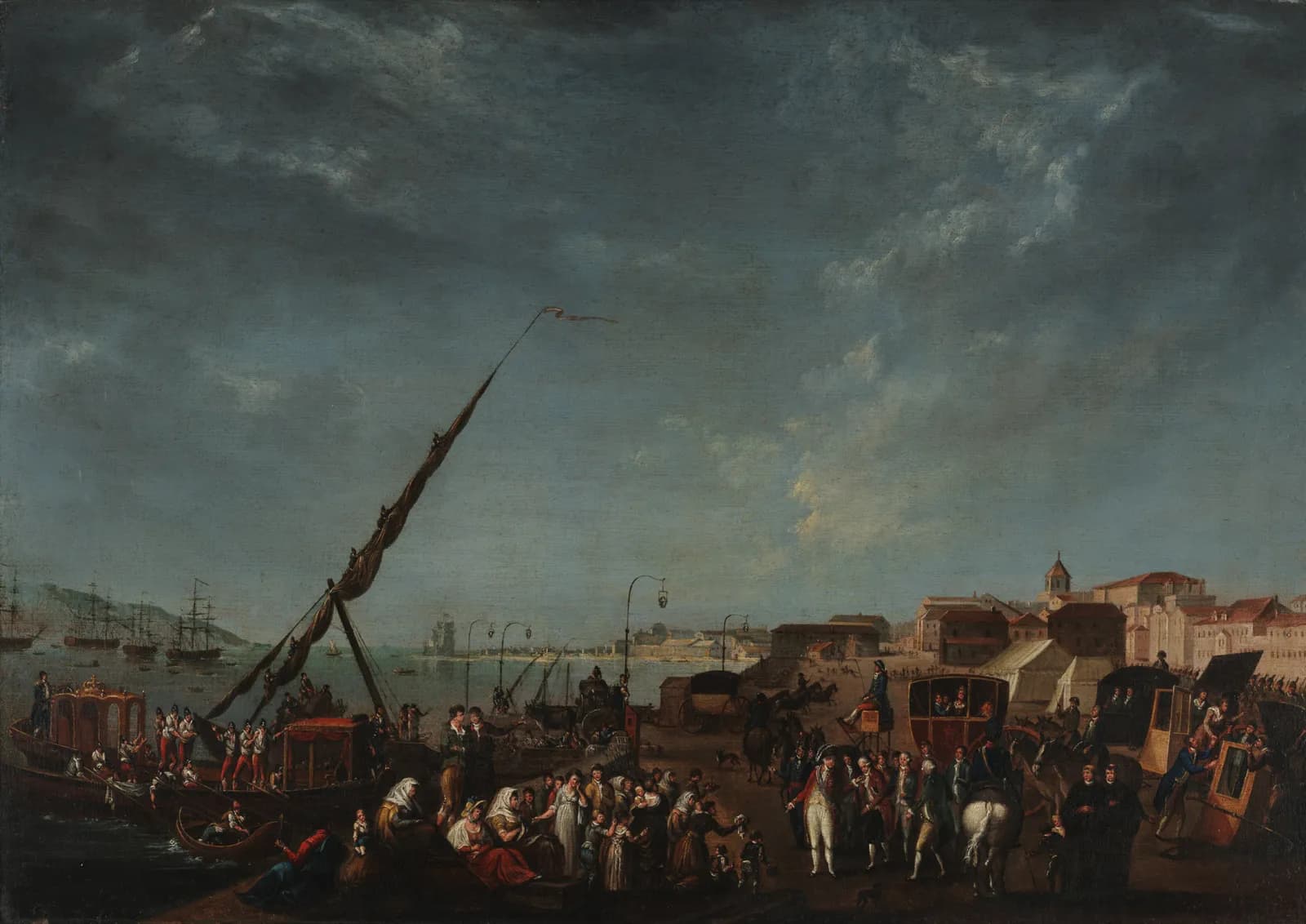
On 27 November 1807, a little before midday, the Prince Regent of Portugal stood on the quay at Belém, on the western edge of Lisbon, and held a last beija-mão, the ceremony at which subjects kissed the royal hand. Then he was rowed out to the Príncipe Real, an 84-gun ship of the line anchored in the Tagus, which was to carry him, his mother, Queen Maria I, his sons Pedro and Miguel and his Spanish nephew Pedro Carlos.
His wife, Carlota Joaquina, went aboard the Afonso de Albuquerque with four of their daughters. The queen's sisters took the Príncipe do Brasil, and two more princesses the Rainha de Portugal. Behind them, courtiers, officials, servants and their families scrambled for room on the remaining ships.
José Trazimundo, the future Marquês de Fronteira, was five. Relatives of his were leaving with the court, and his aunts tried to take him to see them off. Decades later he described what they found.
“My aunts at once sent for two carriages, which took us in all haste to the quay at Belém, where the greatest confusion and disorder reigned. The court's baggage, exposed to the weather and almost abandoned, covered the ground from the Rua da Junqueira to the quay… I shall never forget the tears I saw shed by the people, by the servants of the Royal Household and by the soldiers who were in the Largo de Belém.”
For two days the wind held from the west and the fleet could not move. During the night of the 28th it swung round to the south-east. At first light on the 29th the crews weighed anchor, took the river pilots aboard and ran down the Tagus and over the bar.
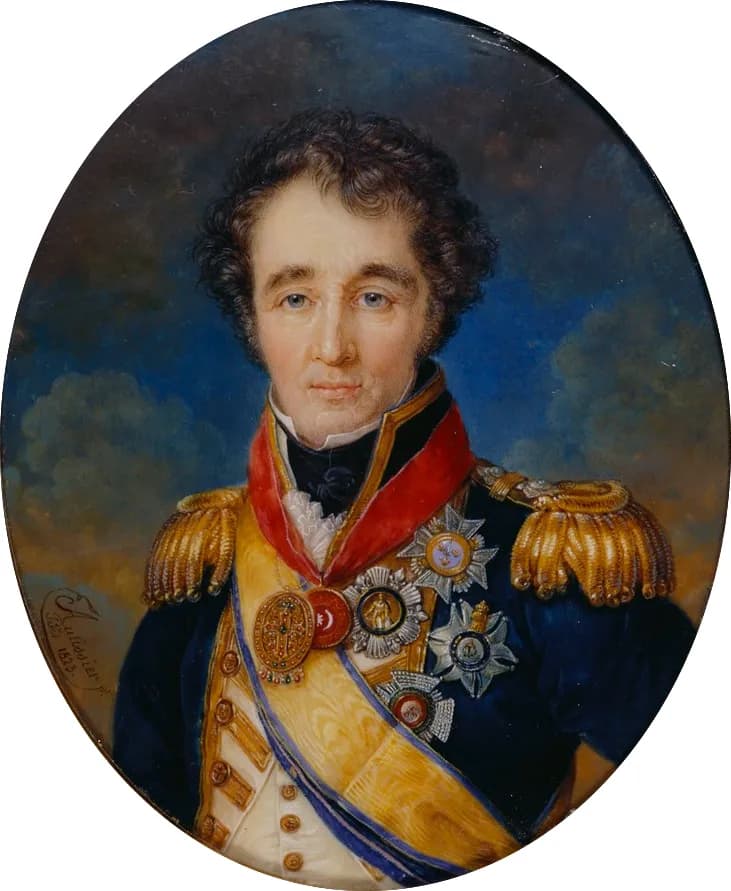
Outside, Sir Sidney Smith's British squadron was waiting in line of battle with its guns manned. Until the day before, in Smith's words, the two fleets had been on terms of hostility. After a friendly exchange the ships fired a salute of 21 guns at about half past four. The Príncipe Real stayed silent so as not to frighten the queen, who was mentally ill. By Light's reckoning, the first French troops marched into Lisbon some eighteen hours later.
Portugal between Napoleon and Britain
By 1807 Napoleon had beaten every power in continental Europe, but after Trafalgar, in 1805, he could not touch Britain at sea. His answer was the Continental Blockade, begun in 1806: no port in Europe was to trade with the British. Portugal, Britain's old ally, was the last gap in the wall.
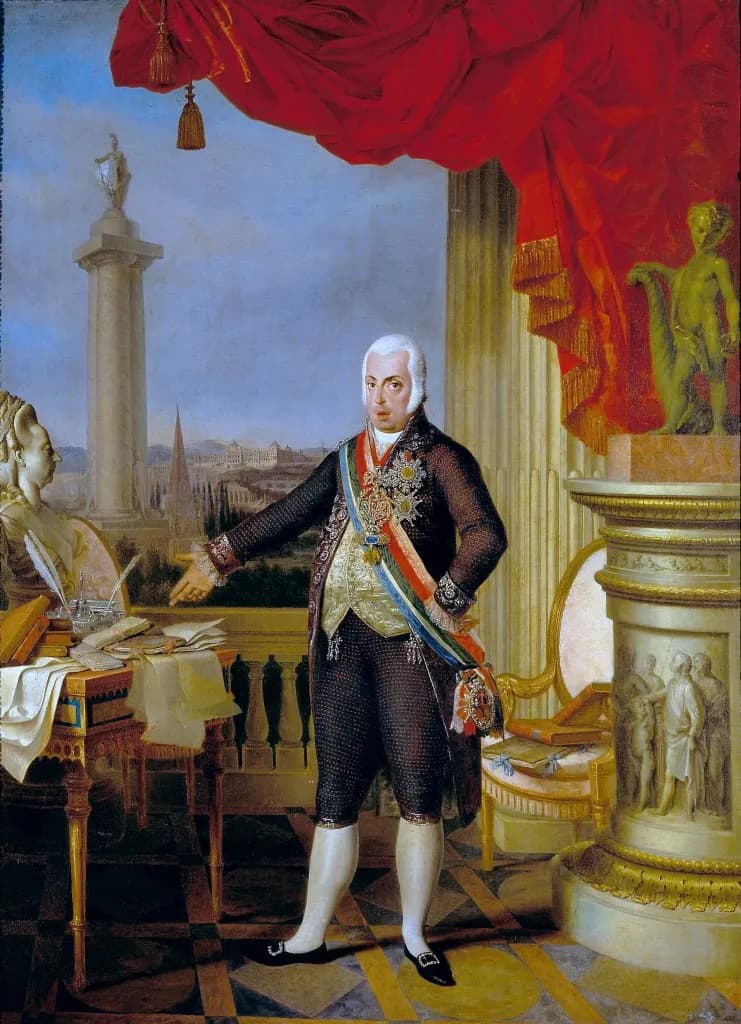
Portugal was ruled by João, Prince of Brazil, as regent for his mother, Maria I, whom illness had left unable to govern. He wanted above all to stay neutral. On 12 August 1807 the French and Spanish envoys in Lisbon gave him until 1 September to declare war on Britain, close his ports, seize British goods and arrest British subjects.
João tried to do half of what was asked. He offered to close the ports but refused to seize British merchants without a declaration of war. Napoleon rejected the offer, and on 30 September the envoys left Lisbon. The prince gave way step by step: he declared war on Britain on 20 October and ordered the detention of the British subjects still in Portugal on 8 November.
At the same time he kept a door open to London. A secret convention signed with Britain on 22 October provided for the Royal Navy to escort the Portuguese fleet if the court had to leave. According to the historian Kenneth Light, the voyage had been prepared over the previous six months without alarming France or Spain.
Napoleon had already decided what would happen to Portugal. On 27 October 1807, at Fontainebleau, his marshal of the palace, Géraud Duroc, and Eugenio Izquierdo, the private agent of the Spanish chief minister Manuel Godoy, signed a secret treaty that carved the kingdom into three.
| Territory | To go to | Title |
|---|---|---|
| Entre-Douro-e-Minho, with Porto | The King of Etruria, a Spanish Bourbon prince | King of Northern Lusitania |
| Alentejo and the Algarve | Manuel Godoy, Spain's chief minister | Prince of the Algarves |
| Beira, Trás-os-Montes and Portuguese Estremadura, with Lisbon | Held by France until a general peace, then disposed of by agreement | None |
| Portugal's overseas colonies | To be divided equally between France and Spain | Charles IV of Spain to become Emperor of the Two Americas within three years |
A secret convention signed the same day set the invading force at 25,000 French infantry and 3,000 cavalry, joined by Spanish corps, with 40,000 more French troops to gather at Bayonne.
Junot's race to Lisbon
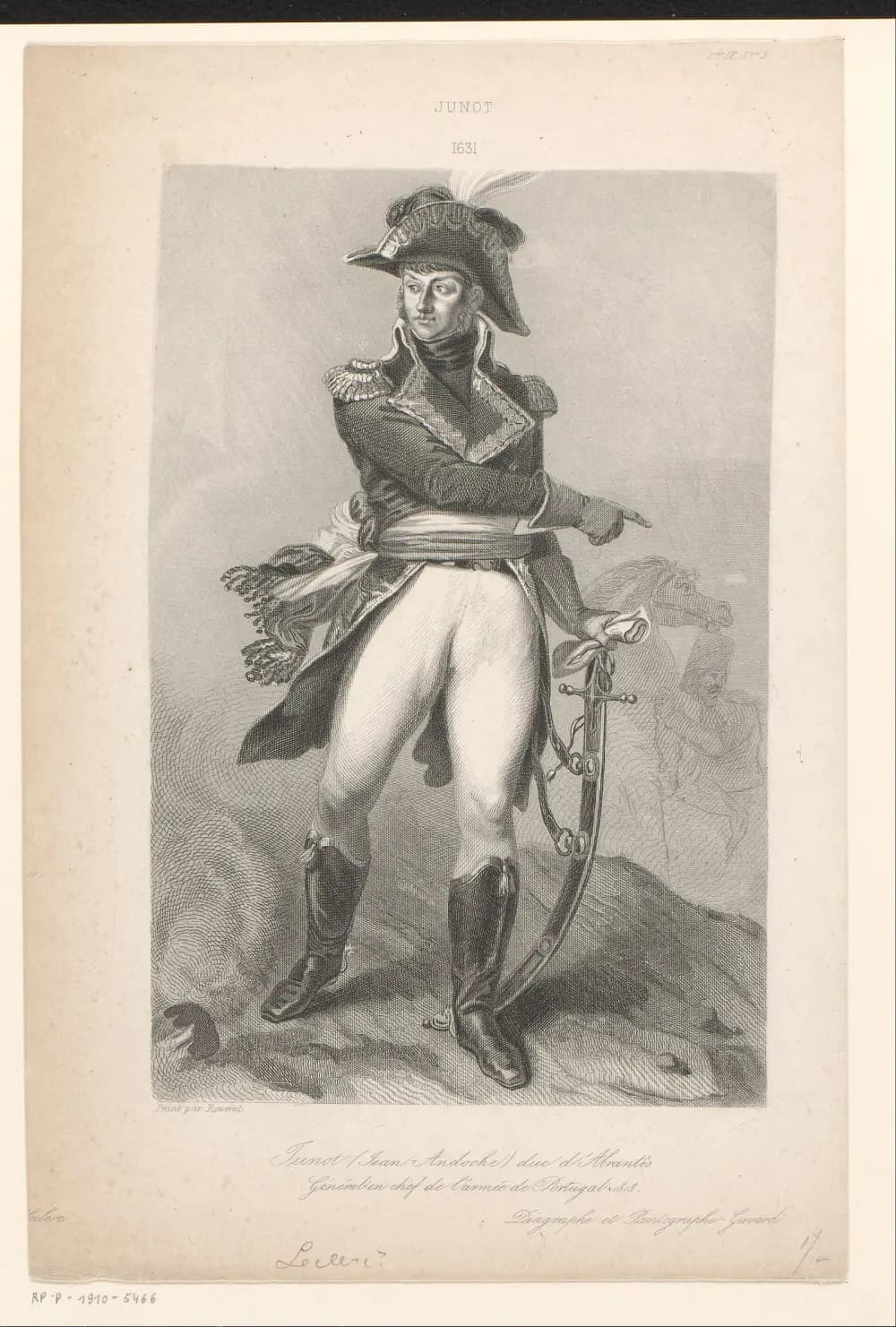
The French army had crossed into Spain on 18 October, before the treaty was even signed. Its commander, General Jean-Andoche Junot, knew Lisbon well: he had been Napoleon's ambassador there in 1805. Charles Oman, the British historian of the Peninsular War, judged him a good fighting man but a mediocre general.
On 12 November, at Salamanca, Junot received orders to hurry. Napoleon told him to drop the usual road through Almeida and Coimbra and go straight down the Tagus valley, the shortest way on the map. “20,000 men can feed themselves anywhere, even in a desert,” the emperor wrote.
The map did not show the country. The army struggled over the mountain track to Alcántara and then along the Portuguese side of the frontier in the November rains, through granite ravines with every stream in flood. Half the horses died, nearly all the guns were left behind, and a quarter of the infantry scattered to look for food. The head of the column reached Abrantes on 23 November.
At Abrantes Junot found no Portuguese army, only an envoy offering submission. He picked the fittest companies of every regiment, formed four battalions and pushed on for the capital, about 75 miles away, with neither guns nor cavalry.
In Lisbon, the British minister, Lord Strangford, had left the city and joined Sir Sidney Smith's squadron off the Tagus on 17 November. Smith declared the river blockaded. What finally made up the prince's mind was a newspaper. A copy of the Paris Moniteur, brought from England by a British warship, reported that the House of Braganza had ceased to reign in Europe. Light dates its arrival to 24 November, and the Council of State resolved that same day to leave for Brazil. Oman has Strangford receiving the paper a day later.
The decree and the scramble for the ships
The decree announcing the departure was signed at the palace of Ajuda on 26 November. The Lisbon chronicler says it was posted up on the 27th; Strangford wrote that it was published on the 28th. It blamed the French: the prince had closed his ports to the subjects of “My Ancient and Loyal Ally the King of Great Britain” and emptied his treasury to keep the peace, and still the emperor's troops were marching on the capital.
“Wishing to avoid the fatal consequences that may follow from a defence which would be more harmful than useful, serving only to shed blood to the detriment of humanity… I have resolved, for the benefit of My vassals, to go with the Queen My Lady and Mother, and with all the Royal Family, to the States of America, and to establish Myself in the City of Rio de Janeiro until the general Peace.”
The decree named five governors to rule in his absence, with the Marquês de Abrantes first among them. Its written instructions told the governors to keep the peace and to see that the emperor's troops were well quartered and supplied, punishing any insult to them. Lisbon was to be handed over, not defended.
An anonymous Lisbon chronicler, writing in 1809, remembered the three days that followed as a time when everything seen and heard was misfortune: palaces being stripped and left open, and streets full of stunned crowds, like a flock that had lost its shepherd.
“The quays heaped with household goods and fine furniture left unattended; the Tagus thick with transport boats hurrying from one bank to the other; ships in no order, with few sailors, less ballast, badly rigged, slipping their moorings suddenly and in confusion; merchandise and goods going aboard without clearance or inspection; the price of provisions climbing without limit; countless families on the beaches in floods of tears, saying goodbye to relatives and friends.”
Money stopped moving. The discount on paper currency swung wildly, and on the afternoon of the 28th and all of the 29th the exchange houses stayed shut.
Not everything went. In a report to the prince of 12 October 1808, Alexandre António das Neves, keeper of the royal library at Ajuda, recalled that of the many crates of books ready for loading, not one had been taken from the quay on board. The historian Lilia Schwarcz follows the library to Rio in three shipments in 1810 and 1811, the last 87 crates arriving in November 1811. Other accounts, including the timeline of Brazil's National Library, have books landing with the court in 1808, and the crate counts differ.
12 August
Ultimatum
France and Spain demand that Portugal declare war on Britain by 1 September.
18 October
Junot enters Spain
The French army crosses the Bidassoa at Irun.
20 October
War on Britain
Portugal declares war on its old ally.
22 October
Secret convention
Britain agrees to escort the Portuguese fleet if the court leaves.
27 October
Fontainebleau
France and Spain agree to partition Portugal.
17 November
Blockade
Strangford joins Sidney Smith's squadron off the Tagus; the river is blockaded.
23 November
Abrantes
The head of Junot's column reaches Abrantes.
24 November
Decision
The Moniteur reaches the prince and the Council of State resolves to leave.
26–27 November
Decree and embarkation
The decree is signed and posted; the royal family goes aboard.
29 November
Departure
The wind turns and the fleet crosses the bar under British escort.
30 November
Junot in Lisbon
About 1,500 French soldiers enter the capital.
13 December
Tricolour
The Portuguese flag is lowered in Lisbon; a riot is broken up by cavalry.
How many ships, and how many people
The warships can be counted, because Smith copied the list given to him by the Portuguese admiral on the day of departure. The merchant ships are vaguer. Smith wrote only of “a crowd of large armed merchant ships”. Strangford put the whole fleet at about 36 sail, and the Lisbon chronicler's own list also adds up to 36.
| Source | Warships | Merchant ships | Total |
|---|---|---|---|
| Lord Strangford, dispatch of 29 November 1807 | 8 ships of the line, 4 large frigates, several armed brigs, sloops and corvettes | “A number of Brazil ships” | About 36 |
| Sir Sidney Smith, list of 1 December 1807 | 8 ships of the line (64 to 84 guns), 4 frigates, 3 brigs, 1 schooner | “A crowd of large armed merchant ships” | Not given |
| Observador Portuguez, Lisbon, 1809 | 8 ships of the line, 3 frigates, 2 brigs, 1 schooner, 1 supply ship | 21 | 36 (the sum of its list; no total is printed) |
| Charles Oman, historian (1902) | 15 men-of-war | “More than twenty” | Not given |
| Kenneth Light, from British log books | 18 Portuguese warships, plus 13 British | 26 | 36 ships sailed for Brazil |
Smith's text says two brigs, but his list names three, and he gives four frigates, one of them unnamed. Light's count of 18 warships and 26 merchantmen comes from the British logs a few days out and does not match his own total of 36 ships for the voyage.
Nobody counted the passengers. According to the historians Antonio Otaviano Vieira Junior and Daniel Barroso, writing in 2010, the version repeated most often puts the royal party at between 10,000 and 15,000. Lisbon's Museu dos Coches used 15,000 for its 2017 exhibition marking 210 years since the departure. Charles Oman also wrote of 15,000 people fleeing with the prince, and John Luccock, an English merchant in Rio, put the newcomers there at 15,000.
Kenneth Light, who spent five years on the log books of the British escort, wrote of “perhaps a total of some 12,000 to 15,000 Portuguese”. Other estimates, gathered by Vieira Junior and Barroso, are less generous. One puts the people who followed the squadron at about 6,000, before the royal family and the court are added. Another counts only 211 people, besides the royal family, arriving in Brazil in 1808, with 233 more travellers in 1809.
Drawing on a 2008 review of the figures by the historian Jurandir Malerba, Vieira Junior and Barroso put the spread down to the different documents used and how they were read. The logs give one hard number. After 69 passengers were moved to HMS London on 6 December, the Príncipe Real still had 1,054 people aboard: a crew of 950 and 104 passengers.
- Ships that sailed for Brazil
- About 36, by Strangford, the Observador Portuguez and Light
- Portuguese ships of the line
- 8, from the 84-gun Príncipe Real down to 64-gun ships
- Ships of the line left in Lisbon
- 4, one under repair and three judged unserviceable
- People aboard the Príncipe Real
- 1,054 after 6 December: 950 crew and 104 passengers
- Estimates of all who sailed
- From a few hundred to 15,000; the range most often repeated is 10,000 to 15,000
Across the Atlantic under the British flag
Smith went aboard the Príncipe Real to pay his respects on the day of departure and reported to London on 1 December. His dispatch was printed in the London Gazette on 22 December 1807, together with Strangford's, which presented the departure as the reward of British policy towards Portugal.
“The Scene impressing every Beholder (except the French Army on the Hills) with the most lively Emotions of Gratitude to Providence, that there yet existed a Power in the World able, as well as willing, to protect the oppressed.”
The fleet headed north-west at first, because a south-easterly gale allowed no other course. The ships struck their upper masts to ride it out. On 5 December, roughly halfway to Madeira, Smith turned back to resume the blockade of Lisbon. Four British ships of the line, the Marlborough, London, Bedford and Monarch, under Captain Graham Moore, stayed with the Portuguese all the way to Brazil.
On the night of 8 December, about 50 leagues north of Madeira, the fleet hove to in rain and poor visibility. The Príncipe Real and the Afonso de Albuquerque, with two frigates and the Bedford, sailed on without signalling and by morning were alone. The two halves of the fleet never met again at sea, although on 2 January 1808 they passed within sight of each other's lights.
The division with the Rainha de Portugal and the Conde D. Henrique watered at Santiago, in the Cape Verde Islands, and made straight for Rio. The royal ships went on without stopping, lost ten days crawling through the calms near the equator, and on 16 January changed course for Salvador da Bahia.
Days from the Tagus to arrival in Brazil
days after 29 November 1807
Days counted from departure on 29 November 1807 to the arrival dates given by Kenneth Light from British log books (1808 was a leap year). Light, counting both ends, gives 55 days for the Príncipe Real's voyage to Salvador. The Martim de Freitas stopped briefly at Salvador on the way to Rio, the last bar includes a month in Salvador, and the Príncipe do Brasil was delayed by repairs.
Show the data
| Days at sea | |
|---|---|
| Medusa (Recife, 13 Jan) | 45 |
| Rio division (17 Jan) | 49 |
| Príncipe Real (Salvador, 22 Jan) | 54 |
| Martim de Freitas (Rio, 26 Jan) | 58 |
| Príncipe do Brasil (Rio, 13 Feb) | 76 |
| Príncipe Real (Rio, 7 Mar) | 99 |
Salvador, Rio and a court in the tropics
The Príncipe Real anchored at Salvador da Bahia on 22 January 1808. The royal family went ashore the next day and the queen the day after. For a month the prince held audiences and dealt with local business.
The most important decision of that month came on 28 January. With Lisbon occupied, Brazil's trade, which by law had to pass through Portugal, had stopped. A royal letter to the governor of Bahia, the Conde da Ponte, admitted to Brazil's customs houses all goods carried in Portuguese ships or in those of powers at peace with the crown. It was described as provisional. In practice the main beneficiary was Britain.
The fleet left Salvador on 26 February, with 84 strongboxes of valuables transferred to the Bedford, and entered the harbour of Rio de Janeiro on 7 March 1808 to salutes from the forts and ships. Rio had been preparing since January. The viceroy's palace was enlarged by taking over the jail next door, its walls hung with silk, and a canopy of fine cloth was put up near the quay.
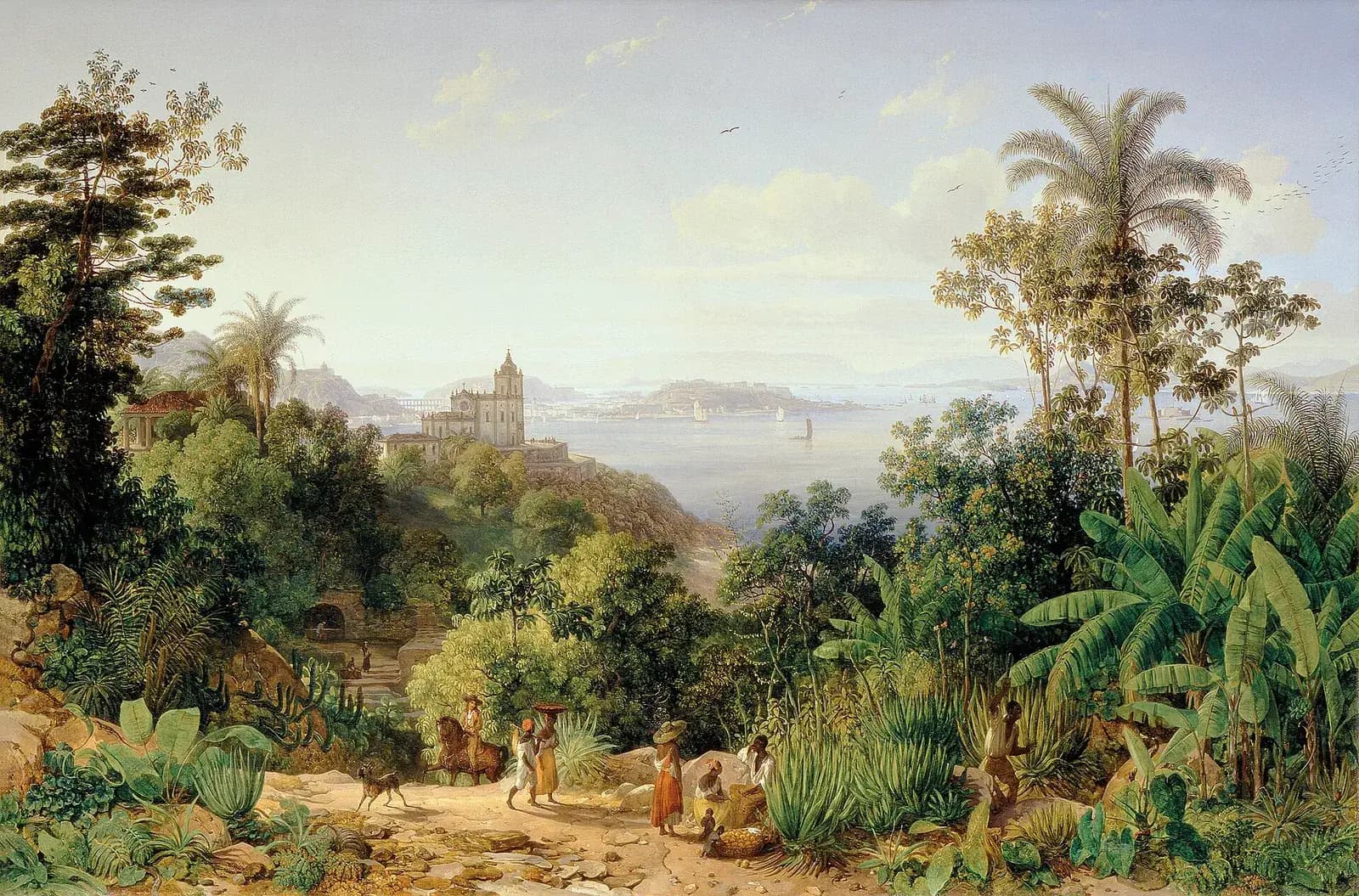
On 11 March the prince named his ministers, and Rio began to acquire the machinery of a European capital: a royal press, the first in Portuguese America, a medical school, academies, the royal library, a Bank of Brazil and Brazilian copies of the high courts and treasury of Lisbon. The city's population doubled to about 80,000 between 1808 and 1821. About half its people were enslaved Africans and their descendants.
Aftermath: two capitals, one crown
Oman puts Junot at the head of about 1,500 soldiers in rags, their cartridges soaked through; the Lisbon chronicler put the ragged first division at nearer 10,000. Nobody resisted. The stragglers took ten days to come in, and the Spanish columns entered the north and south of the country in December. When Junot had the Portuguese flag replaced by the tricolour on 13 December, a crowd rioted and was dispersed by a cavalry charge.
Junot then broke up the Portuguese army and sent about 6,000 to 7,000 of its men to serve Napoleon in northern Europe. Many of them later died in the retreat from Moscow. He was beaten by an Anglo-Portuguese army in August 1808 and left under the Convention of Cintra. Two more French invasions followed, the last stopped in 1810 by the Lines of Torres Vedras.
The crown, meanwhile, stayed across the Atlantic. Lisbon was governed by the regency, more and more subordinated to the needs of the British army. The king's return in 1821, according to the journalist Armando Seixas Ferreira, who has read the logs of two of its ships, was better prepared and better supplied than the departure of 1807.
| Lisbon to Brazil, 1807–1808 | Rio to Lisbon, 1821 | |
|---|---|---|
| Departure | 29 November 1807 | 26 April 1821 |
| Arrival | Salvador 22 January 1808; Rio harbour 7 March 1808 | Tagus at Lisbon 3 July 1821; the king landed on 4 July |
| Ships | About 36 Portuguese, with a British escort of 4 ships of the line | 12, led by the ship of the line D. João VI |
| People | Disputed: from a few hundred to 15,000 | 3,000 to 4,000 |
| Time at sea | 55 days to Salvador for the royal division, by Light's count | 68 days |
Why it still matters
Napoleon's plan for Portugal depended on capturing the dynasty or forcing it to submit, as happened to the Spanish Bourbons a few months later. By sailing, the Braganzas kept their crown, their fleet and their treasury out of his hands. Whether that was cowardice or statecraft has been argued ever since. Light, writing from the British logs, calls it a wise decision; Oman, writing in 1902, called the prince timid and incapable.
In Brazil, the consequences are easier to measure. The Brazilian Chamber of Deputies, in its exhibition for the bicentenary of independence, dates the start of the road to 1822 to the arrival of the court in 1808. The opening of the ports ended the colonial monopoly on trade, and the royal library that crossed in crates became the core of Brazil's National Library in Rio, which dates its foundation to a decree of 29 October 1810.
FAQs
Why did the Portuguese royal family flee to Brazil in 1807?
Napoleon wanted Portugal to join his Continental Blockade against Britain, and in October 1807 France and Spain secretly agreed to partition the country. When a French army under Junot reached Abrantes and a Paris newspaper announced that the Braganzas had ceased to reign, the Prince Regent João sailed for Brazil under British escort rather than be captured.
How many people went to Brazil with the Portuguese court?
Nobody knows exactly. About 36 ships sailed. The figure most often repeated is 10,000 to 15,000 people, and Kenneth Light suggested 12,000 to 15,000, but other estimates are far lower: about 6,000 besides the royal family and court, or even 211 people besides the royal family arriving in 1808.
When did Junot enter Lisbon?
On 30 November 1807, the day after the fleet left the Tagus. According to the historian Charles Oman he arrived with about 1,500 exhausted soldiers, the only part of his army that had kept up; a Lisbon eyewitness put the first French division at nearer 10,000.
When did the court arrive in Brazil?
The Prince Regent's ship reached Salvador on 22 January 1808, and he opened Brazil's customs houses to friendly nations there on 28 January. Part of the fleet had already reached Rio on 17 January. The prince entered Rio de Janeiro harbour on 7 March 1808.
How long did the Portuguese court stay in Rio de Janeiro?
Thirteen years. João VI left Rio on 26 April 1821, sailed into the Tagus on 3 July 1821 and landed in Lisbon the next day, leaving his son Pedro as regent of Brazil, which declared independence in 1822.
On the timeline
Open the timelineNearby moments from invasions, brazil and the liberal wars (1807–1851).
The court sails for Brazil
The fleet carrying the Portuguese royal family and court sails out of the Tagus for Brazil under British naval escort, a day before French troops reach Lisbon. Rio de Janeiro was the seat of the monarchy for thirteen years, the first time a European monarch had moved his court to one of his colonies.
The vanguard of General Junot's army, exhausted and ragged after a forced march through the hills of Beira, enters Lisbon unopposed the day after the royal fleet had sailed, beginning the first French occupation of Portugal, which ended after the defeat at Vimeiro the following August.
Two months after fleeing Napoleon's invasion, Prince Regent João signs a royal charter in Salvador da Bahia opening Brazil's ports to trade with friendly nations. The measure ends the colonial monopoly that obliged Brazil to trade only through Portugal and sets it on the road to independence.
The Portuguese Royal Family, having fled Lisbon to escape Napoleon's invasion, arrives in Rio de Janeiro aboard the royal fleet. Prince Regent João would govern the Portuguese Empire from Brazil for the next 13 years.
Coming up in history
All long reads 1 December 1640Nine o'clock at the Paço da Ribeira: the Restoration of 1 December 1640
 2 December 1964The night Lisbon's national theatre burned: 2 December 1964
 3 December 1944António Variações, the barber who sang between Braga and New York
 4 December 1980Camarate, 1980: the plane crash that killed Portugal's prime minister
20 sources
Archives, scholarship and reporting this article was checked against.
- 1
The London Gazette Extraordinary, issue 16100, 22 December 1807: dispatches of Lord Strangford (Hibernia, off the Tagus, 29 November 1807) and Rear-Admiral Sir Sidney Smith (1 and 6 December 1807)The London Gazette (official archive)
- 2
Observador portuguez, historico, e politico de Lisboa, desde o dia 27 de novembro do anno de 1807, em que embarcou para o Brazil o Principe RegenteImpressão Régia, Lisbon, 1809 (anonymous); John Carter Brown Library copy digitised by the Internet Archive
- 3
The journey of the royal family to Brazil, 1807–1808 (Kenneth H. Light)Instituto Histórico de Petrópolis (first published in the Tribuna de Petrópolis, 2 and 9 November 1997; the English version online was revised for the 194th anniversary, in 2001)
- 4
A History of the Peninsular War, vol. I: 1807–1809, from the Treaty of Fontainebleau to the Battle of Corunna (Charles Oman)Clarendon Press, Oxford, 1902; Project Gutenberg edition
- 5
Histórias de “movimentos”: embarcações e população portuguesas na Amazônia joanina (Antonio Otaviano Vieira Junior and Daniel Souza Barroso)Revista Brasileira de Estudos de População, vol. 27, no. 1 (2010), pp. 193–210
- 6
Perfeita civilização: a transferência da corte, a escravidão e o desejo de metropolizar uma capital colonial. Rio de Janeiro, 1808–1821 (Kirsten Schultz)Tempo, vol. 12, no. 24 (2008), pp. 5–27, Universidade Federal Fluminense (via Redalyc)
- 7
A Carta Régia de 28 de janeiro de 1808 (documentary note with extracts of the text)Revista de História, Universidade de São Paulo
- 8
Histórias de “movimentos”: a migração de homens, mulheres e famílias de Portugal à Amazônia joanina (1808–1821) (Antonio Otaviano Vieira Junior and Daniel Souza Barroso)Anais do XXVI Simpósio Nacional de História, ANPUH, São Paulo, 2011
- 9Quando os franceses ficaram dois dias a ver naviosDiário de Notícias, 30 November 2017
- 10
D. João VI e os livros no Brasil: o caso da Real Biblioteca (Lilia Moritz Schwarcz)Convergência Lusíada 24 (2007), Real Gabinete Português de Leitura, Rio de Janeiro
- 11
Histórico: 1808–1820Fundação Biblioteca Nacional (Brazil)
- 12
- 13
O Rio de Janeiro no tempo de D. João VI (Carollina Carvalho Ramos de Lima)OPSIS, vol. 8, no. 11 (2008), pp. 341–360, Universidade Federal de Catalão
- 141821, O Regresso do Rei: a história de uma viagem estratégica “à frente do seu tempo” (Andreia Martins, interview with Armando Seixas Ferreira)RTP Notícias, 2021
- 15
200 anos de Independência: memória da exposição (curator José Theodoro Mascarenhas Menck)Câmara dos Deputados (Brazil), Comissão Curadora do Bicentenário da Independência, 2022
- 16
- 17
- 18
- 19
Conflictos entre Wellington y los gobernadores de Portugal durante la campaña de 1810-1811 contra Masséna (Fernando Dores Costa)Cuadernos de Historia Moderna, Anejos IX (2010), pp. 123–145, Universidad Complutense de Madrid
- 20
4 July 1821: João VI disembarks in Lisbon and swears an oath to the Constitutional basesParques de Sintra, Palácio Nacional de Queluz: King Pedro IV chronology
Image credits
- The embarkation of the royal family at Belém in November 1807, in a nineteenth-century painting attributed to Nicolas-Louis-Albert Delerive in the Museu Nacional dos Coches, Lisbon. The same composition was engraved in London in 1812. Nicolas-Louis-Albert Delerive, Public domain, via Wikimedia Commons.
- The Prince Regent João, painted by Domingos Sequeira in 1802. He had run the government for his mother, Maria I, since 1792 and was formally made regent in 1799. Domingos Sequeira, Public domain, via Wikimedia Commons.
- Jean-Andoche Junot, later Duke of Abrantes, “general-in-chief of the army of Portugal”, in an engraving by J. Leclerc after a painting by Raverat, published in Paris by Charles Gavard between 1838 and 1841. Rijksmuseum, CC0, via Wikimedia Commons.
- Admiral Sir Sidney Smith in a miniature by Louis-Marie Autissier, 1823. In 1807 he commanded the British squadron that blockaded the Tagus and then escorted the Portuguese fleet out to sea. Louis-Marie Autissier, Public domain, via Wikimedia Commons.
- View of Rio de Janeiro and Guanabara Bay by the Austrian painter Thomas Ender, who came to Brazil with an Austrian scientific expedition in 1817, nine years after the court. Thomas Ender, Public domain, via Wikimedia Commons.