

The night Lisbon's national theatre burned: 2 December 1964
A little over a week after Amélia Rey Colaço's company opened Macbeth, the national theatre on the Rossio burned to its outer walls. Superstition blamed the play, the company never went home, and the rebuilt house did not open until 1978.
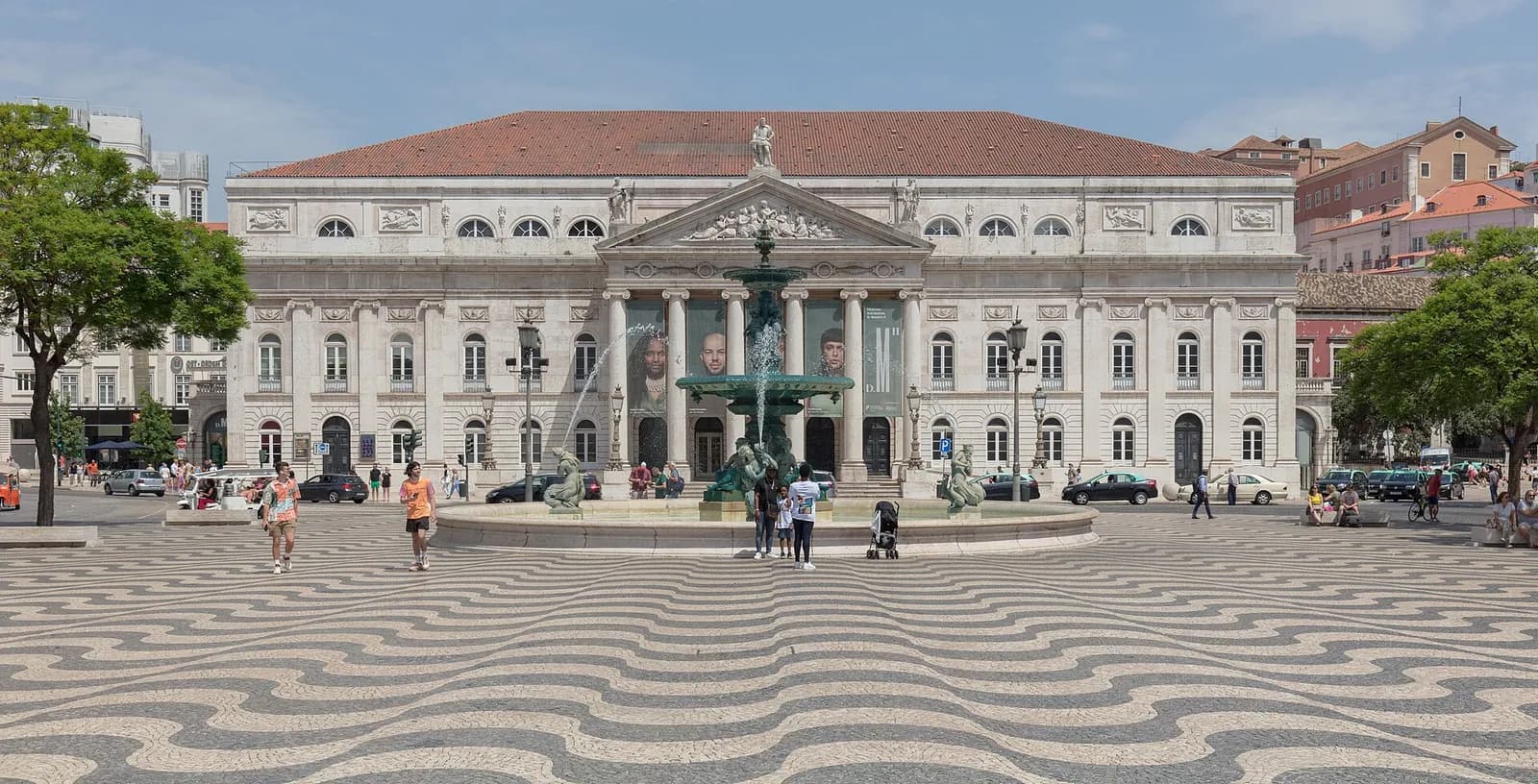
At a glance
- At about four in the morning of 2 December 1964, fire broke out in the stage area of the Teatro Nacional D. Maria II, Portugal's national theatre on Lisbon's Rossio, and spread through the building.
- It left little more than the outer walls, the entrance hall and the Salão Nobre. Columbano Bordalo Pinheiro's painted ceiling and the resident company's wardrobe were lost; the archive and library were carried out.
- The play running that week was Macbeth, staged by the English director Michael Benthall for the Rey Colaço-Robles Monteiro company. Superstition blamed the play; the exact cause was never established.
- The government decided the same day to rebuild. The architect Guilherme Rebello de Andrade kept the neoclassical exterior and rebuilt the interior, and the theatre reopened on 11 May 1978.
- The house did not produce Macbeth again until 18 September 2026, when Pedro Penim's staging reopened the building after a renovation of almost four years.
Flames over the Rossio
Carlos Queiroz had been home in Amadora for only a few hours. A second-year drama student, he had a small part in Macbeth at the Teatro Nacional D. Maria II, Lisbon's national theatre, and had played it again that evening. His father liked to fall asleep with a little radio by his ear. At about half past four in the morning of Wednesday 2 December 1964, he woke his son with the news: the Nacional was on fire.
Queiroz set off for the city. A wide safety cordon had been set around the Rossio, the great square at the heart of the Baixa, and he had to go round it. From the edge he could see flames pouring from the top-floor dressing room he shared with the other young actors.
The fire had started in the stage area, hours after the last performance, and spread fast. Many fire crews raced to the Rossio and attacked it quickly, but they could not save the building. As actors and staff arrived, some of them reached the main entrance and joined firefighters and passers-by in a human chain that carried out part of the theatre's library and archive.
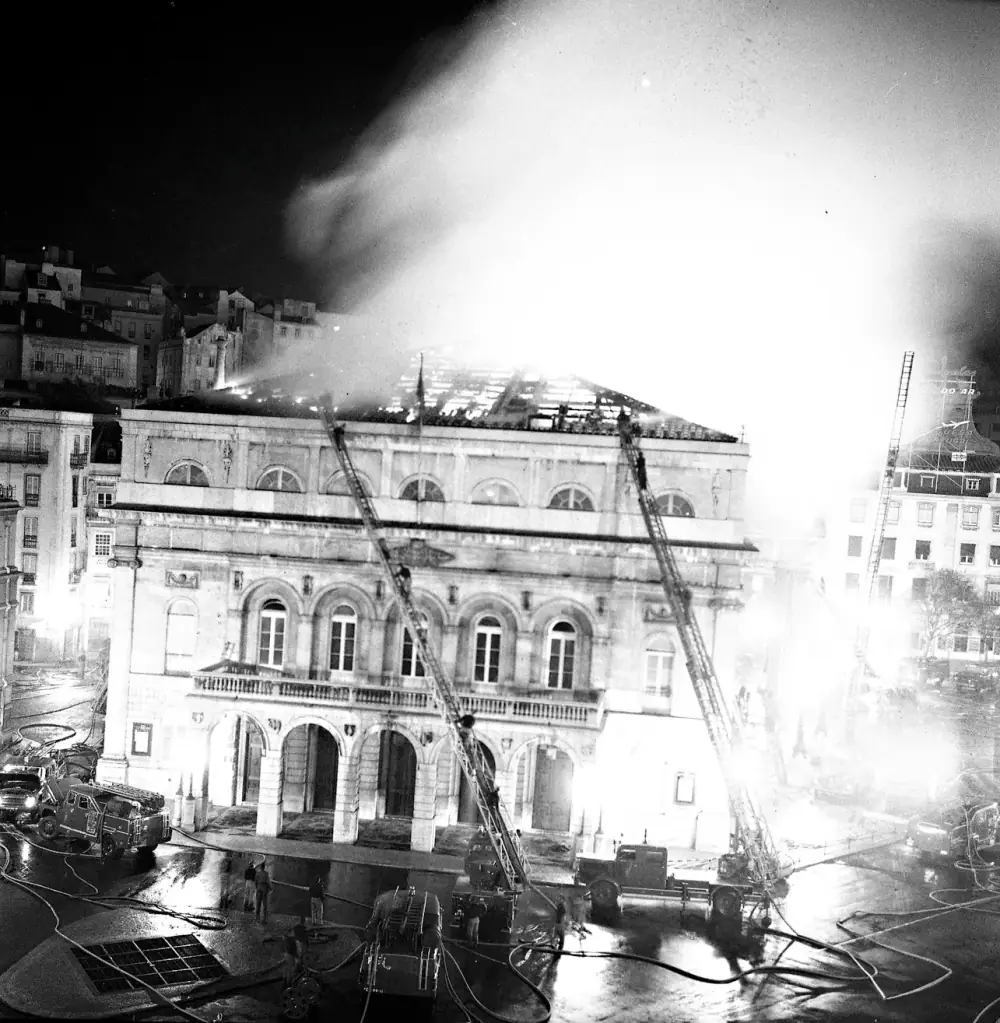
Amélia Rey Colaço, who had run the company in the building since 1929, watched with her actors and many Lisbon people as it burned. That month the RTP programme Cena Aberta showed her, visibly moved, being comforted by the chief stage machinist, Joaquim Alves da Silva. Queiroz kept his last pay packet, a pale blue envelope of coins that had been in the theatre safe. He says it still smells of smoke.
- Date
- Wednesday 2 December 1964, at about 4 am
- Place
- Teatro Nacional D. Maria II, Rossio, Lisbon
- Where it began
- The stage area, some hours after the evening's performance
- On stage that week
- Macbeth, by the Rey Colaço-Robles Monteiro company
- Left standing
- The outer walls, the entrance hall and the Salão Nobre
- Cause
- Never established; an electrical fault or a cigarette were suggested
- Reopened
- 11 May 1978
A theatre for the nation
The building that burned was 118 years old, but the idea behind it was older. After the liberal revolution of 9 September 1836, the new head of government, Passos Manuel, asked the writer and politician Almeida Garrett to draw up a plan for a national theatre. Romantic Europe wanted national repertoires, and Garrett was also told to create a drama conservatoire, a theatre inspectorate and prizes for new plays.
The site chosen was the ruin of the Palácio dos Estaus on the north side of the Rossio. Built at the order of Prince Pedro, a son of King João I, and finished in 1456, the palace first lodged distinguished visitors and sometimes the court. From 1584 it was the seat of the Inquisition's Lisbon tribunal and its General Council.
The earthquake of 1755 destroyed the palace and it was rebuilt. In 1820 it housed the liberal provisional government. In 1836 a fire wiped it out, and in 1842 the ruins were demolished. A theatre on the spot would close the square and answer the grid of streets laid out after the earthquake a century before.
The architect was Fortunato Lodi, from Bologna, who had family ties to the Count of Farrobo, the impresario of the São Carlos opera house. In a time of strong nationalist feeling, critics including the historian Alexandre Herculano objected to a foreigner. Work only began in 1842. The portico, pediment and columns were changed along the way and the high water table under the square caused trouble, but the result stayed close to Lodi's design.
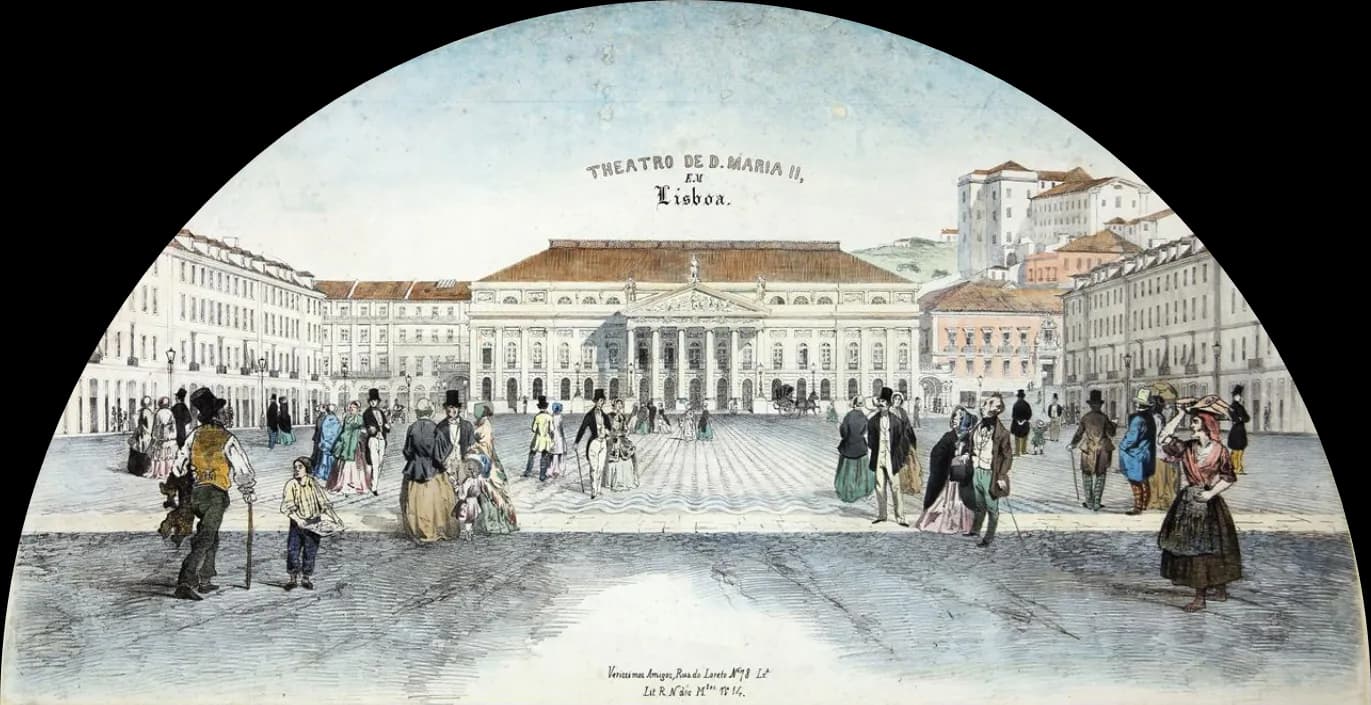
The doors first opened a few months early. On 29 October 1845, by royal order, a gala marked the birthday of the king consort, Fernando, with a cantata, a comedy by Alexandre Dumas and a farce. Gustavo de Matos Sequeira, the theatre's official historian, wrote that the staging flopped but the party went on until two in the morning. The building, much criticised while it went up, won wide praise.
The theatre opened officially on 13 April 1846, during the celebrations of Queen Maria II's 27th birthday (she was born on 4 April), and took her name. The first play was O Magriço, ou os Doze de Inglaterra, by Jacinto Heliodoro de Loureiro. Outside it looked like a classical temple, with an Ionic portico, a sculpted pediment and a statue of Gil Vicente, the father of Portuguese theatre, on top. Inside was an Italian-style horseshoe auditorium with tiers of boxes, worked plaster and a painted ceiling.
Garrett's own Frei Luís de Sousa was staged there in 1850, with sets by the Italian designers Rambois and Cinatti and the novelty of gas lighting. After the Republic was proclaimed in 1910 the house was renamed Teatro Nacional Almeida Garrett. It became the D. Maria II again in 1939.
Thirty-five years of Amélia Rey Colaço
The state owned the building but seldom ran it for long. At first a society of actors managed it under a government inspector, and from 1847 the state paid an annual subsidy and laid down rules, censorship and guidelines for the repertoire. When debts piled up the government took over, and after some fifteen years of direct rule it let the house by tender to private companies.
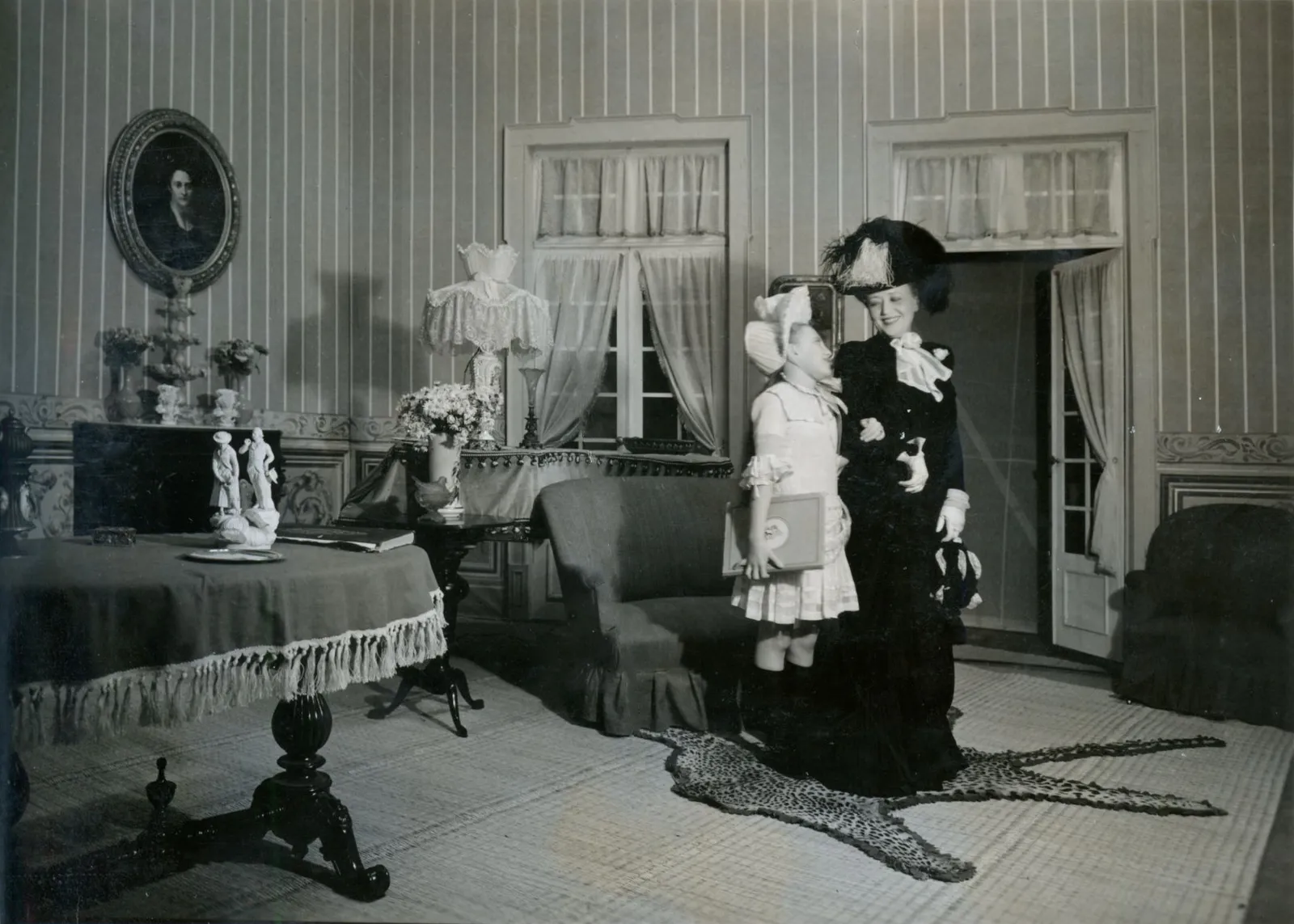
Two companies stand out. The actors Eduardo Brazão and the brothers João and Augusto Rosa held the theatre for most of the 1880s and 1890s and brought Shakespeare and Molière to its stage. The longest concession went to the company of Amélia Rey Colaço and her husband, the actor Felisberto Robles Monteiro, who had married in 1920 and founded the Companhia Rey Colaço-Robles Monteiro the next year. It held the D. Maria II from 1929 until the fire.
Even so, the concession was renewed again and again. The company championed Portuguese classics, above all Gil Vicente, whose plays had been left to drama students, and gave a stage to living authors such as Alfredo Cortez, Bernardo Santareno and Luiz Francisco Rebello.
Macbeth at the Nacional
For the autumn of 1964 the company brought in an English director, Michael Benthall, to stage Shakespeare's Macbeth in a translation by the Brazilian poet Manuel Bandeira. Michael Annals designed the sets and costumes, and the designer Lucien Donnat made them. João Guedes played Macbeth and Mariana Rey Monteiro Lady Macbeth, with Varela Silva as Macduff, Lurdes Norberto as Lady Macduff, Raul de Carvalho as Duncan and Paiva Raposo as Banquo. The record of the production at the Museu Nacional do Teatro e da Dança credits 40 actors.
Everyone in the company knew the play's reputation. In theatres, many people will not say “Macbeth” aloud and call it “the Scottish play” instead. Carlos Queiroz, who played Banquo's son Fleance and later spent 35 years working in England, remembers that “the subject was talked about a lot from the moment we started rehearsals”. A rumour went round that an actor had been badly hurt in the final battle when Benthall staged the same production in Japan.
Rehearsals lasted a month and a half. The run had begun little more than a week before the fire. On the night of 1 December the company played as usual and went home; the fire broke out in the early hours of the 2nd.
Evening, 1 December
Macbeth is performed as usual
The run had opened a little over a week earlier.
c. 4 am, 2 December
Fire is seen at the theatre
It began in the stage area and spread quickly.
c. 4.30 am
News on the radio
Carlos Queiroz is woken in Amadora and heads for the Rossio.
Before dawn
A human chain saves the archive
Staff, firefighters and passers-by pass out books and papers through the main entrance.
2 December
The government decides to rebuild
The new building is to respect the form and image of the old one.
What burned and what was saved
By morning the national theatre was a shell. Cristina Faria, who reconstructed the night from the newspapers of the time, wrote that the fire spared little more than the outer walls. The auditorium that burned was white with gilded ornament, with three tiers of boxes and two galleries. Among the losses were the auditorium chandelier, a painted drop curtain by the Italian architect and stage designer Cinatti, and the ceiling of the main hall, painted by Columbano Bordalo Pinheiro in 1894.
The company lost its whole wardrobe, decades of costumes that were described at the time as “the most valuable wardrobe in the Peninsula and in Europe”, and its sets went too. The company restaged its work elsewhere, but the RTP documentary on Amélia Rey Colaço says the loss left it considerably weakened.
| Lost | Saved |
|---|---|
| The auditorium, its boxes and stage | The outer walls and the façade |
| Columbano Bordalo Pinheiro's painted ceiling of 1894 | The entrance hall |
| The chandelier of the auditorium | The Salão Nobre, the theatre's grand reception room |
| Cinatti's painted drop curtain | The archive and library |
| The company's wardrobe and sets | An oil portrait of Queen Maria II, busts of actors and some other works of art |
| The rest of the interior | One dressing room |
The theatre's own history says that “a dressing room” survived, without saying whose. None of the sources used here names it as Amélia Rey Colaço's, as some retellings do.
The archive mattered most to historians. Its books and papers, carried out that night, include rarities that scholars still use to write the history of Portuguese theatre. The portrait of the queen is on show in the theatre today, and the entrance hall that survived holds marble busts of two nineteenth-century stars, José Carlos dos Santos and Francisco Taborda.
A company without a house
The company did not stop. Within weeks it restaged Macbeth at the Coliseu dos Recreios in Lisbon. The President of the Republic, Admiral Américo Tomás, came to a performance with the education minister, Inocêncio Galvão Teles. The programme carried a photograph of the burning theatre and the words “Mas o Nacional continua”, “But the Nacional goes on”. The veteran actress Palmira Bastos spoke from the stage, and the audience stood to applaud.
Still officially the company of the national theatre, it played in other Lisbon halls with help from the Calouste Gulbenkian Foundation and the government. In 1965 it sublet the Teatro Avenida, a theatre of 1888 on the Avenida da Liberdade that had lived on comedy, drama and revue and had grown shabby.
Amélia Rey Colaço paid to make it fit for an official company. She spent about 1,000 contos (a million escudos) on the auditorium and the stage's electrical equipment, which swallowed almost all the insurance money from the fire, itself less than the value lost. She also brought chandeliers, tapestries, velvet curtains and armchairs from her own home, and the designer Lucien Donnat redecorated the hall.
The Avenida reopened on 6 February 1965, two months after the fire. The Diário de Lisboa wrote that the star of the night was the house itself, turned into a small Parisian-style theatre in the heart of Lisbon. Away from the Rossio the company could stage more contemporary writers, such as Max Frisch, Harold Pinter, Lorca and Pirandello, though it still faced censorship and money troubles. It did not give up the classics: a 1965 Auto da Alma by Gil Vicente had sets designed by the modernist artist Almada Negreiros.
“The difference in prestige between the Teatro Nacional de D. Maria II and the Teatro Avenida shows, to an incalculable degree, at the box office and in how long plays stay on.”
The company never went home. Early in 1974 Amélia Rey Colaço took it to the São Luís, where her own career had begun, and then closed it. It kept the title of Companhia do Teatro Nacional until it was dissolved, a month after the revolution of 25 April 1974 by one account; the RTP documentary dates its formal end to 1988. Either way, when the D. Maria II reopened in 1978 the company had stopped working. Amélia Rey Colaço backed the creation of the Museu do Teatro, which opened in Lisbon in 1982, and played her last great role in 1985, at the age of 87.
Rebuilding behind the old façade
The decision to rebuild was taken on the day of the fire, with one condition: the new theatre had to respect the form and image of the old. The project went to the architect Guilherme Rebello de Andrade, whose team made several studies to reconcile the original architecture with the technical and comfort standards of a modern theatre.
Outside, the building stayed strictly neoclassical. Inside, everything was rebuilt and reorganised. The main hall kept its Italian layout, but its size and capacity were adjusted for comfort and sightlines. The Salão Nobre was resized, and a small experimental space, the Sala Estúdio, was built above it. A basement was dug for technical areas and the base of a revolving stage.
“The result may not be extraordinary, but it is solid, dignified and balanced. Classical in its way, as befits a National Theatre, it achieves […] a link of continuity with its origin, with its history, with its past and with the very memory of the city.”
The theatre reopened on 11 May 1978, four years after the fall of the dictatorship and 13 and a half years after the fire. The opening programme paired two founders of Portuguese drama and of the house itself: Gil Vicente's Auto da Geração Humana and Garrett's O Alfageme de Santarém. Plays the censors had banned soon reached its stage, among them Felizmente há luar! and Santareno's O Judeu.
Brecht's Mother Courage, which Amélia Rey Colaço had fought to stage, finally reached the stage in 1986 as a co-production between the national theatre and the Novo Grupo/Teatro Aberto, directed by João Lourenço with her pupil Eunice Muñoz in the title role. Since 2004 the theatre has been run as a state-owned company, and in 2012 its building was reclassified as a national monument.
Years the national theatre worked without its Rossio building
years
Approximate time between dates given by the theatre and the press: legal creation in 1836 to the opening of April 1846; the fire of 2 December 1964 to the reopening of 11 May 1978; the closure in January 2023 (2022 on the theatre's website) to the reopening of 18 September 2026. In 1836 to 1846 the old Teatro da Rua dos Condes was the provisional national theatre.
Show the data
| Years | |
|---|---|
| 1836–1846: before the building opened | 10 |
| 1964–1978: after the fire | 13.4 |
| 2023–2026: renovation | 3.7 |
Macbeth comes home
For six decades the house left Macbeth alone. It hosted other companies' versions, but its director Pedro Penim says the play was never again produced by the theatre itself. He calls the fire a trauma in its history and says the blame for it always hung over the text.
The memory stayed alive inside the building. In 2016 the artists Miguel Fragata and Inês Barahona built a guided tour of the theatre around the curse, A Visita Escocesa, “The Scottish Visit”, which ended with the fire alarm going off. Penim says the idea of reopening with Macbeth came to him from an exhibition on the theatre's last hundred years, curated by Tiago Bartolomeu Costa, with a whole section on the fire and the 1964 production.
In January 2023, by the account of its president and its artistic director (the theatre's own history says 2022), the D. Maria II closed again, this time for works funded by Portugal's Recovery and Resilience Plan, an investment of close to €10 million. They renewed the sound and ventilation of the Sala Garrett, the main auditorium, gave it a stage that turns and can be raised, and reopened windows that the 1978 rebuilding had blocked with extra floors.
Workers also uncovered the letters “M.D.P.”, for the Movimento Democrático Português, a political movement, painted in white on a wall of the second balcony; the theatre chose to keep them. While the building was shut, the company toured more than 100 municipalities.
On 18 September 2026, 180 years after the theatre first opened, Penim reopened it with his own translation of Macbeth, with José Raposo and Bárbara Branco in the leading roles, for a run until 31 October. He had wanted to use Bandeira's 1964 translation, but the holders of the poet's rights never replied, though the theatre kept asking for nine months.
“There is something deliciously reckless about reopening a theatre with the most superstitious play in the history of theatre, in a building that burned down precisely while it was on stage.”
FAQs
When did the Teatro Nacional D. Maria II burn down?
In the early hours of Wednesday 2 December 1964, at about four in the morning. The fire began in the stage area some hours after a performance of Macbeth and destroyed almost all of the interior.
What caused the 1964 fire at the D. Maria II?
The exact cause was never established. Superstition blamed the curse of Macbeth, which was running that week. More ordinary explanations suggested at the time and since are an electrical fault or a badly extinguished cigarette.
What was destroyed in the fire?
The auditorium and stage, the ceiling painted by Columbano Bordalo Pinheiro in 1894, the chandelier, a drop curtain by Cinatti and the resident company's wardrobe and sets. The outer walls, the entrance hall, the Salão Nobre, a dressing room, some works of art and the archive and library survived.
When did the D. Maria II reopen after the fire?
On 11 May 1978, after a rebuilding by the architect Guilherme Rebello de Andrade that kept the neoclassical exterior and rebuilt the interior. The opening programme was Gil Vicente's Auto da Geração Humana and Almeida Garrett's O Alfageme de Santarém.
Why did the D. Maria II reopen in 2026 with Macbeth?
Macbeth was the play running when the theatre burned in 1964, and the house had not produced it since. Pedro Penim chose it to reopen the building on 18 September 2026 after almost four years of renovation, to confront that memory directly.
On the timeline
Open the timelineNearby moments from dictatorship and the estado novo (1926–1974).
Sporting CP win the European Cup Winners' Cup, beating MTK Budapest 1–0 in a replay in Antwerp after a 3–3 draw in Brussels two days earlier. The winner is João Morais's celebrated goal scored direct from a corner.
Death in Lisbon, aged 70, of Marshal Francisco Craveiro Lopes, President of the Republic from 1951 to 1958. His cool relations with Salazar and his sympathy for opponents of the regime cost him a second term, and he was later linked to the failed Botelho Moniz coup attempt of April 1961.
FRELIMO guerrillas attack the Portuguese administrative post at Chai in Cabo Delgado province, launching the Mozambican War of Independence. The conflict lasted a decade, ending only after the Carnation Revolution opened the way to Mozambican independence.
The D. Maria II fire of 1964
Fire guts the Teatro Nacional D. Maria II on Lisbon's Rossio in the early hours, sparing little more than the outer walls, entrance hall and Salão Nobre; Columbano Bordalo Pinheiro's painted ceiling and the company's wardrobe are lost. Superstition blames 'Macbeth', performed there that evening. Rebuilt behind its neoclassical façade, the national theatre only reopened in 1978.
General Humberto Delgado, the most prominent opponent of the Salazar dictatorship, is lured by the PIDE to a fake meeting of conspirators in Spain and murdered near Olivenza with his Brazilian secretary, Arajaryr Campos. Their bodies are found near Villanueva del Fresno in April.
Actress and director Maria de Medeiros is born in Lisbon. She played Anaïs Nin in 'Henry & June' and Fabienne, Bruce Willis's girlfriend, in 'Pulp Fiction', and directed 'Capitães de Abril' (2000), a film about the Carnation Revolution screened at Cannes.
Birth in Madeira of José Tolentino de Mendonça, priest, theologian and one of the most admired Portuguese poets of his generation. Called to Rome by Pope Francis as Archivist and Librarian of the Holy Roman Church in 2018, he was made a cardinal in 2019 and later became Prefect of the Vatican's Dicastery for Culture and Education.
Coming up in history
All long reads 4 December 1980Camarate, 1980: the plane crash that killed Portugal's prime minister
 5 December 1496Manuel I orders the Jews and Muslims out of Portugal: Muge, 5 December 1496
 6 December 1185The death of Afonso Henriques, 1185: Portugal's first king and his legends
 7 December 2002Metro do Porto opens on old railway tracks: 7 December 2002
15 sources
Archives, scholarship and reporting this article was checked against.
- 1
HistóriaTeatro Nacional D. Maria II
- 2
Novos olhares sobre o «Teatro da Nação» (Ana Isabel Vasconcelos), review of Maria João Brilhante (coord.), Teatro Nacional D. Maria II: Sete olhares sobre o teatro da nação (2014)Sinais de Cena, Centro de Estudos de Teatro, Universidade de Lisboa, 2016
- 3
Macbeth: a peça que dá azar e pegou fogo ao Nacional (Gonçalo Frota)Clube Somos Espectadores
- 4
Macbeth, 1964: photograph of João Guedes as Macbeth (MNTD 70952), with the production creditsMuseu Nacional do Teatro e da Dança (Museus e Monumentos de Portugal)
- 5
- 6
Apresentação da peça “Macbeth” em Lisboa (Noticiário Nacional, December 1964)RTP Arquivos
- 7Pedro Penim trata um “trauma da história do Teatro Nacional” com fogo e provocação. Quem tem medo de “Macbeth”?Observador, September 2026
- 8
O Pátio das Antigas: A noite em que o Teatro D. Maria II ardeuTime Out Lisboa
- 9
- 10
Roteiro da Inquisição em Lisboa: uma possibilidade cultural?João Miguel Cabral Borges Capela, master's dissertation, Iscte – Instituto Universitário de Lisboa, 2021
- 11A Senhora Dona Amélia (documentary, 2020)RTP
- 12
O Estado Novo (1933-1974)Assembleia da República
- 13
Teatro Nacional D. Maria II: Voltar ao Rossio com um país dentroJornal Económico, 2026
- 14
Teatro Nacional D. Maria II, uma casa com 180 anos, que volta a abrir portas em setembro de 202624 Notícias, 2026
- 15
Macbeth defies curse as Lisbon's Teatro D. Maria II reopensEuronews, 18 September 2026
Image credits
- The Teatro Nacional D. Maria II at the north end of the Rossio in July 2022, six months before it closed for renovation. Fortunato Lodi's façade of 1846 survived the fire of 1964; almost everything behind it was rebuilt. Diego Delso, CC BY-SA 4.0, via Wikimedia Commons.
- Firefighters on turntable ladders at the burning Teatro Nacional in the early hours of 2 December 1964: a Diário de Notícias photograph. Diário de Notícias, Public domain, via Wikimedia Commons.
- Theatro de D. Maria II em Lisboa: a coloured lithograph of the mid-nineteenth century, printed by Veríssimos Amigos in Lisbon. Verissimos Amigos, Public domain, via Wikimedia Commons.
- Amélia Rey Colaço as Maria Eduarda, with Lourdes Norberto as Rosa, in the company's stage version of Eça de Queirós's Os Maias at the D. Maria II in 1945. Horácio Novais (1910-1988), Public domain, via Wikimedia Commons.
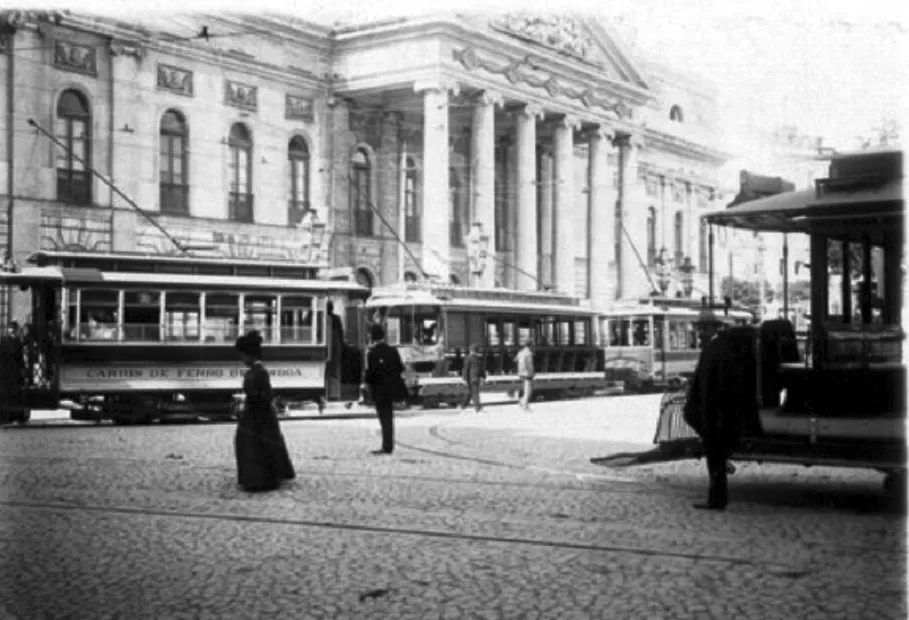
- Electric trams in front of the theatre's portico in the 1900s. The façade and outer walls in this photograph are the parts that survived the fire. Unknown author, Public domain, via Wikimedia Commons.