

TAP Flight 425: the night a Boeing 727 ran off Madeira's runway
On a stormy Saturday night in 1977, TAP Flight 425 made a third attempt to land on Madeira's 1,600-metre runway. It touched down too far along and too fast, and only 33 of the 164 people on board survived.
At a glance
- At 9.48 pm on 19 November 1977, TAP Flight 425, a Boeing 727 from Brussels via Lisbon, ran off the end of runway 24 at Funchal's Santa Catarina airport, in Madeira, during heavy rain.
- The aircraft hit an old stone bridge 28 metres below the end of the runway. The tail stayed on the bridge; the rest of the fuselage fell onto the beach and burned.
- Of the 164 people on board, 33 survived. The final report counted 122 dead and nine missing, presumed dead, so the toll is usually given as 131. It is the worst accident in TAP's history.
- The official inquiry found the jet touched down 323 metres beyond the normal touchdown point, at 19 knots above its reference landing speed, on a wet runway 1,600 metres long. It named very bad weather and possible aquaplaning among the factors.
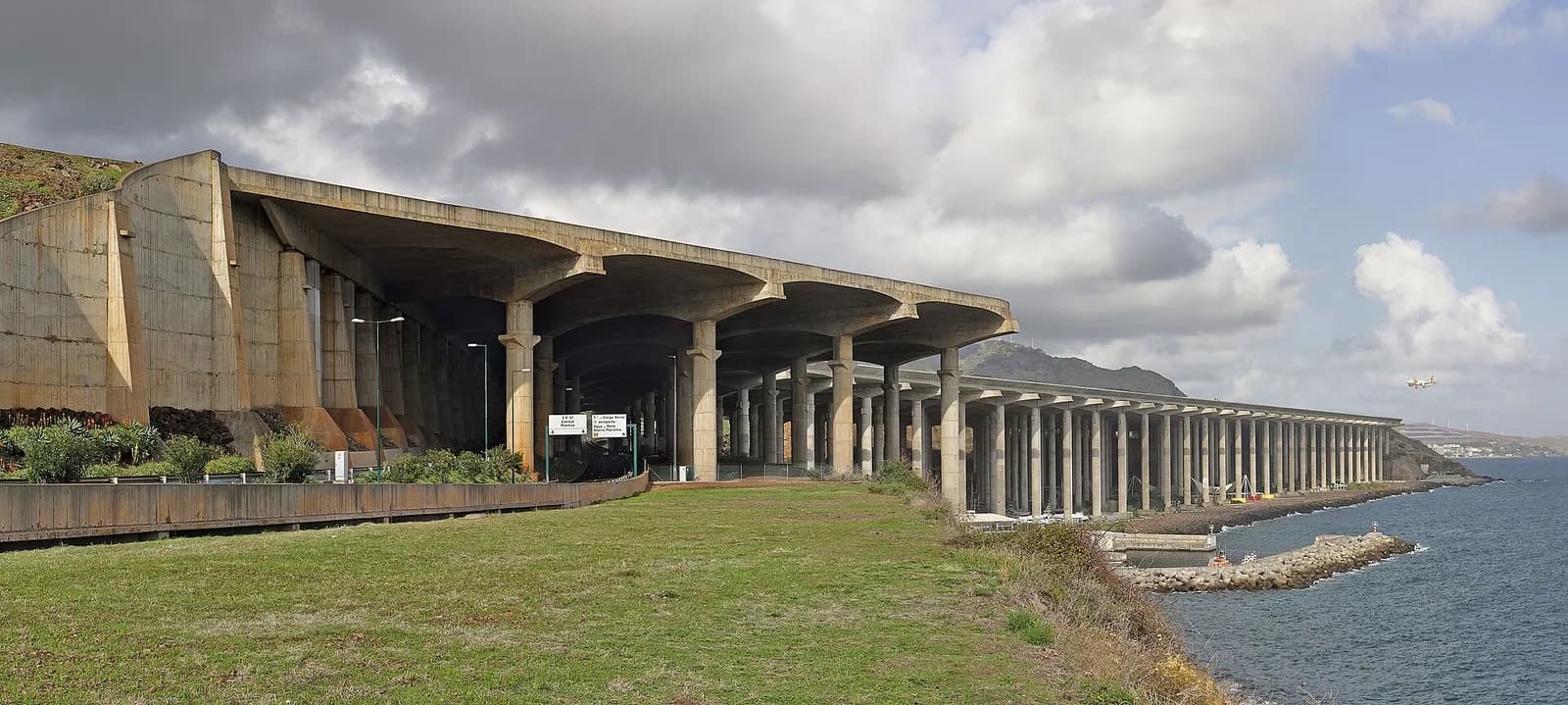
- The runway was lengthened to 1,800 metres in 1986 and to 2,781 metres in 2000, partly on 180 pillars over the shore. Since 2017 the airport has carried the name of Cristiano Ronaldo.
A third approach in the rain
Shortly before ten o'clock on the night of Saturday 19 November 1977, a TAP Boeing 727 was trying to land on Madeira in a storm. Flight TP425 had come from Brussels, with a stop in Lisbon. Twice the crew had tried to land at Santa Catarina airport, near Santa Cruz, and twice they had lost sight of the runway in the rain and pulled away.
The captain, João Lontrão, knew he had one more try before he would have to divert to Las Palmas, in the Canary Islands. When the tower suggested he hold for a while until the shower passed, the reply from the cockpit was that there was fuel for only one more approach.
“I'm going to try one more approach now, and if I can't get in this time we're going to Las Palmas.”
On the third approach, to runway 24, the wheels met the tarmac far beyond the normal touchdown point, on a short, wet runway in heavy rain. At 9.48 pm the aircraft ran off the end and dropped onto an old stone bridge 28 metres below. It broke apart. The tail section stayed on the bridge; the rest of the fuselage fell another 14 metres onto the rocky beach and burned.
Of the 164 people on board, 33 lived. It remains the worst accident in the history of the Portuguese airline TAP. In the years that followed, Madeira's runway was lengthened twice.
An airport on a ledge
Madeira's airport was built on the island's east side, mostly in the municipality of Santa Cruz, with part of the runway later reaching into neighbouring Machico. Earthworks for the site began on 5 June 1961 at a road junction in the parish of Santa Cruz, and the demolition of a house was the first symbolic act.
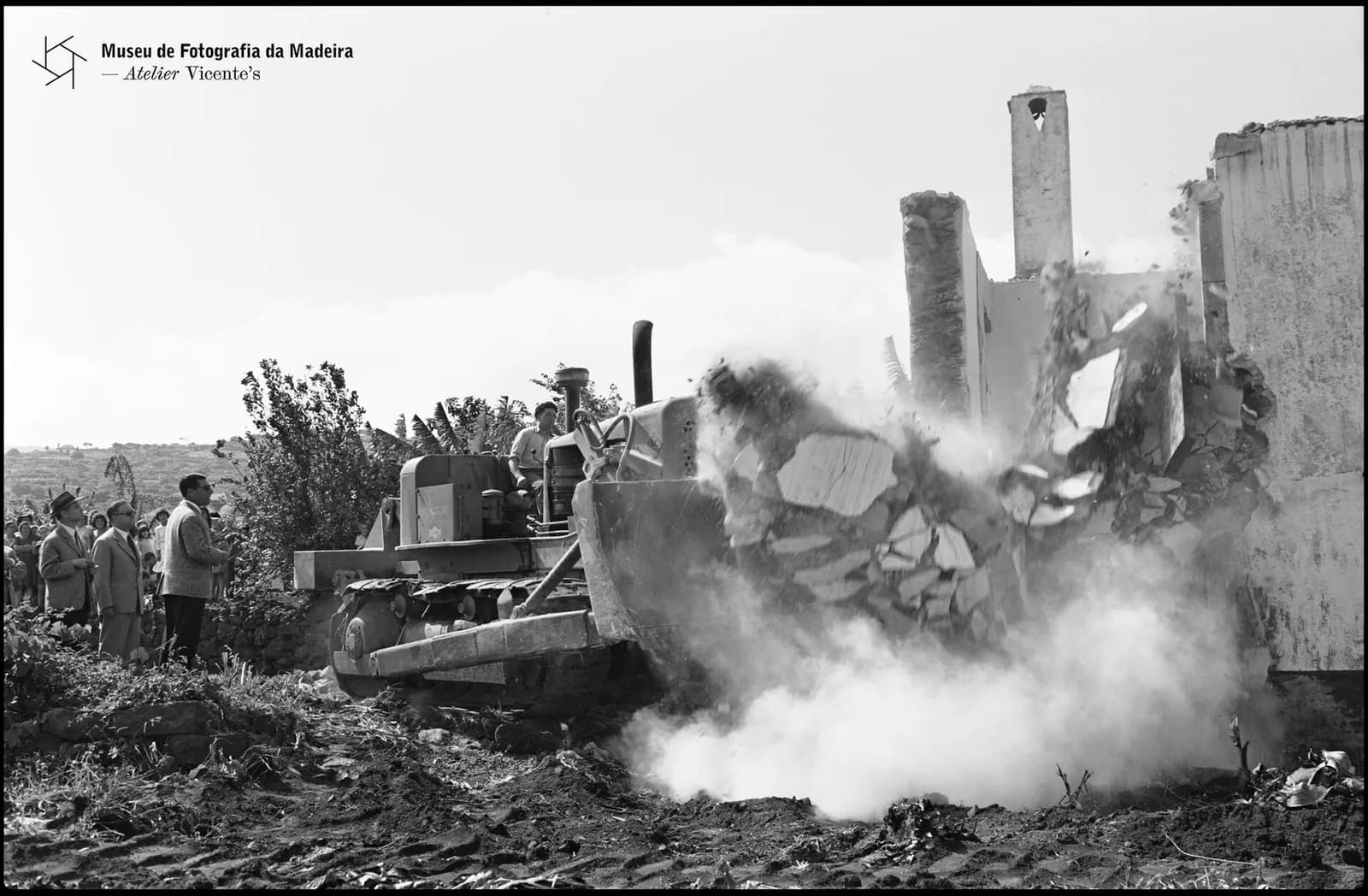
The Funchal studio Perestrellos Photographos recorded the first day of work, in photographs attributed to Raul Martins Perestrello, and the Diário de Notícias printed one the next morning. The negative is now in the Museu de Fotografia da Madeira.
The airport opened on 8 July 1964 with a single runway 1,600 metres long and 45 metres wide. It was cut into a hillside and ended almost at the coast at both ends, with no overrun area and nothing to catch an aircraft that failed to stop.
For aircraft landing on runway 24, heading south-west, the usable length was 1,540 metres, because the threshold was set 60 metres in from the end. Beyond the far end, the ground dropped to a road, an old stone bridge and a rocky beach.
Flight TP425
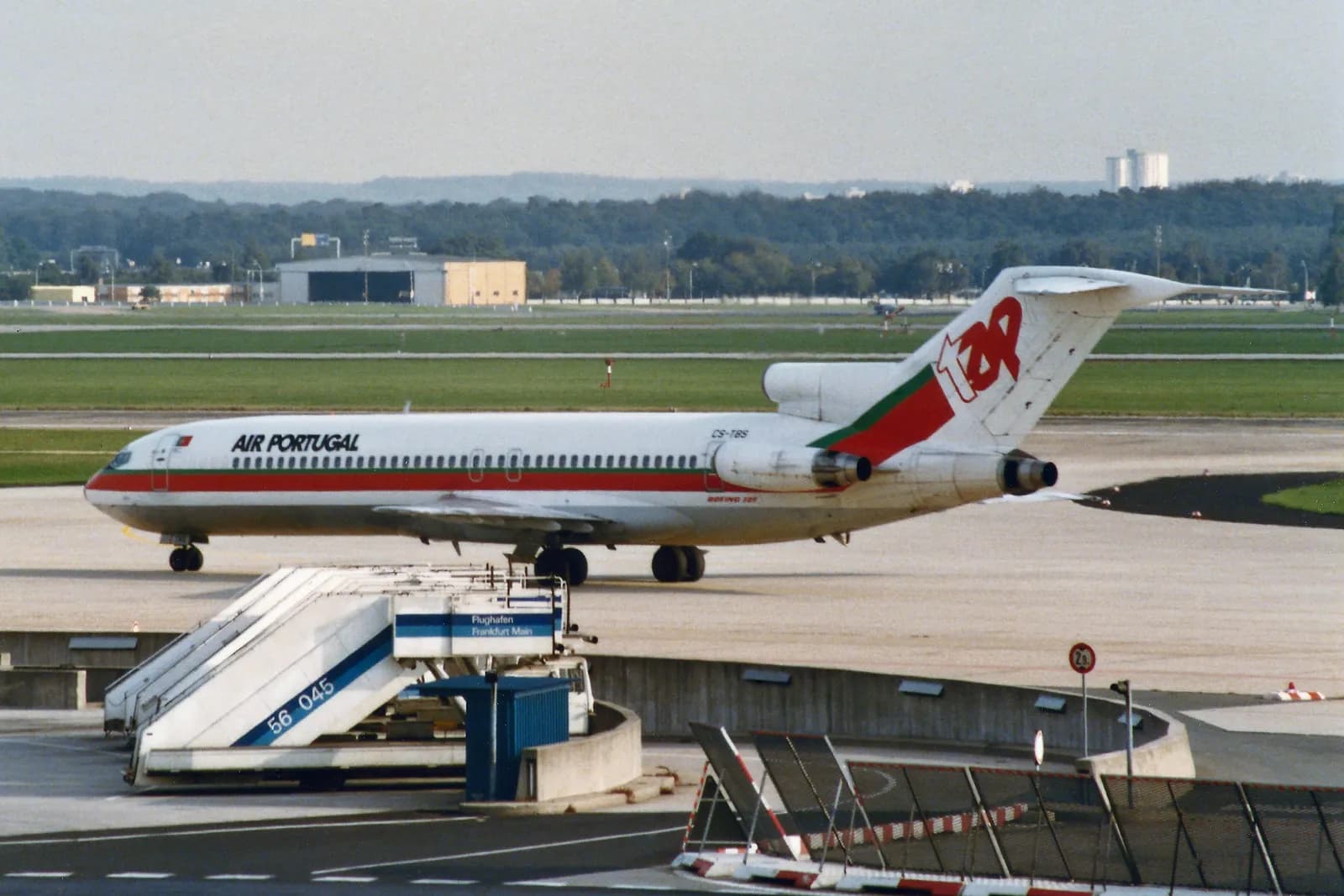
The aircraft, registered CS-TBR, was a Boeing 727-282 Advanced, a jet with three Pratt & Whitney engines, built for TAP in 1975. It carried the name Sacadura Cabral, after the Portuguese aviator of the 1922 flight across the South Atlantic, who had himself died in a flying accident at sea.
- Date
- Saturday 19 November 1977, at 9.48 pm
- Route
- Brussels to Funchal, with a stop in Lisbon
- Aircraft
- Boeing 727-282 Advanced CS-TBR, named Sacadura Cabral
- On board
- 164: 156 passengers and 8 crew
- Runway
- Runway 24, Santa Catarina airport, 1,600 metres long (1,540 metres usable)
- Weather
- Night, heavy showers, visibility about 3 kilometres
- Survivors
- 33
The flight crew were the captain, his co-pilot Miguel Guimarães Leal and a flight engineer, with five cabin crew. That day they had already flown Lisbon to Brussels and back. TP425 left Lisbon for Funchal at 7.55 pm, with a forecast of isolated thunderstorms on the way and passing showers at the island.
Shortly after 9 pm, as the jet came down towards Madeira, the tower reported showers over the airport and visibility down to three kilometres. The first approach, aimed at runway 06, was abandoned when the crew lost sight of the ground. The second, to runway 24, ended the same way at 9.36 pm.
At 9.47 pm the tower reported calm wind on runway 24 and cleared the jet to land. It was raining hard: the inquiry later estimated 55.5 millimetres an hour between 9.46 and 9.51 pm.
The flight data recorder showed what happened next. The 727 crossed the threshold at the correct height but at 154 knots, 24 knots above its reference landing speed, known as Vref. TAP's own procedure for Funchal called for Vref plus 10 knots, with up to Vref plus 20 allowed for wind and gusts.
The pilot closed the throttles and the flaps were raised from 40 to 25 degrees, and the jet floated. Its main wheels touched down 628 metres past the threshold, 323 metres beyond the normal touchdown point, at 148 knots. That left 912 metres of wet runway.
Almost at once a large movement of the rudder to the left sent the aircraft skidding along the right side of the runway. The spoilers, panels that rise from the wings to kill lift, did not deploy automatically and came out 2.5 seconds late, by hand. About 15 seconds after touchdown the jet left the end of the runway at 78.5 knots, with reverse thrust building.
Landing on standing water can cause aquaplaning, in which a film of water lifts the tyres off the surface. A wheel in that state gives no effective braking and no steering, and the braking grip falls to less than a fifth of that on a dry runway.
Aviation safety specialists list excessive touchdown speed, a touchdown beyond the normal touchdown zone and a runway contaminated by water among the classic causes of a landing overrun. TP425 had the first two, as the recorder showed. The inquiry judged the third possible.
On the beach at Santa Cruz
The airport's firefighters had been watching the landing. They drove to the end of runway 24, found the burning wreckage far below, and had to go back to the apron to reach the access road. The wind blew their foam back, and the fire was not out for about three hours.
A woman living about 700 metres away first took the noise for thunder, then saw the fire from her roof terrace. Fire engines came from Funchal and the surrounding towns, and the police closed the road to everything but emergency vehicles. Rain and fog made it hard to recover the dead and the wreckage through the night.
“The resources of an island seemed too few to face the tragedy.”
Most of the survivors were thrown clear when the fuselage broke apart at the bridge, some of them into the sea. A few in the last row of seats stayed in the tail on the bridge, which did not burn, and were lifted out by rescuers. Every survivor was hurt.
The first count, printed in the Funchal paper on 20 November, was 123 dead and 39 injured in hospital. The final count was 131 dead and 33 survivors: 31 passengers and two crew members, all of whom had been in the rear of the aircraft.
| Passengers | Crew | Total | |
|---|---|---|---|
| On board | 156 | 8 | 164 |
| Killed or missing | 125 | 6 | 131 |
| Survived | 31 | 2 | 33 |
The final report counted 122 dead and nine missing, presumed dead (five passengers and four crew), which make up the total of 131. Early press reports gave 123 dead.
At the airport, people waiting for the flight had no news, and staff struggled to tell families what had happened. One of the first survivors to reach the terminal was a Belgian passenger who came by taxi and asked that his family be told he was alive. He remembered the first impact, and then waking on the pebbles with seawater around him.
Another survivor, Emanuel Torres, was sitting near the back. He saved a two-year-old child, and forty years later he told his story to the Funchal newspaper Diário de Notícias.
Nine people were never found, among them the captain and the co-pilot. Among the dead were João Melo, his wife Lurdes and their small daughter Mafalda. Forty years later the couple's goddaughter, who was ten in 1977, recalled being told that Mafalda, who loved flying, had clung to her grandmother the day before the trip and had not wanted to go.
The tail was the only part of the aircraft not destroyed. By the next morning it had been painted white to cover the airline's markings. The insurers paid for a replacement 727, which joined the fleet in a plain white livery.
The President of the Republic, General António Ramalho Eanes, sent a message of deep regret, and a commission of inquiry travelled quickly to the island.
What the inquiry found
The Minister of Transport and Communications appointed a commission of inquiry on 21 November 1977, and its report was issued by the Direcção-Geral da Aeronáutica Civil, Portugal's civil aviation authority at the time. The US National Transportation Safety Board transcribed the cockpit voice recorder, and Boeing, NASA, the NTSB and TAP each analysed the flight data. Accident investigation in Portugal now belongs to a separate body, the GPIAAF.
The final report did not settle on one cause. It described a chain of conditions that together left the aircraft too little runway.
“The impossibility of decelerating the aircraft to a stop within the length of the runway.”
The report listed five probable factors: very unfavourable weather at the moment of landing; the possible existence of conditions for aquaplaning; a landing speed of Vref plus 19 knots; a long landing, caused by a long flare as the aircraft levelled off; and an abrupt correction of direction after touchdown.
The wording was careful. The report did not say the aircraft had aquaplaned, only that conditions for it may have existed. Its evidence was indirect: the wheels had not spun up normally, there were no clear braking marks on the runway, and the jet slowed very little all the way along it. Its tyres showed no sign of skidding on locked wheels.
It found other contributions to the long landing. Raising the flaps before touchdown, the extra speed and the runway's downhill slope of 1% may have stretched the flare. The green lights that mark the touchdown point were switched off, because the wiring did not allow them to run at the same time as the approach slope lights, and their absence may also have played a part.
Not everyone accepted the aquaplaning finding. Some survivors and witnesses rejected it and said the aircraft had braked before it went over the edge. TAP's own internal report, according to Notícias ao Minuto, pointed to the poor condition of the runway, including how it drained water.
The official report did record those problems among its findings: deformations in the surface that stopped water draining sideways in places, rubber deposits, and reduced grip along the centre of the runway. It did not name them among the factors in its probable cause.
Its three recommendations were about better radio aids for approach and landing at Funchal, making every airline respect the airport's landing minima, and better weather observation around the airfield. None of them called for a longer runway.
After the accident, TAP stopped flying the longer 727-200 to Madeira and used only the 727-100, about five metres shorter and with roughly 60 fewer seats. The wreckage stayed on the beach for a long time, and the old bridge where the tail came to rest later disappeared under the runway extension.
A month later Madeira's airport saw a second disaster. On 18 December 1977, at about 8.14 pm, a Caravelle jet of the Swiss charter airline SATA, flying from Geneva, came down in the sea on its approach to Funchal. Fishermen who put out at once and the Navy pulled survivors from the water; 21 people reached land alive. Observador gives the death toll as 36.
Early reports blamed the weather again, but the official report on the Caravelle rejected that. It found that the aircraft had been put down on the sea unintentionally during the approach. Its flight below the normal descent path may have come from poor coordination between the pilots and a visual illusion as they looked for the runway lights.
Building a longer runway
The first extension added 200 metres, swallowing the ground around the old bridge at the end where TP425 had gone over. The 1,800-metre runway came into service on 1 February 1986. Larger aircraft, such as the Boeing 747, needed far more.
Length of the runway at Madeira airport
metres
The runway was 1,600 metres long when it opened in 1964 and still in 1977. It reached 1,800 metres on 1 February 1986 and 2,781 metres on 15 September 2000.
Show the data
| Runway length | |
|---|---|
| 1964 | 1,600 |
| 1977 | 1,600 |
| 1986 | 1,800 |
| 2000 | 2,781 |
The second extension, opened on 15 September 2000, took the runway to 2,781 metres. A section 1,020 metres long and 180 metres wide stands on a concrete deck held up by 180 pillars, whose foundations go down as far as 70 metres.
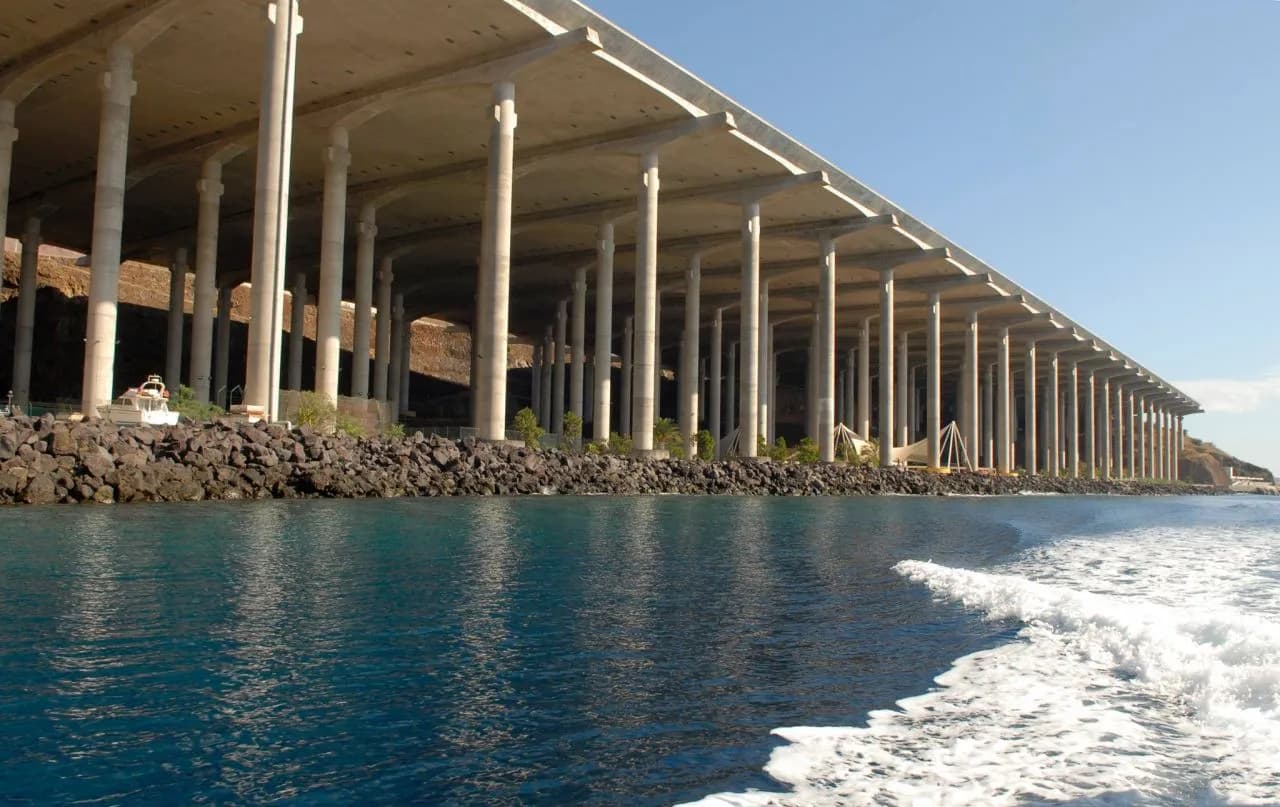
The project cost 520 million euros and raised the airport's capacity to 3.5 million visitors a year. The longer runway was built to take aircraft as large as the Boeing 747. The International Association for Bridge and Structural Engineering gave it an Outstanding Structure Award, and Guinness World Records lists it as the longest bridge-supported runway in the world.
5 June 1961
Works begin
Earthworks start in the parish of Santa Cruz, with the demolition of a house.
8 July 1964
Airport opens
A single runway, 1,600 metres long.
19 November 1977
TAP Flight 425
A Boeing 727 overruns runway 24; 131 of 164 on board die.
18 December 1977
SATA Caravelle
A Swiss charter jet comes down in the sea on approach; 36 die.
1 February 1986
First extension
The runway reaches 1,800 metres.
15 September 2000
Runway on pillars
The runway reaches 2,781 metres, partly on 180 pillars.
2015
Memorial
Children of crew members killed in 1977 place a memorial on the Santa Cruz seafront.
29 March 2017
A new name
The airport starts using the name of Cristiano Ronaldo.
Why it still matters
The crash came three and a half years after the revolution of 25 April 1974 ended the dictatorship. When Observador listed six great tragedies of Portugal's democracy in 2017, after the Pedrógão Grande wildfire, the two Madeira air crashes of 1977 came first.
The other four on that list were the Alcafache rail crash of 1985, the crash of a SATA Air Açores plane on São Jorge in the Azores in 1999, the collapse of the Entre-os-Rios bridge in 2001 and the Madeira floods of 2010.
The runway that passengers land on today, on its rows of concrete pillars, is nearly 1,200 metres longer than the one TP425 tried to stop on. Press accounts link both extensions to the crash, although the second came 23 years later and was built for wide-bodied jets.
On 29 March 2017 the airport began to use the name of the footballer Cristiano Ronaldo for commercial purposes, while the formal change of designation went through the paperwork needed for international recognition.
For the families, the memory is more personal. In 2015 the children of some of the crew members who died placed a memorial sculpture, made from old aircraft parts, on the seafront promenade at Santa Cruz, close to the end of the runway.
FAQs
What happened to TAP Flight 425?
On the night of 19 November 1977, TAP Flight 425, a Boeing 727 flying from Brussels to Funchal via Lisbon, landed long and fast on the wet 1,600-metre runway at Madeira's Santa Catarina airport on its third approach. It ran off the end, fell onto a stone bridge and the beach below, broke apart and caught fire.
How many people died in the Madeira air crash of 1977?
Of the 164 people on board, 156 passengers and 8 crew, 33 survived. The final report counted 122 dead and nine missing, presumed dead, a total of 131. The first press count, on 20 November 1977, was 123 dead.
What caused the TAP crash at Funchal?
The official report gave as the probable cause the impossibility of stopping the aircraft within the runway, with five factors: very bad weather, possible aquaplaning, a landing speed 19 knots above the reference speed, a long flare and an abrupt correction of direction after touchdown. The jet touched down 323 metres beyond the normal point. TAP's internal report also blamed the runway's condition, and crew fatigue has been raised as a possible factor.
Why is Madeira's runway built on pillars?
The airport sits on a narrow strip of coast with drops at both ends. To extend the runway from 1,800 to 2,781 metres in 2000, engineers built a deck over the shore on 180 pillars. The section on pillars is 1,020 metres long, and Guinness World Records lists it as the longest bridge-supported runway.
On the timeline
Open the timelineNearby moments from revolution and democracy (1974–1986).
Portugal becomes the 19th member state of the Council of Europe, with Foreign Minister José Medeiros Ferreira signing the instrument of accession in Strasbourg — a milestone in the young democracy's return to the European fold.
Portugal holds its first democratic local elections, choosing 304 mayors and thousands of councillors and parish representatives. The Socialists win the most votes, about a third, and take Lisbon and Porto, though they tie with the PPD at 115 mayors each; abstention, at around 35%, is more than double that of the parliamentary election held that April.
Mário Soares's government formally applies for Portugal to join the European Economic Community, less than three years after the Carnation Revolution. Seen as the anchor of the young democracy, membership would follow on 1 January 1986.
TAP Flight 425 at Funchal
TAP Flight 425, a Boeing 727 arriving from Brussels via Lisbon, overruns the short, rain-soaked runway at Funchal in Madeira and plunges onto the beach below, killing 131 of the 164 people on board. It remains the worst accident in TAP's history; the runway was later lengthened twice, in 1986 and in 2000, the second time on pillars over the sea.
Formal negotiations for Portugal's accession to the European Economic Community open, some eighteen months after the application lodged by Mário Soares's government in March 1977. They concluded with the signing of the accession treaty in June 1985.
Nicolau Lobato, president of Fretilin and first prime minister of the short-lived Democratic Republic of East Timor, is killed by Indonesian forces in the mountains south of Dili. Born in Portuguese Timor in 1946, he is honoured today as a national hero, and Dili's international airport bears his name.
Maria de Lourdes Pintasilgo is sworn in as Portugal's first female Prime Minister, forming the fifth constitutional government at the invitation of President António Ramalho Eanes. She remains the only woman to have held the office.
Coming up in history
All long reads 21 November 1857Columbano Bordalo Pinheiro, the painter of Portugal’s thinkers, born 1857
 22 November 1970Operation Green Sea: Portugal's secret night raid on Conakry in 1970
 23 November 1930Herberto Helder: the Funchal-born poet who said no
 24 November 1632Spinoza, born to Amsterdam's Portuguese Jews on 24 November 1632
10 sources
Archives, scholarship and reporting this article was checked against.
- 1
Transportes Aéreos Portugueses, Boeing 727-282 CS-TBR, Aeroporto de Santa Catarina, Ilha da Madeira, 19 Novembro 1977 (final report of the commission of inquiry)Direcção-Geral da Aeronáutica Civil, Lisbon; public version (crew details removed), PDF hosted by Notícias ao Minuto
- 2
Um dos maiores desastres aéreos em solo português aconteceu há 40 anos, by Anabela de Sousa DantasNotícias ao Minuto, 19 November 2017
- 3
Há 43 anos acontecia na Madeira a maior tragédia da aviação em Portugal, by Ana Luísa CorreiaDiário de Notícias da Madeira (DNoticias.pt), 19 November 2020
- 4
A história do Aeroporto da MadeiraRTP Madeira, 29 March 2017
- 5
Airport with the longest bridge-supported runway extensionGuinness World Records
- 6
Faz hoje 43 anos que Sacadura Cabral teve o segundo acidente no Arquipélago da Madeira, by José Luís FreitasFunchal Notícias, 19 November 2020
- 7As seis grandes tragédias da democracia portuguesaObservador, 18 June 2017
- 8
Início das demolições para a construção do aeroporto do Funchal, 5 June 1961, photograph attributed to Raul Martins PerestrelloMuseu de Fotografia da Madeira, Atelier Vicente's (inv. PER/8526), via Wikimedia Commons
- 9
AquaplaningSKYbrary Aviation Safety
- 10

Image credits
- The extension of Madeira's runway, opened in 2000, stands on 180 concrete pillars along the shore. A plane approaches on the right. Photographed in December 2013. Richard Bartz, CC BY-SA 3.0, via Wikimedia Commons.
- A bulldozer knocks down a house at the start of the works for Funchal's airport, in the parish of Santa Cruz, on 5 June 1961. Raul Martins Perestrello (atr.), Public domain, via Wikimedia Commons.
- CS-TBS, a sister ship of the aircraft lost at Funchal and the same model, a Boeing 727-282 Advanced, at Frankfurt in 1984. No freely licensed photograph of CS-TBR, the Sacadura Cabral, is available. Kambui, CC BY 2.0, via Wikimedia Commons.
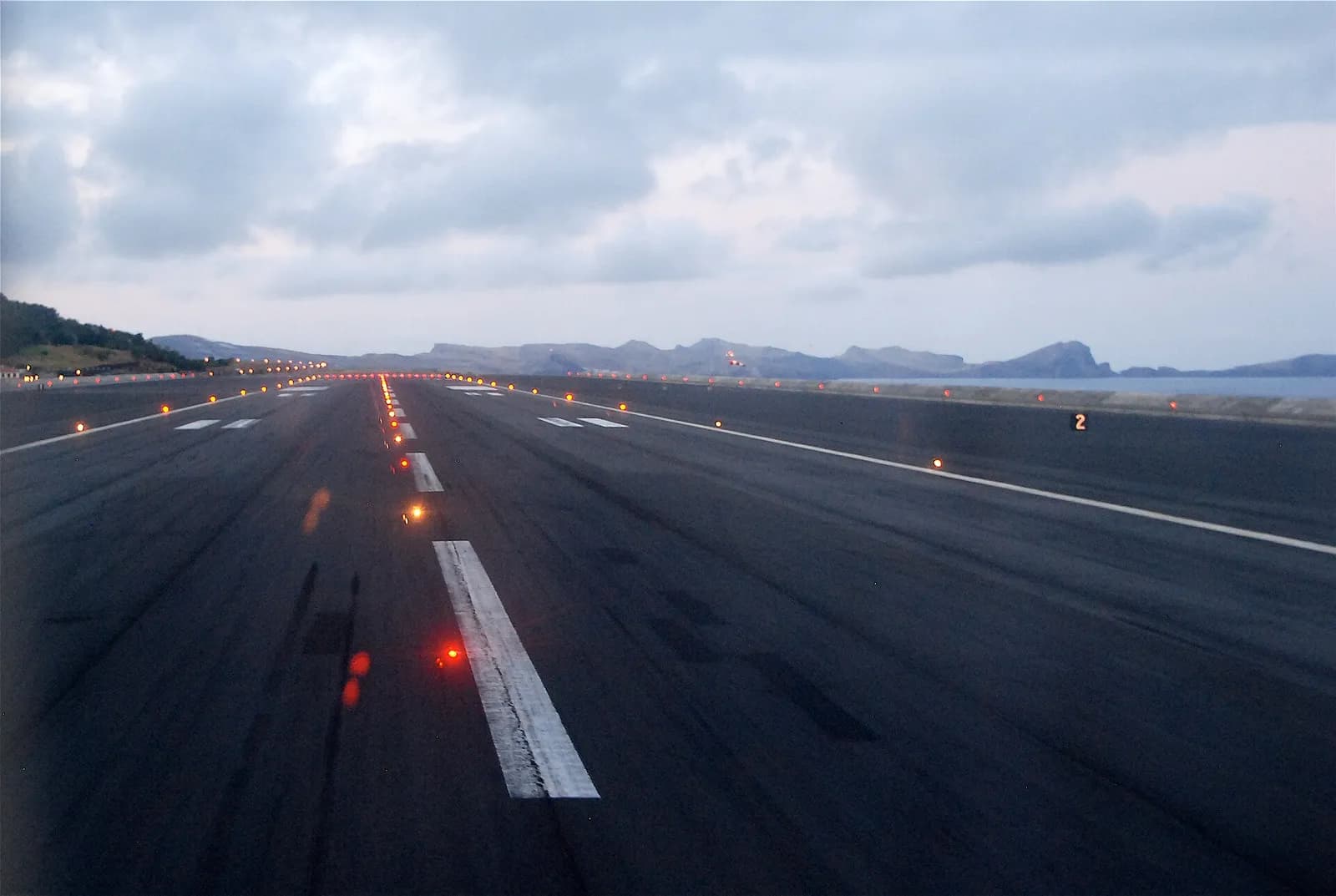
- Madeira's runway at dusk in July 2011, with its lights on. By then it was 2,781 metres long, more than 1,100 metres longer than in 1977. Aero Icarus from Zürich, Switzerland, CC BY-SA 2.0, via Wikimedia Commons.
- The runway deck seen from the sea on 29 March 2017, the day the airport began to use the Cristiano Ronaldo name. Virgílio Gomes, CC BY-SA 4.0, via Wikimedia Commons.