

The Bicesse Accords: Angola's peace signed in Lisbon, 31 May 1991
Portugal spent a year bringing Angola's government and the UNITA rebels to the same table. The peace they signed in Lisbon gave Angola its first free elections, and lasted seventeen months.
At a glance
- On 31 May 1991 President José Eduardo dos Santos and UNITA's leader, Jonas Savimbi, signed the Peace Accords for Angola at the Ministry of Foreign Affairs in Lisbon.
- Portugal mediated six rounds of talks between April 1990 and May 1991, led by the secretary of state José Manuel Durão Barroso, with the United States and the Soviet Union as observers.
- The accords set a ceasefire, a single 50,000-strong army, a ban on new weapons and free elections with a second round, and left the two former enemies to supervise it all jointly.
- In the elections of 29 and 30 September 1992 dos Santos won 49.57 per cent and Savimbi 40.07. UNITA alleged fraud, the UN judged the vote generally free and fair, and war resumed before a runoff.
- Human Rights Watch estimated that about 300,000 people died from October 1992 to late 1994, probably more than in the previous sixteen years of war.
A handshake at the Necessidades
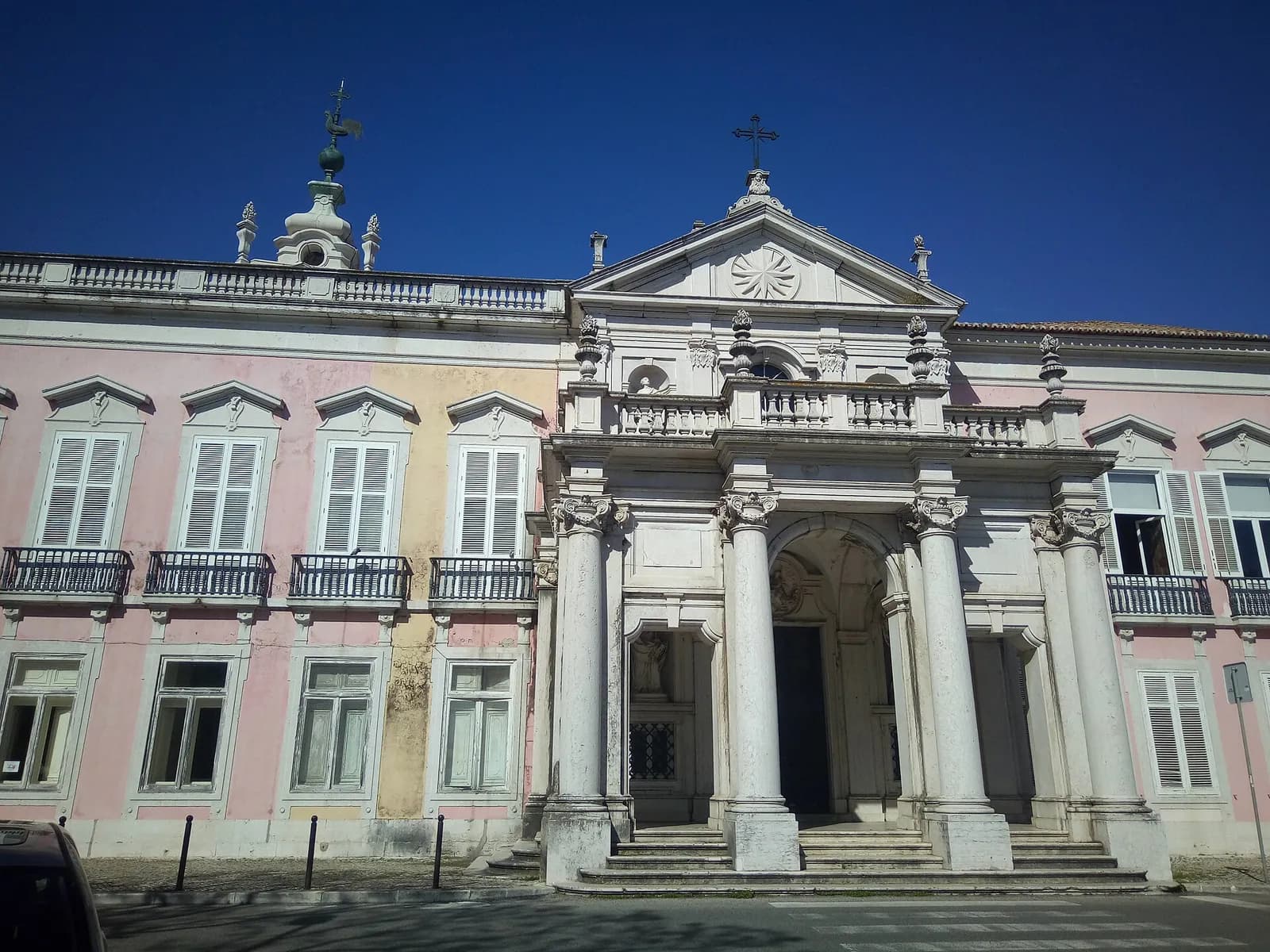
On 31 May 1991, in a room of the Palácio das Necessidades, the former royal palace in Lisbon that houses Portugal's Ministry of Foreign Affairs, two men who had been at war for sixteen years signed a peace. José Eduardo dos Santos, president of Angola, signed for his government. Jonas Savimbi signed for UNITA, the rebel movement he had founded in 1966. Portugal's prime minister, Aníbal Cavaco Silva, looked on.
Representatives of the United States and the Soviet Union, which had armed opposite sides of the war, were there, with envoys of the United Nations and the Organisation of African Unity. The guns were already quiet. A ceasefire had held in practice since midnight on 15 May, when both sides told the Portuguese prime minister that they accepted the texts their delegations had initialled at Estoril on 1 May. The day before the signing, the UN Security Council voted to send unarmed observers to watch it.
“It is important to take up again the message of the intense ten seconds before the moment of the photograph that illustrates this book: national reconciliation is possible, peace is always possible.”
The handshake made the front page of the New York Times the next day, Cavaco Silva recalled. The accords promised Angola its first multi-party elections and one national army in place of two. Seventeen months later the country was at war again, and the fighting that followed probably killed more people, by Human Rights Watch's estimate, than the sixteen years before it.
A Cold War battlefield
Angola became independent from Portugal on 11 November 1975 with a civil war already under way, a story told in our article on Angolan independence. The MPLA, the Popular Movement for the Liberation of Angola, held Luanda and built a one-party socialist state backed by the Soviet Union and Cuba. UNITA, the National Union for the Total Independence of Angola, was driven into the bush, regrouped and fought on.
Both sides had powerful friends. South African forces crossed into southern Angola again and again in support of UNITA, partly to hit the Namibian guerrillas the MPLA sheltered. A government offensive in 1985 had the help of some 50,000 Cuban troops. In Washington, Congress lifted its 1976 ban on covert aid in 1985, and the United States then sent UNITA about $250 million between 1986 and 1991, its largest covert programme after Afghanistan.
In 1987 and 1988 South African and UNITA forces besieged the government garrison at Cuito Cuanavale, in the south-east. Human Rights Watch calls the outcome a military stalemate; a 1994 chronology by a Lisbon think tank calls it a victory for the Angolan and Cuban side. Talks between Angola, Cuba and South Africa followed, under American mediation. In December 1988 agreements signed in New York tied the withdrawal of Cuba's troops to independence for Namibia, and a first UN mission, UNAVEM, was sent to watch the Cubans leave. The last of them left in May 1991.
Peace between Angolans proved harder. In June 1989, at Gbadolite in Zaire, dos Santos and Savimbi shook hands in front of 18 African heads of state, but the deal soon fell apart because each side had understood something different. By the time of the Bicesse Accords two years later, the war had killed between 100,000 and 350,000 people, according to Human Rights Watch.
Portugal as go-between
Relations between Lisbon and independent Angola had mostly “verged on the catastrophic”, in the words of a 1994 study by the Institute for Strategic and International Studies (IEEI), a Lisbon think tank. That changed after 1987, when Cavaco Silva's government made José Manuel Durão Barroso, a secretary of state then in his early thirties, the architect of its African policy.
Barroso dates the start of the process to a meeting with dos Santos in Windhoek on 20 March 1990, on the eve of Namibia's independence, at which the Angolan president asked him to arrange a secret meeting with Savimbi. The first direct talks between the two delegations took place in secret near Évora on 24 April 1990. Portugal at first offered its good offices; by the autumn it was mediating outright, with American and Soviet observers at the table. The three countries became known as the troika.
20 March 1990
Dos Santos asks Barroso, in Windhoek, to arrange a secret meeting with Savimbi
24 April 1990
First round of direct talks, in secret near Évora
16 June 1990
Second round, at Oeiras near Lisbon
27 August 1990
Third round, without progress
24 September 1990
Fourth round, under Portuguese mediation with US and Soviet observers
11 November 1990
Fifth round, at Sintra
December 1990
Baker and Shevardnadze meet in Washington; the MPLA congress votes for a multi-party system
4 April 1991
Sixth round opens, to run without a break until a deal is reached
1 May 1991
Delegations initial the Peace Accords at Estoril
15 May 1991
De facto ceasefire from midnight
31 May 1991
Dos Santos and Savimbi sign the accords in Lisbon
The decisive push came from the superpowers. In December 1990 the US secretary of state, James Baker, and the Soviet foreign minister, Eduard Shevardnadze, met in Washington while both Angolan delegations were in town. According to the IEEI study, Moscow there left Washington a free hand. The MPLA was told that American support for UNITA would continue until there was a settlement, and UNITA that it would end if UNITA alone stood in the way. The resulting Washington document guaranteed UNITA's political existence after a ceasefire.
“The President pledged our continued support for Dr. Savimbi and his movement. The President believes that the steadfastness of that support is a key factor in pushing the current negotiations to a successful conclusion.”
The MPLA was changing too. Its congress of December 1990 voted to give up the one-party state and Marxism-Leninism, and the constitution was amended on 6 May 1991 to allow other parties. The IEEI study reads this partly as a move to take away UNITA's main reason for fighting, the absence of democracy.
The hardest bargaining was over time. The MPLA wanted three years before elections, with a government of national unity in the meantime. UNITA, sure it would win, wanted a vote within a year and no interim government. They settled on 15 to 18 months, and on a window from 1 September to 30 November 1992. The troika urged a date early in it, preferably in September, because it was the dry season and to cut the cost of monitoring the ceasefire.
Barroso said in 2026 that Portugal also had to resist ideas of splitting the country. Some powers, he said, without naming them, put plans in front of him with maps dividing Angola, and Portugal said no.
What was signed
The Peace Accords for Angola, also called the Bicesse Accords, were four documents. The government of Angola sent the full English text, as initialled, to the UN Secretary-General, who circulated it to the Security Council in May 1991.
| Document | What it covered |
|---|---|
| Ceasefire agreement, with two annexes | The ceasefire, its timetable, the assembly areas and the joint monitoring bodies |
| Fundamental principles for the establishment of peace | UNITA's recognition of the state, political rights, elections, the army; annex creating the CCPM |
| Concepts for resolving the issues still pending | UNITA's political rights, the ban on new weapons, supervision of the ceasefire and UN monitors, the new army, election observers |
| Protocol of Estoril | Election rules and dates, the CCPM, internal security and police, UNITA's political rights, administration, the new armed forces |
The core bargain was short. UNITA recognised the Angolan state, President dos Santos and his government until elections were held. In return it gained the right to organise and campaign freely from the moment the ceasefire took effect. Free and fair elections would follow under international observers: a president elected by majority, with a second round if needed, and a National Assembly by proportional representation.
The ceasefire was to be “total and definitive”. Both sides would release their prisoners, with the Red Cross checking, and stop all hostile propaganda. A “triple zero” clause barred them from acquiring lethal weapons, and the United States and the Soviet Union promised to stop supplying any. Troops were to move into 50 assembly areas, 27 for the government and 23 for UNITA, between 1 July and 1 August 1991.
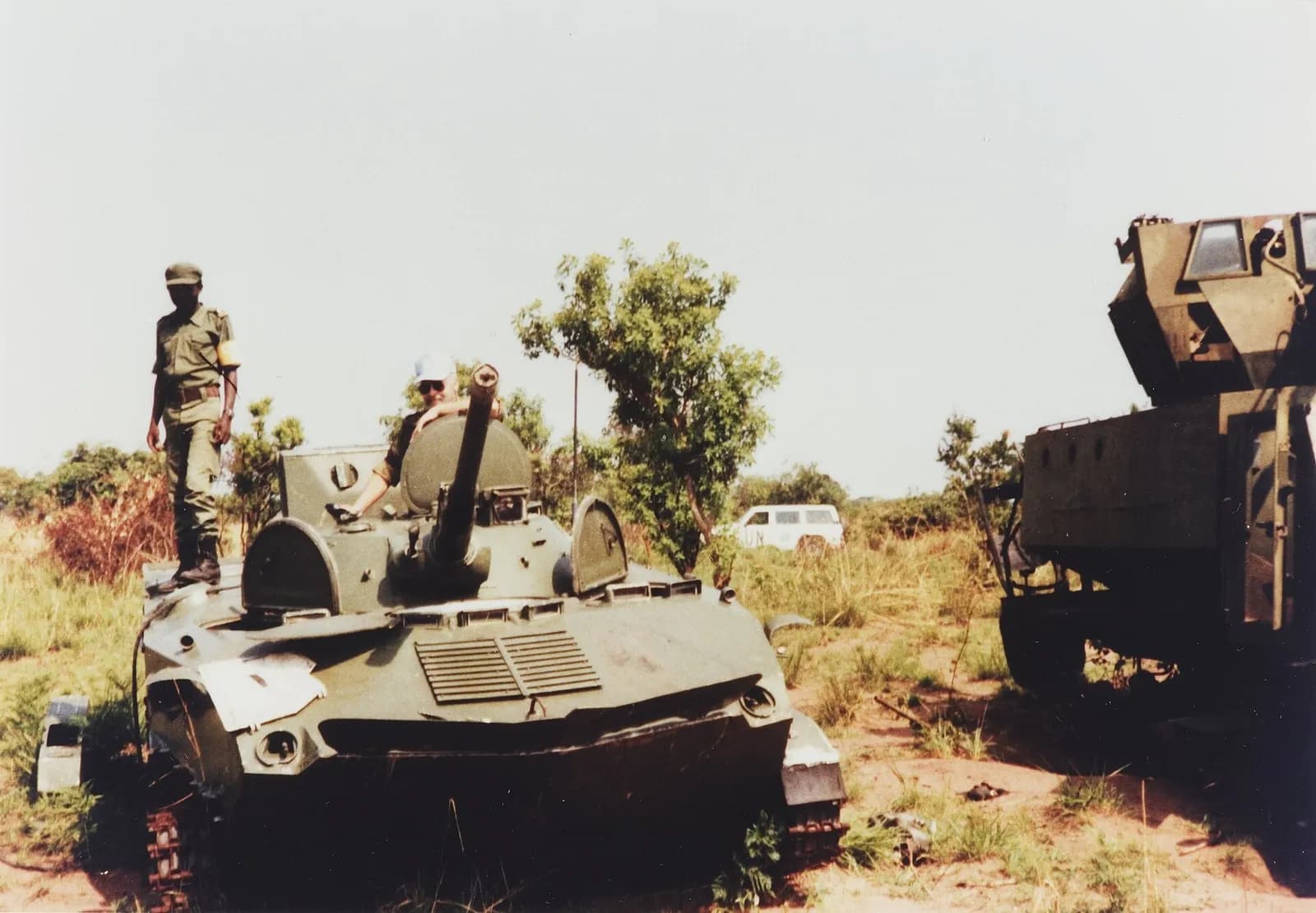
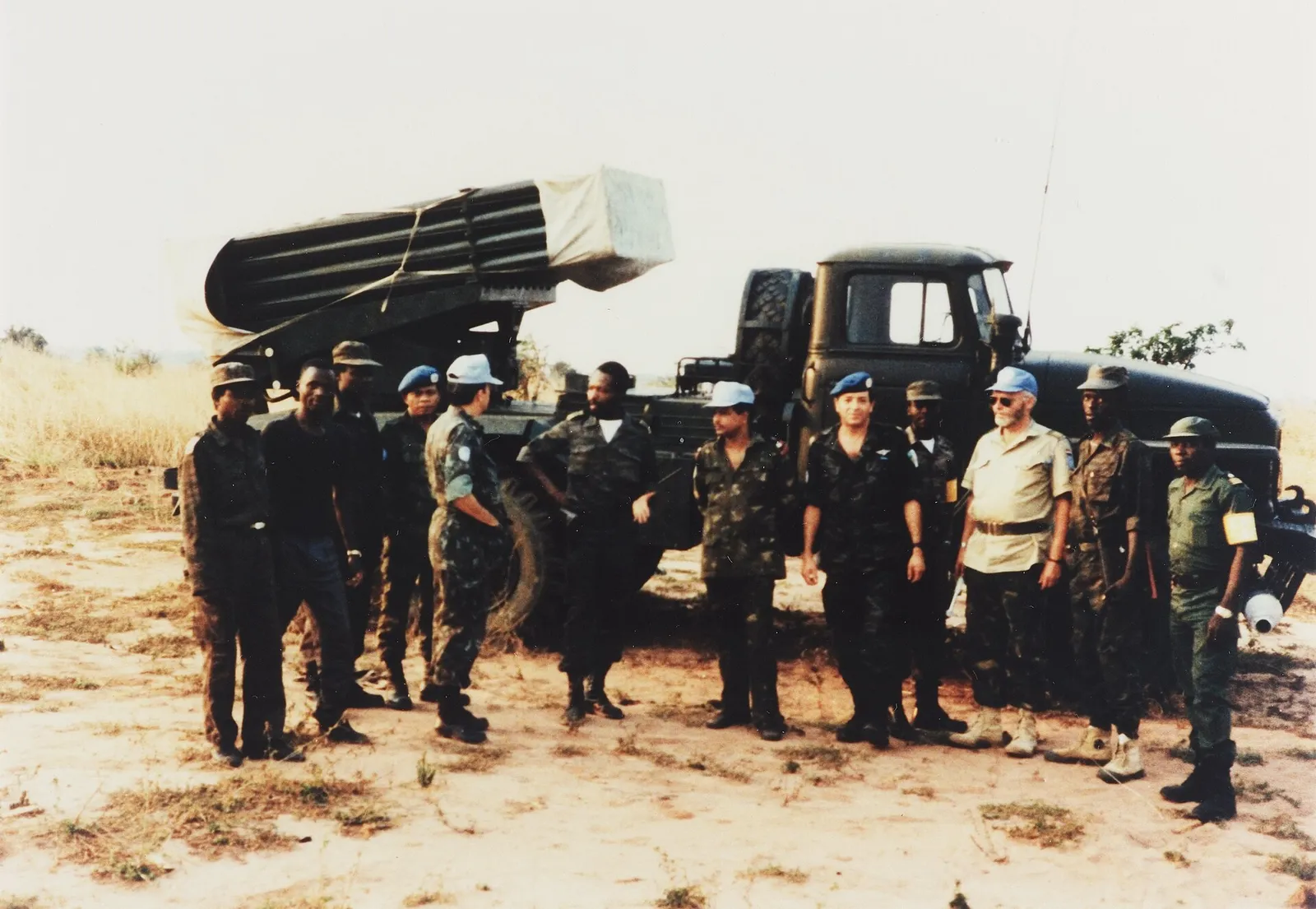
The Angolans were left to police their own peace. A Joint Political-Military Commission, the CCPM, would oversee the transition, but its decisions needed consensus between the government and UNITA. Portugal, the United States and the Soviet Union sat as observers, and the UN only by invitation. The UN's task was to check that joint monitoring teams did their job, with up to 350 unarmed military observers and 90 police observers.
By election day only one army was to exist, the Angolan Armed Forces, or FAA. Each side would provide 20,000 men to a 40,000-strong army, while the air force and navy, which UNITA did not have, would come from the government's side. Portugal, France and the United Kingdom would advise on forming it. Every other soldier was to be demobilised before the vote.
| Branch | Strength by election day | Drawn from |
|---|---|---|
| Army | 40,000 | 20,000 from FAPLA (government) and 20,000 from FALA (UNITA) |
| Air Force | 6,000 | FAPLA at first; UNITA to join later on terms to be agreed |
| Navy | 4,000 | FAPLA at first; UNITA to join later on terms to be agreed |
| Total | 50,000 |
Each side's 20,000 were to be 15,000 soldiers, 3,000 non-commissioned officers and 2,000 officers.
Sixteen months of uneasy peace
The ceasefire largely held. There were no major violations, the UN reported, but almost everything else slipped. By October 1991 the movement of troops into the assembly areas was far behind schedule and the joint police monitoring groups did not exist. Camps lacked food, medicine and clothes, and in government camps unpaid soldiers rioted or simply walked away.
Washington pressed both men. When dos Santos visited in September 1991, President Bush urged him to sort out the delays and agree a date for the vote, and told him the United States would establish diplomatic relations with the government that emerged from free and fair elections. In October Bush told Savimbi the same thing about timing: Washington wanted the elections in September 1992.
Neither side disarmed in good faith, the IEEI study argues. In March 1992 the government began moving elite demobilised soldiers into a new riot police, nicknamed the “ninjas”; UNITA called it a breach of the accords, and the government called it normal practice. UNITA declared 37,330 fighters, although Savimbi had earlier claimed 50,000 to 70,000, and one joint investigation found several hundred undeclared UNITA troops in Cuando Cubango.
That same March two senior UNITA figures, Miguel N'Zau Puna and Tony da Costa Fernandes, left the movement and spoke of killings of dissidents inside it. UNITA said the MPLA had arranged their defection. Armed UNITA men set up roadblocks in Luanda. The state press, radio and television were openly partial to the MPLA and at times stoked hostility to UNITA, and UNITA's own radio, Vorgan, answered in kind.
Some things went better than anyone expected. Voter registration, from 20 May to 10 August 1992, signed up 4.86 million people, about 92 per cent of an estimated 5.3 million eligible voters. Margaret Anstee, a British UN official, was appointed in February 1992 to lead the UN mission, which was enlarged to observe the elections. Two days before the vote the old armies were declared dissolved and the FAA formally came into being.
- Troops to demobilise
- 151,900 by the IEEI count, about three-quarters of them government troops
- Government troops demobilised by 7 October 1992
- 96,620, or 80 per cent of the target
- UNITA troops demobilised
- At best 10,000 to 15,000 (IEEI estimate)
- Voters registered
- 4.86 million, about 92 per cent
- UN military observers
- Up to 350
The vote, and the return to war
Angolans voted on 29 and 30 September 1992, the first free multi-party elections in the country's history. More than 91 per cent of those registered turned out, many after walking for miles, and 400 UN observers visited about 4,000 of some 6,000 polling stations. On 3 October, as early results put the MPLA ahead, Savimbi alleged widespread and systematic fraud on Vorgan. Two days later 11 former UNITA generals, among them the commander of its army, walked out of the new FAA.
The National Electoral Council sent investigators, with UN help, to all 18 provinces and found no conclusive evidence of systematic and massive fraud. Official results came on 17 October. The MPLA won the parliamentary vote with 53.74 per cent to UNITA's 34.1. Dos Santos took 49.57 per cent of the presidential vote and Savimbi 40.07, so neither had a majority and a second round was required.
Angola's elections of September 1992: official results
% of the vote
- Presidential election
- Legislative election
Results announced by the National Electoral Council on 17 October 1992. Smaller parties and candidates shared the rest. Some sources, including Human Rights Watch, give Savimbi 40.7 per cent; the official figure was 40.07.
Show the data
| Presidential election | Legislative election | |
|---|---|---|
| MPLA, dos Santos | 49.6 | 53.7 |
| UNITA, Savimbi | 40.1 | 34.1 |
“With all deficiencies taken into account, the elections held on 29 and 30 September 1992 can be considered to have been generally free and fair.”
UNITA did not accept the verdict. It had expected to win, and it had long distrusted a UN mission based in Luanda, which it saw as leaning towards the government. Before the vote, when the troika pressed both leaders to agree to share power afterwards, UNITA's Jorge Valentim accused Barroso, and the Portuguese government in particular, of trying to save their ally, the MPLA, from losing power altogether. UNITA still presents Bicesse as an attempt to restore the promise of the 1975 Alvor Agreement, which in its view the MPLA broke.
Instead of a runoff came war. UNITA forces began occupying municipalities and removing government officials. On 30 October soldiers of both sides fought at Luanda airport, which the government said UNITA had tried to seize, and on 31 October heavy fighting broke out in the capital. Over three days police, troops and armed civilians attacked UNITA's offices and supporters in Luanda and other towns, and the government did little to stop them.
Human Rights Watch counted at least 1,200 killed in the street battles in Luanda, many of them civilians, and eyewitnesses told it of deliberate mass killings by pro-government forces. UNITA's vice-president, Jeremias Chitunda, and Elias Salupeto Pena, Savimbi's nephew and the head of UNITA's team on the joint commission, were shot dead trying to leave the city. The IEEI study speaks of hundreds of UNITA supporters killed.
Blame is still argued over. Human Rights Watch called UNITA's strategy brinkmanship in clear violation of the accords, which pushed the government to breaking point and provoked the backlash. The IEEI study also puts the main problem with UNITA, but adds that the United States insisted on holding the vote on time whatever the state of demobilisation, because it expected its old ally to win.
The fighting that followed was worse than anything before it. UNITA took Huambo on 8 March 1993 after a siege that cost 15,000 casualties, and besieged Cuito, where 35,000 people died in nine months, both by UN estimates. Between May and October 1993, the UN reported, as many as 1,000 people were dying every day. Estimates of the total vary: in its 1994 report Human Rights Watch gave 500,000 dead from fighting, hunger and disease, and in 1999 it put the deaths from fighting between October 1992 and late 1994 at about 300,000.
29–30 September 1992
Presidential and legislative elections
3 October 1992
Savimbi alleges fraud on UNITA's radio
5 October 1992
Eleven former UNITA generals leave the new army
17 October 1992
Official results; the UN judges the vote generally free and fair
31 October to 2 November 1992
Fighting and killings in Luanda
8 March 1993
UNITA takes Huambo
19 May 1993
The United States recognises the Angolan government
15 September 1993
UN arms and oil embargo on UNITA
20 November 1994
Lusaka Protocol signed
Why the peace failed
“To all intents and purposes, Angola has returned to civil war, and is probably in an even worse situation than that which prevailed before the Peace Accords were signed in May 1991.”
In November 1992 the Secretary-General listed what had not been done: demobilisation and the storage of weapons only half achieved, a unified army created only two days before the vote, central government not restored in much of the country, no neutral police. It had also been hard, he wrote, to build trust in 16 months after as many years of civil war.
Critics point to the design. The accords made the two armed rivals joint custodians of their own peace, with no outside power able to enforce it. The elections decided everything, with no guaranteed place for the loser. The observers had little formal power, and in the IEEI study's phrase the troika “could perhaps have been a high judge, instead it played the role of consort”.
A British diplomat quoted in the study called it the Tinkerbell syndrome: the troika believed that if it believed hard enough in the process, and criticised neither side, the transition would succeed. One source quoted in the study said the mediators had been convinced the peace was irreversible, “and as a result we gave them too much leeway”.
The United States recognised the elected government on 19 May 1993, and in September the Security Council imposed an arms and oil embargo on UNITA. New talks produced the Lusaka Protocol of November 1994, with the same troika as observers, but it did not hold either. The war ended only after Savimbi's death in February 2002.
Why it still matters
For Portugal the mediation was a turn in relations with its largest former colony, fifteen years after Angola's independence. Barroso, who later became Portugal's prime minister, sees it in those terms.
“It was Portugal's reconciliation with its history, after colonisation and a decolonisation that was not easy either.”
In November 2025 the book Bicesse, o Caminho da Paz, with testimonies from 22 people who took part in the talks, was launched in the same room of the ministry where the accords were signed. In May 2026 Barroso took it to Luanda for the 35th anniversary. Despite all the problems, he said, Bicesse secured the unity of the Angolan state, the first free elections and a single army.
In Angola both sides of the old front line mark the date. President João Lourenço received Barroso for the 35th anniversary, and UNITA, now the largest opposition party, marked the 32nd in 2023 by calling Bicesse the start of the turn from a one-party to a multi-party system, and paid tribute to those who died for democracy and peace.
FAQs
What were the Bicesse Accords?
They were the Peace Accords for Angola, four documents agreed between the Angolan government and UNITA under Portuguese mediation, with US and Soviet observers. They set a ceasefire, a single national army, a ban on new weapons and multi-party elections. They were initialled at Estoril on 1 May 1991 and signed in Lisbon on 31 May 1991.
Who signed the Bicesse Accords?
President José Eduardo dos Santos signed for the Angolan government and Jonas Savimbi for UNITA, at Portugal's Ministry of Foreign Affairs in Lisbon, in the presence of the prime minister, Aníbal Cavaco Silva. The chief Portuguese mediator was José Manuel Durão Barroso, then secretary of state for foreign affairs and cooperation.
Were Angola's 1992 elections free and fair?
The UN's special representative, Margaret Anstee, judged them generally free and fair on 17 October 1992, after investigations found no conclusive evidence of systematic fraud. UNITA rejected the results. Dos Santos won 49.57 per cent and Savimbi 40.07, so a runoff was required but never held.
Why did the Bicesse Accords fail?
Demobilisation was incomplete, especially on UNITA's side, and the new army existed mostly on paper. The two rivals supervised the transition jointly, with no one to enforce it, and the elections were winner-takes-all. When UNITA rejected the results, fighting resumed at the end of October 1992.
On the timeline
Open the timelineNearby moments from portugal in europe (1986–today).
Rosa Mota wins the Olympic marathon in Seoul by thirteen seconds, becoming the first Portuguese woman to win an Olympic gold medal.
Salvador Sobral is born in Lisbon. In 2017 his gentle ballad 'Amar pelos dois', written by his sister Luísa, won the Eurovision Song Contest in Kyiv with a record 758 points. It was Portugal's first win since its 1964 debut, ending the longest losing run in the contest's history. Months later he underwent a heart transplant.
President Mário Soares is re-elected for a second term as President of Portugal.
The Bicesse Accords, 1991
Angolan President José Eduardo dos Santos and UNITA leader Jonas Savimbi sign the Bicesse Accords in Portugal, mediated by the Portuguese government with US and Soviet observers. The deal briefly halts Angola's civil war and paves the way for multi-party elections in 1992.
Portugal wins the FIFA World Youth Championship (under-20) on home soil at the Estádio da Luz in Lisbon, defeating Brazil on penalties. Back-to-back champions after their 1989 win in Saudi Arabia, the 'Golden Generation' of João Pinto, Rui Costa and Luís Figo heralds a new era of Portuguese football.
Indonesian troops open fire on a peaceful procession of more than 2,000 people at the Santa Cruz cemetery in Dili, East Timor, killing scores of young Timorese. Footage smuggled out by the British cameraman Max Stahl was shown around the world and revived the cause of independence for Portugal's former colony.
A month into Portugal's first presidency of the European Community, foreign minister João de Deus Pinheiro and finance minister Jorge Braga de Macedo sign the Maastricht Treaty for Portugal. The treaty created the European Union and set the course for the euro, which Portugal adopted in 1999.
Coming up in history
All long reads 2 October 1969Mr Five Per Cent's museum: the Gulbenkian opens in Lisbon, 1969
 3 October 1910Miguel Bombarda: the shooting at Rilhafoles on the eve of the Republic
 4 October 1582The ten days Portugal never had: the calendar change of October 1582
 5 October 1910The morning Portugal became a republic: 5 October 1910
18 sources
Archives, scholarship and reporting this article was checked against.
- 1
Letter dated 17 May 1991 from the chargé d'affaires of Angola to the Secretary-General, enclosing the Peace Accords for Angola (S/22609)United Nations Security Council, 17 May 1991
- 2
Angola: UNAVEM II, backgroundUnited Nations Peacekeeping
- 3
Portuguese mediation and the peace talksInstituto de Estudos Estratégicos e Internacionais (IEEI), Cadernos do Lumiar no. 3, 1994 (Arquivo IEEI, e-cultura)
- 4
- 5
Angola Unravels: The Rise and Fall of the Lusaka Peace Process, chapter III, BackgroundHuman Rights Watch, 1999
- 6
- 7Acordo de Bicesse marca “reconciliação de Portugal com a sua história”, diz Durão BarrosoObservador (Lusa), 18 November 2025
- 8Paz é possível mesmo no contexto de incerteza e tensões internacionais, diz Cavaco SilvaRTP Notícias (Lusa), 17 November 2025
- 9Aqui turista não entra: a alta diplomacia portuguesa acontece nestas salas das Necessidades (Hugo Amaral)ECO, July 2021
- 10
O caso peculiar das relações com Angola (Carla Folgôa)Janus 2002, Observatório de Relações Exteriores, Universidade Autónoma de Lisboa
- 11
Ex-PM português Durão Barroso: “Aquilo que foi negociado em Bicesse foi a unidade do Estado angolano”Ver Angola (Lusa), May 2026
- 12
Statement by Press Secretary Fitzwater on the President's Meeting With Jonas Savimbi of the National Union for the Total Independence of Angola, 2 October 1990The American Presidency Project, University of California, Santa Barbara
- 13
- 14
- 15
- 16
- 17
A Guide to the United States' History of Recognition, Diplomatic, and Consular Relations, by Country, since 1776: AngolaOffice of the Historian, US Department of State
- 18
Image credits
- The Palácio das Necessidades in Lisbon, home of Portugal's Ministry of Foreign Affairs, where dos Santos and Savimbi signed the accords on 31 May 1991. Photographed in May 2021. Hugo Ferreira, CC BY-SA 4.0, via Wikimedia Commons.
- Angolan military equipment photographed by the Dutch army during the UNAVEM II mission, with a UN vehicle in the background, between 1992 and 1993. Fotoafdrukken Koninklijke Landmacht, CC BY-SA 4.0, via Wikimedia Commons.
- UN observers of the UNAVEM II mission with Angolan soldiers beside a truck-mounted rocket launcher, photographed by the Dutch army between 1992 and 1993. Fotoafdrukken Koninklijke Landmacht, CC BY-SA 4.0, via Wikimedia Commons.
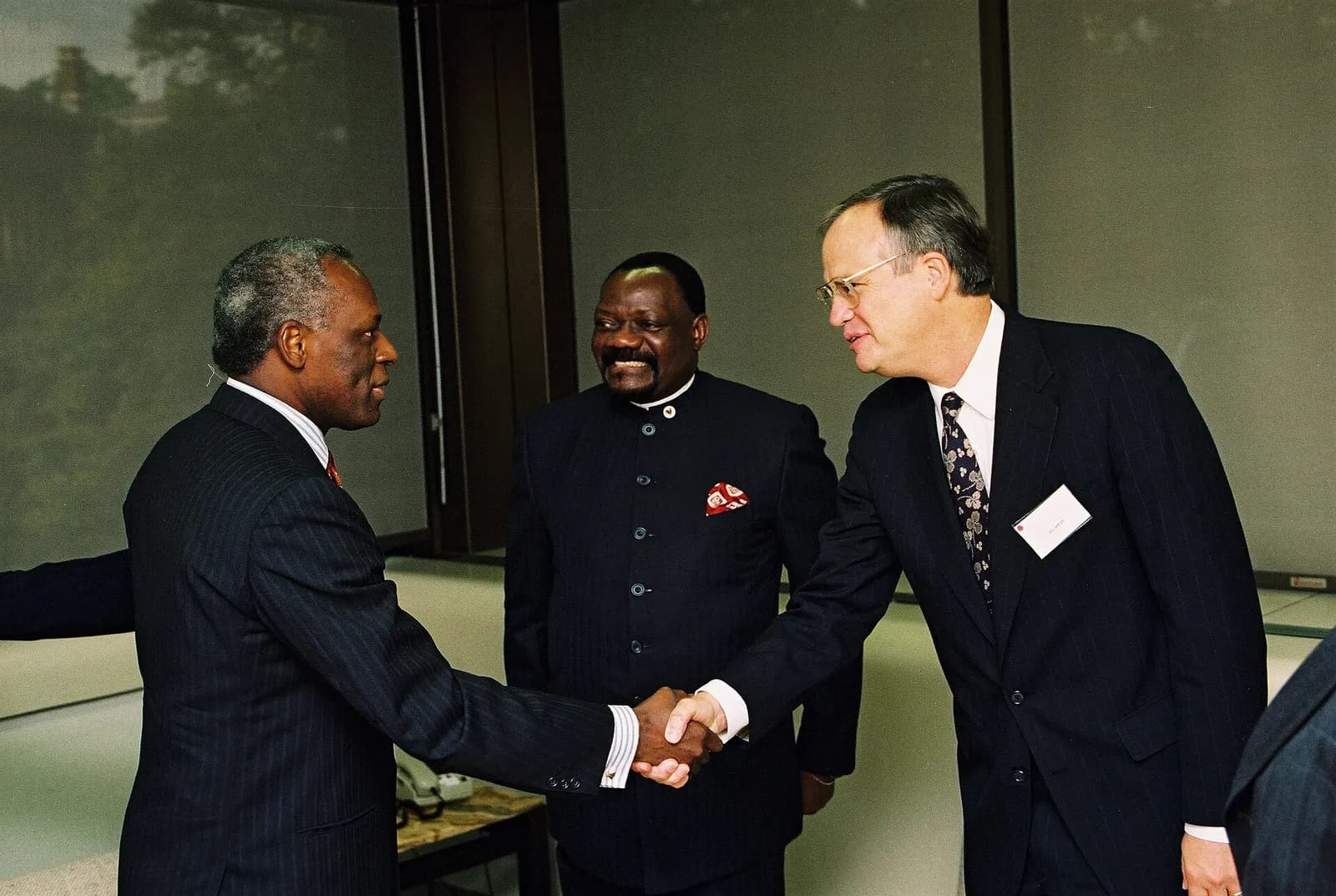
- José Eduardo dos Santos (left) shakes hands with James Gustave Speth, head of the UN Development Programme, as Jonas Savimbi looks on, at a donors' conference on Angola in Brussels, 25 September 1995. EC, CC BY 4.0, via Wikimedia Commons.