

Madjer's back-heel: FC Porto beat Bayern to win the 1987 European Cup
Bayern led at half-time and had booked a banquet for 450 guests. Then an Algerian back-heel and a Brazilian substitute's volley gave a club from Portugal's second city its first European trophy.
At a glance
- On 27 May 1987 FC Porto beat Bayern Munich 2–1 in the European Cup final at the Prater stadium in Vienna, before a crowd variously given as 56,000, 57,500 or 62,000.
- Ludwig Kögl headed Bayern ahead in the first half; Rabah Madjer equalised with a back-heel about 13 minutes from time and minutes later set up the winner for Juary, a half-time substitute.
- It was the first European title for FC Porto and the first European Cup for a Portuguese club since Benfica's in 1962. Artur Jorge became the first Portuguese coach to win the competition.
- Porto played without their captain and top scorer, Fernando Gomes, who broke his left fibula in training 13 days before the final.
- Within eight months Porto added the European Super Cup against Ajax and, on a snow-covered pitch in Tokyo on 13 December 1987, the Intercontinental Cup against Peñarol.
A back-heel in the Prater
With about 13 minutes left in Vienna on the evening of 27 May 1987, FC Porto were still losing. Bayern Munich had led since the 25th minute, and in a stadium full mostly of Bayern supporters the European Cup seemed on its way to Munich for the fourth time.
Then Juary, a Brazilian forward sent on at half-time, broke into the Bayern penalty area and pulled the ball across. It came off a defender and ran along the goal line. Rabah Madjer, an Algerian, had already run towards the near post expecting a cross, so the ball arrived behind him.
With his back to goal and a defender on the line, Madjer let the ball run between his legs and flicked it in with his heel past Jean-Marie Pfaff. By the time the Bayern defenders turned to watch it cross the line, the city of Vienna's history wiki notes, he already had both arms in the air.
“It was a real explosion – I really didn't expect to score from a back-heel in the final.”
Minutes later Madjer beat a defender on the left and crossed for Juary, who scored the winner. A club that had never won anything in Europe was champion of Europe, 25 years after Benfica's second title in Amsterdam.
What you need to know first
Until 1987 Portugal's European football glory belonged to Lisbon. Benfica had won the European Cup in 1961 and 1962, and Sporting the Cup Winners' Cup in 1964. FC Porto, from the country's second city in the north, had first played in a European competition in 1956 and taken part for 31 years without a trophy.
The change began in 1982, when Jorge Nuno Pinto da Costa, the club's former director of football, was elected president. His campaign slogan asked members to vote for him if they wanted 'a strong Porto in Portugal and in Europe'. By his own account he enlarged the Estádio das Antas from 65,000 to 90,000 places, and in 1984 Porto reached the Cup Winners' Cup final in Basel, losing 2–1 to a Juventus side with Michel Platini, Paolo Rossi and Zbigniew Boniek.
That summer the club's great coach of the period, José Maria Pedroto, was seriously ill. According to Diário de Notícias, it was Pedroto who persuaded Pinto da Costa to hire his former pupil Artur Jorge, then 38. Born in Porto in 1946, Artur Jorge had been a prolific centre-forward for Académica and Benfica, had studied German philology at Coimbra, helped found the players' union in 1972 and published a book of poems. Porto won the league in his first two seasons.
The country around the club was changing too. Portugal had joined the European Economic Community on 1 January 1986. In an anniversary text in 2024, FC Porto described itself in 1987 as a club 'from a small city in a poor country' that beat 'a sporting and financial colossus'.
The road to Vienna
Porto entered as Portuguese champions of 1985-86 and began with a 9–0 home win over Rabat Ajax of Malta in September 1986, Fernando Gomes scoring four. The second round was harder: they lost 1–0 in Czechoslovakia to TJ Vítkovice and turned it round with a 3–0 win at the Antas.
Brøndby of Denmark went out 2–1 on aggregate in March 1987, Madjer scoring at home and Juary away. In the semi-final Porto beat Dynamo Kyiv, whose striker Igor Belanov had been voted European Footballer of the Year for 1986, 2–1 at home and 2–1 in Kyiv. In the return leg Celso and Gomes scored in the first 11 minutes.
| Round | Opponent | First leg | Second leg | Aggregate |
|---|---|---|---|---|
| First round | Rabat Ajax (Malta) | Porto 9–0 Rabat Ajax, 17 Sep 1986 | Rabat Ajax 0–1 Porto, 1 Oct 1986 | 10–0 |
| Second round | TJ Vítkovice (Czechoslovakia) | Vítkovice 1–0 Porto, 22 Oct 1986 | Porto 3–0 Vítkovice, 5 Nov 1986 | 3–1 |
| Quarter-final | Brøndby IF (Denmark) | Porto 1–0 Brøndby, 4 Mar 1987 | Brøndby 1–1 Porto, 18 Mar 1987 | 2–1 |
| Semi-final | Dynamo Kyiv (USSR) | Porto 2–1 Dynamo, 8 Apr 1987 | Dynamo 1–2 Porto, 22 Apr 1987 | 4–2 |
| Final | Bayern Munich (West Germany) | Porto 2–1 Bayern, Vienna, 27 May 1987 | Single match | 2–1 |
Porto scored 21 goals and conceded 5. Their top scorer in the competition was Fernando Gomes with five, who missed the final through injury.
Bayern were the clear favourites. Under Udo Lattek, who had coached the club to its first European Cup in 1974, they led the Bundesliga by six points over Hamburg and had knocked out Real Madrid 4–2 on aggregate in the semi-final. Bayern's captain on the night was Lothar Matthäus, and their side also included Andreas Brehme and Dieter Hoeneß.
Porto's preparations went wrong 13 days before the final. On 14 May, ten minutes into training at the Antas, Gomes caught his boot in the turf making a sliding tackle and broke his left fibula at the ankle. The club doctor, Domingos Gomes, ruled him out for at least four months. Lima Pereira, the Brazilian striker Casagrande and Jaime Pacheco were also injured. Bayern had their own absentee: their regular captain, Klaus Augenthaler, was suspended.
Juary later told Diário de Notícias that for two weeks Artur Jorge and his assistant, Octávio Machado, kept telling the players that Bayern were very strong and that losing narrowly would be a good result. In Vienna, he said, they switched on the television to relax and it showed nothing but Bayern. Madjer remembered it differently: on the eve of the match, he recalled, he said it was 50-50 and that Porto would win 2–1 the next day.
The final: 45 minutes to make history
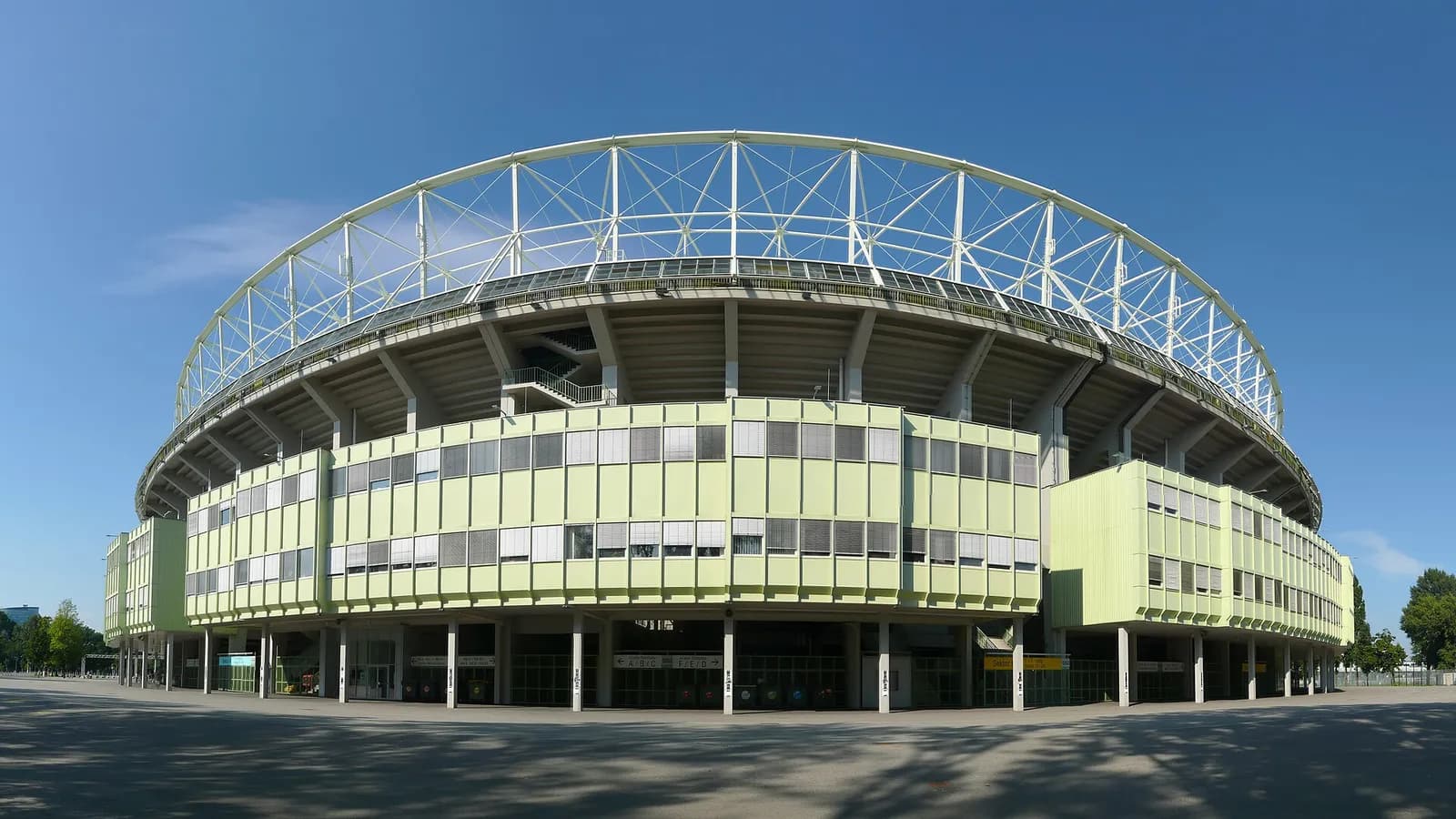
The Prater stadium had opened in 1931 as Austria's national stadium and had just reopened, renovated and roofed, in October 1986. It had already staged the European Cup final of 1964. Alexis Ponnet of Belgium refereed the 1987 final. RSSSF gives the crowd as 56,000 in one table and 57,500 in another, the figure the Vienna wiki also uses; the German Football Association's database gives 62,000, the number of seats after the renovation.
For 45 minutes the script held. Matthäus drove Bayern on, and after 25 minutes Ludwig Kögl, only 1.71 metres tall, headed them in front after a lapse in Porto's defence. A Bola wrote later that Porto looked afraid: of Bayern's players, of their coach and of a stadium full of their fans.
What happened at half-time has become club legend. Paulo Futre, Porto's winger, said on the coach's death that Artur Jorge told the dressing room that they had 45 minutes to make history. Juary remembers him asking each player his age and telling them to go out and play 'like Porto'. Then, Juary says, the coach added that they could see the beast was not as fearsome as he had made out.
“You have 45 minutes to go down in history.”
The Bayern dressing room argued too. Dieter Hoeneß, playing his last match for the club, recalled that Lattek wanted to keep pressing, but the defenders persuaded him to sit back and counter-attack. 'For once in his life he listened to the wrong people,' Hoeneß said.
Artur Jorge replaced the midfielder Quim with Juary at the interval, and Porto were quicker and more direct at once. Midway through the half he took off the left-back Inácio and sent on the midfielder Frasco. Futre ran at the Bayern defence again and again, António André covered the left side, and Frasco took over the midfield. Bayern, without Augenthaler, could not hold them.
Madjer was hurt in the move that brought the equaliser and went off to be treated on the touchline by the club doctor. Porto kept the ball while he recovered. Limping, he came back on, took a pass on the left from the Brazilian defender Celso, beat a defender and crossed for Juary, who met it with a right-foot volley.
“The second goal came from the most incredible move I have ever seen, what Madjer did to the Bayern defender marking him.”
25'
Kögl scores for Bayern
A header after a lapse in Porto's defence. Some sources give the 24th minute.
35'
Jaime Magalhães booked
The first of three Porto bookings; Celso and Sousa followed.
46'
Juary on for Quim
Artur Jorge sends on a forward for a midfielder.
65'–66'
Frasco on for Inácio
Porto now attack with an extra midfielder.
77'–78'
Madjer's back-heel, 1–1
Juary's ball across the area is deflected; Madjer flicks it in with his heel.
79'–80'
Juary volleys the winner, 2–1
Madjer beats a defender on the left and crosses.
82'
Lars Lunde on for Hansi Flick
Bayern's last change brings no reply.
- Date
- Wednesday 27 May 1987
- Venue
- Praterstadion, Vienna
- Result
- FC Porto 2 Bayern Munich 1 (0–1 at half-time)
- Scorers
- Kögl (Bayern); Madjer, Juary (Porto)
- Attendance
- 56,000, 57,500 or 62,000, depending on the source
- Referee
- Alexis Ponnet (Belgium)
- Coaches
- Artur Jorge (Porto), Udo Lattek (Bayern)
- Porto line-up
- Młynarczyk; João Pinto (captain), Eduardo Luís, Celso, Inácio (Frasco); Quim (Juary), Jaime Magalhães, Sousa, André; Madjer, Futre
After Vienna
João Pinto, captain in Gomes's absence, lifted the cup. Juary did not join the lap of honour. He went straight to the dressing room for a shower, wanting only to get home to Porto, and told Diário de Notícias nearly 30 years later that he first touched the trophy on the plane, when it sank in that they were champions of Europe.
In Munich the defeat was a trauma. Bayern had booked a banquet for 450 guests at the Marriott on Vienna's Parkring, with filet mignon and morels on the menu. Lattek complained that he could no longer take responsibility for what some of his players did on the pitch, and left at the end of the season. The general manager, Uli Hoeneß, called it the worst defeat of his life.
In Portugal the honours piled up. The club magazine, Dragões, ran the headline 'A Europa é azul e branca' (Europe is blue and white) in its June issue and listed congratulations from, among others, the Soviet embassy and the crew of the cod-fishing ship Senhor dos Mareantes. Cavaco Silva's government awarded the club the Grand Collar of Sporting Merit, and the mayor of Porto, Fernando Cabral, gave medals of merit to Gomes, Pinto da Costa and Artur Jorge.
At a dinner for the champions at the casino in Póvoa de Varzim, the former Benfica president Fernando Martins drew applause by telling the room not to let their president get away. He had reason to worry. Two days after the final Pinto da Costa had told L'Équipe that he would stop at the end of the season, because he had kept his promises and could not go on working ten hours a day for the club.
He stayed for another 37 years. The team, though, broke up quickly. Artur Jorge left for Paris to coach Matra Racing, a club backed by big money, and came back to Porto in 1988 after things went badly in France. Tomislav Ivić took over as coach.
Futre went to Atlético Madrid. Pinto da Costa later explained that his contract had allowed a transfer abroad for a release fee of about 200,000 contos. In May 1987 the Spanish businessman Jesús Gil, who wanted Futre for Atlético, arrived in Porto ready to pay it by cheque. By then Porto had agreed a new contract with Futre that removed the clause, and they spent three weeks negotiating better terms. Futre joined Atlético in July 1987, for a club-record fee, and finished second to Ruud Gullit in that year's European Footballer of the Year vote.
Champions of the world in the snow
As European champions Porto played for two more trophies in the months that followed. In the European Super Cup against Ajax, Rui Barros scored after five minutes in Amsterdam on 24 November 1987 and António Sousa scored the only goal of the second leg at the Antas on 13 January 1988.
In between came the Intercontinental Cup, played as a single match in Tokyo between the European champions and the winners of South America's Copa Libertadores. On the morning of 13 December 1987 the city woke up white. Pinto da Costa later said the sun had shone the day before, and that Peñarol of Uruguay, who had never played in snow, did not want to play. A postponement would have moved the match to March or April, the busiest part of Porto's season.
He argued the other way. The Austrian referee, Franz Wöhrer, was undecided, and Pinto da Costa reminded him that he was due to retire on 31 December, so a postponed match would go to someone else. The game went ahead. Ivić thought the snow would hurt Peñarol's short passing more than Porto's counter-attacks, and had his players training at 7 in the morning and lunching at 10 to adjust to Japanese time.
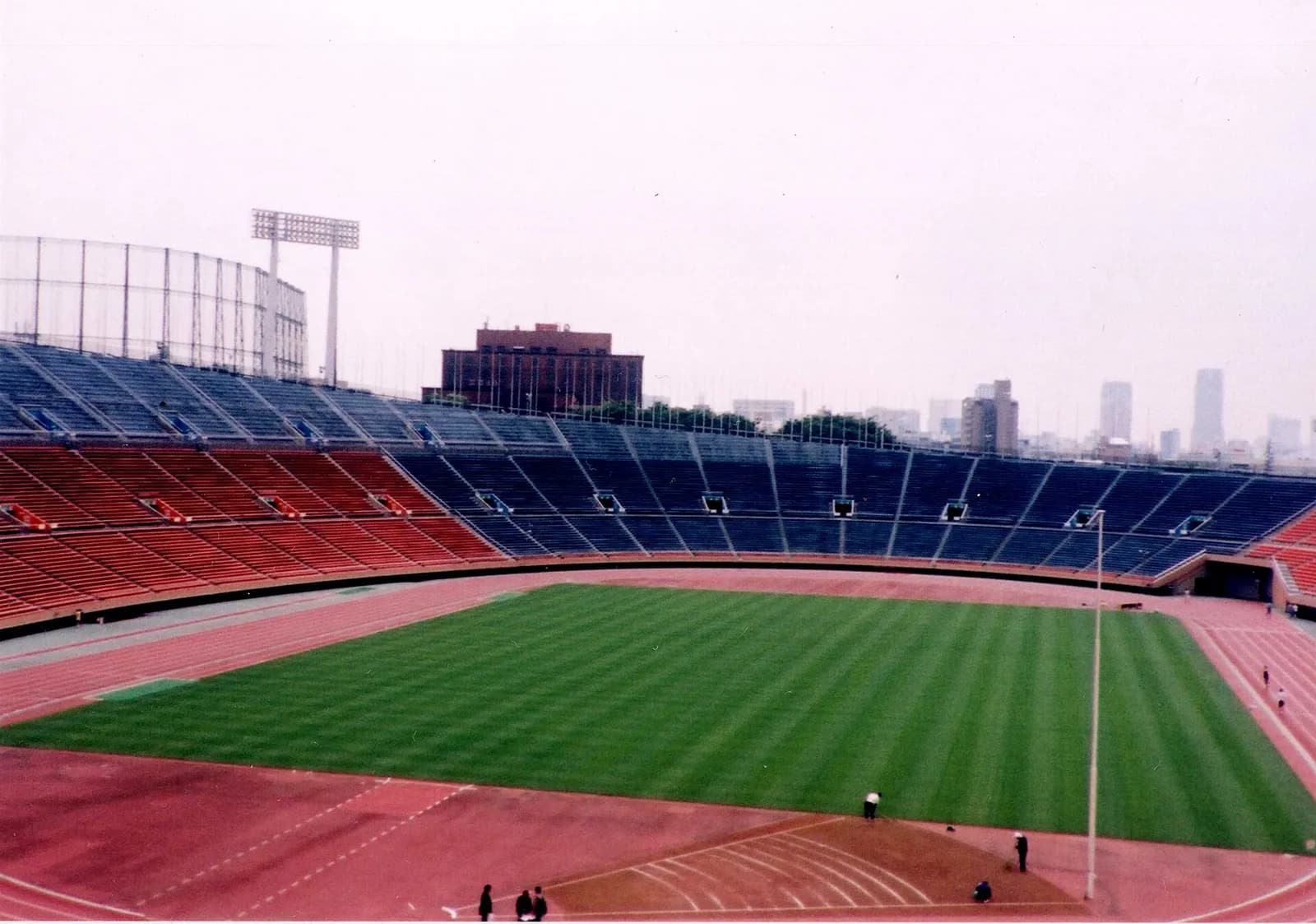
Gomes, back from the injury that had kept him out of Vienna, put Porto ahead three minutes before half-time. Viera equalised for Peñarol ten minutes from the end. In the 110th minute, deep into extra time, Madjer lobbed the goalkeeper from long range; the ball slowed in the snow but crossed the line. Porto won 2–1 before a crowd of about 45,000.
Madjer was named man of the match and won a car, a Toyota Carina II. The original idea was to sell it and share the money among the players, but Pinto da Costa insisted on keeping it, and it is now displayed in the club museum.
| Competition | Opponent | Result | Where and when | Porto scorers |
|---|---|---|---|---|
| European Cup | Bayern Munich | 2–1 | Vienna, 27 May 1987 | Madjer, Juary |
| European Super Cup | Ajax | 1–0 and 1–0 | Amsterdam, 24 Nov 1987; Porto, 13 Jan 1988 | Rui Barros; Sousa |
| Intercontinental Cup | Peñarol | 2–1 after extra time | Tokyo, 13 Dec 1987 | Gomes, Madjer |
In the 1986-87 Portuguese league Porto finished second, two points behind Benfica.
Why it still matters
After Vienna, Porto came to dominate Portuguese football. Before 1987 it had won eight national league titles in nearly half a century; in the ten seasons that began in the 1990s it won seven, including five in a row from 1994-95 to 1998-99. Benfica remained the club with the most titles overall.
Portuguese league titles by decade, 1938-39 to 2025-26
titles
- FC Porto
- Benfica
- Sporting
Primeira Divisão titles grouped by the decade in which each season began (so 1989-90 counts in the 1980s). The 1930s cover only 1938-39 and 1939-40, and the 2020s the six seasons from 2020-21 to 2025-26. Belenenses (1945-46) and Boavista (2000-01) won the other two titles. Counted from RSSSF's list of champions.
Show the data
| FC Porto | Benfica | Sporting | |
|---|---|---|---|
| 1930s | 2 | 0 | 0 |
| 1940s | 0 | 4 | 5 |
| 1950s | 2 | 3 | 5 |
| 1960s | 0 | 7 | 3 |
| 1970s | 2 | 6 | 2 |
| 1980s | 4 | 5 | 1 |
| 1990s | 7 | 2 | 1 |
| 2000s | 6 | 2 | 1 |
| 2010s | 5 | 5 | 0 |
| 2020s | 2 | 1 | 3 |
Europe followed. Under José Mourinho, Porto won the UEFA Cup in 2003 and the Champions League in 2004, beating Monaco 3–0 in Gelsenkirchen and, in UEFA's words, reclaiming the trophy for the first time since 1987. A second Intercontinental Cup followed in 2004 and the Europa League in 2011. FC Porto counts six international trophies won since the night in Vienna.
Benfica kept coming close. A year after Vienna, Benfica lost the 1988 European Cup final to PSV Eindhoven on penalties, and in 1990 it lost the final to AC Milan in the same Prater stadium.
The men of 1987 are now part of the club's memory. Artur Jorge, remembered as the first Portuguese coach to win the European Cup, died in February 2024 at 78; the club said he would be as unforgettable as that night in Vienna. Pinto da Costa lost the presidency to André Villas-Boas in 2024 after 42 years and died in February 2025, aged 87.
FAQs
Who scored in the 1987 European Cup final?
Ludwig Kögl headed Bayern Munich ahead in the first half. Rabah Madjer equalised with a back-heel in the 77th or 78th minute, and Juary, a half-time substitute, scored Porto's winner two or three minutes later from Madjer's cross.
Where was the 1987 European Cup final played?
At the Prater stadium in Vienna, now called the Ernst-Happel-Stadion, on 27 May 1987. The crowd is given as 56,000 or 57,500.
Who was FC Porto's coach in 1987?
Artur Jorge, a former Académica and Benfica striker from Porto, who had taken over in 1984. He was the first Portuguese coach to win the European Cup and left that summer for Matra Racing in Paris. Tomislav Ivić then coached Porto to the Super Cup and the Intercontinental Cup.
What is a goal 'à la Madjer'?
A back-heeled finish with the scorer's back to goal, named after Madjer's equaliser against Bayern. He said he had run to the near post, so the ball arrived behind him, and he back-heeled it because a defender was on the line.
Which Portuguese clubs have won the European Cup?
Benfica won it in 1961 and 1962. FC Porto won it in 1987 and again in 2004, when it had become the Champions League, beating Monaco 3–0 in Gelsenkirchen.
On the timeline
Open the timelineNearby moments from portugal in europe (1986–today).
Mário Soares beats Diogo Freitas do Amaral in the presidential run-off by just over two points, becoming Portugal's first civilian president in six decades. The founder of the Socialist Party would serve two terms, until 1996.
José 'Zeca' Afonso dies in Setúbal of amyotrophic lateral sclerosis, aged 57. The singer-songwriter's 'Grândola, Vila Morena', broadcast on the radio as a signal to the rebel troops on 25 April 1974, made him the voice of the Carnation Revolution.
Prime Minister Cavaco Silva and Premier Zhao Ziyang sign the Sino-Portuguese Joint Declaration in Beijing, agreeing that Macau is Chinese territory under Portuguese administration and that sovereignty would pass to China on 20 December 1999, under the 'one country, two systems' principle.
FC Porto's European Cup, 1987
FC Porto win the European Cup, coming from behind to beat Bayern Munich 2–1 at Vienna's Praterstadion with Rabah Madjer's famous back-heel and a Juary volley — the first European Cup for a Portuguese club since Benfica's in 1962.
Death of Fernando Van Zeller Guedes, the Porto wine-maker behind Mateus Rosé. Launched in 1942 by the company that became Sogrape, the lightly sparkling pink wine in its flask-shaped bottle — with the baroque Mateus Palace near Vila Real on the label — became one of the world's best-selling wines, shifting millions of cases a year at its peak.
Admiral Américo Tomás, the last President of the Estado Novo regime, who was deposed in the Carnation Revolution of 1974, dies aged 92.
TSF begins regular broadcasts in Lisbon as a news radio run by a cooperative of journalists. Private local stations were not yet licensed, so it went out as a pirate until unlicensed stations went silent in December; its live coverage of the Chiado fire that August made its name.
Coming up in history
All long reads 29 May 1385The Battle of Trancoso: how feuding Beira lords stopped a Castilian raid
 30 May 1834The decree that shut Portugal's monasteries: 30 May 1834
 31 May 1991The Bicesse Accords: Angola's peace signed in Lisbon, 31 May 1991
 1 October 1777The Treaty of San Ildefonso: Portugal and Spain redraw South America, 1777
31 sources
Archives, scholarship and reporting this article was checked against.
- 1
European Champions' Cup 1986-87: details (Antonio Zea and Marcel Haisma)RSSSF
- 2
1986/87: Madjer inspires Porto triumphUEFA
- 3
- 4
Europacupfinalspiele in Wien (Fußball)Wien Geschichte Wiki, City of Vienna
- 5
Pinto da Costa e Futre: «Puxou do livro de cheques para nos pagar os 200 mil contos»A Bola, 16 February 2025
- 6Juary. O herói do Prater ensina a arte aos miúdos do SantosDiário de Notícias, 12 March 2017
- 7
FC Bayern: ein legendärer Albtraum mit skurrilen FolgenSport1, 27 May 2026
- 8
- 9
- 10
- 11
- 12
- 13
- 14
- 15
- 16Artur Jorge, o jogador e treinador com alma de poeta que levou o FC Porto à glóriaDiário de Notícias, 22 February 2024
- 17“Tão inesquecível como aquela noite de Viena”. Do FC Porto ao Benfica, todas as reações à morte de Artur JorgeDiário de Notícias, 22 February 2024
- 18
- 19
Portugal na UEEuropean Commission Representation in Portugal
- 20
European Footballer of the Year (“Ballon d'Or”): overview and top five by yearRSSSF
- 21
1987: o ano admirávelRecord, 15 April 2013
- 22Renascido das cinzas (Rui Alves)RTP Memória
- 23
- 24
Madjer, une marque déposéeFIFA, 15 December 2020
- 25
- 26
FC Porto – Bayern München, European Cup final 1986-87DFB Datencenter (German Football Association)
- 27
- 28
- 29
- 30
- 31
Image credits
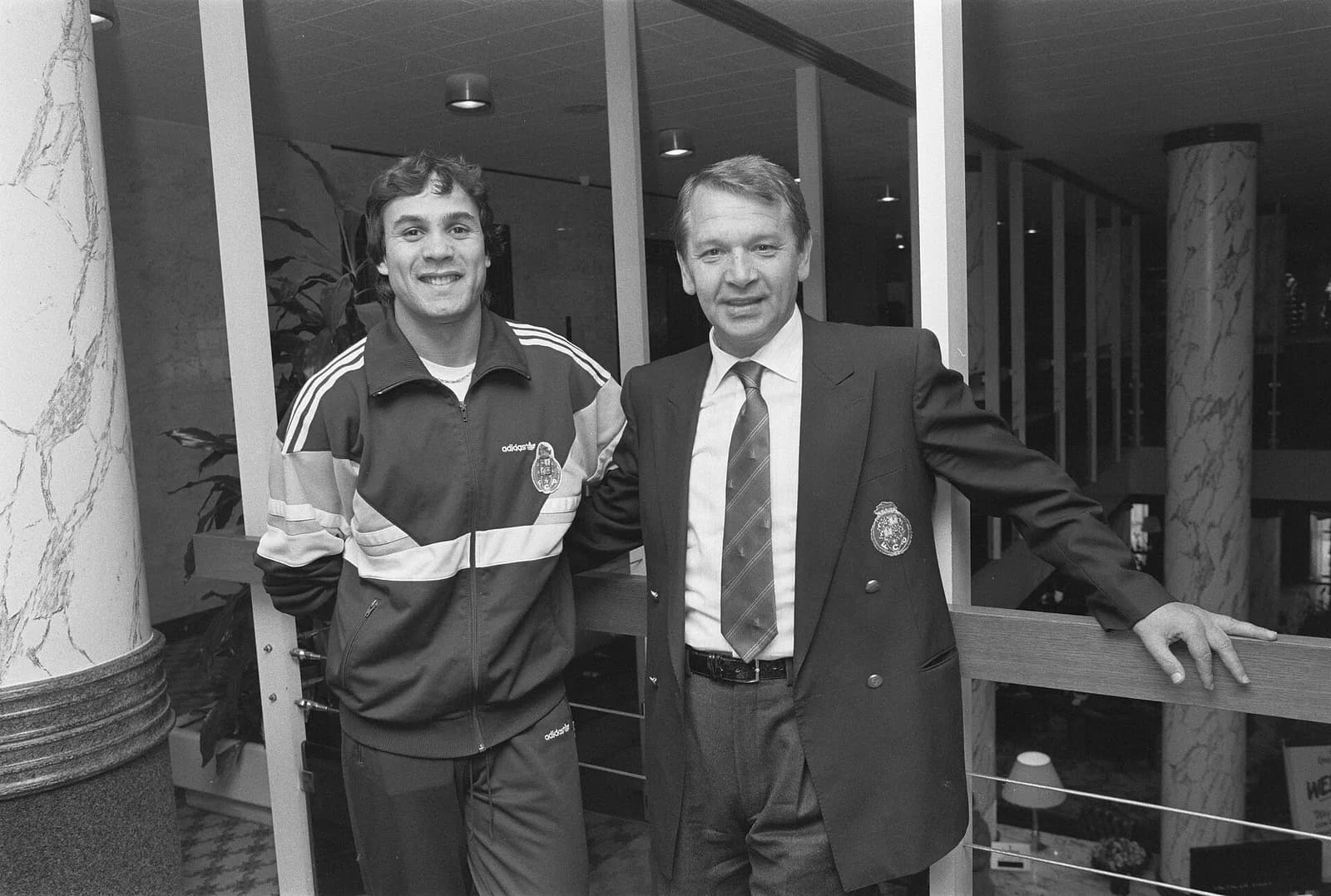
- Rabah Madjer (left) with Tomislav Ivić, who succeeded Artur Jorge as FC Porto's coach, in the team hotel on 23 November 1987, the day before the first leg of the European Super Cup against Ajax in Amsterdam. Bart Molendijk / Anefo, CC0, via Wikimedia Commons.
- The Prater stadium in Vienna, renamed the Ernst-Happel-Stadion in 1993, photographed in August 2010. The roof was added in a renovation; the stadium reopened in October 1986, seven months before the final. Peter Gugerell, Public domain, via Wikimedia Commons.
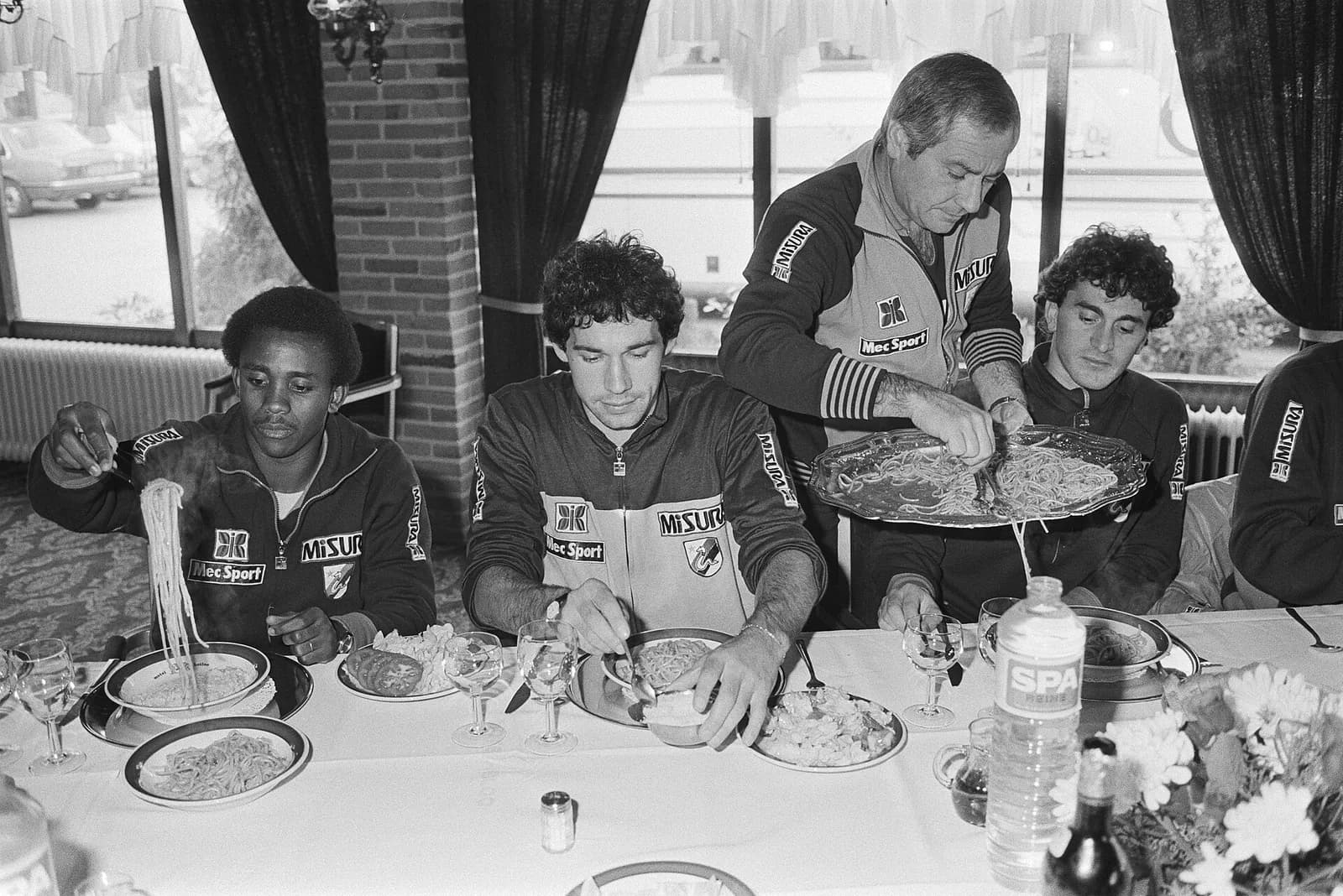
- Juary (left), then an Inter Milan player, at lunch with team-mates Giuseppe Baresi and Sabato as the assistant coach serves spaghetti, at Motel Heilo in North Holland, 19 October 1982. He joined FC Porto after a difficult spell in Italian football. Marcel Antonisse for Anefo, CC0, via Wikimedia Commons.
- The National Stadium in Tokyo, where Porto beat Peñarol in the snow on 13 December 1987, photographed in July 2005. Kentin, CC BY-SA 3.0, via Wikimedia Commons.