

The Convention of Evoramonte: how Portugal's war of two brothers ended
Ten days after his army was routed at Asseiceira, Dom Miguel's commander signed terms in a house in a hilltop village in the Alentejo. Miguel sailed into exile within the week, and from Genoa he took it all back.
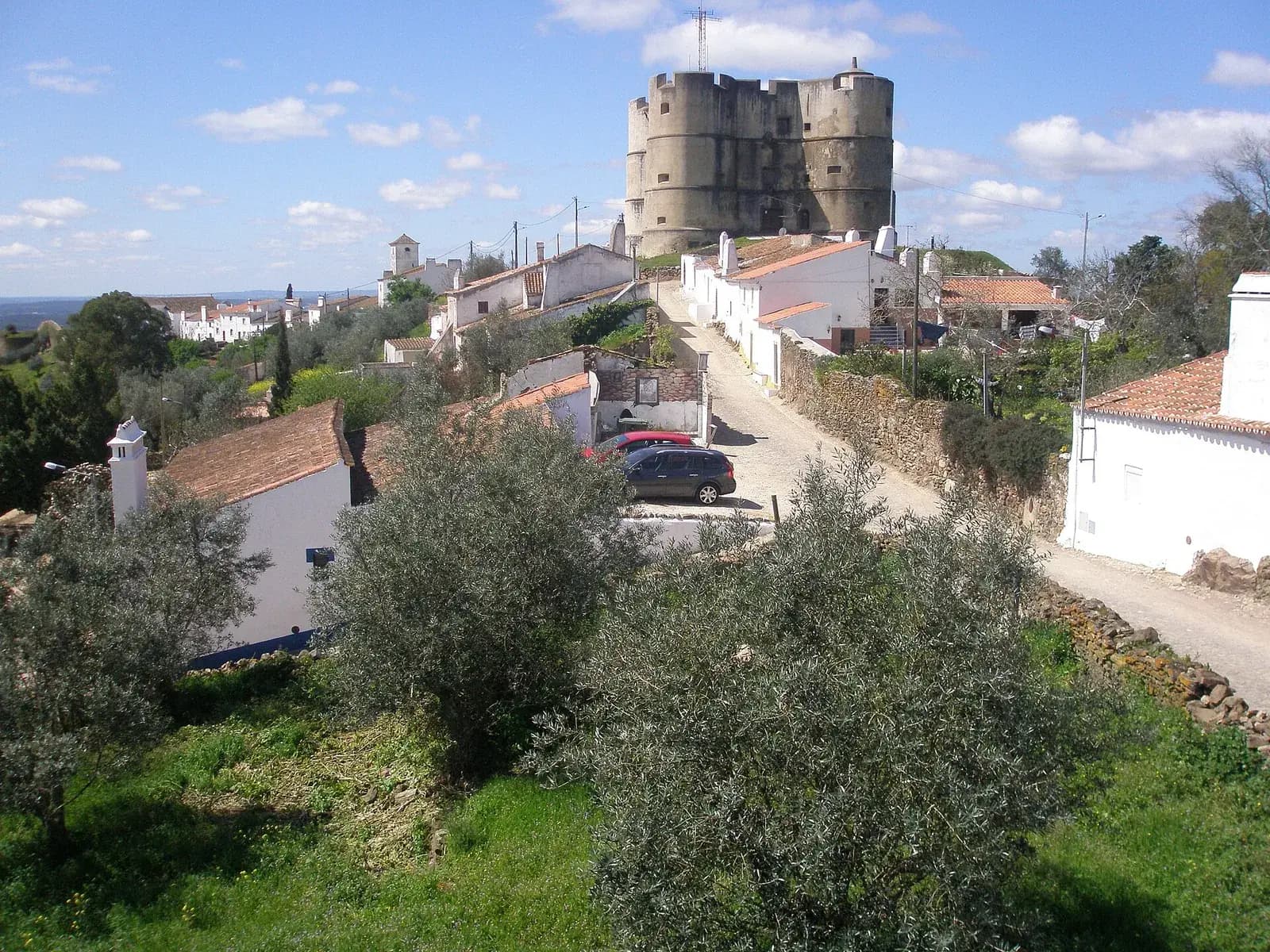
At a glance
- On the night of 26 May 1834, at Evoramonte in the Alentejo, the liberal marshals Terceira and Saldanha and Miguel's commander, José António de Azevedo Lemos, signed the terms that ended Portugal's civil war of 1832 to 1834.
- The battle that forced the issue was Asseiceira, near Tomar, on 16 May 1834: Terceira's troops took about 1,400 prisoners, including 74 officers, and all eight of the enemy's guns.
- The terms gave a general amnesty for political crimes, let officers keep their ranks and granted Miguel a pension of 60 contos a year, on condition that he left within 15 days and never returned to the Iberian Peninsula.
- Miguel sailed from Sines on the British frigate Stag on 1 June. On 20 June, in Genoa, he declared that he had signed under force and that the agreement was void.
- The Cortes answered with a law of 19 December 1834 that excluded Miguel and his descendants from the succession and revoked his pension. He never saw Portugal again and died in Germany in 1866.
A night in a hilltop village
In Évora on 26 May 1834, José António de Azevedo Lemos wrote the letter that ended a war. Lemos was a lieutenant-general and commanded what was left of Dom Miguel's army, gathered in and around the old Alentejo city. Two divisions of the queen's troops were closing in from the west and the north-east, and one of their commanders, the Count of Saldanha, had just sent him copies of his orders from Lisbon and a bundle of proclamations signed by Pedro.
“In answer, I have to inform you, that, to avoid the further shedding of Portuguese blood, the conditions of which your Excellency forwarded me a copy are accepted.”
That night the two marshals of the queen's armies, the Duke of Terceira and the Count of Saldanha, met Lemos at Evoramonte, a walled village on a hill near Évora. In a house in the village they signed the terms in duplicate. The manuscript copy in the National Library of Portugal ends with the place and date, Evoramonte, twenty-sixth of May 1834, and the names of the three men.
The document is usually called the Convention of Evoramonte (Convenção de Évora-Monte in older spelling). It ended a civil war that had lasted almost two years, between the liberals fighting for the young Queen Maria II and the absolutists who had acclaimed her uncle Miguel as king in 1828. Within a week Miguel was on a British warship, and he never came back.
Two brothers and one throne
The war was a quarrel inside the royal family that split the country. When King João VI died in 1826, his elder son Pedro, already Emperor of Brazil, gave Portugal a Constitutional Charter and abdicated in favour of his daughter Maria, aged seven. His younger brother Miguel, the hope of the absolutists, was to marry her and govern as regent. Instead, in 1828, he dissolved the Chamber of Deputies, had himself proclaimed king and annulled the Charter. Those stories have their own articles.
Liberals who escaped arrest fled to Galicia, France and England. In 1831 Pedro gave up the throne of Brazil to lead them, and in July 1832 his small army landed near Porto and took the city, where Miguel's forces besieged it for a year. In June 1833 a liberal expedition sailed south, its ships under Charles Napier, a British officer commanding Pedro's fleet, and its troops under the Duke of Terceira. It landed in the Algarve, marched north and entered Lisbon on 24 July 1833.
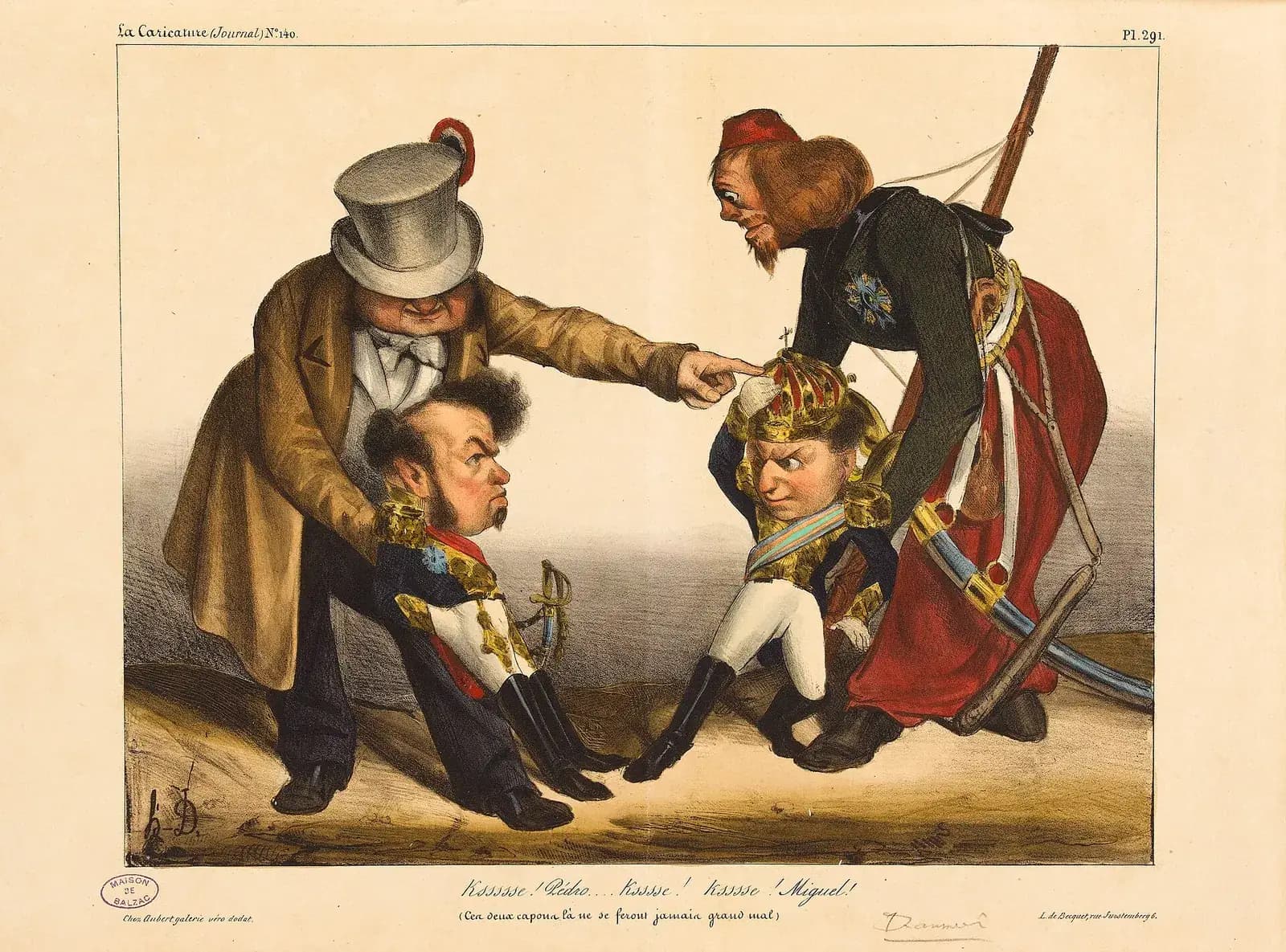
Miguel still held much of the interior, with his headquarters at Santarém on the Tagus. Abroad, the liberals gained the Quadruple Alliance, signed in London on 22 April 1834 by Britain, France, Spain and Pedro's government. Spain, whose own pretender, Don Carlos, had taken refuge with his nephew Miguel, agreed to send troops into Portugal to expel both princes, and a Spanish corps under General Rodil crossed the border. By then, the historian Fátima Bonifácio notes, the war was in practice already decided.
Asseiceira, 16 May 1834
The last battle was fought in the hills east of Tomar. On 15 May Terceira, whose northern division had occupied Tomar the evening before, intercepted a letter from the Miguelist general Guedes ordering guns coming from Santarém to halt at Golegã. Terceira read it as a sign that Guedes meant to withdraw, and decided to attack before he could.
On the morning of 16 May he marched out of Tomar by the Atalaia road and found the enemy drawn up on the heights and in the valleys of Asseiceira, about a league and a half from the town. He formed three columns: Colonel Queirós on the right, João Nepomuceno in the centre, Colonel Vasconcelos on the left. The Miguelists held strong ground, used their artillery well and charged repeatedly with their cavalry, but the columns kept their formation and carried the heights.
The pursuit did the damage. Liberal cavalry broke the enemy squadrons and chased the infantry down the roads towards Punhete (today Constância), Torres Novas and Golegã. Napier, following Terceira's report, counts 1,400 prisoners, among them 74 officers, four standards and the whole of the Miguelist artillery, eight guns. He gives no figure for the dead, only “an immense number” killed and wounded. Napier, who arrived at Tomar that night with his own column, called it the only decisive action of the war that was fought and then followed up.
- Date
- Friday 16 May 1834
- Place
- Heights of Asseiceira, about a league and a half from Tomar
- Liberal commander
- Duke of Terceira, in three columns under Queirós, Nepomuceno and Vasconcelos
- Miguelist commander
- General Guedes
- Captured
- About 1,400 prisoners (74 officers), 4 standards, 8 guns
Asseiceira made Santarém untenable. On 17 and 18 May Miguel's army crossed the Tagus so quietly, Napier says, that Saldanha, watching the town, did not notice until it had gone. He got there in time to stop the enemy taking 11 guns with them, and scribbled a note to his wife on a half-sheet of official paper on which someone had begun one of Miguel's despatches: “I am writing to you in D. Miguel's cabinet.”
Five days in the Alentejo
Miguel reached Évora on 22 May, where Don Carlos and his family had arrived before him. Pedro, who had come up to Santarém to take nominal command, sent his two marshals after him: Terceira crossed the Tagus at Santarém and marched on Estremoz, Saldanha crossed at Salvaterra and marched on Évora. Napier gives each about 9,000 men.
The armies in the Alentejo, late May 1834 (Napier's figures)
men
Charles Napier's round figures. He gives Terceira 9,000 men and Saldanha “a like number”; the Algarve division had been ordered to join Miguel, and Bourmont had brought his column from Alcácer do Sal. Saldanha's biographer, the Conde da Carnota, puts the Miguelist force at Évora at 16,000.
Show the data
| Men | |
|---|---|
| Terceira's division | 9,000 |
| Saldanha's division | 9,000 |
| Miguel's army at Évora | 10,000 |
| Miguelist Algarve division | 3,000 |
| Bourmont's column | 1,500 |
Napier reckoned that Miguel had gathered about 10,000 men at Évora, with 3,000 more ordered up from the Algarve and 1,500 brought by the French general Louis de Bourmont. Bourmont proposed picking 8,000 of the best troops and falling on one of the two liberal divisions before the other could arrive. At a council of war Miguel's senior officers refused. They were, Napier wrote, worn out and tired of war, and thought they had done enough.
From 22 May Lemos wrote to both marshals proposing a suspension of arms, and on the 23rd he offered Terceira a meeting at any hour and place. Terceira answered from the road that he would reply once he reached Estremoz. Saldanha halted for a day at Montemor-o-Novo and told Lemos about the Quadruple Alliance. Lemos replied that his government accepted an armistice and had asked the British minister in Lisbon to mediate.
Saldanha would have none of it. In the letters his biographer printed, he had promised to wait one day, not to agree an armistice, and his orders were to accept nothing less than a surrender. Napier, writing in 1836, says Saldanha did grant a 48-hour suspension of arms. Saldanha enclosed copies of his orders and announced that he would march next to Arraiolos and then, with Terceira, on Évora.
“The result of an attack admits of no doubt; and its consequences cannot but be disastrous. Your Excellency will be responsible for them to Portugal, and to Europe; and this, not only for the blood which will be shed during the action, but for that which, in spite of all we may do to prevent it, will be spilt after it.”
He added that Lemos would answer for the lives of the royal family in Évora if he exposed the city to an assault. Many men in the liberal ranks had seen relatives and friends put to death under Miguel, and Carnota, Saldanha's biographer, thought Lemos understood what a sack might mean. The reply accepting the terms came the next day.
22 April 1834
Quadruple Alliance
Britain, France, Spain and Pedro's government sign in London; it is made known in Lisbon on 10 May.
16 May
Battle of Asseiceira
Terceira routs Guedes near Tomar.
17-18 May
Santarém abandoned
Miguel's army crosses the Tagus and falls back on Évora.
22 May
Miguel at Évora
Lemos begins writing to the marshals to propose a suspension of arms.
26 May
Terms accepted and signed
Lemos accepts by letter from Évora; the convention is signed at Evoramonte that night.
27 May
Miguel's farewell
He tells his soldiers he is leaving them; in Lisbon, Pedro is jeered at the São Carlos opera house.
29 May
Miguel's declaration
He signs a promise never to meddle in Portugal's politics.
30-31 May
Departure and disarmament
The dates set by the convention for Miguel to leave Évora for Sines and for his troops to lay down their arms.
1 June
Embarkation
Miguel sails from Sines on the British frigate Stag.
20 June
Protest at Genoa
Miguel declares the capitulation void.
What was signed at Evoramonte
The manuscript copy kept by the National Library of Portugal runs to four folios. It has two parts. The first is a grant, not a bargain: Pedro, Duke of Bragança, regent in the name of Queen Maria II, “moved by the desire” to end the shedding of Portuguese blood, grants to the forces gathered at Évora, and to anyone who submits to the queen, a list of nine articles. The second part is four articles in which Lemos, having accepted the grant for everyone covered by it, agrees how to carry it out.
| Article | What it said |
|---|---|
| 1 | General amnesty for political crimes since 21 July 1826. Property returned but not to be sold until the Cortes decided; no restoration of offices, crown property, orders or pensions; crimes against private persons not covered |
| 2 | Those amnestied, Portuguese or foreign, free to leave the country and dispose of their property, on their word to keep out of politics |
| 3 | Officers keep the ranks they held legitimately; the government to pay their subsistence according to rank |
| 4 | Clergy and civil servants to be considered according to their services and merits |
| 5 | Miguel granted a pension of 60 contos de réis a year “in view of the high rank in which he was born”; he keeps his private property but must return the jewels and anything belonging to the crown or to private persons |
| 6 | He may sail on a warship of any of the powers of the London treaty of 22 April 1834, from the port he chooses |
| 7 | He must leave Portugal within 15 days and never return to any part of the Iberian Peninsula or the Portuguese dominions, nor disturb their peace, on pain of losing the pension |
| 8 and 9 | His troops hand in their arms, horses and ammunition and disband to their homes, or lose the amnesty |
| Execution 1 and 2 | Orders to every fortress, field force and authority still loyal to Miguel, including overseas, to submit to Maria II |
| Execution 3 | Miguel leaves Évora on 30 May for Sines, with his household, 20 of his own horsemen and two squadrons of the queen's cavalry |
| Execution 4 | On 31 May the troops at Évora lay down their arms in the city's seminary and march home by region under their own officers |
Quotations translated from the Portuguese. The manuscript gives the amnesty date as 21 July 1826, and Napier's 1836 English translation agrees. Napier equates the pension with 400,000 francs; Carnota with £15,000 a year.
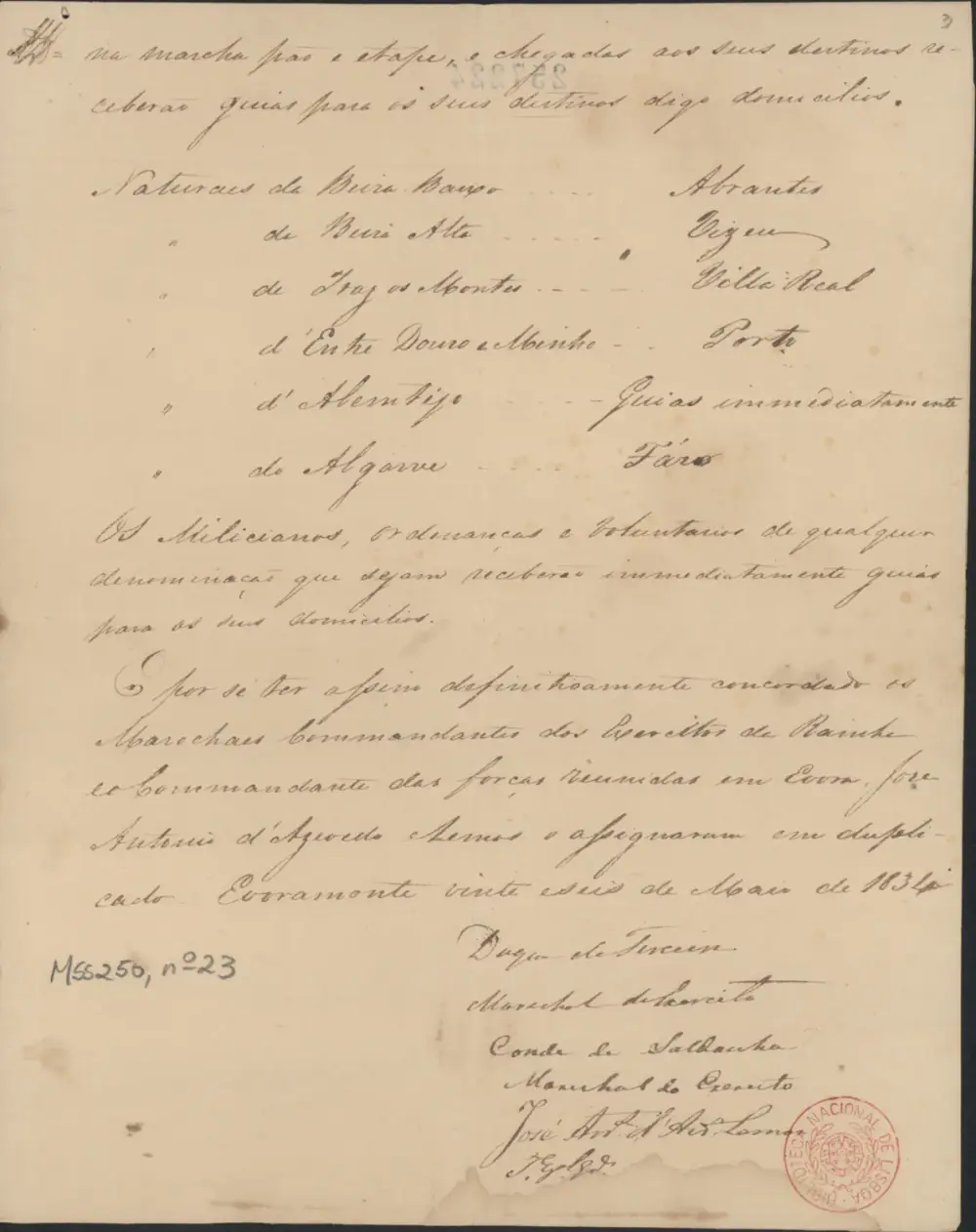
The soldiers were sent home by the shortest safe route. Men from Beira Baixa were to march under their officers to Abrantes, from Beira Alta to Viseu, from Trás-os-Montes to Vila Real, from Entre Douro e Minho to Porto and from the Algarve to Faro, drawing bread and rations on the way and receiving passes for their homes on arrival. Alentejo men, militiamen and volunteers got their passes at once.
“To satisfy the further requirements of the Marshals, Duke da Terceira and Count de Saldanha, in the name of their Government, I declare that I will never directly or indirectly interfere in the political affairs of this kingdom and its dominions.”
Sines, Genoa and a promise withdrawn
Miguel said goodbye to his army in a proclamation dated at Évora on 27 May. He praised his soldiers' valour and loyalty and blamed the foreign powers that had joined the government in Lisbon to force him out. Carrying on, he told them in the English version Napier printed, “can only lead to the useless effusion of Portuguese blood”.
The convention set 31 May for the troops at Évora to give up their weapons. Carnota says 16,000 men laid down their arms there, more than Napier's figures for the whole Miguelist force in the south, and, citing the historian Luz Soriano, that 138 of them were Spanish officers. The first day of June found Miguel at Sines, the small Alentejo port he had chosen, boarding the British frigate Stag under Captain Lockyer. Napier says the embarkation was managed with some difficulty and danger amid the jeers of a crowd that seemed ready to kill him, and Carnota describes insults and threats on the road.
The Stag called at Cascais Bay, where Admiral Parker arranged Miguel's passage to Genoa, the city he had chosen to live in. On 20 June 1834, soon after landing, Miguel issued a public protest: everything he or his agents had signed before leaving had been extracted by force, and the capitulation was null and worthless.
Lisbon replied with a law dated 19 December 1834. As Carnota summarises it, Miguel and his descendants were excluded for ever from the succession, his pension was revoked, and if he set foot in Portugal a military commission of seven officers was to order him shot within three hours of proving his identity, the whole process to take no more than twenty-four hours. It was turned on his followers too: in May 1837, Mesquita shows, the war minister, Sá da Bandeira, ordered army commanders to proceed under it against Miguelists caught in arms.
Miguel lived the rest of his life in exile, the later part in Germany. He married Princess Adelaide of Löwenstein-Wertheim-Rosenberg, and they had six daughters and a son. He died in 1866. His remains, and Adelaide's, now lie in the Braganza pantheon at the monastery of São Vicente de Fora in Lisbon.
Peace without reconciliation
In Lisbon the terms looked too generous. When the news arrived on the night of 27 May, Pedro was at the São Carlos opera house with the empress and the queen. There were loud outcries against the leniency of the terms, inside the theatre and in the street, and the regent himself was insulted. One writer called for “eternal hatred” of whoever had advised such a convention. Mesquita notes that many people saw the amnesty as whitewashing what they had suffered under “the usurpation”, as the liberals called Miguel's reign.
The winners rewarded themselves quickly. A decree of 27 May made Saldanha a marquis and gave Terceira the honours of a relative of the royal family. On 28 May another decree declared that the peers who had petitioned Miguel to abolish the Charter had given up their seats, and the defeated side had no place in the House of Peers until the 1850s. Four days after the signing, a decree of 30 May abolished the religious houses of the male orders and took their property for the state, a measure with its own article.
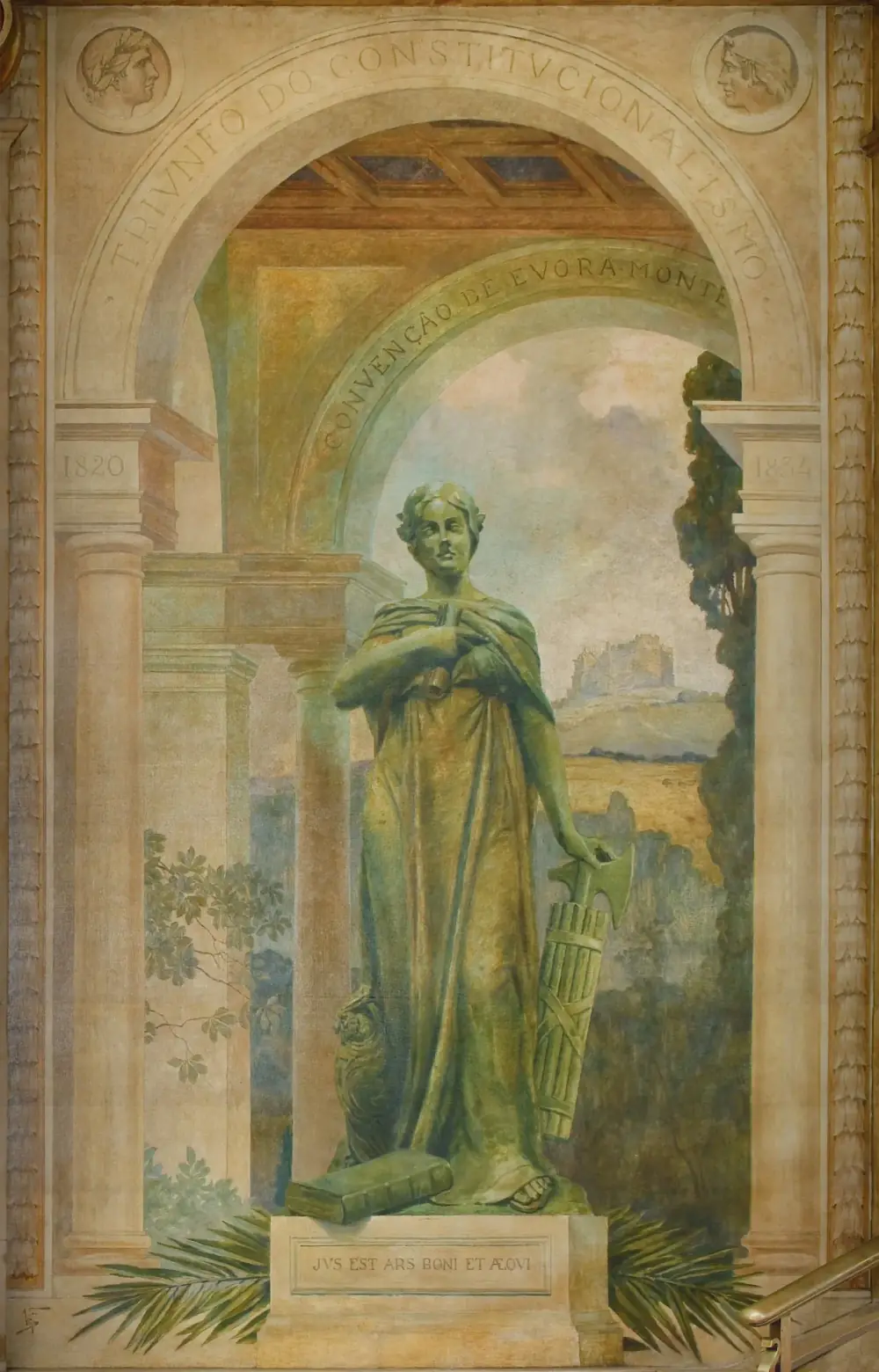
Pedro did not live to see much of the peace he had won. On 18 September 1834 the Cortes declared Maria II of age, at 15, and on 24 September her father died at Queluz, in the room where he had been born. He was 35.
Not every Miguelist laid down his arms. In the Algarve, José Joaquim de Sousa Reis, known as the Remexido, took to the hills after the convention and led a guerrilla war in Miguel's name across the Algarve and the southern Alentejo, at its fiercest between 1836 and 1838. To the winners he was simply a rebel who had refused the amnesty. Government columns caught him near São Marcos da Serra at the end of July 1838; a court martial at Faro condemned him, and he was shot there on 2 August. With him, Mesquita argues, the Miguelist cause died too.
Why it still matters
Evoramonte settled the quarrel over the crown in Maria's favour. The liberals' victory brought back the Charter of 1826, and with interruptions Portugal was a constitutional monarchy, with an elected chamber, until the republic of 1910. The Charter's later story, and the quarrels among the liberals themselves, have their own articles.
The settlement ended the war with an amnesty for the rank and file, ranks kept for officers, and the losing claimant paid to go away. It did not heal the division. Miguelist peers were kept out of the House of Peers until the 1850s, and Miguel's line kept its claim. Duarte Pio, Duke of Braganza, today's pretender to the vanished throne, is Miguel's great-grandson and also descends from Pedro.
FAQs
What was the Convention of Evoramonte?
It was the agreement of 26 May 1834 that ended Portugal's civil war between the liberals of Queen Maria II and the absolutists of her uncle Miguel. Formally it was a grant of terms by the regent, Pedro, accepted by Miguel's commander José António de Azevedo Lemos and signed at Evoramonte by Lemos and the marshals Terceira and Saldanha.
Did Miguel abdicate at Evoramonte?
No. The convention has no abdication clause and Miguel did not sign it. He agreed to leave within 15 days and never return to the Iberian Peninsula, and on 29 May he signed a separate promise not to interfere in Portuguese politics. From Genoa, on 20 June 1834, he declared it all void because it had been signed under force.
What happened at the Battle of Asseiceira?
On 16 May 1834, near Tomar, the Duke of Terceira attacked the Miguelist army of General Guedes in three columns and took the heights of Asseiceira. Napier, using Terceira's despatch, counts about 1,400 prisoners, 74 of them officers, and all eight Miguelist guns. Ten days later the war was over.
Where did Miguel go after 1834?
He sailed from Sines on the British frigate Stag on 1 June 1834 and went to Genoa. He spent the rest of his life in exile, later in Germany, married Adelaide of Löwenstein-Wertheim-Rosenberg and died in 1866. His remains are now in the Braganza pantheon at São Vicente de Fora in Lisbon.
Can you visit the place where it was signed?
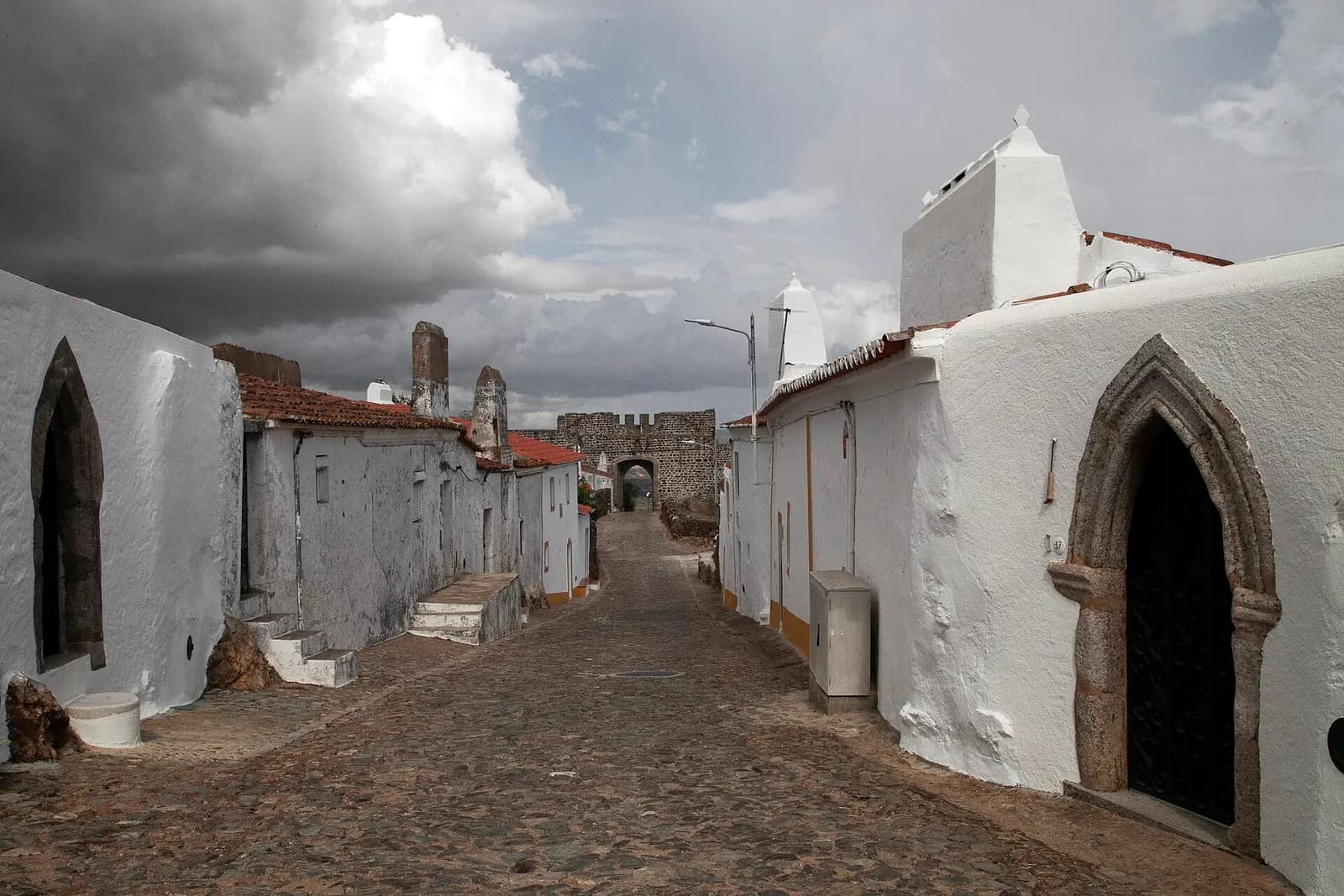
Yes. The Casa da Convenção, where it was signed, is inside the walls of Evoramonte, a village near Évora. The castle keep at the top of the village, on the Rua da Convenção, is open to visitors.
On the timeline
Open the timelineNearby moments from invasions, brazil and the liberal wars (1807–1851).
Battle of the Cova da Piedade (or Combat of Cacilhas). The Liberal forces of the Duke of Terceira, having marched up from the Algarve through the Alentejo, defeat the Miguelist army of General Telles Jordão on the south bank of the Tagus across from Lisbon. The victory leaves the capital undefended and decides the outcome of the Portuguese Civil War.
The day after the victory at Cova da Piedade, with the Miguelist forces having withdrawn from the capital, the Liberal commander Duke of Terceira enters Lisbon unopposed to the cheers of crowds. The fall of the capital restores the cause of Queen Maria II and effectively decides the Portuguese Civil War.
Liberal forces under the Duke of Terceira rout Dom Miguel's army on the heights of Asseiceira near Tomar, taking some 1,400 prisoners. The last and decisive battle of the Liberal Wars forces Miguel to capitulate ten days later at Évoramonte.
Convention of Evoramonte, 1834
The Convention of Evoramonte is signed, ending the Portuguese Civil War (Liberal Wars). Miguel's army lays down its arms and he agrees to leave Portugal for good, securing the throne of the young Queen Maria II and the constitutional monarchy.
The decree of 30 May, as the Liberal government cited it, abolishes all male religious orders in Portugal. Drafted by justice minister Joaquim António de Aguiar, it hands hundreds of monasteries and friaries to the state — which is why so many of Lisbon's old convents now house parliament, museums and barracks. It earns Aguiar the nickname 'Mata-Frades' ('Friar-Killer').
Following his defeat in the Liberal Wars and the Convention of Evoramonte, the former King Miguel I embarks at Sines aboard a British warship bound for exile in Genoa. His departure ends absolutism in Portugal and consolidates the constitutional monarchy of his niece, Queen Maria II.
Pedro IV of Portugal, who had also reigned as Pedro I, first Emperor of Brazil, dies of tuberculosis at the Palace of Queluz aged 35, in the very room where he was born. His death came only months after the liberal victory in the Portuguese Civil War secured the throne for his daughter Maria II.
Coming up in history
All long reads 28 May 1926The coup of 28 May 1926: how a rising in Braga ended the First Republic
 29 May 1385The Battle of Trancoso: how feuding Beira lords stopped a Castilian raid
 30 May 1834The decree that shut Portugal's monasteries: 30 May 1834
 31 May 1991The Bicesse Accords: Angola's peace signed in Lisbon, 31 May 1991
17 sources
Archives, scholarship and reporting this article was checked against.
- 1
[Convenção de Évora Monte, estabelecida entre os Comandantes dos Exércitos de Dona Maria II e de Dom Miguel, a 26 de Maio de 1834] (manuscript, 4 folios, MSS 250, n.º 23)Biblioteca Nacional de Portugal, Biblioteca Nacional Digital
- 2
An Account of the War in Portugal between Don Pedro and Don Miguel, vol. II (Charles Napier, 1836), chapters X and XI and appendix nos. XXIX to XXXIIT. & W. Boone, London; digitised by the Internet Archive
- 3
- 4
26 May 1834: Signing of the Convention of ÉvoramonteParques de Sintra, Palácio Nacional de Queluz (D. Pedro IV chronology)
- 5
- 6
A «causa» de D. Maria II (1826-1834) (M. Fátima Bonifácio)Análise Social, vol. XXXIX (172), 2004
- 7
A resistência miguelista no Algarve: a guerrilha do Remexido (José Carlos Vilhena Mesquita), in Lagoa, Poder Local e Municipalismo: 245 anos de criação do concelho de Lagoa (1773-2018)Município de Lagoa, 2021; Sapientia repository, Universidade do Algarve
- 8
Coisas para fazer em Evoramonte (Ágata Xavier)Time Out Lisboa
- 9
A Carta Constitucional portuguesa de 1826 (José Miguel Sardica)Historia Constitucional, no. 13 (2012), pp. 527-561, Universidad de Oviedo
- 10
- 11
- 12
HistorialJunta de Freguesia de Asseiceira (Tomar)
- 13
D. Maria Ana de Áustria: a rainha desaparecida (Eduardo Sucena)Arqueologia & História, no. 58/59 (2006/2007), Associação dos Arqueólogos Portugueses
- 14
Hospício de Nossa Senhora da Piedade do Funchal (archival description)Arquivo Nacional Torre do Tombo
- 15
- 16
- 17
Image credits
- Evoramonte and its castle keep, photographed in 2010. The convention that ended the civil war was signed in a house in this hilltop village on the night of 26 May 1834. Javier Habladorcito from Gijón, Spain, CC BY 2.0, via Wikimedia Commons.
- “Kssssse! Pédro... Kssssse! Ksssse! Miguel!”, Honoré Daumier's lithograph for the Paris paper La Caricature, 11 July 1833. Louis-Philippe of France, in the top hat, eggs on Pedro; Miguel, crowned, is backed by a figure the Maison de Balzac in Paris, which holds this print, identifies as Tsar Nicholas I. The line underneath says the two cowards will never do each other much harm. Honoré Daumier, Public domain, via Wikimedia Commons.
- The last page of the manuscript copy in the National Library of Portugal: the marching orders by region, the closing formula dated Evoramonte, 26 May 1834, and the names of the Duke of Terceira, the Count of Saldanha and José António de Azevedo Lemos. Duque da Terceira, Public domain, via Wikimedia Commons.
- “Triumph of Constitutionalism”, a decorative panel by the painter João Vaz in the Assembleia da República, Lisbon. The inner arch names the Convention of Évora-Monte, the pillars carry the dates 1820 and 1834, and the castle of Evoramonte stands on its hill behind the figure. João Vaz, Public domain, via Wikimedia Commons.
- The Rua da Convenção in Evoramonte, photographed in 2022, runs inside the village walls towards one of its gates. Its name recalls the convention of 1834. Carlos Vieira Romão, CC BY-SA 4.0, via Wikimedia Commons.