

Senna's first Formula One win, in the Estoril rain, 1985
In his second race for Lotus, a 25-year-old Brazilian started from pole, led every lap of a flooded Portuguese Grand Prix and lapped every other finisher bar one. Estoril had been on the world championship calendar for six months.
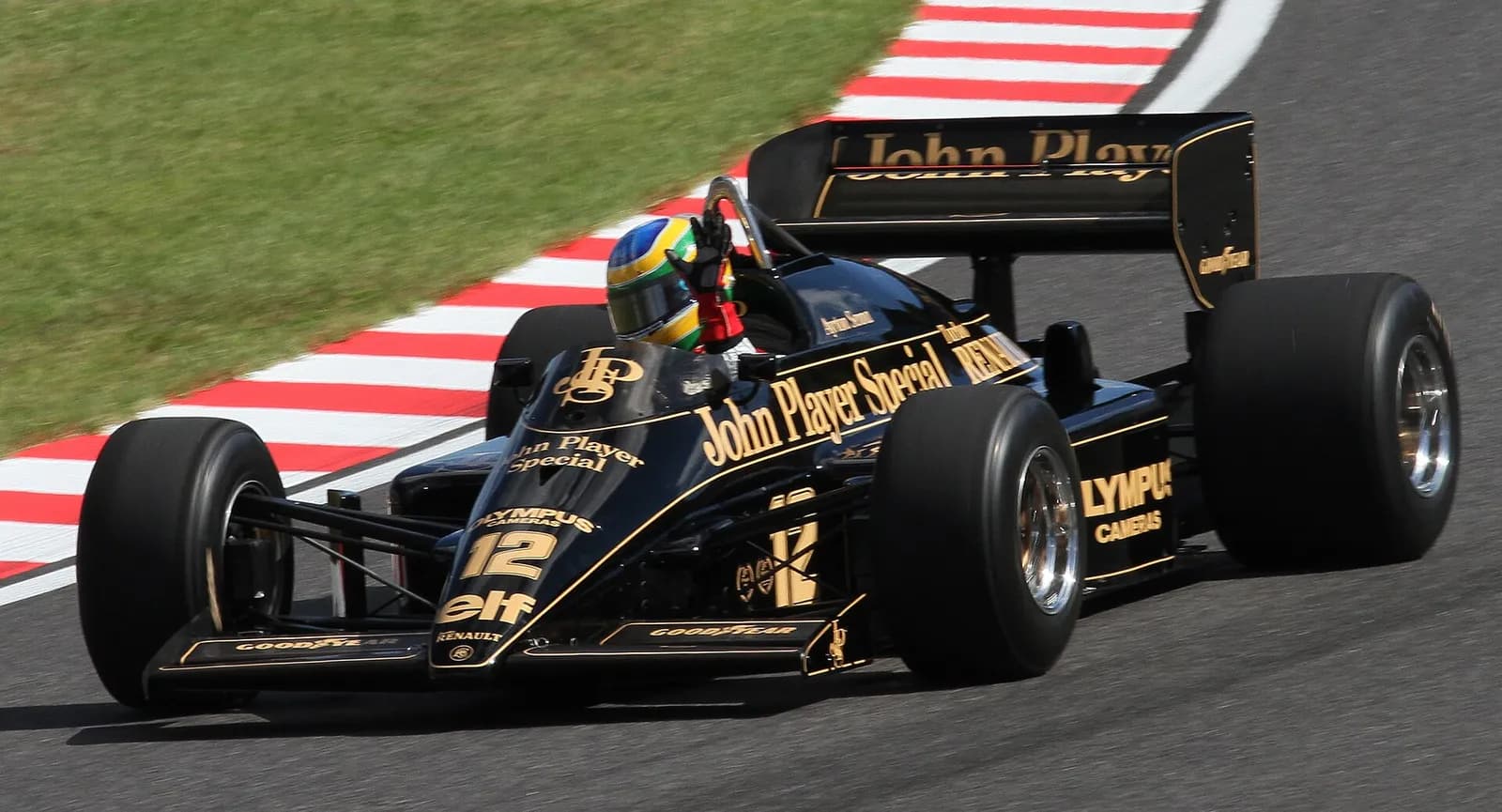
At a glance
- Ayrton Senna won the Portuguese Grand Prix at the Autódromo do Estoril, near Cascais, on Sunday 21 April 1985. It was the first of his 41 Formula One victories.
- He had taken his first pole position the day before, 0.413 seconds faster than Alain Prost, and he led every lap and set the fastest lap in the race.
- Rain fell throughout, at times torrentially. The race was stopped after 67 laps when the two-hour limit was reached, with Senna 62.978 seconds ahead of Michele Alboreto's Ferrari.
- Every other finisher was at least a lap down. Only nine cars were classified, and Alain Prost, Niki Lauda and Keke Rosberg all failed to finish.
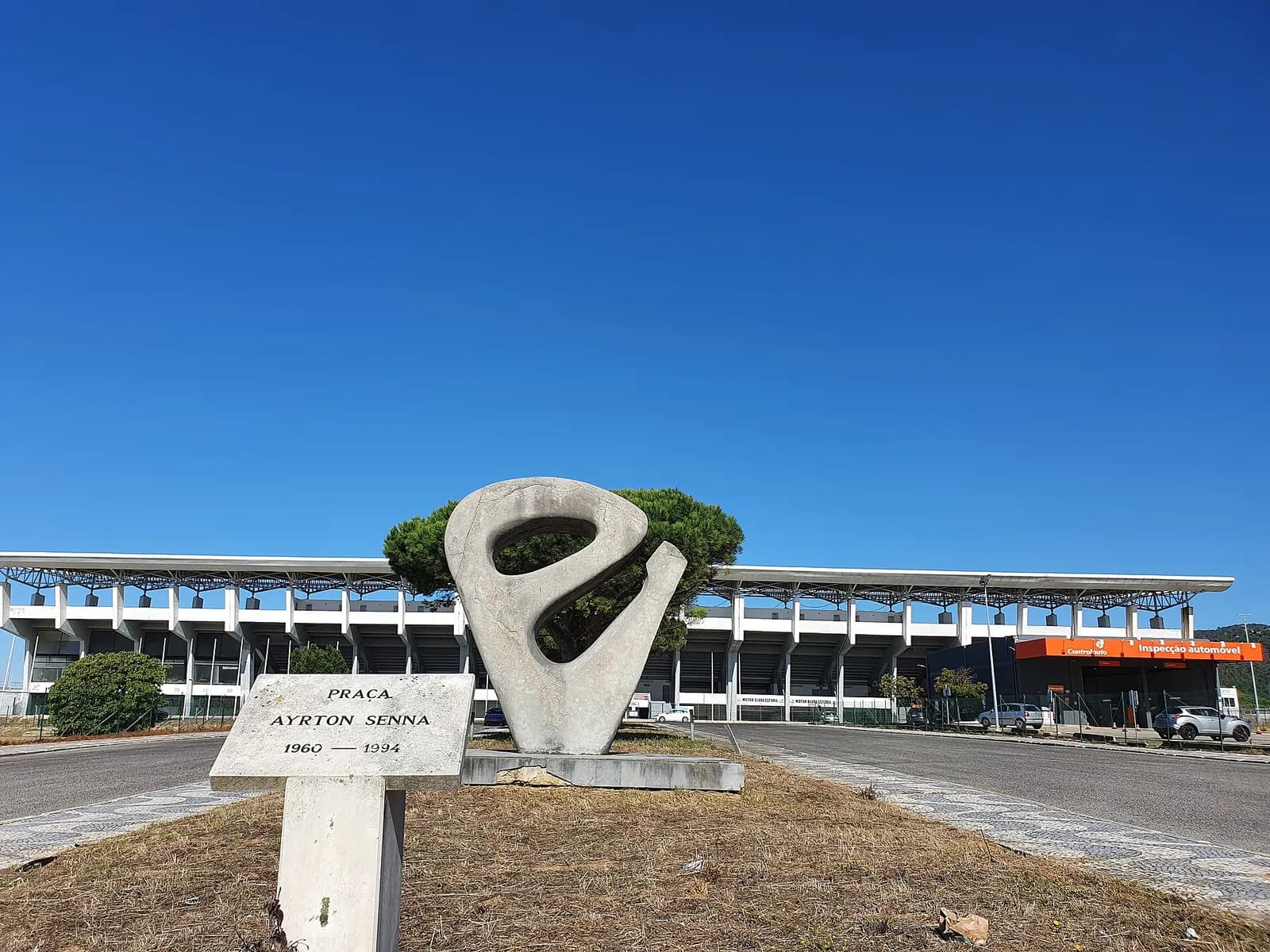
- Estoril, opened in June 1972, hosted the Portuguese Grand Prix from 1984 to 1996. A square at the circuit gates is now named after Senna.
Flag to flag in a flood
The sky over Estoril was briefly blue on the morning of Sunday 21 April 1985. By the warm-up the clouds were thickening, around noon it began to rain, and by 1.30pm it was torrential. Nobody suggested delaying the race. In the words of the Motor Sport writer Nigel Roebuck, television waited for no man.
On pole position, in a black and gold Lotus with the number 12 on its nose, sat Ayrton Senna, a 25-year-old Brazilian in his second season of Formula One and only his second race for the team. He got away cleanly, without much wheelspin. Into the first corner the car in his mirrors was his team-mate Elio de Angelis, who had jumped from the second row past Alain Prost's McLaren.
After two laps Senna was three seconds clear. After twenty he was half a minute clear. Two hours later, when the chequered flag came out, he was more than a minute ahead of the only driver he had not lapped. Before he reached the first turn on his slowing-down lap he had thrown off his belts and was half out of the cockpit.
Standing at the first corner was Denis Jenkinson, Motor Sport's veteran Grand Prix correspondent, cap dripping and glasses misted. For some time he had refused to talk to drivers, calling it a waste of time. He would talk to this one, all the way home on the Monday flight to London.
“Villeneuve all over again, isn’t it? A racing driver who’s ahead of his car…”
The driver, the team and the season
Ayrton Senna da Silva was born on 21 March 1960 into a wealthy Brazilian family. He first raced a kart at 13 and won. At 21 he moved to Britain to race single-seaters and won five championships in three years before reaching Formula One with the small Toleman team in 1984.
He already knew Estoril. In September 1979 the world karting championship was held at the circuit, and Senna tied on points with his Dutch team-mate Peter Koene. The organisers gave the title to Koene on the semi-final results. Senna's team argued that it should have been decided by the last final, which Senna had won.
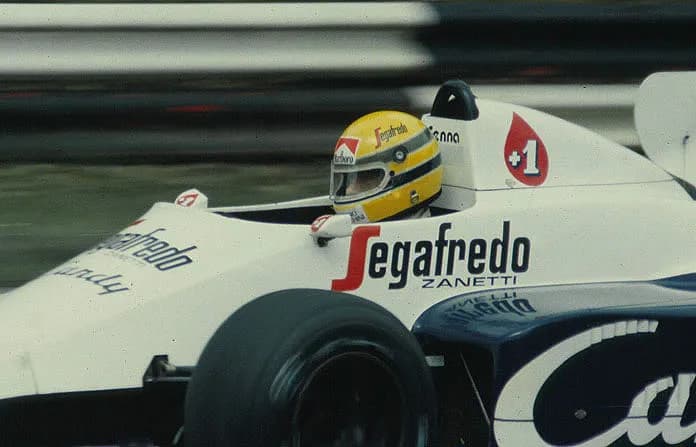
His first season showed what he could do in the wet. At Monaco on 3 June 1984, in torrential rain, he brought the Toleman home second behind Prost in a race stopped after 31 laps. At Estoril that October he finished third. He then bought himself out of his Toleman contract and signed for Lotus.
Lotus needed him. The team founded by Colin Chapman had not won a race since de Angelis took the Austrian Grand Prix in 1982, and Chapman had died since then. The car for 1985, the 97T, used a turbocharged Renault engine of around 1,000 horsepower. It had a manual H-pattern gearbox and no traction control.
The team to beat was McLaren. Its cars had won 12 of the 16 races in 1984, Niki Lauda taking the title from his team-mate Prost by half a point at Estoril, and Prost had won the 1985 opener in Brazil on 7 April. Senna had retired there with a fuel pump problem, while de Angelis finished third.
A circuit in the hills behind Estoril
Portugal had held the world championship before, on street and park circuits: at Boavista in Porto in 1958 and 1960, and at Monsanto in Lisbon in 1959. Stirling Moss won the first two races and Jack Brabham the third. Then the Portuguese Grand Prix disappeared from the calendar for 24 years.
The idea of a permanent track near Estoril dates from October 1966, according to RTP's history of the circuit, and work began in August 1967. It was driven by the Portuguese-Brazilian businesswoman Fernanda Pires da Silva, whose Grão-Pará group dealt in property and tourism and who had already worked on circuits in Brasília and Rio de Janeiro. Her company, Autodril, built it on land bought from Tomé Feteira, in the municipality of Cascais.
The track was meant to be the centre of a resort with a hotel, a drive-in cinema, tennis courts, exhibition halls and a motor museum. Almost none of it was built. The circuit was inaugurated on 17 June 1972 before it was finished, and work carried on afterwards.
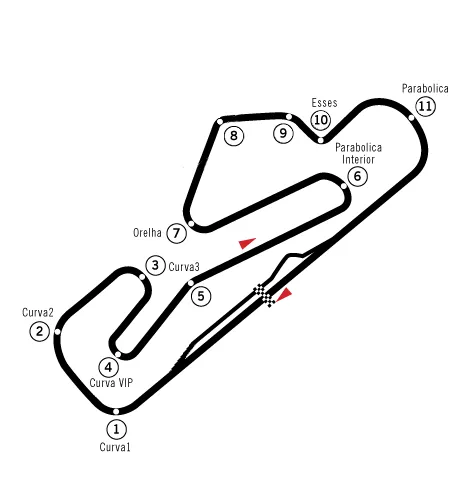
The circuit fell into disrepair in the late 1970s. The European Formula Two championship came in 1982, and in 1984 Formula One needed a replacement for the last race of the season. Jenkinson called it a little “mickey-mouse” autodrome that had needed a lot of facelifting. Drivers found it quite fun, he reported, though hours of rain on the Friday of the 1984 meeting turned the car parks into quagmires and left the pits nearly awash.
The 1984 race settled the championship. Prost won, and Lauda came through to second, which was enough to give him his third title by 72 points to 71.5. Six months later Estoril hosted the second round of the 1985 season.
Portugal itself was changing. On 29 March 1985 the European Communities, the forerunner of today's European Union, had agreed terms for Portuguese and Spanish entry, and Portugal's accession treaty would be signed in Lisbon on 12 June.
Saturday: the first pole
Practice did not go smoothly for Senna. The mechanics took time to find the cause of a misfire that had troubled his car in Brazil, and his spare car stranded him on the circuit with clutch trouble during an untimed session.
In qualifying he was fastest in both official sessions. His best lap, 1 minute 21.007 seconds, beat Prost by 0.413 seconds and de Angelis by more than a second. It was the first of his 65 pole positions. His engineer, Steve Hallam, said Senna had a gift for judging the soft qualifying tyres: “It’s like tying a tie.”
Prost was not worried. He had run low turbo boost in qualifying, he said, and had the handling exactly as he liked it for the race. The rain on Sunday wiped out everyone's set-up work. Hallam remembered that the only wet preparation the Lotus got was the classic one, brake bias two turns to the rear and “Good luck chap!”
Sunday: two hours of rain
Behind Senna the race fell apart. Keke Rosberg stalled his Williams on the grid and was clipped by Jonathan Palmer's Zakspeed. Nigel Mansell had spun on the warm-up lap, damaged his car's nose and started from the pit lane. Cars on Pirelli tyres were hopeless in the wet: Nelson Piquet stopped so often that on one visit to the pits he changed into dry overalls before giving up.
Jacques Laffite parked his Ligier after 15 laps, saying the race should have been stopped, as Monaco had been the year before. Rosberg crashed at the long right-hander before the pit straight and hurt his hand, and his car sat in the middle of the track while drivers swerved round it. Senna himself waved repeatedly to officials to call a halt. They did not.
Senna's own method was simple to describe. He ran in the highest gear he could, which cut wheelspin on the flooded surface. When Roebuck later asked whether he had taken the first corner a gear higher than usual, Senna replied: “Of course I was! Less wheelspin… easier to drive. Wasn’t everyone doing that?”
Start
Senna leads from pole
De Angelis jumps from fourth to second. Rosberg stalls on the grid; Mansell starts from the pit lane.
Lap 2
Three seconds clear
Senna is already lapping faster than his team-mate.
Lap 10
Almost 13 seconds
Senna's lead over de Angelis, who is holding off Prost.
Lap 15
Fastest lap
Senna laps in 1 minute 44.121 seconds, the quickest of the race and 23 seconds slower than his dry pole lap.
Lap 20
Half a minute
Senna leads by about 30 seconds.
Lap 31
Prost spins out
Aquaplaning on the pit straight at about 290 km/h, the McLaren hits the guard rail.
Lap 43
Alboreto into second
The Ferrari passes de Angelis but is already a minute behind Senna.
Lap 67
Two hours
The time limit is reached and the race ends a few laps short of its scheduled distance.
McLaren's afternoon went wrong as Prost began his 31st lap. Running behind de Angelis, the car weaved left, then right, then spun into the barrier. “I was doing maybe 290kph,” Prost said, “and once you start aquaplaning at that speed, you are finished.” When Lauda's engine failed after 49 laps, McLaren had lost both cars.
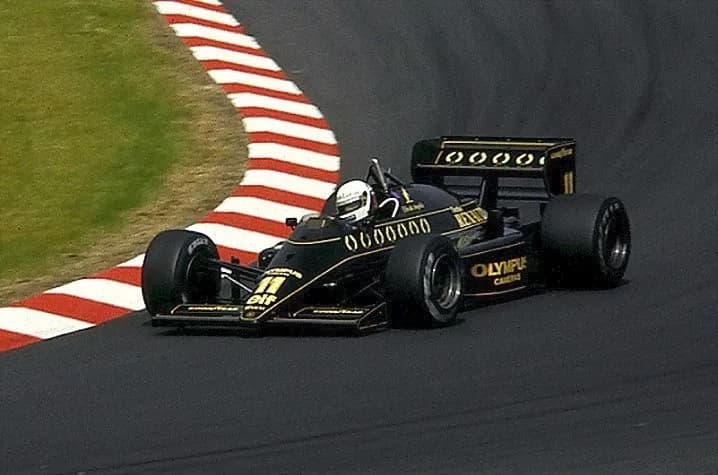
Alboreto took second from de Angelis on lap 43. De Angelis then slid wide, picked up a slow puncture and was caught near the end by Patrick Tambay's Renault, which had started 12th. Senna was never caught. He was not, though, untouchable, and he said so.
“Maybe people think I made no mistakes, but that’s not true — I’ve no idea how many times I went off! On one occasion I had all four wheels on the grass, totally out of control… but the car came back on the circuit. Everyone said, ‘Fantastic car control!’ It was just luck…”
Motor Sport's race report, initialled A.H., placed that excursion on the downhill stretch behind the paddock. It noted with approval Senna's “intelligent self-appraisal” after the race, and remarked that top drivers seem to make their own luck.
The result
- Date
- Sunday 21 April 1985, round 2 of 16
- Winner
- Ayrton Senna, Lotus-Renault 97T, number 12
- Race time
- 2 hours 0 minutes 28.006 seconds for 67 laps
- Margin
- 62.978 seconds over Michele Alboreto (Ferrari)
- Pole position
- 1:21.007, Senna's first of 65
- Fastest lap
- 1:44.121 by Senna, on lap 15
- Classified finishers
- 9 of 26 starters
| Position | Driver | Car | Laps | Gap to winner | Points |
|---|---|---|---|---|---|
| 1 | Ayrton Senna | Lotus Renault | 67 | Winner | 9 |
| 2 | Michele Alboreto | Ferrari | 67 | 62.978 seconds | 6 |
| 3 | Patrick Tambay | Renault | 66 | 1 lap | 4 |
| 4 | Elio de Angelis | Lotus Renault | 66 | 1 lap | 3 |
| 5 | Nigel Mansell | Williams Honda | 65 | 2 laps | 2 |
| 6 | Stefan Bellof | Tyrrell Ford | 65 | 2 laps | 1 |
Derek Warwick, Stefan Johansson and Piercarlo Ghinzani were also classified. Manfred Winkelhock was still running, 17 laps down, but was not classified. Sixteen cars retired, among them Lauda (49 laps), Prost (30) and Rosberg (16).
Senna left Portugal level with Prost on nine points, three behind Alboreto. Lotus had its first win in almost three years. And for the first time since Dallas in July 1984, a McLaren had failed to win a Grand Prix.
How slow the race was shows in the numbers. Divide each winner's official race time at Estoril by the laps completed, and 1985 stands alone at almost 108 seconds a lap. In every other year the winner averaged between 78 and 87 seconds.
Winner's average lap at Estoril, 1984 to 1996
seconds per lap
Each winner's official race time divided by the laps completed, rounded to a tenth of a second. The cars changed every year and the slower Variante section was added to the track in 1994, so years are only roughly comparable.
Show the data
| Race winner's average lap time | |
|---|---|
| 1984 | 86.7 |
| 1985 | 107.9 |
| 1986 | 83.5 |
| 1987 | 83.2 |
| 1988 | 83.7 |
| 1989 | 81.8 |
| 1990 | 80.8 |
| 1991 | 80.9 |
| 1992 | 80.1 |
| 1993 | 78.4 |
| 1994 | 85.5 |
| 1995 | 86.1 |
| 1996 | 86 |
Few people saw it in person. Roebuck later put the crowd at only 10,000, because grandstand tickets were expensive for local fans. Bernardo Sá Nogueira, then a 15-year-old karter whose father imported Lotus cars into Portugal, cleaned Senna's helmet that weekend. “I still never saw him, or anyone, so happy to win a race,” he told Motor Sport in 2018.
After Estoril
Senna won once more in 1985, at Spa in September, and finished fourth in the championship with 38 points as Prost took the title. He stayed at Lotus until 1987, taking 16 pole positions and six wins there. Peter Warr, the team boss, summed up the new task for his staff, Hallam recalled: “if we can make the car finish the race, he’s gonna win it.”
In 1988 he joined Prost at McLaren and won the first of three world championships, adding the others in 1990 and 1991. By the end he had 41 wins and 65 pole positions. On 1 May 1994, leading the San Marino Grand Prix at Imola in a Williams, he crashed at the Tamburello corner and was killed.
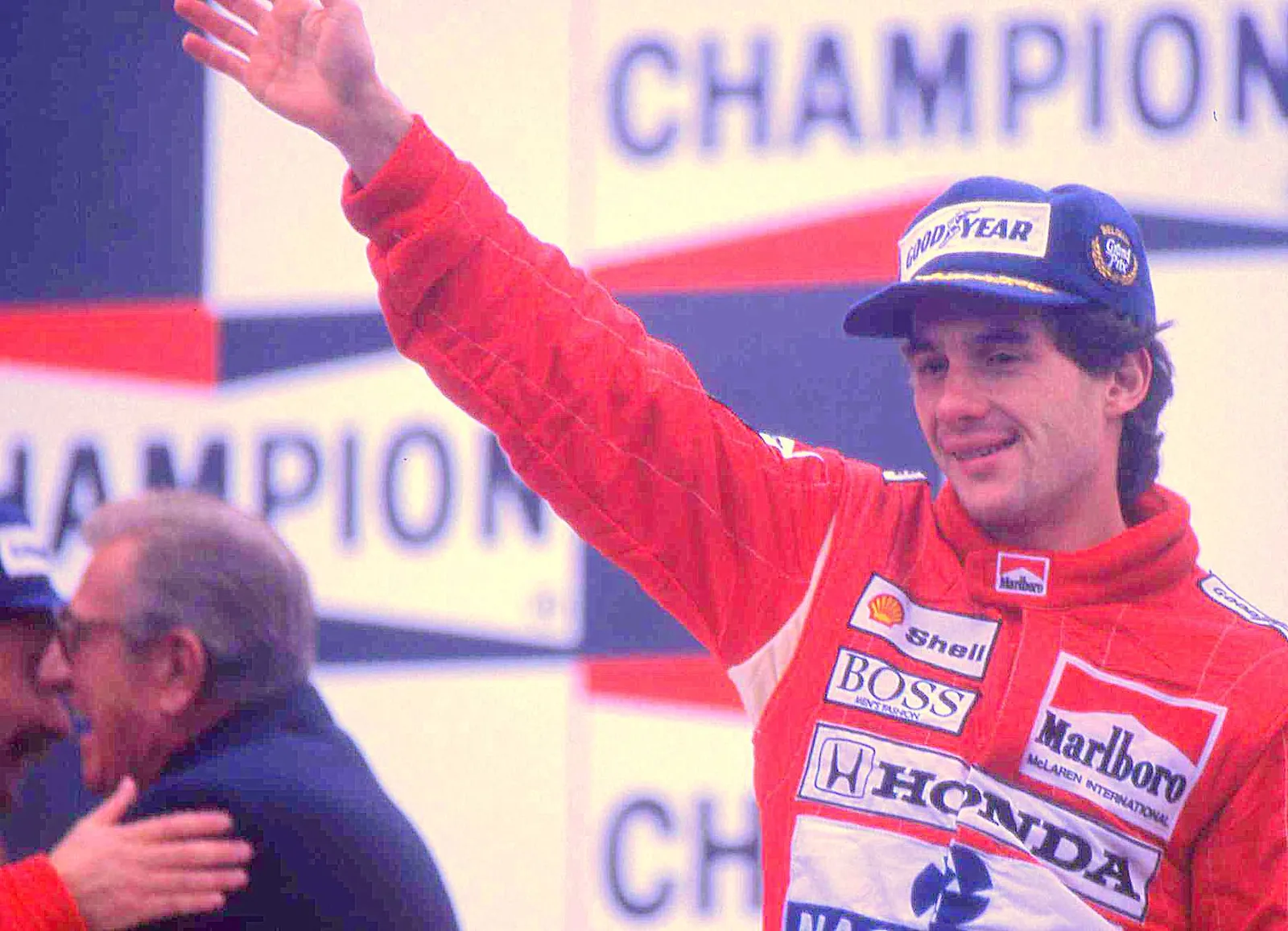
Many people rank his win in the rain at Donington Park in 1993 as his greatest drive. Senna did not. He had traction control that day, he said later, and the car was much easier to drive: “compared with Estoril ’85, it was nothing, really.”
Portugal stayed close to him. After European races he often stayed at a friend's house at Quinta da Penalva, in the Sintra hills about ten minutes from the circuit, and he tested at Estoril whenever he could. He was there testing ten days before Imola.
Estoril's Grand Prix years
Estoril held the Portuguese Grand Prix every year from 1984 to 1996. After 1985 the race always took place in September. Senna raced there ten times and won only once.
| Year | Date | Winner | Car | Senna's result |
|---|---|---|---|---|
| 1984 | 21 October | Alain Prost | McLaren TAG | 3rd (Toleman) |
| 1985 | 21 April | Ayrton Senna | Lotus Renault | Won |
| 1986 | 21 September | Nigel Mansell | Williams Honda | 4th |
| 1987 | 20 September | Alain Prost | McLaren TAG | 7th |
| 1988 | 25 September | Alain Prost | McLaren Honda | 6th |
| 1989 | 24 September | Gerhard Berger | Ferrari | Retired |
| 1990 | 23 September | Nigel Mansell | Ferrari | 2nd |
| 1991 | 22 September | Riccardo Patrese | Williams Renault | 2nd |
| 1992 | 27 September | Nigel Mansell | Williams Renault | 3rd |
| 1993 | 26 September | Michael Schumacher | Benetton Ford | Retired |
| 1994 | 25 September | Damon Hill | Williams Renault | Died 1 May 1994 |
| 1995 | 24 September | David Coulthard | Williams Renault | – |
| 1996 | 22 September | Jacques Villeneuve | Williams Renault | – |
Senna drove for Toleman in 1984, Lotus from 1985 to 1987 and McLaren from 1988 to 1993.
The circuit had its own landmarks in those years. In 1993 Prost clinched his fourth title there and announced his retirement on the same weekend, and Michael Schumacher took his second win. The pits, paddock tunnels and control tower were rebuilt that year. After Senna's death the Tanque corner was replaced in 1994 by a slower section, the Variante.
The 1996 race was the last. Formula One was expanding beyond Europe, and Estoril closed for two years of heavy rebuilding, reopening in 1999. It hosted the Portuguese motorcycle Grand Prix from 2000 until 2012, but never another Formula One race.
Ownership passed to the state. The Grão-Pará group handed over 51% of the company in 1997 to settle tax and social security debts, and the state holding company Parpública has owned all of it since 2002. The newspaper Público estimated, ECO reported, that the state put €68 million into the circuit between 1997 and 2016. In January 2024 ECO reported that Parpública was preparing to sell the company that runs the track. The company's website now announces a different plan: a market consultation on granting a surface right, a long-term right to use the land, over the site.
When the Portuguese Grand Prix returned, in October 2020 and May 2021, it was held at the Autódromo Internacional do Algarve at Portimão, and Lewis Hamilton won both races. It was the first Portuguese Grand Prix since 1996.
Why it still matters
For Senna, Estoril was the first of 41 wins and 65 poles, and the race he himself rated far above his celebrated win at Donington in 1993. Hallam said the team saw that day that he was no one-off. Motor Sport's report at the time came close to saying he had brought a fresh standard of driving to the sport, and stopped just short.
For Portugal, the Grand Prix years, and this race above all, put a circuit dreamed up by a private developer in the 1960s in front of Formula One's television audience. The track still runs under its official name, Autódromo Fernanda Pires da Silva, owned by the state and used for racing, testing and track days. Its final corner is called the Parabólica Ayrton Senna.
FAQs
Where and when did Ayrton Senna win his first Formula One race?
At the Portuguese Grand Prix at the Autódromo do Estoril, near Cascais, on 21 April 1985. It was his second race for Lotus and the first of his 41 wins.
How much did Senna win by at Estoril in 1985?
By 62.978 seconds over Michele Alboreto's Ferrari, the only other car on the lead lap. Patrick Tambay was third, a lap down, and everyone else was at least a lap behind.
Why did the 1985 Portuguese Grand Prix end after 67 laps?
The rules limited a Grand Prix to two hours. The rain made the race so slow that the two-hour mark passed after 67 laps, three short of the 70 scheduled (Nigel Roebuck gave the planned distance as 69).
Does Estoril still host Formula One?
No. Estoril held the Portuguese Grand Prix from 1984 to 1996. When the race returned in 2020 and 2021 it went to Portimão, in the Algarve. Estoril is now state-owned and used for other racing, tests and track days.
Is there a memorial to Senna at Estoril?
Yes. The square at the circuit entrance is called Praça Ayrton Senna, with a stone sculpture and a small memorial, and the last corner of the track is named the Parabólica Ayrton Senna.
On the timeline
Open the timelineNearby moments from revolution and democracy (1974–1986).
Niki Lauda finishes second behind his McLaren team-mate Alain Prost at the Portuguese Grand Prix in Estoril, the circuit's first world championship race, and takes the Formula One title by half a point, still the narrowest margin in the sport's history.
Cristiano Ronaldo is born in Funchal, Madeira. The forward would win five Ballon d'Or awards and five Champions League titles, become the all-time leading goalscorer in men's international football, and captain Portugal to victory at Euro 2016.
Carlos Lopes wins the Rotterdam Marathon in 2:07:12, a world best that would stand for three years. Then aged 38, the runner from Vildemoinhos, near Viseu, had won Olympic gold in Los Angeles eight months earlier.
Senna wins at Estoril, 1985
Ayrton Senna takes the first of his 41 Formula One victories in a torrential downpour at the Portuguese Grand Prix in Estoril, driving a Lotus and lapping every rival except second-placed Michele Alboreto.
In the cloister of the Jerónimos Monastery in Lisbon, Prime Minister Mário Soares signs Portugal's treaty of accession to the European Communities; Spain signs its own in Madrid the same day. Both countries join on 1 January 1986, closing a decade of transition from dictatorship and opening the way to billions in structural funds.
The Multibanco network goes live with 12 cash machines in Lisbon and Porto. Portugal was one of the last countries in western Europe to adopt ATMs, but its shared interbank system, run by SIBS, grew into one of the world's most versatile, used for everything from withdrawals to paying bills and taxes.
Two trains collide head-on near Alcafache on the Beira Alta line and burst into flames. Officially 49 people died and 64 were never found; unofficial estimates put the toll at around 150, making it the worst railway disaster in Portuguese history.
Coming up in history
All long reads 23 April 1909The Benavente earthquake: when the Tagus valley shook in 1909
 24 April 1970Cassiano Branco, Lisbon’s Art Deco dissenter, dies: 24 April 1970
 25 April 1974The Carnation Revolution of 25 April 1974: a dictatorship falls in a day
 26 April 1916The death of Mário de Sá-Carneiro, Pessoa's friend, in Paris, 1916
41 sources
Archives, scholarship and reporting this article was checked against.
- 1
5. Grande Premio de Portugal 1985: race resultFormula One World Championship Limited, formula1.com official results archive
- 2
Portuguese Grand Prix (race report, by A.H.)Motor Sport, June 1985
- 3
- 4
- 5
- 6A nova era do automobilismo português (Rui Alves)RTP Memória
- 7
HistóriaCircuito Estoril, S.A. (official circuit website)
- 8
On This Week #17: Ayrton Senna and the Portugal GPPirelli
- 9
- 10
40 years ago, Ayrton Senna became the runner-up in the World Go-Kart Championship at EstorilAyrton Senna (senna.com)
- 11
- 12
- 13
- 14
- 15
- 16
- 17
- 18
- 19
- 20Parpública prepara venda do Autódromo do EstorilECO, 5 January 2024
- 21
- 22
- 23
Political agreement on the accession of Spain and Portugal (29 March 1985)CVCE.eu, from the Bulletin of the European Communities 3/1985
- 24
Assinatura do Tratado de Adesão às Comunidades EuropeiasEuropean Commission Representation in Portugal
- 25
- 26
- 27
- 28
- 29
- 30
- 31
- 32
- 33
- 34
- 35
- 36
- 37
- 38
- 39
- 40
- 41
Image credits
- Ayrton Senna's Lotus 97T, the model he drove to victory at Estoril, demonstrated by Bruno Senna at the Japanese Grand Prix in October 2010. Morio, CC BY-SA 3.0, via Wikimedia Commons.
- Senna in the Toleman TG184 at the British Grand Prix, Brands Hatch, in July 1984, his first season of Formula One. PSParrot, CC BY 2.0, via Wikimedia Commons.
- The Estoril layout used from 1972 to 1993, the one Senna raced on in 1985. In 1994 a slower section, the Variante, replaced the Tanque corner. Ilmar Fernandes de Souza Junior, CC BY-SA 4.0, via Wikimedia Commons.
- Elio de Angelis in the other Lotus 97T at the Nürburgring on 2 August 1985. He ran second to Senna at Estoril for 42 laps and finished fourth. Lothar Spurzem, CC BY-SA 2.0, via Wikimedia Commons.
- Senna on the podium after winning the Belgian Grand Prix at Spa on 27 August 1989, during his McLaren years. madagascarica from Verneuil Grand, France, CC BY 2.0, via Wikimedia Commons.
- Praça Ayrton Senna, the square at the entrance to the Estoril circuit, in August 2020. The marker gives his years, 1960 to 1994. GualdimG, CC BY-SA 4.0, via Wikimedia Commons.