

The Carnation Revolution of 25 April 1974: a dictatorship falls in a day
Two songs on the radio set the army in motion. By evening a captain from Santarém had the prime minister surrounded in a Lisbon barracks, a crowd had filled the streets, and a restaurant worker with an armful of carnations meant for customers had given the day its name.
At a glance
- On 25 April 1974 the Armed Forces Movement (MFA), a clandestine network of mostly junior officers, overthrew the Estado Novo, the dictatorship that had ruled Portugal since a military coup in 1926.
- Two songs on the radio were the signals: ‘E Depois do Adeus’ at 10.55pm on 24 April, and José Afonso's ‘Grândola, Vila Morena’ on Rádio Renascença at about 12.20am on the 25th.
- Captain Fernando Salgueiro Maia's column from Santarém took the Terreiro do Paço at dawn and by early afternoon had surrounded the Carmo barracks, where Prime Minister Marcelo Caetano had taken refuge. Caetano handed power to General António de Spínola that evening.
- Crowds ignored the call to stay at home. Celeste Caeiro, a restaurant worker, gave a soldier a carnation, and the flower in the rifle barrel gave the revolution its name.
- The day was not bloodless. That evening agents of the political police, the PIDE/DGS, fired from their headquarters on a crowd, killing four men; an employee of the police was also shot dead.
Five minutes to eleven
At five minutes to eleven on the night of Wednesday 24 April 1974, the announcer João Paulo Diniz told listeners of the Emissores Associados de Lisboa, a group of Lisbon radio stations, what came next: Paulo de Carvalho singing ‘E Depois do Adeus’ (And After the Goodbye). It was Portugal's entry at that month's Eurovision Song Contest, a sad love song that had finished 14th. In barracks across the country a few officers were listening for it.
The song was a signal. It told the units of the Armed Forces Movement, the MFA, a secret network of mostly junior officers, to start getting ready. In a prefabricated hut at the 1st Engineering Regiment in Pontinha, on the northern edge of Lisbon, Major Otelo Saraiva de Carvalho and six other officers had set up the movement's command post. Army signallers had laid a telephone cable to it in secret over the previous two days.
The second signal went out at about 12.20am on Rádio Renascença, the Catholic station, during its late programme Limite. In the Associação 25 de Abril's account, a recording of the announcer Leite de Vasconcelos reading the first verse of José Afonso's ‘Grândola, Vila Morena’ was played, and then the song. Vasconcelos had recorded it earlier without knowing why.
The presenter on duty, Paulo Coelho, was not in on the plan and nearly spoiled the timing by reading the advertisements early. The censor in the studio seemed to realise only at the end that he had heard something he had not expected. RTP's official history tells it differently, with Vasconcelos himself in the booth.
‘Grândola’ meant go. By half past four in the morning the movement held the main radio stations, the television studios, Lisbon airport and the army's headquarters for the Lisbon region. By the evening Marcelo Caetano, the head of the government, had surrendered, and a dictatorship that had lasted since 1926 was over.
An old regime and a long war
Portugal had been a dictatorship since a military coup in May 1926. António de Oliveira Salazar built it into the Estado Novo, or New State, with censors who read everything the newspapers printed and a political police, the PIDE, renamed the DGS under Caetano. Caetano had succeeded Salazar as President of the Council, in effect prime minister, in 1968. Admiral Américo Tomás was President of the Republic.
The regime was also fighting colonial wars in Africa: in Angola from 1961, then in Guinea and Mozambique. By 1974 the fighting had gone on for thirteen years.
The officers' revolt began as a dispute over careers. On 9 September 1973, 136 army officers met secretly at Alcáçovas, near Évora, to protest against a decree that let conscript officers overtake graduates of the Military Academy. Their movement grew quickly, and its aims widened from promotions to the war and then to the regime itself.
On 16 March 1974 a column from Caldas da Rainha set out for Lisbon too early and alone, and turned back. The movement learned from it. Otelo took charge of a detailed operations plan, and the coup was set for the week of 22 to 29 April. On 17 April, at Otelo's house in Oeiras, a cavalry captain from Santarém, Fernando Salgueiro Maia, was given his part.
- Date
- Night of 24 to 25 April 1974
- Signals
- ‘E Depois do Adeus’, 10.55pm; ‘Grândola, Vila Morena’, about 12.20am
- Command post
- 1st Engineering Regiment, Pontinha, under Major Otelo Saraiva de Carvalho
- Surrender
- Marcelo Caetano hands power to General Spínola at the Carmo barracks, early evening
- Deaths
- Four men shot by the PIDE/DGS, and a DGS employee shot dead later that night
The night of the code names
Some units moved after the first song. At the Practical Artillery School in Vendas Novas, by 11pm, officers of the movement had arrested the commander and his deputy and locked up the sergeants who would not join; the conscript corporals and junior sergeants all came over. After ‘Grândola’, the same thing happened in barracks across the country.
The objectives had code names borrowed from foreign places. At 3.15am a company from the Serra da Carregueira firing range reported that it held ‘Tóquio’, the state broadcaster Emissora Nacional. At 4.25am Captain Rui Rodrigues of the Mafra infantry school reported that ‘Nova Iorque’, the airport, was under control, and an air force captain, José Costa Martins, closed Portuguese airspace from the control tower.
| Objective | Code name | Unit | Reported to the command post |
|---|---|---|---|
| Emissora Nacional, Rua do Quelhas | Tóquio | Serra da Carregueira firing range | 3.15am |
| Rádio Clube Português | México | A group of officers, supported by a Caçadores 5 company | 3.20am |
| RTP studios, Lumiar | Mónaco | Practical School of Military Administration | 3.59am |
| Lisbon airport | Nova Iorque | Practical Infantry School, Mafra | 4.25am |
| Lisbon Military Region headquarters | Canadá | Caçadores 5 | 4.30am |
| Terreiro do Paço, Bank of Portugal, Marconi radio company | Toledo, Bruxelas, Viena | Practical Cavalry School, Santarém | 6.10am |
| Legião Portuguesa headquarters | Marrocos | Santarém cavalry force under Major Jaime Neves | about 2pm |
Times as given by the Associação 25 de Abril. The Rádio Clube Português page heads its entry 3.32am but gives 3.20am in the text.
With the airport secure, the command post told Rádio Clube Português to broadcast the movement's first communiqué. Joaquim Furtado, the journalist on duty, offered to read it himself. It asked people to stay calm and doctors to go to the hospitals. The Associação 25 de Abril, the veterans' association, puts the reading at 4.26am; the Museu do Aljube says 4.20am.
The regime was slow to understand. The head of the political police, Major Silva Pais, telephoned Caetano at home: “Senhor Presidente, the revolution is in the street!” He urged him to go to the barracks of the GNR, the paramilitary National Republican Guard, in the Largo do Carmo, “where the GNR is solid”. Caetano was there by about six.
Men in some of the MFA's columns on 25 April 1974
men (approximate)
Figures from the Associação 25 de Abril: “more than” 60 vehicles and 500 men for the northern group, drawn from four units; “about” 220 for Salgueiro Maia's force (a Ponte de Lima library leaflet says 240); about 200 for the airport force; about 100 for the Caçadores 5 force at the Lisbon Military Region headquarters; about 100 for the RTP force, which RTP's own history puts at 130.
Show the data
| Approximate strength | |
|---|---|
| Northern group (four units) | 500 |
| Santarém cavalry (Salgueiro Maia) | 220 |
| Mafra infantry (airport) | 200 |
| Caçadores 5 (region headquarters) | 100 |
| Military Administration (RTP) | 100 |
A captain from Santarém
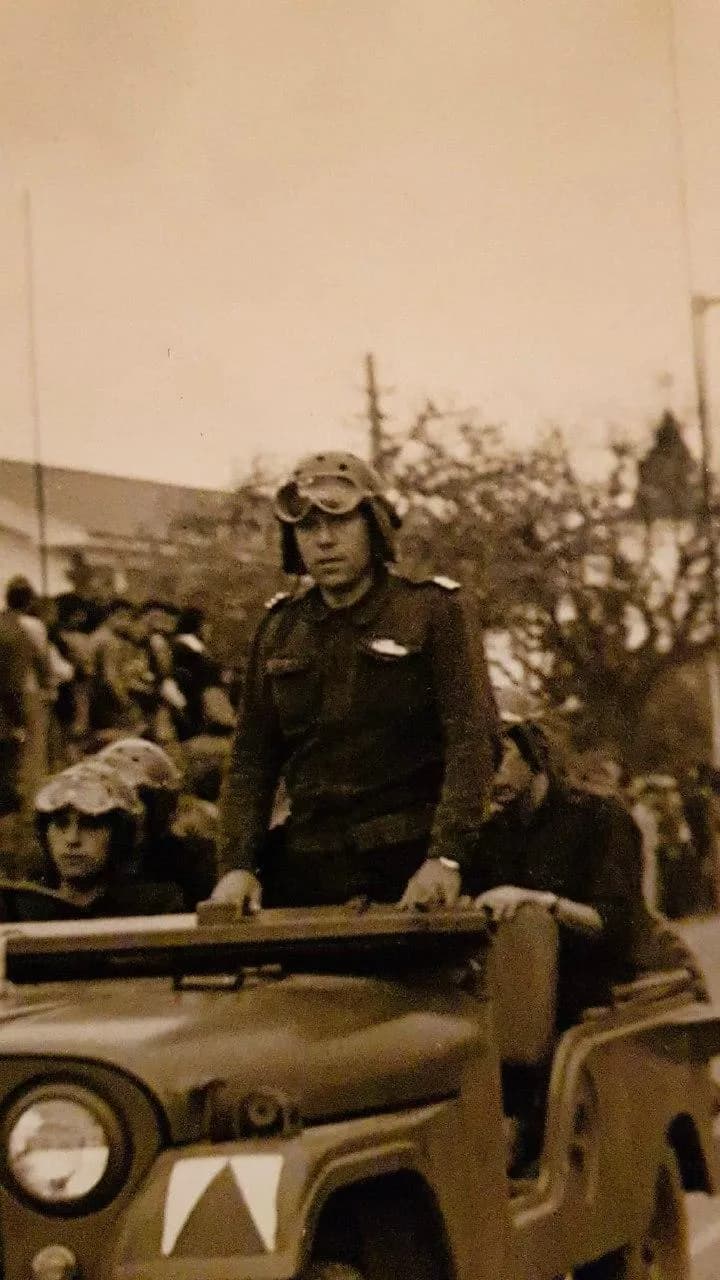
At the Practical Cavalry School in Santarém the men were woken and formed up on the parade ground. Salgueiro Maia was 29. He had fought in Mozambique from 1967 to 1969 and in Guinea from 1971 to 1973. Accounts of what he told them differ in the detail, but all end the same way.
“So, on this solemn night, we are going to put an end to the state we have got ourselves into!”
The column left at 3.30am: ten armoured cars, a squadron of about 160 men in twelve lorries, two ambulances and a jeep. In Lisbon it drove past riot police at Campo Grande, who did nothing. At 6am it reached the Terreiro do Paço, the great riverside square where the ministries of the Army and the Navy stood, and ten minutes later Maia radioed that he held the square, the Bank of Portugal and the Marconi company's international communications centre.
The regime's answer came from Cavalry Regiment 7, with M47 tanks and Panhard armoured cars. Maia's men were short of ammunition, so he talked. One loyalist commander, Lieutenant-Colonel Ferrand de Almeida, gave himself up beneath the windows of the Army ministry. Near the river, Brigadier Junqueira dos Reis ordered an officer cadet, Sottomayor, to open fire on Maia, who was walking towards the tanks with a white handkerchief. Sottomayor refused, and so did the tank gunners.
On the river, the frigate Almirante Gago Coutinho was ordered to fire on the troops in the square. Her commander did not, saying the square was full of people and ferries were close by; the Associação 25 de Abril credits her second-in-command, First Lieutenant Fernando Caldeira dos Santos, with stopping it. One by one the regime's units changed sides or went home.
The siege of the Carmo
By late morning the command post knew where Caetano was. It ordered the forces in the Terreiro do Paço to split: Maia to the Largo do Carmo to obtain the prime minister's surrender, and Major Jaime Neves to the headquarters of the Legião Portuguesa, the regime's militia, which gave up at about 2pm. At the Rossio an infantry company sent to stop Maia joined him instead.
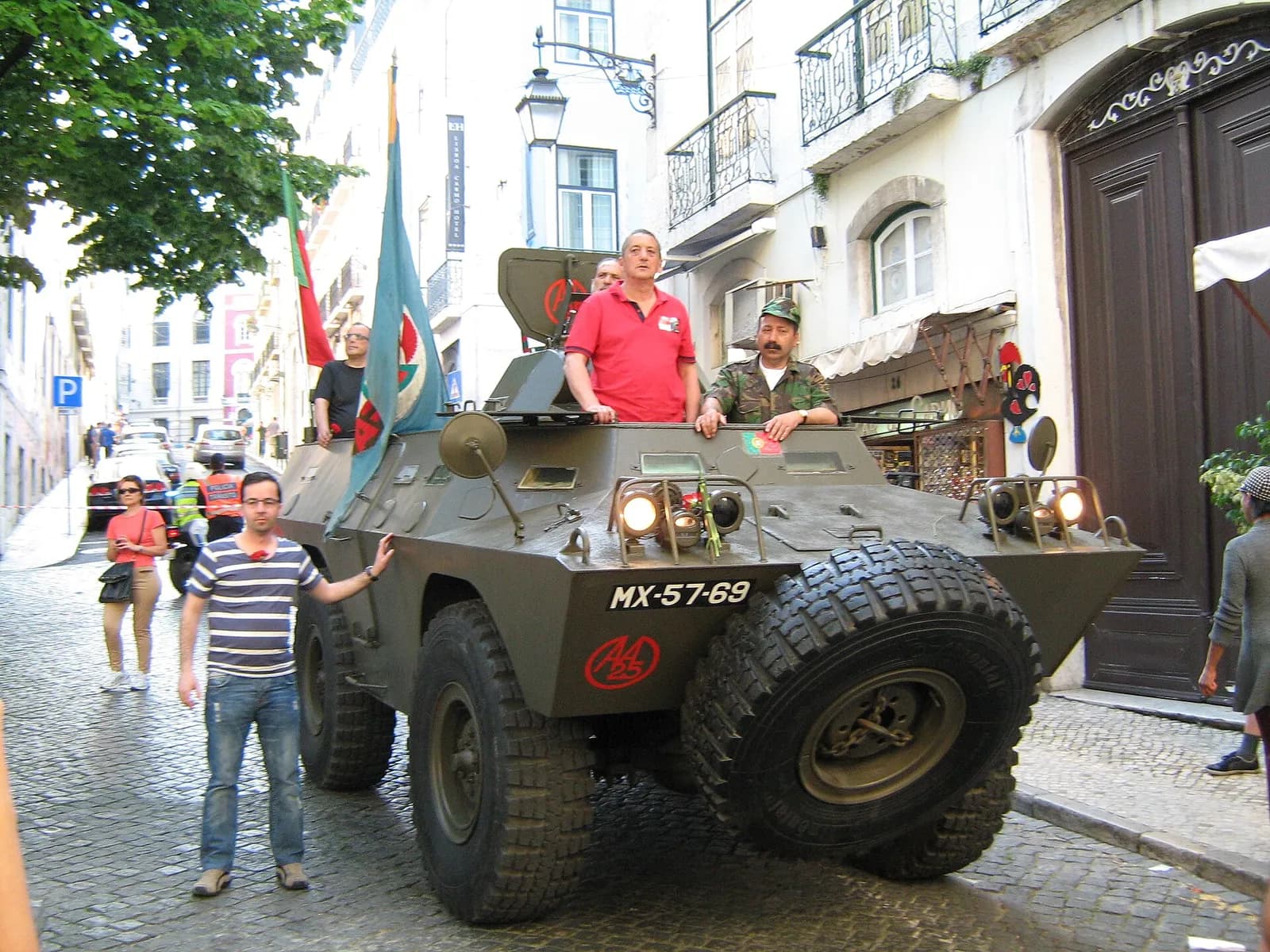
Thousands of people now filled the Baixa. They had been asked to stay at home and came out anyway. They walked with the armoured cars up the steep streets to the Carmo, a small square in the Chiado, where the column arrived at about 12.30. Maia placed his ten armoured cars at the entrances and in front of the barracks gates.
The regime tried to surround him in turn, with what was left of Cavalry 7 at the Largo de Camões, GNR troops at the Largo da Misericórdia and riot police in the Largo do Chiado. Then armoured cars of Cavalry Regiment 3 from Estremoz, which had crossed the Tagus bridge at about 1.15pm, arrived to cover Maia's rear. The GNR went back to barracks and Junqueira dos Reis left.
Inside the barracks the GNR's chief of staff, Colonel Ângelo Ferrari, played for time on the telephone with Otelo, even denying that Caetano was there. Otelo sent Maia a written message, which a liaison officer, Captain Rosado da Luz, handed to him in person.
“With the megaphone, try to get in touch and give a warning-ultimatum to surrender. I have already threatened Colonel Ferrari, but he does not seem to have believed me. Blow the locks of the gate with the armoured cars so they can see it is serious. I don't think they will react. Good luck. A hug. – Otelo”
Maia gave the barracks ten minutes by megaphone (the Museu do Aljube says fifteen). When nothing happened, Lieutenant Santos Silva fired bursts from the machine guns of his armoured car at the top of the façade and the windows burst.
Maia had an armoured car brought into firing position and began to count aloud. Before he finished, two civilians were brought to him: Pedro Feytor Pinto, the director of information services, and Nuno Távora, an aide to the secretary of state for information, carrying a written authority from General António de Spínola.
Spínola, who had commanded the armed forces in Guinea, had been sacked as deputy chief of the general staff in March. Earlier that day he had told the government's go-between that he had nothing to do with the movement, but would take power if the government wanted a peaceful way out.
Caetano agreed to hand over to him. Maia then went into the barracks and spoke to Caetano alone, and Caetano asked for a general to receive the transfer of power. He did not want, he told Spínola by telephone, to surrender to a captain.
“That way power does not fall into the street.”
Spínola telephoned the command post to ask for a mandate and got it. He reached the Carmo by car in the early evening and disappeared into the cheering crowd. The Museu do Aljube puts his entry into the barracks at 6pm; the Associação 25 de Abril dates the handover to about 6.30. Afterwards Caetano and ministers including Rui Patrício and César Moreira Baptista were driven out in an armoured car called Bula, inching through the crowd, to the command post at Pontinha.
Spínola arrived there with the prisoners and greeted the officers: “Gentlemen, I must begin by informing you that I have just taken power at the Carmo barracks. Now let's get to work.” His own followers began giving orders and making appointments at once.
A carnation instead of a cigarette
Celeste Caeiro was 40 and worked in a self-service restaurant in the Franjinhas building on the Rua Braamcamp. It was the restaurant's first birthday, and the owner had bought carnations to give the women customers; the men were to get a glass of port. With soldiers in the streets he decided not to open, and told the staff to take the flowers home before they wilted.
Celeste took the metro to the Rossio with her bunch of red and white carnations and walked towards the Chiado, where she found the armoured cars. She asked a soldier what was happening. “We're going to the Carmo to arrest Marcelo Caetano,” he said. Then he asked her for a cigarette.
“The soldier asked me for a cigarette. I didn't smoke, I never have. For a few seconds I wondered how I could make it up to that lad, up there on that vehicle, fighting for us. He was giving me something good and I had nothing to give him. Without thinking, I took a carnation from the bunch I was carrying and offered it to him.”
The soldier put it in the barrel of his rifle. She handed out more, others copied the gesture, and carnations appeared in rifle barrels across the Baixa. Celeste gave away half a dozen at most. She never found out who the soldier was. She died in Leiria on 15 November 2024, aged 91.
Shots in the Rua António Maria Cardoso
One part of the regime did not give up that day. As the crowds grew, people headed for the headquarters of the DGS, the political police, in the Rua António Maria Cardoso, a few streets from the Carmo. They threw stones at the building, and agents answered with gunfire from the windows and balcony.
Four men were killed. Fernando Carvalho Giesteira, 17, was a waiter from Montalegre. José James Harteley Barneto, 38, a clerk from Vendas Novas, had four children. João Guilherme Rego Arruda, 20, from the Azores, was a second-year philosophy student. Fernando Luís Barreiros dos Reis, 23, was a soldier on leave, the only serviceman to die in the revolution.
The historian António Araújo dates the fatal shooting to about 8.10pm and the Associação 25 de Abril to about 8.15pm; the Museu do Aljube places it in the late morning. There was more than one burst of fire: Araújo records five people wounded at about 1pm, and Observador counts three shootings in all. The association counts 45 wounded.
At 9.25pm António Lage, 32, a DGS orderly with no police duties, was shot dead as he left the building. He had given himself up and was being searched by soldiers when he panicked and ran. Neither Araújo nor Observador says who fired.
From Pontinha, Otelo asked Spínola to have the detained interior minister, César Moreira Baptista, telephone the DGS director, Silva Pais, who said he would surrender if the armed forces protected his agents. Marines and the Estremoz cavalry surrounded the building, and on the morning of 26 April Silva Pais handed it over. Told that the portraits of the regime's leaders were still on the wall, he took one down himself.
Prisoners out, exiles home
At 1.30am on 26 April Spínola appeared on RTP, flanked by the other members of the new Junta de Salvação Nacional, the National Salvation Junta, and read its proclamation. The junta had chosen him as President of the Republic. The movement's officers had wanted General Francisco da Costa Gomes.
The first laws were dated 25 April. Law 1/74 removed the President and the government and dissolved the National Assembly. Decree-laws abolished the DGS, the Legião Portuguesa and the Mocidade Portuguesa youth organisation, dissolved the regime's party, the ANP, and dismissed the governors of Angola and Mozambique.
The MFA's programme had been handed to the newspaper República at 11am on the 25th. That night Spínola and Costa Gomes insisted on changes, and after an argument that lasted until 7am the officers gave way: the explicit recognition of the colonies' right to self-determination and independence came out. It was the first of many clashes between Spínola and the movement.
24 April, 10.55pm
First signal
‘E Depois do Adeus’ on the Emissores Associados de Lisboa.
25 April, about 12.20am
Second signal
‘Grândola, Vila Morena’ on Rádio Renascença.
3.15am to 4.30am
Radio, television, airport and headquarters taken
The first communiqué follows on Rádio Clube Português.
About 6am
Santarém column in the Terreiro do Paço
Caetano takes refuge at the Carmo barracks.
About 12.30pm
Salgueiro Maia surrounds the Carmo
Crowds fill the Baixa and the Chiado.
Early evening
Caetano hands power to Spínola
He leaves for Pontinha in the armoured car Bula.
About 8.10pm
DGS agents fire on the crowd
Four men are killed in the Rua António Maria Cardoso.
26 April, 1.30am
Junta's proclamation on RTP
Spínola reads it on television.
26 April
DGS headquarters surrenders
Caetano and Tomás are flown to Funchal; prisoners at Caxias are freed.
27 April
Political prisoners freed at Peniche
28 and 30 April
Exiles return
Mário Soares arrives at Santa Apolónia station, Álvaro Cunhal at Portela airport.
1 May
May Day
Hundreds of thousands march across the country.
Américo Tomás and Marcelo Caetano were flown to Funchal, in Madeira, on 26 April and held there. Caetano later went into exile in Brazil, where he died in 1980. Mário Soares, the Socialist leader, and Álvaro Cunhal, the Communist leader, were home from exile within the week.
What followed was a year and a half of upheaval. Portugal recognised Guinea-Bissau's independence on 10 September 1974, and Angola became independent on 11 November 1975. On 25 April 1975 voters elected a Constituent Assembly, with 91.66 per cent of those registered taking part. The military crisis of 25 November 1975 ended the revolutionary period.
Why it still matters
25 April is one of Portugal's national public holidays, listed in the Labour Code. The suspension bridge over the Tagus, then called the Ponte Salazar, is now the Ponte 25 de Abril. Workers replaced its iron lettering with the new name for the 5 October commemorations in 1974, according to RTP; the Associação 25 de Abril dates the name to 1979.
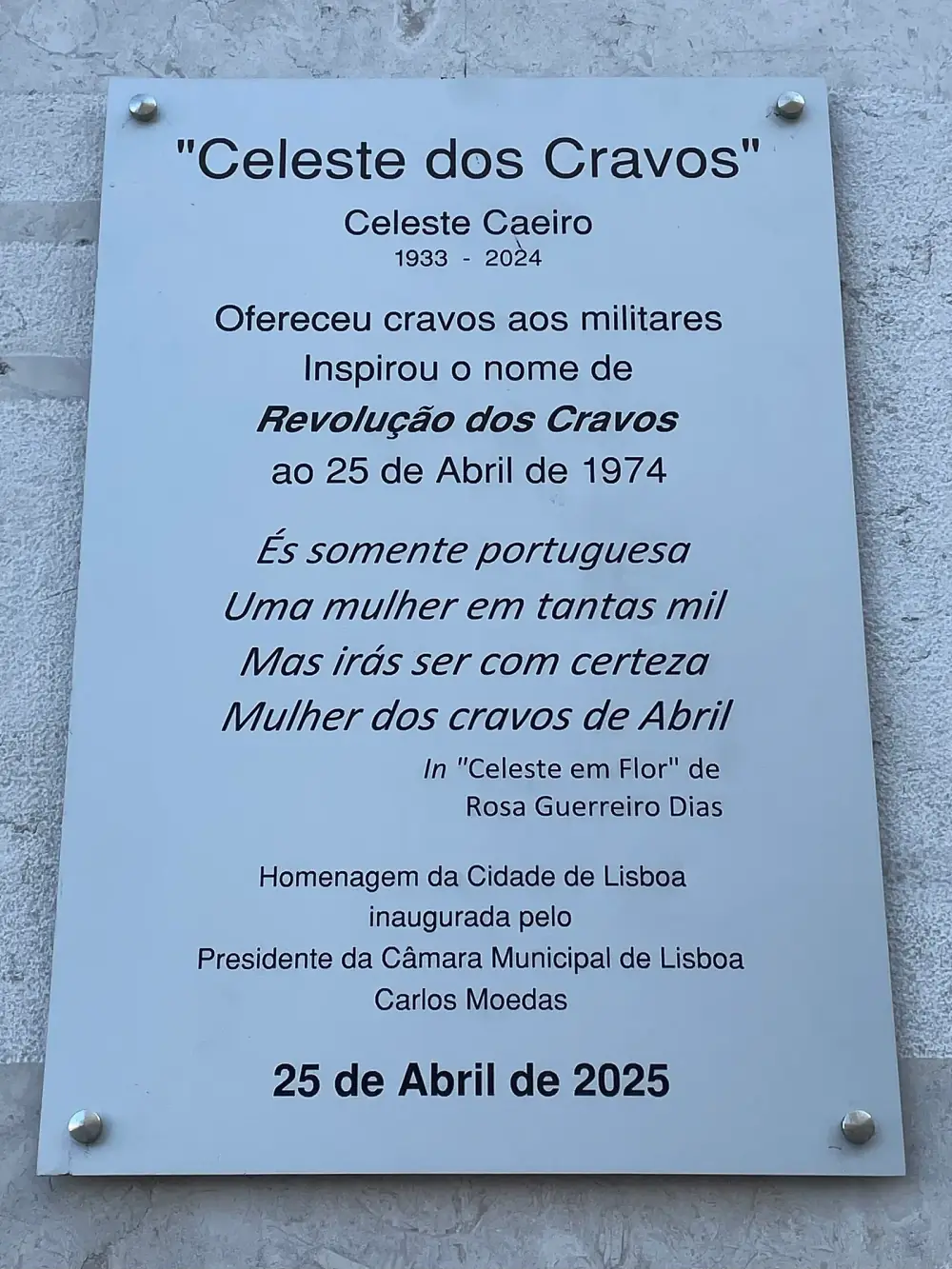
The places of the day have become monuments. The prefabricated command post at Pontinha has been a National Monument since 2015. The Carmo barracks houses the GNR's museum, which offered free guided tours for the 50th anniversary in April 2024. The four men killed in the Rua António Maria Cardoso have their plaque, and on 25 April 2025 the city unveiled one to Celeste Caeiro where the Rua do Carmo meets the Rossio.
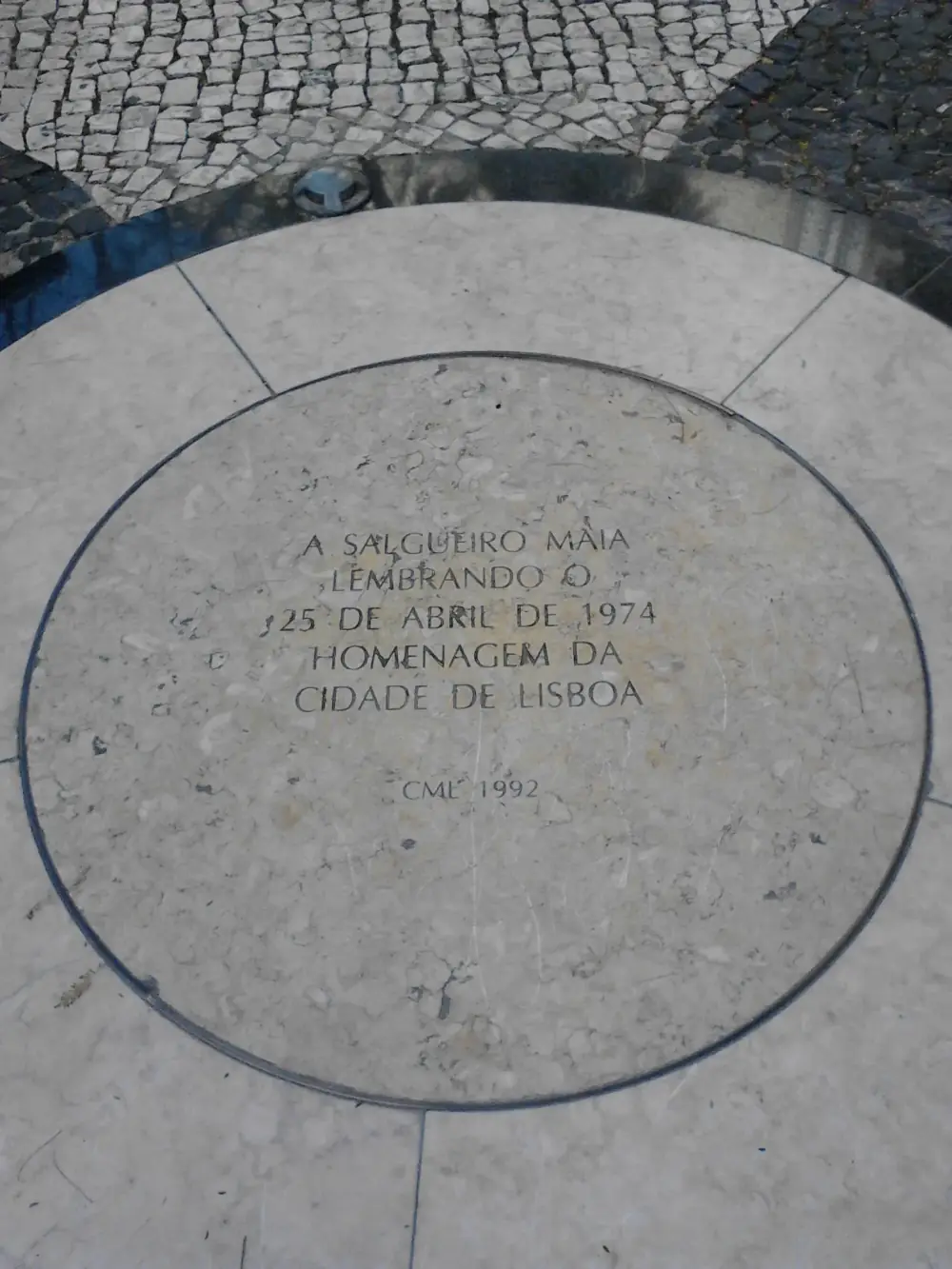
Salgueiro Maia died of cancer on 4 April 1992, aged 47. In the Largo do Carmo he is remembered by a stone in the pavement.
FAQs
Why is it called the Carnation Revolution?
On 25 April 1974 Celeste Caeiro, a restaurant worker, was carrying carnations her employer had bought for customers. A soldier on an armoured car asked her for a cigarette; she had none and gave him a carnation, which he put in his rifle barrel. Others copied him, and the flower became the symbol of the revolution.
Was the Carnation Revolution bloodless?
Almost, but not entirely. The army units avoided fighting each other, but in the evening agents of the political police, the DGS, fired from their headquarters in the Rua António Maria Cardoso on a crowd, killing four men and wounding dozens. A DGS orderly was also shot dead as he ran from soldiers who were searching him, so five people died on 25 April, although the Associação 25 de Abril counts only the four.
What were the radio signals for 25 April?
The first was Paulo de Carvalho's Eurovision song ‘E Depois do Adeus’, played on the Emissores Associados de Lisboa at 10.55pm on 24 April, telling units to get ready. The second was José Afonso's ‘Grândola, Vila Morena’, broadcast on Rádio Renascença's programme Limite at about 12.20am on 25 April, confirming that the operation was under way.
Who was Salgueiro Maia?
Fernando José Salgueiro Maia (1944–1992) was a cavalry captain at the Practical Cavalry School in Santarém. On 25 April 1974 he led the column that took the Terreiro do Paço and surrounded the Carmo barracks, where Prime Minister Marcelo Caetano surrendered. He died of cancer in 1992, aged 47.
What happened to Marcelo Caetano?
After handing power to General Spínola at the Carmo barracks on the evening of 25 April 1974, he was taken in an armoured car to the MFA command post at Pontinha. On 26 April he and President Américo Tomás were flown to Funchal, in Madeira. He later went into exile in Brazil and died there in 1980.
On the timeline
Open the timelineNearby moments from revolution and democracy (1974–1986).
The Carnation Revolution
The Carnation Revolution (Revolução dos Cravos): the Armed Forces Movement overthrows the Estado Novo dictatorship in an almost bloodless coup. José Afonso's 'Grândola, Vila Morena' on Rádio Renascença is the signal to move; armoured columns enter Lisbon; Prime Minister Marcelo Caetano surrenders at the Carmo Barracks. It ends 48 years of authoritarian rule and is celebrated annually as Freedom Day.
Three days after the Carnation Revolution, Socialist Party leader Mário Soares returns from exile in Paris to a jubilant reception in Lisbon, marking the beginning of a new democratic era for Portugal.
Five days after the Carnation Revolution, Communist Party leader Álvaro Cunhal flies home from exile in Paris to a cheering crowd at Lisbon's Portela airport and speaks from the top of a tank. He had spent nearly eleven unbroken years in the regime's prisons, about eight of them in isolation, before escaping from Peniche fortress in 1960.
Just six days after the Carnation Revolution, Portugal celebrates its first free May Day in nearly half a century. Hundreds of thousands pour into Lisbon's streets, and the Socialist Mário Soares and the Communist Álvaro Cunhal, both just back from exile, march side by side. A year later they marched apart.
Coming up in history
All long reads 27 April 1521Magalhães killed at Mactan: 27 April 1521
 28 April 1855José Malhoa, the painter of O Fado, born in Caldas da Rainha in 1855
 29 April 1826The Constitutional Charter of 1826: Portugal's constitution made in Rio
 30 April 1824The Abrilada: how Prince Miguel held his father captive in April 1824
97 sources
Archives, scholarship and reporting this article was checked against.
- 1
Largo e Quartel do Carmo, 25 April 1974 (Lugares de Abril)Associação 25 de Abril
- 2
- 3
- 4Os dias da PIDE-DGS depois da revolução (António Araújo; first chapter of Morte à PIDE!)Diário de Notícias, 19 September 2019
- 5
25 de Abril de 1974 (#nestedia)Museu do Aljube Resistência e Liberdade, 25 April 2024
- 6Morreu Celeste Caeiro, a mulher que deu o cravo ao 25 de AbrilDiário de Notícias, 15 November 2024
- 7O calcanhar de Aquiles dos defensores do fascismoRTP Notícias (Estórias)
- 8
- 9
- 10
- 11
Década de 70: “25 de Abril de 1974: uma emissão para a História”RTP 50 Anos de História (text by Vasco Hogan Teves, 2007), Museu Virtual RTP
- 12
- 13
- 14
- 15
- 16
- 17
- 18
- 19
28 de Maio de 1926 (Maria Alice Samara)Comissão Comemorativa 50 Anos 25 de Abril
- 20
- 21Quatro linhas e entrelinhasDiário de Notícias, 19 April 2018
- 22
Marcelo José das Neves Alves Caetano (Os Procuradores da Câmara Corporativa)Assembleia da República
- 23
O “Levantamento das Caldas” em 16 de março de 1974 (Louro Carvalho, opinion)sinalAberto, March 2023
- 24
- 25‘Portugal e o Futuro’ de Spínola “funcionou como uma verdadeira pedrada no charco” (Leonídio Paulo Ferreira)Diário de Notícias, 20 February 2024
- 26
- 27
- 28
- 29
Salgueiro Maia, 1944–1992, parte I (Um mês, um facto, uma personalidade)Biblioteca Municipal de Ponte de Lima
- 30
- 31
- 32
- 33
- 34
- 35
- 36
- 37
- 38
- 39
- 40
- 41
- 42
- 43Livro sobre Salgueiro Maia lançado no dia em que faria 70 anosObservador, 1 July 2014
- 44
- 45
- 46
- 47
- 48
- 49
- 50
- 51
- 52
Inside Quartel do Carmo: the epicentre of the Carnation RevolutionMensagem de Lisboa, 7 May 2024
- 53
- 54
- 55
- 56
- 57
- 58
- 59
- 60
- 61
- 62
- 63
- 64
- 65
- 66
- 67
- 68
- 69
- 70
- 71
- 72Morreu Celeste Caeiro, a mulher que distribuiu cravos aos militares no 25 de Abril. Tinha 91 anosObservador, 15 November 2024
- 73
- 74
Celeste dos Cravos eternizada na cidade onde nasceu e fez história (Lusa)Postal, 24 April 2025
- 75
- 76Cravos, sangue e uma saraivada de tiros: o cinema e a televisão contam a história dos mortos do 25 de AbrilObservador, April 2024
- 77
- 78
- 79
- 80
- 81
- 82
- 83
- 84
- 85
- 86
- 87
- 88
- 89
- 90
- 91
- 92
Texto da declaração Portugal-PAIGC (Algiers, 26 August 1974) and Declaração sobre a independência da República da Guiné-Bissau (10 September 1974)Textos Históricos da Revolução, ed. Orlando Neves, reproduced by the Marxists Internet Archive
- 93
- 94
Mapa nacional da eleição para a Assembleia Constituinte, 25 de Abril de 1975 (Diário do Governo, II série, suplemento ao n.º 115, 19 May 1975)Comissão Nacional de Eleições
- 95
25 de Novembro: quantos golpes afinal? (Maria Manuela Cruzeiro)Centro de Documentação 25 de Abril, Universidade de Coimbra
- 96
Lei n.º 8/2016, de 1 de abril (restores national holidays; new text of article 234 of the Labour Code)Diário da República
- 97“Ponte 25 de Abril” fez 40 anosRTP Notícias, 2014
Image credits
- A Chaimite armoured car, the model of the Bula that carried Caetano away, at the Largo do Carmo in Lisbon on 25 April 2013, the 39th anniversary of the revolution. On 25 April 1974 Salgueiro Maia's armoured cars surrounded the barracks on this square, where the prime minister had taken refuge. BKP, CC BY-SA 3.0, via Wikimedia Commons.
- Salgueiro Maia at a parade in Santarém, photographed by his wife, Natércia Maia. His family dates the picture to 25 January 1975. Natércia Maia, CC0, via Wikimedia Commons.
- The city of Lisbon's plaque to “Celeste dos Cravos”, unveiled on 25 April 2025 at the corner of the Rua 1.º de Dezembro and the Rua do Carmo, below the Chiado. Photographed in June 2025. DiogoBaptista, CC BY-SA 4.0, via Wikimedia Commons.
- A stone set into the pavement of the Largo do Carmo: “To Salgueiro Maia, remembering 25 April 1974, tribute of the City of Lisbon”. The city council laid it in 1992, the year he died. Threeohsix, CC BY-SA 4.0, via Wikimedia Commons.