

José Malhoa, the painter of O Fado, born in Caldas da Rainha in 1855
He failed twice to win a scholarship to Paris and left painting for a shop counter. A canvas shown in Madrid brought him back, and for half a century he painted village feasts, tavern drinkers and a fado singer in a Lisbon back room.
At a glance
- José Vital Branco Malhoa was born in Caldas da Rainha on 28 April 1855 and died at Figueiró dos Vinhos on 26 October 1933, aged 78.
- He studied at the Lisbon Academy of Fine Arts from 1867 to 1875, left painting to work in his brother's shop after twice failing to win a state scholarship to Paris, and came back in 1881.
- He was a founder of the Grupo do Leão, the Lisbon painters who brought open-air naturalism to Portugal in the 1880s, and was elected president of the Sociedade Nacional de Belas-Artes in 1918; two museums say he was also its first president, in 1901.
- His best-known pictures are Festejando o S. Martinho of 1907, often called Os Bêbados, and O Fado of 1910, which shows the guitarist Amâncio and his lover, known as Adelaide da Facada.
- The Museu José Malhoa in Caldas da Rainha, created in 1933 and opened on his birthday in 1934, holds the largest group of his works; its building was the first in Portugal designed as a museum.
A guitar on a bench
One lazy afternoon, José Malhoa was sitting in his studio with his eyes half closed. A Portuguese guitar lay on a bench, and it set him wondering who had sung the very first fado. That, he told the newspaper A Lucta in 1915, was how his most famous painting began.
“On a lazy afternoon – like this one – I was in my workshop with my eyes semi-closed thinking about some vague plans. A guitar on a bench made me think of this: Who created the first fado? I was taking pleasure in that dream while all the Severas appeared before my eyes, with a cigarette in their mouths and their legs crossed, singing the melancholic song of the lost women…”
The Severas of his daydream were versions of Maria Severa, a fado singer who died in Lisbon's Mouraria quarter in 1846, aged 26, and whose life was later retold on stage and screen. Malhoa did not paint a legend in the end. He found two living people from the fado world, the guitarist Amâncio and his lover, known as Adelaide da Facada, and sat them in a cramped room.
The result, O Fado, is dated 1910. A century later the Museu do Fado wrote that the picture soon took a central place in the way the song is pictured. Its painter was 55 that year. He had entered art school 43 years before, and for about six of those years he had stopped painting.
From Caldas da Rainha to the Academy
José Vital Branco Malhoa was born on 28 April 1855 in Caldas da Rainha. He moved to Lisbon when he was eight, and four years later, at 12, he enrolled at the school of the Royal Academy of Fine Arts.
He stayed from 1867 to 1875. His teachers included the painter Miguel Ângelo Lupi, the sculptors Vítor Bastos and José Simões de Almeida, and the landscape painter Tomás da Anunciação. Malhoa finished the course with merit.
The next step for a gifted student was a state grant to study in Paris. Malhoa applied twice and was turned down twice, the second time in 1875. Disheartened, he put his brushes away and went to work in his brother's shop.
He was away from painting for about six years. What brought him back was a canvas called A Seara Invadida (The Invaded Cornfield), which was shown in Madrid in 1881 and well reviewed. He went back to his easel and to the Lisbon exhibitions, and showed there almost every year for the rest of his life.
- Full name
- José Vital Branco Malhoa
- Born
- 28 April 1855, Caldas da Rainha
- Died
- 26 October 1933, Figueiró dos Vinhos, aged 78
- Training
- Academy of Fine Arts, Lisbon, 1867 to 1875
- Movement
- Naturalism; founder member of the Grupo do Leão
- Best-known works
- Festejando o S. Martinho (Os Bêbados), 1907; O Fado, 1910
The painters of the Leão de Ouro
Malhoa came back to a Lisbon art scene in motion. In 1880 the painter Silva Porto had brought in plein-air painting: working outdoors, in front of the subject, rather than composing landscapes in the studio. A group of young painters gathered round him and took their name from the place where they met, the Leão de Ouro, a beer cellar on what was then Rua do Príncipe.
Malhoa was one of the founders of this Grupo do Leão. From 1881 the group held yearly exhibitions under the name Modern Painting, and Malhoa showed with them until 1889. Their style was naturalism: painting landscapes and everyday people as they looked, in natural light, in a break with the Romantic manner of the older generation.
In 1885 Columbano Bordalo Pinheiro painted the whole group for the entrance of the refitted beer hall, a story told in our article on Columbano. In his picture of 14 men around a white table, Malhoa is third from the left, between the painters Ribeiro Cristino and João Vaz. The canvas hung at the brewery until 1945 and is now in the Museu do Chiado, Lisbon's national museum of contemporary art.
His own work of those years was small and quiet. Maria de Aires Silveira, who wrote the Museu do Chiado's catalogue entries on him, describes his first pictures as small, rather melancholy landscapes by a pupil of Anunciação, followed by his first naturalist pieces, painted under Silva Porto's influence at Figueiró dos Vinhos, Aveiro, Praia das Maçãs, Caldas da Rainha and Azenhas do Mar. One of them, a little landscape now in the Museu do Chiado, once belonged to Columbano.
In 1880 he married Juliana Júlia de Carvalho. Almost nothing is known of her origins, and his friends never commented on the marriage. They travelled abroad together and made their home in Lisbon, with stays at Figueiró dos Vinhos. In 1914 he painted her, grey-haired among flowers, her face hidden from the viewer, and in 1919 he gave the picture to the state.
Painter of feasts and taverns
Malhoa divided his life between Lisbon and Figueiró dos Vinhos, a country town in the district of Leiria where he kept a house known as the Casulo, the Cocoon. Figueiró gave him his subjects. Its pilgrimages, processions and drinkers fill his big canvases of the 1900s, painted in strong sunlight and full of detail.
Clara, of 1903, is more than two metres tall. A country girl from the Minho wrings out washing beside a field of ripe wheat and looks straight at the painter, while a young man watches from the distance. Malhoa's own label made her one of the heroines of As Pupilas do Senhor Reitor, a novel by Júlio Dinis. The Brazilian banker Guilherme Guinle gave the picture to the Portuguese embassy in Rio de Janeiro, and it reached the Museu do Chiado in 1955.
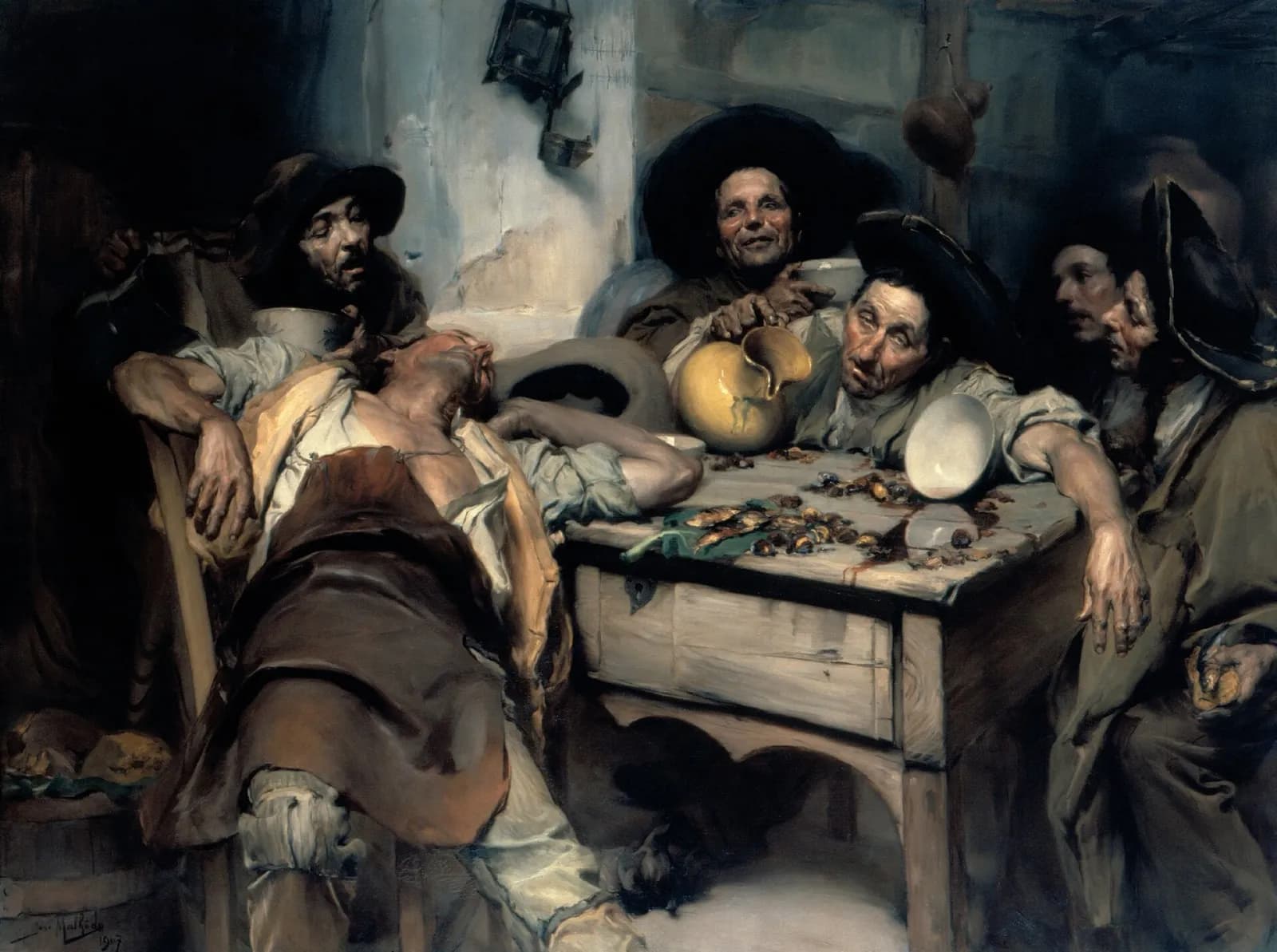
Festejando o S. Martinho (Celebrating St Martin's Day) of 1907 moved indoors. Six men sprawl round a table in a dark tavern, in every state from apparent clear-headedness to deep sleep. The regedor, the local parish official, is sober and about to eat a sardine on bread. The men were real Figueiró people, later named by António Montês: O Carriço, Jerónimo Godinho, Alfredo Ventura, Júlio Soares Pinto and Julião dos Santos.
The picture was shown in Paris in 1907, in Rio de Janeiro in 1908 and in Lisbon in 1909, and was bought from the artist with money from the Valmor bequest in 1908 or 1909. It has belonged to the Museu do Chiado since 1911. Malhoa kept working on the theme, and a third, more restrained version is dated 1912.
“A realistically constructed painting, it is identified with a mythical imagery of ‘Portugueseness’ forged by Malhoa, readily accepted by popular taste and fitted to a supposed national identity.”
In other words, the Portugal in these pictures was partly Malhoa's own invention, a picturesque country of feasts and wine, and it matched what his public wanted to see. Silveira reads the tavern scene and O Fado as a pair: his picture of popular customs in the countryside and in the city.
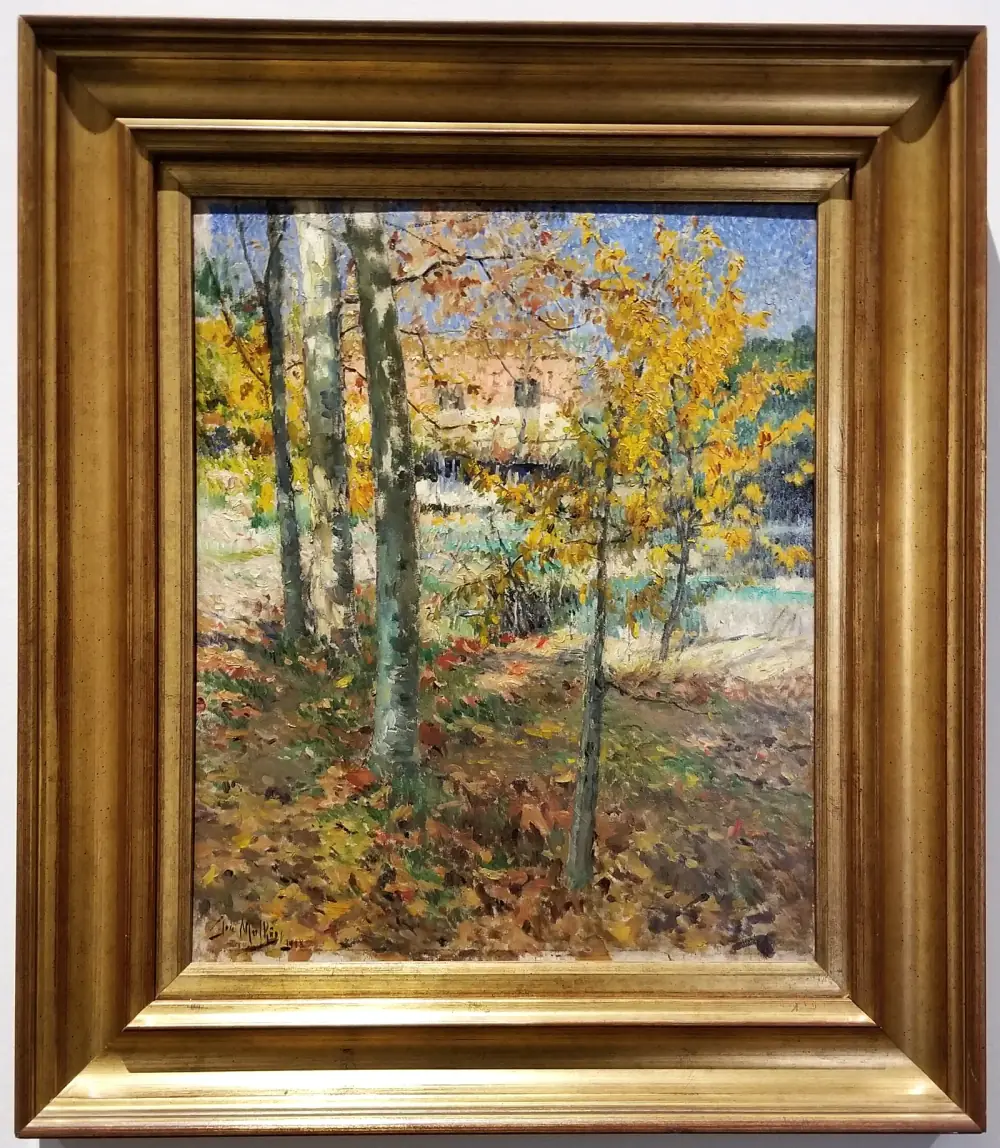
He could also surprise. Outono (Autumn), a small panel of 1918, is made of a curtain of short, bright brushstrokes. Later critics read it as a deliberate example of post-Impressionist divisionism. Silveira sees a late arrival of the Impressionism of the 1870s and calls it an experiment without consequences, as if Malhoa wanted to prove he could be modern. The Museu Soares dos Reis counts him among the Portuguese painters who came closest to Impressionism.
He also took on large official commissions: historical and decorative paintings for the Artillery Museum in Lisbon, the Palácio da Ajuda, the Medical School and Lisbon City Hall. And he painted portraits, such as the one of 1901 of his friend António Novais, the photographer he usually hired to photograph his paintings. A critic called it the best piece in the Sociedade Nacional de Belas-Artes exhibition of 1902.
O Fado, 1910
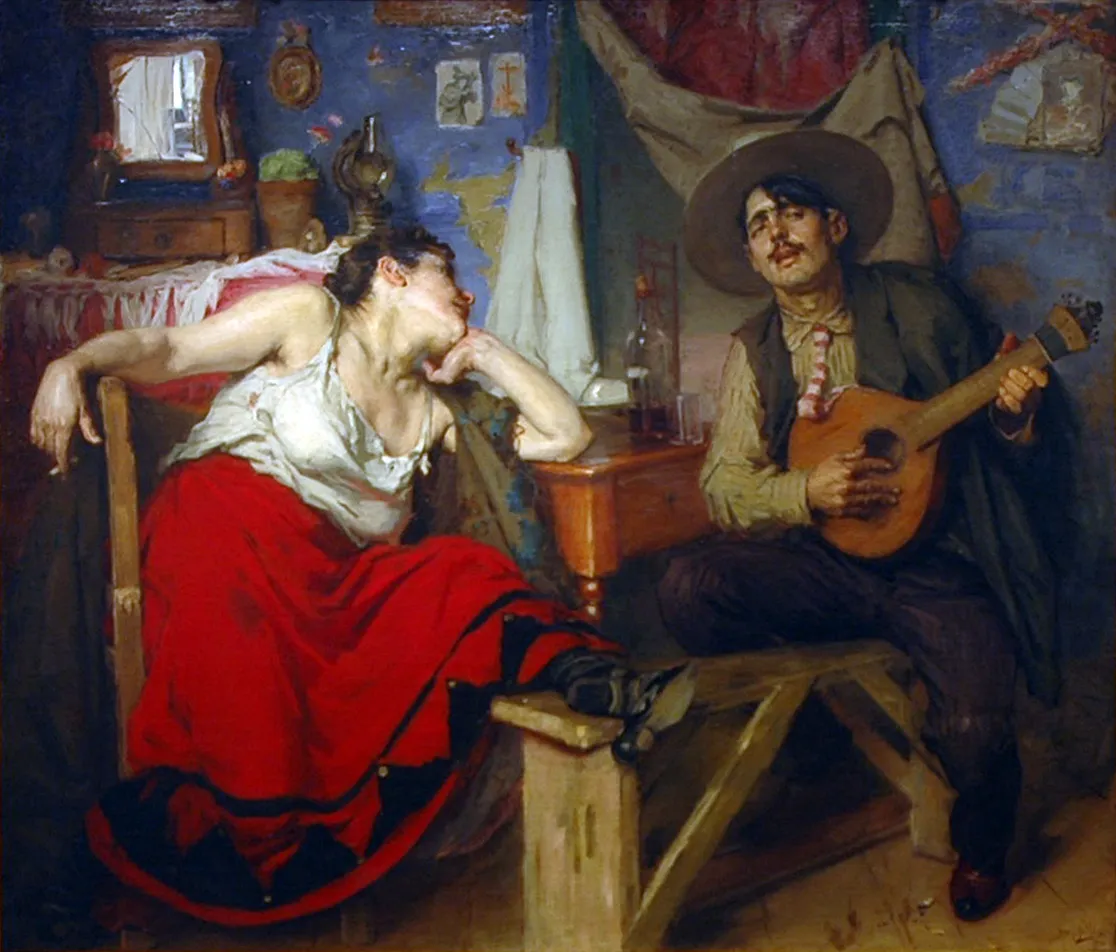
O Fado took years. Studies show that Malhoa first thought of a triptych, a picture in three panels. There are charcoal drawings of Amâncio, and a study of 1908 that adds a third figure to the scene. In the end he kept two people in a poor room: the man in a wide hat, eyes half shut, playing and singing; the woman in a white camisole and red skirt, leaning on her hand and listening.
His sitters came from the world he was painting. Amâncio was a guitarist and Adelaide, whose nickname means roughly Adelaide of the Stab, was his lover. The Museu do Fado calls them both fado singers and says that, almost by accident, they helped fix the image of fado; the story of how the picture was made became well known through the large literature on Malhoa.
There are two versions. One is dated 1909 and is in a private collection; the other, dated 1910, is the famous one. It was much admired at the time and shown abroad, and it belongs to Lisbon City Council. In 2010, the centenary of the Republic, an exhibition staged by the Museu do Fado at the Sociedade Nacional de Belas-Artes showed the two side by side for the first time.
The Museu do Fado describes Malhoa's image of fado as popular, urban and macho, and says it soon became central to the way the genre was pictured. The painting has had a long life outside the museum. It inspired Fado Malhoa, a song by José Galhardo and Frederico Valério first sung by Amália Rodrigues. In 2005 the painter João Vieira parodied it in a canvas whose title, taken from the song, calls it the most Portuguese of oil paintings.
When the Museu do Fado in Alfama reopened after a refit in 2008, the city deposited Malhoa's picture there, at the start of the new permanent display, and it was still there in the museum's Imagens do Fado exhibition of 2024 and 2025.
Honours, a house and a museum
Abroad, Malhoa showed regularly at the Paris Salon from 1897 to 1912 and at the Universal Exhibition in Paris in 1900, and his work went to Berlin, Madrid, Rio de Janeiro, Barcelona, Buenos Aires and San Francisco, winning prizes along the way. At home the new Sociedade Nacional de Belas-Artes, founded in 1901, gave him its Medal of Honour in 1903 and elected him president in 1918. The MACAM museum and the Museu do Fado say he had also been its first president, in 1901; the Museu Soares dos Reis mentions only the 1918 election.
The SNBA, still Portugal's oldest artists' society, was formed by merging the Grémio Artístico, set up in 1891 by Silva Porto and the Grupo do Leão, with the older Sociedade Promotora de Belas-Artes. Malhoa had exhibited with both, and by around 1920 he was one of the masters who gave free classes to its members.
| Exhibition | City | Years |
|---|---|---|
| Sociedade Promotora de Belas-Artes | Lisbon | 1880, 1884, 1887 |
| Grupo do Leão (Modern Painting exhibitions) | Lisbon | 1881 to 1889 |
| Grémio Artístico | Lisbon | 1891 to 1899 |
| Sociedade Nacional de Belas-Artes salons | Lisbon | 1901 to 1933 |
| International exhibition | Berlin | 1896 |
| Salon | Paris | 1897 to 1912 |
| Universal Exhibition | Paris | 1900 |
| International exhibition | Madrid | 1901 |
| International exhibition | Rio de Janeiro | 1908 |
| International exhibitions | Barcelona and Buenos Aires | 1910 |
| Panama-Pacific International Exposition | San Francisco | 1915 |
As listed by the MACAM museum and the Museu Soares dos Reis. The Museu Soares dos Reis says only that he showed regularly at the SNBA salons from 1901; MACAM gives 1901 to 1933.
Success paid for a house. In 1904 and 1905 the architect Norte Júnior designed a home and studio for Malhoa in Lisbon, on land that was part of the city's planned expansion. The Casa Malhoa was the first artist's house in the capital and won the Valmor Prize, Lisbon's architecture award, in 1905.
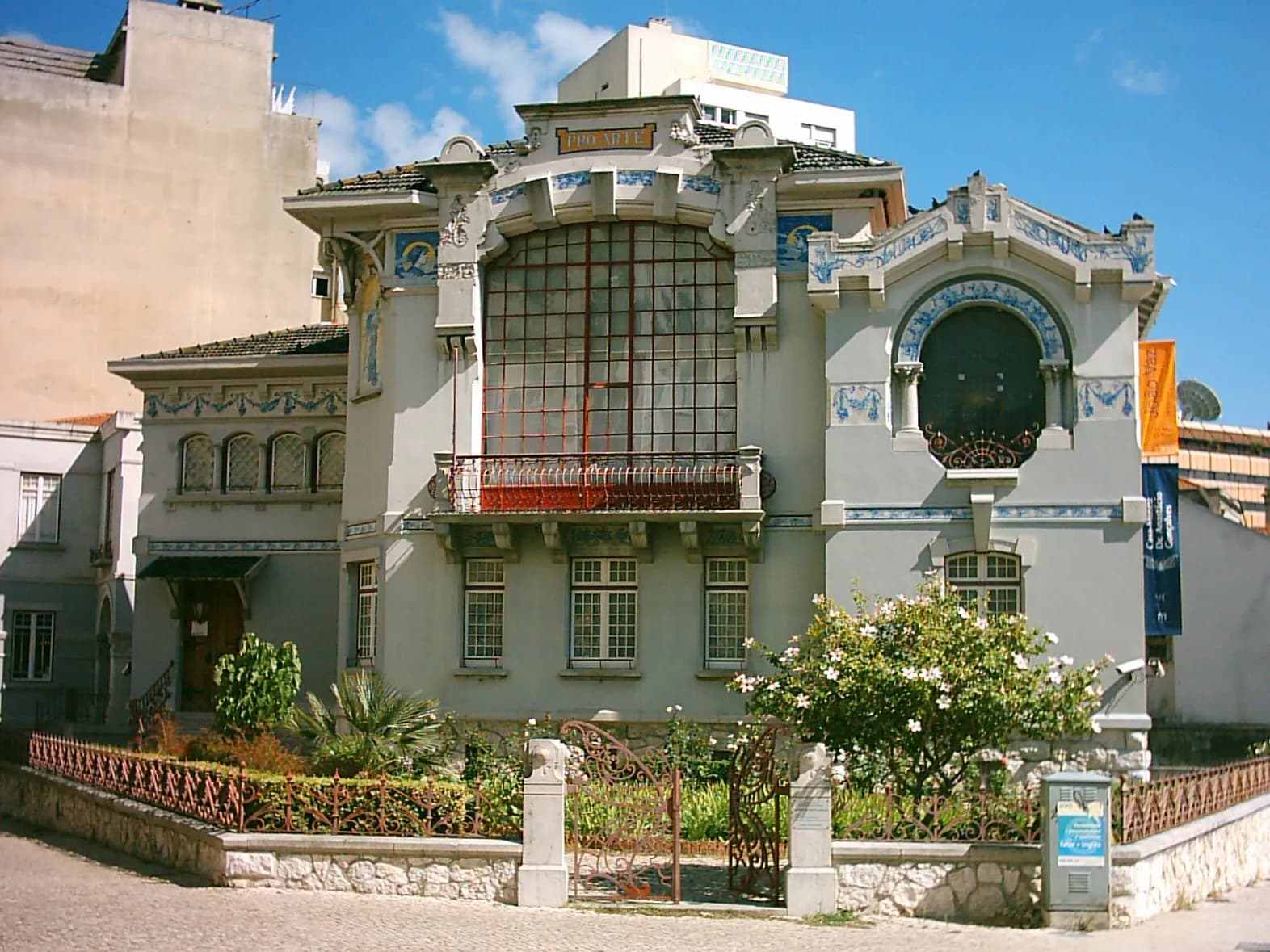
In 1928 the Sociedade Nacional de Belas-Artes gave him a large retrospective exhibition, and a José Malhoa Award was created in his name. In 1932 the Lisbon house passed to the doctor and collector António Anastácio Gonçalves, and Malhoa died at Figueiró dos Vinhos on 26 October 1933, aged 78.
The idea of a Malhoa museum in Caldas da Rainha came from António Montês, also born in the town, who had wanted since 1924 to bring the painter closer to it. In 1926, at Montês's request, Malhoa gave the town a painting of Queen Leonor, who had founded its thermal hospital, and in 1932 he gave the first pictures for a future museum.
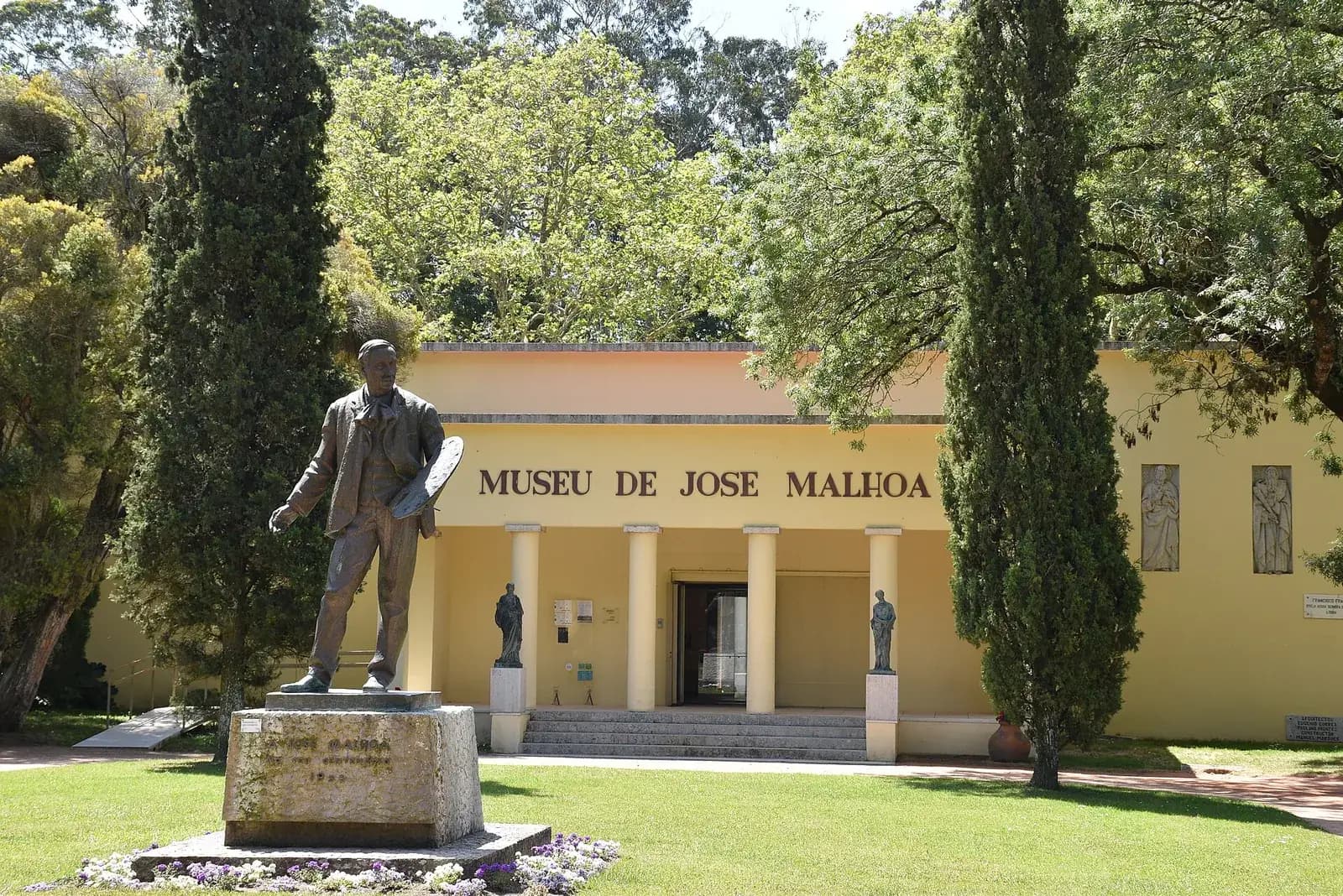
The Museu José Malhoa was created by ministerial order in 1933, a few months before he died; a government statement of 2022 calls it a civic initiative. It opened on 28 April 1934, which would have been his 79th birthday, in temporary rooms in the Casa dos Barcos, a boathouse in the town's Parque D. Carlos I. Montês was its first director.
Its own building, in the same park, was the first in Portugal designed to be a museum, but sources date it differently. Museus e Monumentos de Portugal, the state agency that runs it, dates its first architectural project to 1940 and names the architects as Paulino Montês and Eugénio Correia. A 2018 report written at the museum says Paulino Montês showed a preliminary design and the first stone was laid on the opening day in 1934, and that the building opened on 11 August 1940. The 2022 government statement puts it at 1933, the year the museum was founded. It was classified as a building of public interest in 2002.
28 April 1855
Born in Caldas da Rainha
1867 to 1875
Studies at the Academy of Fine Arts, Lisbon
1875
Second failed bid for a Paris scholarship; works in his brother's shop
1880
Marries Juliana Júlia de Carvalho
1881
A Seara Invadida well reviewed in Madrid; first Grupo do Leão exhibition
1885
Columbano paints O Grupo do Leão, with Malhoa third from the left
1897
First of his years at the Paris Salon, until 1912
1901
Sociedade Nacional de Belas-Artes founded; by two museums' accounts, Malhoa is its first president
1903
Paints Clara; SNBA Medal of Honour
1905
His Lisbon house and studio wins the Valmor Prize
1907
Paints Festejando o S. Martinho
1910
O Fado
1918
Paints Outono; SNBA president again
1928
Retrospective at the SNBA; José Malhoa Award created
1933
Museu José Malhoa created; dies at Figueiró dos Vinhos on 26 October
28 April 1934
The museum opens in temporary rooms on what would have been his 79th birthday
1940
The museum's own building opens in the Parque D. Carlos I
Why he still matters
Malhoa's village feasts, taverns and fado singer are still part of how Portugal pictures its own past, and more than 90 years after his death the state is still buying his work.
In 2025 it paid €400,000 for the 1912 version of Os Bêbados, the most important of 16 works bought that year for national museums for a total of nearly €650,000. The picture went to the Museu do Abade de Baçal in Bragança, which has a group of naturalist paintings. The art historian Nuno Saldanha had described the series as a study of the consequences of vice and excess.
In Caldas da Rainha the museum reopened on 20 December 2023 after a closure for extensive building works. The €410,000 job, handed to the builders in October 2022 and paid for from the national Recovery and Resilience Plan, was meant to fix a leaking roof and drains that threatened the collection and to digitise 1,546 objects. Besides Malhoa, its collection includes works by Columbano, Rafael Bordalo Pinheiro and Maria Helena Vieira da Silva.
| Painting | Date | Where it is |
|---|---|---|
| Clara | 1903 | Museu do Chiado, Lisbon |
| Festejando o S. Martinho (Os Bêbados) | 1907 | Museu do Chiado; in 2026 on show at the Museu José Malhoa, Caldas da Rainha |
| O Fado | 1909 | Private collection |
| O Fado | 1910 | Lisbon City Council collections, on deposit at the Museu do Fado |
| Os Bêbados, third version | 1912 | Museu do Abade de Baçal, Bragança, bought in 2025 |
| Retrato da minha mulher | 1914 | Museu do Chiado, given by Malhoa in 1919 |
| Outono | 1918 | Museu do Chiado |
| Praia das Maçãs | c. 1926 | Museu do Chiado, bought by the state in 1926 |
Works rotate between display and storage, and some travel on loan. Check with each museum before you go.
FAQs
When and where was José Malhoa born?
José Vital Branco Malhoa was born in Caldas da Rainha on 28 April 1855. He moved to Lisbon as a child, studied at the Academy of Fine Arts from 1867 to 1875 and died at Figueiró dos Vinhos on 26 October 1933.
Who are the people in Malhoa's painting O Fado?
The guitarist Amâncio and his lover, known as Adelaide da Facada, both from Lisbon's fado world. Malhoa painted two versions, dated 1909 and 1910; the 1910 picture belongs to Lisbon City Council and hangs in the Museu do Fado.
Where is Os Bêbados by José Malhoa?
The best-known version, Festejando o S. Martinho of 1907, belongs to the Museu Nacional de Arte Contemporânea do Chiado in Lisbon and was on show at the Museu José Malhoa in Caldas da Rainha in May 2026. A third, more restrained version of 1912 was bought by the state in 2025 for the Museu do Abade de Baçal in Bragança.
What was the Grupo do Leão?
A group of Lisbon naturalist painters gathered around Silva Porto from about 1880, named after the Leão de Ouro beer cellar where they met. Malhoa was a founder and showed at its Modern Painting exhibitions from 1881 to 1889.
Why is the Museu José Malhoa important?
It holds the largest group of Malhoa's paintings and sculptures, and its building in the Parque D. Carlos I, Caldas da Rainha, was the first in Portugal designed as a museum. It first opened on 28 April 1934, the anniversary of his birth, and reopened in December 2023 after repairs.
On the timeline
Open the timelineNearby moments from regeneration and the last kings (1851–1910).
Wenceslau de Moraes is born in Lisbon. A naval officer who fell in love with Japan, he became Portugal's consul in Kobe and later settled in Tokushima, the home town of his late companion O-Yoné. His books, from 'Dai-Nippon' to 'O Bon-Odori em Tokushima', introduced Japan to Portuguese readers.
João Franco is born in Alcaide, near Fundão. King Carlos makes him prime minister in May 1906, and from May 1907, with parliament dissolved, he rules by decree. The anger at this dictatorship forms the backdrop to the regicide of 1 February 1908.
Cesário Verde is born in Lisbon's Madalena parish. He worked in the family hardware business, died of tuberculosis at 31 and never saw a book of his own in print, yet poems such as 'O Sentimento dum Ocidental', a dusk walk through gas-lit Lisbon, made him a master of modern Portuguese poetry, championed by Pessoa.
José Malhoa, painter of O Fado
Birth in Caldas da Rainha of José Malhoa, a leading painter of Portuguese naturalism. His 'O Fado' (1910), showing a guitarist singing to his lover in a humble Lisbon room, became a defining image of the genre. Caldas da Rainha's art museum bears his name.
King Pedro V rides the inaugural train of Portugal's first railway, a 36-kilometre line from Lisbon to Carregado. It was the first stretch of what became the Linha do Norte, which would eventually link the capital with Porto.
The painter Columbano Bordalo Pinheiro is born in Cacilhas, younger brother of the caricaturist Rafael. His group portrait of the 'Grupo do Leão' and his sombre portraits of Antero de Quental and Teófilo Braga made him the leading portraitist of his generation; he later directed the National Museum of Contemporary Art and helped design the republican flag.
Death in Lisbon of Queen Estefânia, the German-born wife of King Pedro V, from diphtheria at just 22, barely a year after her wedding. Known as the 'angel of the poor' for her charitable work, she is remembered in the Hospital de Dona Estefânia, the Lisbon children's hospital that bears her name, and her death left the young king inconsolable.
Coming up in history
All long reads
26 sources
Archives, scholarship and reporting this article was checked against.
- 1
169th birth anniversary of the painter José MalhoaMuseu Nacional Soares dos Reis, 28 April 2024
- 2
José Malhoa: biography (FMV, October 2020)MACAM, Museu de Arte Contemporânea Armando Martins, Lisbon
- 3
Festejando o S. Martinho, 1907 (Inv. 2): catalogue entry by Maria de Aires SilveiraMuseu Nacional de Arte Contemporânea do Chiado
- 4
Fado 1910 (exhibition, 26 June to 31 August 2010)Museu do Fado, Lisbon (EGEAC)
- 5Imagens do Fado: exposição que o representa na arte portuguesaRTP Notícias (Antena 1), 10 December 2024
- 6
Museu José MalhoaMuseus e Monumentos de Portugal
- 7
- 8
Severa (biography)Museu do Fado, Lisbon (EGEAC)
- 9
José Malhoa (biography)Fundação Dionísio Pinheiro e Alice Cardoso Pinheiro, Águeda, on Google Arts & Culture
- 10
- 11
- 12
- 13
- 14Estado adquire quadro de José Malhoa por 400 mil euros para Museu do Abade de BaçalRTP Notícias, with Lusa, 15 May 2026
- 15
- 16
- 17
Nomination file no. 00563 for inscription on the Representative List in 2011: Fado, urban popular song of PortugalUNESCO Intangible Cultural Heritage (submitted by Portugal; signed by the Mayor of Lisbon, last revision 23 June 2011)
- 18
- 19
- 20Quadro de Malhoa integra renovado Museu do Fado que abre quinta-feiraRTP Notícias, with Lusa, 28 September 2008
- 21
A SNBASociedade Nacional de Belas-Artes, Lisbon
- 22
- 23
Contextualização Museológica no Pós 25 de Abril (1974-1976), annexes (Cristina Maria Esteves Veludo Loureiro, project report)Faculdade de Letras da Universidade do Porto, Repositório Aberto, 2014
- 24
Museu José Malhoa: Experiência Formativa (Sienna Sara Eithne Cook, master's internship report in cultural management)Politécnico de Leiria, IC-Online repository, March 2018
- 25
Museu José Malhoa vai ser requalificadoXXIII Governo Constitucional (portugal.gov.pt), 6 October 2022
- 26
Image credits
- Festejando o S. Martinho, often called Os Bêbados (The Drunks), painted by José Malhoa in 1907. The men were real people from Figueiró dos Vinhos. Museu Nacional de Arte Contemporânea do Chiado, Lisbon. José Malhoa, Public domain, via Wikimedia Commons.
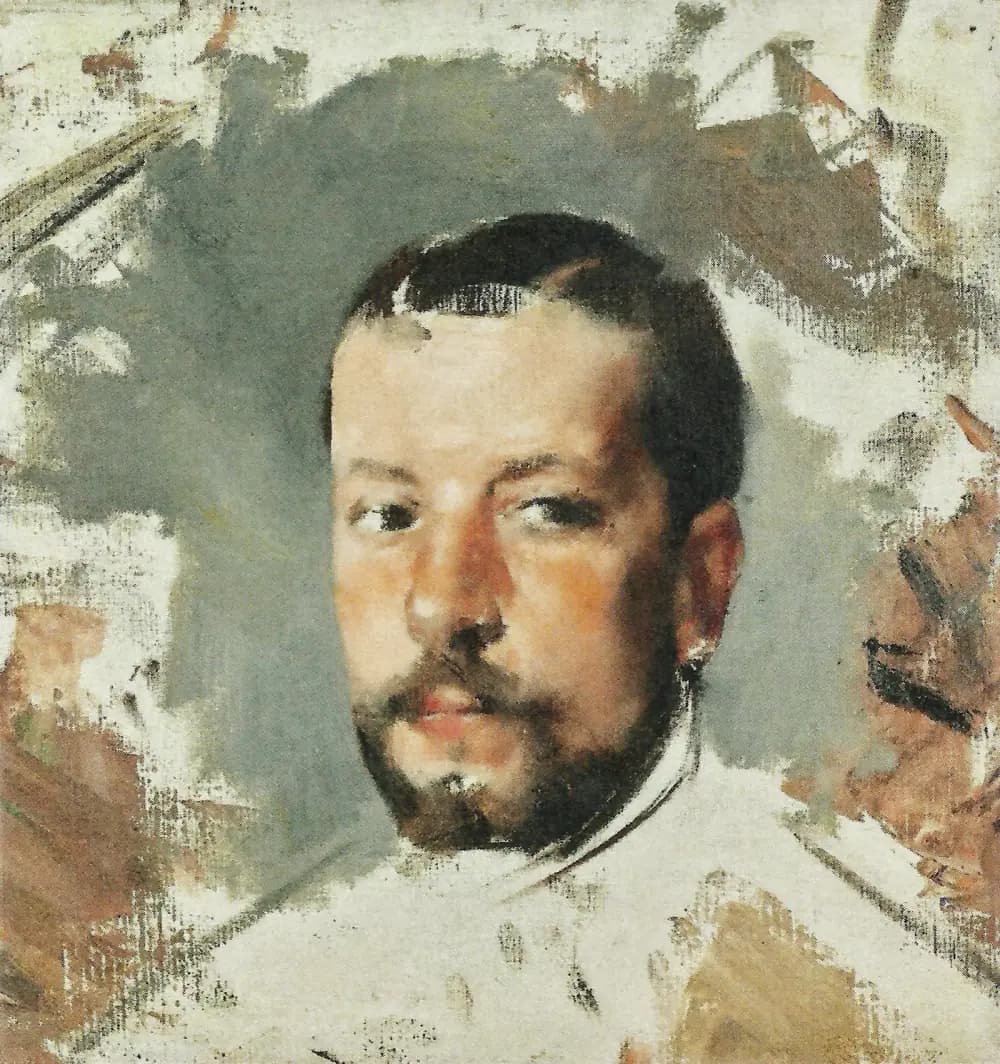
- José Malhoa at about 27, in an unfinished portrait of 1882 by his friend António Ramalho, another member of the Grupo do Leão. Museu José Malhoa, Caldas da Rainha. Ramalho Júnior, Public domain, via Wikimedia Commons.
- Outono (Autumn), 1918, a small panel in which Malhoa built the scene out of short touches of colour. Museu Nacional de Arte Contemporânea do Chiado, Lisbon. Londonjackbooks, CC0, via Wikimedia Commons.
- O Fado, dated 1910: the guitarist Amâncio and Adelaide da Facada. The painting belongs to Lisbon City Council's collections and has hung in the Museu do Fado since 2008. José Malhoa, Public domain, via Wikimedia Commons.
- The Casa Malhoa on Avenida 5 de Outubro, Lisbon, built for the painter in 1904 to 1905 to a design by Norte Júnior. It is now the Casa-Museu Dr. Anastácio Gonçalves. Juntas, CC BY-SA 3.0, via Wikimedia Commons.
- The Museu José Malhoa in the Parque D. Carlos I, Caldas da Rainha, with a statue of the painter in front. The photograph was published by the museum in 2019. Museu José Malhoa, CC BY-SA 4.0, via Wikimedia Commons.