

The king of Kongo is baptised João: 3 May 1491
A Portuguese embassy reached the capital of Kongo with friars, masons and a banner of the cross. The king took the name of Portugal's king, and within a generation his son was writing to Lisbon that the slave trade was emptying his land.
At a glance
- On 3 May 1491, the feast of the Holy Cross, Portuguese friars baptised the ruler of Kongo, a large kingdom of west-central Africa, in a room of his palace. He took the name João, after King João II of Portugal.
- The embassy had left Lisbon on 19 December 1490. Its first captain and its Kongolese guide died of plague on the way, and a cousin, Rui de Sousa, led it into the kingdom.
- Six Kongo nobles were baptised with the king, and the queen followed on 4 June as Leonor. The king had asked for friars, masons, carpenters, farmers and women to teach bread-making.
- Kongo tradition remembers the king as Nzinga a Nkuwu. His son Mvemba a Nzinga, baptised Afonso, won the throne in a war of succession around 1506 and ruled until the early 1540s.
- In letters of 1526 Afonso told João III of Portugal that free Kongolese were being kidnapped and sold to Portuguese merchants and that his land was being depopulated. João III answered that a trade of 10,000 slaves a year would do Kongo more honour.
A room in the palace, a basin of water
The friars chose the best room they could find in the king's palace. They set up altars, lit torches and candles, and laid tables with great basins of water. When everything was ready they sent word that the king could come whenever he wished.
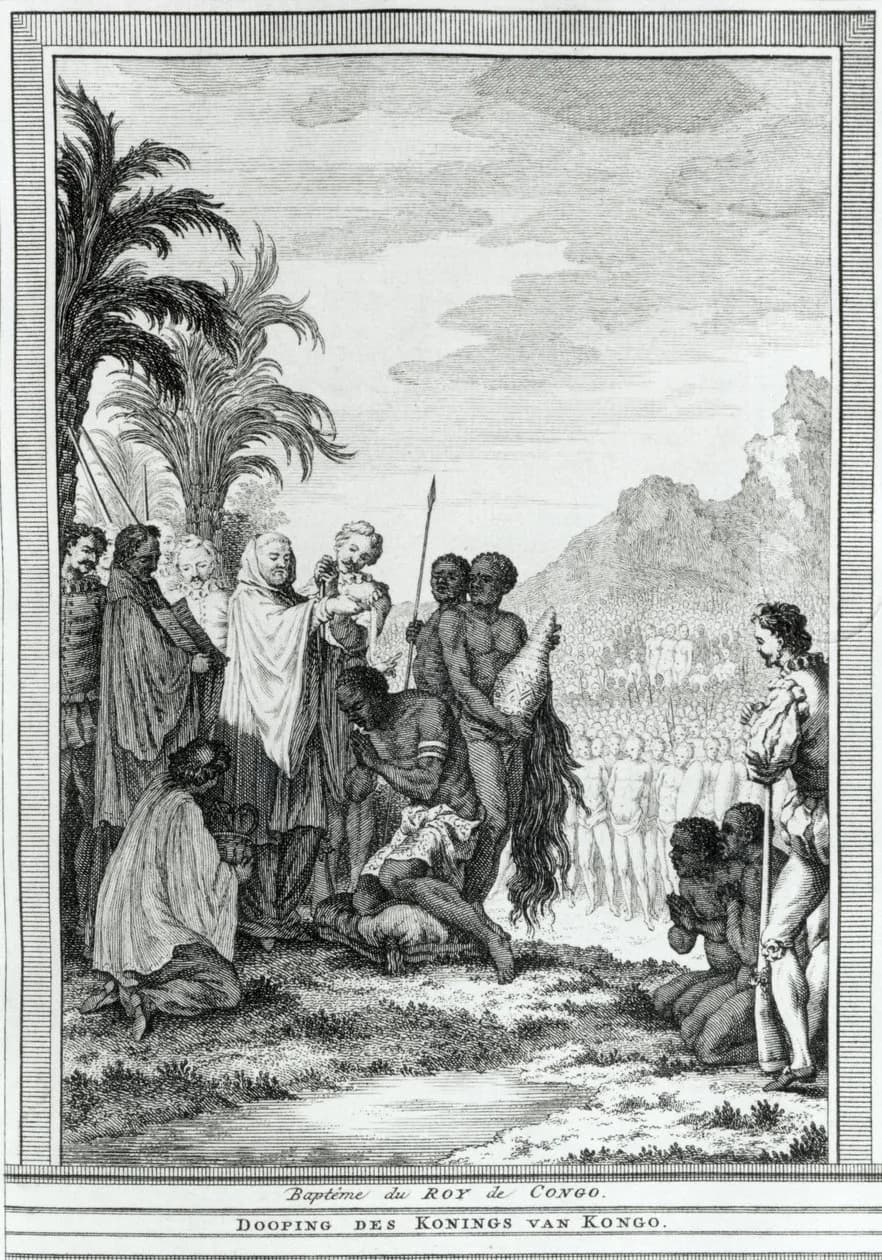
He came at once, with six of the great lords of his kingdom. He stood before the altar while Frei João, the head of the friars, said the office. Then he was baptised. He took the name João, after the king of Portugal who had sent the friars, and his lords became Francisco, Gonçalo, Jorge, Lopo, Diogo and Rodrigo.
Rui de Pina, the Portuguese royal chronicler, dated the ceremony to the day of the Holy Cross, 3 May 1491. The place was the capital of Kongo, a kingdom of west-central Africa whose lands now lie in parts of Angola and the two Congos. Its capital, Mbanza Kongo, is today a town in northern Angola.
After the midday meal the courtyard filled with people. The new João I called for his bow and arrows and said he would celebrate the day himself. He went round the courtyard bow in hand, turning this way and that, Pina wrote, while some twenty noblemen moved around him on their knees, clearing pebbles and straw from where he was about to tread.
Then the lords who had not been chosen came before him to complain. What disloyalty had he found in them, they asked, that he had left them out?
Two kingdoms, nine years of contact
Kongo was much older than its links with Portugal. UNESCO dates the kingdom from the fourteenth century, and Kongo tradition remembers its founder as Nimi a Lukeni, who brought a group of chiefdoms under one king. Its weavers made palm-fibre cloth that the Portuguese chroniclers praised for its fine weave and colours.
Its capital stood on a plateau 570 metres above sea level. UNESCO describes it as prosperous when the Portuguese arrived, a large town built of local materials, and as the political and spiritual centre of one of the largest states of southern Africa.
Caçuta's embassy reached João II at Beja early in 1489, Pina wrote. It brought ivory, carved ivory objects and palm cloths in fine colours, and a request. The king of Kongo asked for friars and priests and everything needed to baptise him and his people, for masons and carpenters to build churches, for farmers to tame oxen and teach his people to work the land, and for women to teach Kongo women to make bread.
He also sent boys to be baptised and taught to read and write, so that, knowing both languages, they could serve him at home. João II kept the Kongo party in Portugal until the end of 1490 to learn Portuguese and the faith.
João II had his own reasons. When the fleet left Kongo, some Portuguese stayed behind with orders to travel overland towards India and Prester John, the Christian king Europeans hoped to find somewhere in Africa or Asia.
A hundred days at sea and an Easter on the river
The fleet sailed from Lisbon on 19 December 1490 under Gonçalo de Sousa, a nobleman of the royal household. With him went João da Silva, many Franciscan friars, and vestments, crosses, bells, organs and books enough for a cathedral. Plague was raging in Lisbon when they left.
Near the Cape Verde islands Gonçalo de Sousa died of it. João da Silva died after him, and so did another young Black Christian. Pina says the crews did not know what to do without their captain and their guide. They held a council at anchor, chose Gonçalo's cousin Rui de Sousa as captain-major and sailed on. João de Barros, writing about sixty years later, calls Rui a nephew and says the captains quarrelled over the command.
On 29 March 1491 they reached the river of the Padrão, named after the stone pillar Cão had left at its mouth. The land there belonged to the lord of Soyo, an uncle of the king, a man of about fifty, according to both chroniclers. He came down to the port with three thousand archers, asked to be baptised, and was, with his son, on Easter Sunday, 3 April. He took the name Manuel and his son António.
The chroniclers have him tell his people that no men in the world were as fortunate or as wise as the white men. It is a Portuguese account written for a Portuguese king, and should be read that way.
From the coast to the court was fifty leagues. Rui de Sousa went inland with two hundred porters. The king ordered that the Christians be given whatever they wanted, on pain of death, and sent a courtier with thousands of nzimbu, the small white shells Kongo used as money, and sheep, goats, hens, honey and palm wine. The journey took 23 days by Pina's count and 20 by Resende's.
Early 1489
Kongo embassy at Beja
Caçuta asks João II for friars, craftsmen and teachers, and is baptised João da Silva.
19 December 1490
Fleet leaves Lisbon
Under Gonçalo de Sousa, with Franciscan friars and church furnishings.
Before March 1491
Deaths near Cape Verde
Gonçalo de Sousa and João da Silva die of plague; Rui de Sousa takes command.
29 March 1491
Mouth of the Congo
The fleet anchors in the land of the lord of Soyo.
3 April 1491
Easter Sunday
The lord of Soyo and his son are baptised as Manuel and António.
3 May 1491
The king is baptised
He takes the name João, with six nobles.
4 June 1491
The queen is baptised
She takes the name Leonor, after the queen of Portugal.
June 1491
War against rebel vassals
The king marches under the banner of the cross sent from Lisbon.
1492
Fleet home
Rui de Sousa reports to João II in Lisbon.
Earth on the captain's chest
Crowds met them at the capital with ivory trumpets and drums. The king of Kongo received Rui de Sousa sitting on a raised dais in a courtyard of his palace. He was bare from the waist up, with a cap of palm cloth on his head, a horse's tail mounted in silver over his shoulder, an ivory bracelet on his left arm, and below the waist damask that João II had sent him.
The captain kissed his hand in the Portuguese manner. The king answered in his own. He took up earth in his hands and rubbed it on the captain's chest and then on his own, which, the chronicler explained, was the greatest courtesy a Kongo king could show.
Then came the gifts: the masons and carpenters with their tools, the farmers with their implements, the women with their basins and cauldrons, a horse, brocades and silks. The king, Pina says, told his lords that the king of Portugal alone deserved to be called lord of the world.
Work on a stone church began at once. A thousand men carried the stone on their backs from two or three leagues away, singing as they went. The king meant to wait for it before being baptised. One afternoon, according to Pina, he summoned the friars and asked them a question.
“Friends, can I perhaps be a Christian somewhere other than in that church? ... Then since my error can be put right without it, I do not want to live in it any longer, and tomorrow, come what may, I want to be a Christian, because my heart tells me so.”
A queen, a banner and a war
To the lords who had been left out, the king gave an answer. They would be baptised, he said, once his wife, his son and his brother had been, since they ranked above them. The lords touched the earth with their hands and put it on their faces in thanks. In Pina's telling, baptism at the Kongo court was something to be granted in order of rank, and the nobles treated it as an honour.
The queen pressed to be baptised too. The king put her off, waiting for the church and for the prince, who was away in his own lands. Then Frei João died and the other friars fell ill, and the king asked Frei António to baptise the queen at once. On Saturday 4 June she became Leonor, after the queen of Portugal. Two days later, when the friars explained the articles of faith to her, she laid out small stones on her dais to remember each one, which Pina calls her art of memory.
That same day the Portuguese handed the king a banner with the cross, sent by João II. Vassals on islands in the river had risen against him, and he set out to fight them, barefoot, with the banner carried ahead. The chroniclers credit the victory to the cross and claim an army of 800,000 men, a figure no historian needs to take literally.
Rui de Sousa then took the fleet home, reaching Lisbon in 1492. Four friars stayed in Kongo with the church furnishings, along with the craftsmen and the women. So did a Kongolese Christian who could read and write and had begun teaching the sons of the great lords at court.
Afonso: a son, a brother and a sign in the sky
The king's son Mvemba a Nzinga was then governor of the province of Nsundi, according to the Belgian church historian Mgr J. Cuvelier, who dated his baptism, as Afonso, to 4 June 1491. Pina does not record it. For what came next, the main source is Afonso himself.
In 1512 Afonso sent a letter to the lords of his kingdom telling the story. It survives in more than one version. In the one the chronicler Damião de Góis printed, Afonso wrote that his father had made a good start in the faith but had been turned away from it, through the envy of the Devil. Afonso, by his own account, held to it and fell into disfavour with his father and the great men of the kingdom, and his father sent him into exile far away.
When João I died, the great lords and most of the people, who were still pagan, backed another son, who had refused baptism. Afonso hurried to the capital with 37 Christian followers (36 in the other version). His brother came against him with a great army from the city and beyond. Afonso said that as the arrows fell on his men they called on St James, and the enemy turned and fled. The Góis version adds that the brother was captured and put to death. It is the winner's account.
“...the cause of their flight was that, when we called on the Apostle St James, all of them saw a white cross in the sky and a great number of armed men on horseback, which struck such terror into them that they could not withstand it, and at once took to flight.”
Sources disagree on the date of the battle: Cuvelier put it in 1506, others as late as 1509. His brother is remembered as Mpanzu a Kitima, or Mpanzu a Nzinga. Afonso reigned until his death, which Cuvelier placed, probably, in 1541 and other writers in 1542.
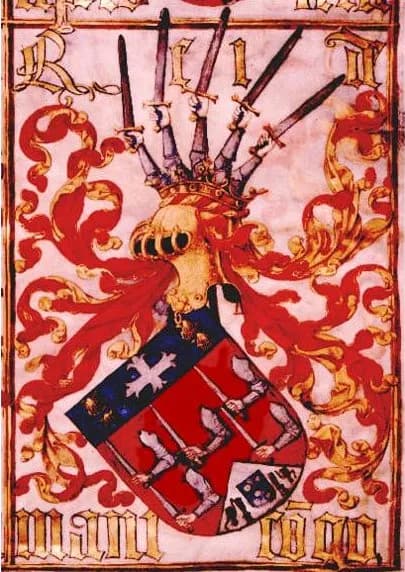
The miracle went into Afonso's coat of arms, which the Góis version says King Manuel I of Portugal sent him. In the letter Afonso described it piece by piece: a red field for the blood shed in the battle, a blue chief with a silver cross for the cross seen in the sky, scallop shells for St James, five armed arms with swords for the horsemen, who were angels, and a small shield of Portugal flanked by two broken black idols.
José Mateus Francisco, writing in a Brazilian history journal in 2021, reads the story as political as well as religious. In his view Afonso used the new faith to legitimise his rule, and the alliance that Portugal hoped would make Kongo a vassal ended up strengthening the Kongo monarchy instead.
Afonso sent his son Henrique to be educated in Portugal. On 3 May 1518 Pope Leo X wrote to King Manuel I agreeing, not without difficulty, to make the son of the king of Kongo a bishop, and on 5 May Henrique was named titular bishop of Utica, a see in North Africa, with leave to act as a bishop in the diocese of Funchal.
“Our land is being depopulated”
By the 1520s Portuguese ships were buying people in Kongo, many of them for the sugar plantations of São Tomé, a Portuguese island colony in the Gulf of Guinea. In 1526 Afonso wrote to King João III of Portugal about it. His letters were written out by a scribe, Dom João Teixeira, signed by the king and sent to Lisbon. The originals are now in the Torre do Tombo national archive.
On 6 July he complained that João III's officials let merchants set up shops all over his kingdom, so that vassals who had more goods than their king no longer obeyed him. Worse was the trade in people.
“The said merchants take every day our natives, sons of the land and sons of our noblemen and vassals, and our relatives, because thieves and men of bad conscience steal them, wanting the goods and wares of your kingdom, and bring them to be sold. So great, Sir, is this corruption and licence that our land is being completely depopulated.”
Kongo needed nothing from Portugal, he went on, except priests, a few people to teach in the schools, and wine and flour for the Mass. He asked the king to stop sending merchants, “because it is our will that in these kingdoms there should be no trade in slaves nor outlet for them”.
By 18 October his position had shifted. Free people, including noblemen and the king's relatives, were being seized and smuggled to the white men, some of them at night, then branded with hot irons. Afonso now passed a law that any white man in Kongo who bought slaves had first to show them to three officials of his court, who would check whether they were captives or free. Only those cleared could be shipped. He allowed this, he wrote, for the sake of João III's share of the trade.
| Date | Writer | What it says |
|---|---|---|
| 6 July 1526 | Afonso I to João III | Merchants' goods are turning his vassals against him; free Kongolese are kidnapped and sold; asks for priests, teachers, wine and flour for Mass, and an end to the trade in slaves |
| 18 October 1526 | Afonso I to João III | Asks for two physicians, two apothecaries and a surgeon; describes free people branded by buyers; sets up a check of every slave sold, by Dom Pedro Manipunzo, Dom Manuel Manissaba and Gonçalo Pires |
| Late 1529 | João III to Afonso I | Doubts that Kongo is being emptied; suggests a supervised place in the market; offers one small caravel a year with wine and flour if Kongo wants no trade, but argues against it |
All three are printed in Monumenta Missionaria Africana, vol. I. The October letter calls the three checkers noblemen and officials of the court: Dom Manuel Manissaba was the chief bailiff (meirinho-mor) and Gonçalo Pires the armador-mor.
João III replied at length late in 1529. He believed, he wrote, that Afonso said this because of the grievances the Portuguese gave him, for he heard that Kongo was so populous that no slave ever seemed to leave it, and that Afonso had slaves bought outside the kingdom, married them and made them Christians. The same letter asked Afonso to help the Portuguese priests in Kongo buy slaves whenever they had the money.
“It seems to me no honour to you or to your kingdom, for it is more to be praised that ten thousand slaves, ten thousand manillas and as many elephant tusks are taken out of Kongo each year than that it should be said that in Kongo there is no trade at all.”
The alliance after Afonso
The kingdom stayed Christian, in its own way. UNESCO notes that Kongo adopted Christianity while keeping elements of its earlier customs. Stone churches rose in the capital, which came to be known as São Salvador. A Jesuit college there was where the first catechism in Kikongo was written, in 1624, and in 1608 the Pope accredited an ambassador from Kongo in Rome, the first from a state south of the Sahara.
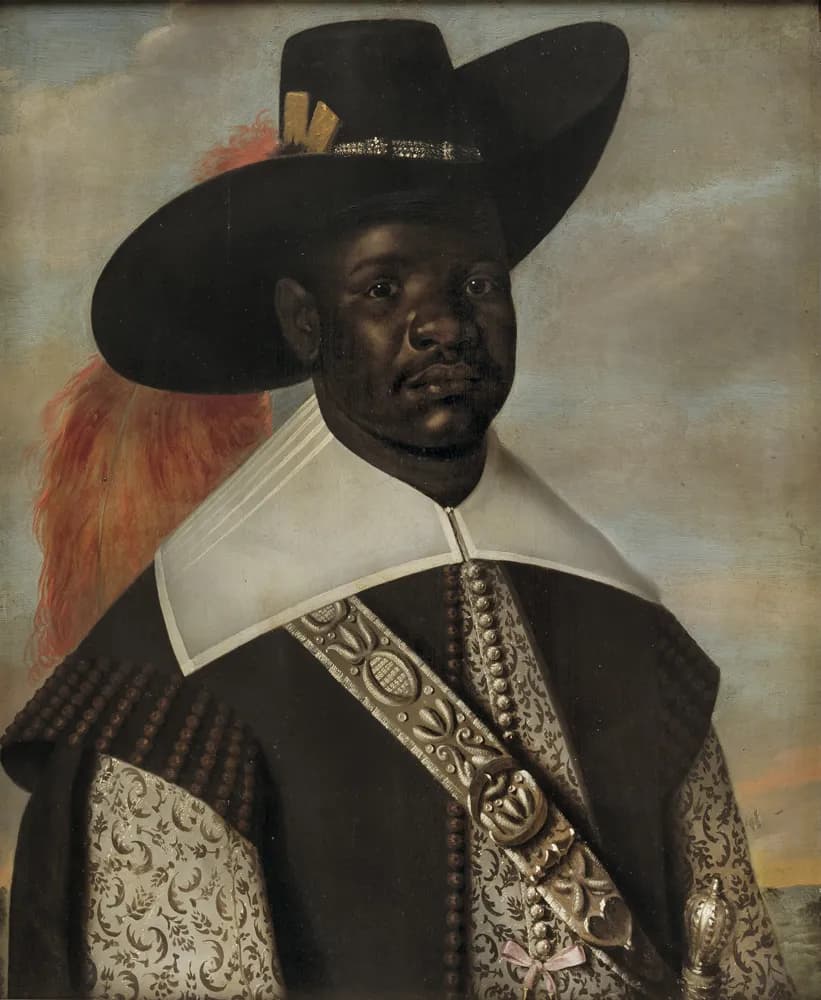
Kongo's own lords took part in the slave trade too. In the 1640s the lord of Soyo, the coastal province where the 1491 embassy had landed, quarrelled with the king of Kongo and sent an envoy, Dom Miguel de Castro, to seek support from the Dutch. As part of the mission, the National Gallery of Denmark notes, he gave 200 enslaved people to the governor of Dutch Brazil.
The decisive blow came from Luanda, the Portuguese base on the coast to the south. On 29 October 1665 a Portuguese force met the army of King António I at Ambuíla. The Kongo army was beaten, António was killed and beheaded, and his crown and sceptre were sent to Portugal. The kingdom sank into civil war.
Angola today remembers the battle as an act of resistance. In 2015 its government classified the battlefield, in the municipality of Kitexe in Uíge province, as a national historic site, describing it as an important testimony of resistance to the occupation of the kingdoms that existed at the start of Portuguese colonisation.
Why it still matters
Afonso can still be heard in his own words. His letters reached Lisbon and stayed in the royal archive, and they are the main source for his reign. They show a Christian African king arguing with his Portuguese counterpart about a trade that, as UNESCO puts it, made Kongo the centre of the most important route for enslaved people taken to the Americas and the Caribbean.
The town where João I was baptised is now Mbanza Kongo, in Angola's Zaire province. In 2017 UNESCO inscribed its historic centre on the World Heritage List, citing documents that cover five centuries, from 1483 to the present. Its customary court, which settles disputes, has been reinstated after four decades of war.
FAQs
When was the king of Kongo baptised?
On 3 May 1491, the feast of the Holy Cross, according to the Portuguese chronicler Rui de Pina. He was baptised in a room of his palace with six nobles and took the name João. His queen followed on 4 June 1491 as Leonor.
Who was Nzinga a Nkuwu?
Nzinga a Nkuwu is the name Kongo tradition gives the king who ruled when the Portuguese arrived and who was baptised João I in 1491. Afonso, his son, later wrote that his father turned away from the faith. He died around 1506, and his sons fought over the throne.
Did Afonso I of Kongo oppose the slave trade?
He opposed the kidnapping and sale of free Kongolese. In July 1526 he asked João III to stop sending merchants and said there should be no trade in slaves from his kingdom. By October he instead required that every slave bought be checked by three of his officials, so that only lawful captives left.
Where was the capital of the kingdom of Kongo?
At Mbanza Kongo, also called São Salvador, on a plateau 570 metres above sea level in what is now northern Angola. The remains of the old capital have been a UNESCO World Heritage site since 2017.
On the timeline
Open the timelineNearby moments from the age of discoveries (1415–1580).
King João II grants an annuity 'in consideration of his services' to Diogo Cão, back in Lisbon from the voyage on which he became the first European to reach the mouth of the Congo. Days later he was given a coat of arms bearing the two padrões — carved stone pillars — he had planted on the African coast.
Pêro da Covilhã and Afonso de Paiva set out from Santarém on João II's secret overland mission to find the spice route to India and the court of Prester John. Travelling disguised as merchants via Cairo and Aden, Covilhã would reach India years before Vasco da Gama.
Bartolomeu Dias lands at Mossel Bay, South Africa, on the day usually reckoned from its old name, São Brás (St Blaise's day). He had passed the Cape of Good Hope unseen, the first known European to sail beyond Africa's southern tip.
The baptism of the king of Kongo
Nzinga a Nkuwu, ruler of the Kingdom of Kongo, is baptised by Portuguese missionaries and takes the Christian name João, after Portugal's king. The alliance brings priests and masons, but within a generation his son Afonso I is writing to João III to protest that Portuguese slave traders are depopulating his kingdom.
Death at age 16 of Prince Afonso, only legitimate son and heir of King João II and Queen Eleanor, after a fall from a horse on the banks of the Tagus near Santarém. The tragedy ends the direct Avis succession and sets in motion the dynastic chain that, three generations later, will deliver Portugal into the hands of the Habsburgs.
Ferdinand and Isabella of Spain sign the Alhambra Decree, ordering the expulsion of all Jews who refuse to convert. Tens of thousands of Spanish Jews flee to Portugal, significantly increasing the Jewish population until Manuel I's own expulsion edict in 1496.
Christopher Columbus, returning from his first voyage to the Americas, is driven by a storm into the Tagus and anchors at Restelo, near Lisbon. João II receives him on 9 March and claims the new lands for Portugal, a dispute settled by the Treaty of Tordesillas.
Coming up in history
All long reads 5 May 1210Afonso III, born 5 May 1210: from count of Boulogne to king of the Algarve
 6 May 1908Manuel II swears his oath: the acclamation of Portugal's last king, 1908
 7 May 1487Pêro da Covilhã's secret journey to India and Ethiopia, 1487
 8 May 1782Questioned, condemned, spared: the Marquis of Pombal's last years, 1777–1782
12 sources
Archives, scholarship and reporting this article was checked against.
- 1
Chronica d'elRey D. João II (Rui de Pina), chapters LVII to LXIIICollecção de livros ineditos de historia portugueza, vol. II, Academia Real das Sciencias, Lisbon, 1792 (Internet Archive, John Carter Brown Library copy)
- 2
- 3
- 4
Decision 41 COM 8B.10: Mbanza Kongo, Vestiges of the Capital of the former Kingdom of Kongo (Angola)UNESCO World Heritage Committee, 2017
- 5
Affonso I (Mvemba Nzinga) (Mgr J. Cuvelier)Biographie Coloniale Belge, vol. II (1951), col. 3-4, Institut royal colonial belge (Royal Academy for Overseas Sciences)
- 6
Política e religião no reino do Congo (séculos XV-XVI): dom Afonso I o rei “convertido” (José Mateus Francisco)Temporalidades: Revista de História, vol. 13, no. 1 (2021), Universidade Federal de Minas Gerais
- 7
Affonso 1. (Dag Leraand)Store norske leksikon, updated 26 November 2024
- 8
- 9
- 10
Battle of AmbuilaEBSCO Research Starters: Military History and Science
- 11
Dom Miguel de Castro, Kongolesisk gesandt (KMS7)SMK, National Gallery of Denmark
- 12
Secular campo de batalha contra ocupação portuguesa de Angola passa a sítio históricoLusa / Ver Angola, 4 June 2015
Image credits
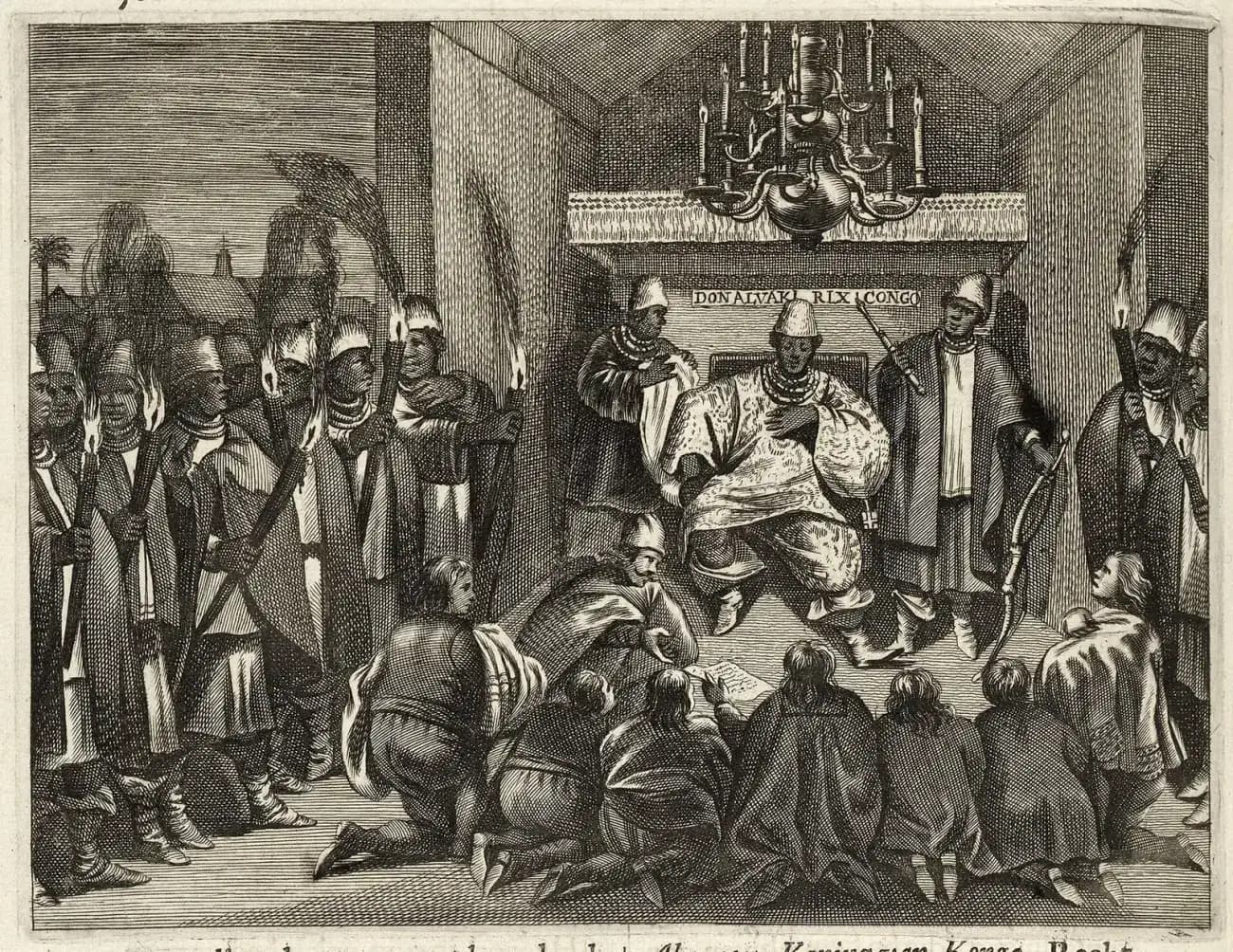
- Dutch envoys kneel before a king of Kongo labelled Don Alvaro during a mission of the early 1640s, as engraved by Jacob van Meurs for Olfert Dapper's description of Africa, published in Amsterdam in 1668. No contemporary picture of the 1491 baptism is known. Jacob van Meurs, Public domain, via Wikimedia Commons.
- “Baptême du Roy de Congo”, an eighteenth-century engraving that Commons attributes to Robert Bénard and dates to 1780. It imagines the scene outdoors under palm trees; Pina places the baptism indoors, in a room of the palace. Robert Benard, Public domain, via Wikimedia Commons.
- The arms of the king of Manicongo as painted by António Godinho in the Livro da Nobreza e Perfeição das Armas, a Portuguese armorial of the second quarter of the sixteenth century. They match Afonso's description of 1512. Antonio Godinho, Public domain, via Wikimedia Commons.
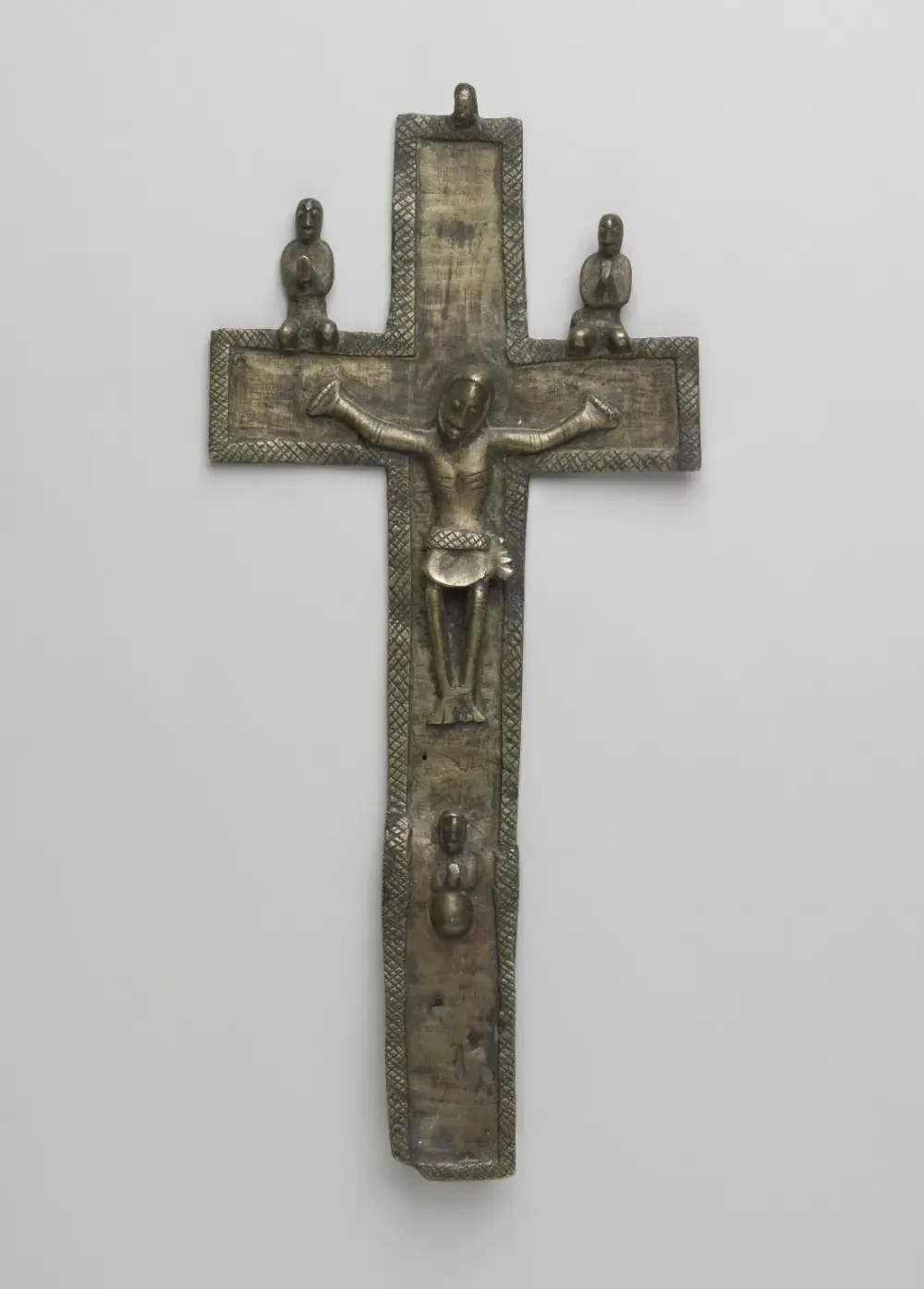
- A Kongo crucifix, or nkangi kiditu, of copper alloy, made in the seventeenth century, now in the Brooklyn Museum. Kongo artists cast such crosses long after the first missionaries arrived. Unknown author, CC BY 3.0, via Wikimedia Commons.
- Dom Miguel de Castro, envoy of the lord of Soyo, painted in the Netherlands in 1643. The painter is not known for certain; in 2008 the art historian Katie Heyning attributed it to Jaspar or Jeronimus Beckx. Attributed to Jaspar Beckx, Public domain, via Wikimedia Commons.