

Questioned, condemned, spared: the Marquis of Pombal's last years, 1777–1782
The minister who rebuilt Lisbon and crushed his enemies spent his last five years in a small provincial town, fighting creditors, answering the queen's judges and begging her pardon. He died there on 8 May 1782, and it was more than 150 years before Lisbon put up his statue.
At a glance
- Sebastião José de Carvalho e Melo, Marquis of Pombal, ran Portugal for King José I; he died in disgrace at his house in Pombal, in central Portugal, on 8 May 1782, five days before his 83rd birthday.
- José I died on 24 February 1777. His daughter Maria I accepted Pombal's resignation on 4 March, freed the prisoners of his regime and let him retire to Pombal, where he arrived on 15 March.
- Sued by creditors and by men he had ruined, he wrote a defence of his government that the courts ordered suppressed. From 9 October 1779 to 15 January 1780 a judge sent by the queen questioned him at his house.
- A royal decree of 16 August 1781 declared him guilty and deserving of exemplary punishment, but spared him because of his age and illness, ordering him to stay at least 20 leagues from court.
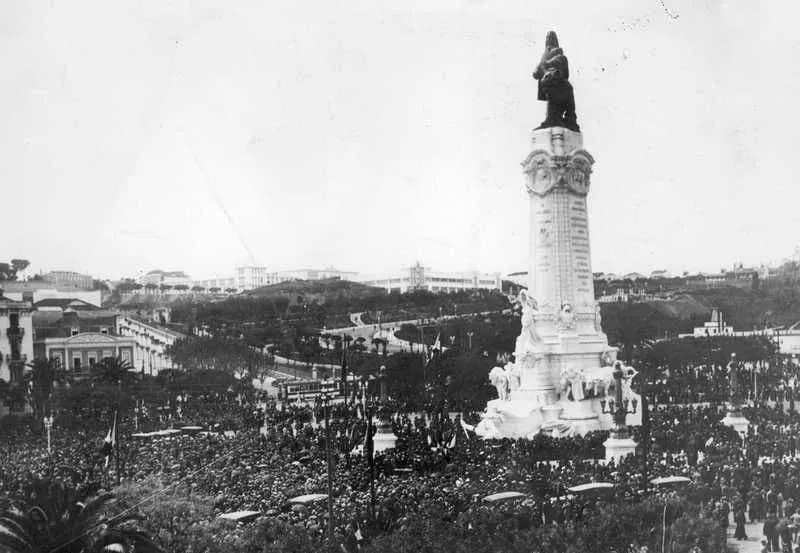
- His body lay in Pombal until 1856 and in the Mercês chapel in Lisbon until 1923; it is now in the Igreja da Memória in Ajuda. The statue at the top of the Avenida da Liberdade was unveiled on 13 May 1934.
A coach in the night at Pombal
On the night of 11 May 1782 a coach drawn by three pairs of animals carried a coffin through the small town of Pombal, on the road between Lisbon and Coimbra. It stopped at the church of the friars' convent of Santo António. At the door stood the Bishop of Coimbra, Francisco de Lemos, one of the very few friends the dead man had left.
The dead man was Sebastião José de Carvalho e Melo, Marquis of Pombal. For 27 years he had governed Portugal in the name of King José I. Now he had died in exile in a damp old house, after five years of lawsuits, interrogations and a royal decree that called him a criminal. He was 82.
Doctors had opened the body before it was embalmed and found the heart hugely enlarged. People came from the villages around for the funeral, the grandest the district had seen. The Benedictine preacher, Joaquim de Santa Clara, praised the man the court had condemned.
“The Marquis of Pombal dies. But his memory will never die ... he will be the great man in every century; his deeds will be the example of justice and patriotism, and his tomb can have no epitaph more lasting or more forceful than his name.”
Who Pombal was, and why he had so many enemies
Carvalho e Melo was born in Lisbon on 13 May 1699 and baptised in the Mercês chapel, which his family held. A minor noble who had been a diplomat in London and Vienna, he became Secretary of State for Foreign Affairs and War when José I came to the throne in 1750, and Secretary of State for the Kingdom, the senior post, in 1756. He was made Count of Oeiras in 1759 and Marquis of Pombal by a decree of 17 September 1770, and history knows him by the second title.
His ministry is remembered for a handful of things, each the subject of its own story. He ran the response to the earthquake of 1 November 1755 and the rebuilding of Lisbon's Baixa. After shots were fired at the king in 1758 he oversaw the trial that sent members of the Távora and Aveiro families to the scaffold at Belém in January 1759, and that year the Jesuits were expelled. He reformed the treasury, the university and trade.
He also filled the prisons. Nobles, priests, magistrates and former colleagues were locked in forts on the Tagus, many without trial, on a simple royal order. His last act of power, on 23 January 1777, was to have the fishing village of Trafaria, across the river from Lisbon, set on fire to flush out men hiding there from military service.
- Full name
- Sebastião José de Carvalho e Melo
- Born
- 13 May 1699, Lisbon
- Titles
- Count of Oeiras (1759); Marquis of Pombal (1770)
- In office
- 1750 to March 1777, under King José I
- Died
- 8 May 1782, at his house in Pombal, aged 82
- Buried
- Pombal (1782), Mercês chapel in Lisbon (1856), Igreja da Memória (1923)
The fall: winter 1776 to spring 1777
Pombal's power rested on one man. On 12 November 1776 José I suffered a stroke from which he never recovered, and on 29 November his wife, Queen Mariana Vitória, became regent. The doors of the king's room were closed to the minister for the first time. After 1 February 1777 no government decision was published in his name.
He asked to resign on 7 February. José died on 24 February, and his daughter became Queen Maria I. In a short final will the king asked her to pay his debts and to pardon the prisoners of state, and the prisons opened at once. A count at the time put the political prisoners at more than 800; the historian Patrícia Alves writes of some hundreds.
On 1 March Pombal renewed his request and said he wished to leave Lisbon. The decree of 4 March 1777 accepted his resignation, let him keep his secretary of state's salary and gave him the income of a commandery of a military order. It did not thank him for his services; the only reason it gave was the late king's regard for him. A separate note warned him that the queen reserved the right to act if there was cause, “principally over misappropriations from the royal treasury”.
He left the next day for his house at Oeiras, his escort barely holding off crowds that shouted at him and threw stones. From there he wrote to his son, the Count of Oeiras.
“The night was as you can well believe, with the separation from children and sons-in-law whom I love so tenderly added to the earlier troubles ... God, who sees my troubles and the resignation with which I bear them, will give me strength to endure them.”
His wife joined him on 9 March and they set off north in the rain. To avoid the towns along the Tagus, where he feared a hostile reception, they went by Bucelas, Sobral and Alenquer. Near Ota, at night, the marchioness and a daughter had to walk through the mud by torchlight while the broken carriage dragged the old man on. They reached Pombal on 15 March.
In Lisbon the new reign became known as the Viradeira, the turnabout. In April 1777 the bronze medallion with Pombal's portrait was taken off the pedestal of José I's equestrian statue in the Terreiro do Paço and replaced with the city's arms. So many satirical verses against him circulated that, Azevedo wrote, they would fill volumes.
Creditors, lawsuits and a dangerous defence
Money was the first charge. Rumour said he had hidden millions in Dutch banks, while his defenders claimed he had left 78 million cruzados in coin in the treasury, besides many millions in diamonds. The examination of the public accounts found about 1,740 contos of réis, little more than 4 million cruzados, plus some 5 to 6 million cruzados' worth of uncut diamonds.
The royal treasury as Pombal handed it over, 1777
contos de réis
- Balance he declared
- Of which held in coin
Pombal's own statement to the queen of the money in each of the treasury's chests, rounded to a tenth of a conto (one conto was a million réis). Of the 2,901 contos declared, 1,741 were in coin; the rest was paper for sums advanced for urgent spending. More than half the declared total came from property confiscated from people condemned for crimes against the state.
Show the data
| Balance he declared | Of which held in coin | |
|---|---|---|
| Main treasury | 637.6 | 27.3 |
| Confiscated property | 1,591.1 | 1,041.1 |
| Vacant commanderies | 312.4 | 312.4 |
| Reserve | 360 | 360 |
In Pombal the creditors came. Men who had never dared ask for their money now sued for it, and others claimed back land he had bought cheaply or taken while in power. By 1779 he was defending sixteen lawsuits. A decree of 20 March 1779, requested by the board of the Águas Livres aqueduct, ordered his property seized; he was accused of diverting water from two public fountains to his own houses in Lisbon.
The suit that ruined him was brought by Galhardo Mendanha. Mendanha had bought property from Pombal, felt cheated and stopped paying; Pombal had him jailed in a string of prisons ending in a fort on Terceira, in the Azores, his daughters shut in a convent and the running of his estate taken from him. Freed after the king's death, Mendanha sued for the sale to be annulled and turned his claim into an indictment of Pombal's whole government.
Pombal welcomed the chance. His reply reviewed his administration from 1750 onwards and attacked his enemies, living and dead, and he had seven copies made. They passed from hand to hand in Lisbon. The Desembargo do Paço, the high court, ordered those passages struck from the case and every copy destroyed, and the lawyers were jailed. A royal decree of 3 September 1779 condemned what it called an apology for his administration under the pretext of a civil suit.
Questioned in his own house
At three in the afternoon of 9 October 1779 two horsemen dismounted at his door in Pombal. They were magistrates sent by the queen to question him: José Luís da França as judge and Bruno Monteiro as clerk. Told that he was asleep and ill, they insisted on seeing him at once and read the decree at his bedside, with the marchioness present. Then two servants helped him to the room where they waited, and the first session lasted two and a half hours.
He was very sick. Boils and sores covered his body, a constant itch kept him awake, and two servants sat by his bed at all hours scratching them. His doctors called it sarna castelhana, Castilian scabies, and treated it with viper broth; his biographer J. Lúcio de Azevedo believed it was leprosy. He told his son not to come: his wife and two daughters were nursing him, and the son should come for them when he died.
- Ordered
- October 1779, by Queen Maria I
- Questioned by
- Judge José Luís da França, with Bruno Monteiro as clerk
- Place
- Pombal's house in the town of Pombal
- Sessions
- 9 October 1779 to 15 January 1780, with breaks for his illness
- Outcome
- Royal decree of 16 August 1781
His defence was that he had only ever obeyed. Until 1759, he told his questioners, José I had decided everything himself, while the minister dealt with trade and shipping; the arrests and executions were the king's orders or the regular sentences of courts. Azevedo, who read the record, rejected much of this and thought it a miserable defence for a man who had run the country.
The charges that stuck were narrow. By Azevedo's summary he was accused of calling himself first minister when he had not been one; of claiming that the character of minister stayed with him after he resigned; of saying that secretaries of state could not be made to account for what they did in the king's name; of revealing state secrets; and of keeping drafts of the defence a decree had ordered suppressed. All came out of the Mendanha case. The abuses of 27 years of government were barely touched.
| Date | Step |
|---|---|
| 4 March 1777 | Resignation accepted; the queen reserves the right to act over misappropriated treasury funds |
| 20 March 1779 | Decree ordering his property seized at the request of the Águas Livres board |
| 3 September 1779 | Decree condemning the defence of his government written for the Mendanha suit |
| 9 October 1779 | First interrogation at Pombal |
| 15 January 1780 | Last session; by Azevedo's account he begs for the queen's mercy |
| 16 August 1781 | Decree declaring him guilty, remitting bodily punishment and keeping him 20 leagues from court |
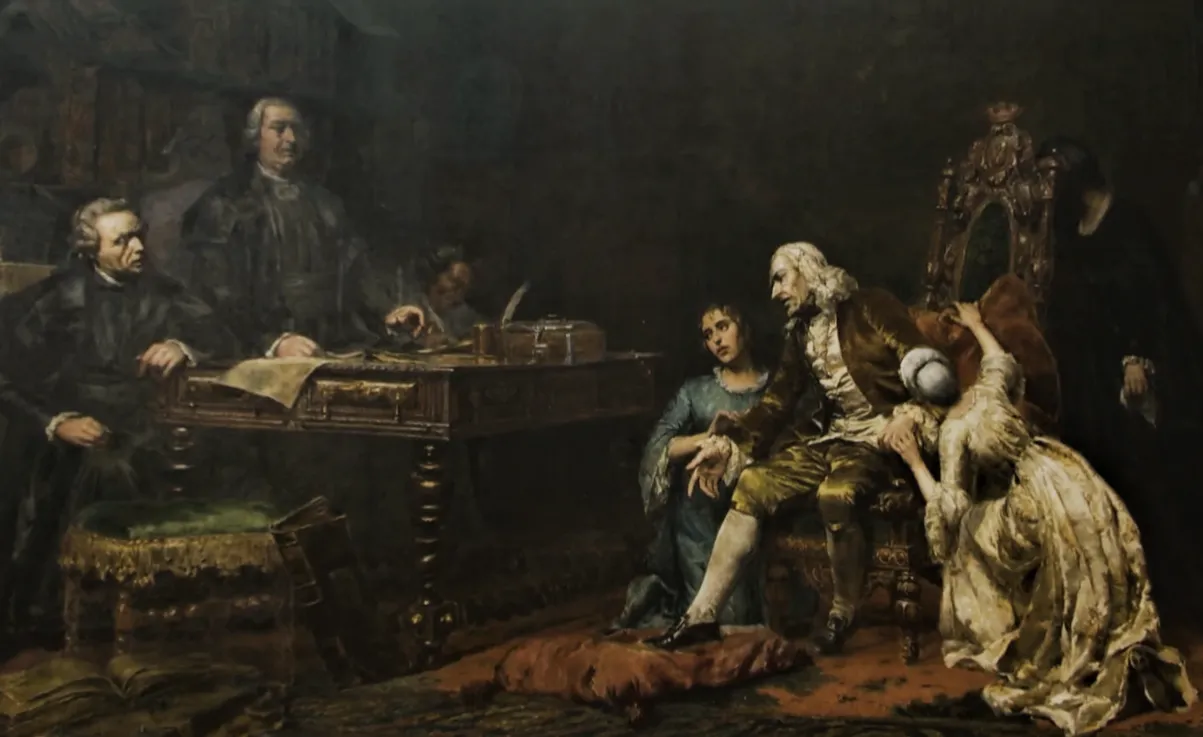
The last session, on 15 January 1780, is told two ways. Azevedo says the judge read him statements by former agents, among them the future police chief Pina Manique, who swore they had acted on his direct orders, and that the old man broke down in sobs, begged the queen for mercy and accepted the charges. Pombal's admiring biographer the Conde da Carnota called the claim that he asked for pardon false. Malhoa's painting of 1891 imagines the scene.
The decree of 16 August 1781
Then nothing happened for a year and a half. The court's attention had moved to the Távora case: on 23 May 1781 a board of judges cleared the memory of most of the nobles executed at Belém in 1759, a sentence passed while Pombal was in power. In Pombal he waited, arguing his lawsuits with his lawyer and growing weaker.
The verdict came as a royal decree dated 16 August 1781. Two of the judges whose advice it followed, José Ricalde Pereira de Castro and the crown attorney Azeredo Coutinho, had once been Pombal's trusted men on the commission that reformed the University of Coimbra.
“Nevertheless, out of regard for the advanced age of the offender, and of his heavy infirmities, consulting my clemency rather than my justice, I have been softened by the prayers of the said Marquis, who has supplicated for pardon, detesting his own rash excesses, and have remitted all bodily punishments, enjoining him simply to absent himself from the Court, at a distance of at least twenty leagues, until further orders on my part.”
The decree first declared that the judges had found him “a criminal worthy of exemplary punishment”. It left the Crown and anyone he had wronged free to pursue his estates for restitution and damages, during his life or after his death. His son wrote with relief that the decree had closed the door on any further proceedings.
Death in Pombal
His body had been failing for years. As early as May 1780 he wrote that he could hardly stand, and a carbuncle on his left shoulder let him lie on one side only; servants lifted him onto a sofa when his bed was changed. The government refused him leave to take the waters, at Caldas by Azevedo's account and at Coimbra by Carnota's, and he was too weak to move to a house near Coimbra that the bishop offered him. He outlived the decree by almost nine months and died at Pombal on 8 May 1782.
Even the funeral was punished. Azevedo says the preacher, Santa Clara, was moved to the monastery of Tibães for his praise; Carnota says he was confined in a convent in Cape Verde and that the bishop was reprimanded. The government refused to let the family take the body to the Mercês chapel in Lisbon, where Pombal had asked to lie, and according to Carnota it ordered his epitaph erased from the tomb.
His body stayed in the convent church, known as the Cardal, for 74 years. When Masséna's French army retreated through the town in 1811, soldiers broke open the coffin and stripped the skeleton; someone gathered the bones and closed the tomb again.
From disgrace to the Rotunda
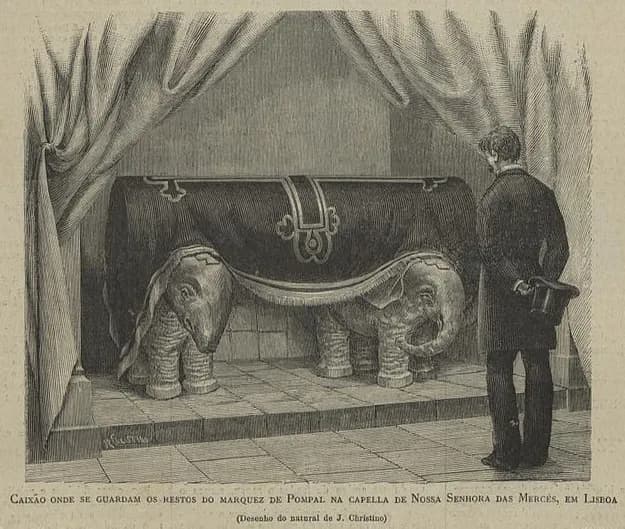
Rehabilitation began with the liberals. In the civil war that ended absolute monarchy, a decree of 10 October 1833 ordered his bronze medallion put back on José I's statue, calling him the Portuguese who had most honoured his nation in the previous century. In 1856 his remains were brought to Lisbon, arriving on 1 June, and laid in the Mercês chapel, where he had been baptised, in a coffin resting on two carved elephants.
The centenary of his death made him a hero. Students in Lisbon, Coimbra and Porto organised civic processions, lectures and literary evenings, and smaller towns joined in: at Valença, on the Minho, a poem in his honour was recited at the local theatre on 8 May. On 6 May 1882 Lisbon council named the new roundabout at the top of the Avenida da Liberdade the Praça Marquês de Pombal.
The festivities were political. Republicans and freemasons, campaigning against the return of the religious orders, celebrated the expeller of the Jesuits; the students' programme in Porto, echoing Lisbon's, asked the government to enforce strictly the laws of Pombal and of the liberal minister Joaquim António de Aguiar against the religious orders. In Porto the Catholic paper A Palavra called the students' procession a “civic masquerade” that mocked Catholic ritual, and traditionalists called Pombal a tyrant. The novelist Camilo Castelo Branco answered the praise with a hostile Perfil do Marquês de Pombal.
“The marquis died unpunished, quietly scratching his leprosy.”
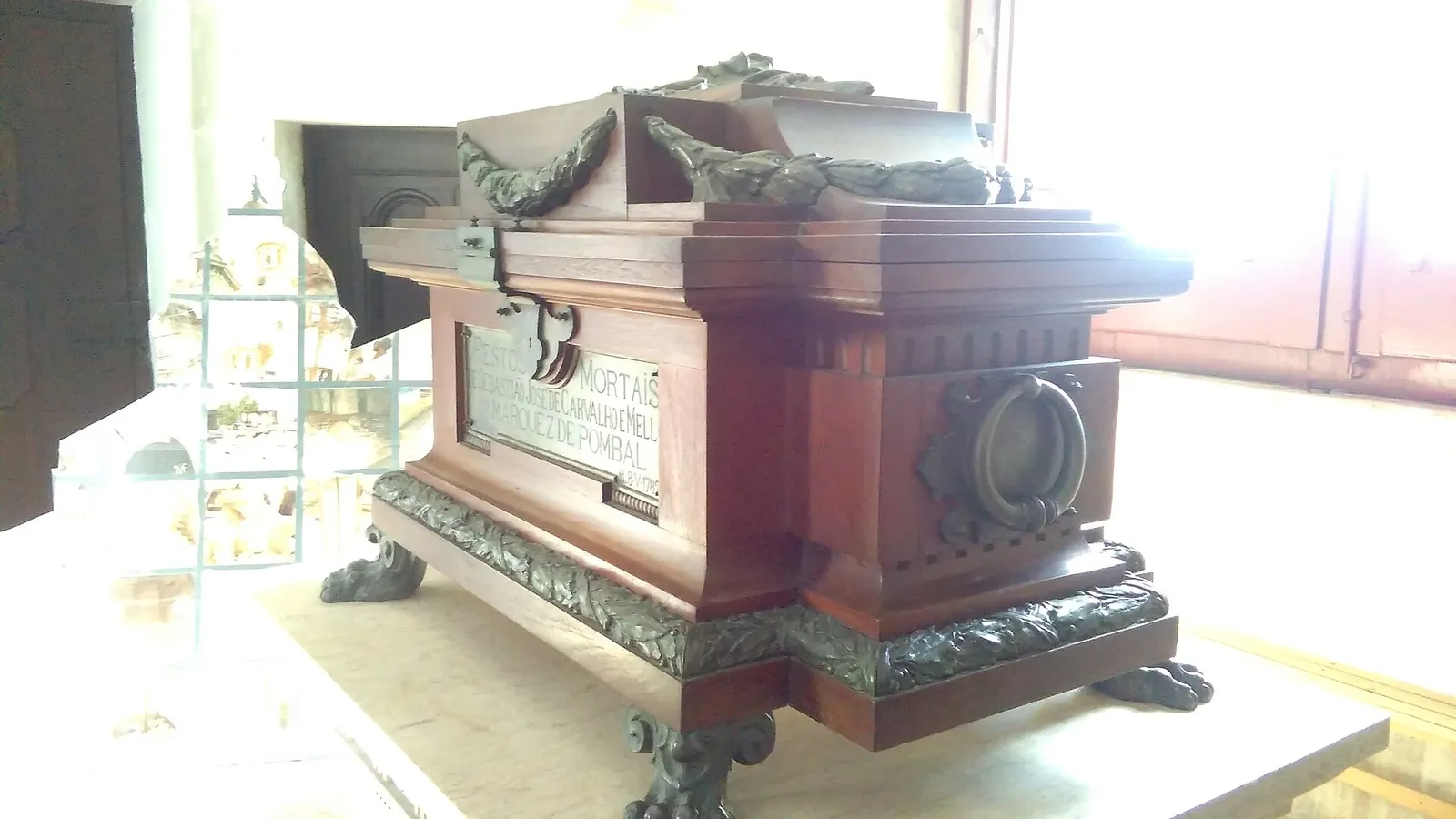
The Grande Oriente Lusitano, the main masonic body, proposed a monument in 1882, but the idea stalled until a competition in 1913, won by the architects Adães Bermudes and António do Couto with the sculptor Francisco dos Santos. The first stone was laid in August 1917 and again on 13 May 1926. In 1923 Pombal's remains left the Mercês chapel for the Igreja da Memória in Ajuda, the church built where José I had been shot in 1758.
The statue was finally unveiled on 13 May 1934, the 235th anniversary of his birth, paid for by public subscription. By then Salazar's Estado Novo dictatorship was in power, and it was choosing other heroes. According to Luiz Eduardo Oliveira, Lisbon council had voted in 1926 to make 13 May a municipal holiday; 1934 was the last year it was kept, and the city chose instead 25 October, the anniversary of the Christian conquest of 1147.
May 1782
Funeral at Pombal
His body is carried to the church of the convent of Santo António, the Cardal, on the night of 11 May.
1811
Tomb broken open
By French soldiers retreating through the town.
10 October 1833
Medallion restored
A liberal decree puts his portrait back on José I's statue.
1 June 1856
Back in Lisbon
His remains are laid in the Mercês chapel.
May 1882
Centenary
Students' festivities across Portugal; the Rotunda becomes the Praça Marquês de Pombal.
1913
Monument competition
Won by Adães Bermudes, António do Couto and Francisco dos Santos.
1923
Igreja da Memória
His remains move to the church in Ajuda.
13 May 1934
Statue unveiled
On the 235th anniversary of his birth.
Why it still matters
Pombal is still argued over. To his admirers he was the modernising reformer who rebuilt Lisbon and took on the Church; to his critics he was a despot who jailed hundreds without trial and enriched his family. The decree of 1781 branded him a criminal in the queen's name; the centenary of 1882 turned him into a national hero.
“Few historical figures in Portugal can have been so praised and, at the same time, so execrated.”
Azevedo thought the legend got the man backwards: after years of silence, he wrote, the grim despot was transfigured into a leader of liberty. Yet the name stuck. Most people in Lisbon still call his square the Rotunda, and the Metro station there was renamed Marquês de Pombal in 1998.
FAQs
When and where did the Marquis of Pombal die?
At his house in the town of Pombal, in central Portugal, on 8 May 1782, five days before his 83rd birthday. A few older books give other dates: Carnota's biography of 1871 says 5 May and the 1922 edition of Azevedo's says 8 August. The Portugal dictionary, which has his body carried to the church on the night of 11 May, Lisbon City Council and the centenary held on 8 May 1882 all support 8 May.
Why did the Marquis of Pombal fall from power?
His power depended on King José I. When José died on 24 February 1777, his daughter Maria I and the nobles and churchmen Pombal had persecuted took over. He resigned, the queen accepted on 4 March 1777, his political prisoners were freed and he retired to Pombal.
Was the Marquis of Pombal convicted?
Yes, in a royal decree rather than a court sentence. After a judge questioned him at Pombal from October 1779 to January 1780, Maria I's decree of 16 August 1781 declared him a criminal deserving exemplary punishment, then spared him because of his age and illness. He had to stay at least 20 leagues from court, and the Crown and private claimants kept the right to sue his estate.
Where is the Marquis of Pombal buried?
In the Igreja da Memória in Ajuda, Lisbon, since 1923. He was first buried in the convent church of the Cardal in Pombal in 1782; his remains were brought to the Mercês chapel in Lisbon in 1856 and moved to the Igreja da Memória in 1923.
When was the Marquês de Pombal statue in Lisbon built?
The square was named after him on 6 May 1882, for the centenary of his death, and a monument was proposed the same year. A design competition was held in 1913, and the statue was unveiled on 13 May 1934, the 235th anniversary of his birth.
On the timeline
Open the timelineNearby moments from earthquake and enlightenment (1750–1807).
Portugal and Spain sign the preliminary Treaty of San Ildefonso on South American borders: Portugal cedes Colónia do Sacramento and drops its claim to the Sete Povos mission lands, while Spain returns the island of Santa Catarina and recognises Portuguese rule in Rio Grande de São Pedro, today's southern Brazil.
By the Treaty of El Pardo, Portugal hands Spain the islands of Fernando Pó (Bioko) and Annobón in the Gulf of Guinea, in return for settling the borders of southern Brazil. They become the nucleus of Spanish Guinea — today's Equatorial Guinea, where Annobón still speaks a Portuguese-based creole.
Birth in Castelo de Vide of José Xavier Mouzinho da Silveira, the liberal jurist whose sweeping decrees of 1832, issued in the Azores and besieged Porto during the civil war, abolished tithes, the medieval 'forais' (feudal charters and dues) and small entailed estates. Historians often credit him with laying the legal foundations of modern Portugal.
Death of the Marquis of Pombal
The Marquis of Pombal dies in disgrace at Pombal, aged 82. Minister of King José I from 1750 to 1777, he rebuilt Lisbon after the 1755 earthquake and expelled the Jesuits; under Maria I he lost office, and a 1781 decree declared him guilty but spared him for his age.
João Carlos de Saldanha, later Duke of Saldanha, is born. A grandson of the Marquis of Pombal, he fought in the Peninsular War, commanded liberal forces in the civil war of 1832–34 and dominated politics for decades, serving several times as prime minister and twice seizing power by military pronouncement.
Joaquim José da Silva Xavier, known as Tiradentes ('Tooth-Puller'), is hanged in Rio de Janeiro for his leading part in the Inconfidência Mineira, a plot for Brazilian independence from Portugal betrayed in 1789. He is now Brazil's national hero.
Bernardo de Sá Nogueira de Figueiredo, later Marquis of Sá da Bandeira, is born in Santarém. A liberal soldier and statesman, he served as Prime Minister five times and led the drive to abolish the slave trade in the Portuguese empire.
Coming up in history
All long reads 10 May 1984Joaquim Agostinho: the farm boy who climbed Alpe d'Huez
 11 May 1937Afonso Costa dies in Paris: the First Republic's strongman in exile, 1937
 12 May 1982A blade on the basilica steps: John Paul II at Fátima, 12 May 1982
 13 May 1798Porto's Real Teatro de São João opens on a prince's birthday, 1798
13 sources
Archives, scholarship and reporting this article was checked against.
- 1
O Marquês de Pombal e a sua época (J. Lúcio de Azevedo), 2nd edition with correctionsAnnuario do Brasil, Seara Nova and Renascença Portuguesa, 1922 (first edition 1909); digitised by the University of Toronto, Internet Archive
- 2
- 3
Sebastião José de Carvalho e Melo, 1.º conde de Oeiras e 1.º marquês de PombalPortugal: Dicionário Histórico, Corográfico, Heráldico, Biográfico, Bibliográfico, Numismático e Artístico, vol. V (João Romano Torres, 1904–1915), electronic edition by Manuel Amaral
- 4
D. João de Almeida Portugal e a revisão do processo dos Távoras: conflitos, intrigas e linguagens políticas em Portugal nos finais do Antigo Regime (c. 1777-1802) (Patrícia Woolley Cardoso Lins Alves, PhD thesis)Universidade Federal Fluminense, Niterói, 2011
- 5
Passado pombalino em disputa: o Perfil do Marquês de Pombal, de Castelo Branco, em meio a embates sobre Pombal entre católicos e republicanos (Porto, 1882) (Gustavo Pereira)Cantareira 36, January–June 2022, Universidade Federal Fluminense
- 6
Pombal, uma sombra sobre Salazar (Luiz Eduardo Oliveira)Antares: Letras e Humanidades 17 (38), August 2025, Universidade de Caxias do Sul
- 7
A Rotunda e a Praça Marquês de PombalToponímia de Lisboa, Câmara Municipal de Lisboa, 20 December 2017
- 8
- 9
- 10
Nascimento de D. José IArquivo Nacional Torre do Tombo
- 11
Homenagem ao Marquez de Pombal, 1782–1882 (Alberto de Magalhães)Typographia Commercial, Valença, 1882; Project Gutenberg eBook 25239
- 12
- 13
Agenda de Pombal, May 2024Câmara Municipal de Pombal
Image credits
- José Malhoa's The Last Interrogation of the Marquis of Pombal, painted in 1891, more than a century after the event. It imagines the sick old minister before the queen's magistrates in his house at Pombal, with the women of his family beside him. The painting is in the Museu José Malhoa in Caldas da Rainha. José Malhoa, Public domain, via Wikimedia Commons.
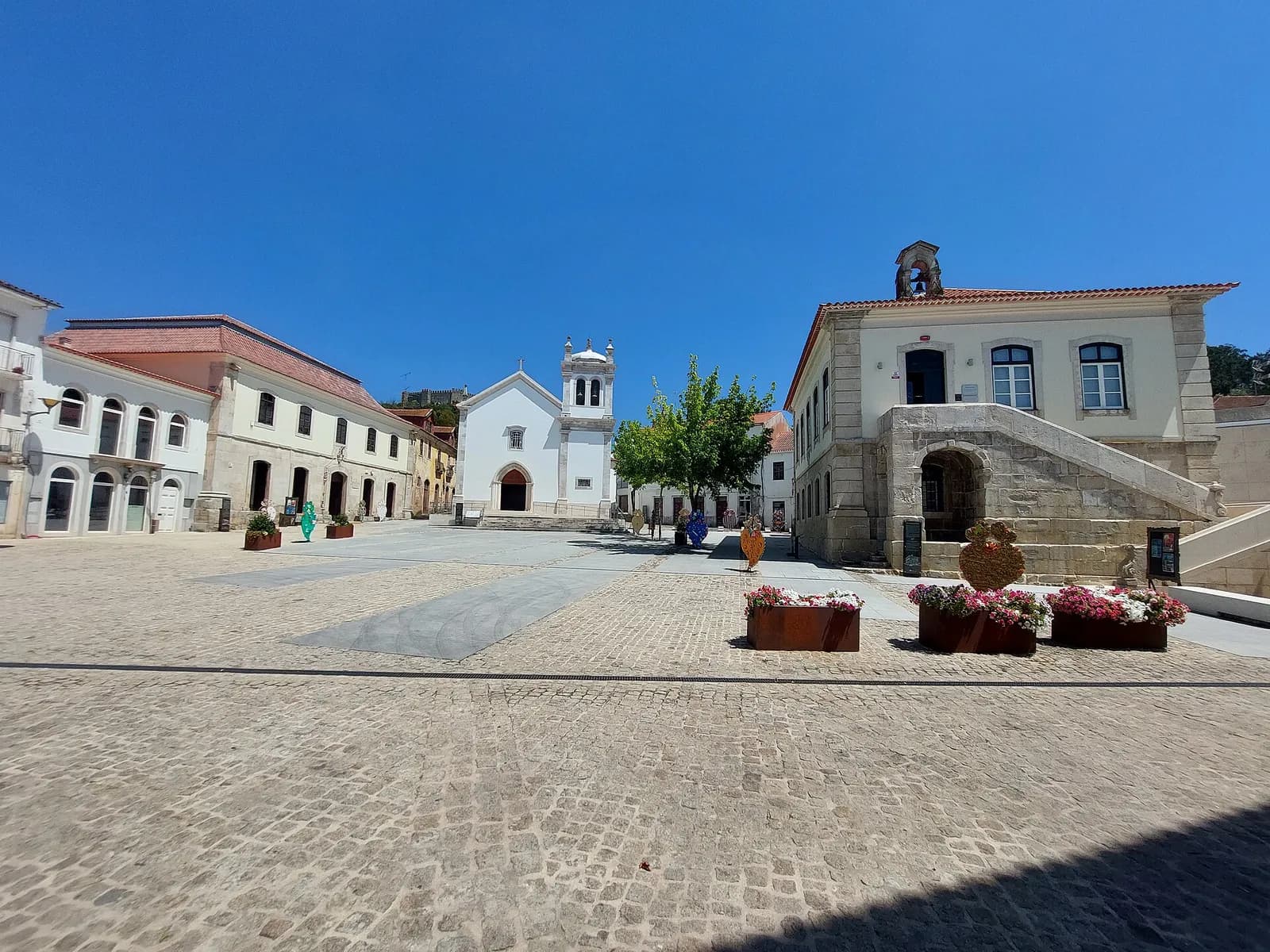
- The Praça Marquês de Pombal in the town of Pombal in 2022, with the Marquis's granary on the left, the parish church in the centre and the old jail on the right. The castle stands on the hill behind. Threeohsix, CC BY-SA 4.0, via Wikimedia Commons.
- Pombal's coffin in the Mercês chapel in Lisbon, drawn by J. Christino for the illustrated magazine O Occidente of 8 May 1882, the centenary of his death. J. Christino, Public domain, via Wikimedia Commons.
- The urn holding Pombal's remains in the Igreja da Memória in Ajuda, Lisbon, photographed in 2016. The plaque gives his date of death as 8 May 1782. The remains were moved here from the Mercês chapel in 1923. RicardoFilipePereira, CC BY-SA 4.0, via Wikimedia Commons.
- Crowds at the unveiling of the monument to the Marquis of Pombal at the top of the Avenida da Liberdade, Lisbon, on 13 May 1934. Photographer unidentified; Arquivo Municipal de Lisboa. Unknown author, Public domain, via Wikimedia Commons.