

Porto's Real Teatro de São João opens on a prince's birthday, 1798
Porto's merchants and magistrates wanted a playhouse to match Lisbon's. They built it with shares and opened it on the birthday of the future João VI, and the city has kept a theatre on the same site ever since.
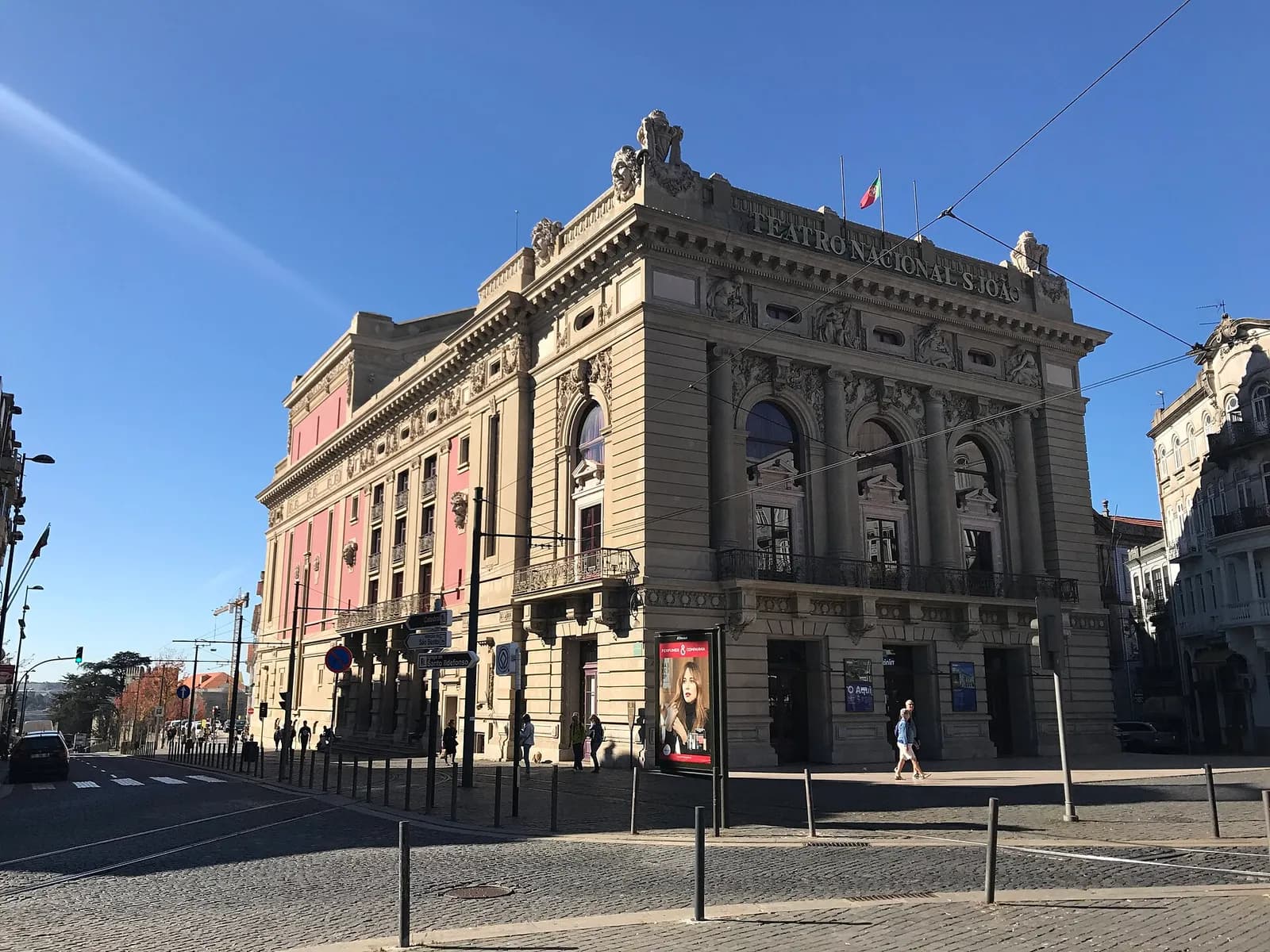
At a glance
- The Real Teatro de São João opened in Porto on 13 May 1798, the 31st birthday of Prince João, who was governing Portugal for his mother, Maria I, and later reigned as João VI.
- It was the first building in Porto put up purely for performances. The magistrate Francisco de Almada e Mendonça promoted it and private shareholders paid for it.
- The Italian stage designer Vincenzo Mazzoneschi drew the plans. A Porto chronicler counted 36 boxes on each side of the house, in four tiers.
- For a century it was the city's opera house. Fire gutted it on the night of 11 to 12 April 1908, and José Marques da Silva's new theatre opened on the same site on 7 March 1920.
- The building was a cinema from 1932 and was bought by the state in 1992, when it reopened as the Teatro Nacional São João.
A full house for the prince
On the evening of Sunday 13 May 1798, crowds filled a new building on the south side of the Praça da Batalha in Porto. Many had come from out of town; even the general came from Viana. Latecomers found that every bench in the pit was already taken.
The day was the birthday of Prince João, heir to the throne, and Porto marked it, as it had the year before, with a Te Deum at the church of the Third Order of Carmo. This year the city also had a present for him: a theatre named in his honour, which the local chronicler called the theatre “of the Prince”.
“On the night of this day the new theatre called “The Prince's” opened for the first time. [...] The play on this first night was the comedy called The Illustrious Camp-Followers. The theatre is truly magnificent and worth seeing. They say it will never again see as many people as attended this night, so that in the pit whoever came late found no bench at all.”
The evening had three parts. First came an elogio, a short dramatic tribute to the prince, by António Soares de Azevedo, a university graduate, with the title O Mau Gosto Destruído ou o Porto Desafrontado (Bad Taste Destroyed, or Porto Avenged). Then the main play, the comedy Os Militares Heróis ou as Vivandeiras Ilustres, roughly The Hero Soldiers, or the Illustrious Camp-Followers. A farce, A Dama Astuciosa (The Cunning Lady), closed the night.
The chronicler took careful note of the house. Along each side ran 36 boxes in four tiers, with three more on each side above the stage itself. There was also the prince's own box, which nobody else was allowed to use, with a balcony of three arches above it.
- Opened
- 13 May 1798, Prince João's birthday
- Place
- South side of the Praça da Batalha, Porto
- Designer
- Vincenzo Mazzoneschi, Italian stage designer
- Promoter
- Francisco de Almada e Mendonça, chief magistrate (corregedor) of Porto
- Paid for by
- A public subscription of shares
- Boxes
- 36 on each side in four tiers, plus three on each side over the stage
- First programme
- A tribute to the prince, the comedy Os Militares Heróis ou as Vivandeiras Ilustres and a farce
The second city wants a stage
In the 1790s Porto was a merchant city, rich on the trade in port wine, and was often called the “second city of the kingdom”. Its leading men measured themselves against Lisbon, the seat of the court. Lisbon had a new royal opera house, the São Carlos, opened in 1793 and named in honour of João's wife, Carlota Joaquina. Porto had nothing like it.
What it did have was an improvised stage. In 1760, for the festivities around the marriage of the future Queen Maria I, the coach houses of the Duke of Lafões's palace at the Corpo da Guarda were fitted out for operas and comedies. Until 1798 this converted coach house was the only theatre the city had. Nicola Setaro's company, which had come from Lisbon, sang four operas there in 1760.
Royal birthdays, births and weddings were the great public events of eighteenth-century Porto. The city council organised and paid for illuminations, bullfights, fireworks and plays, and in 1757 the military governor, João de Almada e Melo, added a mock assault on a fort for the birthday of King José I. A theatre opened on the prince's birthday fitted that tradition exactly.
A magistrate, an Italian designer and a box of shares
The driving force was Francisco de Almada e Mendonça, the crown's chief magistrate in Porto, who was also behind much of the remodelling of the city's streets in the late eighteenth century. A nineteenth-century account says a group of young actors from the Corpo da Guarda went to court in 1793 to ask for royal protection for a new theatre, following a plan of his. Luísa Cymbron, a historian of music, treats that story with caution.
The documented steps are clearer. A royal order of 9 October 1794 approved the plans, and building began in 1796: in March according to one later source, in early May according to the chronicler of 1798. Like Lisbon's São Carlos and many Italian opera houses, it was built with private money, raised by a public sale of shares. The prospectus argued that Porto, “the second city of the Kingdom” by its size and population, could not do without “this fine school of manners and civility”.
“In the reign of Dona Maria I, her son Dom João being Regent, this Royal Theatre was built by a society of private shareholders through the diligent efforts of the Desembargador, Corregedor and Provedor of this district, Francisco de Almada e Mendonça, in the year 1798.”
The designer, Vincenzo Mazzoneschi (Vicente in Portuguese sources), was a set designer. He had worked in Rome between 1780 and 1791 and came to Portugal after the papal city closed its theatres in 1792. He worked at the São Carlos from the spring of 1795 to Carnival 1796, then moved to Porto, probably to watch over the building work, and returned to Lisbon in 1799. He had already designed the Teatro Principal in Málaga, opened in 1793.
Little of his work survives. His drawings for Porto were kept in the theatre's own archive and burned with it in 1908. According to Pedro Sobrado, chairman of the TNSJ in 2020, the builders reused stones from the Fernandine wall, the medieval wall around the city, and Marques da Silva's later theatre recycled them again.
A century of Italian opera on a tight budget
Almada e Mendonça died in 1804, and the shareholders who owned the building took over its management. They ran it until the fire of 1908. Portuguese drama companies and Italian opera companies shared the stage, not always peacefully: there were quarrels in 1812 and again in 1817, when mourning for Queen Maria I closed the house and left both troupes short of money. There is no record that the state ever thought of buying it, as it bought the São Carlos in 1854.
Over the century opera won. Until the end of the nineteenth century every opera performance in Porto took place at the São João. Seasons depended on impresarios, some of whom went bankrupt in mid-season, and they settled into a regular autumn opening only in the 1850s.
Money was always short. In 1827 a decree gave the theatre the surplus income of the Ponte das Barcas, the bridge of boats over the Douro. A judge in Porto reported that this was not enough: the Italian company's impresario wanted 8 to 12 contos a year (a conto was a million réis). From 1839 the state paid the company 4 contos a year, a fifth of what the São Carlos received in Lisbon.
Subsidies brought supervision. The liberals, who favoured a constitution, beat the absolutist government of King Miguel in a civil war that ended in 1834, and in 1836 the new state set up an Inspectorate-General of Theatres. In Porto an edict from the district's administrator on 1 January 1838 put a detachment of the municipal guard in the theatre at every performance. Walking sticks and umbrellas went to the cloakroom, servants were to keep out of the corridors, and nobody was to smoke in the boxes, the pit or on the stairs.
| Year | Theatre | Amount (réis) | What it was |
|---|---|---|---|
| 1825 | São Carlos, Lisbon | 25,000$000 | Subsidy to António Marrare's company |
| 1827 | São João, Porto | 12,000$000, or at least 8,000$000 | Annual subsidy requested by the impresario Luigi Scassa |
| 1837 | São Carlos, Lisbon | 26,000$000 | Subsidy for the year |
| 1839 to at least 1876 | São João, Porto | 4,000$000 | Annual subsidy to the Italian company, a fifth of the São Carlos subsidy |
4,000$000 réis was 4 contos. In 1827 Scassa also asked for at least a third of what the São Carlos received. The Porto subsidy was not paid every season: in 1843 only the drama company had one, and in 1849 Parliament cut it by 2,000$000.
Porto made do. Its impresarios hired scores, scenery and even stage machinists from the São Carlos, and sometimes used pirated music: for Verdi's I Due Foscari in the 1848 to 1849 season, players in the orchestra scored the opera themselves from a piano reduction. According to the historian John Rosselli, Porto was one of the places outside Italy where singers were paid least, so big names rarely came, except at the start or the end of their careers.
The baritone Leone Giraldoni, later one of Verdi's favourite singers, did both. He arrived from Madrid in December 1849, two years after his debut and six years before he first sang at La Scala, and came back for the 1875 to 1876 season, near the end of his career.
“S. Carlos is an institution; S. João is a tour de force. [...] The theatre of S. João, far from being a constitutional cog, represents the effort of Porto's vanity, which in many things wants to stand shoulder to shoulder with Lisbon.”
Porto did have one advantage. Lisbon audiences, Cymbron writes, despised anything that was not Italian or had not succeeded in Italy, and Portuguese composers found a warmer welcome up north. Francisco de Sá Noronha's Beatrice di Portogallo was sung at the São João in 1863, and Miguel Ângelo Pereira's Eurico was cheered there in 1874 after it had flopped in Lisbon.
The night of 11 April 1908
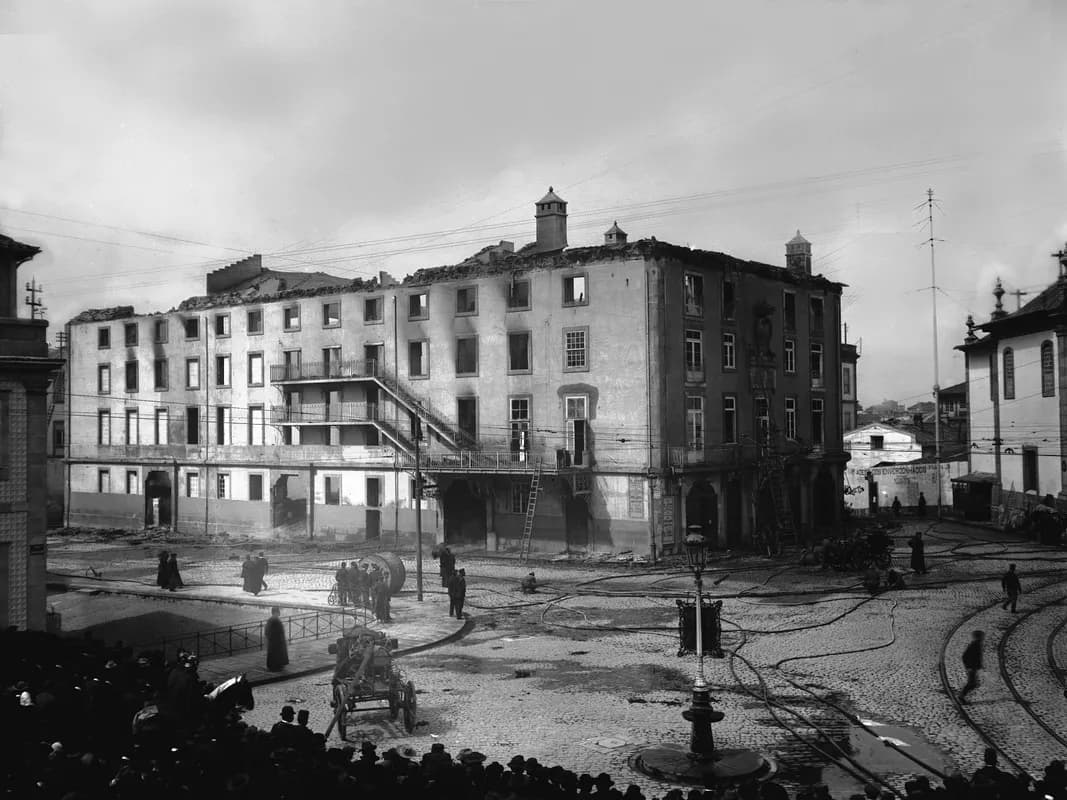
The Real Teatro was still the pride of Porto society when it burned on the night of 11 to 12 April 1908. Only the outer walls were left standing. With the building went the theatre's archive, including Mazzoneschi's plans.
“The sight of the building is desolate: only the walls remain, and through its doors and windows one glimpses the enormous ruin into which our first playhouse has been turned.”
The royal arms from the old façade survive. Carved in granite in eight blocks, with the Portuguese shield under a closed crown, they are now in the collection of the Museu Nacional Soares dos Reis in Porto.
Marques da Silva's new São João
Porto decided to rebuild on the same spot. A public competition followed, launched in October 1908 according to the theatre's English history and in October 1909 according to its Portuguese one; the architectural historian Rui Ramos dates the winning design to 1909. The winner was José Marques da Silva, later called “Porto's last classical and first modern architect”.
Marques da Silva, born in 1869, had trained at the École des Beaux-Arts in Paris in the studio of Victor Laloux. Back home in 1896 he designed São Bento railway station, built between 1896 and 1911. He died in 1947.
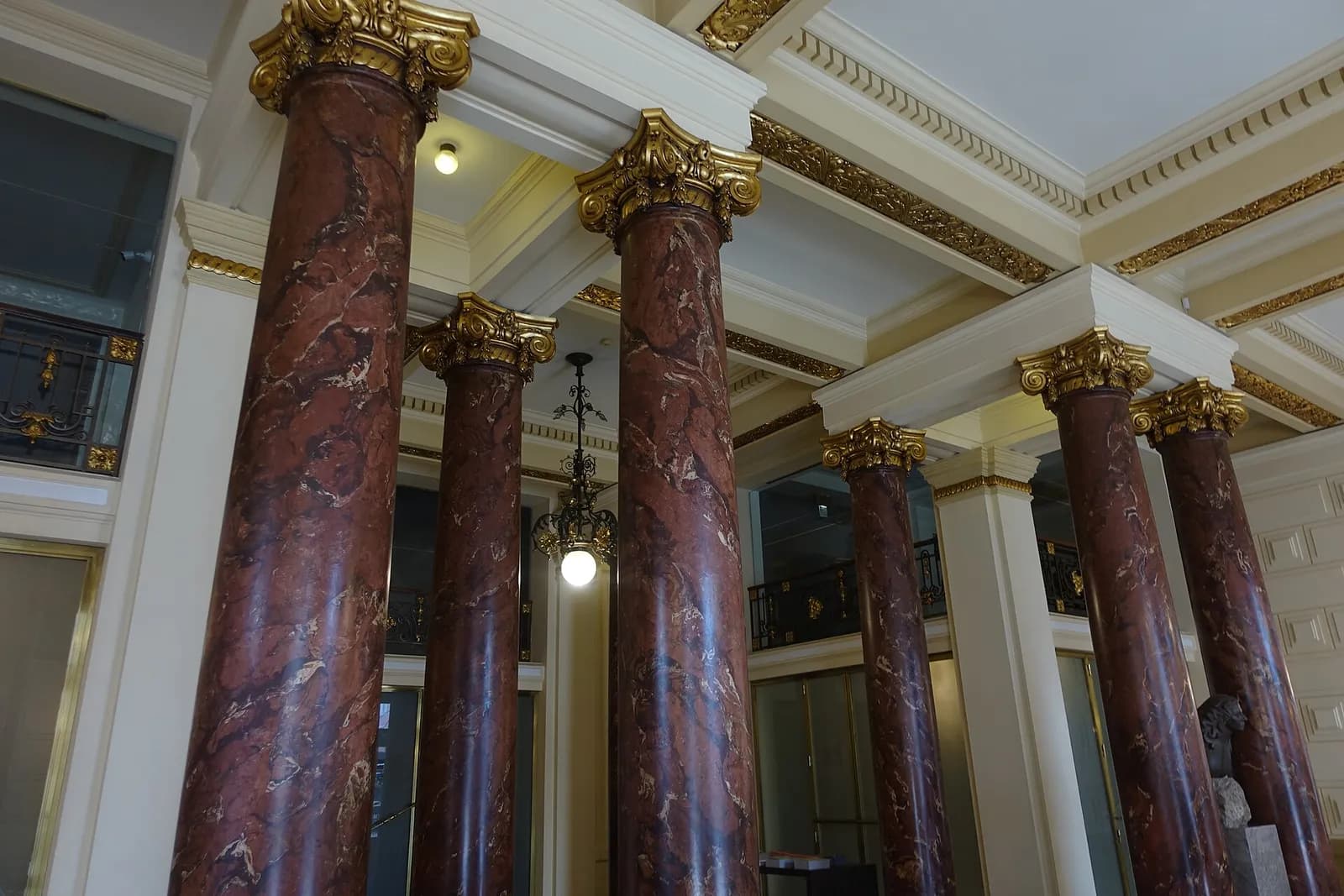
His theatre echoed the lost building and drew on French models, with a carefully staged passage from the entrance through the foyers to the auditorium. Underneath it was new: he used concrete for the main structure and cement mortar for the façades.
As in 1798, Porto's own people paid, not the state. Tens of thousands of shares were issued at 20 escudos each. The work dragged on through the coups and riots of the First Republic (1910 to 1926), shortages of materials during the First World War and an epidemic of typhus. The new Teatro de São João opened on 7 March 1920.
From cinema to national theatre
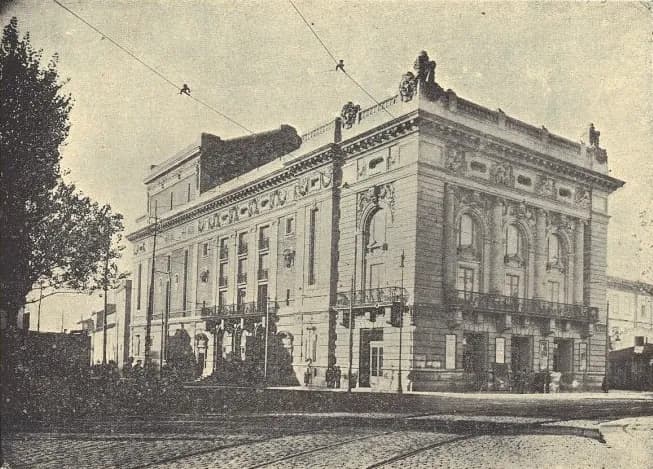
The new theatre had a short life as a theatre. In 1932, twelve years after it opened and with Porto's stage in decline, it was renamed São João Cine and from then on showed mostly films. The building slowly ran down.
In February 1982 the building was listed as a property of public interest. Ten years later, on 8 October 1992, the Portuguese state bought it, and on 28 November 1992 it reopened as the Teatro Nacional São João (TNSJ), with Eduardo Paz Barroso as director. Between 1993 and 1995 it was restored and re-equipped to a project by the architect João Carreira, largely following the original specifications.
In December 1995 the director Ricardo Pais took charge and gave the house its own artistic programme, with new productions of Portuguese and foreign plays and festivals that brought directors such as Robert Wilson and Peter Stein to Porto. In 2003 the TNSJ took on a second stage, the Teatro Carlos Alberto, and in 2007 it became a state-owned company and was given the São Bento da Vitória monastery as a third venue.
The concrete later showed its age. In 2006 the joints of the structure began to expand and blocks of concrete fell from the façade, so the building was wrapped in safety netting and boarded up at street level. The exterior was restored between May 2013 and September 2014.
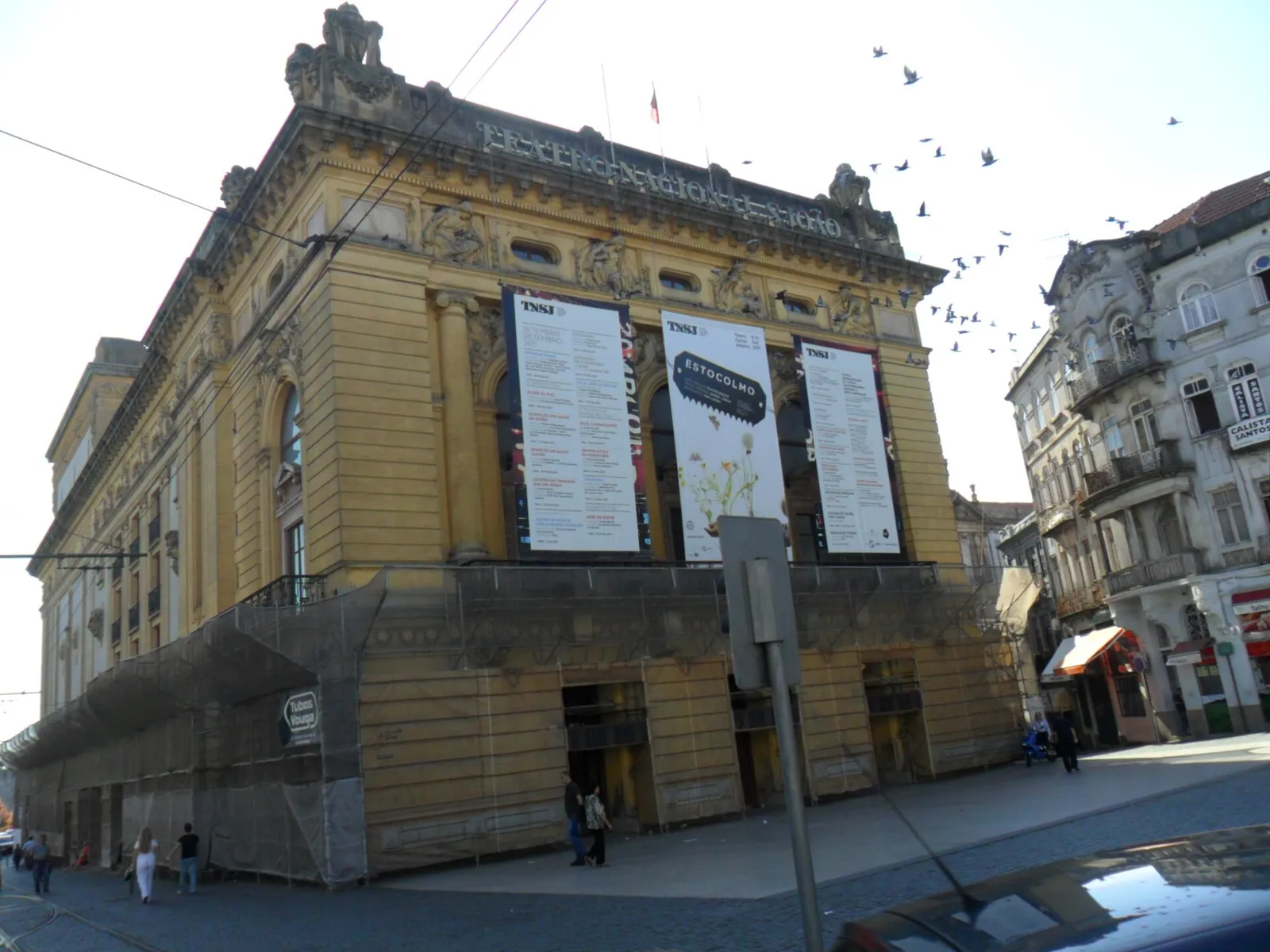
A decree of 10 July 2012 raised the building to the rank of national monument, together with Lisbon's Teatro Nacional D. Maria II. It called the theatre a notable example of the Beaux-Arts style and noted that it had become a reference point in the country's cultural life.
One site, five lives: years in each role, 1798 to 2026
years
Lengths worked out from the opening on 13 May 1798, the fire of 11 to 12 April 1908, the reopening on 7 March 1920, the change to a cinema in 1932 and the reopening as a national theatre on 28 November 1992, counted to 2026. The site spent longer as a cinema than it has so far as a national theatre.
Show the data
| Years | |
|---|---|
| Real Teatro (1798–1908) | 110 |
| Ruins and rebuilding (1908–1920) | 12 |
| Teatro São João (1920–1932) | 12 |
| São João Cine (1932–1992) | 60 |
| National theatre (1992–2026) | 34 |
From prince's theatre to national theatre
1760
Coach houses at the Corpo da Guarda become Porto's first stage
9 October 1794
Royal order approves the plans for a new theatre
1796
Building begins, in March or early May by different accounts
13 May 1798
The Real Teatro de São João opens on Prince João's birthday
1804
Almada e Mendonça dies; the shareholders run the theatre
1839
The state starts paying the Italian opera company 4 contos a year
11–12 April 1908
Fire destroys the theatre
October 1908 or 1909
Competition for a new theatre, won by José Marques da Silva
7 March 1920
Marques da Silva's Teatro de São João opens
1932
Renamed São João Cine
28 November 1992
Reopens as the Teatro Nacional São João
1993–1995
Restored to a project by João Carreira
10 July 2012
Reclassified as a national monument
Why it still matters
One of Portugal's national theatres stands where Porto's merchants built their playhouse in the 1790s. Pedro Sobrado, the TNSJ's chairman, said in 2020 that it is a national theatre “of” Porto rather than “in” Porto, because both the 1798 theatre and the 1920 one were paid for by the city's own people, not by the state.
The old theatre is also part of the city's map. Introducing a round table of historians on the Real Teatro, the TNSJ described it as a theatre that “civilised the city” and helped shape its plan. Apart from the twelve years after the fire, a theatre has stood on the south side of the Praça da Batalha since 1798.
FAQs
When did the Teatro de São João in Porto open?
The Real Teatro de São João opened on 13 May 1798, the birthday of Prince João, the future João VI. The present building, by José Marques da Silva, opened on 7 March 1920 after the original burned down in 1908.
Who designed the original Teatro de São João?
The Italian stage designer Vincenzo Mazzoneschi, who had worked in Rome and at Lisbon's São Carlos opera house. The project was promoted by Porto's chief magistrate, Francisco de Almada e Mendonça, and paid for by private shareholders.
What was performed on the opening night in 1798?
A short dramatic tribute to the prince by António Soares de Azevedo, the comedy Os Militares Heróis ou as Vivandeiras Ilustres and the farce A Dama Astuciosa.
Is the Teatro Nacional São João the same building as the 1798 theatre?
No. It stands on the same site, but the 1798 theatre was destroyed by fire on the night of 11 to 12 April 1908. Marques da Silva's replacement opened in 1920, was a cinema from 1932 and became the Teatro Nacional São João in 1992.
Can you visit the Teatro Nacional São João?
Yes. Besides attending a performance, you can join a guided tour from Tuesday to Saturday at 12.30, with audio guides in English, French and Spanish.
On the timeline
Open the timelineNearby moments from earthquake and enlightenment (1750–1807).
Bernardo de Sá Nogueira de Figueiredo, later Marquis of Sá da Bandeira, is born in Santarém. A liberal soldier and statesman, he served as Prime Minister five times and led the drive to abolish the slave trade in the Portuguese empire.
A royal charter issued in Queen Maria I's name and signed by her son Prince João, acting for her during her illness, creates the Real Biblioteca Pública da Corte in Lisbon, today's Biblioteca Nacional. Built around the library of the royal censorship board, it opened in 1797 in the western pavilion of Terreiro do Paço to the general public, not just to scholars.
Off Cape São Vicente, the south-western tip of the Algarve, 15 British ships of the line under Sir John Jervis defeat a Spanish fleet of up to 27. Commodore Horatio Nelson makes his name by leaving the British line and boarding two Spanish ships in succession, the San Nicolás and the San José.
Porto's Teatro de São João opens
Porto's Real Teatro de São João opens on the birthday of Prince João, the future João VI, with the comedy 'Os Militares Heróis ou as Vivandeiras Ilustres'. Gutted by fire in 1908, it was rebuilt to a design by José Marques da Silva and reopened in 1920; today it is the São João National Theatre.
António Luís de Seabra is born at sea, aboard the ship 'Santa Cruz' off Cape Verde on its way to Rio de Janeiro. A judge, minister and rector of Coimbra University, he wrote Portugal's first Civil Code, approved in 1867 — the 'Código de Seabra', which governed private life in the country for a full century.
Almeida Garrett is born in Porto. Poet, playwright, novelist, journalist and liberal politician, he is regarded as the greatest figure of Portuguese Romanticism, author of 'Viagens na Minha Terra' and the drama 'Frei Luís de Sousa'.
Spanish forces under Manuel de Godoy invade the Alentejo, beginning the brief War of the Oranges. Godoy sends orange branches from Elvas to the Spanish queen, giving the war its name; the Treaty of Badajoz in June forces Portugal to cede Olivenza to Spain — a dispute unresolved to this day.
Coming up in history
All long reads 15 May 1964Morais's corner: how Sporting won the Cup Winners' Cup in 1964
 16 May 1919Through the fog to Horta: the NC-4 and the first flight across the Atlantic
 17 May 1959Cristo Rei: the bishops' wartime vow that rose over the Tagus in 1959
 18 May 1881Carvalho Araújo: the deputy who took a trawler against a U-boat
14 sources
Archives, scholarship and reporting this article was checked against.
- 1
A festa barroca no Porto ao serviço da família real na segunda metade do século XVIII: subsídios para o seu estudo (Joaquim Jaime B. Ferreira-Alves)Revista da Faculdade de Letras: História, II série, vol. 5 (1988), Universidade do Porto
- 2
O Teatro de S. João do Porto: novos dados sobre o seu funcionamento (1834-1876) (Luísa Cymbron)Revista Portuguesa de Musicologia 4-5 (1994-95), pp. 147-166
- 3
Teatro Nacional São João: de 1798 a 2020Teatro Nacional São João
- 4
- 5
- 6
Decreto n.º 16/2012, de 10 de julho: reclassificação como monumentos nacionais dos Teatros Nacionais de São João e D. Maria IIDiário da República, 1.ª série, n.º 132, 10 July 2012
- 7
O Real Theatro de S. Carlos de Lisboa desde a sua fundação em 1793 (Francisco da Fonseca Benevides)Internet Archive
- 8
João VI: biographyArchontology.org
- 9
Coat of Arms of the KingdomMuseu Nacional Soares dos Reis
- 10
Teatro Nacional São João (1920-2020): teatro com gente, com história, com Porto (Maria João Leite)A Página da Educação, 2020
- 11
26 May 1834: Signing of the Convention of ÉvoramonteParques de Sintra, Palácio Nacional de Queluz (D. Pedro IV chronology)
- 12
- 13
- 14
Image credits
- The Teatro Nacional São João on the Praça da Batalha in 2017. José Marques da Silva's building of 1920 stands on the site of the Real Teatro de São João, which opened on 13 May 1798. -wuppertaler, CC BY-SA 4.0, via Wikimedia Commons.
- The shell of the Real Teatro de São João after the fire of 11 to 12 April 1908, with fire hoses still lying across the Praça da Batalha and a crowd looking on. Domingos Alvão, via Photographia Portuense, Public domain, via Wikimedia Commons.
- Red marbled columns with gilded capitals in the foyer of Marques da Silva's theatre, photographed in February 2024. Joseolgon, CC BY 4.0, via Wikimedia Commons.
- The São João as printed in the railway magazine Gazeta dos Caminhos de Ferro on 1 June 1934, two years after it became the São João Cine. Tram lines run across the Praça da Batalha in front. Unknown author, Public domain, via Wikimedia Commons.
- The theatre in September 2011, its ground floor boarded up and netted after pieces of concrete began to fall from the façade in 2006. The exterior was restored in 2013 and 2014. Dafema, CC BY-SA 3.0, via Wikimedia Commons.