

14 May 1915: the navy rising that brought down Pimenta de Castro
Warships shelled the Lisbon hills, a general was led away a prisoner and a junta proclaimed the Republic for a second time. Two days later the man chosen to govern was shot on a train.
At a glance
- On 14 May 1915 the navy, part of the army and armed civilians rose in Lisbon against the government of General Pimenta de Castro, which had kept parliament shut since 4 March.
- A five-man junta tied to Afonso Costa's Democratic Party planned the revolt; the naval commander Leote do Rego seized the cruiser Vasco da Gama, whose captain was killed.
- Estimates of the dead run from 102 to more than 200, and of the wounded from 250 seriously hurt to more than 1,000, almost all of them in Lisbon.
- João Chagas, named head of government on 15 May, was shot on the train to Lisbon the next day by a senator and lost an eye; he never took office.
- President Manuel de Arriaga resigned, and in the elections of 13 June the Democrats won 106 seats in the Chamber of Deputies.
Guns on the Tagus
In the early hours of 14 May 1915 a naval commander named Jaime Leote do Rego took over the cruiser Vasco da Gama, anchored in the Tagus off Lisbon. Her captain, Francisco de Assis Camilo, was struck down on his own deck and killed. Soon the cruiser and a second warship, the Almirante Reis, were exchanging fire with army batteries ashore.
Ilustração Portuguesa, the illustrated weekly of the newspaper O Século, rushed out a page while the shooting was still going on. The revolt, it reported, had broken out before dawn on the 14th, “sending a shudder of terror through all Lisbon at the roar of the cannon and the bursting of shells over the houses of the city”.
The target was not a king. Portugal had been a republic for four and a half years, and the government under fire was led by a republican general, Joaquim Pimenta de Castro. The men who rose against him were republicans too. In a little over a day his government had fallen, and two days after the rising the President of the Republic who had appointed him wrote his resignation.
A republic at odds with itself
The Republic proclaimed in October 1910 soon split. By 1912 its leaders had formed three parties: Afonso Costa's Democrats, heirs to the old Portuguese Republican Party and the strongest of the three, António José de Almeida's Evolutionists and Manuel de Brito Camacho's Unionists. The President, the veteran republican Manuel de Arriaga, elected by Congress in 1911, kept trying to form governments above party.
The First World War deepened the split. Every party agreed on defending Angola and Mozambique, and troops sailed for both in September 1914. The Democrats wanted more: to fight beside Britain in Europe, as a chance to show that Portugal was more than a British protectorate. The Unionists wanted to stay out of the European war, and the Evolutionists to follow Britain's lead.
In December 1914 Costa handed the government to a Democrat and naval officer, Vítor Hugo de Azevedo Coutinho. The Senate rejected his name, and Lisbon wits called his cabinet “Os Miseráveis”, a pun on the novelist Victor Hugo. General elections, due in 1914, had been postponed indefinitely since September.
In January 1915 the army boiled over. After a major, Craveiro Lopes, was moved from his post, allegedly for political reasons, officers of the Lisbon garrison protested from 20 to 22 January in what became known as the Movimento das Espadas, the movement of the swords. Pimenta de Castro was among the officers who protested. Cavalry officers marched towards the Belém palace to hand their swords to the President and were arrested. That afternoon Machado Santos, the hero of the Rotunda barricade in 1910, took his own sword to Belém.
Arriaga used the crisis to force the government out on 24 January. The next day he installed his friend Pimenta de Castro, the most senior general in the army and a republican from the days of the monarchy, at the head of a non-party government charged with calming the country and holding fair elections. Seven of its nine ministries went to military officers.
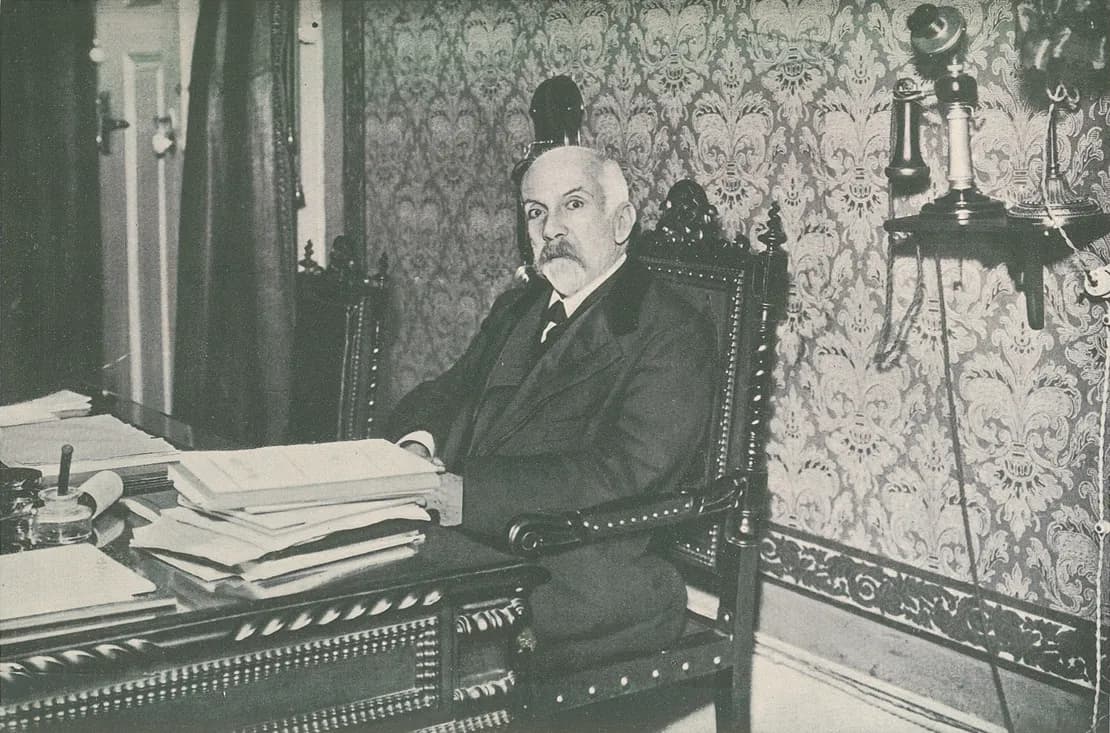
The general freed imprisoned officers, lifted newspaper suspensions, ended telegraph censorship and eased the pressure on the Catholic Church. An amnesty for political crimes let monarchist leaders such as Paiva Couceiro, who had led armed raids against the Republic from Spain, come home. Elections were set for 6 June (Maltez gives 3 June).
Then he closed parliament. He held that Congress, elected in 1911, had outlived its mandate. On 4 March, when its members came to sit, the Republican National Guard (GNR) and the police kept them out of the São Bento palace. It was the first time a government of the Republic had shut parliament, and from then on people spoke of a dictatorship.
Ninety members of Congress met instead at the Palácio da Mitra, in Loures, north of Lisbon. On Costa's motion they declared the general's appointment unconstitutional. Lisbon's city council refused to apply the government's decrees, and 49 of the country's 298 councils followed; the government replaced them with appointees.
The spring grew violent. A Democrat deputy, Henrique Cardoso, was murdered in Lisbon on his way to a party meeting on 28 February, and on 6 March crowds looted eleven bakeries over the price of bread. In early May the Unionists withdrew their support. In Porto on 3 May Costa called the government “a conspiracy to murder the Republic”, and Democratic papers began calling openly for insurrection.
20–22 January
Movimento das Espadas
Army officers protest to the President.
25 January
Pimenta de Castro takes office
4 March
Parliament shut
Members meet instead at the Palácio da Mitra, Loures.
2–3 May
The Unionists withdraw their support
14 May
The rising
The navy and armed civilians rise in Lisbon; a junta takes power.
15 May
João Chagas named head of government
16 May
Chagas shot on the train; Arriaga writes his resignation
17 May
José de Castro takes over the government
29 May
Arriaga's resignation accepted; Teófilo Braga elected
13 June
General election
The Democrats win 106 seats in the Chamber of Deputies.
Five conspirators and a naval commander
A Revolutionary Junta of five men prepared and directed the rising, according to the presidency museum, and Ilustração Portuguesa printed the same five portraits. All but one were Freemasons. Maltez names only three members, António Maria da Silva, Sá Cardoso and Álvaro de Castro, with Norton de Matos and Leote do Rego as their military allies. Behind the scenes, the museum says, Afonso Costa played a leading part.
The many civilians who joined in were organised through the Masonic lodges and the Formiga Branca (White Ant), a band of civilian agitators that Maltez also names among the organisers of the March bread riots.
| Member | In May 1915 | Later |
|---|---|---|
| Alfredo de Sá Cardoso | Artillery major; read the junta's proclamation from Lisbon City Hall | Head of government 1919–20 |
| Álvaro de Castro | Army captain; the one non-Mason; his father, José de Castro, headed the government from 17 May | Head of government in 1920 and 1923–24 |
| José Norton de Matos | Major; governor-general of Angola until February 1915 | Minister of the colonies, then of war from July 1915 |
| José de Freitas Ribeiro | Naval lieutenant-commander; directed the naval operations | Named from the dock by a Noite Sangrenta killer (see below) |
| António Maria da Silva | Civil engineer | Head of government in 1920, 1922–23 and 1925–26 |
Membership and ranks from the Museu da Presidência and Ilustração Portuguesa; Maltez lists only Silva, Sá Cardoso and Álvaro de Castro. Freitas Ribeiro's role is from Maltez; Norton de Matos's ministries from Maltez and Rocha; later premierships from the government's list of heads of government.
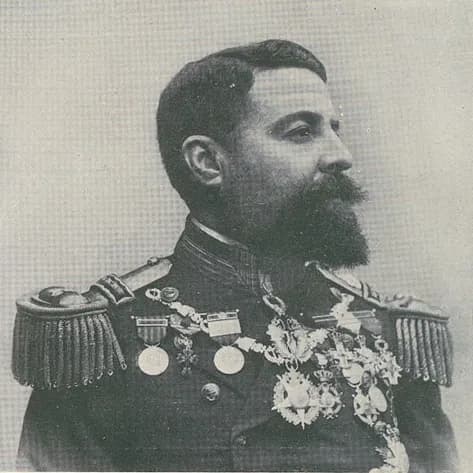
The navy's rebels were led by Leote do Rego, a commander whom Ilustração Portuguesa praised as a writer and speaker, and who had once been a fervent supporter of João Franco's dictatorship under the monarchy. Maltez notes that Norton de Matos had backed Franco too. The navy had played a large part in the revolution of October 1910, and in 1915, the historian João Freire writes, it was almost entirely on the rebels' side.
Bruno J. Navarro, whose study of the Pimenta de Castro government won the Victor de Sá prize in 2010, describes the forces the Democrats could call on: soldiers, corporals and sergeants who no longer obeyed their officers, and civilians drawn by the promise of a purge of the civil service. They were, he notes, much the same people who had made the revolution of 5 October 1910.
Shells over the Baixa
The rising was the navy's work first and foremost. Its two strongholds were the naval barracks at Alcântara and the Arsenal da Marinha, the navy dockyard on the waterfront, where rifles were handed out to civilians. Armed groups attacked police stations. The government took refuge in the Carmo barracks, the Republican Guard's headquarters, where Marcelo Caetano would surrender in 1974.
Army batteries on the Alto de Santa Catarina, at Monsanto and on the Terreiro do Paço fired on the warships, and the ships fired back. Ilustração Portuguesa praised the gunners afloat for aiming only at the batteries, but the city did not escape. A shell burst inside the Senate's offices, and at the request of neighbours whose houses shook with every shot, the guns on the Alto de Santa Catarina were moved down to the Rua do Comércio, in the Baixa.
The navy minister, Admiral Xavier de Brito, ordered the submarine Espadarte to torpedo the rebel ships. Her commander did not obey. The order started a long controversy, and more than twenty years later Xavier de Brito published a text explaining himself. Ilustração Portuguesa photographed a crowd leading him to the Arsenal as a prisoner.
The navy paid for its victory. Besides Assis Camilo on the Vasco da Gama, the commander of the Almirante Reis, Joaquim Nunes da Silva, was hit by bullets and died some days later. Both, Freire writes, were shot as rebels seized their ships. Ilustração Portuguesa printed both men's portraits beside a photograph of Leote do Rego on the Vasco da Gama's bridge.
“The revolutionary act, more impetuous and bloodier than that of 5 October, was marked by sure organisation and by the firm, rigorous execution of the plans of attack, met on the government's side by a remarkable lack of coordination, of concerted effort and of clarity in the plans of defence.”
The end came at the Carmo. By then the street fighting was over, Ilustração Portuguesa reported, but people feared the general might still strike back with regiments from the provinces. Two naval lieutenants from the Arsenal, Philemon Duarte de Almeida, who had commanded it during the fighting, and Fernando Augusto Pereira da Silva, went to the barracks under orders to summon him. Pimenta de Castro agreed to go with them and was taken aboard the Vasco da Gama as a prisoner. On 14 May Machado Santos, who had backed the general, was arrested and his newspaper, O Intransigente, closed down.
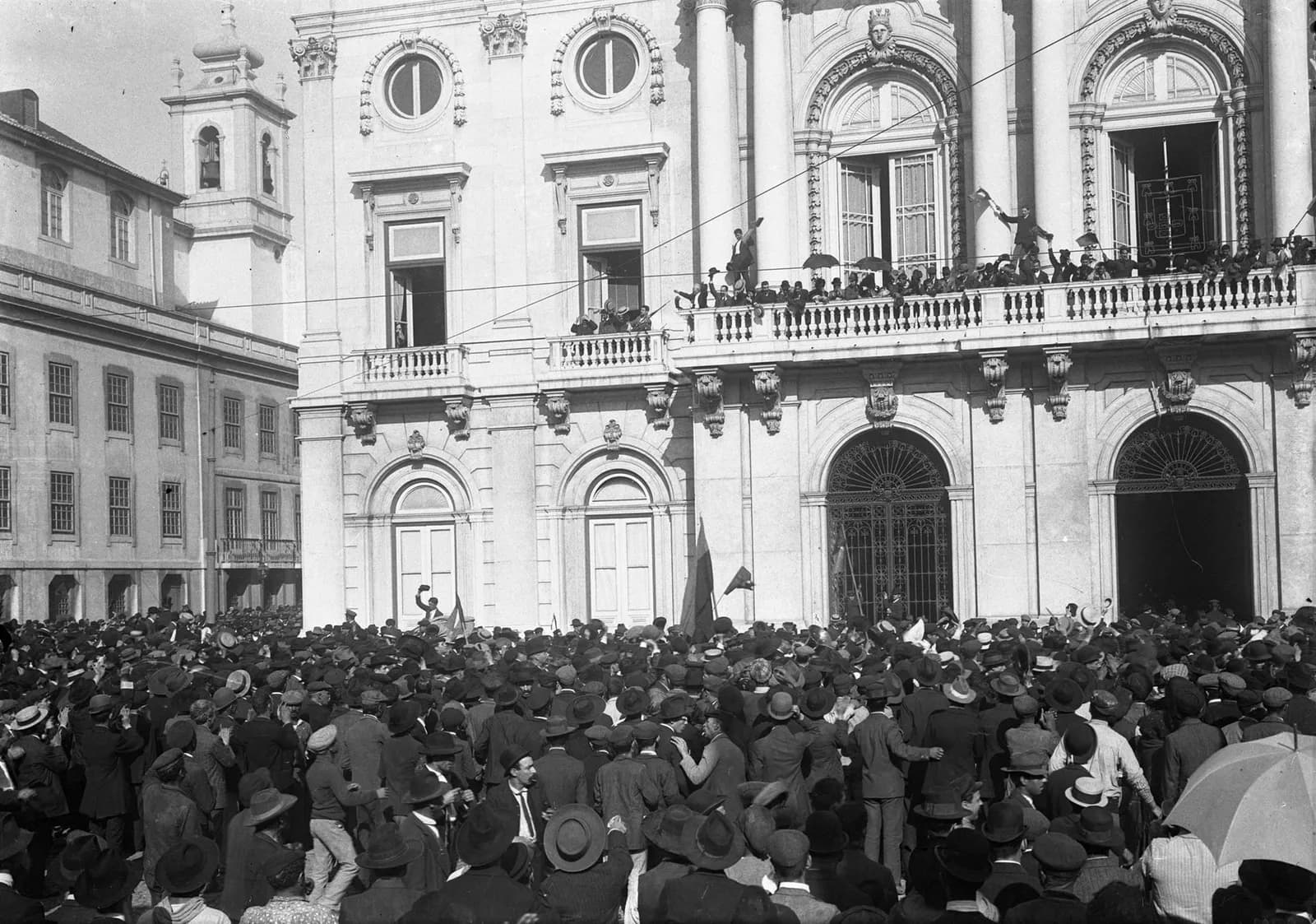
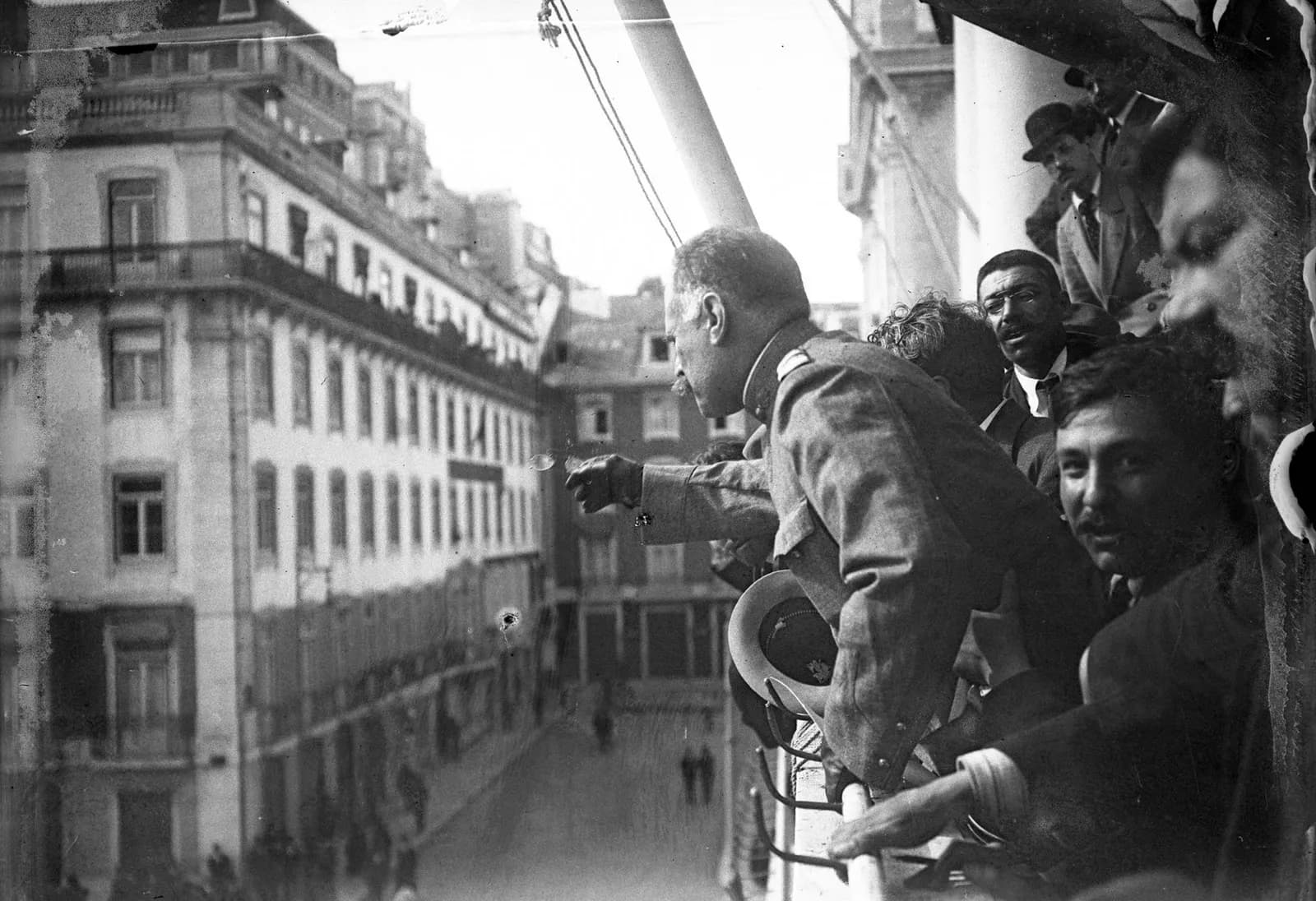
From the balcony of Lisbon City Hall, where the Republic had been proclaimed in 1910, Major Sá Cardoso read out the junta's proclamation: “The Army, the Navy and the civilian element have just proclaimed the Portuguese Republic for the second time.” The junta held power on 14 and 15 May. Ilustração Portuguesa wrote that the revolution won after a little more than 24 hours of fighting; Maltez dates its victory to 16 May.
The violence did not stop with the proclamation. In the following days a force of sailors surrounded the Escola de Guerra, the army's officer school, where cadets held out, and there were more casualties there. Hungry crowds broke into warehouses and bakeries. On 17 May mobs attacked monarchist clubs, the Liga Naval, the church of São Paulo and the monarchist newspaper O Dia.
- Date
- 14 May 1915, from before dawn; sporadic violence for several days after
- Place
- Lisbon: the Tagus, the Arsenal da Marinha, Alcântara, the Carmo barracks
- Rebels
- Most of the navy, part of the army and armed civilians
- Government
- General Joaquim Pimenta de Castro, in office since 25 January 1915
- Dead
- From 102 to more than 200, depending on the source
- Wounded
- From 250 seriously wounded to more than 1,000
Counting the dead
Ilustração Portuguesa's first report could not say how bad it was. “How many Portuguese have lost their lives or been carried wounded to the hospitals, struck by the bullets of their own fellow citizens?” it asked. “At the hour we write, nothing can yet be said.”
Nobody ever settled the figure. Historians quote different totals, and none of them claims a full count. The table sets out the main estimates.
| Source | Dead | Wounded |
|---|---|---|
| José Adelino Maltez, Respublica chronology | 102 | 250 seriously wounded |
| Douglas Wheeler, Republican Portugal (1978), as cited by João Freire (2010) | About 150, all in Lisbon | About 1,000 |
| Bruno J. Navarro (2011) | More than 200 | More than 1,000 |
| Teófilo Braga, message to Congress, 29 May 1915 | “A thousand selfless victims”, not split into dead and wounded |
Maltez gives no source for his figures. Freire cites Wheeler, page 139. Braga's phrase is rhetoric, not a count.
Navarro calls it the bloodiest revolution of the First Republic, Júlio Dantas called it bloodier than the revolution of 1910, and on 29 May the new President, Teófilo Braga, told Congress the Republic had been cemented by the blood of “a thousand selfless victims”.
Shots on the Lisbon train
The junta wanted a government of all republicans. Costa, Camacho and Almeida all refused to serve, and it turned to João Chagas, a veteran republican journalist who had led the first constitutional government in 1911. He had resigned as Portugal's minister in Paris and come home in March, publishing two pamphlets against Pimenta de Castro.
There was an irony in the choice. In 1911 it was Chagas who had made Pimenta de Castro his minister of war, and the general had been dismissed within five weeks, accused of reacting too passively to the first monarchist raid from Spain. On 15 May 1915 Chagas was appointed head of government and set off from Porto to take up the post.
On 16 May, near Entroncamento, a senator named João de Freitas shot him on the Porto–Lisbon train. Chagas was gravely wounded and lost an eye. His attacker was killed; Maltez writes that the crowd lynched him.
Chagas never took office. A week later Ilustração Portuguesa still expected him to take up his post soon, “already recovered from his wounds”, but on 17 May José de Castro, a lawyer, deputy grand master of the Freemasons and Álvaro de Castro's father, had taken over as acting head of government. Chagas was formally relieved on 29 May.
Aftermath: the Democrats' republic
Arriaga, aged 74, wrote his resignation to the head of government on 16 May. Congress, which met again from 27 May, accepted it on 29 May and the same evening elected Teófilo Braga to finish his term, a story told in our article on Braga. Arriaga left the Belém palace that day under a Republican Guard escort.
A new electoral law followed on 2 June, and on 13 June the country voted. Of 471,557 registered voters, in a population of about six million, 282,387 took part. The Democrats won 106 of the 163 seats in the Chamber of Deputies, the Evolutionists 26 and the Unionists 15. In the Senate the Democrats took 45 of the 68 seats.
The winners purged the state. A law of 16 June let the government remove officials who did not give “a complete guarantee” of their adherence to the Republic and the Constitution. Pimenta de Castro's justice minister, the law professor Guilherme Moreira, lost all his posts. A law of 9 September put the revolutionaries of 14 May on the same footing as those of 5 October 1910.
The fallen ministers were never tried. Navarro argues that the new rulers preferred to remove them from the civil service and the army rather than risk an acquittal in court. Machado Santos was sent into exile at Ponta Delgada, in the Azores, on 11 June, with two of the general's ministers, Xavier de Brito and Manuel Goulart de Medeiros.
The war policy changed with the government. Norton de Matos took the war ministry in July and began preparing a force for the Western Front. Costa returned as head of government at the end of 1915, and Germany declared war on Portugal on 9 March 1916, after Lisbon seized the German ships in its ports.
Days in office, governments of June 1914 to May 1915
days
Days between the start and end dates in the Portuguese government's official list of heads of government: 23 June to 12 December 1914, 12 December 1914 to 25 January 1915, 25 January to 14 May, 14 to 15 May and 15 to 17 May 1915.
Show the data
| Days in office | |
|---|---|
| Bernardino Machado (from 23 June 1914) | 172 |
| Azevedo Coutinho | 44 |
| Pimenta de Castro | 109 |
| Revolutionary Junta | 1 |
| João Chagas | 2 |
Why it still matters
For the winners, 14 May was a second founding of the Republic, and it was celebrated every year from 1915. Their case was that a general whom parliament had never approved had shut Congress, ruled by decree and let the monarchists regroup: the first monarchist centre opened in Lisbon on 17 April, and dozens followed. Teófilo Braga's message of 29 May spoke of hands that had “irreverently touched the holy ark of our liberties”.
Navarro, whose study is sympathetic to the general, argues that the ruling party's press set the story that historians repeated for decades: a traitor general, a monarchist plot, a pro-German government.
Others saw the day differently. The poet Fernando Pessoa, writing a few years later, called it the most anti-national of Portugal's revolutions and wrote of the general with sympathy.
“Pimenta de Castro was the purest representative of the middle classes ever to come to power in Portugal. He reflected perfectly their longing for peace, tolerance and liberty.”
The revolt also set a pattern. The presidency museum sees in Pimenta de Castro's cabinet, with officers in seven of its nine ministries, the start of the army's growing hold on government. Maltez points out that the Democrats beat him with the same street-and-barracks method republicans had used against the monarchy in 1910.
Force kept deciding who governed. Sidónio Pais took power by force in December 1917, and the military coup of 28 May 1926 ended the parliamentary Republic.
FAQs
What was the revolt of 14 May 1915?
An armed rising in Lisbon by most of the navy, part of the army and armed civilians against the government of General Pimenta de Castro, who had kept parliament closed since March. A junta linked to Afonso Costa's Democratic Party planned it. The government fell within about a day, and President Manuel de Arriaga resigned soon after.
How many people died in the 14 May 1915 revolt?
No exact count exists. José Adelino Maltez gives 102 dead and 250 seriously wounded; Douglas Wheeler, as cited by João Freire, about 150 dead and 1,000 wounded; Bruno J. Navarro more than 200 dead and more than 1,000 wounded.
Was Pimenta de Castro a dictator?
He governed by decree and shut parliament on 4 March 1915, the first government of the Republic to do so, which is why it was called a dictatorship. Many saw it as a mild one: José Adelino Maltez writes that it arrested no one and suspended no newspaper, though it did order the arrest of local officials who defied it, and it set elections for 6 June.
What happened to João Chagas in May 1915?
Named head of government on 15 May, he was shot on 16 May on the train from Porto to Lisbon, near Entroncamento, by Senator João de Freitas. He was gravely wounded and lost an eye, and José de Castro took over the government on 17 May.
Why did President Manuel de Arriaga resign in 1915?
He had appointed Pimenta de Castro and signed his decrees, so the victors held him responsible for the dictatorship. He wrote his resignation on 16 May, and Congress accepted it on 29 May and elected Teófilo Braga in his place.
On the timeline
Open the timelineNearby moments from the first republic (1910–1926).
Birth of Francisco da Costa Gomes in Chaves. Career soldier, Chief of Staff and a key figure in the 25 de Abril 1974 revolution, he would serve as President of the Republic from September 1974 to July 1976, steering Portugal through decolonisation and the most turbulent months of the transition to democracy.
Meeting in special session, the Portuguese Congress unanimously authorises the government to intervene in the First World War as Britain's ally whenever it judges necessary, a step on the road to the Portuguese Expeditionary Corps being sent to Flanders in 1917.
German troops from South West Africa attack the Portuguese post at Naulila in southern Angola. Some 70 Portuguese soldiers are killed and the garrison retreats — fighting in Africa more than a year before Portugal formally entered the First World War. The retreat set off uprisings in southern Angola that Portugal crushed in a bloody campaign in 1915.
The revolt of 14 May 1915
A violent uprising in Lisbon, led by republicans including Álvaro de Castro, Sá Cardoso and Norton de Matos, topples the dictatorial government of General Pimenta de Castro and restores constitutional rule. One of the bloodiest episodes of the First Republic, it leaves between about 100 and more than 200 dead, depending on the estimate, and soon forces President Manuel de Arriaga to resign.
At Britain's request, Portugal begins seizing the German merchant ships, and two Austro-Hungarian ones, that had sheltered in its ports since 1914: between about 60 and 76 by different counts. Berlin answers by declaring war on 9 March, drawing Portugal into the First World War and, within a year, sending the Corpo Expedicionário Português to Flanders.
The German Empire declares war on Portugal, following Portugal's seizure of German and Austro-Hungarian ships sheltering in Portuguese ports. Portugal formally enters World War I on the side of the Allies.
Death of Mário de Sá-Carneiro in Paris at age 25. He was a leading Portuguese modernist poet, a key figure of the 'Geração d'Orpheu' movement, and Fernando Pessoa's close friend and literary collaborator.
Coming up in history
All long reads 16 May 1919Through the fog to Horta: the NC-4 and the first flight across the Atlantic
 17 May 1959Cristo Rei: the bishops' wartime vow that rose over the Tagus in 1959
 18 May 1881Carvalho Araújo: the deputy who took a trawler against a U-boat
 19 May 1954Catarina Eufémia, the harvest worker shot at Baleizão in 1954
14 sources
Archives, scholarship and reporting this article was checked against.
- 1
Manuel de Arriaga (biography)Museu da Presidência da República
- 2
“Pimenta de Castro: um general no labirinto da I República” (Bruno J. Navarro)Forum 46 (2011), pp. 165–180, Universidade do Minho
- 3
A Marinha e a República, by João FreireLer História, 59 (2010)
- 4
Ilustração Portugueza, 2.ª série, n.º 483, 24 May 1915: Júlio Dantas, “Crónica: a revolução”; “A revolução”; “O novo ministério”Hemeroteca Digital, Câmara Municipal de Lisboa
- 5
1915 (Respublica: cronologia política), by José Adelino MaltezRespublica, Repertório Português de Ciência Política
- 6
- 7
Chefes do Governo desde 1821República Portuguesa, Governo de Portugal
- 8
A Escola de Guerra na revolta de 5 de Dezembro de 1917 (Jorge Silva Rocha)Repositório ISCTE-IUL (book chapter)
- 9
Diário das Sessões do Congresso, no. 15, session of 29 May 1915, pp. 6–8Assembleia da República, Debates Parlamentares
- 10A matança de Outubro. Há cem anos a República vivia a Noite Sangrenta, by José Luís AndradeObservador, 19 October 2021
- 11
Largo e Quartel do Carmo, 25 April 1974 (Lugares de Abril)Associação 25 de Abril
- 12
- 13
- 14
Contributo para a sistematização dum aparente caos político: o caso da Primeira República Portuguesa, by Kathleen SchwartzmanAnálise Social, vol. XVII (65), 1981
Image credits
- The crowd outside Lisbon City Hall listens to the Revolutionary Junta's proclamation after the rising of 14 May 1915. Photograph by Joshua Benoliel. Joshua Benoliel, Public domain, via Wikimedia Commons.
- General Pimenta de Castro in his office at the Ministry of War on 25 January 1915, the day he took over the government, as published in Ilustração Portuguesa. Photograph by Joshua Benoliel. Joshua Benoliel, Public domain, via Wikimedia Commons.
- Commander Jaime Leote do Rego, leader of the naval rising, as Ilustração Portuguesa printed him on 24 May 1915. Unknown author, Public domain, via Wikimedia Commons.
- Major Alfredo de Sá Cardoso reads the Revolutionary Junta's proclamation from the balcony of Lisbon City Hall, May 1915. Photograph by Joshua Benoliel. Joshua Benoliel, Public domain, via Wikimedia Commons.