

Cristo Rei: the bishops' wartime vow that rose over the Tagus in 1959
Portugal's bishops promised in 1940 to raise a monument over Lisbon if the country was spared the war. Nineteen years later a 28-metre Christ opened its arms above Almada, before a crowd the Church put at more than 300,000.
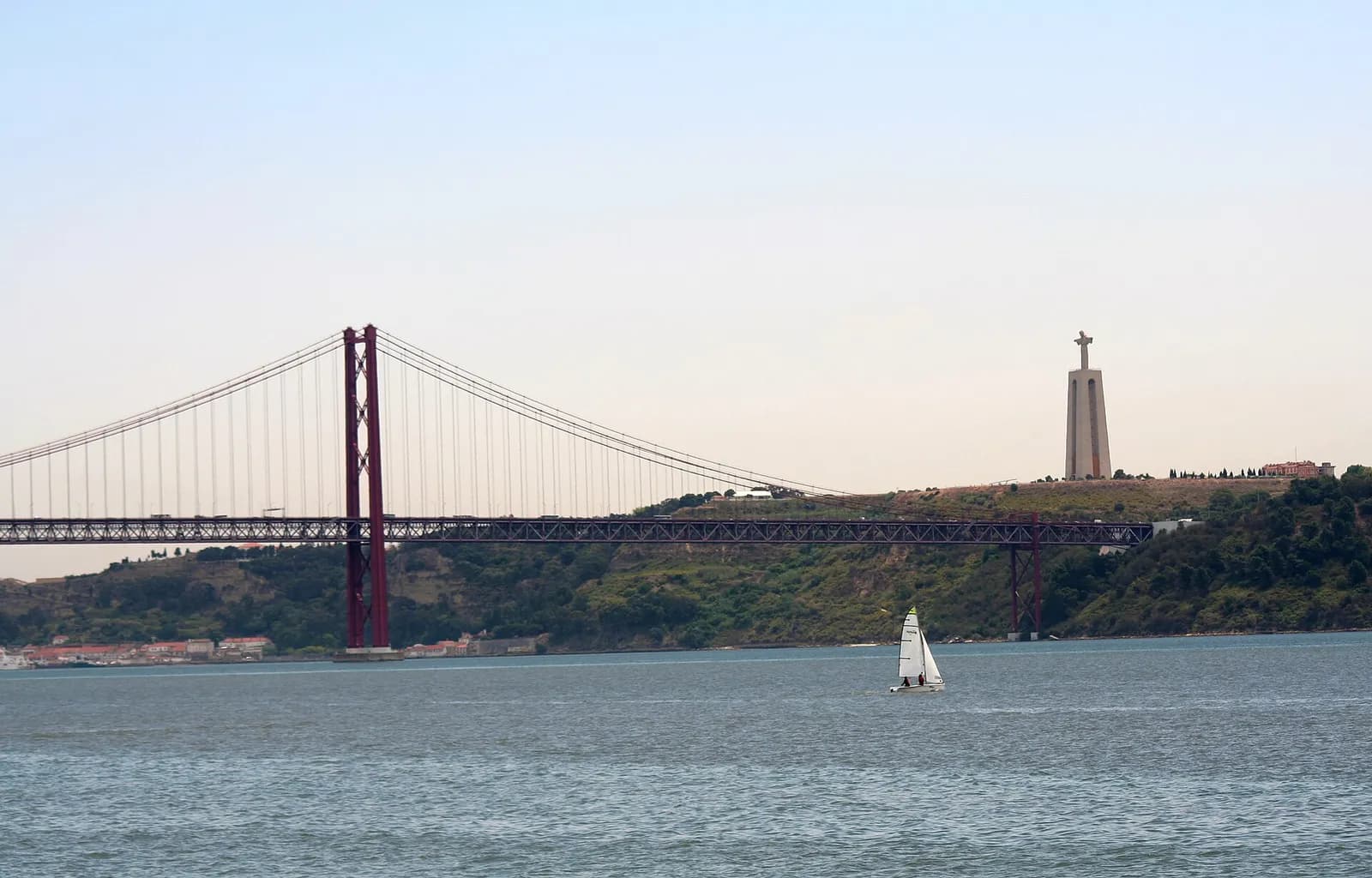
At a glance
- The Cristo Rei monument on the Alto do Pragal in Almada, facing Lisbon across the Tagus, was inaugurated on Sunday 17 May 1959, Pentecost, in front of the whole Portuguese episcopate and President Américo Tomás.
- The idea came from Cardinal Manuel Gonçalves Cerejeira, Patriarch of Lisbon, after he flew over Rio de Janeiro's Christ the Redeemer in October 1934. The bishops adopted it in 1937.
- On 20 April 1940, at Fátima, the bishops vowed to raise a monument to the Sacred Heart of Jesus over Lisbon if Portugal was spared the Second World War. Portugal stayed neutral, which the bishops took as their prayer answered.
- It was paid for by a national collection, including a children's campaign that ran from 1939 to 1958. The first stone was laid on 18 December 1949; the architect was António Lino and the statue is by the Madeiran sculptor Francisco Franco, who died in 1955.
- The monument is 110 metres tall: an 82-metre pedestal and a 28-metre statue. The Church's figure for the inauguration crowd is about 300,000; no independent count exists.
Doves, petals and a radio from Rome
Shortly after six in the evening of Sunday 17 May 1959, Pentecost, the President of the Republic, Admiral Américo Tomás, arrived on the Alto do Pragal in Almada, and the ceremony began. Across the Tagus lay Lisbon. Above him rose a new concrete tower, and at its foot stood the image of Our Lady of Fátima, brought down from the Chapel of the Apparitions for the occasion.
Cardinal Manuel Gonçalves Cerejeira, Patriarch of Lisbon, blessed the monument. As he did, petals poured from the top of the pedestal and a few thousand pigeons were released from it. Over everyone stood a 28-metre Christ on an 82-metre base, arms spread wide towards the capital.
The crowd stood to hear a radio message from Pope John XXIII, in Portuguese. Then Cerejeira, with the bishops, the head of state and members of the government, read the act consecrating Portugal to the Hearts of Jesus and Mary. His voice broke more than once, wrote the Catholic monthly Voz da Fátima, which counted “more than 300,000” people on the hill.
“Such a monument seeks to bear witness to the love and gratitude of the whole Nation to Christ the King, and at the same time it is the fulfilment of a solemn vow for the Fatherland and for the Church, made at a good hour, when Portugal ran the imminent risk of being dragged into the war.”
The evening ended with hymns and the national anthem. Getting there had taken a quarter of a century: the idea dated from 1934, the bishops' vow from 1940 and the first stone from 1949.
A cardinal's idea and a wartime vow
Manuel Gonçalves Cerejeira was a priest from the Minho who had become a history professor at the University of Coimbra. He was made a bishop in 1928 and, the next year, Patriarch of Lisbon and a cardinal. He was also a devotee of the Sacred Heart of Jesus. In 1930 he set himself the aim “to establish in Portuguese society the reign of the Heart of Jesus”.
In October 1934, flying home from the International Eucharistic Congress in Buenos Aires, he passed over Rio de Janeiro and saw the Christ the Redeemer statue on Corcovado. He came back wanting a sanctuary to the Sacred Heart facing Lisbon. The bishops made it a national project in their collective pastoral letter for Lent 1937.
Their reasons belonged to the 1930s. The feast of Christ the King had been created in 1925, and the bishops wanted reparation for what they called the “universal conspiracy against Christ”, thanks for the social peace Portugal had kept while other countries had not, and a “national restoration”. The rector of the sanctuary, Fr Sezinando Alberto, described the original idea in 2019 as one of Catholic militancy.
The war changed its meaning. On 20 April 1940, at the end of their annual retreat at Fátima, the bishops made a vow. Seventeen days later, on 7 May, Portugal and the Holy See signed the Concordat.
“If Portugal were spared from the War, a Monument to the Sacred Heart of Jesus would rise over Lisbon, a visible sign of how God wishes to win all humanity for Himself.”
Portugal stayed neutral and took no direct part in the fighting. According to the rector, the bishops made the vow in secret, and it was only made public in 1946.
Pennies and small stones
Neutrality, the sanctuary says, let a national fundraising campaign get under way, and in 1941, with the war still on, the land on the Alto do Pragal was bought. The monument was paid for only with money from public collections, which ran from the 1930s into the 1950s.
Children were enlisted too. The “Pedras Pequeninas” (little stones) campaign ran from 1939 to 1958. Its point, the sanctuary says, was the value of children's sacrifice and prayer more than the money, and it puts the total raised at about €7,500.
Committees did the rest. A National Commission and diocesan committees organised the collection, and a newspaper, O Monumento, publicised it. When the Pope thanked the Portuguese in 1959, he thanked “the National Commission and everyone, rich and poor, small and great” who had given their sacrifices and prayers. None of the sources consulted gives a total cost.
Concrete, plaster and a sculptor's last work
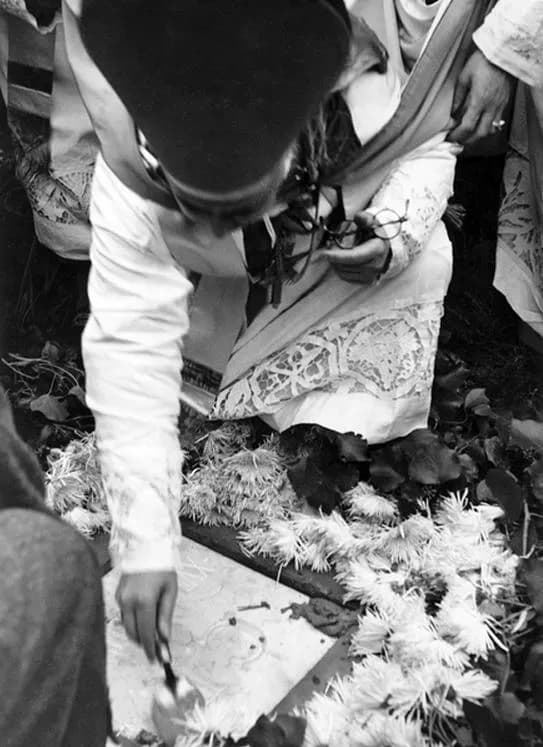
Cerejeira laid the first stone on 18 December 1949. The date was chosen to mark the 50th anniversary of Pope Leo XIII's consecration of mankind to the Sacred Heart of Jesus in 1899.
The monument was designed by the architect António Lino and built under the engineer Francisco de Mello e Castro. Work on the foundations began in 1951, and from 1952 the firm Obras Públicas e Cimento Armado (OPCA) built the base. The pedestal went up in layers using travelling formwork, in which the scaffolding was the structure itself, receiving the concrete as it rose.
The concrete statue was then made in place on top of the pedestal, using plaster moulds prepared from the sculptor's model, and finished by hand more than 100 metres above the ground. The whole structure weighs about 40,000 tonnes.
The model was by Francisco Franco de Sousa, born in Funchal, Madeira, on 9 October 1885. He trained at the Lisbon academy of fine arts and in Paris, and in 1928 finished the statue of the navigator João Gonçalves Zarco that was put up in Funchal in 1930. The Estado Novo made him one of its sculptors: he made his first bust of Salazar in 1934 and a statue of Salazar for the Portuguese pavilion at the 1937 Paris exhibition.
Cristo Rei was his last work. The art historian Teresa Campos dos Santos sees signs of decline in it, partly caused by a car that knocked him down near his studio. Franco died on 15 February 1955, aged 69, four years before the inauguration.
| Part | Measurement |
|---|---|
| Whole monument | 110 m high |
| Pedestal | 82 m |
| Statue | 28 m, also its span from fingertip to fingertip |
| Head | 4.05 m |
| Heart | 1.89 m |
| Each arm | 10 m |
| Base | 625 square metres (25 m a side) |
| Reinforced concrete | 20,000 cubic metres |
| Total weight | 40,000 tonnes |
| Depth of footing | 14 m |
Figures published by the Santuário de Cristo Rei.
1925
The feast of Christ the King is created
October 1934
Cerejeira flies over Rio's Christ the Redeemer and conceives a monument facing Lisbon
Lent 1937
The bishops adopt the project in a collective pastoral letter
20 April 1940
At Fátima, the bishops vow the monument if Portugal is spared the war
7 May 1940
Concordat between Portugal and the Holy See
1941
The land on the Alto do Pragal is bought
1946
The vow is made public, according to the sanctuary's rector
18 December 1949
Cerejeira lays the first stone
1951 to 1952
Foundation works begin; OPCA starts building the base
15 February 1955
Francisco Franco dies, aged 69
13 to 17 May 1959
Festivities, ending in the inauguration on Pentecost Sunday
Five days in May
The bishops announced the programme in a collective pastoral letter dated 16 January 1959. It would begin on 13 May with the national pilgrimage to Fátima and end on the 17th with the blessing of the monument and the renewal of Portugal's consecration to the Hearts of Jesus and Mary. They wrote in the language of a crusade, calling on the whole country to answer “the blasphemous challenge of atheism”.
“A monument to peace, the Almada monument will proclaim the gratitude of the Portuguese for ever: in an hour of apocalyptic grandeur, when the fire of war caught, one might say, the whole world, the Prince of Peace mercifully heard the prayer of Portugal.”
Children were asked to write down “millions of sacrifices” for the conversion of sinners on slips of paper, which the Eucharistic Crusade in Braga gave out free and collected in time for the Virgin's visit to Lisbon. The published programme set the inauguration for 17:00 on the 17th, when the bells of every church in the Portuguese empire were to ring, with illuminations in every town from nightfall to midnight.
On 13 May, after the pilgrimage, the image of Our Lady of Fátima left the Cova da Iria shortly after four in the afternoon on a military carriage of the armed forces, escorted by cardinals and bishops. It passed through towns including Batalha, Alcobaça, Caldas da Rainha, Óbidos, Torres Vedras and Loures and reached Lisbon in the early hours.
On the night of Saturday 16 May it was carried in procession from the Instituto Superior Técnico, on the Alameda D. Afonso Henriques, to the Terreiro do Paço. The procession took three hours. When the image arrived, the lights in the square went out and it was lit only by candles, while thousands of white handkerchiefs waved.
The image then crossed the river on the Rio Jamor, one of the Tagus ferries, decked in damask and lit by 120 candles, with the ministers of the Presidency, the Interior and the Navy on board. Fireworks went off over the water and more than a hundred ships sounded their sirens. It spent the night in the chapel of Bom Sucesso at Cacilhas.
On Sunday morning Cerejeira celebrated a pontifical Mass at the Jerónimos monastery, attended by members of the government and the cardinals and bishops; the Archbishop of Évora preached. The image was meanwhile carried through the streets of Almada to the monument, where the ceremony began after six.
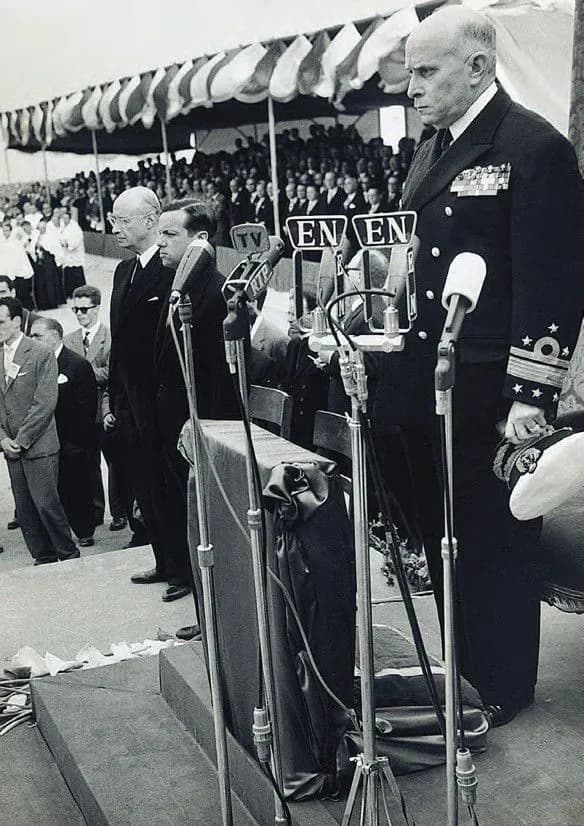
Between the blessing and the Pope's message, Cerejeira spoke and the Cardinal Archbishop of Rio de Janeiro, Jaime de Barros Câmara, greeted the crowd. After the consecration and the President's speech came a Te Deum, during which Cerejeira and the cardinals of Rio and Lourenço Marques carried the monstrance round the monument and blessed what Voz da Fátima called “the four cardinal points of the Portuguese Empire”. One of the white doves that had travelled on the image's litter flew onto the President's platform, the paper noted, just as the crowd sang “Procedenti ab utroque”, words about the Holy Spirit, whose feast it was.
On 18 May, after Mass at the Almada seminary, the image went home by Barreiro, Montijo, Benavente, Almeirim and Santarém, where shops and schools closed for it. It reached the Cova da Iria at about eight in the evening.
Church, state and a bishop in exile
Tomás spoke after the consecration, and he presented his presence as an act of state.
“As Head of a Nation whose religion is the Catholic one, which recognises the divinity of Christ, has the Mother of God as its patroness and has sought to spread the same faith in the overseas parts of its territory, I could not fail to join in this act, at once pious and patriotic.”
Cerejeira tied it to the nation and to Fátima. It would always be “a sign of national gratitude for the gift of peace”, he said, and, addressing the Virgin, he called it a complement to her sanctuary at the Cova da Iria.
Not every bishop was at ease with the regime. António Ferreira Gomes, Bishop of Porto, had written to Salazar on 13 June 1958 in terms that made him unwelcome to the regime. On 23 May 1959, six days after the inauguration, he wrote to his fellow bishops complaining of the Church's silence about the state of the country and of the government's attacks on him.
On 24 July 1959 Ferreira Gomes left Portugal on holiday and was refused re-entry at the border at Valença. He spent ten years in exile and returned to his diocese only in July 1969.
Christ over the Tagus today
Almada, which belonged to the Patriarchate of Lisbon in 1959, passed to the new Diocese of Setúbal in 1975, and the sanctuary now belongs to it. Inside the four pillars is the chapel of Nossa Senhora da Paz, designed by Lino, with an image of the Virgin by Leopoldo de Almeida. The pillars also hold a water reservoir that supplies Almada.
The sanctuary has kept adding to the site, often on 17 May. The Cruz Alta, the tall cross that stood at Fátima from 1951 until 2004, was given to Cristo Rei and set up in front of it in 2007. A chapel opened at the top of the stairs, 84 metres up, in 2008, and a new main door in 2016. Bronze reliefs on the four porticoes followed between 2015 and 2018, and the Pavilhão do Rosário, a hall seating 750, opened in March 2016.
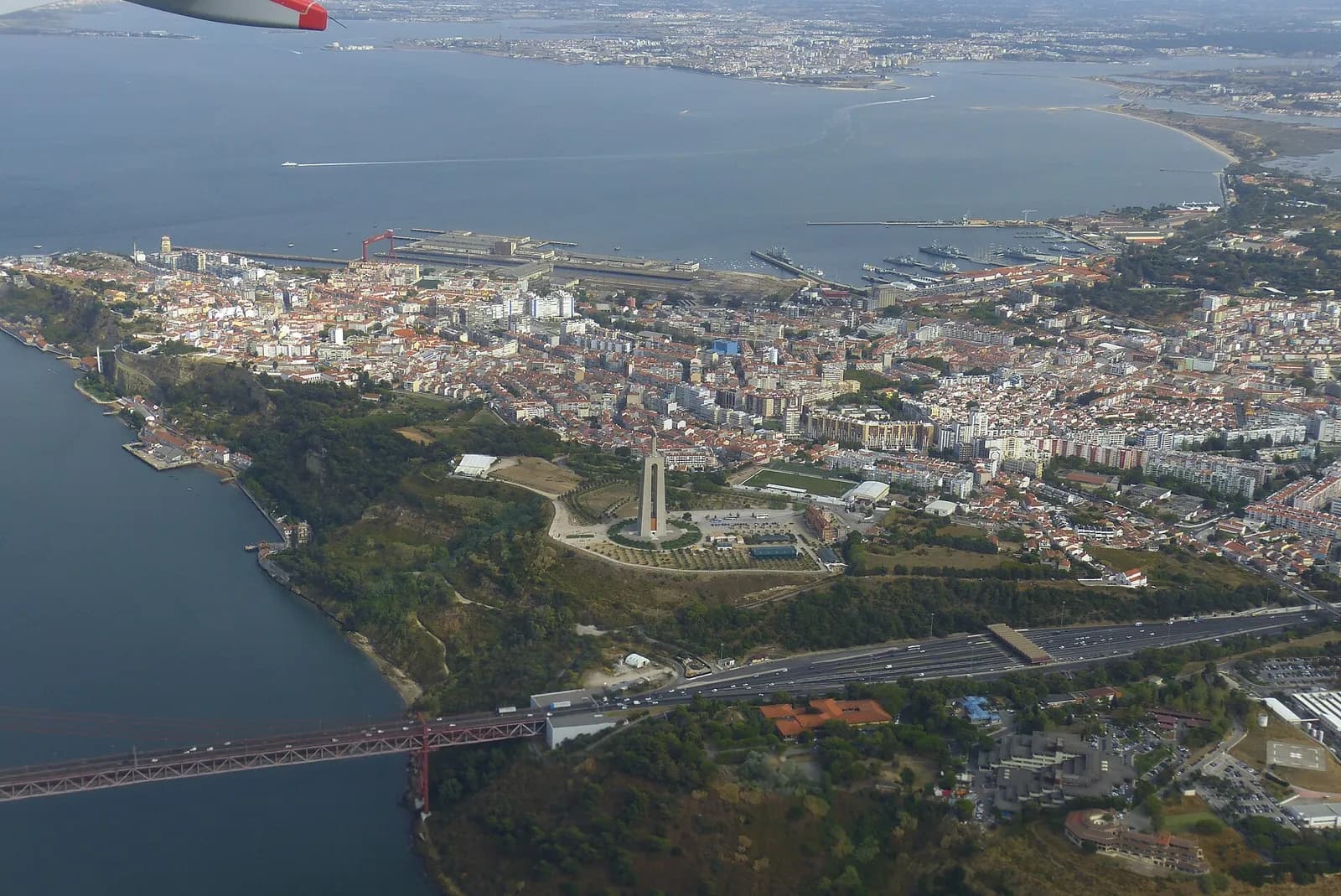
Visitor numbers have grown with Lisbon's tourism. Correio da Manhã reported in March 2016 that more than 600,000 people had visited the sanctuary in the past year and 220,000 had gone up the monument, twice as many tickets as a decade earlier. In 2019 the rector, Fr Sezinando Alberto, said 110,000 had gone up in 2003 and more than 300,000 in 2018. He put all visitors at about a million a year, with growing numbers of foreign pilgrims, many of them on their way to or from Fátima.
People who went up Cristo Rei
visitors a year
Ticketed ascents to the terrace. The 2015 bar is Correio da Manhã's figure for “the past year”, published in March 2016. The 2003 and 2018 figures were given by the rector, Fr Sezinando Alberto, in 2019; for 2018 he said “more than 300,000”. Visitors who did not go up, about two-thirds of the total by his account, are not included.
Show the data
| Ascents of the monument | |
|---|---|
| 2003 | 110,000 |
| 2015 | 220,000 |
| 2018 | 300,000 |
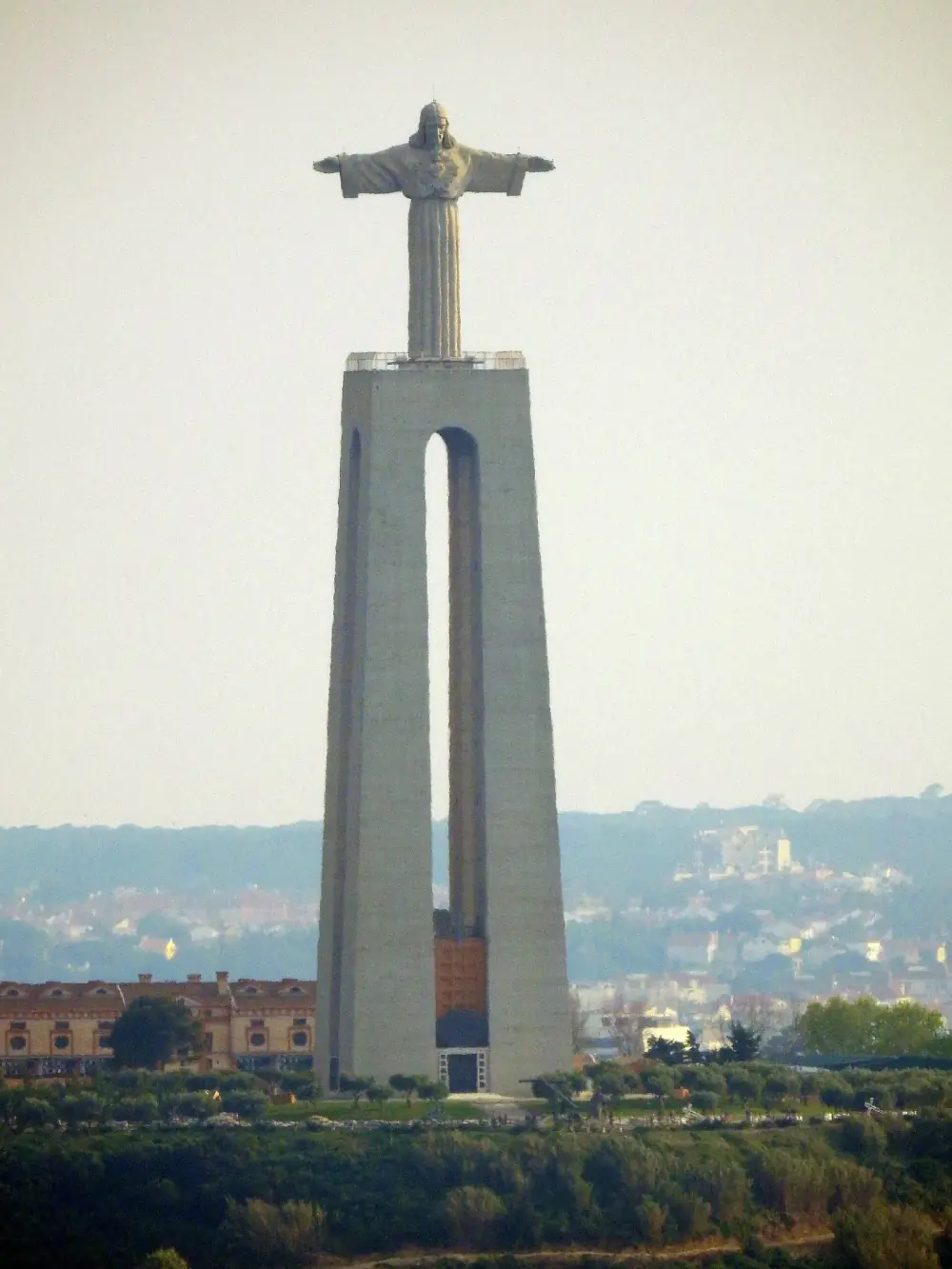
For Lisbon the statue is now part of the view, paired with the 25 de Abril bridge in pictures of the river. The sanctuary still describes it as the bishops did: a monument to the Sacred Heart, and the nation's thanks for the peace Portugal kept while Europe was at war.
FAQs
When was Cristo Rei in Almada inaugurated?
On Sunday 17 May 1959, Pentecost, after five days of festivities that began at Fátima on 13 May. The first stone had been laid on 18 December 1949.
Why was Cristo Rei built?
Cardinal Cerejeira wanted a monument to the Sacred Heart facing Lisbon after seeing Rio's Christ the Redeemer in 1934, and the bishops adopted the idea in 1937. On 20 April 1940 they vowed to build it if Portugal was spared the Second World War, and the Church presents it as the nation's thanks for peace.
Who designed Cristo Rei?
The architect António Lino designed the monument, the engineer Francisco de Mello e Castro directed the construction, and the Madeiran sculptor Francisco Franco made the model for the statue. Franco died in 1955, before it was finished.
How tall is Cristo Rei?
The sanctuary gives the whole monument as 110 metres: an 82-metre pedestal and a 28-metre statue whose arms span 28 metres. The visitors' terrace is at 84 metres.
How many people attended the inauguration?
The Church's own figures are the only ones available: Voz da Fátima reported “more than 300,000” in June 1959, and the sanctuary today says about 300,000.
On the timeline
Open the timelineNearby moments from dictatorship and the estado novo (1926–1974).
Birth of Rosa Mota in Porto's Foz Velha. A pioneer of women's distance running, she won the first ever women's marathon at a European Championships in 1982 and, at Seoul in 1988, became the first Portuguese woman to win Olympic gold.
The film director Pedro Costa is born in Lisbon (some sources say 1959). His slow, luminous films with Cape Verdean immigrants, many made in Fontainhas, a shanty town on the Lisbon–Amadora boundary, won international acclaim; 'Vitalina Varela', shot in Amadora's Cova da Moura, took the Golden Leopard at the Locarno Film Festival in 2019.
Fernando Chalana is born in Barreiro. Nicknamed 'o pequeno genial' (the little genius), the Benfica winger dazzled at Euro 1984, Portugal's first European Championship finals, where they reached the semi-finals, and then moved to Bordeaux.
Cristo Rei inaugurated in Almada
The Cristo Rei monument in Almada is inaugurated, nearly ten years after its first stone was laid, before a crowd the Church put at 300,000. Overlooking the Tagus opposite Lisbon, the statue by the Madeiran sculptor Francisco Franco (no relation to the Spanish dictator) fulfils the bishops' 1940 vow to build it if Portugal was spared the Second World War.
Birth in Lisbon of Pedro Ayres Magalhães, guitarist and founder of Madredeus. Built around the voice of Teresa Salgueiro, the group fused fado, folk and classical music into a sound that made it Portugal's most internationally successful act of its generation, immortalised in Wim Wenders's film 'Lisbon Story' (1994).
RTP broadcasts the first edition of the Telejornal at half past eight in the evening, presented by the journalists Mário Pires and Alberto Lopes. Subject to the Estado Novo's censors in its early years, it is today the longest-running programme in the history of Portuguese television.
The Lisbon Metro is inaugurated after more than four years of work, opening to the public the next day. The first network had 11 stations on a Y-shaped line running from Restauradores, splitting at Rotunda towards Sete Rios and Entre Campos, served by two-carriage trains. Almost every station carried azulejos by the painter Maria Keil.
Coming up in history
All long reads
22 sources
Archives, scholarship and reporting this article was checked against.
- 1
A HistóriaSantuário de Cristo Rei (Diocese de Setúbal)
- 2
“Inauguração do Monumento a Cristo-Rei e Consagração de Portugal aos Sagrados Corações”, Voz da Fátima, n.º 441, 13 June 1959Santuário de Fátima (digitised Voz da Fátima)
- 3
Radiomensagem do Papa João XXIII ao povo português por ocasião da inauguração do monumento nacional dedicado a Cristo Rei, 17 May 1959Holy See
- 4
- 5
O escultor Francisco Franco: entre o modernismo e a construção da imagem da ditadura de António Oliveira Salazar (Teresa Campos dos Santos)Revista de História da Arte e Arqueologia (RHAA), n.º 16, Universidade Estadual de Campinas
- 6
Cristo Rei. Há 60 anos a “abraçar” Lisboa (Ângela Roque)Rádio Renascença, 14 May 2019
- 7
- 8
O Estado Novo (1933-1974)Assembleia da República
- 9
- 10
Cerejeira, Manuel Gonçalves (Sérgio Ribeiro Pinto), part 2: CoimbraDicionário de Historiadores Portugueses, Biblioteca Nacional de Portugal
- 11
- 12
Estreia de cantata e inauguração de escultura assinalam 60 anos do santuário de Cristo Rei (Rui Jorge Martins)Secretariado Nacional da Pastoral da Cultura, 13 May 2019
- 13
O Pátio das Antigas: O Cristo Rei em plena construção (Eurico de Barros)Time Out Lisboa, 8 August 2026
- 14
- 15
The Franco–Salazar Meetings: Foreign policy and Iberian relations during the Dictatorships (1942–1963) (Maria Inácia Rezola)e-Journal of Portuguese History, vol. 6, no. 2 (Winter 2008), via CEPESE
- 16
- 17
- 18
Nota explicativa a “Economismo ou humanismo”, de D. António Ferreira Gomes (Sofia de Melo Araújo)E-topia: Revista Electrónica de Estudos sobre a Utopia, n.º 6, Faculdade de Letras da Universidade do Porto, 2007
- 19
- 20
Sanctuary of Christ the KingOpen House Lisboa, Trienal de Arquitectura de Lisboa
- 21
- 22Pavilhão para 750 fiéis no Cristo Rei (João Saramago)Correio da Manhã, 8 March 2016
Image credits
- Cristo Rei on the Alto do Pragal in Almada, seen across the Tagus from Lisbon in July 2009, beside the 25 de Abril suspension bridge. Montserrat Labiaga Ferrer from Madrid, Spain, CC BY 2.0, via Wikimedia Commons.
- Cardinal Cerejeira laying the first stone of the Cristo Rei monument in Almada, 18 December 1949. Unknown author, Public domain, via Wikimedia Commons.
- President Américo Tomás at the microphones during the inauguration of Cristo Rei, 17 May 1959. Não identificado, Public domain, via Wikimedia Commons.
- Cristo Rei and its esplanade on the edge of Almada, seen from an aircraft in 2016. The 25 de Abril bridge lands just below the monument. Neitram, CC BY-SA 4.0, via Wikimedia Commons.
- Cristo Rei in April 2019: the 82-metre pedestal is made of four pillars joined by arches at the top. Rehman Abubakr, CC BY-SA 4.0, via Wikimedia Commons.